When New Hampshire resident Jake McAlpin accidentally threw away his daughter’s favorite stuffed animal, the town leadership took a whole day out to help find it.
Cupcake is a floppy-eared dog that daughter Charlotte received for Christmas when she was four. Though a grown woman, Cupcake was never far from her side.
Then one day, disaster.
“I said, ‘What are you looking for?’ And she goes, ‘Cupcake,’ and somewhere in the back of my head was like, is that the stuffed animal I just took to the dump?” McAlpin told WMUR News 9 New Hampshire.
Mother Meredith put out a post on Facebook asking if anyone was available to open the dump for them that Thursday.
The post was picked up by Brian Monahan, the “Selectman” for the town of Strafford which is a Mid-Atlantic government position that serves as board member and chief administrative authority of a town in all New England states but not Rhode Island.
Monahan sent a screenshot of what Meredith had written to a colleague with keys to the dump, and asked if they could go find Cupcake and bring her home safe.
On a rainy Thursday morning, the two began searching through trash compactors that had smushed the municipal waste bags so thoroughly that Monahan’s colleague Dan had to use a backhoe to loosen it enough so they could use their hands.
Arriving to see what had transpired, McAlpin witnessed the effort being put in in the name of his daughter’s toy and lept into the trash to help. Together they found it, to the great relief of McAlpin, and then eventually, to Charlotte.
“It made us feel pretty good no one wants to be without their stuffy, and the smile on her face said it all,” said Dan Conway, superintendent of the Strafford Recycling Center.
WATCH the story below from WMUR News 9…
SHARE This Remarkable Dedication To Serving The Community On Social Media…
The Thermal Energy Center control room - released by GLY Construction.
The Thermal Energy Center control room – released by GLY Construction.
It’s been four years now, but Microsoft’s Redmond campus modernization is almost finished. The massive 72-acre rebuild includes dozens of hopefully planet-saving designs and features, but none are more impressive than the Geothermal Energy Center (TEC).
To heat and cool the massive campus, a 6.5-acre geothermal well field, consisting of around 900 boreholes drilled up to 550 feet deep was completed last year with the aim of delivering 50% of the heating and cooling needs without carbon emissions.
The subsurface environment was unmapped, and known to be riddled with past construction debris and natural obstacles. Nevertheless, GLY Construction who managed the drilling efforts completed all work under budget and on time thanks to an innovative approach of virtual design and virtual construction that included a 3D model of the components and the job site true to within 256ths of an inch.
The closed-loop geothermal heating and cooling system sends either cool or warm water to exchange energy with the deep earth, and the refrigeration is so powerful that it could cool 3,000 homes in the summertime.
“Its nine chillers can provide 9,000 tons of refrigeration. The system is sized to serve 3 million square feet of office and amenity space in 17 new buildings, four of which are not yet built.”
The well field was covered over by 2.5 miles of walking and bike trails as well as a multi-purpose field built for softball and other sports, a cricket pitch, and basketball courts.
Giant 28,000-gallon water tanks, four for hot water and three for cold, hold the water that’s exchanged in the piping below the Earth, and the temperature contained within is used to heat or cool the campus before the water is sent back down either to cool off or heat up again.
The whole thing is powered by renewable energy, meaning the comparatively small quantity of electricity needed to power the heat exchanger comes with zero emissions.
The Redmond East campus will include 6.7 million square feet of renovations, and carbon-lowering elements abound, from an all-electric kitchen space to the building of cisterns to catch 200,000 gallons of rainwater.
During the build, Microsoft and their contractors diverted 95% of demolition waste from landfills and reduced embodied carbon in building materials by at least 30%.
“I’ve been in construction my entire 40-plus-year career and have never done a project that has such a commitment to the environment like the Thermal Energy Center,” says Green, building systems director of OAC, a project management firm who represented Microsoft during the build.
WATCH the campus come to life below…
SHARE The Green Revolution Going On At Microsoft With Your Friends…
A “magnet fisherman” trawling his local river had spent several rainy hours pulling out scaffolding components. But deciding not to go home under these conditions, his magnet eventually snagged something rather more interesting.
Pulling it out of the water, Trevor Penny recalls shouting to his friend “what do you think it is?” His friend said something like “it looks like a sword!”
That must have been exciting; but it got an awful lot more exciting as the days went by. Realizing it was very old and indeed a sword, he called the Oxfordshire County Council, who took it into their possession to examine the relic and determine its origins.
“Only out for a couple of hrs today & had my best ever find!” Penny wrote in a Facebook community group of magnet fishermen. “Possibly medieval sword. Whatever era it is, it’s definitely over 250 years old.”
Magnet fishing is exactly what you think it is: simply the aquatic extension of the British love of metal detecting. A strong magnet attached to a rope is lowered into streams and rivers in order to attract metallic objects. Smithsonian Institute says that this can sometimes be dangerous, and reports of live grenades and unexploded ordnance being hooked are not unheard of.
When the Council liaison officer came back to Penny with news, he must have been shocked, because the sword dated back to the 8th to 9th centuries, and almost certainly belonged to a Danish warrior.
Vikings occupy are large chunk of English history during this time period when the island was invaded by the “Great Heathen Army” as it was called. Conquering the kingdoms of Northumbria, Mercia, and East Anglia, they formed a proto-political state known as the Danelaw which wouldn’t cease to influence North Sea geopolitics until William of Normandy took over the country in 1066 CE.
“It’s the oldest thing found in this county magnet fishing,” Penny told a local paper called the Oxford Mail. “The officer said it was archaeologically rare to find whole swords and [sic] treasure of historical importance still intact. It was a proud moment to find it.”
“There was a little dispute with the landowner and the rivers trust who don’t permit magnet fishing,” Penny admitted. “The latter sent a legal document saying they wouldn’t take action on the condition the sword was passed to a museum, which I had done.”
Whether the experts who examined the sword called it Viking or whether they simply dated it to the period of thickest Viking occupation, Penny didn’t say. Vikings treasured their swords, but the Anglo-Saxons did too.
Vikings had a reputation as very poor swordsmiths. Slag content in the iron of Viking swords is consistently found to be higher than swords made in continental Europe, which means they would have often broken in combat.
Stories of swords breaking during battle are recorded in the Icelandic and Scandinavian sagas, and the famous account of the Muslim emissary Ibn Fadlan meeting Vikings on the Volga River states that they all carried Frankish swords.
SHARE This Once-In-A-Lifetime Discovery With Your Friends…
With a new inspirational quote every day, atop the perfect photo—collected and archived on our Quotes page—why not bookmark GNN.org for a daily uplift?
EcoSolidos workers in
La Joyita Prison - Brenda Islas/ICRC
EcoSolidos workers inLa Joyita Prison – Brenda Islas/ICRC
In Panama, prisoners are rehabilitating their behavior and the nation’s rainforests at the same time through a plant nursery and recycling program supported by the Red Cross.
La Joyita prison was famous for its filth and squalor, but the EcoSólidos program, which has prisoners sorting glass, metal, and plastic for recycling, has helped remedy the reputation of the slammer and its inmates.
Meanwhile, the Sembrando Paz (sowing peace) vivarium uses composted material from EcoSólidos as fertilizer for its beds. It has over 16,000 seedlings with a market value of $20,000 and a productivity rate that could be the envy of any private garden.
The presence of the programs has eased tensions at La Joyita, which has seen reduced prison fighting, and dropped the recidivism rate of released inmates by 20%. Of those working in the dual program, none of them re-offended.
“I passed my time being busy. I wasn’t locked up all the time and the work was fun. It fills me with pride,” said William Morillo, 30, who spoke of his time served for drug trafficking in La Joyita with the Guardian.
EcoSólidos was dreamed up by Franklin Ayón, an agronomist by training, who spent time in La Joyita and described some of the unbelievable conditions of filth the prisoners, and by extension the wardens and maintenance staff, were forced to live in.
Prisoners working in La Joyita Prison’s vivarium – Brenda Islas/ICRC
Prisoners would sort and sell the rubbish to recycling companies, earning reduced sentences as a result of their labor. The prisoners liked the idea, so did the authorities, as did the prison gang leaders who made a temporary truce to allow the initiative to proceed.
Ten years on, 80% of all the waste in the prison is recycled, and living conditions have greatly improved from the days when the prisoners were forced to wear their bath towels over their heads and dinner plates at meal times to stop flies swarming on their food.
At the vivarium, 1,500 tree seedlings are contributed every year to the Million Hectares Alliance, a program that seeks to replant one million hectares in Panama over the next 20 years.
Imitation is the sincerest form of flattery, and Paraguay, El Salvador, Peru, Colombia, and Honduras are, according to the Guardian, all interested in replicating the program in their own correctional facilities.
SHARE This Green Transformation Of Panama’s Dirtiest Prison…
While visiting his childhood home, former UFC Heavyweight Champion and Hall of Famer Mark Coleman was woken up by his beloved dog Hammer at 4:00 a.m. as the house was being consumed with fire.
Swapping his metaphorical championship belt for a cape, Coleman managed to run through the burning house and save his elderly parents before succumbing to smoke inhalation.
Rushed to the hospital, he “battled for his life” until he was able to breathe on his own again 3 days later.
“I had to make a decision,” Coleman said about the house fire from his hospital bed, “It was already horrible! I couldn’t breathe!”
“I’m the happiest man in the world. I swear to God I’m so lucky! I can’t believe my parents are alive!” he said with tears in his eyes, after his daughters were allowed to see him for the first time.
Tragically, Hammer perished in the fire—the same fate that almost befell Coleman, who suffered the worst from the smoke when he ran back in to try and rescue his beloved Rottweiler.
The former champ’s adult daughters McKenzie and Morgan took unpaid leave to help Coleman recover, and they set up a GoFundMe to pay for his recovery and to help support his parents, who lost everything in the fire. At publishing time, $127,000 had been raised from friends, family, and fans alike.
“Yesterday my Dad was released from St. Vincents Hospital in Toledo where they thought he was stable enough to go home,” McKenzie wrote in a March 16th update.
“We were only home in Columbus for about an hour when he started to have numbness in his arms and chest pain. My Sister, Morgan, and I rushed him back to the hospital where they determined he has developed pneumonia. Despite all of this, he is still the same positive, spunky, spitfire self just as I am sure you can imagine…”
“He wants to thank you all for the support and love you have shown him, and us during this extremely difficult time.”
For those who are interested, Mark Coleman was the UFC 10 and 11 tournament champion, and the organization’s first-ever Heavyweight champion.
At UFC 82, he was inducted into the UFC Hall of Fame for being the first competitor to use American freestyle wrestling to dominate his opponents, and showing martial artists around the world that if you can’t defend yourself from being taken down to the mat, you stand no chance among the best fighters in the world.
In the latest update, Coleman, frustrated but in good humor by his repeat hospitalization, said “I gotta get training but they won’t let me outta’ my bed!”
WATCH the first words the former champ shared with his daughters…
SHARE This Man’s Heroism And The Inspiring Support He’s Received…
credit - Ministry of Egyptian Tourism and Antiquities
credit – Ministry of Egyptian Tourism and Antiquities
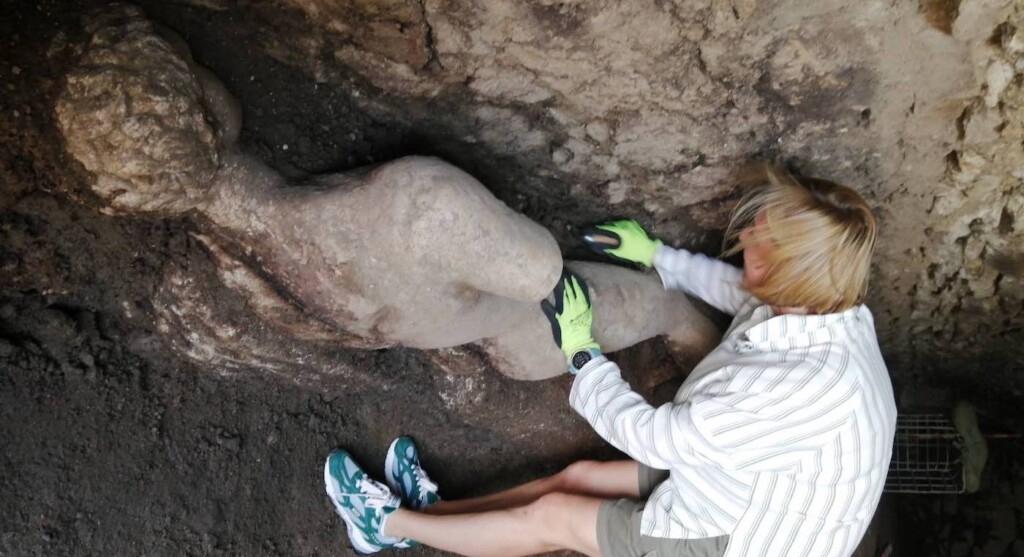
Nearly 100 years after the legs of a giant statue of Pharoah Ramses II were found in Egypt, archaeologists have finally located his better half.
It’s not his wife, but rather his torso, head, and shoulders, which together fit perfectly with the lower half kept in a museum for decades.
With both halves together, the statue towers over mere mortals at 23 feet tall, and depicts perhaps the greatest of all Egyptian rulers in a sitting position with a crown shaped like a cobra—a symbol of kingship. The back of the statue is covered in hieroglyphs that list his many titles.
In a time where lifespans averaged 40-50 years if you survived childhood, Ramses the Great lived into his 90s and outlived almost all of his dozens of children and even some of his nearly 100 grandchildren.
Ushering in a golden age across the 19th Dynasty’s sprawling kingdom that stretched from Sudan to Syria, his glory is reflected in monuments and temples—as well as statues like the newly-reunited one that was originally found in 1930 by the German archaeologist Günther Roeder.
Dr. Adel Okasha, head of the Central Administration of Antiquities of Central Egypt, said that the mission began excavations in the region of Ashmunin during the past year in an attempt to locate the religious center of the ancient city of Hermopolis during the era of the New Kingdom until the Roman era, where a number of temples, including one for Ramses II, are believed to be preserved, according to a statement from the Ministry of Tourism and Antiquities.
“Though we have not found the complex we were initially looking for, a statue of such importance is a sign that we are digging in the right place,” Dr. Okasha, told the National.
The city of Ashmunin in ancient Egypt was known as Khomeno, where it was the seat of worship of the Egyptian Thamun. It later became known in the Greco-Roman era as Hermopolis Magna, and was the center of worship of the god Thoth, and the capital of the fifteenth Egyptian region.
The excavation season is now closed, per the statement, and along with discovering the upper half of the king’s statue, they also succeeded in restoring and reinstalling the huge granite columns on the northern side of the Ashmunin basilica, which was built on the ruins of a Ptolemaic temple.
SHARE This Latest Big Find From The Land Of The Nile…
High-speed rail is a standard form of transport in places like Germany, France, Italy, China, Japan, and Switzerland, but with any luck at all, it should be coming to the Lone Star State before long.
Texas Central has progressed through the planning stage and settled landowning disputes regarding a high-speed railway line from Dallas to Houston, which usually requires a 2-hour flight, a 4-hour drive, or a 5-hour bus ride.
However, at 200 miles per hour, the projected time would be a mere 90 minutes, departing every half hour during peak times and every hour off-peak.
“If we are going to add more high-speed rail to this country, the Dallas to Houston Corridor is a compelling proposition and offers great potential,” said Amtrak Senior Vice President of High-Speed Rail Development Programs Andy Byford.
“We believe many of the country’s biggest and fastest-growing metropolitan areas, like Houston and Dallas, deserve more high quality high-speed, intercity rail service.”
The project isn’t a given yet, but after years of what Engineering News Record called “financial setbacks, leadership issues, and legal woes,” it is moving forward again with plans for 50% of the 236 miles of rails to be on viaducts to help ease landowners’ concerns; although the Texas Supreme Court has already determined that Texas Central has eminent domain authority regarding their proposed route.
“In big complex infrastructure projects, it’s better to have issues during the planning phase” than construction, Angel Pena, vice president for rail and transit at the development firm STV’s Texas/Mountain region. “Planning is the most challenging part of the process.”
Amtrak and Texas Central have submitted applications to several federal programs in connection with further study and design work for the potential Dallas to Houston segment, including the Consolidated Rail Infrastructure Safety and Improvements (CRISI) grant program, the Corridor Identification and Development program, and the Federal-State Partnership for Intercity Passenger Rail (FSP-National) grant program.
These should help Texas Central address the ballooning costs of the project which unfortunately are projected to hover around $33 billion.
Texas is bigger than all the countries mentioned above, and in most places is much flatter too. The Midwest seems to lend itself to high-speed rail, which is truly the most pleasurable way to travel. For anyone who hasn’t seen the countryside go by at 200 miles per hour of silence and comfort, it’s an amazing experience.
SHARE This Exciting And Ambitious Rail Project With Your Texan Friends…
Quote of the Day: “My religion is very simple. My religion is kindness.” – Dalai Lama
Photo by: Yulia Dubina (Юлія Дубина)
With a new inspirational quote every day, atop the perfect photo—collected and archived on our Quotes page—why not bookmark GNN.org for a daily uplift?
A reef that has been degraded—whether by coral bleaching or disease—can’t support the same diversity of species and has a much quieter, less rich soundscape.
But new research from Woods Hole Oceanographic Institution shows that sound could potentially be a vital tool in the effort to restore coral reefs.
A healthy coral reef is noisy, full of the croaks, purrs, and grunts of various fishes and the crackling of snapping shrimp. Scientists believe that coral larvae use this symphony of sounds to help them determine where they should live and grow.
So, replaying healthy reef sounds can encourage new life in damaged or degraded reefs.
In a paper published last week in Royal Society Open Science, the Woods Hole researchers showed that broadcasting the soundscape of a healthy reef caused coral larvae to settle at significantly higher rates—up to seven times more often.
“What we’re showing is that you can actively induce coral settlement by playing sounds,” said Nadège Aoki, a doctoral candidate at WHOI and first author on the paper.
“You can go to a reef that is degraded in some way and add in the sounds of biological activity from a healthy reef, potentially helping this really important step in the coral life cycle.”
Corals are immobile as adults, so the larval stage is their only opportunity to select a good habitat. They swim or drift with the currents, seeking the right conditions to settle out of the water column and affix themselves to the seabed. Previous research has shown that chemical and light cues can influence that decision, but Aoki and her colleagues demonstrate that the soundscape also plays a major role in where corals settle.
The researchers ran the same experiment twice in the U.S. Virgin Islands in 2022. They collected larvae from Porites astreoides, a hardy species commonly known as mustard hill coral thanks to its lumpy shape and yellow color and distributed them in cups at three reefs along the southern coast of St. John. One of those reefs, Tektite, is relatively healthy. The other two, Cocoloba and Salt Pond, are more degraded with sparse coral cover and fewer fish.
At Salt Pond, Aoki and her colleagues installed an underwater speaker system and placed cups of larvae at distances of one, five, 10, and 30 meters from the speakers. They broadcast healthy reef sounds – recorded at Tektite in 2013 – for three nights. They set up similar installations at the other two reefs but didn’t play any sounds.
When they collected the cups, the researchers found that significantly more coral larvae had settled in the cups at Salt Pond than the other two reefs. On average, coral larvae settled at rates 1.7 times (and up to 7x) higher with the enriched sound environment.
The highest settlement rates were at five meters from the speakers, but even the cups placed 30 meters away had more larvae settling to the bottom than at Cocoloba and Tektite.
“The fact that settlement is consistently decreasing with distance from the speaker, when all else is kept constant, is particularly important because it shows that these changes are due to the added sound and not other factors,” said Aran Mooney, a marine biologist at WHOI and lead author on the paper.
“This gives us a new tool in the toolbox for potentially rebuilding a reef.”
Adding the audio is a process that would be relatively simple to implement, too.
“Replicating an acoustic environment is actually quite easy compared to replicating the reef chemical and microbial cues which also play a role in where corals choose to settle,” said Amy Apprill, a microbial ecologist at WHOI and a co-author on the paper.
In a heartwarming video, a 67-year-old actor from Cyprus became determined to use his CPR expertise to save a tiny, helpless sparrow.
The avian creature was found unconsciousness following an “unfortunate pool mishap”.
In the background of the video, you can hear a chorus of teasing and snickering, with voices urging him to dispose of the seemingly lifeless bird—but Costakis Constantinou remained undeterred.
“Nobody thought this was possible or even worth trying, however, he stayed focus and patiently continued,” his son Rolandos told GNN.
With unwavering determination, he persistently, applied his life-saving skills until, against all odds, the sparrow gradually regained consciousness, fluttering back to life.
“I can say with confidence that he was very, very happy, relieved, and satisfied when the little sparrow open its eyes and flied away.”
When Rolandos rewatched the video again (see below), he got emotional and telephoned his dad to tell him how proud he was.
“In the past he saved two people from heart attack by applying CPR. For some reason my father is at the right place the right time.”
A mom started leading hair care workshops teaching dads how to manage their daughters’ hair, training more hands to help in the mornings before school.
Sarah Eaton had been organizing lessons showing moms how to do elaborate plaits and braids when she got the idea because many of the women said their male partners should learn the skills too.
Now, the 38-year-old runs hour-long Dad & Me workshops at her local community center where they learn how to do the basics, like detangle long hair, tie it back in ponytails, and style it into simple braids, bunches, and buns for ballet class.
The hairstylist from West Lothian, Scotland, reports that all the fathers comment on how much more confident it has made them feel.
“The look of admiration on their face after each session is amazing.”
Sarah started her small workshop business, Bonnie Braids, after trying to dress up her two daughters for Halloween in 2022. She bought them both red synthetic wigs which she planned to braid but was surprised to find how hard it was to do.
After chatting with other moms in her town of Armadale, she learned that many of them wanted to know how to do Dutch and French braids.
“It went really well, and then a few moms started telling me how their husbands wanted to learn how to do it, so I decided to set one up for them.”
Bonnie Braids / SWNS
Sarah has run three sessions for dads so far, and says they are only getting more and more popular.
One of the activities in the workshop which draws the most laughs is when the dads are learning how to do the high bun. (See the video below…)
Dad’s style their daughter’s hair at Sarah Eaton’s ‘Dad & Me’ workshop – Bonnie Braids / SWNS
“We get the kids to stand up and the dads hold the hair up high while the girls spin around. The kids are so happy because dad can do a bun for their ballet.”
Sarah runs the workshops on an “ad hoc basis” with a maximum of eight dads per session, and says it overwrites the myth that doing hair is a female job.
“It just goes to show how valuable it is to break down stigmas,” she said.
“Dads should feel just as able to do their daughters hair in the morning before school.”
SHARE THE IDEA for Other Moms and Communities on Social Media…
A new poll showed the ‘luck of the Irish’ may be a real thing—with residents of Ireland reporting a greater prevalence of good fortune.
The survey revealed that those living on the Emerald Isle may actually experience more luck—tallying an average of 40 fortunate moments every year, nearly 10 percent more than people in the rest of the UK.
Irish folks are also more likely to describe themselves as lucky, with nearly half (49%) believing they’re blessed, compared to 40 percent elsewhere.
The poll also found 66% of UK adults believe they are due a bit of good luck in their lives.
Overall, one in four (25%) admitted they don’t truly know the meaning of luck—and think it’s too hard to define.
A spokesperson for Lottoland.co.uk, which commissioned the lucky-in-life quiz to celebrate its Irish Lotto draw this St Patrick’s Day, admitted that luck is ‘a strange concept.’
“Most people question whether it really exists (but) some people certainly seem luckier than others—something our lotto winners would attest to.”
Respondents in the survey were asked if they considered anything to be their lucky charm—whether it was wearing lucky socks or finding a four-leaf clover.
To increase their chances of good fortune, 23% of UK adults say they’ve embraced a lucky charm, but a full 38% of Irish respondents have.
Lucky numbers, special bracelets, and coins are popular on both sides of the Irish sea—but, interestingly, the Celtic people were actually less likely to opt for a four-leaf clover.
A quarter of respondents consider good health something to be thankful for, as it can often be decided by luck.
On the other side of the coin, a belief in bad luck is held by Irish adults at a 17% higher rate than people from the UK (67% compared to 50%).
Furthermore, 57 percent of those polled from the Republic of Ireland have experienced beginner’s luck—doing something well on their first try—compared to only 36 percent of people in England, Wales, Scotland, according to the Onepoll data.
“The question is, do you have to be born in Ireland to enjoy that luck, or can you simply move to Dublin or Galway, and enjoy a boost to your fortunes,” quipped the Lottoland spokesperson.
TOP 10 LUCKY CHARMS IN IRELAND:
1. Lucky number
2. Bracelet
3. Coins
4. Ring
5. Four leaf clover
6. Ladybugs
7. Socks
8. Horseshoe
9. Rainbow
10. Underwear
Do you feel lucky? Tell us in the comments or on social media…
Quote of the Day: “May you have all the happiness that life can hold—and at the end of your rainbows may you find a pot of gold.” – An old Irish blessing (Happy St. Patrick’s Day!)
Photo by: Jeff Hart, CC license
With a new inspirational quote every day, atop the perfect photo—collected and archived on our Quotes page—why not bookmark GNN.org for a daily uplift?
It’s not fortune or fame Americans want to be remembered for—it’s their creativity, according to a new poll.
The survey of 2,000 adults in the U.S. revealed that at the end of their lives, 31% would rather leave their mark through creativity, than through wealth (14%) or humanitarian efforts (10%).
That’s likely to come true, too, because fully 79% of respondents consider themselves creative, with only 5% saying they don’t.
Nearly three-quarters (72%) admitted they wished they engaged in creative activities more often.
In fact, some of those surveyed say they alleviate or combat stress through creative writing (14%), painting (12%) and drawing or doodling (10%).
The top three motivators for people to get more creative are:
– sharing with the world (27%)
– bonding with friends and family (24%)
– wanting to relax or relieving stress (22%)
Regardless of how respondents categorized themselves, 77% admitted they’d be more likely to explore their creativity if they were more confident in their abilities.
Conducted by OnePoll on behalf of Sharpie and Paper Mate, the survey also explored all of the ways Americans are basking in their creativity and found that many are thinking outside the box.
“It’s inspiring to see just how many Americans consider themselves creative, though it’s clear that there is more creativity to be unleashed,” said Gina Lazaro, the Vice President of Brand Management for the companies.
In addition to three-quarters of those polled lacking creative confidence, 44% said they are looking for encouragement from people they care about. 43% want or need more practice, and 36% need more products to help them be more creative.
Markus Spiske
“With the right tools in-hand Americans can overcome some of those barriers to creativity and improve their wellbeing.”
Almost one in five of all respondents engage in creative activities daily (18%), while another 37% do so weekly.
“Whether it’s simple activities like doodling on the margins of a paper or adding color to your calendar, creative confidence can be built in small ways on an everyday basis,” concluded Lazaro.
(Left to right) Ellie, Holly, Georgie and Jess – SWNS
Identical quadruplets who beat all the odds just even being born are now turning 18, and are about to be apart from their sisters for the first time.
Doctors told their parents that they were more likely to win the lottery than see all four babies survive, but 18 years later Ellie, Jessica, Georgie, and Holly are now happy and healthy, reaching adulthood.
The girls have asked for a celebration night out for dinner with mom and dad—Julie and Jose—in Bedfordshire, England. And afterward, they’re all going to a concert together.
“They haven’t really asked for much,” said Julie. “We’re going to celebrate the day as a family. We’re very close.”
“They will then go off into the adult world and do their own thing.
“I think they will miss each other but they will enjoy the freedom.
In 2005, Julie and Jose learned from an 11-week scan that they were having quads, and they were monochorionic babies who were dependent on a shared placenta.
“Initially, the sonographer said it was unlikely that they would survive. We were traumatized.
(L-R) 2-year-old Georgie, Holly, Ellie and Jess – SWNS
“Over the weekend we did some research and accepted it. We felt like we were given a gift.”
When Julie reached 23 weeks on March 23, Ellie, Georgina, Jessica and Holly were born just minutes apart, weighing 2lb 8oz, 2lb 7oz, 2lbs and 1lbs 9oz respectively—before being rushed to the NICU for eight weeks.
The day Julie and Jose were allowed to bring the siblings home was the ‘best day of their life’.
They “thrived” and each branched out with different personalities.
3D scanned creatures by oVert – Released by Florida Museum of Natural History / SWNS
An incredible new project has scanned thousands of creatures to advance scientific research and provide colorful images to the world.
Natural history museums have entered a new stage of scientific discovery and accessibility with the completion of openVertebrate (oVert), a five-year collaborative project among 18 institutions to create 3D reconstructions of vertebrate specimens and make them freely available online.
Now, researchers have published a summary of the project in the journal BioScience reviewing the specimens they’ve scanned to date, offering a glimpse of how the data might be used to ask new questions and spur the development of innovative technology.
“When people first collected these specimens, they had no idea what the future would hold for them,” said Edward Stanley, co-principal investigator of the oVert project and associate scientist at the Florida Museum of Natural History.
Such museums got their start in the 16th century as cabinets of curiosity, in which a few wealthy individuals amassed rare and exotic specimens, which they kept mostly to themselves. Since then, museums have become a resource for the public to learn about biodiversity.
But, the majority of museum collections remain behind closed doors—accessible only to scientists who must either travel to see them or ask that a small number of specimens be mailed on loan—and oVert wants to change that.
“Now we have scientists, teachers, students and artists around the world using these data remotely,” said David Blackburn, lead principal investigator of the oVert project and curator of herpetology at the Florida Museum.
Beginning in 2017, the oVert team members took CT scans of more than 13,000 specimens, with vertebrate species across the tree of life, including over half the genera of all amphibians, reptiles, fishes, and mammals.
A collage of scanned fish from oVert – Released by Florida Museum of Natural History / SWNS
CT scanners use high-energy X-rays to peer past an organism’s exterior and view the dense bone structure beneath. Some specimens were also stained with a contrast-enhancing solution for visualizing soft tissues, like skin, muscle, and other organs.
The models give an intimate look at internal portions of a specimen that could previously only be observed through destructive dissection and tissue sampling.
“You want to protect specimens, but you also want to have people use them,” Blackburn said. “oVert is a way of reducing the wear and tear on samples while also increasing access, and it’s the next logical step in the mission of museum collections.”
Hedgehog CT scan from oVert – Florida Museum of Natural History / SWNS
Skeletons too large to fit into a CT scanner, like a humpback whale, were painstakingly taken apart so that 3D models of each individual bone could be scanned and reassembled.
“These are not things you put in boxes and loan,” Blackburn pointed out.
A set of iconic Galapagos tortoises at the California Academy of Sciences were each photographed in a 360-degree rotation. Photographing their undersides was problematic, as their curved shells made it impossible to keep them upright. After a few trial-and-error runs, they settled on placing the specimens on top of inflatable swimming tubes.
Scientists have already used data from the project to gain astonishing insights into the natural world. Watch the incredible video below, and learn more at the bottom…
In 2023, Edward Stanley was conducting routine CT scans of spiny mice and was surprised to find their tails were covered with an internal coat of bony plates, called osteoderms. Before this discovery, armadillos were considered to be the only living mammals with these structures.
“All kinds of things jump out at you when you’re when you’re scanning,” Stanley said. “I study osteoderms, and through kismet or fate, I happened to be the one scanning those particular specimens on that particular day and noticed something strange about their tails on the X-ray.
“That happens all the time. We’ve found all sorts of strange, unexpected things.”
oVert scans were used to determine what killed a rim rock crown snake, considered to be the rarest snake species in North America.
Another study showed that a group of frogs called pumpkin toadlets had become so small that the fluid-filled canals in their ears that confer balance no longer functioned properly, causing them to crash-land when jumping.
One study of 500 oVert specimens revealed that frogs have lost and regained teeth more than 20 times throughout their evolutionary history.
Other researchers concluded that Spinosaurus, a massive dinosaur that was larger than Tyrannosaurus rex and thought to be aquatic, would have actually been a poor swimmer, and thus likely stayed on land.
And the list goes on, full of insights and ideas that would have been impossible or impractical before the project’s outset. “Now that we’ve been working on this for so long, we have a broad scaffold that allows us to take a broader view of evolutionary questions,” Stanley said.
Fish CT scan from oVert – Florida Museum of Natural History / SWNS
Artists and teachers are benefitting too
Funded in part by the National Science Foundation, the value of the oVert project extends beyond science.
Artists have used the 3D models to create realistic animal replicas, photographs of oVert specimens have been displayed as museum exhibits, and specimens have been incorporated into virtual reality headsets that give users the chance to interact with and manipulate them.
A high school teacher in Cincinnati says it’s been a game-changer for her studies on evolution. “I teach juniors and seniors, and I absolutely love them, but they can be a tough audience,” said Jennifer Broo. “They know when things are fake, which makes them less engaged. Using the oVert models, my class has gotten so much better because I have had the opportunities to work with and expose my students to real data.”
Visit Sketchfab to view a sample of 3D interactive models. At MorphoSource you can access the full openVertebrate repository.
SEND THE GREAT RESOURCE to Creatives, Teachers, and Animal Lovers By Sharing on Social Media…
FREE WILL ASTROLOGY – Week of March 16, 2024
Copyright by Rob Brezsny, FreeWillAstrology.com
ARIES (March 21-April 19):
I will never advise you to dim the flame of your ambition or be shy about radiating your enthusiasm. For the next few weeks, though, I urge you to find ways to add sap, juice, and nectar to your fiery energy. See if you can be less like a furnace and more like a sauna; less like a rumbling volcano and more like a tropical river. Practically speaking, this might mean being blithely tender and unpredictably heartful as you emanate your dazzling glow.
TAURUS (April 20-May 20):
Some spiritual traditions tell us that the path to enlightenment and awakening is excruciatingly difficult. One teaching compares it to crossing a bridge that’s sharper than a sword, thinner than a hair, and hotter than fire. Ideas like these have no place in my personal philosophy. I believe enlightenment and awakening are available to anyone who conscientiously practices kindness and compassion. A seeker who consistently asks, “What is the most loving thing I can do?” will be rewarded with life-enhancing transformations. Now I invite you to do what I just did, Taurus. That is, re-evaluate a task or process that everyone (maybe even you) assumes is hard and complicated. Perform whatever tweaks are necessary to understand it as fun, natural, and engaging.
GEMINI (May 21-June 20):
Do you have a relative your parents never told you about? If so, you may find out about them soon. Do you have a secret you want to keep secret? If so, take extra caution to ensure it stays hidden. Is there a person you have had a covert crush on for a while? If so, they may discover your true feelings any minute now. Have you ever wondered if any secrets are being concealed from you? If so, probe gently for their revelation, and they just may leak out. Is there a lost treasure you have almost given up on finding? If so, revive your hopes.
CANCER (June 21-July 22):
Cancerian poet Pablo Neruda wrote this to a lover: “I want to do with you what spring does with the cherry trees.” That sounds very romantic. What does it mean? Well, the arrival of spring brings warmer soil and air, longer hours of sunlight, and nurturing precipitation. The flowers of some cherry trees respond by blooming with explosive vigor. Some trees sprout upwards of 4,000 blossoms. Maybe Neruda was exaggerating for poetic effect, but if he truly wanted to rouse his lover to be like a burgeoning cherry tree, he’d have to deal with an overwhelming outpouring of lush beauty and rampant fertility. Could he have handled it? If I’m reading the upcoming astrological omens correctly, you Cancerians now have the power to inspire and welcome such lavishness. And yes, you can definitely handle it.
LEO (July 23-Aug. 22):
Speaking on behalf of all non-Leos, I want to express our gratitude for the experiments you have been conducting. Your willingness to dig further than ever before into the mysterious depths is exciting. Please don’t be glum just because the results are still inconclusive and you feel a bit vulnerable. I’m confident you will ultimately generate fascinating outcomes that are valuable to us as well as you. Here’s a helpful tip: Give yourself permission to be even more daring and curious. Dig even deeper.
VIRGO (Aug. 23-Sept. 22):
Unexpected mixtures are desirable, though they may initially feel odd. Unplanned and unheralded alliances will be lucky wild cards if you are willing to set aside your expectations. Best of all, I believe you will be extra adept at creating new forms of synergy and symbiosis, even as you enhance existing forms. Please capitalize on these marvelous openings, dear Virgo. Are there parts of your life that have been divided, and you would like to harmonize them? Now is a good time to try. Bridge-building will be your specialty for the foreseeable future.
LIBRA (Sept. 23-Oct. 22):
Many of you Libras have a special talent for tuning into the needs and moods of other people. This potentially gives you the power to massage situations to serve the good of all. Are you using that power to its fullest? Could you do anything more to harness it? Here’s a related issue: Your talent for tuning into the needs and moods of others can give you the capacity to massage situations in service to your personal aims. Are you using that capacity to its fullest? Could you do anything more to harness it? Here’s one more variation on the theme: How adept are you at coordinating your service to the general good and your service to your personal aims? Can you do anything to enhance this skill? Now is an excellent time to try.
SCORPIO (Oct. 23-Nov. 21):
Psychologist Carl Jung said, “One of the most difficult tasks people can perform is the invention of good games. And this cannot be done by people out of touch with their instinctive selves.” According to my astrological assessment, you will thrive in the coming weeks when you are playing good, interesting games. If you dream them up and instigate them yourself, so much the better. And what exactly do I mean by “games”? I’m referring to any organized form of play that rouses fun, entertainment, and education. Playing should be one of your prime modes, Scorpio! As Jung notes, that will happen best if you are in close touch with your instinctual self—also known as your animal intelligence.
SAGITTARIUS (Nov. 22-Dec. 21):
Can Sagittarians ever really find a home they are utterly satisfied with? Are they ever at peace with exactly who they are and content to be exactly where they are? Some astrologers suggest these are difficult luxuries for you Centaurs to accomplish. But I think differently. In my view, it’s your birthright to create sanctuaries for yourself that incorporate so much variety and expansiveness that you can feel like an adventurous explorer without necessarily having to wander all over the earth. Now is an excellent time to work on this noble project.
CAPRICORN (Dec. 22-Jan. 19):
You picked Door #2 a while back. Was that the best choice? I’m not sure. Evidence is still ambiguous. As we await more conclusive information, I want you to know that Door #1 and Door #3 will soon be available for your consideration again. The fun fact is that you can try either of those doors without abandoning your activities in the area where Door #2 has led you. But it’s important to note that you can’t try *both* Door #1 and Door #3. You must choose one or the other. Proceed with care and nuance, Capricorn, but not with excessive caution. Your passwords are *daring sensitivity* and “discerning audacity.”
AQUARIUS (Jan. 20-Feb. 18):
My second cousin has the same name as me and lives in Kosice, Slovakia. He’s a Slovakian-speaking chemical engineer who attended the Slovak University of Technology. Do we have anything in common besides our DNA and names? Well, we both love to tell stories. He and I are both big fans of the band Rising Appalachia. We have the same mischievous brand of humor. He has designed equipment and processes to manufacture products that use chemicals in creative ways, and I design oracles to arouse inspirations that change people’s brain chemistry. Now I invite you, Aquarius, to celebrate allies with whom you share key qualities despite being quite different. It’s a fine time to get maximum enjoyment and value from your connections with such people.
PISCES (Feb. 19-March 20):
My Piscean friend Jeff Greenwald wrote the humorous but serious book Shopping for Buddhas. It’s the story of his adventures in Nepal as he traveled in quest of a statue to serve as a potent symbol for his spiritual yearning. I’m reminded of his search as I ruminate on your near future. I suspect you would benefit from an intense search for divine inspiration—either in the form of an iconic object, a pilgrimage to a holy sanctuary, or an inner journey to the source of your truth and love.
WANT MORE? Listen to Rob’s EXPANDED AUDIO HOROSCOPES, 4-5 minute meditations on the current state of your destiny — or subscribe to his unique daily text message service at: RealAstrology.com
With a new inspirational quote every day, atop the perfect photo—collected and archived on our Quotes page—why not bookmark GNN.org for a daily uplift?
11-year-old Harrison Johnson founded the Harrison’s Heroes charity drive when he was 10.
The bean fields and mountains of North Carolina are 5 time zones and more than 5,000 miles from Hawai’i, but such differences are trifles compared to the determination of youth.
11-year-old Harrison Johnson from North Carolina has raised $81,000 to help fund history projects to tell the story of the attack on Pearl Harbor. The money was raised by collecting donations door-to-door, selling patriotic popsicles, and public speaking engagements (yes, by Harrison himself).
But what brought this spark of patriotic fervor out of this boy’s heart when he had never even seen the famous harbor on Oahu?
According to WRAL, it began in school with a history project. The particulars of the event fascinated Harrison, who began to study it recreationally, reading books and old newspaper accounts, and even speaking to survivors of the attack.
Following a visit to the Pearl Harbor National Memorial in Oahu, Harrison was motivated to start a campaign to ensure that the heroes and victims of the date which will live in infamy are never forgotten.
His fundraising campaign called “Harrison’s Heroes” is looking to raise $100,000 for Pacific Historic Parks, the Non-Profit that stewards the Pearl Harbor memorial. In particular, Harrison hopes it can produce material that expands the story of the attack to include heroic acts from men and women of color, and other underrepresented members.
“We’re so proud and we pray it makes the impact that he intends,” said Harrison’s mom.
WATCH and LISTEN to Harrison explain his motivations…
SHARE This Young Man’s Inspiring Quest To Honor The Sacrifice Of US Sailors…