Charlotte the stingray - Released by Aquarium and Shark Lab
Charlotte the stingray – Released by Aquarium and Shark Lab
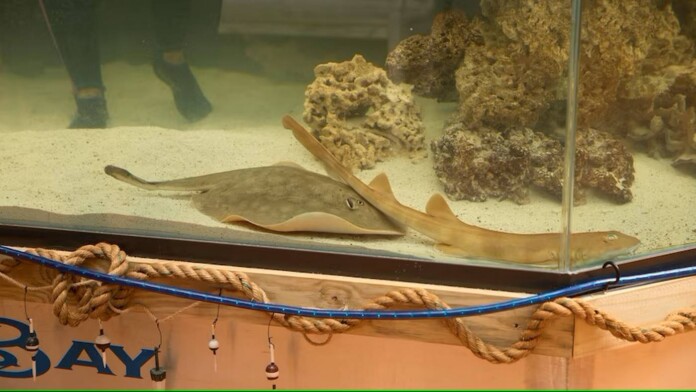
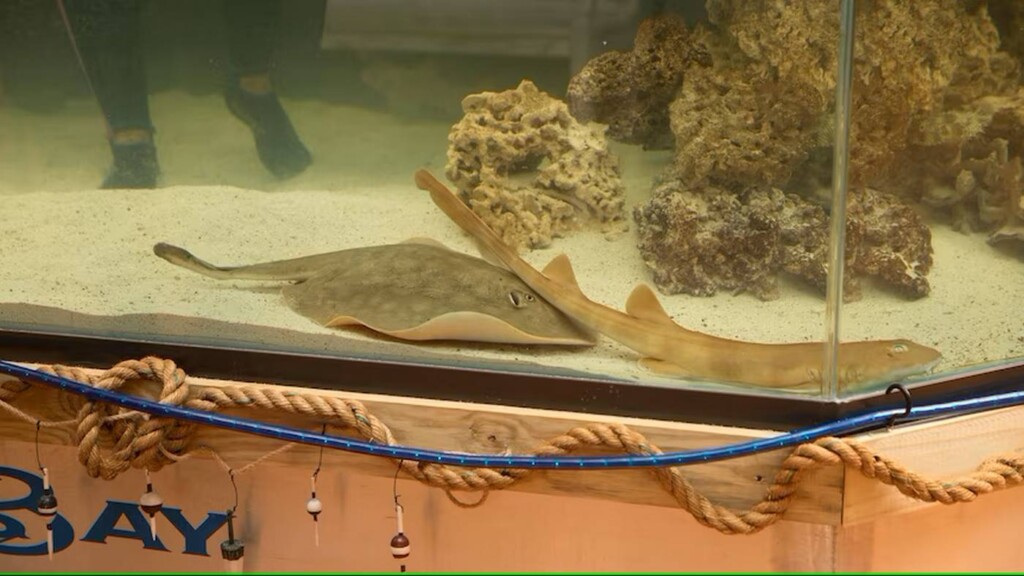
It’s hard being alone on Valentine’s Day—something that Charlotte the round stingray had experienced for eight years in a row.
But this year she decided she wasn’t going to wait for that special someone to celebrate the day of lovers, and managed to get pregnant without a man in sight for miles.
This Valentine’s Day miracle is technically called “parthenogenesis” a kind of asexual reproduction seen in birds, reptiles, amphibians, and fish—but not mammals.
Lacking any genetic material from a male, the female’s egg fuses with another cell known as a polar body, triggers cellular division, and voila—an embryo appears.
The staff at North Carolina’s Aquarium and Shark Lab first noticed that Charlotte was blowing up like a balloon and believed it was merely a case of too much food—but an ultrasound revealed that parthenogenesis had occurred, and that Charlotte would be a mom of 4 pups in the coming weeks.
“We were all like, ‘shut the back door, there’s no way’,” Brenda Ramer, executive director of the small aquarium in Hendersonville, told ABC News Australia. “We thought we were overfeeding her. But we were overfeeding her because she has more mouths to feed.”
Ramer and her staff were quick to point out that Charlotte hadn’t seen another male stingray in 8 years, and it would have been “impossible” for her to get frisky with some of the sharks that share her tank.
Despite being closely related, sharks and rays cannot interbreed; their DNA wouldn’t match up; their ‘anatomy’ even less so.
Kady Lyons, a graduate student at the aquarium, also told ABC Au that she isn’t surprised this auto-impregnation occurred, saying that it’s a case of how “life finds a way.”
SHARE This Story Of Sea Life Auto-Romance With Your Friends…
Quote of the Day: “The sweetest of all sounds is praise.” – Xenophon
Photo by: Massimo Sartirana
With a new inspirational quote every day, atop the perfect photo—collected and archived on our Quotes page—why not bookmark GNN.org for a daily uplift?
Together California groundbreaking – by Victor R. Vega Jr.
Together California groundbreaking – by Victor R. Vega Jr.
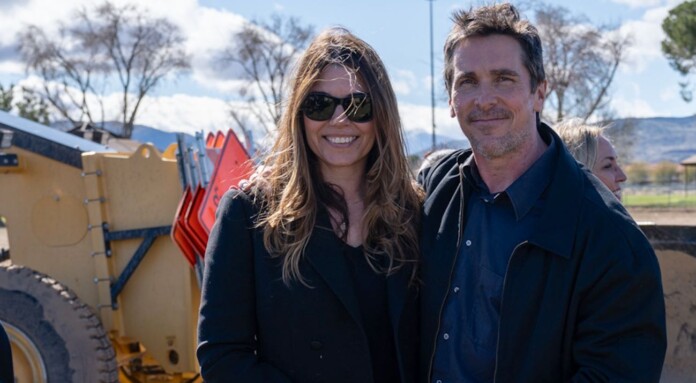
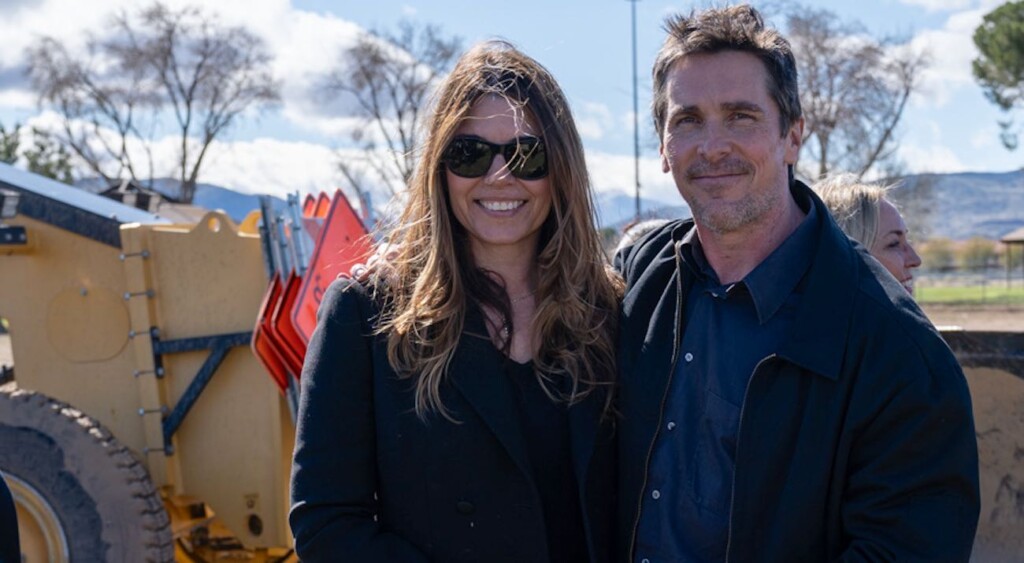
The personal passion project of Hollywood A-lister Christian Bale seems to finally be coming to fruition as the Welsh actor recently broke ground on a children’s foster care village in Palmdale, California.
Founding the non-profit Together California, it’s taken Mr. Bale 16 years to really get the show on the road after being inspired to help improve the foster care system following the birth of his daughter in 2005.
Together California acquired a 4.67-acre site adjacent to McAdam Park in Palmdale, a city in the north of LA numbering around 160,000 inhabitants, in 2022. The ground-breaking ceremony coincided with a break in the recent stormy weather, and left both the natural lighting and sense of the future looking a lot more sunny.
“I had the very unrealistic idea that within one year I’d have created a miniature Sound of Music with kids singing on hills in an endlessly joyful environment,” the Batman star told The Hollywood Reporter. “But I discovered no, it takes an awful long time and really well-motivated people. It’s complicated and tough to help kids.
“It should be a hell of a lot easier than it was, but I didn’t flinch for one second.”
Offering pioneering care designed to keep foster siblings together, the “village” will feature 12 three-bedroom townhomes, each housing six children. A full-time, professionally trained foster parent will provide care and support.
Studio apartments will be available to provide temporary housing for visiting relatives or transitional housing for kids aging out of foster care. A 7,000-square-foot community center will also offer enriching programs and services as part of the project.
Photo by Victor R. Vega Jr.
“Imagine the absolute pain and the trauma of losing your parents or being torn from your parents, and then losing your brothers and sisters on top of that. That’s no way to treat kids—and so, we will be the hub for that,” said Bale.
“I hope that this village will be the first of many, and I hope that people, Californians and Angelenos, know to come join us in opening our eyes to what’s happening right under our noses. These are our children, and we must help our children.”
Together California groundbreaking – by Victor R. Vega Jr.
Bale explained that it was the birth of his daughter, Luka, with his wife Sibi that first enlightened the actor as to the conditions of the foster care system in California.
The state has the largest number of foster kids in the nation, and often it sees siblings go in and get separated—unable to grow up together.
He also said he was influenced by his father, an environmental activist who worked with the Dian Fossey Gorilla Fund and the Humane Society of the United States, and who moved the family around a lot. Philanthropy was part of David Bale’s life, and Christian recalled there often being people sleeping in the family home who had nowhere else to go.
SHARE This Inspiring Story Of A Celebrity Working To Improve His Adopted Home…
Proprietary survey and research data from a DC think tank have demonstrated that a greater percentage of Americans are bilingual than the French, Italians, or British, despite these Europeans having a more immediate need for bilingualism.
Visits to Milano, Paris, or Amsterdam may have given generations of Americans the wrong idea about the talent inherent in the tongues of Europeans: namely that all can easily produce 2 or 3 languages.
The “America the Bilingual Project” has found that the EU average for number of bilingual citizens is 25% of a country’s population, while the US is 23%—a few percentage points higher than France and Britain, just 5% less than Germany, and double that of the Italians.
There are approximately 76 million bilingual Americans, which is 3-times as many as Germany, the next highest country in Europe in terms of absolute numbers of bilingual citizens, but also represents more speakers of the world’s most-spoken languages than any other country.
The US has more English-Spanish bilinguals than all of Latin America combined, so it’s no surprise that the Project found that 66% of American bilinguals are Spanish speakers, but the US also contains more than one million speakers of seven other languages. These include Tagalog (Filipino), Vietnamese, Mandarin Chinese, Yue Chinese (Cantonese), Korean, but also French and German.
The US has between 100,000 and 1 million speakers of 35 other languages, the higher end represented by Portuguese, Hindi, Arabic, Russian, and Italian, and the lower end represented by Persian (Farsi), Greek, Hebrew, Romanian, Thai, Ukrainian, and Dutch.
Obviously immigration is a large part of this success story, but it wasn’t always so. The trend up into the 1960s was actually the rapid abandonment of native languages over the first and second generations following immigration—a rate faster and more prevalent than what is found in any country on Earth.
However, after 1960, the trend reversed, with greater and greater rates of bilingualism developing. An estimated 10%, approximately seven million American bilinguals, grew up in English-speaking homes but managed to gain professional competence in a second language, showing that America’s bilingualism boom wasn’t just down to immigration.
The Project’s founder Steve Leveen, believes that America’s bilingual abilities represent the perfect way to build American soft power around the globe, as not only does our country contain the largest repository of native English-speakers, but also these sky-high rates of bilingualism.
SHARE This Story With Someone Who Needs To Remember To Practice…
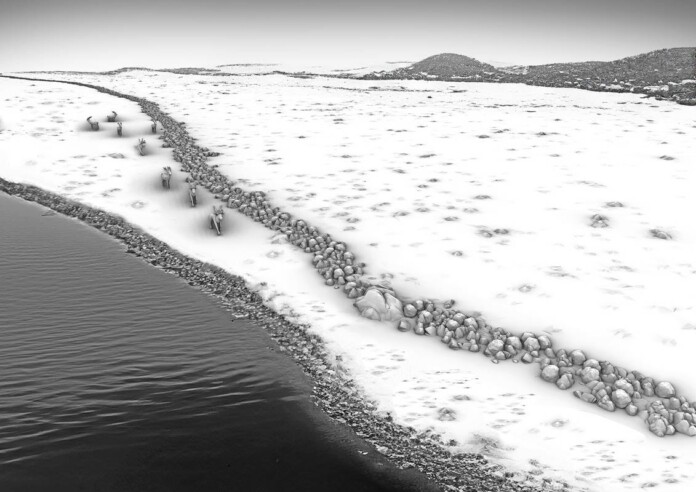
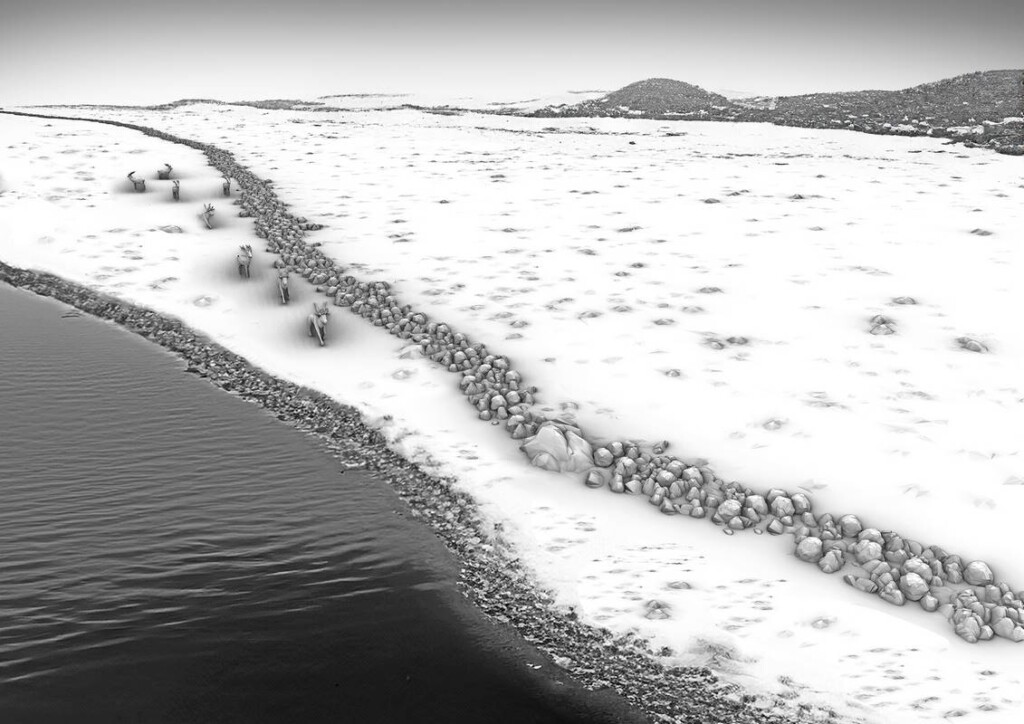
Graphical reconstruction of the stonewall as a hunting structure in a Late Glacial / Early Holocene landscape, based on multibeam bathymetric data and an underwater 3D model - credit Michał Grabowski.
Graphical reconstruction of the stonewall as a hunting structure in a Late Glacial / Early Holocene landscape – Credit: Michał Grabowski
In the autumn of 2021, geologists discovered an unusual row of stones, more than half a mile long, just 21 meters below the sea off the Baltic coast.
The approximately 1,500 stones are aligned so regularly that a natural origin seems unlikely. A team of researchers from different disciplines now concluded that Stone Age hunter-gatherers likely built this structure around 11,000 years ago to hunt reindeer.
The finding represents the first discovery of a Stone Age hunting structure in the Baltic Sea region. The scientists now present their findings in the Proceedings of the National Academy of Sciences (PNAS).
Originally, a team of researchers and students from Kiel University (CAU) wanted to investigate manganese crusts on a ridge of basal till that forms the seafloor about 6 miles off the coast of the Pomeranian town of Rerik.
During their survey, however, they stumbled upon this strange row of stones characterized by many smaller stones that connect several large boulders. The researchers reported their discovery to the Mecklenburg-Vorpommern State Agency for Culture and Monument Preservation.
Today, the Baltic Sea is around 68 feet (21 meters) deep at this location. Thus, the stone wall must have been built before the sea level rose significantly after the end of the last ice age, which happened for the last time around 8,500 years ago. Large parts of the previously accessible landscape ultimately flooded at that time, but beforehand, the end of the wall likely touched a bog or lake; as can be seen in the basin-shaped depression underwater.
For German readers, a more complex study was carried out by the Leibniz Institute for Baltic Sea Research Warnemünde (IOW), the research priority area at Kiel Marine Science at Kiel University, the University of Rostock, the Centre for Baltic and Scandinavian Archaeology (ZBSA, since 2024 part of the Leibniz Centre for Archaeology LEIZA), the German Aerospace Center (DLR), the Alfred Wegener Institute, Helmholtz Centre for Polar and Marine Research (AWI) as well as the LAKD M-V.
This multi-disciplinary team used modern geophysical methods to create a detailed 3D model of the wall and to reconstruct the structure of the ancient landscape. Using sediment samples from the adjacent basin to the south, it was possible to narrow down the period when the wall could have been built. Furthermore, research divers from the universities of Rostock and Kiel explored the stone wall.
“Our investigations indicate that a natural origin of the underwater stone wall as well as a construction in modern times, for instance in connection with submarine cable laying or stone harvesting, is not very likely,” explains Jacob Geersen, lead author of the study. “The methodical arrangement of the many small stones that connect the large, non-moveable boulders, speaks against this.”
Excluding natural processes and a modern origin, the stone wall could only have been formed after the end of the last ice age, when the landscape was not yet flooded by the Baltic Sea.
3D model of a short section of the stone wall – Credit: P. Hoy, University of Rostock, model created using Agisoft Metashape by J. Auer, LAKD M-V
“At this time, the entire population across northern Europe was likely below 5,000 people. One of their main food sources were herds of reindeer, which migrated seasonally through the sparsely vegetated post-glacial landscape,” said Marcel Bradtmöller from the University of Rostock.
“The wall was probably used to guide the reindeer into a bottleneck between the adjacent lakeshore and the wall, or even into the lake, where the Stone Age hunters could kill them more easily with their weapons.”
Such tactics would have been important, since it takes tremendous skill and physical power to throw something like a wooden spear at a large animal like a reindeer and actually wound it.
Comparable prehistoric hunting structures have already been found in other parts of the world, for example at the bottom of Lake Huron (Michigan) at a depth of 30 meters. Here, US archaeologists documented stone walls as well as hunting blinds constructed for hunting caribou, the North American equivalent of reindeer. The stone walls in Lake Huron and in Rerik share many characteristics such as a location on the flank of a topographic ridge, as well as a subparallel trending lakeshore on one side.
As the last reindeer herds disappeared from our latitudes around 11,000 years ago, when the climate became warmer and forests were spreading, the stone wall was most likely not built after this time. This would make it the oldest human structure ever discovered in the Baltic Sea.
“Although numerous well-preserved archaeological sites from the Stone Age are known from the Bay of Wismar and along the coast of Mecklenburg-Vorpommern, these are located in much shallower water depths and mostly date to the Mesolithic and Neolithic periods (approx. 7,000 – 2,500 BCE),” explains Jens Auer from the Mecklenburg-Vorpommern State Office for Culture and Monument Preservation (LAKD M-V), who was involved in the exploration and sampling of many of these sites.
The stone wall and the surrounding seabed will be investigated in more detail using side-scan sonar, sediment echo sounder, and multibeam echo sounder devices. Additionally, research divers from the University of Rostock and archaeologists from the LAKD M-V are planning further diving campaigns to search the stone wall and its surroundings for archaeological finds that could help with the interpretation of the structure.
Luminescence dating, which can be used to determine when the surface of a stone was last exposed to sunlight, may help to get a more precise date of when the stone wall was constructed. Furthermore, the researchers intend to reconstruct the ancient surrounding landscape in more detail.
SHARE This Fascinating Discovery With Your Friends On Social Media…
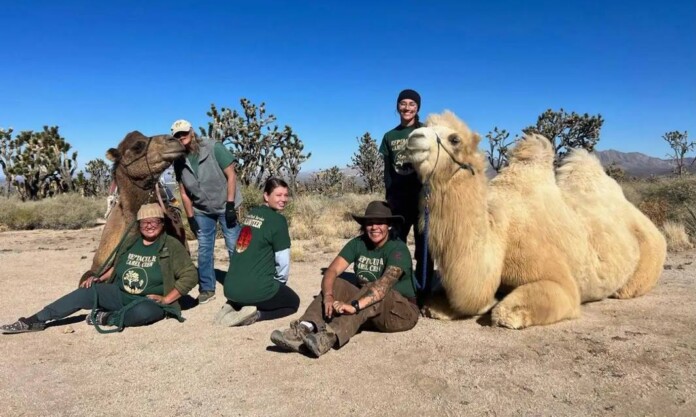
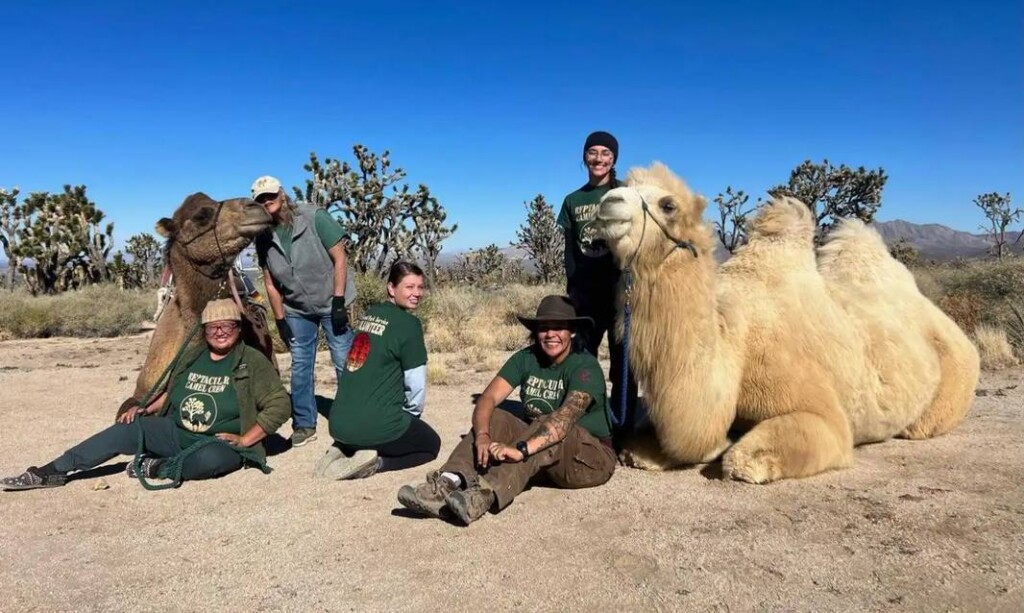
Nance Fite (baseball hat), Jennifer Lagusker (cowboy hat) and other volunteers posing with the camels - supplied to the media by Jennifer Lagusker
Nance Fite (baseball hat), Jennifer Lagusker (cowboy hat), and other volunteers posing with the camels – supplied to the media by Jennifer Lagusker
The Mojave National Preserve is having its iconic Joshua trees restored thanks to a crack team of a dozen volunteers, 3 beasts, and 6 humps.
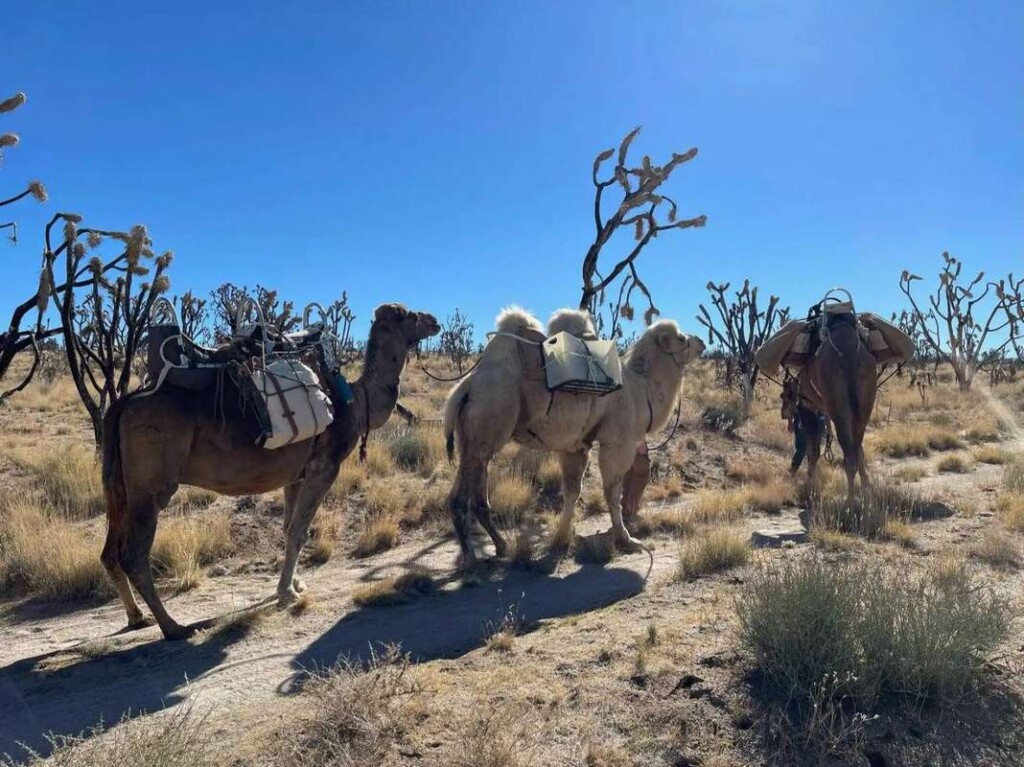
Following wildfires in 2020 and 2023, the National Parks Service undertook a massive project to breed Joshua trees in nurseries and pack them into the high desert country, and a team of volunteers are using camels to do it.
Camels (two humps), not to be confused with dromedaries (1 hump), would have been present on the North American continent during the last Ice Age thanks to the Bearing Land Bridge, so their presence isn’t a total disturbance.
And indeed, the volunteers working with the camels on behalf of the National Park Service argue they cause less disturbance than mules or horses.
Speaking of the Ice Age, the Mojave Desert’s Joshua tree forests are the most expansive in the country, but they were only able to number in the millions because of the Giant Ground Sloth, reports LAist.
These huge furry mammals fed on the Joshua trees, and would have been like double-decker buses for their seeds, carting them around to all corners of the desert. Since their extinction, the plant has had to rely on wind and rodents, with decidedly less success.
– National Parks Service
The germination rate is now extremely low, so the NPS knew the only way to ensure the Joshua tree forests remained as robust as possible was to start a reforestation program for them—setting up a nursery in the Mojave Wilderness Area right on top of the burnt scar from the fires in 2020.
Being that the Mojave is a National Wilderness, there are no roads, no tracks, and no ICE vehicles are permitted inside, so volunteers with the NPS were reduced to hiking hours to the Cima Dome reforestation site with a few seedlings, the cages to protect them, and water to nourish their growth, before having to walk back to the nursery.
Nance Fite, a longtime volunteer at the Mojave National Preserve, realized she had the perfect solution to the arduous task and called up her friend Jennifer Lagusker.
Camels carry Joshua tree seedlings and water in the Mojave – supplied to the media by Jennifer Lagusker
“The job was to pack them and have them carry these things into wherever the park service had us go,” Lagusker told LAist. “When Nance told me about this, I thought, ‘Well, what better way to advocate for the camel than to show the world, hey, they can pack, they really like it, and honestly, they need that kind of a job.'”
Camels are desert specialists, obviously, but their advantages go beyond helping them survive. Their wide and soft feet allow them to pass across the desert wilderness without disturbing the sandy soil and vegetation.
Since 2021, Lagusker and her three camels, Herbie, Sully, and Chico, have been doing most of the restoration work at Cima Dome, a remote area scorched by the wildfires, but after a second round of fires in 2023, the Cima Dome project was considered finished after 3,500 seedlings were successfully planted—carried out into the remote desert on Herbie, Sully, and Chico.
This year the caravan is off to another area, where reforestation work on the Joshua trees will carry on for a long while yet.
SHARE This Awesome Story From The Heart Of American Wilderness…
Quote of the Day: “Man is so made that when anything fires his soul, impossibilities vanish.” – Jean de La Fontaine
Photo by: SH Lam
With a new inspirational quote every day, atop the perfect photo—collected and archived on our Quotes page—why not bookmark GNN.org for a daily uplift?
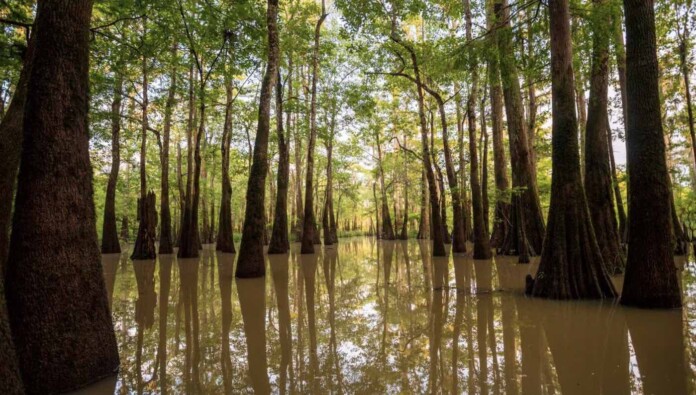
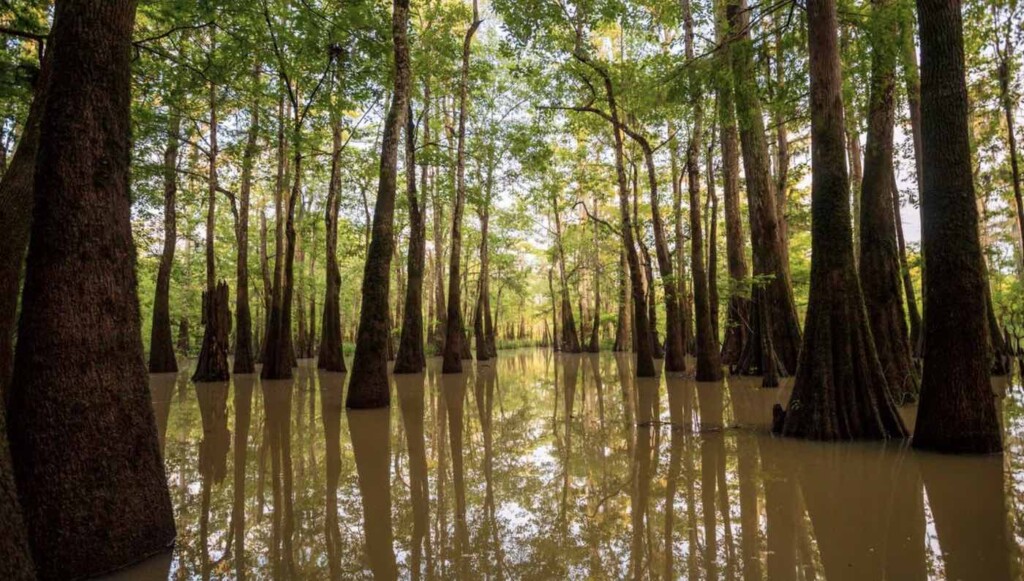
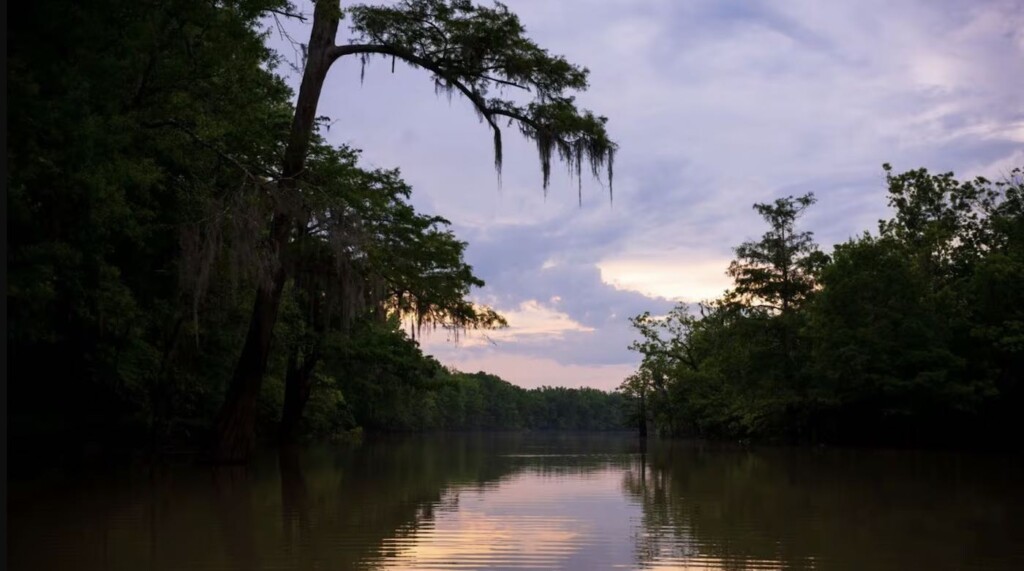
The Land Between the Rivers (Mobile-Tensaw Delta) – Courtesy of The Nature Conservancy in Alabama
The Land Between the Rivers (Mobile-Tensaw Delta) – Courtesy of The Nature Conservancy in Alabama
When considering the great victories of America’s conservationists, we tend to think of the sights and landscapes emblematic of the West, but there’s also a rich history of acknowledging the value of the wetlands of America’s south.
These include such vibrant ecosystems as the Everglades, the Great Dismal Swamp, the floodplains of the Congaree River, and “America’s Amazon” also known as the “Land Between the Rivers”—recently preserved forever thanks to generous donors and work by the Nature Conservancy (TNC).
With what the TNC described as an “unprecedented gift,” 8,000 acres of pristine wetlands where the Alabama and Tombigbee Rivers join, known as the Mobile Delta, were purchased for the purpose of conservation for $15 million. The owners chose to sell to TNC rather than to the timber industry which planned to log in the location.
“This is one of the most important conservation victories that we’ve ever been a part of,” said Mitch Reid, state director for The Nature Conservancy in Alabama.
The area is filled with oxbow lakes, creeks, and swamps alongside the rivers, and they’re home to so many species that it ranks as one of the most biodiverse ecosystems on Earth, such that Reid often jokes that while it has rightfully earned the moniker “America’s Amazon” the Amazon should seriously consider using the moniker “South America’s Mobile.”
The Land Between the Rivers (Mobile-Tensaw Delta) – Courtesy of The Nature Conservancy in Alabama
“This tract represents the largest remaining block of land that we can protect in the Mobile-Tensaw Delta. First and foremost, TNC is doing this work for our fellow Alabamians who rightly pride themselves on their relationship with the outdoors,” said Reid, who told Advance Local that it can connect with other protected lands to the north, in an area called the Red Hills.
“Conservation lands in the Delta positions it as an anchor in a corridor of protected lands stretching from the Gulf of Mexico to the Appalachian Mountains and has long been a priority in TNC’s ongoing efforts to establish resilient and connected landscapes across the region.”
At the moment, no management plan has been sketched out, but TNC believes it must allow the public to use it for recreation as much as possible.
The money for the purchase was provided by a government grant and a generous, anonymous donor, along with $5.2 million from the Holdfast Collective—the conservation funding body of Patagonia outfitters.
The Mobile Bay National Estuary Program produced a 12-minute virtual tour which you can WATCH below…
SHARE This Epic Landscape And A Truly Heroic Rescue For Future Generations…
Thanos Tzounopoulos, P.H.D. says zinc treatment could restore lost hearing (Photo by John Frazos via SWNS)
Thanos Tzounopoulos, P.H.D. says zinc treatment could restore lost hearing (Photo by John Frazos via SWNS)
Anyone who has ever been to a loud concert knows the feeling of ringing ears. Some people experience temporary or even permanent hearing loss or drastic changes in their perception of sound after the loud noises stop.
Scientists have discovered the biological mechanism of hearing loss caused by loud noise, which helped them find a way to prevent it.
When exposed to loud noises some people experience temporary or even permanent hearing loss or drastic changes in their perception of sound after the loud noises stop.
Researchers from the University of Pittsburgh in the US have now discovered that this noise-induced hearing loss stems from cellular damage in the inner ear that is associated with the excess of free-floating zinc, a mineral that is essential for proper cellular function and hearing.
Their experiments showed drugs that work as molecular sponges trapping excess zinc can help restore lost hearing, or if administered before an expected loud sound exposure, can protect from hearing loss.
“Noise-induced hearing loss can be debilitating. Some people start hearing sounds that aren’t there, developing a condition called tinnitus, which severely affects a person’s quality of life,” said Professor Thanos Tzounopoulos from the Pittsburgh Hearing Research Center.
“Noise-induced hearing loss impairs millions of lives but, because the biology of hearing loss is not fully understood, preventing hearing loss has been an ongoing challenge.”
To get their results, published in the journal Proceedings of the National Academy of Sciences, the team studied the inner ear cells of mice.
They found that hours after mice are exposed to loud noise, their inner ear zinc level spikes which, ultimately, leads to cellular damage and disrupts normal cell-to-cell communication.
Thankfully, mice who were treated with a slow-releasing compound that trapped excess free zinc were less prone to hearing loss and were protected from noise-induced damage.
This opens the door for a possible solution to the problem and lays the groundwork for the development of effective and minimally invasive treatments, and even products to protect concertgoers and musicians, in the future.
The researchers hope to test this treatment further with the goal of eventually making it available as a simple, over-the-counter option to protect oneself from hearing loss.
SHARE This Incredibly Simple Method For Potentially Controlling Hearing Los…
The Dotonbori River street - credit Chee Hong. CC 2.0.
The Dotonbori River street – credit Chee Hong. CC 2.0.
Running under the lights of a seemingly endless corridor of neon-lit advertising boards through a dense urban area of 2.7 million inhabitants, the Dotonbori River, was described as having the water quality of a “toilet bowl.”
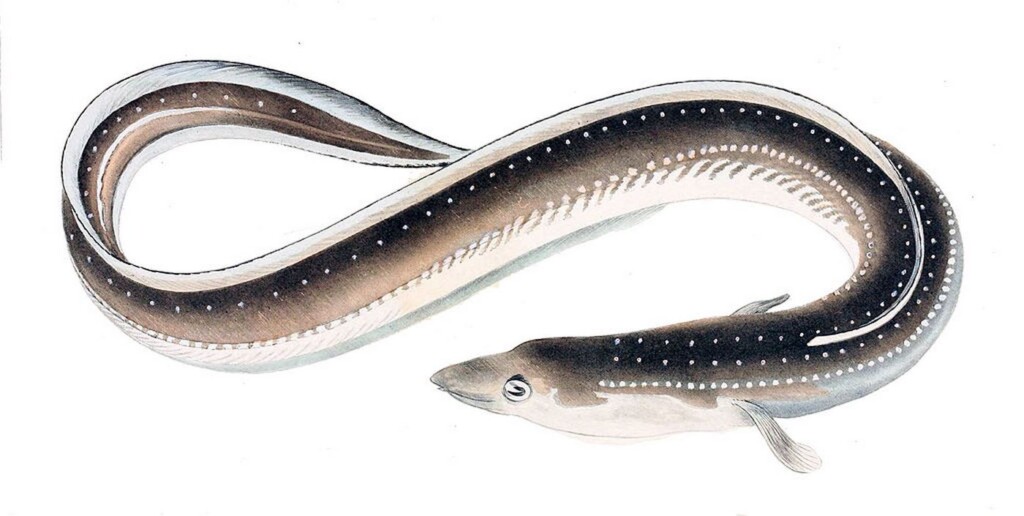
Yet this icon of urban Japan hides a slithery secret—a surprisingly robust population of one of the country’s most beloved fish—the Anguilla japonica or Japanese eel.
Last year, the Mainichi—the oldest English daily paper in Japan, partnered with the Research Institute of Environment, Agriculture and Fisheries in the Osaka Prefecture to conduct a study on the population of eels in the Dotonbori River.
They fished up 11 individuals, which was the first time eels had ever been caught in the river under scientific observation. Three now reside at Osaka Biodiversity Research Center to help educate Osakans on the Umi no sachi or “treasures of the sea” that reside in their river.
“The institute says the study confirmed that crabs and other creatures the eels feed on also live in the river, making it a full-fledged ecosystem,” the Mainichi reports.
DNA analysis on some of the captured eels showed they probably migrated into the river from the seas surrounding Osaka.
During the extensive economic development in the post-war period, the Dotonbori was filled with pollution, but saw improvements during the 1980s after the introduction of sluice gates.
The river flows through the Minami Entertainment District, the very heart of urban life in Osaka. In fact, the eels were caught just a quarter-mile from the Ebisu Bridge, a popular tourist spot and the customary location for late-night celebrations following victories by the Osaka baseball team, the Hanshin Tigers.
Anguilla japonica – US public domain
The study highlights wildlife’s remarkable resilience even in the most urbanized areas, and the researchers who conducted it hope that for people who love to eat unagi, or grilled eel in restaurants, the discovery will make them take a greater interest in the preservation of habitat, urban and rural, that this national delicacy needs to survive.
“I’d like people to learn more about the connection between our daily lives and the places we live in,” Yoshihiko Yamamoto, the institute’s lead researcher, told National Geographic. “If people think that eels and other aquatic creatures may be living in their local rivers, they will become interested in biodiversity and conservation.”
In 2014, the International Union for the Conservation of Nature listed the rather cheery-looking A. japonica as an Endangered species based on the size and rate of population declines since the 1970s. They aren’t rare to see, buy, or catch, though, and remain dispersed across China and the Korean Peninsula.
Yamamoto and his colleagues are petitioning the government to install fish ladders that allow fish to swim over obstacles like lochs and gates, which would help the eels migrate between the sea and river more easily. They are also dropping baskets of rocks to ensure the eels have some habitat to live in down below the flickering lights of the pachinko halls and restaurants.
SHARE This Inspiring Story Of Fishy Resilience With Your Friends…
Some say that Valentine’s Day exists solely as an excuse for smiling and romance amid February’s generally awful weather, but today in Denver, there’s a reason for a lot more than smiling—100 reasons to be specific.
An enterprising and artistic Deverite named Xander Phoenix has hidden 100 papier-mâché hearts made of one hundred $1.00 bills all around the Denver metropolitan area.
“The Heart of Money,” is a temporary art installation that delves into the intricate tapestry of human connections with currency, exploring the dynamic interplay between art and money, per the website.
“Beyond the traditional confines of galleries, ‘The Heart of Money’ transforms these often overlooked connections into a visual and emotional experience.”
Each of the 100 hidden hearts will have a QR code that when scanned takes its finder to a website with more information about the art installation and what to do next.
Finders are encouraged to get creative, and can choose, for example, to soak the papier-mâché heart in lukewarm water and turn it back into currency that they can use, or keep the art piece as-is and appreciate both its artistic value and the experience it provided.
They could leave the heart for someone else to find, experience, and enjoy, or use it as a convenient gift for a loved one or a stranger on the street to brighten their day, but Phoenix also hopes to see other creative uses for the hearts and that which they contain.
“Ultimately, my goal is to spread love and joy around Denver on Valentine’s Day,” Phoenix said. “It’s a fun way to both create and connect community around some important themes. I hope everyone who goes out looking for the hearts and those who find them have as much fun as we’ve had creating and bringing this street art installation to life.”
“My mother unfortunately passed away just a few months ago,” he continued. “She was an award-winning filmmaker, a feminist, and an activist who was working on a fictionalized memoir of her life when she died. In many ways, this project is a tribute to her and a way to carry on her legacy.”
SHARE This Story ASAP With Anyone You Know In Downtown Denver…
Quote of the Day: “In love, gestures are incomparably more attractive, effective, and valuable than words.” – Francois Rabelais (Happy Valentine’s Day!)
Photo by: mehdi lamaaffar
With a new inspirational quote every day, atop the perfect photo—collected and archived on our Quotes page—why not bookmark GNN.org for a daily uplift?
D-Day veteran Bernard Morgan celebrated his 100th birthday in his WWII uniform – SWNS
D-Day veteran Bernard Morgan celebrated his 100th birthday in his WWII uniform – SWNS
Every child born into the Morgan family of Cheshire will be able to hold in their hands a very unique piece of World War II memorabilia thanks to the current patriarch, Bernard.
Sergeant Bernard Morgan was working as a Royal Air Force codebreaker in 1945 when he deciphered a secret telex that read: “The German war is now over… The surrender is effective sometime tomorrow”.
Last week Bernard celebrated his 100th birthday, and while he had already offered copies of the communicae to two different museums, he’s vowed that the real one will pass to his family when he dies.
Ahead of his birthday, the great-grandad read out the note to interviewers, dressed in the uniform he wore on D-day to remind others of the liberties they had won in the victory.
Bernard was the youngest RAF sergeant to land in Normandy in June 1944, when he and his team of codebreakers disembarked on Gold Beach, where the British Army defeated the 352nd Infantry Division and suffered 1,100 casualties.
“I am always keen for the younger generation to know exactly what went on during the War and to appreciate the sacrifice that our lads made so that we can enjoy the freedoms we have today,” said Morgan.
He was stationed in Schneverdingen, Germany, when he got the message on around May 6, 1945, declaring that the war in Europe was ending via his Typex machine.
The note stated:
The German War is now over. At Rheims last night the instrument of surrender was signed which in effect is a surrender of all personnel of the German forces – all equipment and shipping and all machinery in Germany.
Nothing will be destroyed anywhere. The surrender is effective some time tomorrow. This news will not be communicated to anyone outside the service nor to members of the press.
D-day veteran Bernard Morgan holding the letter on his 100th birthday – SWNS
Following the news, and as you might imagine, Bernard had a big party with his close comrades—lighting a huge bonfire and celebrating into the night while being careful not to give the game away. He kept both the note and his role in the war hidden for 50 years due to secrecy documents he had signed, which finally elapsed in 1994.
“The Imperial War Museum in London and in Manchester both wanted the original copy— they weren’t interested in a photocopy—but I’m keeping it for my family,” he said.
“It was a surprise,” he said of receiving the note, “we couldn’t tell anybody until we got the final message to say the war in Germany was now over.”
“We had to decode it—it was in code. It was great when we got that. I was in a little place called Schneverdingen, Germany, near Hamburg. It was nice to see that no more soldiers, sailors, or airmen were giving their lives… and also to thank the civilians who gave their lives for the same reason,” he added.
SHARE This Man’s Memory And Incredible Historical Position On Social Media…
credit - Trustees of the Natural History Museum London
credit – Trustees of the Natural History Museum London
The Isle of Skye isn’t known colloquially for paleontology, but during the Jurassic Era, it was a hotspot for pterosaurs, and a newly-described species of this flying reptile is surprising scientists.
Belonging to the clade Darwinoptera, it joins two other species both of which were found in China, and is the second different species to be found on the famous island.
The rarity of Middle Jurassic pterosaur fossils and their incompleteness have previously hampered attempts to understand early pterosaur evolution.
The animal now bears the genus name Ceoptera evansae: Ceoptera from the Scottish Gaelic word Cheò, meaning mist (a reference to the common Gaelic name for the Isle of Skye: Eilean a’ Cheò, or Isle of Mist), and the Latin word ptera, meaning wing. The species name is in honor of Professor Susan E. Evans, for her years of anatomical and palaeontological research, in particular on the Isle of Skye.
This discovery shows that all principal Jurassic pterosaur clades evolved well before the end of the Early Jurassic, earlier than previously realized. Contrastingly, the discovery also shows that pterosaurs persisted into the latest years of the Jurassic, alongside avialans, the dinosaurs which eventually evolved into modern birds.
“The time period that Ceoptera is from is one of the most important periods of pterosaur evolution, and is also one in which we have some of the fewest specimens, indicating its significance,” said lead author Dr. Liz Martin-Silverstone, a paleobiologist at the University of Bristol.
“Ceoptera helps to narrow down the timing of several major events in the evolution of flying reptiles,” added Professor Paul Barrett, author on the paper who works at the Natural History Museum.
“Its appearance in the Middle Jurassic of the UK was a complete surprise, as most of its close relatives are from China. It shows that the advanced group of flying reptiles to which it belongs appeared earlier than we thought and quickly gained an almost worldwide distribution.”
SHARE This Prehistoric Re-Write On These Fantastical Flying Beasts…
Allegiant Stadium home of Superbowl 58 - CC 2.0. h2kyaks, retrieved from Flickr
Allegiant Stadium home of Super Bowl 58 – CC 2.0. h2kyaks, retrieved from Flickr
The biggest sporting event in America went green this year thanks to its position out in the desert. 621,000 solar panels channeled the electricity needed to power the Allegiant Stadium, home of both Super Bowl VXIII, and the Las Vegas Raiders.
According to CBS News, the stadium entered into a 25-year agreement with NV Energy to buy power from the solar farm, which can power 60,000 homes outside of game day.
Las Vegas sees 300 days of sun a year, so the initiative makes perfect sense, and it’s not the only sustainability initiative found in and around the Allegiant. They recycle all the rubber pellets from the turf, run food scrap collection from the on-site restaurants and divert them from the waste stream to feed livestock, and compost all the grass clippings from the field.
They also have a super-efficient roof which reduces the need for air-con, and multiple efficiency systems like low-energy lighting, lighting control systems, and air handling units.
But the standout feature is the 100% renewable electricity, generated from the sun.
“People sometimes get nervous about renewable power because they’re not sure if it’s going to be reliable,” said U.S. Secretary of Energy Jennifer Granholm, who inspected the stadium’s main electrical entry room, reports CBS News.
“The fact that renewable power can power a facility like this reliably should speak volumes about what could happen in other communities.”
SHARE This Great News From Behind The Scenes Of Superbowl XVIII…
Tom Brady with two Boston boys star in Superbowl ad – Dunkin’
Tom Brady with two Boston boys star in Superbowl ad – Dunkin’
Another Super Bowl, another round of specially crafted ads with big celebrities and plenty of laughs. Here’s a roundup in case you’re wondering what you missed while you got up from your seat during commercials.
1) Talkin’ Like Walken – BMW
What’s it like when you have one of the most easily mimicked voices? Christopher Walken gets an earful of impressions from anyone he meets.
2) Renner’s Morning Routine – SILK
After a terrible road accident in real life that required years of recovery and rehabilitation, Jeremy Renner is looking good—and his morning routine to make breakfast for his daughter is full of life (and features his real-life daughter).
3) The Dunkings – Dunkin’ Donuts
Watch a gaggle of A-list celebrities from Boston embarrass themselves as a rap group, trying to impress J-Lo in her studio. Even Tom Brady gets in on the act.
4) Mountaineering with Patrick Stewart – Paramount+
A selection of characters from Paramount Pictures join Sir Patrick Stewart trying to make it to the top of a cliff.
5) Michael Cera – CeraVe Moisturizer
Taking satirical aim at skincare and perfume ads, Michael Cera promotes his ‘special cream’ that features his actual name in the title.
6) Arnold’s Audition – State Farm Insurance
Arnold’s Austrian accent prevents him from being able to ace the audition for State Farm Insurance. Danny Devito makes a surprise appearance.
7) Messi and Michelob Ultra
The GOAT of soccer makes an appearance dribbling around beachgoers while waiting for the keg to be changed. Former Miami quarterback Dan Marino looks on, as well as ‘Ted Lasso’.
8) Big Game Day Commercial – T-Mobile
A plethora of stars take turns auditioning for T-Mobile including Laura Dern, Bradley Cooper with his mom, Jennifer Hudson, characters from the TV series SUITS, and two of your favorite best friends from Scrubs.
9) ‘Twist on it’ – Oreo
Forget the coin toss, this classic American cookie is proposing a whole new way of making 50/50 decisions.
10) Perfect 10 – Kia
Heartwarming and tear-jerking describes the ad fro Kia’s new electric car, which takes a back seat to the characters in this short film featuring a young figure skater who gives a special performance for her grandfather who couldn’t see her compete in person.
Which one was your favorite? SHARE The Post Game FUN With Your Friends on Social Media…
Quote of the Day: “The most damaging phrase in the language is: ‘It’s always been done that way.’” – Grace Hopper (1906–1992)
Photo by: Matthew Henry
With a new inspirational quote every day, atop the perfect photo—collected and archived on our Quotes page—why not bookmark GNN.org for a daily uplift?
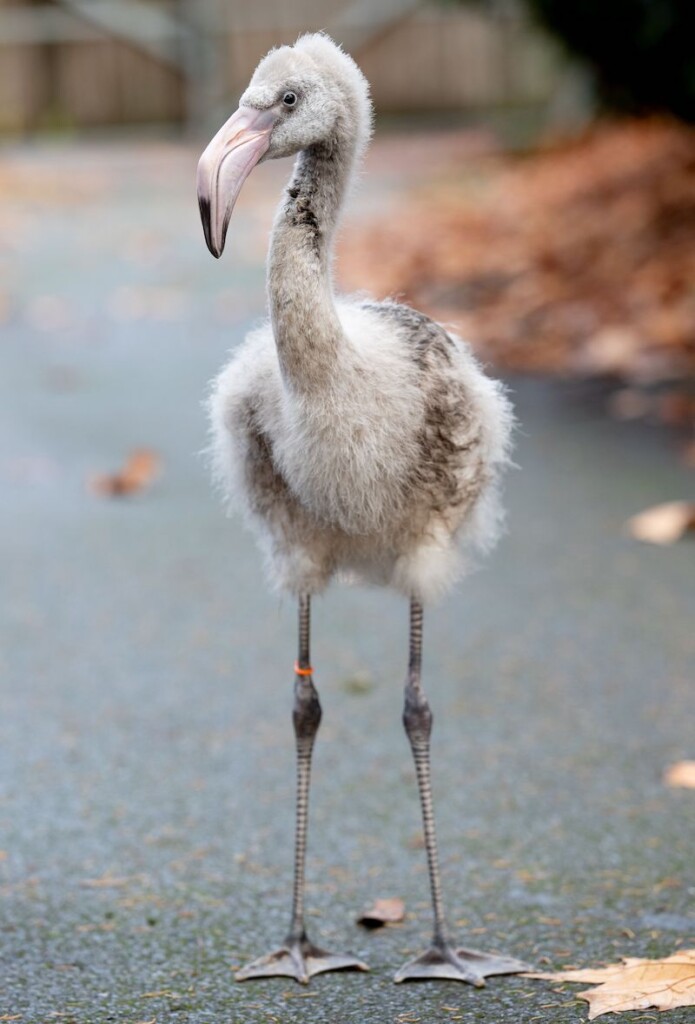
By Jeremy Dwyer-Lindgren / Woodland Park Zoo (cropped)
By Jeremy Dwyer-Lindgren / Woodland Park Zoo (cropped)
Alaska Airlines flight attendant Amber May has had some unusual requests in her 10 years of flying, but being asked to help save some flamingo eggs just about topped them all.
“A passenger rang the call button and asked if I would help keep some eggs warm,” May said in a release from the company.
The passenger as it turned out was a senior zookeeper from Woodland Park Zoo, in Seattle. She was transporting 6 precious flamingo eggs in an incubator which she received from the Atlanta Zoo.
Woodland Park’s stand of flamingos are all past breeding age, so they couldn’t set their own birds up to breed and had to rely on younger ones elsewhere, but the incubator had stopped working, with several hours still to go in the flight.
Responding to the zookeeper’s plea for help, May promptly filled rubber gloves with warm water which the keeper used as a makeshift nest to keep the eggs warm; May continued to supply water-filled gloves as needed throughout the entire flight as the water inside became tepid.
To provide extra insulation for the eggs, passengers seated nearby gave up their coats and scarves.
“The flamingo eggs would not have survived in a non-functioning portable incubator for five hours,” Joanna Klass, a Woodland Park Zoo animal care manager, said in a news release. “We’re so grateful for the creative thinking that led to the safe transport of our precious eggs.”
Released by: Jeremy Dwyer-Lindgren / Woodland Park Zoo
Then, months later, May received a call from the zoo with the invitation to name one of the flamingos. The delighted stewardess chose Sunny, which was the name of her granddaughter newly born.
Then, May and granddaughter Sunny were invited to come visit the animals, and baby Sunny got to meet her namesake up close.
“Having baby Sunny meet flamingo Sunny was just wonderful,” Amber said. “I am excited to see them both grow up. I was honored and so happy that the chicks had hatched—all six of them!”
SHARE This Sunny Story About A Quick-Thinking Flight Attendant…
PICTURED ABOVE: An artist’s impression of the small moon of Mimas which may very well hold a subsurface ocean. PC: Frédéric Durillon, Animea Studio Observatoire de Paris – PSL, IMCCE
Reprinted with permission and alterations from World at Large, an independent news outlet covering world news, conflicts, travel stories, conservation, and science news.
It’s been known for a decade that Saturn’s icy moon of Enceladus almost certainly hides a subsurface ocean beneath its northern pole. But as scientists writing in Nature recently challenged, the same is true for a much smaller and unlikely moon called Mimas.
Think of a glacier shaped like a ball the size of California or Spain and you have some idea of what Mimas looks like. Imagining this compact snowball becomes a bit more difficult if you think that between 12 and 18 miles down lies a contained ocean containing a little less water than the whole Mediterranean Sea.
These subsurface oceans on icy moons are extremely exciting targets for astrobiologists since it’s believed that life first evolved on Earth in its shallow seas. These cryo-geologic features are present on Enceladus and the Jovian moon of Europa, but until now, no one was looking at bodies as small as Mimas, which is many times smaller than the other two.
“Mimas is a small body whose most distinctive feature is a crater so large that it gives the moon the appearance of the Death Star space station from the Star Wars franchise,” writes Matija Ćuk from the SETI Institute in California, and Alyssa Rose Rhoden from the Southwest Research Institute, who together wrote a comment on the paper.
Previous research has suggested two possibilities for Mimas’ interior: either an elongated rocky core or a global ocean. The latest analyses by Valery Lainey and her colleagues at the Observatoire de Paris, reveal that changes to the rotational motion and orbit of the small moon are affected by its interior in such a way as to suggest that beneath its cratered, pock-marked exterior, there lies an ocean and not a rocky core.
To do this, Lainey et al. took careful measurements of the moon’s moments of inertia, or its resistance to rotational acceleration. The inertia allowed the team to understand the moon’s gravitational field.
The team used data from the Cassini spacecraft, which has been exploring the Saturnine environment for many years and led to some of the largest advances in the understanding of the famous ringed planet and its moons.
Moving backwards to go forwards
Time for a science lesson: Saturn and Earth are slightly flattened planets. Among other things, this causes the orbit path of moons to shift in a flat circular motion. Take a ball in one hand and a ring in the other, then move the ring in a flat motion without touching the ball within, and you have a visual picture of this phenomenon.
For the sake of the example, if the ball (or planet) is rotating clockwise, and the ring (or orbit) is moving clockwise as well, this is the effect that flattened planets have on the precession, or shifting of the orbital path, of their moons. If the moon’s shape and/or gravitational field are elongated like an egg, this phenomenon is reversed, i.e. the planet and moon rotate clockwise, but the orbital path is rotating counterclockwise.
PICTURED: Mimas’ large crater called Herschel. PC: NASA/JPL-Caltech – SSI/CICLOPS Kevin M. Gill. CC 2.0.
What Lainey and her colleagues discovered is that Mimas’ orbital precession is the latter case, but if so, the movements of a frozen body of ice and rock do not match the patterns of inertia recorded. Instead, the measurements of Mimas’ position suggest that the evolution of its orbit is better explained as being influenced by an internal ocean.
The authors calculate that the ocean lies beneath an icy shell approximately 12 to 18 miles (20–30 km) deep. Simulations suggest that it appeared between 25 and 2 million years ago. As such, signs of such an ocean would not have had time to make a mark on the surface, such as heavy fracturing on the surface of Europa, or the cryo-volcanoes that spew out ice, gas, and sloshy material present on Enceladus.
“The idea that Mimas’ ocean could have formed relatively recently also has implications for other features of the Saturnian system that remain mysteries, in spite of clues retrieved by the Cassini mission,” explain Ćuk and Rhoden.
“Saturn’s bright icy rings are apparently young in geological terms, but not all scientists agree. The heavily cratered icy moons seem ancient, but the source of the bodies that made the craters is disputed, and there are suggestions that the moons themselves are also geologically young”.
“The clues provided by Mimas and its ocean could help to resolve some of these conundrums. Finally, adding Mimas to the catalogue of ocean worlds changes the general picture of what these moons can look like. The idea that relatively small, icy moons can harbor young oceans is inspiring, as is the possibility that transformational processes have occurred even in the most recent history of these moons,” they add.
Lainey and colleagues’ findings will no doubt motivate a thorough examination of mid-sized icy moons throughout the solar system, of which there may be dozens. Most notably, there is a suite of mid-sized icy moons orbiting Uranus, which was selected as the highest-priority target of a NASA flagship mission by the Planetary Science and Astrobiology Decadal Survey. WaL
SHARE This Amazing Discovery Of Oceans On Tiny Moons…
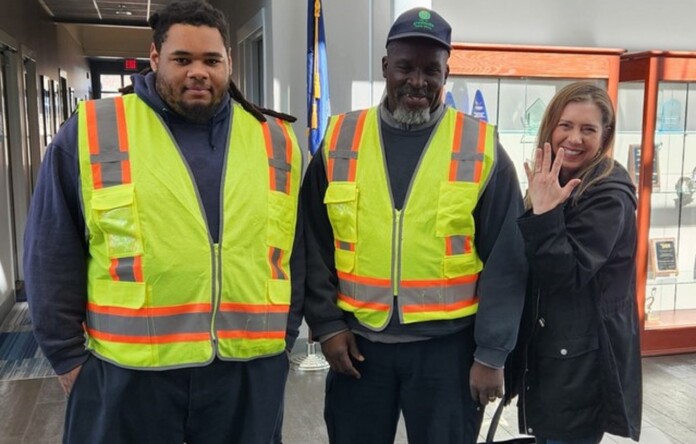
credit - City of Greenville, South Carolina Government / Facebook
credit – City of Greenville, South Carolina Government / Facebook
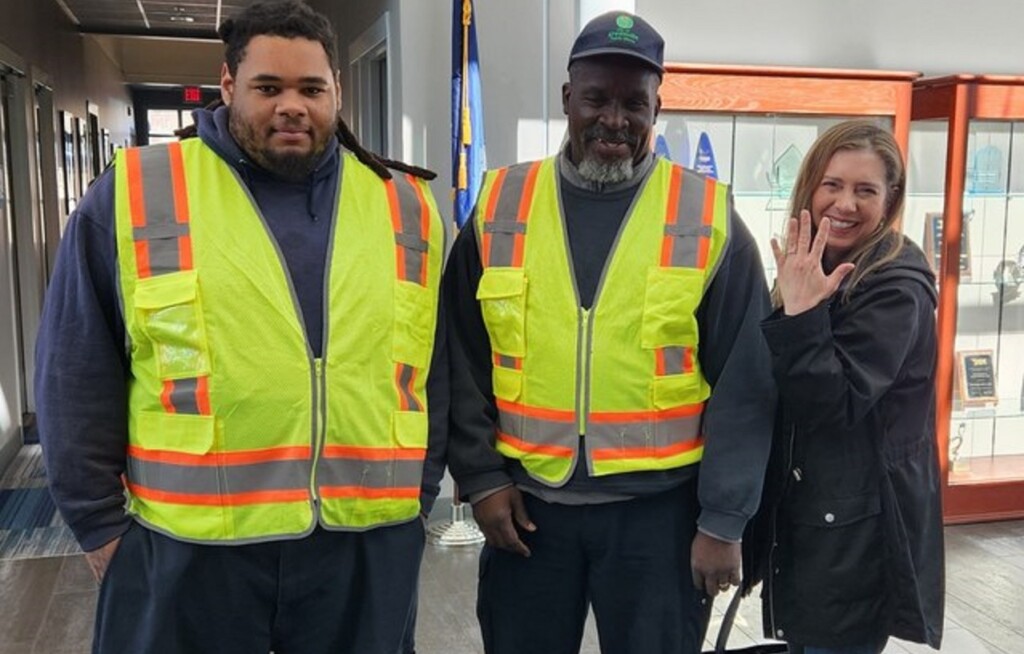
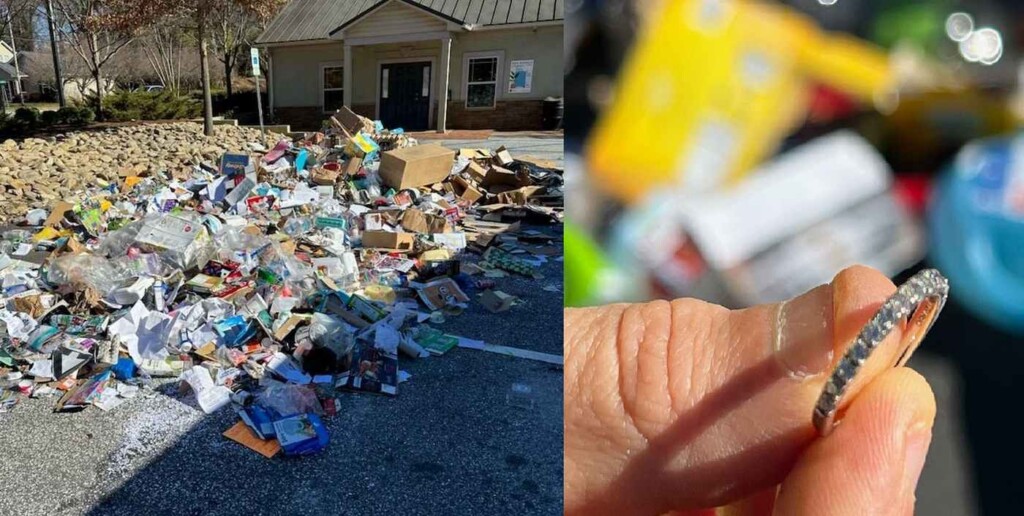
Finding a needle in a haystack is always easier when the needle isn’t worth thousands of dollars, but the stress of it all was borne by the trash collectors from the city of Greenville, and reunited a woman with her lost wedding band.
It was a routine stop at the local recycling center for Melanie Harper, but as she was separating plastics and paper, she accidentally separated white gold and diamonds as well.
Her wedding band slipped off into the bins and she was sure the chances of finding it were slim. Harper emailed the city’s public works department and asked them if they could keep an eye out for a glittery band amid the trash, and while she went home unoptimistic, the litter pickers and public works employees upended the whole container in a parking lot and went to work.
Sifting meticulously through the refuse, the workers epitomized the ideas of public service, and perhaps it was destiny that the man who found it was named “Golden.”
“After hours of searching, Travis Golden struck gold. White gold. They called a very grateful Melanie, who came out to PW to reunite with her ring,” read a post from the Greenville South Carolina Facebook page, which gave a shout-out to Golden and the other staff members who pitched in to find the ring. “We are so grateful for your commitment to our community.”
credit – City of Greenville, South Carolina Government / Facebook
“Finding a needle in a haystack = hard. Finding a ring in a recycling bin = nearly impossible. Unless you’re City of Greenville Public Works, where employees truly dive into their work!” the post added.
It’s not the first time this has happened in the country recently. Last August, GNN reported that parks supervisor Lauren Perez from Corpus Christi organized the complete disruption of Monday morning trash collection in order to locate a 40-yard dumpster where she knew a 17-year-old had lost a ring containing her father’s ashes.
Trash collection workers Jesse Martinez and Robert Trevinco joined Perez in combing through the trash left baking over the weekend’s nearly 100°F heat. They searched for hours until they came upon a big with the Subway boxes—where the girl’s mom had told them they would be—and methodically began opening them one by one until, at last, a purple jewel shined in the morning light.
“It was in the last bag we went through,” Perez told the Washington Post. “I was so excited to let her know.”
SHARE These Dedicated And Considerate Individuals Of South Carolina…