














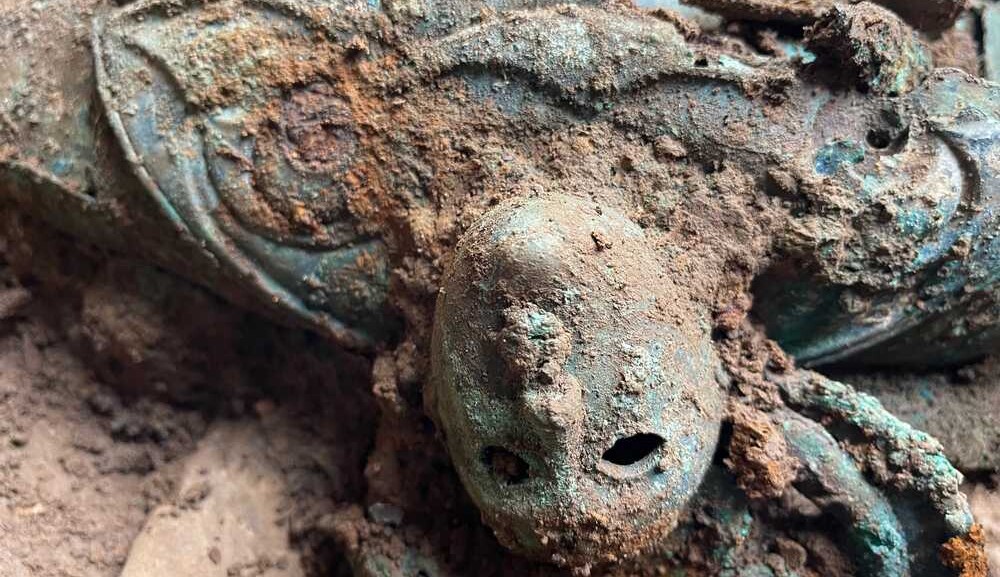
5 years after its discovery and 2 years after preservation, the largest collection of Iron age artifacts ever found in Britain is revealing its secrets.
Found in the “rural backwater” of northern England’s county of Yorkshire, the mélange of horse tackle, carriage pieces, weapons, and home goods is proving the region was anything but.
Now, parts of the hoard will go on display for the first time ever at the Yorkshire Museum for an exhibition entitled: Chariots, Treasure and Power: Secrets of the Melsonby Hoard.
The hoard was discovered in a field near Melsonby by a metal detector in 2021. This unnamed individual immediately alerted archaeologists, to his eternal credit, who arrived and deduced that this was something that had never been seen before.
“Finding a hoard or collection of ten objects is unusual, it’s exciting, but finding something of this scale is just unprecedented,” Tom Moore, Durham’s head of archaeology, told the Guardian’s Mark Brown in 2025. “We were just lost for words.”
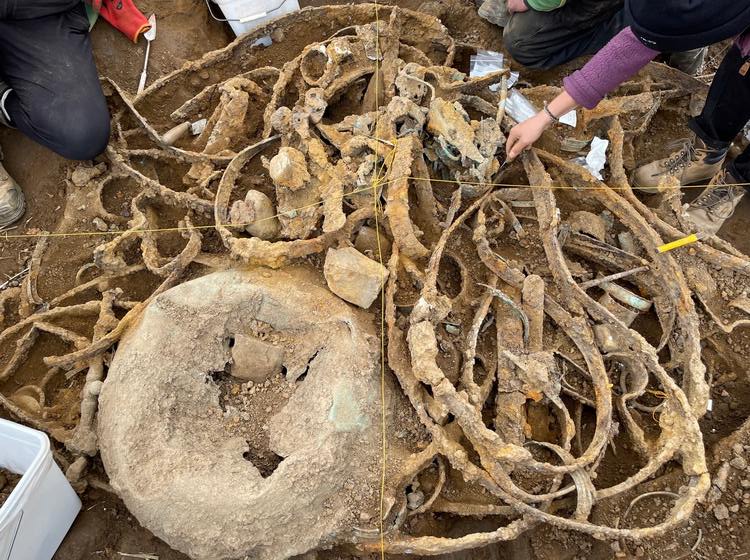
The Melsonby hoard consists of two groups of items: the first is a big stack of chariot components and horse tackle, including bridles and bits which look tantalizingly identical to the ones used today.
The second is called “the Block” and it is basically a mass of iron and copper-alloy artifacts fused together after they were probably thrown into a big pit fire. It was then pulled out of the fire, covered in a sheet, and buried nearby.
The Block contains iron spear points, harness pieces, and wagon parts visible on the outside, but what’s inside is largely a mystery, even after conservators at the University of Durham brought the mass down to Southampton for a detailed CT scan.
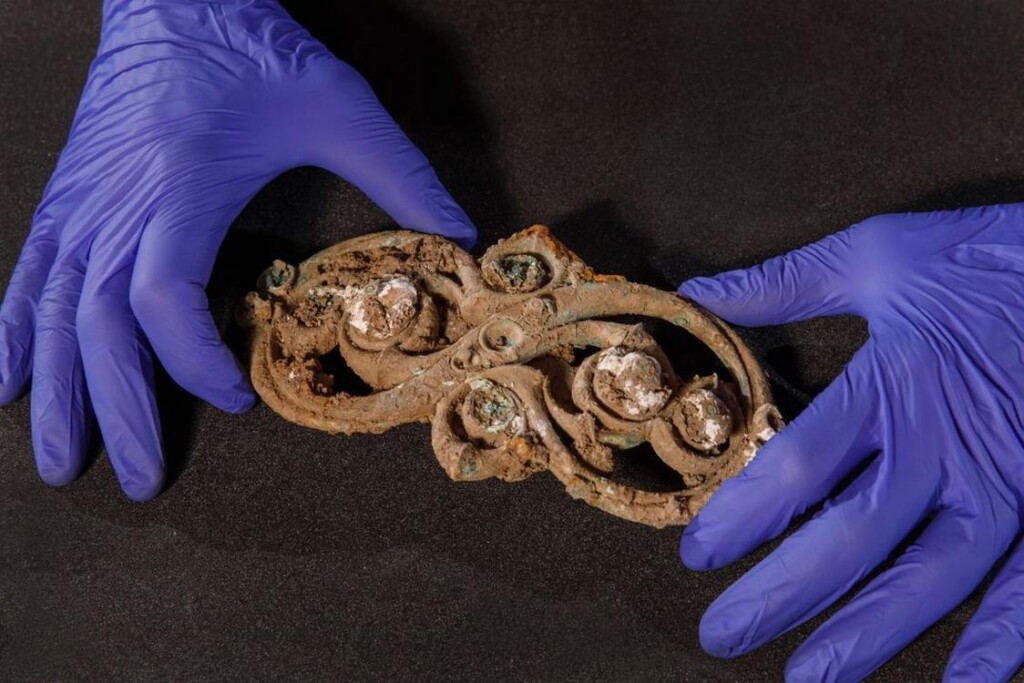
As for the horse tackle, the excavators’ eyes were drawn to the 28 wagon tire bands made of iron all stacked atop one another. In between were all manner of wagon components, including lynchpins, and elements of yokes and reins that seem to point to a 4-horse-drawn wagon or carriage, the first evidence of such a vehicle in Iron Age Britain.
Without a doubt the hoard’s most compelling objects are those which may point to a complex intercontinental trade route—perhaps with the Roman world, which consisted of a large ornamented cauldron, a wine-mixing bowl, blue glass beads, and a mirror.
“The bowl… is really interesting because it is a very unusual type: not something you’d find in Northern Britain,” said Professor Moore, who was involved in both the excavation and the examination of the artifacts.
“Its decoration combines both Mediterranean and British Iron age styles. It also has elaborate decoration of coral, so whoever owned something like that has probably got a network across Britain and across into Europe and even the Roman world.”
MORE ANCIENT BRITAIN: Archaeologists Discover a ‘Master Blacksmith’s’ Workshop Dating to the Very Dawn of the Iron Age in Britain
Though named after the nearby town of Melsonby, the closest contemporary settlement to the artifacts was a fort called Stanwick populated by a tribe called the Brigantes, who at one point were ruled by a queen called Cartimandua, the first documented female sovereign in the island’s history.
In England, as indeed so many lands the world over, a divide in culture and wealth has existed between north and south, and one of the most important aspects of the hoard has been the end of assumptions that this kind of wealth and, in the case of the horse cart, technology, was only found in the south at the time.
GREAT BRITISH HOARDS: English Teenager Discovers Hoard of 3,300 Year-Old Axes and Becomes Metal Detecting Celebrity
“Chariots, Treasure and Power marks the initial stages of research on the hoard, outlining the current understandings of Iron Age Britain and exploring life before the arrival of the Romans, and asking the questions, why was the hoard buried, why were the objects burnt and destroyed and who might have owned these lavish items,” the Yorkshire Museum advertises.
WATCH Professor Moore and his colleagues explain the hoard…
SHARE The Opportunity To See This Transformational Discovery On Display…