All News - Page 267 of 1726 - Good News Network
Home Blog Page 267

British Museum Sends Totem Pole Back to its Indigenous Home in Canada–LOOK

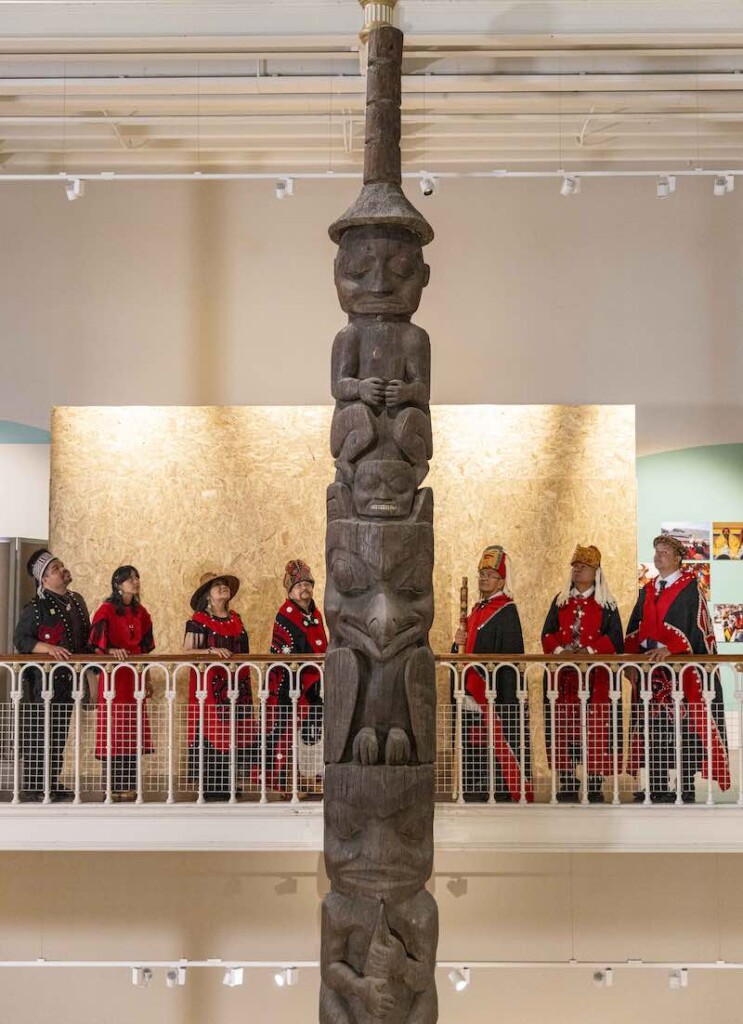
Nisga’a Nation totem pole – SWNS / National Museums Scotland

A 36-foot totem pole carved by the House of Ni’isjoohl in British Columbia a century ago is on a sacred journey back home thanks to National Museums Scotland.

The repatriation comes after a year-long discussion with the Nisg̱a’a Lisims Government and marks a historic moment for reconciliation between the museum and the Nisg̱a’a Nation, where the memorial pole was first erected.

“After nearly 100 years, we are finally able to bring our dear relative home to rest on Nisg̱a’a lands,” said Sim’oogit Ni’isjoohl Chief Earl Stephens, who believes the art is “alive with the spirit of (their) ancestors”.

“It means so much for us to have the Ni’isjoohl memorial pole returned to us, so that we can connect our family, nation, and our future generations with our living history.”

The 36-foot-tall (11m) totem pole has remained in Scotland for nearly a century. It was originally sold to the museum by Canadian anthropologist Marius Barbeau.

Weighing one ton, the art will make its way from Scotland to the Nass Valley in Canada in September.

LOOK: Absolutely Epic: Watch the Release of a Wild Bison Herd onto Blackfeet Tribal Land

Following months of preparatory work, a delegation of family members and supporters from the Nisg̱a’a Lisims Government travelled to Edinburgh to hold a spiritual ceremony on Sunday, preparing the memorial pole for its journey home.

Nisga’a Nation totem pole – SWNS / National Museums Scotland

It will be transported to Terrace, and then driven in a family procession to the Nisg̱a’a Village of Lax̱g̱alts’ap, then be housed at the Hli G̱oothl Wilp-Adoḵshl Nisg̱a’a museum after a public arrival ceremony on Sept. 29, with a Nisg̱a’a feast to follow.

NEVER TOO LATE: Rare 170-Year-Old Cree Jacket Turns Up at Vintage Shop in UK–and They’re Reuniting It With Community–LOOK

The pole will be raised in the following days and available for public viewing later in October.

In 1860, House of Ni’isjoohl Matriarch Joanna Moody, from the G̱anada (frog clan), commissioned the pole to be carved by Nisg̱a’a master carver Oyee to honor her family member Ts’awit, who was next in line to be chief.

“The great significance of the Ni’isjoohl memorial pole to the Nisga’a people and their community was made clear to me when I met with their representatives last year,” said Scotland’s Cabinet Secretary Angus Robertson.

CELEBRITY COMPASSION: How Tony Hawk Joined an Apache Pro Skater to Bring New Skate Park to Reservation

“I’m grateful to all parties for the work that has been undertaken to make it happen.”

MULTIPLY THE GOOD By Sharing the Beauty on Social Media…

“To know you have enough is to be rich.” – Lao Tzu

Quote of the Day: “To know you have enough is to be rich.” – Lao-Tzu

Photo by: Indi Samarajiva, CC license

With a new inspirational quote every day, atop the perfect photo—collected and archived on our Quotes page—why not bookmark GNN.org for a daily uplift?

Scientists Create New Material Five Times Lighter and Four Times Stronger Than Steel

anthony mcgee

Materials that are both strong and lightweight can improve everything from cars to airplanes to medical equipment. Now, researchers have created an extraordinarily strong material with very low density–using two unlikely building blocks: DNA and glass.

“For the given density, our material is the strongest known,” according to Seok-Woo Lee of the University of Connecticut, who partnered with colleagues from Columbia University and Brookhaven National Lab.

“I am a big fan of Iron Man movies,” mused nanomaterials scientist Oleg Gang. “I have always wondered how to create a better armor for Iron Man. It must be very light for him to fly faster. It must be very strong to protect him from enemies’ attacks.

“Our new material is five times lighter but four times stronger than steel.”

Some metals, such as titanium, are stronger and lighter than iron. Certain alloys are even stronger—allowing for lightweight body armor, better medical devices, and safer, faster cars and airplanes. Metallurgical techniques have reached a limit in recent years, until nano materials unleashed creative opportunities.

The colleagues reported in Cell Reports Physical Science that by building a structure out of DNA and then coating it with glass, they have created a very strong material with very low density. Glass might seem a surprising choice, as it shatters easily. However, glass usually shatters because of a flaw – such as a crack, scratch, or missing atoms – in its structure. A flawless cubic centimeter of glass can withstand 10 tons of pressure, more than three times the pressure that imploded the Oceangate Titan submersible near the Titanic this summer.

MOST POPULAR: If Replicated, New Physics Discovery Could Grant Levitation to Any Device via Ambient Pressure Magnetics

According to UCONN News, it is very difficult to create a large piece of glass without flaws. But the researchers knew how to make very small flawless pieces. As long as glass is less than a micrometer thick, it’s almost always flawless. And since the density of glass is much lower than metals and ceramics, any structures made of flawless nano-sized glass should be strong and lightweight.

The team created a structure of self-assembling DNA. Almost like Magnatiles, pieces of DNA of specific lengths and chemistry snapped themselves together into a skeleton of the material. Imagine the frame of a house or building, but made of DNA.

Gang and Aaron Mickelson from Columbia and Brookhaven’s Center for Functional Nanomaterials coated the DNA with a very thin layer of glass-like material only a few hundred atoms thick. The glass only just coated the strands of DNA, leaving a large part of the material volume as empty space, much like the rooms within a house or building. The DNA skeleton, like scaffolding, reinforced the thin, flawless coating of glass making the material very strong—with the voids comprising most of the material’s volume, it became lightweight.

ANOTHER BREAKTHROUGH: Stunned Researchers Discover that Metals Can Heal Themselves ‘Without Human Intervention’

As a result, the glass nanolattice structure created a combination of strength and lightness that has never been achieved before.

“The ability to create designed 3D framework nanomaterials using DNA and mineralize them opens enormous opportunities for engineering mechanical properties.” Gang explained in a UConn News release.

But much research work is still needed. The team is currently working with the same DNA structure but substituting even stronger carbide ceramics for glass. They have plans to experiment with different DNA structures to see which makes the material strongest.

UNBELIEVABLE: Scientists Develop New Material to Make Lithium Ion Batteries Self-Healing and Easily Recyclable

Lee believes that DNA origami nanoarchitecture will open a new pathway to create lighter and stronger materials that we have never imagined before.

INSPIRE Scientific Wonder By Sharing This Breakthrough on Social Media….

She Upcycled Her Late Grandpa’s Shirts Into Cute Tops to Keep Him Close to her Heart–See How

SWNS / Issy Spurway
SWNS / Issy Spurway

A young woman who didn’t want to throw away her late grandfather’s shirts has now upcycled them into fashionable tops—and she’s helping others do it, too.

The 21-year-old uses a scissors and sewing machine to transform pieces pulled from a bag of her late grandpa’s clothing—rearranging them into cool designs to be worn by youngsters.

So far, Issy Spurway has upcycled over 100 garments, and she demonstrates the designs on her TikTok social channel.

“When my grandad died I didn’t want to throw his clothes away–but I didn’t want to wear them–so I made them into something I could wear and take a piece of him with me,” said the Loughborough University textile student.

“I actually think it helped with the grieving process as I know he would have loved it.”

She really honed her sewing skills during the pandemic while locked-down in Gloucestershire, England. She started upcycling clothes to practice, but also because it was cheap and shops were closed.

“Over the months I improved and before I knew it had quite a following,” she told SWNS news. “I think (it’s) because a lot of people love their grandparents and keep their clothes as sentimental pieces after they’ve passed.”

LOOK: Mom Alters Her Old Prom Dress for 5-yo to Wear to Daddy-Daughter Dance

“I find that upcycling is all about looking at the already existing features of a garment and working with these to suit a personal style or to make a certain outcome.”

Issy’s videos on @handmade.byIzzy show her cropping, hemming, gathering, and draping techniques.

She said TikTok UK reached out to her and she worked on a few campaigns with them, doing sewing and upcycling tutorials, before she became a college student.

CHECK OUT: She Turns Old Leather Sofas into Chic $200 Handbags to Cut Down on Waste–And They’re Flying Out the Door

Issy has now taken up employment with an upholstery company in Oxford, while finishing her degree.

SHARE The Inspiring Idea With Grandkids Everywhere On Social Media…

New T-Rex Cousins Had Bulldog Snouts and Even Shorter Arms But Still Ruled in North Africa

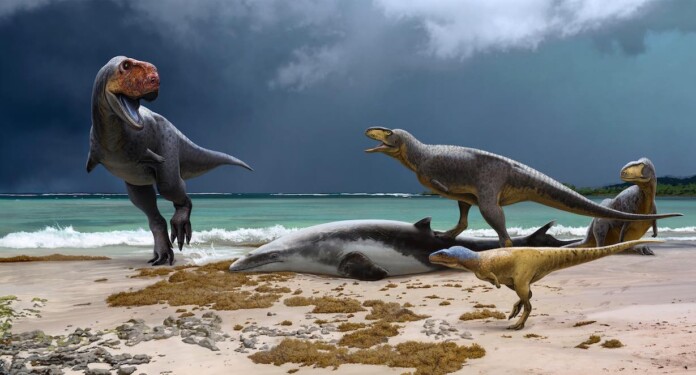
SWNS license
credit – Andrey Atuchin

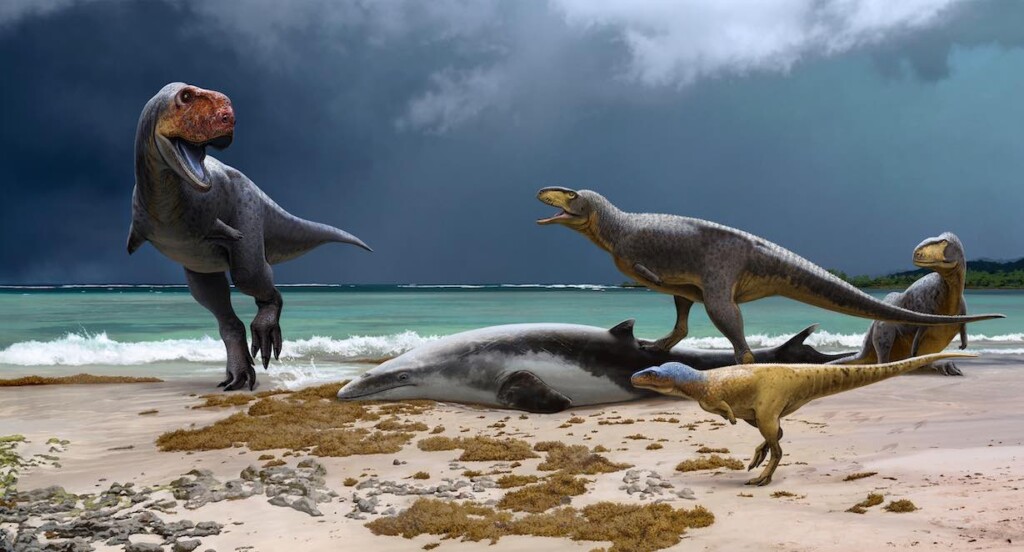
A pair of primitive cousins of T. rex that had short, bulldog-like snouts and even shorter arms have been discovered by scientists in Morocco.

The two new dinosaur species belong to the Abelisauridae, a family of carnivorous dinosaurs that were counterparts to the tyrannosaurs of the Northern Hemisphere.

Living alongside the much larger abelisaur Chenanisaurus barbaricus, the fossils show that Morocco was home to diverse dinosaur species just before a giant asteroid struck the Earth at the end of the Cretaceous, ending the age of dinosaurs 65 million years ago.

The first of the new species was found outside Casablanca near the town of Sidi Daoui. It’s represented by a foot bone from a predator about two and a half meters or eight feet long. The other, from nearby Sidi Chennane, is the shin bone of a carnivore that grew to around twice that length.

“What’s surprising here is that these are marine beds.” said study leader Dr. Nick Longrich, from the Milner Centre for Evolution at the University of Bath. “It’s a shallow, tropical sea full of plesiosaurs, mosasaurs, and sharks. It’s not exactly a place you’d expect to find a lot of dinosaurs. But we’re finding them.”

Morocco as a whole presents an exceptionally clear picture of animal life in the late Cretaceous, and these shallow sea beds host an extremely diverse collection of taxa.

So far, the small number of dinosaur fossils that have been recovered represent five different species—a small duckbill dinosaur named Ajnabia, a long-necked titanosaur, the giant abelisaur Chenanisaurus, and now the two new abelisaurs.

MORE EXCITING DINO NEWS: Fossil Preserves Dinosaur Being Attacked and Eaten by Mammal as Mudslide Entombs them Both

“We have other fossils as well, but they’re currently under study. So we can’t say much about them at the moment,” said Dr. Longrich.

Although it’s been argued that dinosaurs were already in decline before the giant asteroid hit the Yucatan and wiped out about 90% of life on Earth, the Moroccan dinosaurs suggest that they thrived in North Africa up to the very end.

MORE MEMBERS OF THE T-REX CLAN: Frightening Relative of T-Rex is Discovered –And Might be ‘Missing Link’ in Tyrannosaur Evolution

“The end of the Cretaceous in western North America definitely seems to become less diverse at the end,” commented Dr. Longrich. “But that’s just one small part of the world. It’s not clear that you can generalize from the dinosaurs of Wyoming and Montana to the whole world.”

“It also grew colder near the end, so it might not be surprising if dinosaurs at higher latitudes became less diverse. But we don’t know much about dinosaurs from lower latitudes.”

SHARE A Bit Of Science On Social Media With Your Friends…

The Top 20 Things That Make People Feel Good–And a New Positivity Bench in London

Join the Goodness campaign – SWNS
The Goodness Bench inside King’s Cross Station – SWNS

A poll of 2,000 adults revealed the top 20 things that make us feel good—with a good night’s sleep and a sunny blue sky coming in at number one and two.

45 percent said a nice compliment is guaranteed to boost their mood, while laughing until tears flowed also scored high.

The average respondent experiences these uplifting moments three times a day and claims that, in a typical week, they feel good about their day four times out of seven.

But, some are finding it increasingly hard to be happy. In fact, 83% said they proactively avoid negative stories on social media and TV due to it leaving them feeling ‘emotionally drained’.

The survey, commissioned by the cheese company Babybel, also found that nearly half of Londoners would welcome a pick me up.

In response, the brand has created ‘the Goodness Bench’ inside King’s Cross train station in London, as part of its ‘Join the Goodness’ campaign.

It’s designed to spread feel-good vibes by sharing a few positive news stories from the week while donating to its longstanding charity partner, Comic Relief, every time someone sits on the bench.

LOOK: ‘I Celebrated My 90th Birthday by Jumping Out of a Plane at 12,000 Feet’

A spokesperson for the brand said: “We all need a boost from time-to-time and feeling good goes hand in hand with doing good, which is why we wanted to spread positivity through this activation.”

68 percent of the Brits polled believe happiness is infectious, and as a result, over a third say they often or always go out of their way to spread a bit of positivity.

But, oddly, according to the OnePoll results, just 24 percent actively set aside time on a regular basis to do things that make themselves happy.

CHECK OUT: Adults 70 and Older Swear by These Activities to Keep Them Younger Than Their Age

“Doing things to make others happy also has the benefit of making us happy as well, making it a really positive circle of behavior,” the Babybel spokesperson added. “And many of the things on our top 20 list of happiness-makers come at absolutely no cost at all.”

“We all need a boost from time-to-time and feeling good goes hand in hand with doing good, which is why we wanted to spread positivity through this activation.”

TOP 20 THINGS THAT MAKE US FEEL GOOD

1. A good night’s sleep
2. A sunny blue sky
3. Summer
4. Receiving a compliment or praise
5. Booking a holiday
6. Crying with laughter
7. Getting a quiet moment to yourself
8. Eating your favorite snack
9. Pets being happy to see you
10. Looking back at old photographs
11. Finishing a great book
12. Helping an elderly person with something
13. Finishing a workout
14. Hearing children really belly-laughing
15. Finding a parking space when it’s busy
16. A newly-cleaned car
17. When your football or other sports team wins
18. A heart-to-heart with a loved one
19. Volunteering or helping others
20. Finding out your children have done well at school

DID YOU KNOW? How the Mind Can Be ‘Trained Like a Muscle’ to Focus – Try Using These Simple Exercises

SHARE With Londoners Who May Need a Pick-Me-Up on Social Media…

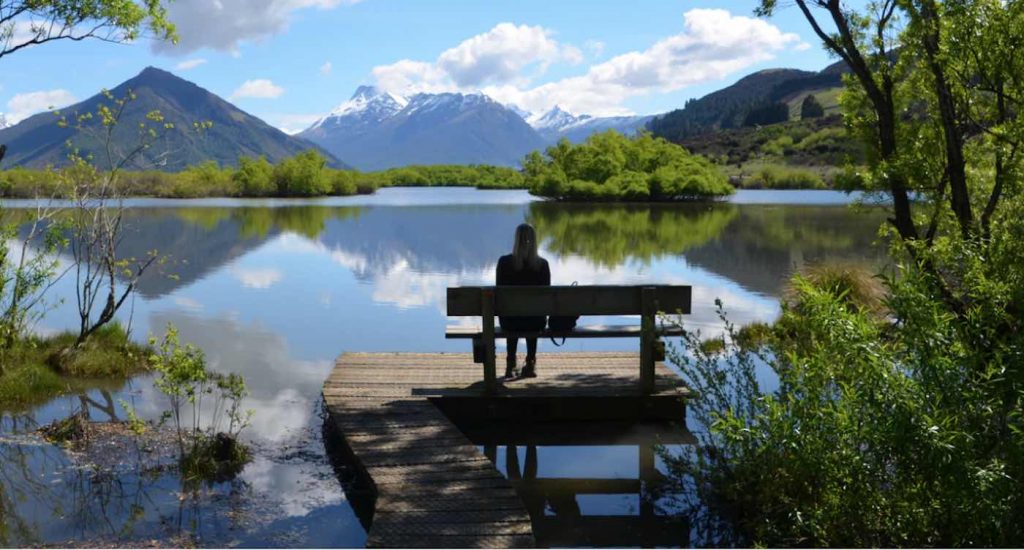
“Those who dwell among the beauties and mysteries of the earth are never alone or weary of life.” – Rachel Carson

Robert Pearce

Quote of the Day: “Those who dwell among the beauties and mysteries of the earth are never alone or weary of life.” – Rachel Carson

Photo by: Robert Pearce

With a new inspirational quote every day, atop the perfect photo—collected and archived on our Quotes page—why not bookmark GNN.org for a daily uplift?

Robert Pearce

Commercial Cargo Ship is Crossing Ocean Using ‘Wind Wings’ Like High-Tech Sails

The installation of the wings took place at the COSCO shipyard in China and the Pyxis Ocean is now on the water, conducting her maiden voyage. See SWNS story SWMRsails. It may sound like a step back in time, but shipping has discovered sails. A cargo ship has been fitted with cutting-edge, so-called "wind propulsion" units. Called WindWings, the large wing sails measuring up to 37.5 metres in height and can be added to the deck of commercial vessels. Mitsubishi Corporation’s Pyxis Ocean, chartered by Cargill, is the first vessel to be retrofitted with two WindWings. Produced by industrialisation partner Yara Marine Technologies, they are expected to generate average fuel savings of up to 30 percent on new build vessels, which could be even higher if used in combination with alternative fuels.
credit -Yara Marine Technologies-Pyrix Ocean-Cargill via SWNS

It seems a bit silly, but merchant shipping which long ago ditched its sails for internal combustion is now switching back, but not to any sail you’ve ever seen.

Called WindWings, the large wing sails measure around 100 feet (37 meters) in height and can be added to the deck of commercial vessels.

Pyxis Ocean, chartered by US global food corporation Cargill, is the first vessel to be retrofitted with two WindWings.

Produced by industrialization partner Yara Marine Technologies, they are expected to generate average fuel savings of up to 30% on new vessels, which could be even higher if used in combination with alternative fuels.

Pyxis Ocean is now on the water, conducting her maiden voyage with the WindWings having recently launched in China.

“At Cargill we have a responsibility to pioneer decarbonizing solutions across all our supply chains to meet our customer’s needs and the needs of the planet,” Jan Dieleman, President of Cargill’s Ocean Transportation business, said in a statement.

“A technology like WindWings doesn’t come without risk, and as an industry leader—in partnership with visionary shipowner Mitsubishi Corporation—we are not afraid to invest, take those risks, and be transparent with our learnings to help our partners in maritime [sic] transition to a more sustainable future.”

OTHER TECHNOLOGIES LIKE THIS: Watch This Cargo Ship Fly a Giant Kite to Save Fuel and Cut Emissions

The WindWings project, which is co-funded by the European Union is a retrofit solution that is capable of semi-decarbonizing existing vessels. Over half of the world’s merchant shipping vessels are over 9 years old, so extensive retrofitting is a must.

The International Maritime Organization (IMO) has set ambitious goals for carbon emissions reduction from the use of diesel fuel on vessels. They hope to lower CO2/equivalents by 70% by 2050 compared to a 2008 baseline.

GREEN SHIPPING NEWS: The First Cargo Ship Running on Green Methanol Weighs Anchor Amidst Merchant Shipping Decarbonization

The performance of the WindWings will be closely monitored over the coming months to further improve their design, operation, and performance, with the aim that the Pyxis Ocean will be used to inform the adoption process across not only Cargill’s fleet but the industry.

According to a Cargill release, on an average global route, WindWings can save 1.5 tonnes of fuel per WindWing per day—with the possibility of saving more on trans-ocean routes.

WATCH the WingWings go below… 

SHARE This Return To Tech From The Past With Industry-Minded Friends… 

India Becomes Fourth Nation to Touch Down on the Moon In Mission to Study its South Pole

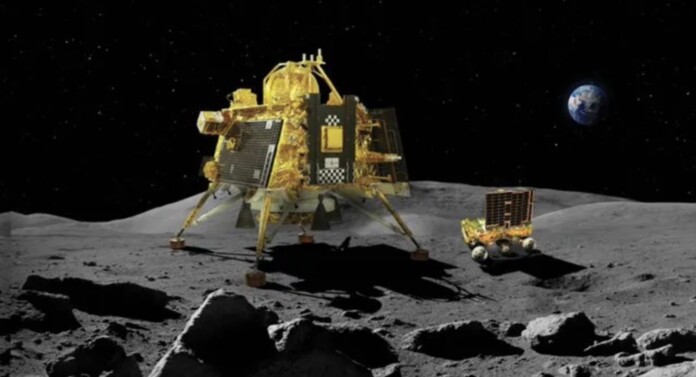
Chandrayaan-3's rover Pragyan – Image credit: ISRO
Chandrayaan-3’s rover Pragyan – Image credit: ISRO

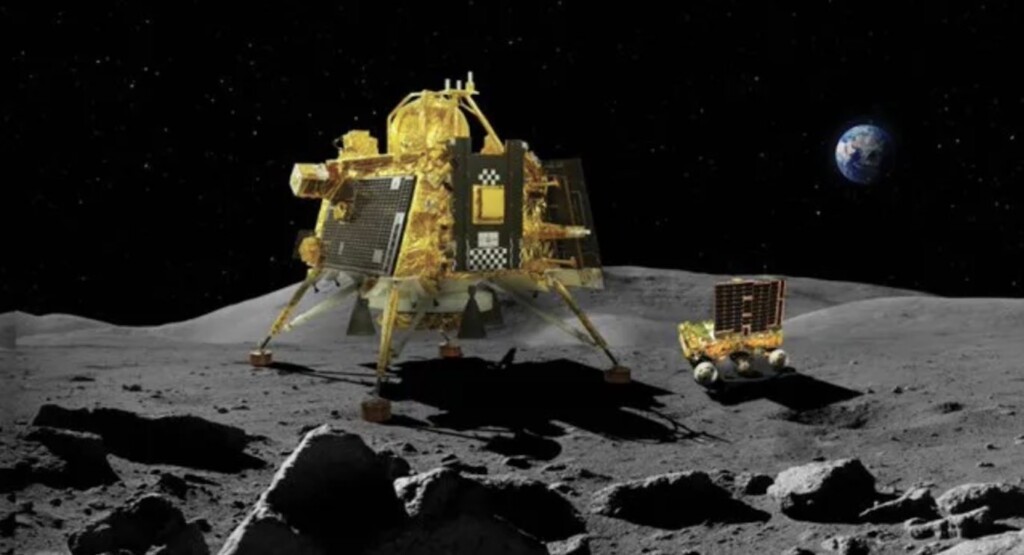
“India is on the Moon,” exclaimed S. Somanath, chief of the Indian Space Research Organisation (ISRO) after their lander/rover combo touched down on the Lunar South Pole on Wednesday, August 23.

In doing so India became the fourth nation to operate on the Moon after the US, Russia, and China, while also beating Japan to our nearest satellite after their attempted mission failed after hitting a crater rim. India is the first-ever nation to visit the South Polar Region.

Nestled between Manzinus C and Simpelius N craters, the Chandrayaan-3 mission is reportedly working well, with both the Vikram lander and the Pragyan rover establishing communications with ISRO command center and deploying solar panels.

The pair comes equipped with a variety of scientific instruments. The Vikram lander has 4 in total, including a seismometer to detect moonquakes, and a passive laser array. Another, a thermophysical probe, is already returning data after having drilled into the Lunar surface to measure temperature differentiations between various depths.

A fourth Vikram instrument, reports Space.com, will study the Moon’s ionosphere, which is filled with electrons and ions formed largely as a result of solar radiation. Indian physicists hope to determine if the ionosphere remains stable over time or changes in density.

The southern pole of the Moon is believed to potentially contain large amounts of frozen water trapped in ice. To that end, the Pragyan rover will spend 2 weeks trundling about examining the messy mixture of small rocks and dust known as regolith.

The ice is believed to be located at the bottom of permanently shadowed craters. Along with water for astronauts, potential harvesting of this water could also mean in situ production of rocket propellant for return journeys. Both uses would dramatically reduce the cost of manned lunar missions.

MORE SPACE MISSIONS: For New Rover, NASA is Swapping Buggy Shape for a Giant Snake in Hopes it Can Explore Icy Moon of Saturn

Another potential use of those craters, because of their permanent umbrage, is the placement of sophisticated space telescopes that would allow scientists to peer farther into the universe.

Nations need to be thrifty in space, and the thrust module that brought the lander and rover to the Moon is also equipped with a science instrument, one that will monitor the orbit of Earth as if it were an exoplanet.

Vikram is Sanskrit for valor, while Pragyan is wisdom.

WATCH the landing video below… 

SHARE India’s Own One Giant Leap With Your Friends… 

City Sparrows Make Better Dads Than Their Country Cousins, Says New Research

A sparrow in Berlin - Svetozar Cenisev
A sparrow in Berlin – Svetozar Cenisev

Despite being more aggressive in defending their territory, sparrows that live in urban areas find more time to visit the nest and feed their young, a surprise to scientists who believed that more aggression would mean less time with their offspring.

Researchers have dubbed them city sparrows, as city life seems to make the males better parents.

There’s something about the big city that can make humans agitated. Scientists were once able to predict the population of a city based solely on the average walking speeds of its citizens.

Scientists observing the sparrows believe that as a result of less predation pressure in the city compared to the country, the birds breed more successfully, and that this potentially increases the habits of the city sparrow sire to visit its nest.

“Male songbirds in temperate zones are thought to reduce parental care when they are more aggressive,” said Dr. Samuel Lane, lead author of the study at Virginia Tech. “Yet in this study, we show that urban male song sparrows provided more care for their young.”

“Against our expectations, we found that they visited nests more frequently and were more successful parents than rural males.”

The study, published in the journal Frontiers in Ecology and Evolution, studied six sites in southwest Virginia characterized by recent urban sprawl over four breeding seasons.

The team already knew that urbanized sparrows were more aggressive in defending their territory despite lower density than those in the countryside.

They thought that this would leave them less time to invest in the care of their offspring.

MORE CITY BIRDS: Falconry Saves Man from Life of Crime, Now he Helps Birds and At-Risk Youth Take flight

The researchers expected that more aggressive urban male sparrows were sacrificing parental care for territorial aggression, which in turn was expected to have a negative impact on the survival of their young.

But not only did they visit their nests significantly more often than their rural fellows, but on top of this they also began feeding nestlings earlier in the day.

And their efforts paid off despite brood parasitism, where other species lay their eggs in the sparrow nest like a cuckoo, which is more common in cities.

MORE GREAT ANIMAL PARENTS: Dolphin Moms Use ‘Baby Talk’ with Their Calves, Research Shows

“It turns out urban males are super males—able to defend their territories and care for their young,” said Dr. Lane.

“Our study adds to growing evidence that certain species of songbirds even benefit from living in urban environments when there is sufficient green space for them to find food and nest locations.”

MORE GREAT ANIMAL PARENTS: The Animal Kingdom’s Top 10 Best Dads for Father’s Day

The scientists hope ongoing research in this field will contribute to designing urban environments that support wildlife better.

However he cautioned that these results, however, should not be generalized to all locations, or other species and animals.

SHARE These Urbanite Sparrow Dads With Your Friends…

Off-Duty Officer Hailed as Hero for Rescuing Woman Who ‘Disappeared’ Under the Waterfall

courtesy of Dave Brosha

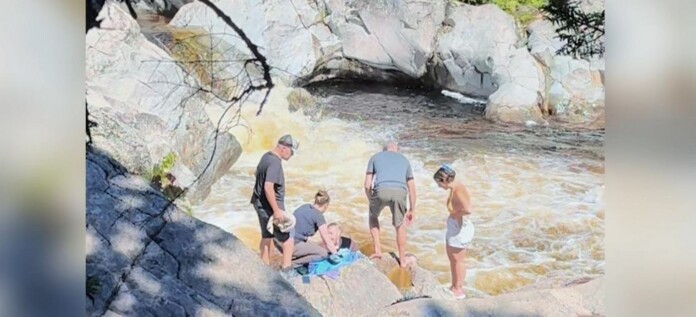
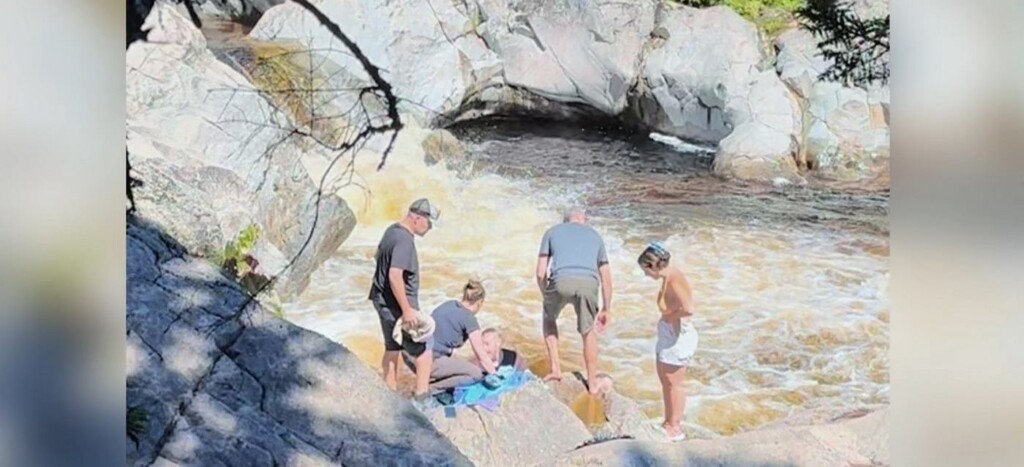
During a hiking trip in Fundy National Park, New Brunswick, a group of swimmers had the good fortune of being found by some hikers that included an off-duty police officer who ended up saving their friend from a raging edy.

The officer, Bruce Lake, was exploring the Laverty Falls area with his wife and friends, and though being hailed as a hero, he was initially told that everything was okay.

Thankfully piercing the veil of the social contract, one of Lake’s friends said that a woman out in the water appeared to be exhausted and might need some help, and that’s when the whole party watched her disappear under the foam after making a short-lived attempt to return to shore.

“She was kind of stuck between these two little waterfalls,” Lake recalled. “She immediately went underneath and then came back up again right near the rock and then grabbed the rock and held on. So she was obviously a little scared.”

Global News quotes Dave Brosha, one of Lake’s friends, who described the events as something “out of a bad movie” after the woman disappeared a second time, but wasn’t remerging, and that’s when the aptly-named Lake made his move, jumping into the water and swimming to the rock to help.

Reaching the rock, the water was deeper than he expected, and the rescue plan devolved to essentially waving his arms and legs about seeing if he could touch her, and as fortune would have it, his hand brushed her arm.

MORE RESCUE STORIES: Pakistani Man is True Hero in Dramatic Cable Car Rescue After Youth Were Stranded 15 Hours–WATCH

Grabbing her and swimming like mad, they approached their friends.

“So I pushed her toward the shore. Her friend got her arm and then I lost touch with her… I was getting sucked back into the exact same spot and only for her to turn around, and she reached her arm and I actually grabbed her arm and we got pulled in together,” he told Global News.

Lake’s wife Bernadette says it’s exactly the sort of man he is to risk his life for a complete stranger.

MORE WATER RESCUES: 7-Year-Old Massiah Is Hero After Rescuing a Drowning 3-Year-Old – All on His Own

Dave Brosha is a professional photographer and snapped a photo post-rescue to honor the savior, but described that after asking the Truro police officer if he could have permission to do so, the response was something like utter disbelief—which Brosha interpreted as a man feeling he did what anyone would have done in that situation.

WATCH the story below from Global News… 

SHARE This Right Place Right Time Rescue With Your Friends From Canada…

“The little things? The little moments?… They aren’t little.” – Jon Kabat-Zinn

Quote of the Day: “The little things? The little moments? They aren’t little.” – Jon Kabat-Zinn

Photo by: Stas Ostrikov

With a new inspirational quote every day, atop the perfect photo—collected and archived on our Quotes page—why not bookmark GNN.org for a daily uplift?

Pakistani Man is True Hero in Dramatic Cable Car Rescue After Youths Were Stranded 15 Hours–WATCH

Sahib Khan and Nasir Khan - released by family.
Sahib Khan and Nasir Khan – released by the family.

A rather unassuming young man with kind brown eyes is being hailed as a hero for his volunteer efforts to rescue 7 teenagers trapped in a cable car in Pakistan.

After two of the three supporting cables snapped, the teenagers were left dangling from an hour before school opened to the darkest watches of the night. A military helicopter originally came to affect a rescue, but fading light and high winds allowed them to save only 1 individual.

Sahib Khan and his older brother Nasir volunteered to rescue the remaining 7, having some experience with such things since they ran a cablecar business themselves. They used a zipline to reach the cable car with enough equipment to help the 5 children and 2 adults back to solid ground at a time.

Footage captured by local news and widely reported shows villager after villager embracing Sahib.

“Today, the way these two young men carried out the rescue operation has made the whole nation proud of them,” said Javed Nasir, a local resident with his arm wrapped around Sahib’s slight shoulders.

The rescue took place in the remote Battagram District of northern Pakistan where building cable cars across ravines can save millions of dollars and months of labor, and it began after the military, who had originally prohibited the villagers from doing anything, acquiesced to the idea that a zipline could be suspended close to the remaining suspension cable.

SIMILAR RESCUE STORIES: All His Training Pays Off: Slackliner Wins Carnegie Medal for Ski Lift Rescue Over Cables

Sahib and Nasir could then use the zipline to come close enough to help the teenagers escape the hanging metal box, but the line and its “dolly,” a byword for a small makeshift gondola, was only big enough for 1 person.

“Our dolly was small, but we were afraid of the load on the zip line. It was a little bit windy and very dark, everything was difficult,” Sahib told Al Jazeera. “But by the grace of God, we were able to bring the second child back down.”

WATCH the rescue happen from SCMP… 

SHARE These Rural Rescuers With Your Friends On Social Media…

Ospreys Breed in Ireland for the First Time in More Than 200 Years

The Golden Eagle Trust

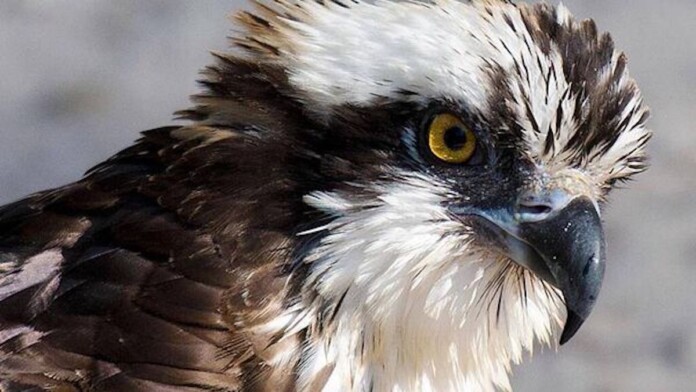
Irish conservationists report that the magnificent osprey has successfully bred in the wilds of the Emerald Isle for the first time in almost 250 years.

Worldwide, ospreys are doing great—listed as “Least Concern” by the IUCN who add they are increasing in population. However their massive brown and white wings have been absent from Irish skies for two centuries after being hunted to extinction.

The last recorded osprey to nest in Ireland was found in 1779 writes the Ireland-based conservation group Golden Eagle Trust on Facebook.

Visiting ospreys sometimes stop on the island to rest, but almost since the signing of the US Declaration of Independence, no pair has ever deemed it a safe environment to raise young.

A nesting pair (ospreys mate for life) was discovered by experienced birdwatcher Giles Knight, the Environmental Farming Scheme Advisor with Ulster Wildlife, a conservation non-profit.

“Along with my son Eoin, I have watched the adults return to the same site since 2021, so you can imagine my excitement the moment that I saw three chicks and two adults this year,” said Knight in a statement. “It was a rub-your-eyes, once-in-a-lifetime moment; an absolute highlight of my 30-year wildlife career—like finding long-lost treasure.”

“With at least two of the chicks fledging this season, this is a huge conservation success story and indicates a healthy wetland ecosystem with plenty of suitable habitat and fish to bring this apex predator back to our skies and plunging into the Fermanagh Lakelands. Truly the return of a living countryside!”

MORE NEWS FROM THE BRITISH ISLES: For the First Time in 240 Years, White-Tailed Eagles Spotted Flying Over England

Ireland has experienced a fair amount of recent raptor conservation success, and Ulster Wildlife admits that all the signs have been pointing toward this long-awaited return.

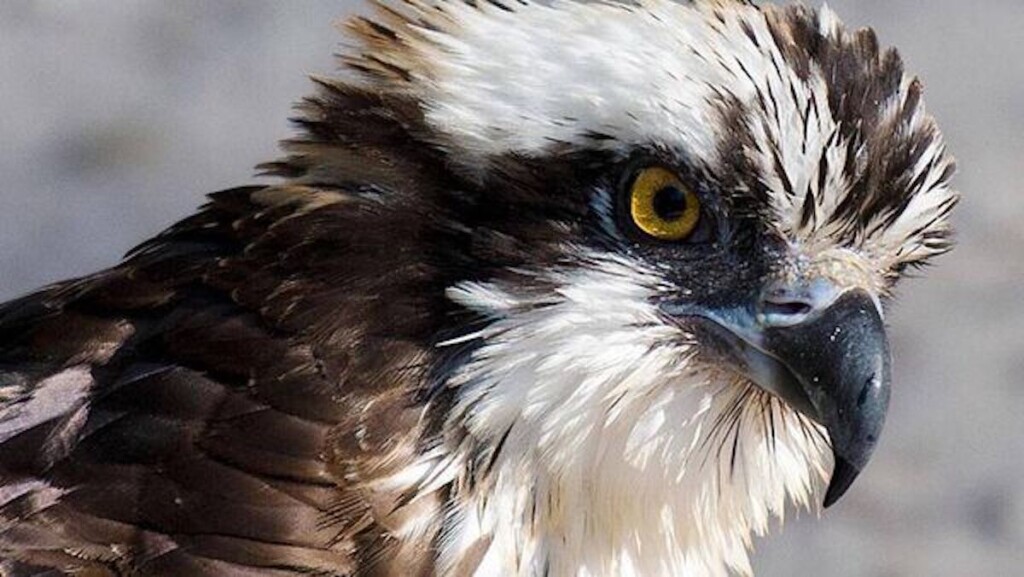
The old Gaelic name for osprey was “Iascaire Coirneach”, meaning “Tonsured Fisherman”, possibly related to how its black eye band and white crown give it the appearance of the semi-bald tonsure typical of medieval Christian monks, the Golden Eagle Trust wrote on Facebook in a celebratory post.

“Now these birds are back in Ireland and breeding successfully, it is critical that they are left in peace so their numbers can continue to grow by returning year on year to breed,” Knight added in the statement. “We believe and hope that this could be the start of a raptor dynasty.”

SHARE This Long-Awaited Return With Your Friends… 

A 5-Year-Old’s Lemonade Stand in Seattle Raised Over $17,000 for Victims of Maui Wildfires

Edison’s lemonade stand – Courtesy: Ami Jean Juel

This young boy in Seattle is showing that there’s no barrier to entry for disaster relief; that all it takes is a willing heart, a hot summer day, and some ice-cold lemonade.

Having recently returned from a family vacation on the Big Island, Ami Juel and her husband were watching the devastation of the Lahaina fires on television when their son, Edison, asked them to turn it off because it was too sad.

They didn’t realize the 5-year-old could become so emotionally connected to an abstraction so far away and seen only on television, so they decided to take the time to make a life lesson out of it and explain what had happened to the famous Maui town.

Edison immediately wanted to help and suggested setting up a lemonade stand like he saw once in Colorado. Ami and Edison’s father thought it a great idea, and so stocked up on pink and yellow lemonade, ice cream sandwiches, candy, sparkling water, and popsicles.

The hard opening came last Saturday on a busy Seattle street, where the response was absolutely prolific—stunning the family.

Even though the lemonade sold for $1.00 per cup, drivers regularly paid with $5, $10, or $20 bills with instructions to donate the change.

“Most people were like, ‘this is so cool. What a great idea. We’ve been looking for ways to help. We felt so helpless and didn’t know where to donate,'” Ami with USA Today. “A lot of people came by and stopped and told us like their story of a trip to Hawaii or some connection they had to the island.”

MORE MAUI STORIES: ‘My Brother Died a Hero’ Going Back to Save 4 Seniors in Maui Wildfire

Ami took the idea a bit further and set up ways to donate online, and she and her husband even got their corporate jobs to match whatever was made from selling lemonade. After a week’s worth of sales, Ami and Edison had $17,000 to send to Lahaina.

SHARE This Young Man’s Inspiring Efforts With The World…

Your Weekly Horoscope From Rob Brezsny: A ‘Free Will Astrology’

Our partner Rob Brezsny provides his weekly wisdom to enlighten our thinking and motivate our mood. Rob’s Free Will Astrology, is a syndicated weekly column appearing in over a hundred publications. He is also the author of Pronoia Is the Antidote for Paranoia: How All of Creation Is Conspiring To Shower You with Blessings. (A free preview of the book is available here.)

Here is your weekly horoscope…

FREE WILL ASTROLOGY – Week of August 26, 2023
Copyright by Rob Brezsny, FreeWillAstrology.com

VIRGO (Aug. 23-Sept. 22):
“I don’t believe that in order to be interesting or meaningful, a relationship has to work out—in fiction or in real life.” So says Virgo novelist Elizabeth Curtis Sittenfeld, and I agree. Just because a romantic bond didn’t last forever doesn’t mean it was a waste of energy. An intimate connection you once enjoyed but then broke off might have taught you lessons that are crucial to your destiny. In accordance with astrological omens, I invite you to acknowledge and celebrate these past experiences of togetherness. Interpret them not as failures but as gifts.

LIBRA (Sept. 23-Oct. 22):
The amount of rubbish produced by the modern world is staggering: over 2 billion tons per year. You and I can diminish our contributions to this mess, though we must overcome the temptation to think our personal efforts will be futile. Can we really help save the world by buying secondhand goods, shopping at farmer’s markets, and curbing our use of paper? Maybe a little. And here’s the bonus: We enhance our mental health by reducing the waste we engender. Doing so gives us a more graceful and congenial relationship with life. The coming weeks will be an excellent time to meditate and act on this beautiful truth.

SCORPIO (Oct. 23-Nov. 21):
I hope that in the coming weeks, you will wash more dishes, do more laundry, and scrub more floors than you ever have before. Clean the bathrooms with extra fervor, too. Scour the oven and refrigerator. Make your bed with extreme precision. Got all that, Scorpio? JUST KIDDING! Everything I just said was a lie. Now here’s my authentic message: Avoid grunt work. Be as loose and playful and spontaneous as you have ever been. Seek record-breaking levels of fun and amusement. Experiment with the high arts of brilliant joy and profound pleasure.

SAGITTARIUS (Nov. 22-Dec. 21):
Dear Sagittarius the Archer: To be successful in the coming weeks, you don’t have to hit the exact center of the bull’s-eye every time—or even anytime. Merely shooting your arrows so they land somewhere inside the fourth or third concentric rings will be a very positive development. Same is true if you are engaged in a situation with metaphorical resemblances to a game of horseshoes. Even if you don’t throw any ringers at all, just getting close could be enough to win the match. This is one time in your life when perfection isn’t necessary to win.

CAPRICORN (Dec. 22-Jan. 19):
I suspect you are about to escape the stuffy labyrinth. There may be a short adjustment period, but soon you will be running half-wild in a liberated zone where you won’t have to dilute and censor yourself. I am not implying that your exile in the enclosed space was purely oppressive. Not at all. You learned some cool magic in there, and it will serve you well in your expansive new setting. Here’s your homework assignment: Identify three ways you will take advantage of your additional freedom.

AQUARIUS (Jan. 20-Feb. 18):
Though my mother is a practical, sensible person with few mystical propensities, she sometimes talks about a supernatural vision she had. Her mother, my grandmother, had been disabled by a massive stroke. It left her barely able to do more than laugh and move her left arm. But months later, on the morning after grandma died, her spirit showed up in a pink ballerina dress doing ecstatic pirouettes next to my mother’s bed. My mom saw it as a communication about how joyful she was to be free of her wounded body. I mention this gift of grace because I suspect you will have at least one comparable experience in the coming weeks. Be alert for messages from your departed ancestors.

PISCES (Feb. 19-March 20):
“Those who know the truth are not equal to those who love it,” said the ancient Chinese sage Confucius. Amen! Seeking to understand reality with cold, unfeeling rationality is at best boring and at worst destructive. I go so far as to say that it’s impossible to deeply comprehend anything or anyone unless we love them. Really! I’m not exaggerating or being poetical. In my philosophy, our quest to be awake and see truly requires us to summon an abundance of affectionate attention. I nominate you to be the champion practitioner of this approach to intelligence, Pisces. It’s your birthright! And I hope you turn it up full blast in the coming weeks.

ARIES (March 21-April 19):
None of the books I’ve written has appeared on the New York Times best-seller list. Even if my future books do well, I will never catch up with Aries writer James Patterson, who has had 260 books on the prestigious list. My sales will never rival his, either. He has earned over $800 million from the 425 million copies his readers have bought. While I don’t expect you Rams to ever boost your income to Patterson’s level, either, I suspect the next nine months will bring you unprecedented opportunities to improve your financial situation. For best results, edge your way toward doing more of what you love to do.

TAURUS (April 20-May 20):
Addressing a lover, D. H. Lawrence said that “having you near me” meant that he would “never cease to be filled with newness.” That is a sensational compliment! I wish all of us could have such an influence in our lives: a prod that helps arouse endless novelty. Here’s the good news, Taurus: I suspect you may soon be blessed with a lively source of such stimulation, at least temporarily. Are you ready and eager to welcome an influx of freshness?

GEMINI (May 21-June 20):
Humans have been drinking beer for at least 13,000 years and eating bread for 14,500. We’ve enjoyed cheese for 7,500 years and popcorn for 6,500. Chances are good that at least some of these four are comfort foods for you. In the coming weeks, I suggest you get an ample share of them or any other delicious nourishments that make you feel well-grounded and deep-rooted. You need to give extra care to stabilizing your foundations. You have a mandate to cultivate security, stability, and constancy. Here’s your homework: Identify three things you can do to make you feel utterly at home in the world.

CANCER (June 21-July 22):
On Instagram, I posted a favorite quote from poet Muriel Rukeyser: “The world is made of stories, not atoms.” I added my own thought: “You are made of stories, too.” Many of my stories happen while I’m alone with my inner world. My nightly dreams are some of my favorite stories.” Anyway, Cancerian, I’m offering this exchange to you now because you are in a story-rich phase of your life. The tales coming your way, whether they occur in social settings or in the privacy of your own fantasies, will be extra interesting, educational, and motivational. Gather them in with gusto! Celebrate them!

LEO (July 23-Aug. 22):
Author A. Conan Doyle said, “It has long been my axiom that the little things are infinitely the most important.” Spiritual teacher Jon Kabat-Zinn muses, “The little things? The little moments? They aren’t little.” Here’s author Robert Brault’s advice: “Enjoy the little things, for one day you may look back and realize they were the big things.” Ancient Chinese sage Lao-Tzu provides even further nuance for you to contemplate this week: “To know you have enough is to be rich.”

WANT MORE? Listen to Rob’s EXPANDED AUDIO HOROSCOPES, 4-5 minute meditations on the current state of your destiny — or subscribe to his unique daily text message service at: RealAstrology.com

(Zodiac images by Numerologysign.com, CC license)

SHARE The Wisdom With Friends Who Are Stars in Your Life on Social Media…

“I do not give up, I never give up, for there is nothing in this entire world that is irrevocably unchangeable.” – Sri Chinmoy

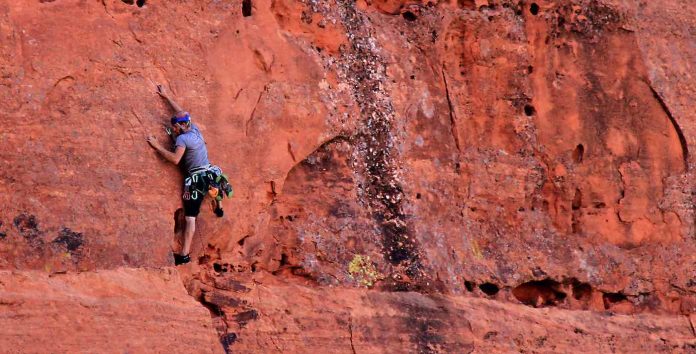
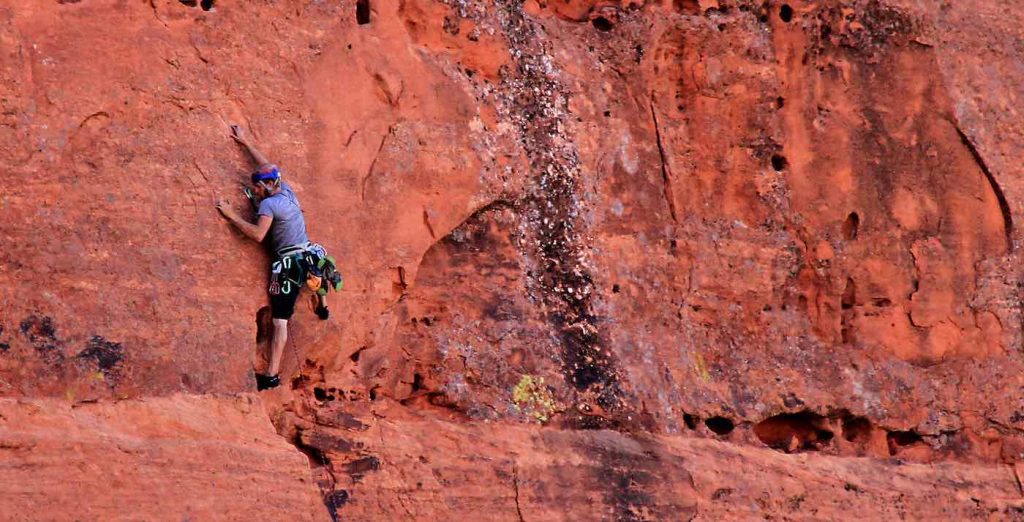
Quote of the Day: “I do not give up, I never give up, for there is nothing in this entire world that is irrevocably unchangeable.” – Sri Chinmoy (on the anniversary of the spiritual leader’s birth in 1931)

Photo: Utah climber by arbyreed, CC license

With a new inspirational quote every day, atop the perfect photo—collected and archived on our Quotes page—why not bookmark GNN.org for a daily uplift?

A Powerful Antibiotic That Can Tackle Superbugs Has Been Discovered in the ‘Dark Matter’ of Bacteria

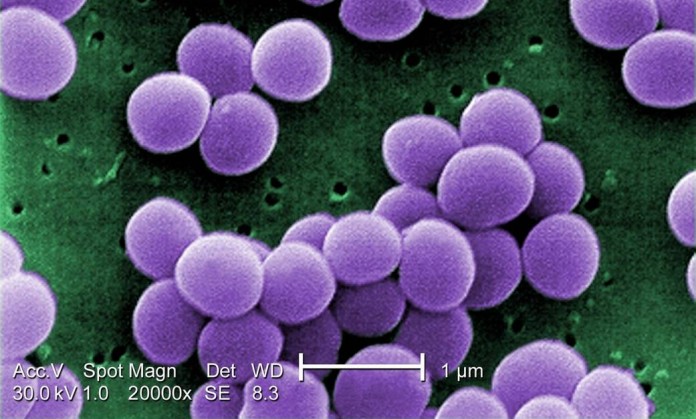
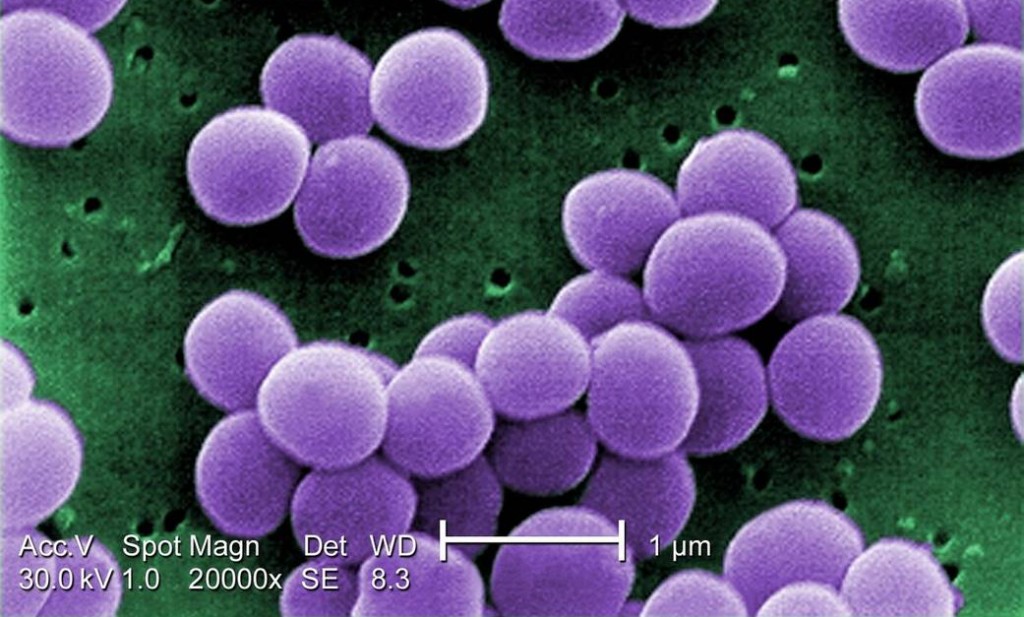
VRSA (Staphylococcus Aureus), a kind of medically-resistant infection, under a microscope
VRSA (Staphylococcus Aureus) under a microscope

A new drug, called Clovibactin, has been created out of “dark matter bacteria” which rather than being a research term, was created by the press to suit the mysterious origins of Clovibactin and potential future drugs like it, which could represent an urgently needed new font of antibiotics.

Scientists in the US managed to grow the bacteria out of a morass of life cleverly coined ‘bacterial dark matter,” due to the fact that it was based on a lifeform that can’t be cultured in a petri dish.

99% of all bacteria are similarly unculturable and could not be grown in laboratories previously, hence the moniker dark matter, because 95% of the universe is made up of dark matter and dark energy.

The new drug was discovered from bacterial dark matter found in sandy soil from North Carolina, and developed by an international team of researchers alongside the company NovoBiotic in Boston.

“We urgently need new antibiotics to combat bacteria that become increasingly resistant to most clinically used antibiotics,” said Dr. Markus Weingarth, a researcher from the chemistry department of Utrecht University.

“Clovibactin is different. Since Clovibactin was isolated from bacteria that could not be grown before, pathogenic bacteria have not seen such an antibiotic before and had no time to develop resistance. In fact, we did not observe any resistance to Clovibactin in our studies.”

MORE NEWS LIKE THIS: Life-Saving Breakthrough for Antibiotics Uses Shapeshifting Chemistry that Won 2022 Nobel Prize

Clovibactin successfully attacked a broad spectrum of bacterial pathogens in mice, including the so-called antibiotic-resistant Staphylococcus aureus.

It targets not just one, but three different precursor molecules that are all essential for the construction of the cell wall, an envelope-like structure that surrounds bacteria.

“The multi-target attack mechanism of Clovibactin blocks bacterial cell wall synthesis simultaneously at different positions,” said co-author Professor Tanja Schneider from the University of Bonn in Germany. “This improves the drug’s activity and substantially increases its robustness to resistance development.”

The results, published in the journal Cell, revealed the drug was named after its mechanism acting like a cage, with Clovibactin derived from the Greek word “Klouvi”, which means cage.

This was because it was discovered that Clovibactin self-assembles into large fibrils on the surface of bacterial membranes.

MORE NEW DRUGS: Scientists Develop Invisibility Cloak for Cancer Drugs

These fibrils are stable for a long time and ensure that the target molecules remain locked in for as long as necessary to kill bacteria.

“Since these fibrils only form on bacterial membranes and not on human membranes, they are presumably also the reason why Clovibactin selectively damages bacterial cells but is not toxic to human cells,” Dr. Weingarth said.

“Clovibactin hence has potential for the design of improved therapeutics that kill bacterial pathogens without resistance development,” he added.

SHARE This Important, Potentially Game-Changing Discovery… 

Airline Pilot Reunites 9-Year-Old with Her Beloved Doll Lost Half a World Away

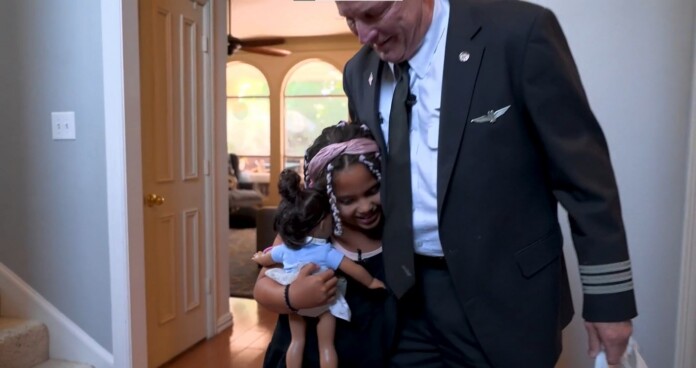
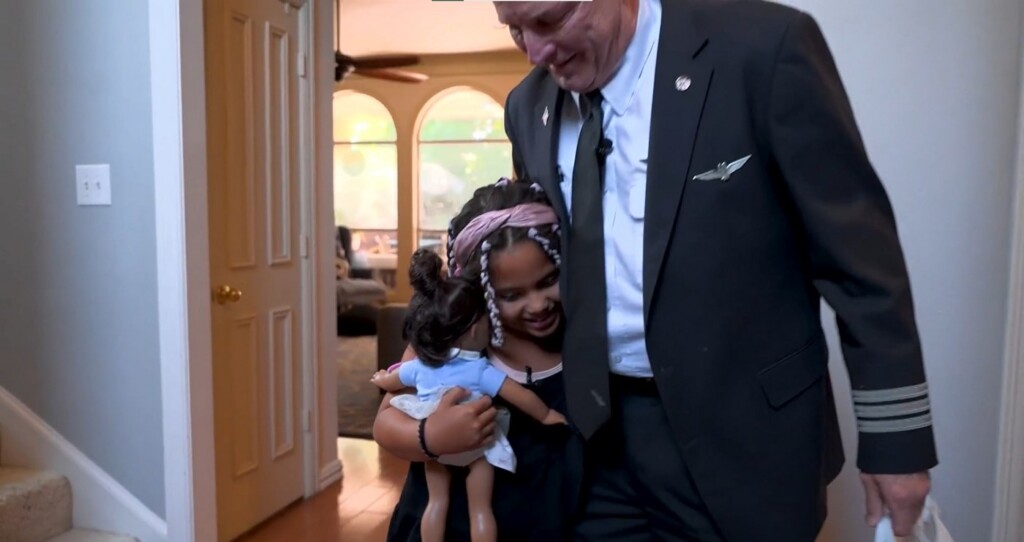
From Texas comes the story of a girl named Beatrice who was taken to meet the captain on a flight home from Tokyo.

Beatrice is an American Girl Doll, and her flight home would see her reunited with her loving owner, 9-year-old Valentina Dominguez who was left devastated after losing the doll on a similar trip a month before.

Returning to Plano, Texas from a family trip a Japan, Valentina and her parents frantically searched through the luggage trying to find her best friend, to no avail. Her father Rudy reasoned they must have lost Beatrice at Haneda Airport, or perhaps even left her on the plane.

Fortunately, a social media post about the doll alerted a friend, who alerted a neighbor, who alerted American Airlines First Officer of 30 years, James Danen.

Describing his readiness to help others as something “in his nature,” he got in contact with the lost and found staff at Turkish Airlines, and was directed to their workers at Haneda Airport in Tokyo who had by that time found Beatrice.

“It’s my nature. I like helping people… that’s just what I like doing,” said Danen, adding that he just so happens to fly to Tokyo often. “I was really glad I could do something nice for somebody.”

ANOTHER STORY LIKE THIS ONE: Airline Captain Writes Sweet Note to Tooth Fairy For Girl on Plane

It took Danen two such trips to finally get his hands on Beatrice.

Last Monday, Danen, who lives just a few miles from the Dominguez Household, personally escorted Beatrice back into the loving arms of her best friend.

“Thank you! Was she well-behaved on the flight?” Valentina asked Jim who brought back some Japanese candy and a map of the world showing all the places Beatrice had visited on her travels, according to WFAA.

WATCH the news story below from WFAA…

SHARE This Sweet Hero Pilot With Your Friends…

Tree-Loving Brits Crowdsource a National ‘Ancient Tree Inventory’ – 200,000 Unique Trees

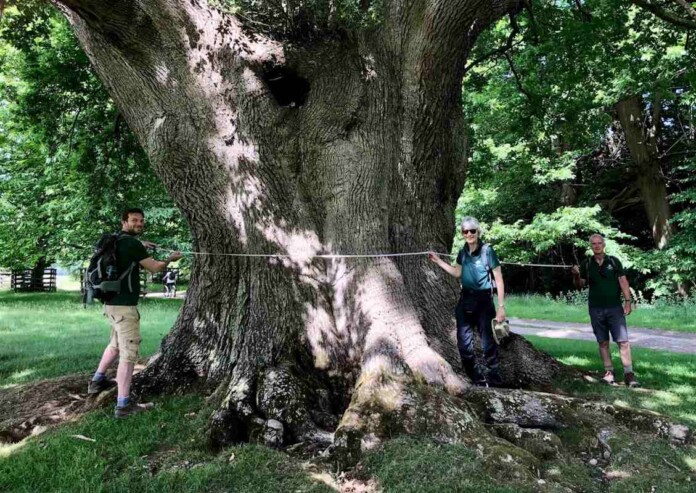
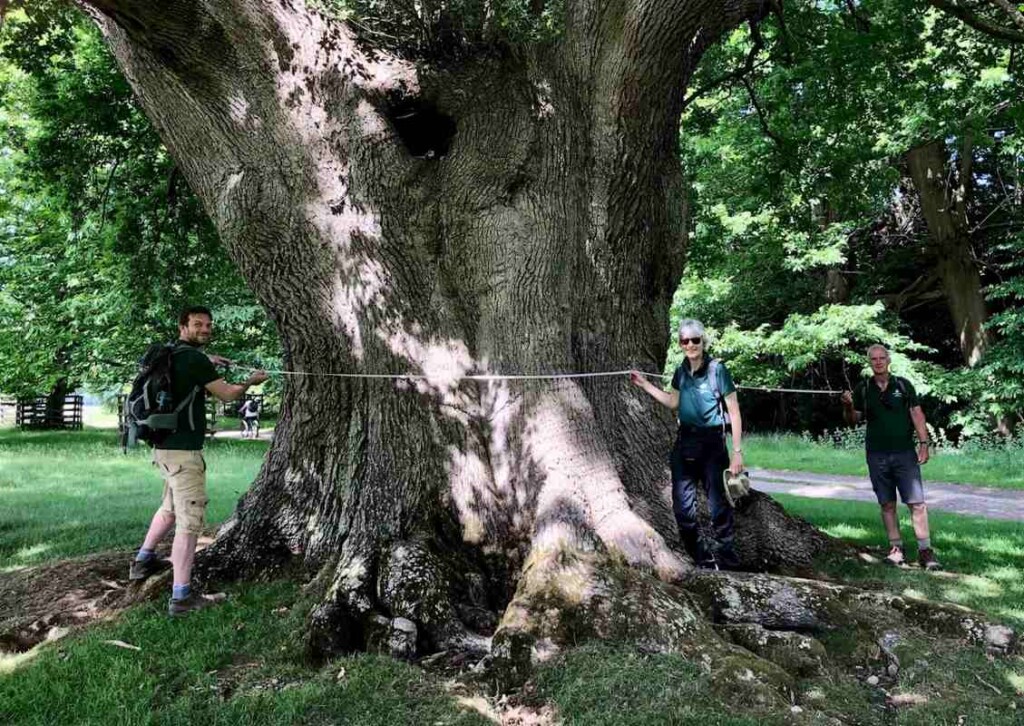
Tom (ATI Citizen Science Officer), Hilary and Jeremy measuring a huge ancient oak at Petworth Park - credit Woodland Trust Blog
Tom (ATI Citizen Science Officer), Hilary and Jeremy measuring a huge ancient oak at Petworth Park – credit Woodland Trust Blog

A UK non-profit has leveraged the special relationship that the British have for trees to create an ‘Ancient Tree Inventory’ to coordinate conservation, environmental activism, and scientific research by allowing anyone familiar with an ancient tree to record and share its existence with the country.

Perhaps a lesser-known trait in the world at large of the British is their faithful love and dedication to the surprising numbers of ancient and elder trees on their islands.

Even by the late Neolithic, much of the woodlands that would have covered lower Britain had been cleared by stone axes. Waves of immigration and warfare continually reduced the size of forests, and industrialization accelerated it even further.

Despite this, there are hundreds of thousands of trees on the British Isles that are hundreds of years old.

The Ancient Tree Inventory organized by the Woodland Trust is more than just a national tree registry, such as they have in Italy; it’s crowdsourced, and each tree is not only measured by its size but by the number of species living on or inside it.

Italy’s Monumental Tree Registry has about 22,000 individuals—the ATI from Woodland Trust has almost ten times as many.

OTHER COOL CITIZEN SCIENCE PROJECTS: Fungi Species New to Science Discovered in Scottish Highlands

“As I find and record these magnificent trees, I’m grateful to be playing a small part in helping to protect them and to preserve them for [posterity],” writes Kevin Stanley, an ancient tree “verifier.”

The Woodland Trust maintains an app as well as printed sheets to allow anybody to officially register the location and characteristics of ancient, ‘veteran,’ or ‘notable’ trees, which can then be found on a GPS map on the Trust’s website.

Ancient trees are fundamental to the health of forested ecosystems worldwide. Having survived myriads of storms, insects, cold snaps, and droughts, their seeds contain vital genetic memories to help future trees adapt to changing conditions.

MORE STORIES LIKE THIS: Ancient Cypress in Chile May be World’s Oldest Tree, at 5,000 Years Old

Studies done on woodland health have shown that when a forest loses too many ancients or elders, the overall survival of the whole ecosystem falls precipitously. By contrast, forests that have their ancients are much more likely to maintain high biodiversity and canopy cover, even those that exist in unstable areas.

The Woodland Trust every year organizes the Tree of the Year contest in the UK to raise awareness and celebrate these ancient woody Britons. See this year’s contestants here.

WATCH the Ancient Tree Inventory explainer video below…

SHARE This Awesome Project With Your Friends In The UK…