Quote of the Day: “We have subtle subconscious faculties we are not using, a vast realm of mind that includes extrasensory abilities; intuition; wisdom.” – Kabir Helminski (modern Sufi master)
Photo by: Michael Dziedzic
With a new inspirational quote every day, atop the perfect photo—collected and archived on our Quotes page—why not bookmark GNN.org for a daily uplift?
City Church in Gastonia NC – City Church Facebook group
City Church in Gastonia NC – City Church Facebook group
A North Carolina pastor has been helping children in need throughout his county, whether they need clothes, housing, or even a family—with programs like his church’s Foster and Adoption Ministry.
A few years ago his City Church in Gastonia started Hope Closet, a clothing giveaway for kids who may be displaced, or kids in schools who need new shoes.
A few weeks ago he ran across a news article about the growing number of kids whose school lunch accounts remain unpaid.
School lunch debt is a problem for districts across North Carolina, including Gaston County where Pastor Dickie Spargo learned that families owe a total of $13,000.
“We decided that we were going to share it with our church, and then just take up an offering and see what would happen,” Spargo told local media.
In less than two weeks, the congregation raised $23,000.
“What a great opportunity to bless these kids,” the pastor told his congregation after delivering the check.
He learned that the schools are “doing their best” to reach parents, urging them to apply for the ‘free or reduced lunch program’, which the government uses to reimburse costs of meals that would otherwise be charged to the school.
The $23,000 donation from the large Christian church will eliminate student lunch debt for the year, and the rest will help pay off debt for next school year.
A survey of 2,000 Americans delved into their sentiments around environmentalism and found that a significant majority—seven in 10—feel they’ve become more ethically responsible as they’ve gotten older (71%).
Over the past year, U.S. adults have also been taking small steps in their everyday lives to do the right thing—such as starting conversations with their loved ones about going green (39%), donating clothing (37%), and purchasing sustainable products (36%).
When it comes to doing their part, other regular habits include avoiding littering (51%), recycling (49%), and using compostable eating materials, like plates and cups (46%).
The poll, sponsored by Chinet, found that, when asked about the businesses and brands they want to support, a majority of Americans said it’s important that they share the same values (73%).
Gen Z (77%) and millennials (82%) were especially likely to say this is the case.
Nearly half of all respondents have stopped supporting or using a brand because their values didn’t align with something they’ve said or done (48%), with the average person leaving five brands behind.
“As part of our 2030 strategy, we are committed to innovating our products to be recyclable, compostable or reusable, in order to help consumers enjoy gatherings knowing they are taking steps toward being more sustainable,” said Chinet brand manager Melissa Rakos.
“Hosts and guests alike shouldn’t worry about sacrificing convenience for sustainability,” she added. “Utilizing products that are made from recycled material and ridding unrecyclable foam items completely is an easy way for people to get started with making these changes in their everyday lives.”
A similar poll of Brits in the UK, found three-quarters of respondents described themselves as greener today than they were a decade ago—with a large majority believing they have a responsibility to live a sustainable lifestyle.
Making greener choices than ever before, 58 percent believe that being environmentally-conscious is a ‘badge of honor’.
The random double-opt-in survey of 2,000 adults in the general population was conducted by market research company OnePoll, a member of the American Association for Public Opinion Research and the European Society for Opinion and Marketing Research.
A wedding reception is a great occasion for people young and old to mingle—and things always get interesting when they start dancing.
One senior was ready to show who’s the boss of the dance floor, as soon as the DJ started playing Michael Jackson’s Billy Jean.
The balding, eyeglass-wearing gent is named John Lawless Jr. and he stole the show with his spot-on moves, including floor drops that floored everyone who gathered round at the Long Island reception.
“Oh my goodness gracious, I can’t believe a story has been done on me,” he exclaimed, after the GNN video began going viral on NewsBreak. “Totally blown away.”
“It makes me want to dance all over again,” said John, who works for the US Postal Service.
FREE WILL ASTROLOGY – Week of March 25, 2023
Copyright by Rob Brezsny, FreeWillAstrology.com
ARIES (March 21-April 19):
If we were to choose one person to illustrate the symbolic power of astrology, it might be Aries financier and investment banker J. P. Morgan (1837–1913). His astrological chart strongly suggested he would be one of the richest people of his era. The sun, Mercury, Pluto, and Venus were in Aries in his astrological house of finances. Those four heavenly bodies were trine to Jupiter and Mars in Leo in the house of work. Further, sun, Mercury, Pluto, and Venus formed a virtuoso “Finger of God” aspect with Saturn in Scorpio and the moon in Virgo. Anyway, Aries, the financial omens for you right now aren’t as favorable as they always were for J. P. Morgan—but they are pretty auspicious. Venus, Uranus, and the north node of the moon are in your house of finances, to be joined for a bit by the moon itself in the coming days. My advice: Trust your intuition about money. Seek inspiration about your finances.
TAURUS (April 20-May 20):
“The only thing new in the world,” said former US President Harry Truman, “is the history you don’t know.” Luckily for all of us, researchers have been growing increasingly skilled in unearthing buried stories. Three examples: 1. Before the US Civil War, six Black Americans escaped slavery and became millionaires. (Check out the book Black Fortunes by Shomari Wills.) 2. Over 10,000 women secretly worked as code-breakers in World War II, shortening the war and saving many lives. 3. Four Black women mathematicians played a major role in NASA’s early efforts to launch people into space. Dear Taurus, I invite you to enjoy this kind of work in the coming weeks. It’s an excellent time to dig up the history you don’t know—about yourself, your family, and the important figures in your life.
GEMINI (May 21-June 20):
Since you’re at the height of the Party Hearty Season, I’ll offer two bits of advice about how to collect the greatest benefits. First, ex-basketball star Dennis Rodman says that mental preparation is the key to effective partying. He suggests we visualize the pleasurable events we want to experience. We should meditate on how much alcohol and drugs we will imbibe, how uninhibited we’ll allow ourselves to be, and how close we can get to vomiting from intoxication without actually vomiting. But wait! Here’s an alternative approach to partying, adapted from Sufi poet Rumi: “The golden hour has secrets to reveal. Be alert for merriment. Be greedy for glee. With your antic companions, explore the frontiers of conviviality. Go in quest of jubilation’s mysterious blessings. Be bold. Revere revelry.”
CANCER (June 21-July 22):
If you have been holding yourself back or keeping your expectations low, please STOP! According to my analysis, you have a mandate to unleash your full glory and your highest competence. I invite you to choose as your motto whichever of the following inspires you most: raise the bar, up your game, boost your standards, pump up the volume, vault to a higher octave, climb to the next rung on the ladder, make the quantum leap, and put your ass and assets on the line.
LEO (July 23-Aug. 22):
According to an ad I saw for a luxury automobile, you should enjoy the following adventures in the course of your lifetime: Ride the rapids on the Snake River in Idaho, stand on the Great Wall of China, see an opera at La Scala in Milan, watch the sun rise over the ruins of Machu Picchu, go paragliding over Japan’s Asagiri highland plateau with Mount Fuji in view, and visit the pink flamingos, black bulls, and white horses in France’s Camargue Nature Reserve. The coming weeks would be a favorable time for you to seek experiences like those, Leo. If that’s not possible, do the next best things. Like what? Get your mind blown and your heart thrilled closer to home by a holy sanctuary, natural wonder, marvelous work of art—or all the above.
VIRGO (Aug. 23-Sept. 22):
It’s an excellent time to shed the dull, draining parts of your life story. I urge you to bid a crisp goodbye to your burdensome memories. If there are pesky ghosts hanging around from the ancient past, buy them a one-way ticket to a place far away from you. It’s OK to feel poignant. OK to entertain any sadness and regret that well up within you. Allowing yourself to fully experience these feelings will help you be as bold and decisive as you need to be to graduate from the old days and old ways.
LIBRA (Sept. 23-Oct. 22):
Your higher self has authorized you to become impatient with the evolution of togetherness. You have God’s permission to feel a modicum of dissatisfaction with your collaborative ventures—and wish they might be richer and more captivating than they are now. Here’s the cosmic plan: This creative irritation will motivate you to implement enhancements. You will take imaginative action to boost the energy and synergy of your alliances. Hungry for more engaging intimacy, you will do what’s required to foster greater closeness and mutual empathy.
SCORPIO (Oct. 23-Nov. 21):
Scorpio poet Richard Jackson writes, “The world is a nest of absences. Every once in a while, someone comes along to fill the gaps.” I will add a crucial caveat to his statement: No one person can fill *all* the gaps. At best, a beloved ally may fill one or two. It’s just not possible for anyone to be a shining savior who fixes every single absence. If we delusionally believe there is such a hero, we will distort or miss the partial grace they can actually provide. So here’s my advice, Scorpio: Celebrate and reward a redeemer who has the power to fill one or two of your gaps.
SAGITTARIUS (Nov. 22-Dec. 21):
Poet E. E. Cummings wrote, “May my mind stroll about hungry and fearless and thirsty and supple.” That’s what I hope and predict for you during the next three weeks. The astrological omens suggest you will be at the height of your powers of playful exploration. Several long-term rhythms are converging to make you extra flexible and resilient and creative as you seek the resources and influences that your soul delights in. Here’s your secret code phrase: higher love.
CAPRICORN (Dec. 22-Jan. 19):
Let’s hypothesize that there are two ways to further your relaxation: either in healthy or not-so-healthy ways—by seeking experiences that promote your long-term well-being or by indulging in temporary fixes that sap your vitality. I will ask you to meditate on this question. Then I will encourage you to spend the next three weeks avoiding and shedding any relaxation strategies that diminish you as you focus on and celebrate the relaxation methods that uplift, inspire, and motivate you.
AQUARIUS (Jan. 20-Feb. 18):
Please don’t expect people to guess what you need. Don’t assume they have telepathic powers that enable them to tune in to your thoughts and feelings. Instead, be specific and straightforward as you precisely name your desires. For example, say or write to an intense ally, “I want to explore ticklish areas with you between 7 and 9 on Friday night.” Or approach a person with whom you need to forge a compromise and spell out the circumstances under which you will feel most open-minded and open-hearted. PS: Don’t you dare hide your truth or lie about what you consider meaningful.
PISCES (Feb. 19-March 20):
Piscean writer Jack Kerouac feared he had meager power to capture the wonderful things that came his way. He compared his frustration with “finding a river of gold when I haven’t even got a cup to save a cupful. All I’ve got is a thimble.” Most of us have felt that way. That’s the bad news. The good news, Pisces, is that in the coming weeks, you will have extra skill at gathering in the goodness and blessings flowing in your vicinity. I suspect you will have the equivalent of three buckets to collect the liquid gold.
WANT MORE? Listen to Rob’s EXPANDED AUDIO HOROSCOPES, 4-5 minute meditations on the current state of your destiny — or subscribe to his unique daily text message service at: RealAstrology.com
Quote of the Day: “It requires a self-esteem to receive—a pleasant acquaintance and liking for oneself.” – John Steinbeck
Photo by: Sebastián León Prado
With a new inspirational quote every day, atop the perfect photo—collected and archived on our Quotes page—why not bookmark GNN.org for a daily uplift?
In the oldest and most prestigious young adult science competition in the nation, 17-year-old Ellen Xu used a kind of AI to design the first diagnosis test for a rare disease that struck her sister years ago.
With a personal story driving her on, she managed an 85% rate of positive diagnoses with only a smartphone image, winning her $150,000 grand for a third-place finish.
Kawasaki disease has no existing test method, and relies on a physician’s years of training, ability to do research, and a bit of luck.
Symptoms tend to be fever-like and therefore generalized across many different conditions. Eventually if undiagnosed, children can develop long-term heart complications, such as the kind that Ellen’s sister was thankfully spared from due to quick diagnosis.
Xu decided to see if there were a way to design a diagnostic test using deep learning for her Regeneron Science Talent Search medicine and health project. Organized since 1942, every year 1,900 kids contribute adventures.
She designed what is known as a convolutional neural network, which is a form of deep-learning algorithm that mimics how our eyes work, and programmed it to analyze smartphone images for potential Kawasaki disease.
2023 Regeneron Science talent search winners – credit Society For Science
However, like our own eyes, a convolutional neural network needs a massive amount of data to be able to effectively and quickly process images against references.
For this reason, Xu turned to crowdsourcing images of Kawasaki’s disease and its lookalike conditions from medical databases around the world, hoping to gather enough to give the neural network a high success rate.
Xu has demonstrated an 85% specificity in identifying between Kawasaki and non-Kawasaki symptoms in children with just a smartphone image, a demonstration that saw her test method take third place and a $150,000 reward at the Science Talent Search.
WATCH the big winner explain her invention…
SHARE This Brilliant Kid’s Brilliant Idea With Your Friends…
In the 2023 World Happiness Report, a wonderful trend has emerged from the data.
Despite a major war in Europe, and all the government shutdowns and totalitarian policing measures in front of the largest pandemic in 100 years, happiness ratings have remained much the same across Europe and elsewhere.
The report, which is a publication of the UN Sustainable Development Solutions Network, uses the Gallop World Poll data from 150 nations looking at things like a sense of social support and positive feelings toward others to rank order countries on reported happiness.
GDP, medical facilities, and freedom to make life choices are then compared with the perception of government corruption, and sense of dystopia as factors to try and get a sense of why people in certain countries rank their happiness higher than others, though these socio-economic indicators do not contribute to overall score.
CNN reports that an average from 2020 to 2022 shows that scores have remained concretely high in Europe.
“Even during these difficult years, positive emotions have remained twice as prevalent as negative ones, and feelings of positive social support twice as strong as those of loneliness,” John Helliwell, one of the report’s authors, said in a news release.
“Benevolence to others, especially the helping of strangers, which went up dramatically in 2021, stayed high in 2022.”
For the 6th year in a row, Finland occupies the top spot on the index, while Denmark retains its position in 2nd. Israel moved up the most, from 9th position in 2022 to 4th in 2023.
Neither Russia nor Ukraine dropped in the report. Helliwell suggested that now that the pandemic is well and truly behind us, it could spur a general rise in happiness as people re-evaluate that to which they are returning, and a closer look at what it is they want out of life.
There’s been a lot of talk recently about so-called “forever chemicals” and how our society can use new technologies to remove these old toxins from the water and soils of our world.
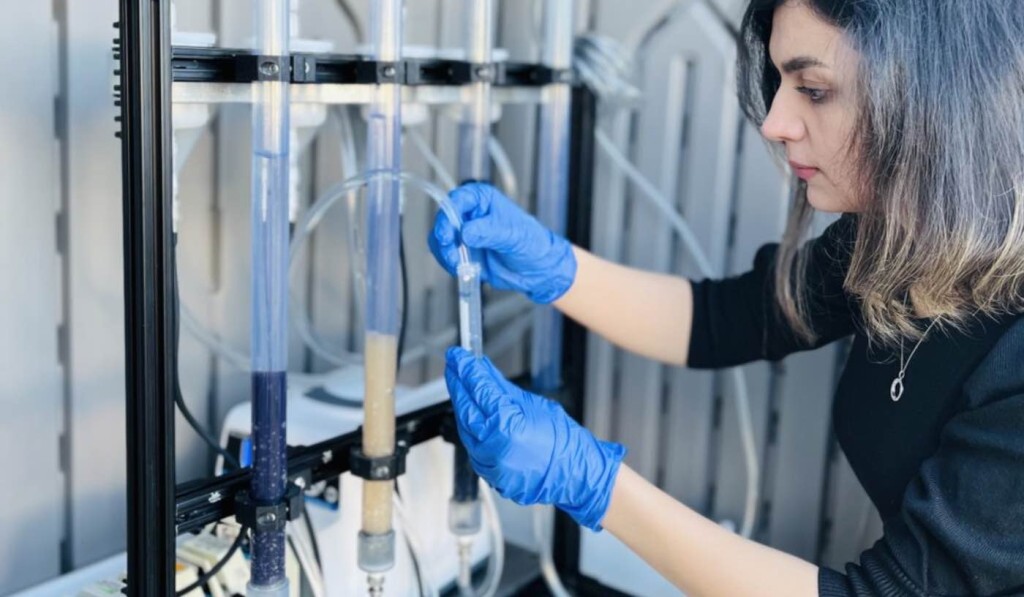
A new solution from the Univ. of British Columbia can both filter out and then destroy these forever chemicals, purifying water resources cheaply and effectively.
“Think Brita filter, but a thousand times better,” says UBC chemical and biological engineering professor Dr. Madjid Mohseni, who developed the technology.
Generally referred to as PFAS, short for poly-fluoroalkyl substances, forever chemicals number in the thousands and are generally what make products stain-resistant or non-stick.
Too much exposure to these chemicals can lead to a myriad of health problems from cancer to hormonal dysregulation.
One of the major challenges with PFAS contimination is that they are included in foams and sprays used by firefighters to combat blazes in houses and in the woods. These then leech into groundwater or flow into rivers and contaminate drinking water, especially in smaller locales where sufficient filtration equipment isn’t present.
“Our adsorbing media captures up to 99% of PFAS particles and can also be regenerated and potentially reused,” Dr. Mohseni said. “This means that when we scrub off the PFAS from these materials, we do not end up with more highly toxic solid waste that will be another major environmental challenge.”
Once the PFAS particles are captured, they are destroyed via electrical and photochemical processes. The results were published in Chemosphere.
In the study Mohseni and his team tested their aparatus on perfluorooctanoic acid, a PFAS known to be ubiquitous in contamined water. They are now preparing a real-world test at a number of locations in B.C. starting this month.
“The results we obtain from these real-world field studies will allow us to further optimize the technology and have it ready as products that municipalities, industry and individuals can use to eliminate PFAS in their water,” said Dr. Mohseni.
SHARE This Welcome News With Your Friends On Social Media…
Mr. Pickles with baby –Credit: Jackelin Reyna / Houston Zoo
Mr. Pickles with baby –Credit: Jackelin Reyna / Houston Zoo
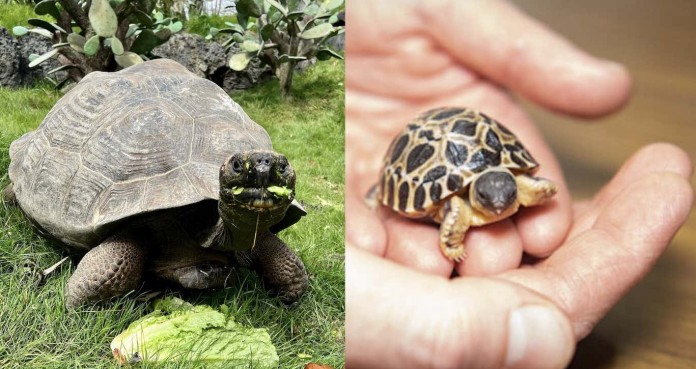
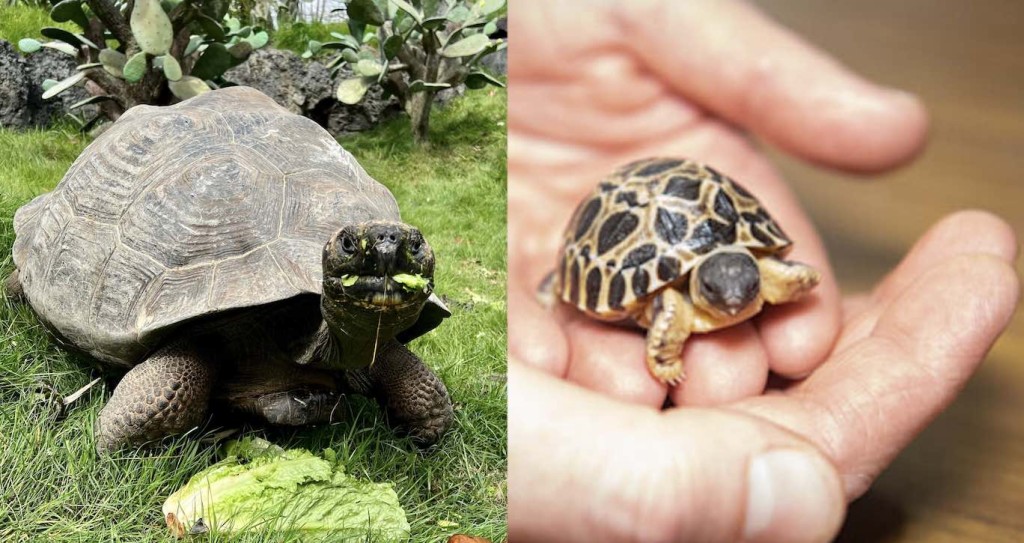
Mr. Pickles, a 90-year-old radiated tortoise and the oldest animal at the Houston Zoo, became a father for the first time last week.
Mr. Pickles and his 53-year-old partner, Mrs. Pickles, welcomed three hatchlings that could live for up to 150 years if well taken care of.
Native to southern Madagascar, radiated tortoises are Critically Endangered and rarely produce offspring, Houston Zoo officials said.
“The new hatchlings came as a surprise when a herpetology keeper happened upon Mrs. Pickles as the tortoise was laying her eggs at closing time,” the Houston Zoo blog reported.
“The animal care team quickly went to work uncovering the eggs and getting them to the safety of the Reptile & Amphibian House. The soil in Houston isn’t hospitable to the Madagascar native tortoises, and it’s unlikely the eggs would have hatched on their own if the keeper hadn’t been in the right place at the right time.”
3 Baby Pickles – Credit: Jackelin Reyna / Houston Zoo
Arriving in 1996, Mrs. Pickles has lived at the Houston Zoo alongside Mr. Pickles ever since. The kids have been named Dill, Gherkin, and Jalapeño.
The new parents have been key to the Association of Zoos and Aquariums Species Survival Plan for this exquisite reptile that has unfortunately fallen afoul of the illegal animal trade.
In 2018 10,000 radiated tortoises were found in a private home in Toliara, Madagascar. Rescuers transported them to Le Village Des Tortues (“Turtle Village”), a private wildlife rehabilitation facility in Ifaty, 18 miles north of Toliara.
Preventative measures for insuring against the extinction of the reptile has been the establishment of breeding colonies on the Reunion Islands and Mauritius where the conditions are similar to its home in Madagascar.
SHARE These Adorable New Parents With Your Friends…
Quote of the Day: “Wildness is perennially within us, dormant as a hard-shelled seed, awaiting the fire or flood that awakes it again.” – Gary Snyder
Photo by: Droid Gingerbread, CC license
With a new inspirational quote every day, atop the perfect photo—collected and archived on our Quotes page—why not bookmark GNN.org for a daily uplift?
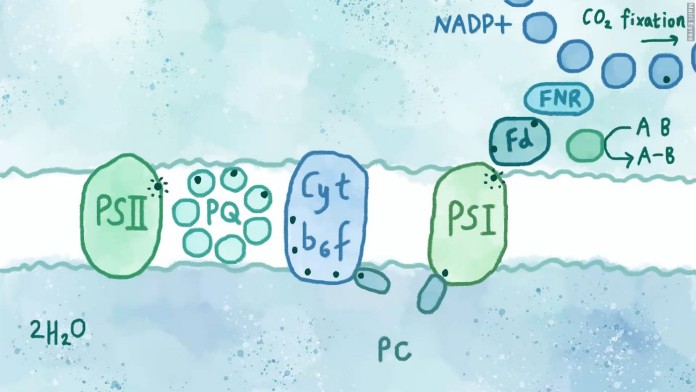
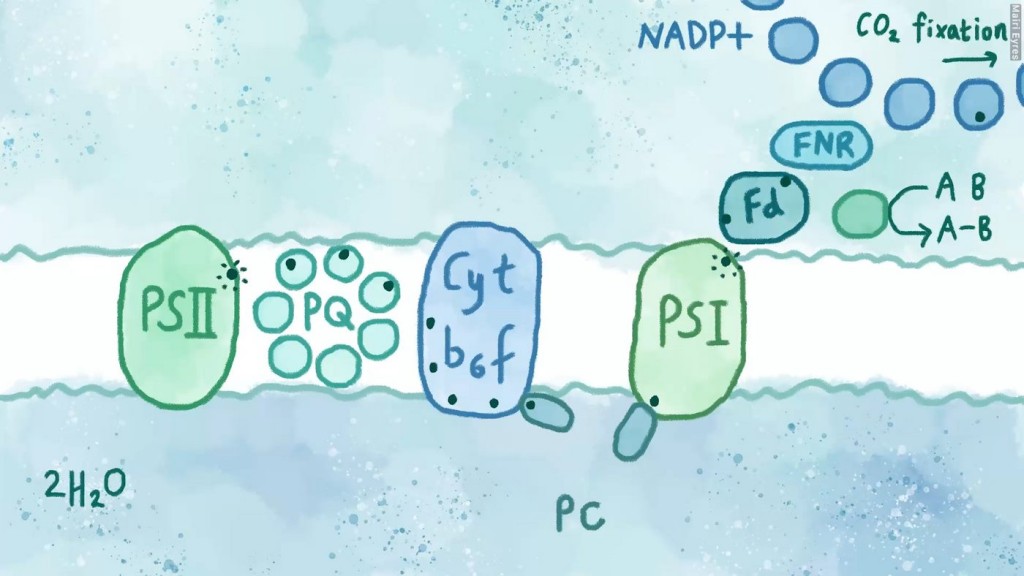
A “mind-blowing” discovery in the early stages of photosynthesis has been discovered by scientists that could help improve the efficiency of renewable energy technologies.
While trying to figure out if it were possible to extract electrons from a known process in the early stages of photosynthesis, the scientists instead found an entirely-new electron transfer pathway, which for those who remember their biology 101, is the metabolic method that extracts the most energy from food.
The study’s authors believe this new understanding of photosynthesis could create new and more efficient ways of harnessing the process’s power to generate biofuels.
The research team, comprised of scientists from across the globe, first set out to understand why a ring-shaped molecule called a ‘quinone’ is able to steal electrons from the photosynthetic process
Quinones, which are common in nature, are able to easily accept and give away electrons.
Using a technique called ultrafast spectroscopy, the study team observed how quinones behave in photosynthetic cyanobacteria which obtain energy via photosynthesis like plants and algae.
Observing the process at an incredibly fast timescale of a millionth of a millionth of a second, the researchers found that the protein scaffold where the initial chemical reactions of photosynthesis take place is leaky, enabling some electrons to escape.
This leakiness could help plants protect themselves from damage from bright or rapidly changing light.
The researchers say that being able to extract electrons at an earlier point in photosynthesis could come in handy when manipulating the photosynthetic pathways to create clean, renewable fuel from the sun.
For the same reasons, they think the ability to regulate photosynthesis could also enable crops to become more tolerant to intense bouts of sunlight.
“We didn’t know as much about photosynthesis as we thought we did, and the new electron transfer pathway we found here is completely surprising,” said corresponding author Dr. Jenny Zhang from Cambridge
“…we thought we were just using a new technique to confirm what we already knew. Instead, we found a whole new pathway, and opened the black box of photosynthesis a bit further.”
“At first, we thought we’d made a mistake: it took a while for us to convince ourselves that we’d done it,” said Dr. Zhang. “The fact that we can steal them at an earlier process is mind-blowing.”
Photosynthesis is a wholly natural process, and scientists have been studying ways in which we can harness it to address the climate crisis.
For example, scientists have been looking for ways to mimic processes to generate clean fuels from sunlight and water.
Dr. Laura Wey, who is now based at the University of Turku in Finland, added told Cambridge Univ. Press that since the electrons from photosynthesis are dispersed through the whole system, more of them can be accessed.
“The fact that we didn’t know this pathway existed is exciting, because we could be able to harness it to extract more energy for renewables,” said Dr. Wey.
SHARE This Basic Science Breakthrough On Social Mdia…
President Da Silva with the Yanomami - CC 2.0. Palácio do Planalto
President da Silva with the Yanomami – CC 2.0. Palácio do Planalto
When President ‘Lula’ da Silva took office this year in Brazil, many environmental and indigenous rights groups hoped he would fulfill campaign promises of better protection for the Amazon rainforest and the people who live there.
Nearly four months into his tenure and early signs are that Lula was telling the truth, as Brazilian police have evicted dozens of illegal gold miners from the Yanomami Reserve, an area the size of Portugal inhabited by around 35,000 tribesmen.
Illegally-mined gold accounts for around half of all the country’s exports, and a new Environment of the Amazon division of the federal police is seeking international assistance in building a first-rate structure for targeting the outside funding toward and sales from illegal gold mining.
Reuters says that so far, the new division has ousted nearly all miners from the area, including overseeing the destruction of 250 mining camps and 70 low-tech boats used for dredging. 48 planes and helicopters for smuggling the gold out of the reserve have been seized as well.
The police hope to use radioisotope technology and methods to be able to pinpoint the exact mineralogical makeup of illegally mined gold as a way of targeting it in the market even after it’s melted into ingots.
MORE GOOD NEWS FROM THE AMAZON:
They also plan to remove miners from 6 other Amazon reserves this year, while setting up a permanent, floating police station on a river in the Yanomami Reserve.
At the moment, the Lula Administration is considering the best set of laws for tackling the problem. While 804 miners have been arrested in the raids, all were let go, and many others fled in the police advance.
Humberto Freire, from the new Amazon division, told Reuters he and his department hope to create a sophisticated electronic tax receipt for any transactions of precious metals to help pinpoint sales and distribution of suspected illegal bullion.
WATCH the story below from Reuters…
CELEBRATE This Massive Accomplishment For Indigenous Rights With Your Friends…
Arist's rendition of a tidally-locked exoplent CC 2.0. Beau.TheConsortium (Copy)
Artist’s rendition of a tidally-locked exoplanet CC 2.0. Beau.TheConsortium
In a new study, astronomers describe how extraterrestrial life has the potential to exist on distant exoplanets inside a special area called the ‘terminator zone.’
Despite its frightening-sounding name, it’s better thought of as the “ending zone” and can be found on planets that have one side which always faces its star and one side that is always dark.
In these perpetual dawn/dusk zones, conditions would be perfect year-round for liquid water, and therefore life.
It’s wild to think about a planet that doesn’t turn—when daylight shines down on one half for all eternity, and another sits in perpetual darkness. However, exoplanets in this paradigm are likely more common than not since they’re found around M-dwarf stars, which make up about 70% of all the stars we can see.
“This is a planet where the dayside can be scorching hot, well beyond habitability, and the night side is going to be freezing, potentially covered in ice. You could have large glaciers on the night side,” Ana Lobo, a postdoctoral researcher at UC Irvine who led the new work, which just published in The Astrophysical Journal.
Lobo’s modeling work is believed to be the first of its kind that demonstrates the conditions and scenarios that show how life on these worlds would be possible.
She relied on similar methods to those used on Earth to calculate the climate here to find that a rocky world with water present would harbor ideal and relatively unchanging conditions for life in the terminator zone.
“Ana has shown if there’s a lot of land on the planet, the scenario we call ‘terminator habitability’ can exist a lot more easily,” said co-author Aomawa Shields, UCI associate professor of physics & astronomy. “These new and exotic habitability states our team is uncovering are no longer the stuff of science fiction—Ana has done the work to show that such states can be climatically stable.”
In her paper, Lobo explains that if her models are correct, future observations of the atmospheres of exoplanets orbiting M-dwarf stars should be conducted around the terminator belt where every moment of every day is like the hour just before sunrise.
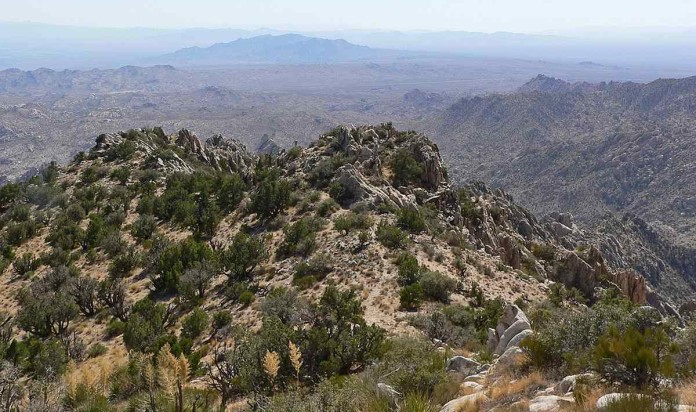
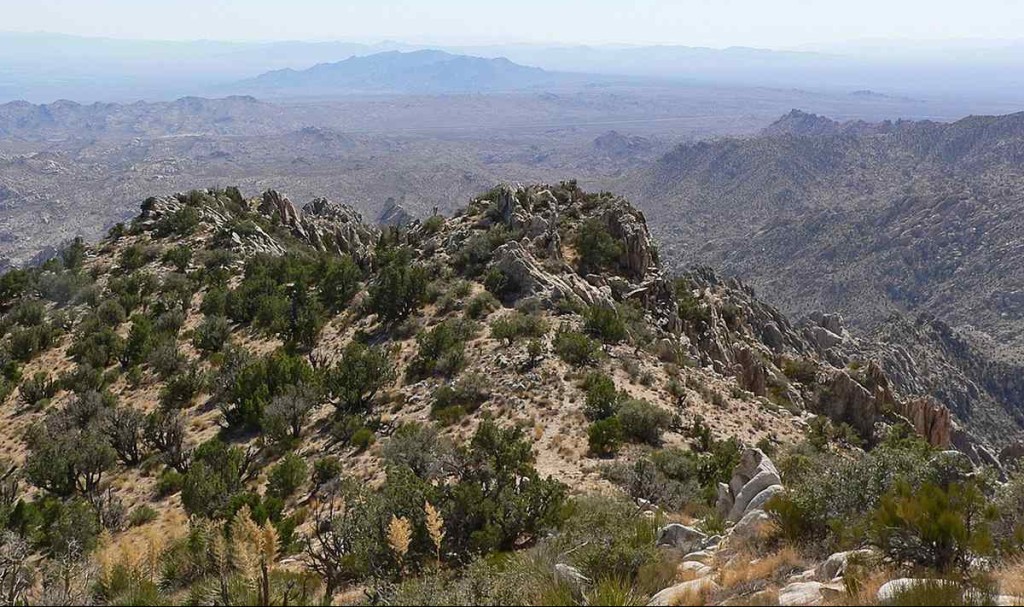
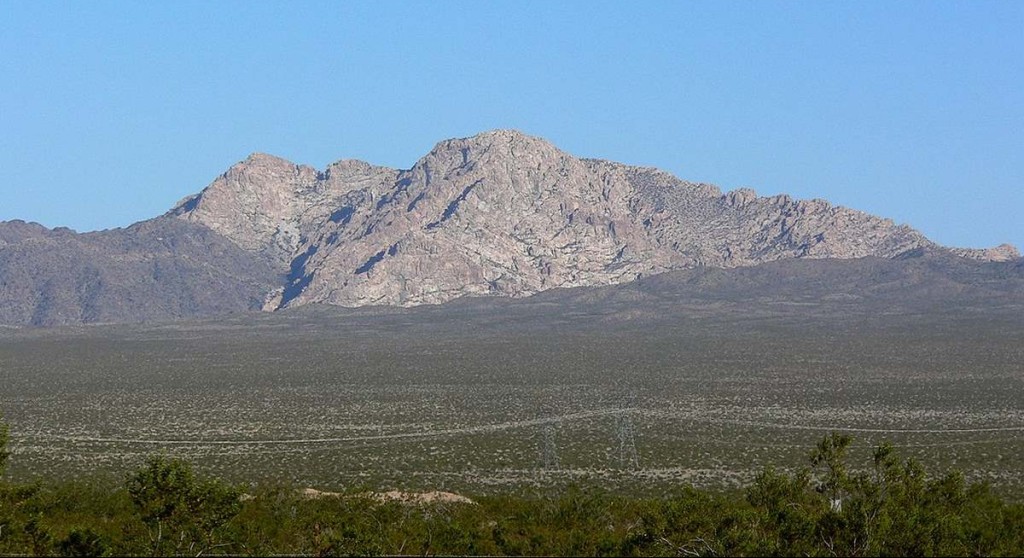
Spirit Mountain summit area - credit Stan Shebs CC 3.0. SA
Spirit Mountain summit area – credit Stan Shebs CC 3.0. SA
Last week President Biden continued the bipartisan executive tradition of conserving historic and scientifically significant lands by designating Spirit Mountain—Avi Kwa Ame, in Nevada as a National Monument.
Sacred to several Native American tribes, principally the people of the Fort Mojave Indian Reservation, Spirit Mountain sits at the confluence of the Mojave and Sonoran deserts at the southernmost point of Nevada.
The designation covers 506,000 acres, one of the largest tracts of land to come under federal protection since Biden took office, and will conjoin with the existing Ireteba Peaks National Wilderness.
Secretary of the Interior, Deb Haaland, herself a native of the Pueblo peoples, held roundtable talks with the Mohave and other tribes in September of last year to discuss the need to conserve the area.
The slopes and flatlands around Avi Kwa Ame are dotted with important sites dating to modern Indian times but also back as far as the neolithic period. Rock Shelters, petroglyphs, and sacred sites will all be sheltered under the National Monument designation.
Spirit Mountain – credit Stan Shebs CC 3.0. SA
“Avi Kwa Ame is the point of Mojave creation; it’s a very important and integral part of our history and belief system,” Ashley Hemmers, the tribal administrator for Fort Mojave, told CNN. “For us, that mountain is a living landscape; it’s like a person. If something were to happen to it, it would be like losing a loved one.”
Beyond the irreplaceable value of the landscape to the Mohave, Gila monster, desert bighorn sheep, desert tortoise, and centuries-old Joshua trees are among the species that can be found on this diverse desert landscape.
The monument includes all of the Spirit Mountain, South McCullough, Wee Thump Joshua Tree, Nellis Wash, and Bridge Canyon. It borders Lake Mead National Recreation Area, Mojave Trails National Monument, Mojave National Preserve, and Castle Mountains National Monument thereby creating a much larger contiguously protected area of the Mojave Desert, and opens the door to an eventual conversion of the whole area, perhaps one day, to a National Park.
SHARE This Healing And Conservation With Your Friends…
Quote of the Day: “It’s important to be skeptical, but if you don’t have hope, you’re defeated before you start.” – Gloria Steinem
Photo by: Diana Parkhouse
With a new inspirational quote every day, atop the perfect photo—collected and archived on our Quotes page—why not bookmark GNN.org for a daily uplift?
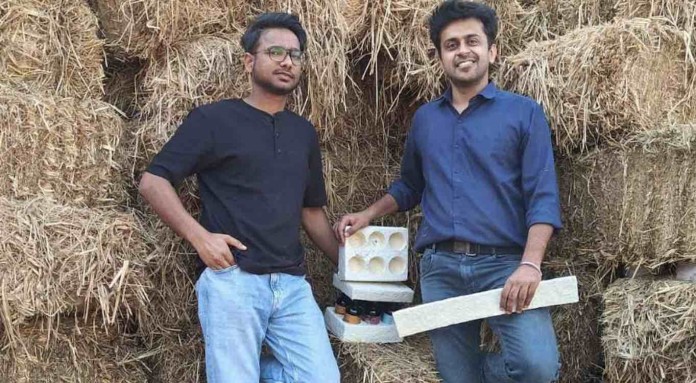
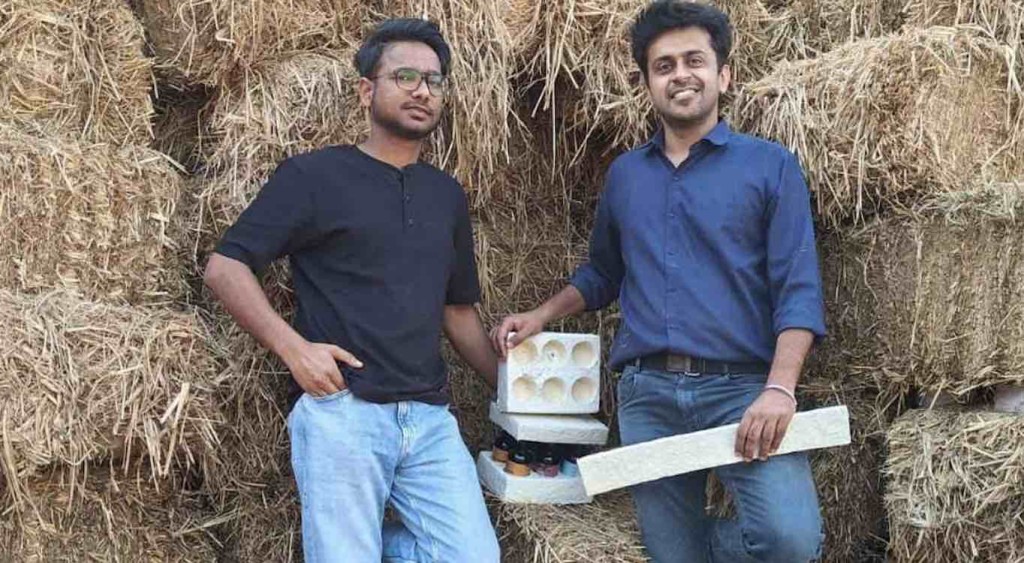
A Delhi-based engineer has designed a replacement for polystyrene packaging out of “rice stubble” the dead stalks left over after the rice season in India, millions of tons of which are burned every year.
They say wisdom oft comes from the mouths of babes, and Mr. Arpit Dhupar was at first left scratching his head when his young nephew drew a picture of the world with a grey sky.
Everything else was normal, green grass, yellow sun, white and brown mountains; why was the sky grey? It dawned on him that his nephew was drawing the sky as he saw it every year when the rice stubble was burned: grey.
“We shouldn’t live in a world where we have to explain to kids that the sky should be painted blue. It should be a given,” he told The Better India.
So he launched a new business venture called Dharaksha Ecosystems in order to tackle the rice stubble problem. Essentially, the farmers need it cleared off their land asap after harvest. Its high moisture content means it’s not useful for stove fuel, so they burn it in massive pyres.
In his factory, he turns 250 metric tons of rice stubble harvested from 100 acres of farmland in Punjab and Haryana into packaging, while paying the farmers a rate of $30 per acre for something they would usually burn.
Dhupar originally wanted to use mushrooms to rapidly biodegrade baled stacks of rice stubble, but found that the fungus left behind a metabolite that wasn’t biodegradable—in other words, he’d have to create a waste problem to solve a waste problem.
Over time he realized that the filaments that make up the subterranean structure of the mushrooms, called mycelium, were acting as a sort of binding agent, turning the baled stubble into something durable.
“This wasn’t a waste material but could be a usable one,” said Dhupar. “Through bio-fabrication, we could use the stubble waste to create a material similar to [polystyrene], but one that was biodegradable.”
There are a lot of these sorts of sustainable packaging ideas floating around, invented by people who rarely have experience in markets and commerce. This is not the case with Dhupar’s stubble packaging.
Rice stubble burning seen from space – credit NASA Earth Observatory
He has already prevented over half a million pounds of polystyrene from entering landfills since launching his product, which has numerous, exceptional properties.
Baked in the oven, the mycelium-bound stubble becomes hard and fire-retardent, allowing it to be laser engraved. Further, the product can tolerate high moisture content and is also anti-static.
Released by Panthera / Department of National Parks, Senegal, by Kris Everatt
Reprinted with permission from World at Large, an independent news outlet covering conflict, travel, science, conservation, and health and fitness.
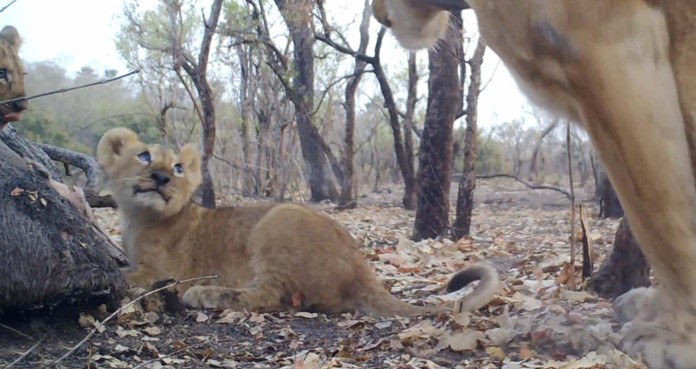
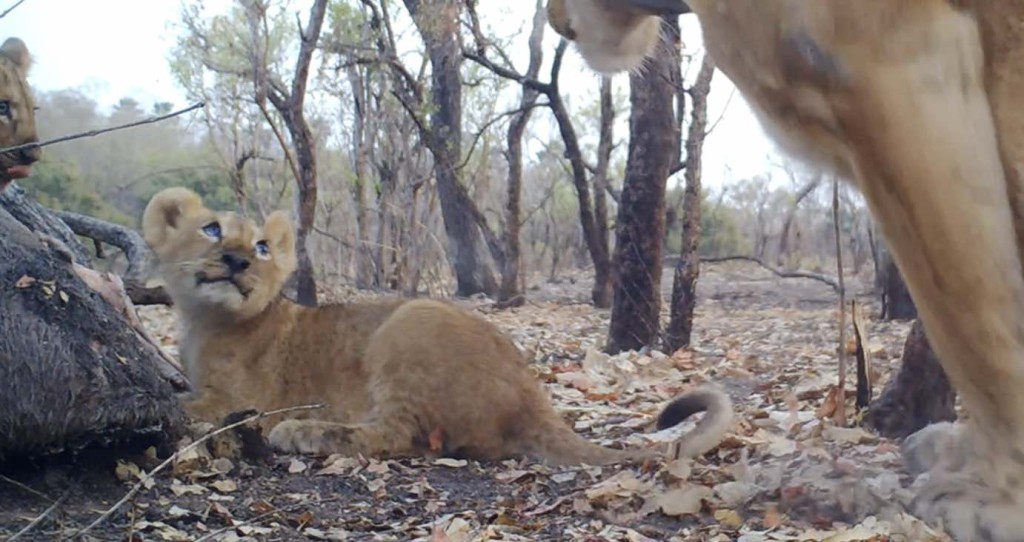
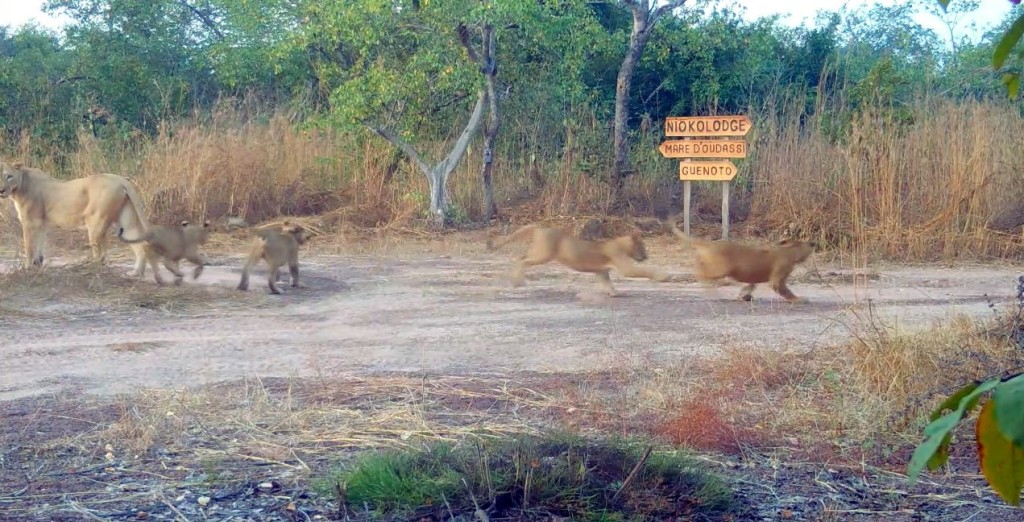
In a thrilling sign of recovery for the Critically-Endangered West African lion, camera trap footage and photos of a West African lioness and her three cubs playing, nursing, and feeding in Senegal’s Niokolo Koba National Park (NKNP) were released by the conservation outfit Panthera.
The high-definition videos and photos feature Florence, a 9 to 10-year-old GPS-collared lioness that scientists believe has now given birth to three litters, totaling nine cubs, since 2021.
Now considered the matriarch of Niokolo Koba, this lioness has contributed approximately one-third of the park’s lion population which has grown slowly from a razor’s edge pride of 10 to 15 individuals in 2011 to perhaps as many as 40 today.
Just 120-374 West African lions are estimated to remain in the wild today, with their historic range having shrunk by 99%. They are part of the Northern lion subspecies, which used to range across North Africa.
When WaL reported on NKNP’s lions last year, Panthera West and Central Africa Regional Director Dr. Philipp Henschel said that the lions had hunkered down in a tiny core area, about 10% of the park’s massive 9,000 square kilometers.
Since then, the lions have become more adventurous, and have slowly been exiting that core.
“We covered the entire park in camera traps last year and that also provided evidence of lions in areas where we didn’t know resident lions existed,” Dr. Henschel told WaL on Wednesday. “And so overall if we add that up we’re at about over a third, so about 35% or so of the park occupied by lions and it might be more, it’s not always a given that you’ll detect them”.
Lions being pride animals, some of this territorial expansion seems to be the early stages in the creation of new prides, since the camera trap arrays have picked up a coalition of pride-less males roaming around the park, all of whom might be Florence’s offspring.
“These animals we detect ranging quite widely out of this core area, and now we’ve also picked up a number of females leaving this core area,” says Dr. Henschel. “As these lions fill in the landscape the females breed and this leads to the establishment of new prides in new areas that we’re currently documenting”.
Lions at one of the road crossings in the park – Panthera, Department of National Parks, Senegal, by Kris Everatt
Against all odds
Henschel and his colleagues from Panthera arrived in Senegal’s largest national park, and the second-largest in West Africa, in 2011 when the situation was dire and uncertain.
Along with a “commendable” team of under-equipped rangers, they managed to collar Florence in the dead of night last year.
“They were never collared before so we know almost nothing about these cats,” Henschel told WaL a year ago in May.
“They were never seen. Back in the days in 2011 when we did the first survey there, I had a team of 4 people all part of the park’s staff, and of them, nobody had ever seen a lion. One of them, a driver, had already worked in the park for 10 years; he had never seen a lion”.
Now the work of restoring the lion populations is going about as well as anyone could have dared hope for. There’s much more interest from the government, which has been able to finance, train, and maintain 3 armed ranger squads that last year covered almost 9,000 kilometers of ground on their patrols, or about 35% of the park on foot.
There’s a commitment from the Park’s lead conservator who has given the green light to equip and hire 3 more ranger teams, which Henschel describes as “no small feat for the government,” which pays for real paramilitary training, and “a good salary”.
Perhaps the largest danger to the lions now is a population bottleneck, something that just comes with the territory when restoring a species from such a tiny number.
“Even when I carried out the first ever lion surveys in 2011, I did intensive searches for lion scats, lion droppings, and we already have a snapshot from 2011 when the population was extremely low at 10-15 animals, and it still looked alright,” said Dr. Henschel.
“The geneticist reassured me that the genetic diversity was still quite high and that with a possible recent collapse of the lion population but [sic] that still has intrinsic diversity within it”.
“When the geneticists looked at the lion genetics, what they found was the Senegal population contains haplotypes that cannot be found in any other lion population in the world. So these are really unique to the Senegal population. Ideally, we would leave this genetic unit intact, but it depends on the results of our genetic analysis,” said Dr. Henschel.
The analysis is expected next year, but the central government and parks department are keen to take advantage of the lions for tourism revenue. The park is truly enormous; the same size as Yellowstone in the US, and contains other rare species like leopards, and the only remaining population of West African wild dogs.
“Compared to when we started the lions are so much more visible,” says Dr. Henschel. “There’s a new lodge in the park. I spoke to the lodge manager last month and they’re now fully booked for the game viewing season, and things are moving in that direction”.
SHARE This Unbelievable Recovery With Your Own Pride…
In York, a seemingly normal apartment was hiding a historic secret for centuries until a kitchen remodeling exposed it to the light of day.
29-year-old Luke Budworth received a call from the men putting a new kitchen into his apartment. It read “did you know there was a painting behind here?”
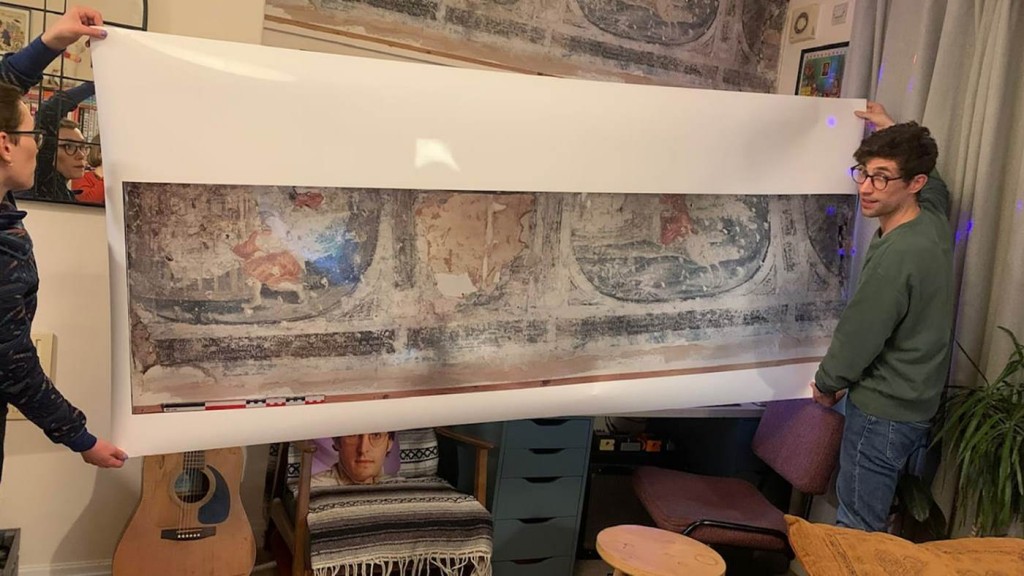
It wasn’t a painting, nor a bit of leftover Victorian wallpaper as Budworth had originally suspected, but rather a frieze dating back hundreds of years ago depicting a Biblical scene
The kitchen remodeling was finished before Budworth could see for himself, but after doing a little investigation in the open-plan living space he discovered another frieze. He contacted Historic England, the largest historical preservation society in the country, to see if they were able to make sense of the discovery.
Over time, Budworth came to learn that York had once been encircled by a wall, and his second-floor apartment was built using some of this wall. The ground floor is taken up by a cafe and charity bookshop which is listed as being a Grade II Georgian building from 1747.
released by Luke Budworth
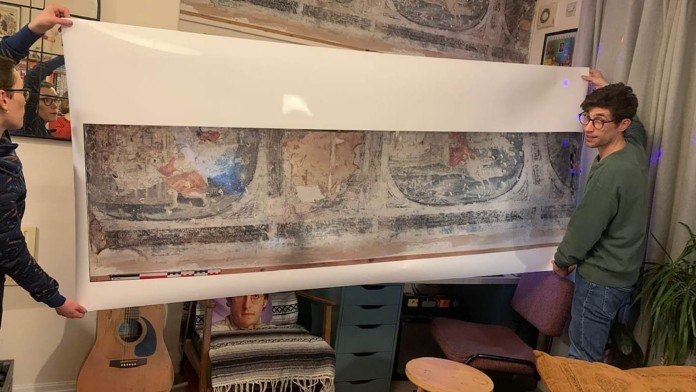
Yet his discovery dates even further back. Historic England gave him and his partner a full-size replica of the frieze to hang on the wall, and Budworth used the Biblical imagery as a reference and managed to find a picture exceedingly similar from a book called Emblems written in 1635 written by the poet Francis Quarles.
Historic England explained that pictures such as those in the frieze fell out of fashion by the year 1700, so the work was done between those two dates, potentially placing it nearly 400 years old.
“They raise various questions about the ages of the buildings in this row of historic homes and the history of Micklegate itself,” Historic England told CNN. “Finds like this tell us that our historic homes have many secrets and we’ve been pleased to work with this homeowner on looking after these murals for the future.”
HAVE You Ever Stumbled Upon A Bit Of History Before? Tell Us In The Comments Below…
Europe’s love of train travel is about to transform the continent’s solar energy production as the Swiss are set to begin installing solar panels in between train tracks.
The startup called Sun-Ways is waiting for a sign-off from the Federal Office of Transport to start installing their panels between the tracks near Buttes Station in the west of the country.
With the Swiss national railway network stretching beyond 2,000 miles of track, estimates place the amount of power generation at potentially beyond 1 terawatt hour or 2% of the entire gross annual consumption.
“There are over a million kilometers of railway lines in the world,” co-founder Baptiste Danichert tells SWI Swissinfo. “We believe that 50% of the world’s railways could be equipped with our system.”
A great way to incorporate solar panels into an economy is to find a place where flat ground is used by other industries, like canals, pastures, or warehousing.
Sun-Ways’ invention uses a specialized train car to lay down solar panels as if it were unrolling a carpet to save on labor costs.
At the moment, the idea is facing some pushback, including concern that the reflection of the sun off the panels could distract drivers, and that in areas with heavy snowfall, the panels would be a large waste of money.
Dust, debris, and damage from the vibrations of the rails could all potentially interfere the panels, but Sun-Ways have said they are taking all of this into account with the design and materials of the panels. For dust, they added that brushes could be attached to the undersides of trains to clean the panels as they drive by.