All News - Page 298 of 1715 - Good News Network
Home Blog Page 298

Mom Recycles a Ton of Trash With Backyard Public Recycling Center That Collects Things the City Doesn’t

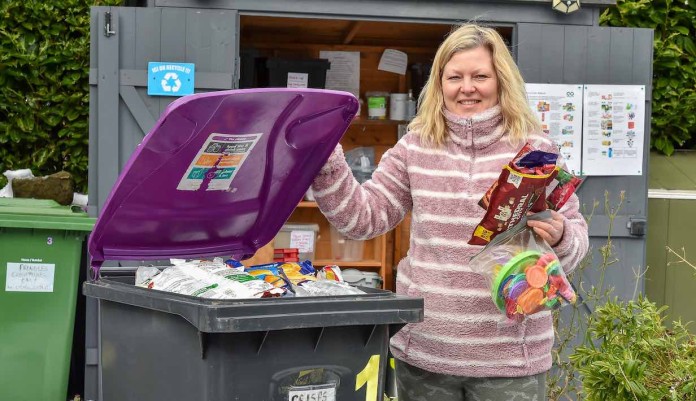
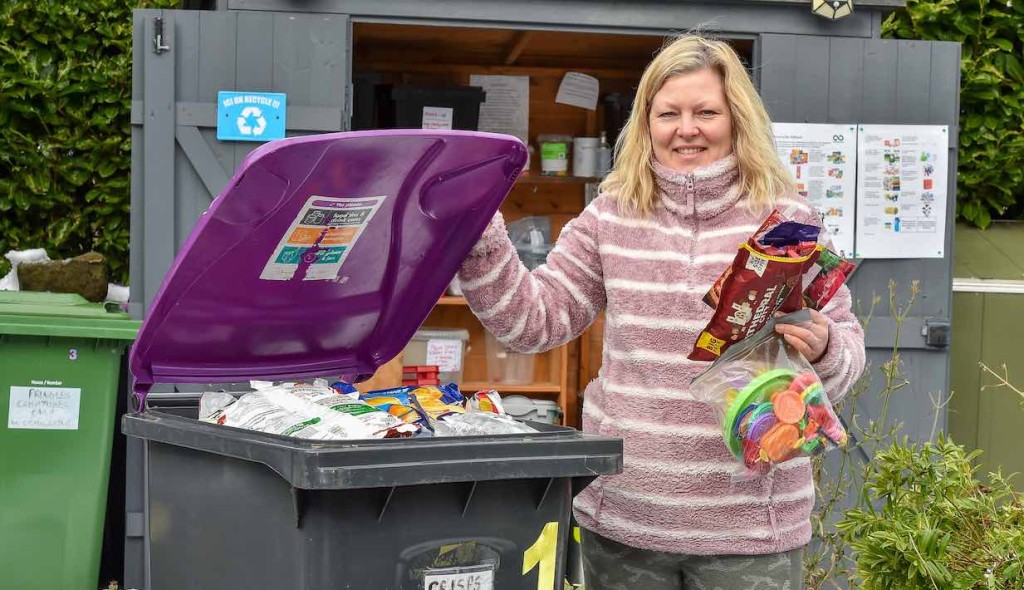
Liz Pinfield-Wells recycling litter for Terracycle - SWNS
Liz Pinfield-Wells recycling litter for TerraCycle – SWNS

An English woman has found her calling and recycled more than 2,000 pounds of trash after setting up a drop-off point in her garden shed for people to leave items that garbage men don’t collect.

Liz Pinfield-Wells built the DIY recycling center following the birth of her third child after she learned she couldn’t recycle his baby food pouches.

Along with the pouches, certain food packaging, and even toothbrushes were all excluded from her town’s curbside recycling service.

Inspired to take action she set up a drop-off point at the end of her driveway in the town of Dawley, Shropshire, and encouraged the public to leave their mixed recycled items.

Since starting her green project four years ago, Liz has recycled 2,600 pounds (1,200 kg) of trash split between 30 different categories of recyclable waste that’s not taken by trash collection and raised thousands for her local community in the process.

“Our family has always done what we can, where we can as a household to help reduce our carbon footprint and recycle as much as possible,” said Liz, adding that dozens of residents leave their trash in her shed.

MORE RECYCLING EFFORTS: Zero-Waste Recycling on Mallorca Turns Crushed Stone and Ceramic into Awesome New Material

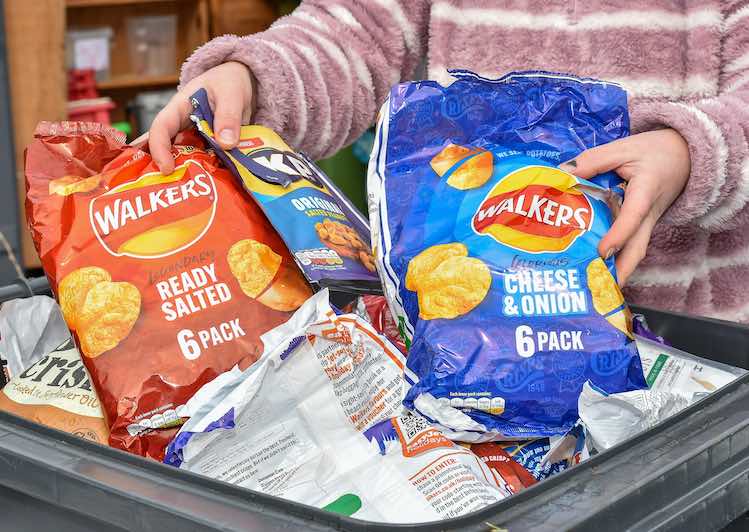
Every month, she sends off the trash in vacuum-packed bags to TerraCycle, a firm that shreds it into small plastic pellets to be made into other items such as watering cans and benches.

The weight of the junk is then converted into points for money which can be paid out twice a year to a charity or sports organization of her choice.

Liz Pinfield-Wells, 43, upcycles hard-to-recycle trash – SWNS

In the last three years, Liz has raised more than £1,000 which she has donated to her 14-year-old daughter Zoe’s gymnastic group to buy new equipment.

She has also donated a sum of the money to another local charity to buy woodchips for their community garden.

MORE RECYCLING STORIES: This Greek Island Replaced its Landfill with Recycling Plant That Now Reduces Waste by 85%

Among the items commonly deposited in the shed are bread wax wraps, home hygiene packaging, plastic bread wrappers, cheese bags, pens, rubber gloves, printer ink, and used postage stamps, none of which are recycled via the town council.

“We take Pringles tubes too, and these items have metal and plastic in so they really shouldn’t be put in your [curbside] bin,” she said. “It can sometimes seem a little daunting knowing where to start with recycling but with every small step, it gets that little bit easier.”

EVEN MORE RE-RE-RE: Dutch Visionary Helps Refugee Camp Recycling All of its Plastic Trash into New Products

“I definitely think it has helped to raise awareness to my children about the need to recycle more too.”

Liz started a Facebook group for her eco-hub recycling shed, which now has more than 1,000 members.

WATCH Liz in action below… 

SHARE This One Woman’s Efforts To Change Her World… 

New UN Treaty for the High Seas Finally Drafted After 17 Years of Debate on Language

To ensure the conservation of species and their environment, a new United Nations treaty on the sustainable use and protection of the High Seas has finally been drafted after a two-week round-the-clock marathon of talks in New York.

The agreed framework has overhauled the requirements of environmental impact assessments for natural resource extraction and set a universal standard for the procedure of conducting them and reporting findings.

Furthermore, the treaty would grant the parties to the treaty the right to establish conservation zones and protected areas in international waters, where no country would normally be able to enforce law.

The main efforts were carried out by the EU, UK, US, and China, and were rapidly accelerated since the COP15 summit in Montreal last year. However, discussions of the additions to the Convention on the Law of the Sea have been ongoing since 2004, reports New Scientist. 

Two years ago, the concept of protecting 30% of the land and oceans on Earth for the purpose of conservation was advanced at one of the summits on the parties to the Paris Climate Agreement, and many conservationists see this new treaty as the best hope of achieving that landmark.

GNN has reported on findings that when the entirety of a marine ecosystem is preserved, fishing industries benefit even if a season only lasts a short period, Among the hopes of the signees will be that diminishing catch rates for prized fish like tuna can be permanently reversed.

Regarding signatures, as with all UN treaties, they are only legally enforceable if a nation makes itself a legal party to them. Once 60 parties ratify any UN treaty, it is considered international law, and enters into force.

MORE FISHING NEWS: True ‘River Monster’ of the Amazon Has Recovered Thanks to New Sustainable Fishing

Among the work still to be done will be to decide how marine protected areas in international waters will be established, managed, and the protections on them enforced.

As was seen when the US, France, UK, Russia, China, India, Pakistan, North Korea, and Israel failed to ratify the UN ban on nuclear weapons, adopted by over 140 countries in the year 2020, or as several nations’ unwillingness to implement the Rome Statute that established the International Criminal Court, the UN has little power to force nations into compliance which don’t adopt the treaty into their own law.

MORE FROM THE UN: 100 Nations Take Action To Save Oceans from Illegal Fishing and Plastic Pollution

“The treaty lays down broad commitments to protect 30% of the high seas. Which parts will be protected, and how strictly, remains to be decided,” marine biologist Helen Scales told New Scientist.

“My hope is that the treaty will implement meaningful protection, that is strictly safeguarding areas from all potential sources of harm.”

SHARE This Conservation Breakthrough 17 Years In The Making… 

800-Year-Old Gold Hoard with Stunning Earrings Unearthed in Germany

Earring front and back - Archaeological State Office of Schleswig-Holstein
Earring front and back – Archaeological State Office of Schleswig-Holstein

Hoard Alert! The metal detectives of Europe strike gold once again—this time in Germany as bejeweled earrings and silver coins are turned up in Schleswig-Holstein.

The jewelry was all of gold and probably made by the Byzantines. The rings, earrings, and a brooch, all studded with gems, were deliberately buried along with 30 coins minted under the Danish King Valdemar II.

This helps date the burying of the hoard to around 1240 CE.

Schleswig-Holstein was called Hedeby in the times the riches were brought there. The area was part of a critical trading hub for the Danish Vikings between the 8th and 11th centuries.

The metal detectives were out surveying a well-studied plot of the second-largest Viking trading town on mainland Europe, today a UNESCO World Heritage Site.

It’s known that Norsemen used major rivers like the Volga to cross Eurasia from the Baltic Sea to the Black Sea, where they took to trading and raiding the Byzantine Empire. This great kingdom held extensive gold reserves, and they were the region’s second large power next to the Arab caliphates to the south.

MORE VIKING TREASURES: Biggest Coin Hoard in a Decade Worth $180,000 Discovered During “Metal Detecting Rally” In British Countryside

These networks reveal not only the extent of the Vikings’ reach, but also the ubiquity of inter-continental trade at the time. Regarding the hoard, it’s unknown whether they were personal items hidden during a crisis or hot property in need of fencing.

Islamic coin brooch – Archaeological State Office of Schleswig-Holstein

“An extensive north-south and east-west trade network has developed here since the early Middle Ages, in which the Mediterranean region, the North Sea, and the Baltic Sea were integrated,” Ulf Ickerodt, director of the State Archaeological Department of Schleswig-Holstein (ALSH), told Live Science in an email. “The hoard was certainly not put down by chance.”

An imitation of an Islamic coin was pierced and turned into a brooch, perhaps to showcase the exotic origins of an original that was too small for the purpose. For a people whose language was written in stem runes, Classical Arabic must have been a fascinating sight.

SHARE This Story Of Treasure And Trading With Your Friends… 

“Courage is the ladder on which all the other virtues mount.” – Clare Boothe Luce

Quote of the Day: “Courage is the ladder on which all the other virtues mount.” – Clare Boothe Luce

Photo by: Elie Khoury

With a new inspirational quote every day, atop the perfect photo—collected and archived on our Quotes page—why not bookmark GNN.org for a daily uplift?

Researchers Film Mussels Squirting Offspring Through the Air, a Never-Before-Seen Tactic for Preservation-LOOK

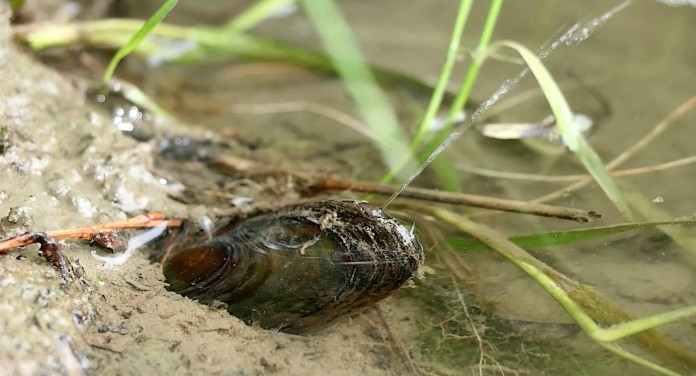
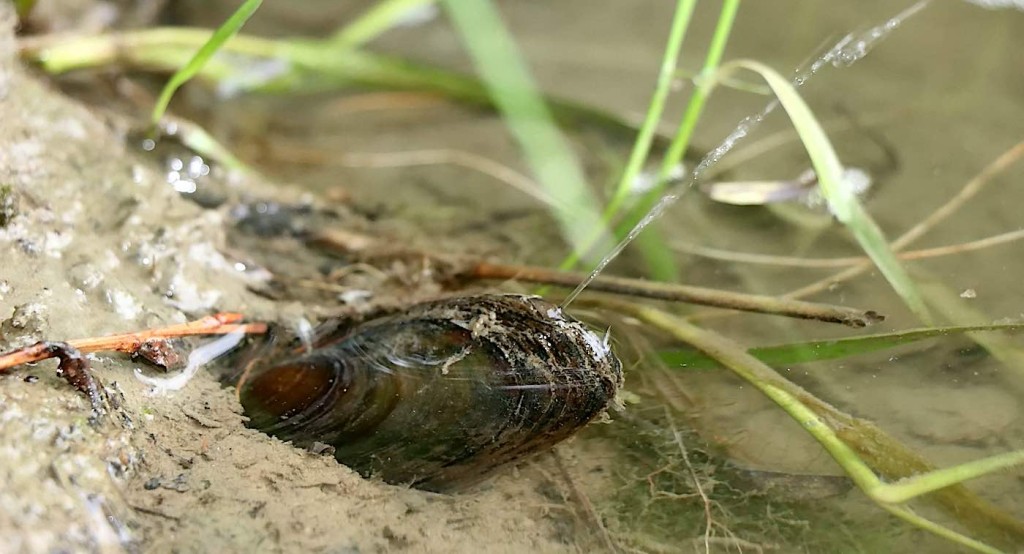
The endangered freshwater mussel, Unio crassus, squirts out regular water jets that land in the river water up to a metre away. Remarkable squirting mussels have been captured on film. See SWNS story SWMRmussels. Cambridge researchers have observed a highly unusual behaviour in the endangered freshwater mussel, Unio crassus. In spring, female mussels were seen moving to the water’s edge and anchoring into the riverbed, with their back ends raised above the waterline. Then they squirted out regular water jets, which landed in the water up to a metre away. Squirting cycles lasted 3-6 hours. This behaviour has never been seen in any other mussel species. The jets disturb the river surface and attract fish. Mussel larvae in the jets can then attach to the gills of the fish and complete their metamorphosis into adults.
The endangered freshwater mussel squirting – SWNS

British researchers have filmed endangered mussels squirting their offspring through the air—a never-before-seen tactic believed to increase their lifespan.

Experts at the University of Cambridge filmed female mussels—which don’t have a head or brain—moving to the water’s edge and anchoring into the riverbed. With their back ends raised above the waterline, the freshwater mussel (Unio crassus) squirted jets of water containing viable mussel larvae.

They shot long distances from the banks of the Biała Tarnowska River in Poland, disturbing the river’s surface and attracting fish to which the mussel larvae could attach themselves.

Researchers at Cambridge’s department of zoology said in a report the “squirting cycles” lasted between three and six hours.

“Who’d have thought that a mussel, that doesn’t even have a head or a brain, knows to move to the river margin and squirt jets of water back into the river during springtime?” said lead author of the report, Professor David Aldridge. “It’s amazing!”

Unlike other mussel species, Unio crassus has a limited range of suitable host fishes. They include minnows and chub.

These species were attracted to the falling water jets, the researchers said.

POPULAR: Kayaker Singing in Hopes of Attracting Beluga Whales Never Imagined They Were Actually Listening

They think the mussels squirt water jets to increase the chances of their larvae attaching to the most beneficial host fishes.

By being squirted into the air and not the water, shown in the video below, the larvae are propelled greater distances from the parent mussel.

Six squirts were collected from each mussel for analysis, and researchers confirmed they contained viable mussel larvae.

Before now, there was only anecdotal evidence of this behavior, and some scientists thought the water jets might be the mussel expelling feces.

POPULAR: Once Devastated Pacific Reefs See Amazing Rebirth, Recovering With ‘Shocking Speed’

This behavior could explain why Unio crassus is an endangered species: Climbing out of the water to squirt makes it vulnerable to floods, destruction of river margins, and predators like mink. And its need for specific host fishes links its survival to theirs.

Understanding how this species completes its life cycle is important for its conservation under changing environmental conditions.

The study carried out during spring, funded by the Woolf Fisher Trust, was published in the journal Ecology.

SHARE The Cool Animal Behavior With Learners on Social Media…

Taking Care of Your Teeth Could Help Prevent Arthritis and Joint Pain

Pixabay
Pixabay

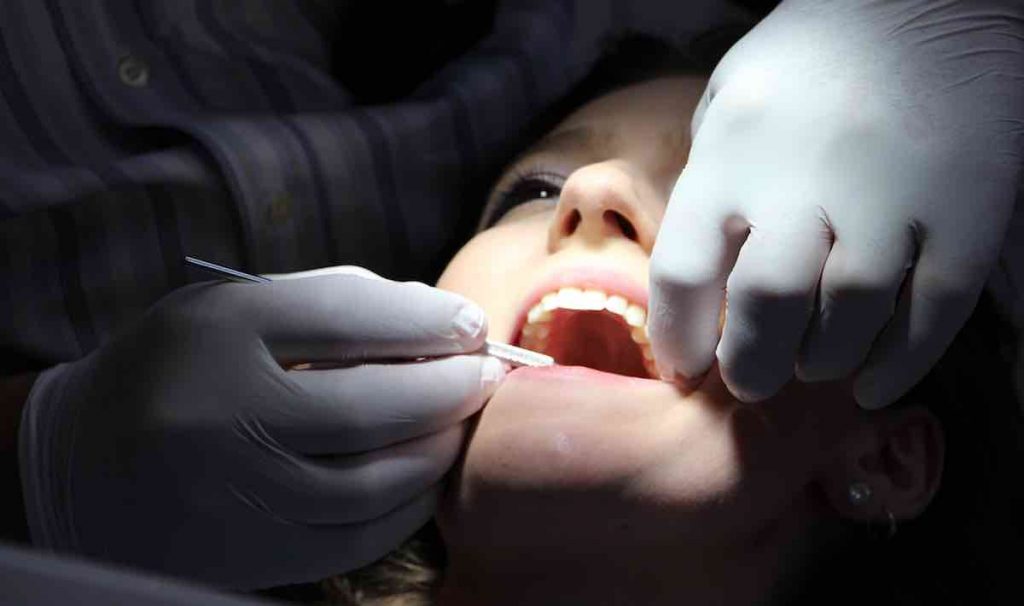
Taking care of your teeth could help prevent chronic joint pain, according to a scientist who spotted a clue in discarded data.

Rice University computational biologist Vicky Yao found traces of bacteria associated with periodontal disease in samples collected from rheumatoid arthritis patients, helping spur research that confirmed a connection between the diseases.

Tracing this connection between the two conditions could help develop therapies for rheumatoid arthritis, an autoimmune inflammatory disease that attacks the lining of the joints and can cause heart-, lung- and eye-problems.

It underlines the importance of regular brushing—and the new research approach also could prove fruitful for other diseases, such as cancer.

“I was curious about this tool that allowed you to detect microbes floating around in human samples,” said Dr. Yao, the lead author of the study published in the journal Science Translational Medicine. “This data perhaps holds more information than we are immediately able to derive from it.”

Yao’s hunch was confirmed when she took a deeper look into data collected from rheumatoid arthritis patients by colleagues at Rockefeller University and the Howard Hughes Medical Institute working with on a different project that tracked changes in gene expression during arthritis attacks.

RELATED: Cure for Osteoarthritis Could Be ‘No Further Than the End of Your Nose’, Researchers Find

Studying these bacteria they found that germs associated with gum disease changed consistently prior to arthritic flare ups.

“One of the things that came up was, how cool would it be if you could prescribe some kind of mouthwash to help prevent rheumatoid arthritis flares.”

The discovery of meaningful information in the microbial signatures in the leftover human samples inspired her to take a similar approach in looking at data from cancer patients.

“Now, we are doing something similar in looking at cancer. The hope here is that if we find some interesting microbial or viral signatures that are associated with cancer, we can then identify productive experimental directions to pursue.

CHECK OUT: Molecule Combo Actually Reverses Arthritis in Human Cartilage and Rats, Says ‘Exciting’ New Study

“For instance, if having a tumor creates this hotbed of specific microbes that we recognize, then we can maybe use that knowledge as a means to diagnose the cancer sooner or in a less invasive or costly way.

“Or, if you have microbes that have a very strong association with survival rates, that can help with prognosis. And if experiments confirm a causal link between a specific virus or bacteria and a type of cancer, then, of course, that could be useful for therapeutics.”

One of the better known examples of a pathogen associated with cancer is the human papillomavirus (HPV).

Dr. Yao added, “When we did the same exercise looking at cervical cancer tumor samples, we consistently detected the virus.

“I am really interested in using computational approaches to bridge the gap between available experimental data and ways to interpret it.

MORE: There’s ‘No Link’ Between Exercise and Developing Arthritis in the Knee

“Computational analysis is a way to help interpret data and prioritize hypotheses for clinicians or experimental scientists to test.”

SHARE The Health Tip With Friends and Family on Social Media…

Dinosaur With Biggest Claws Ever Discovered Was ‘Edward Scissorhands on Speed’ Scientists Say

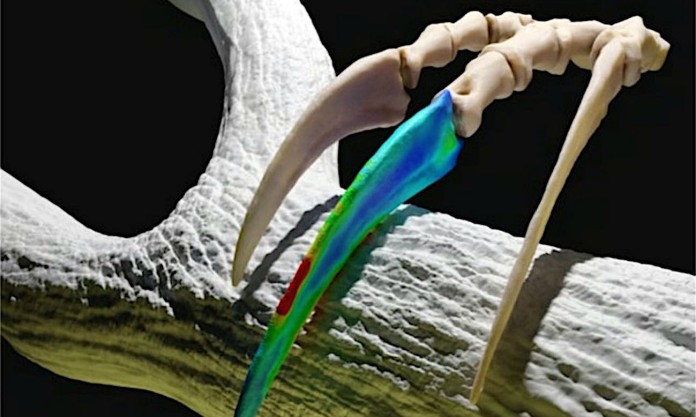
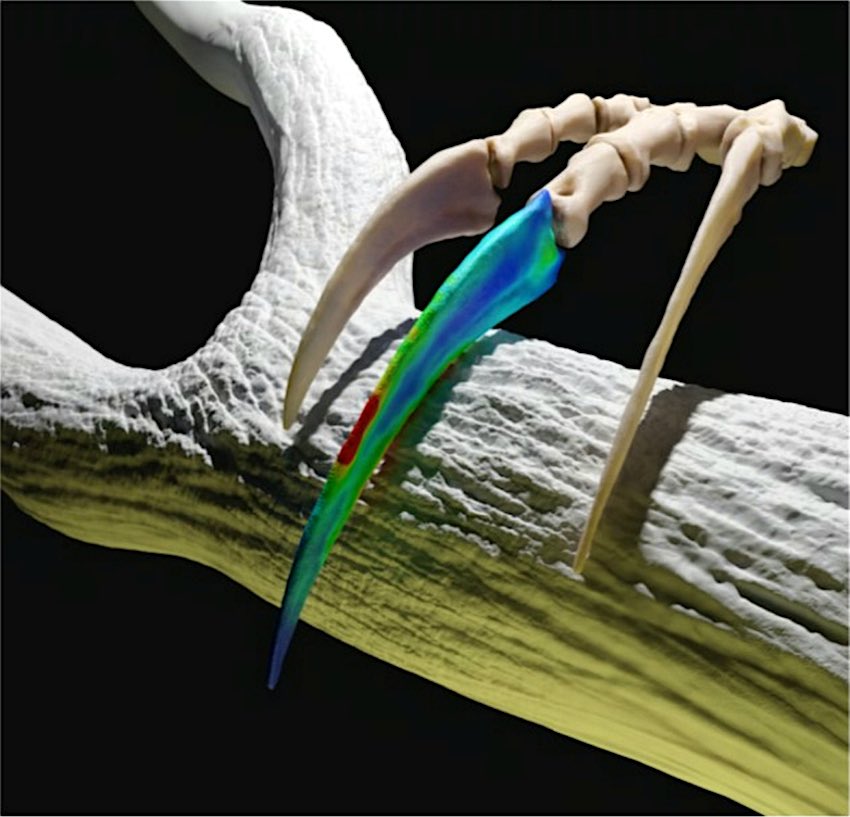
Therizinosaurs claw compared with tree – Image credit: Shuyang Zhou for the 3D modeling and functional scenario restoration – SWNS

This bizarre dinosaur had the biggest claws ever discovered, showing itself to be like an ‘Edward Scissorhands on speed’, say scientists.

But the purpose of its terrifying talons have remained a mystery—until now.

“Therizinosaurus is famous for its sickle-like claws, each as long as a samurai sword: Edward Scissor-hands on speed,” said Dr. Chun-Chi Liao, an expert from University of Bristol and the Institute of Vertebrate Paleontology and Paleoanthropology who co-authored the study.

“We all saw Therizinosaurus in ‘Jurassic World’ hitting deer and killing the giant predator Giganotosaurus. However, this is unlikely. These long, narrow claws were too weak for combat. Our engineering simulation shows that these claws could not withstand much stress.”

The beast’s terrifying talons were more than three-feet long (1-meter)—but instead of using them to kill its prey, they were used like plumage to attract mates—like Johnny Depp’s razor sharp ‘fingers’ helped attract a love interest in the film co-starring Winona Ryder.

According to the new research, the Therizinosaurus (‘giant claw’) lived 75 million years ago and belonged to the theropods, a group of predominantly meat-eaters that included T. Rex and Velociraptor.

Lead author Zichuan Qin, a PhD student at the University of Bristol, developed computer simulations to identify functions based on detailed computations. Claws were represented in three dimensions from CT scans and modeled for stress and strain using engineering techniques.

RELATED: Bizarre Creature From China Had a Dinosaur Head on Bird’s Body – a Missing Link From 120 Million Years Ago

“Alvarezsaurs and therizinosaurs are definitely the strangest cousins among dinosaurs,” said Qin’s supervisor Professor Michael Benton. “Alvarezsaurs were the tiniest dinosaurs ever, the size of chickens, with robust single claws, but their closest relative, the therizinosaurs, evolved in the exact opposite path.”

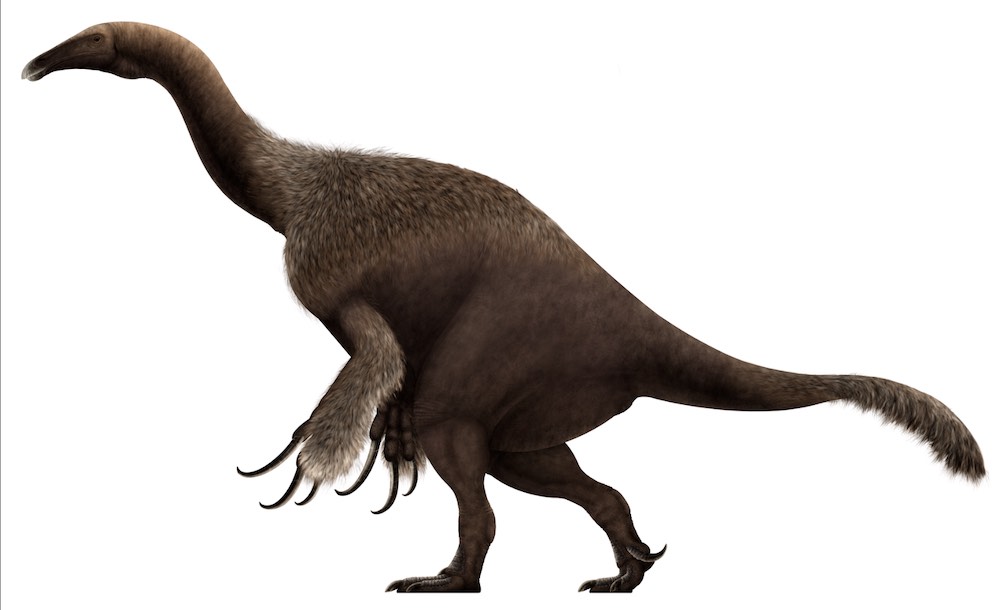
It reached up to 40-feet long and six tons in weight. Roaming conifer forests on the edges of the Mongolian desert, it ate plants and meat, using its long neck to stretch for leaves on tall trees.

Life restoration of Therizinosaurus – Image credit: PaleoNeolitic, CC 4.0

“Not all therizinosaur hand claws were so useless in combat, but most other related species could use their claws as powerful hooking tools when feeding on leaves from the trees,” said Dr. Liao. “So we conclude the largest claws of any animal ever were actually useless in mechanical function, and so must have evolved under sexual selection to be used in display.”

WATCH: How Texas Man Found Huge Dinosaur Tracks in Riverbed Dried From Drought

The team concluded that the adult Therizinosaurus could wave the claws at a competitor and effectively say, ‘Look at me; back off’—or wave them around in some way like a peacock displaying its tail to attract females for mating.

Therizinosaurus also had weird feet, resting on four toes while standing and walking. Most theropods only had three.

“Science and technology cannot bring dinosaurs back to life, but advanced computing and engineering techniques can show us how extinct animals lived,” said Bristol University Professor Emily Rayfield, co-author of the study published in the journal Communications Biology.

“Especially for extinct animals like alvarezsaurs and therizinosaurs, they are so bizarre that we even can’t find any living animals like them.

CHECK OUT: Bizarre Creature From China Had a Dinosaur Head on Bird’s Body – a Missing Link From 120 Million Years Ago

“Luckily, advanced technology can help us to simulate, on a computer, the functioning of extinct animals using fundamental engineering and biomechanical principles.

“This study shows very well how selection for function can lead to the emergence of specific, sometime very bizarre, forms.”

SHARE With Dinosaur Fans on Social Media…

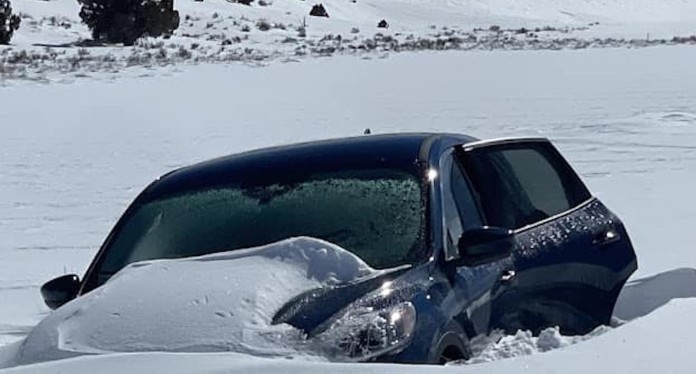
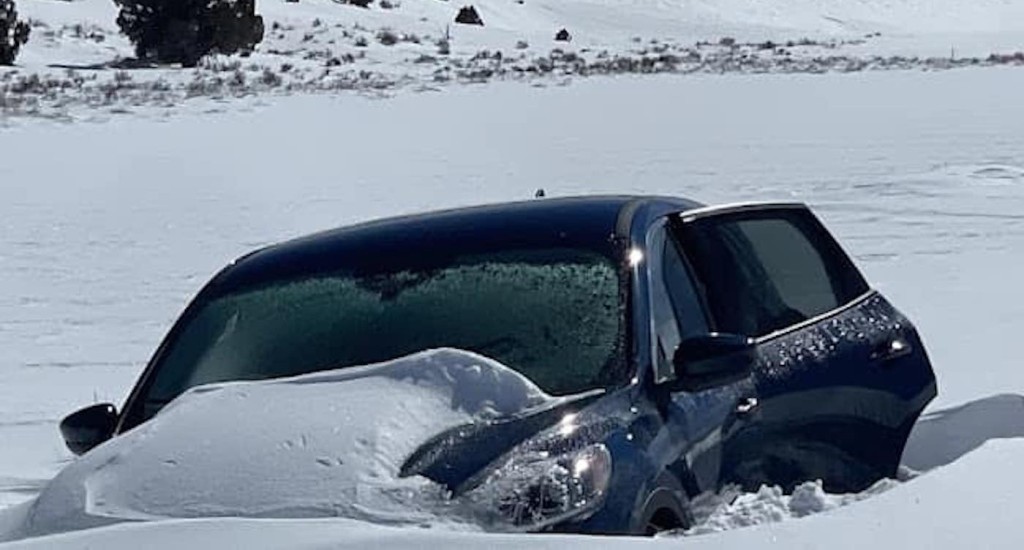
81-Year-old Survives Nearly a Week Stuck in Snowbank With Only Croissants and Candy

Inyo County Sheriff's Office – Facebook
Inyo County Sheriff’s Office – Facebook

An 81-year-old man survived on croissants, candy, and biscotti after a snowstorm left him stranded on a desolate California highway alone for nearly a week.

Jerry Jouret’s family eventually called the Inyo County Sheriff’s Office to report a missing person after the mathematician and former NASA employee never made it to his destination of Gardnerville, 3 hours away from his mountain house in Big Pine.

Apparently, he had set off in good weather. There was a snowstorm in the forecast, but Jouret thought he could arrive safely before the winter weather began.

Over the following days, a series of winter storms continued to affect the region, which delayed the county’s Search and Rescue team from launching a search along Hwy 168 for a day.

On March 1, five days after Mr. Jouret set out, two attempts to find him were unsuccessful. However, on March 2, with support from California Highway Patrol helicopters, they identified a cellular ping from his phone somewhere in the Gilbert Pass area.

CNN reports that the petite man was ill-prepared for the weather, wearing only a light windbreaker. “A light quilt and a hotel bath towel were the only things Jouret had to keep himself warm.”

He smartly conserved his car battery and gas for several days—only starting the SUV’s engine periodically to warm up.

STAY SAFE WITH THESE TIPS: 7 Things You Must Keep in Your Car – Learn From Stranded Drivers on Freezing Interstate Highways For 21-48 Hours

He rolled down his window occasionally to eat snow—but that survival technique to keep himself hydrated backfired on the third day when the battery died while rolling up the window. That’s probably when he wished modern cars also featured non-electric manual crank windows in case of emergency, because it then remained open a few inches for the remainder of his ordeal.

Amid the search, one of the helicopter pilots “spotted something he initially thought was a large rock,” reported CNN. “A closer look revealed a vehicle—and the pilot spotted an arm waving out of the small opening in the car window.”

Miraculously, the senior was discharged from the hospital later that evening, suffering only from dehydration.

The Inyo County Sheriff’s Office shared the story on Facebook saying, “The success of this mission was the result of the many volunteers who commit their personal time to serve as members of Inyo County Search and Rescue, Sheriff’s Office, CHP Air Operations, Caltrans District 9, as well as many members of the community – both near and far – who offered planning, logistical, and moral support.”

WINTER HERO: Utah Man Jumps Into Icy River to Save Woman Attempting Suicide at the Same Spot Where he First Dated His Wife

Officials took the opportunity to remind everyone to always be prepared for unexpected events and have a safety plan in place when traveling through the mountains. (Check out the 7 things you should always keep in your car.)

“If it is snowing, make sure you are prepared…and bring extra supplies with you.”

SHARE The Miraculous Rescue on Social Media…

“The best place to find God is in a garden. You can dig for him there.” – George Bernard Shaw

Quote of the Day: “The best place to find God is in a garden. You can dig for him there.” – George Bernard Shaw

Photo by: Behzad Ghaffarian

With a new inspirational quote every day, atop the perfect photo—collected and archived on our Quotes page—why not bookmark GNN.org for a daily uplift?

A Cat and Rabbit Team-Up to Co-parent Their Litters and Feed Each Other’s Babies (LOOK)

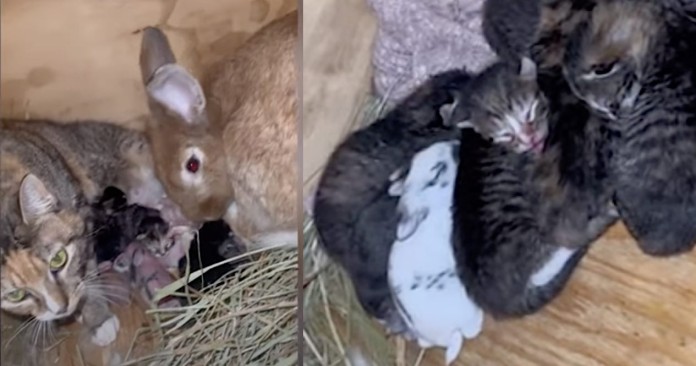
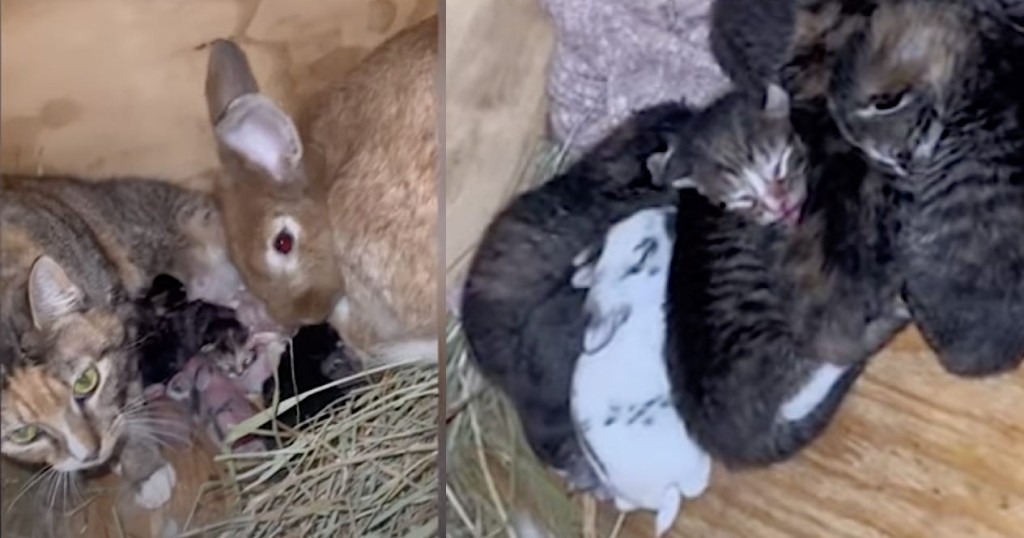
Screenshots from video by Destiny Hampton – SWNS

A cat and a rabbit have teamed up as parents of both their litters after they gave birth days apart—and they even feed each other’s babies.

The bunny known as Amy became an inter-species nanny more than two weeks ago, after Chrissy the cat moved her kittens into the rabbit hutch.

Destiny Hampton had set up a hutch for Amy and her brood, but after checking in one day, discovered Chrissy snuggling up with her own newborns.

The discovery came as a big surprise because Hampton didn’t even know the feline was pregnant.

The photo on the left shows the moment Hampton walked in on the unlikely natal scene.

“I was a little worried at first that they might fight, or hurt each other,” said the 47-year-old woman.

The wildlife rescuer and owner of Roberson Creek Farm in Tobaccoville, North Carolina, attempted to separate the pair out of concern for the babies.

But that turned out to be a mistake. Both mothers immediately stopped feeding their young as a result of the stress.

The animals were not only getting along well, they were co-parenting their young. Chrissy was feeding the baby rabbits.

Amy is only feeding her young once a day, so Chrissy is often picking up the slack.

“They get along great,” exclaimed Hampton on social media. “They all want to be together, the babies and the mothers.”

“It’s so weird, because cats move their babies a lot (but) Chrissy… doesn’t.”

“I think maybe she knew that the rabbit mom wasn’t making enough milk and wanted to help her.

The main reason Hampton was shocked is because Chrissy “isn’t the nicest cat.”

LOOK: This Perfectly Spherical Dog With 100K Instagram Followers Reminds Us That Cute Comes in All Shapes and Sizes

“Chrissy is feral. She won’t let me touch her, but she loves Amy apparently.

“The babies are all doing great, and cuddle all the time.”

MORE INTER-SPECIES: Fearless Rats Are Caring for Orphan Kittens at This Loving Cat Cafe

Watch a recent video below… Follow their progress on the Farm’s Facebook page or on TikTok.

@roberson.creek.farm Y’all!!! I’m not gonna lie. I got a little teary-eyed when she put her arm around the little bunny 🥹❤️ this is by far my favorite video I’ve taken so far. Chrissy is such a good mama. ##fyp##foryou##trending##cabbits##rescueanimals##rescuefarm ♬ Nothing's Gonna Stop Us Now - Starship

DON’T FORGET to Share This Adorable Story With Animal-Lovers on Social Media…

17th Century Gold Ring Worth $12K Discovered by Retired Teacher in His Back Garden

Noonans Auction House / SWNS

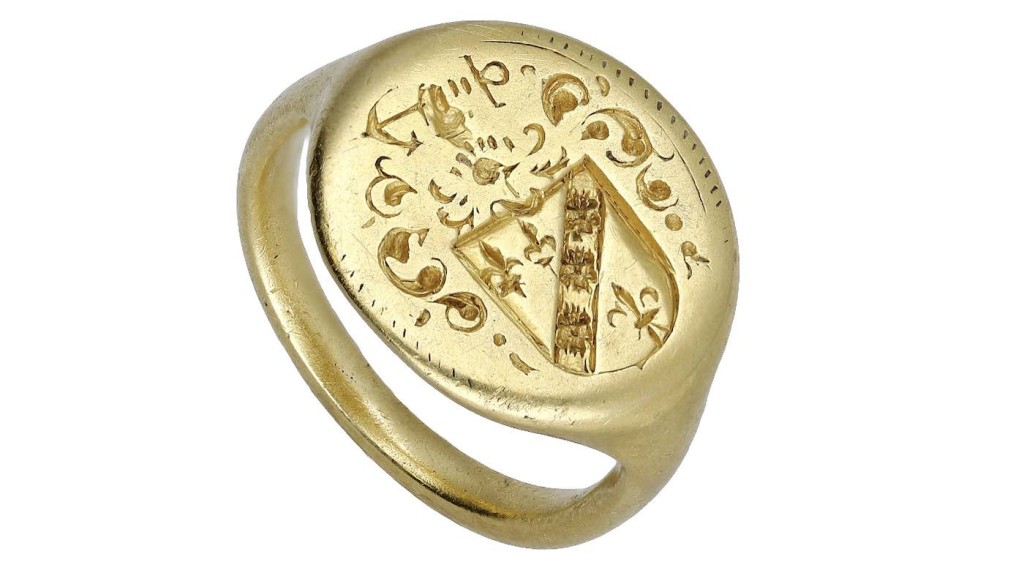
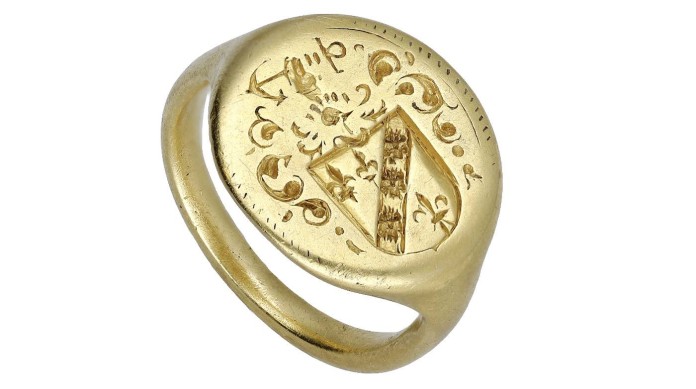
A 17th-century gold ring is estimated to fetch at least $12,000 at a British auction, after being found by a retired school teacher in his back garden.

The historic gold seal ring from 1620 was discovered by Richard McCaie, whilst he was planting a shrub.

The 71-year-old discovered the ring about 10-inches deep on the grounds of his 16th century English farmhouse in Braunton, Devon.

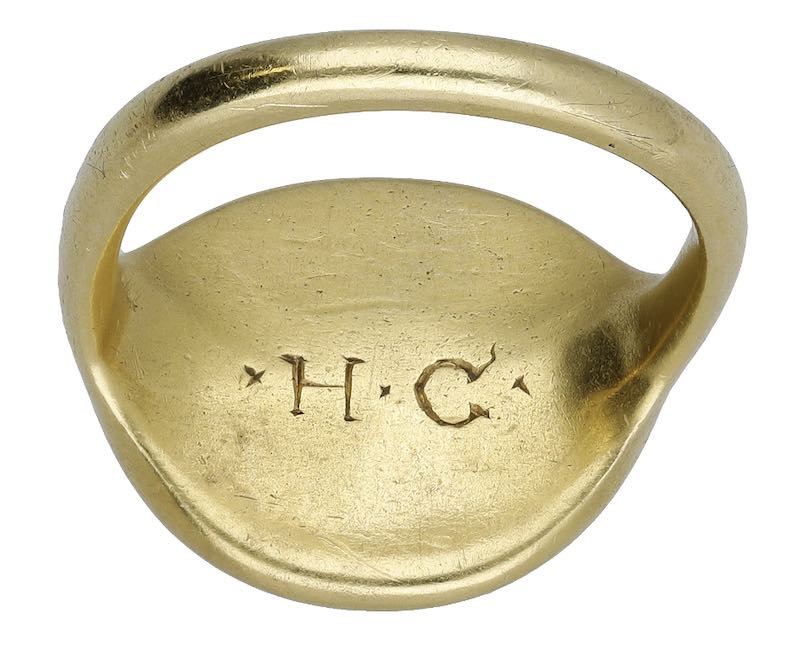
“The ring dates from 1620 and very likely belonged to Humphrey Cockeram of Cullompton in Devon,” said Nigel Mills, artifacts and antiquities consultant at Noonans auction house.

“The ring bears a seal with the coat of arms of the Cockeram family and the initials H C behind. Humphrey was recorded as the head of the family in 1620 and lived at Hillersdon Manor in the early 17th century which is 42 miles east of where it was found.

“The family were great patrons of the church, and their name comes from old English ‘Coccan’ meaning dweller by the stream.”

Noonans Auction House / SWNS

Mr. McCaie recalled the moment he uncovered the treasure.

SURPRISE: Metal Detector Left Him Stunned After Unearthing Ancient Ring Belonging to the Sheriff of Nottingham

“I was very excited when I dug up the ring, which has now been recorded on the Portable Antiquities Database.

“We were amazed when Noonans told us the value and we are planning to use the proceeds from the sale to help our children.”

LOOK: The First Time a 10-Year-old Boy Uses His Birthday Metal Detector, He Unearths a Centuries-Old Sword

The ring is coming up for auction on Tuesday, March 14.

UNEARTH This Good News Gold on Social Media…

Brisk Walking for Just 11 Minutes a Day Slashes Risk of Premature Death by 23% Says Study of 30 Million People

Henry Xu
Henry Xu

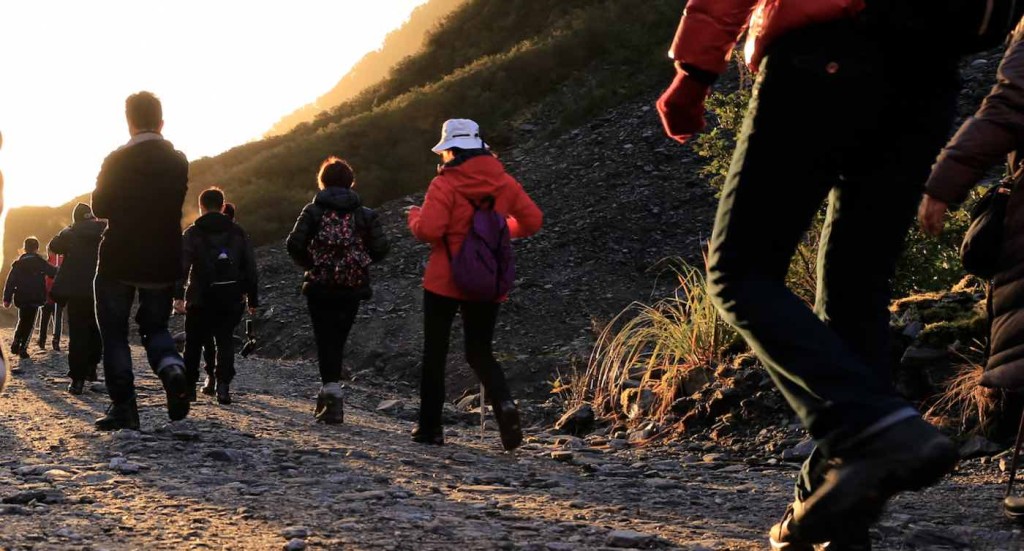
Walking at a brisk pace for just 11 minutes a day slashes the risk of a premature death by almost a quarter, according to new research.

The team led by researchers at the University of Cambridge showed how one in ten early deaths could be prevented if everyone managed to reach the threshold of 75 minutes per week of moderate-intensity physical activity.

The study demonstrated that this would be sufficient to lower the risk of heart disease and stroke–the leading causes of death globally—as well as a number of cancers.

To explore the amount of physical activity necessary to have a beneficial impact on several chronic diseases and premature death, researchers from the Medical Research Council (MRC) Epidemiology Unit at the University of Cambridge carried out a systematic review and meta-analysis, pooling and analyzing cohort data from all of the published evidence. This approach allowed them to bring together studies that on their own did not provide sufficient evidence and sometimes disagreed with each other to provide more robust conclusions.

In total, they looked at results reported in 196 peer-reviewed articles, covering more than 30 million participants from 94 large study cohorts, to produce the largest analysis to date of the association between physical activity levels and risk of heart disease, cancer, and early death.

POPULAR: Six Lifestyle Choices to Slow Memory Decline Identified in 10-Year Study of Aging

The researchers found that, outside of work-related physical activity, two out of three people reported activity levels below 150 minutes per week of moderate-intensity activity, the amount recommended by NHS, Britain’s national health service.

Broadly speaking, they found that beyond 150 min per week of moderate-intensity activity, the additional benefits in terms of reduced risk of disease or early death were marginal. But even half this amount came with significant benefits: accumulating 75 min per week of moderate-intensity activity brought with it a 23% lower risk of early death.

“If you are someone who finds the idea of 150 minutes of moderate-intensity physical activity a week a bit daunting, then our findings should be good news,” said Dr. Soren Brage, lead author of the study published in the British Journal of Sports Medicine.

If you find that 75 minutes a week is manageable, then you could try stepping it up gradually to the recommended full 150 minutes, he suggested.

RELATED: Cardiologist Reveals Top 10 Heart Symptoms You Should Never Ignore, But Many People Do

Specifically, 75 minutes per week was enough to reduce the risk of developing cardiovascular disease by 17% and cancer by 7%. For some specific cancers, the reduction in risk was greater – head and neck, myeloid leukaemia, myeloma, and gastric cardia cancers were between 14-26% lower risk. For other cancers, such as lung, liver, endometrial, colon, and breast cancer, a 3-11% lower risk was observed.

“We know that physical activity, such as walking or cycling, is good for you, especially if you feel it raises your heart rate. But what we’ve found is there are substantial benefits to heart health and reducing your risk of cancer even if you can only manage 10 minutes every day,” stated Professor James Woodcock from the MRC Epidemiology Unit.

The researchers calculated that if everyone in the studies had completed a full 150 min per week of moderate-intensity activity, around one in six (16%) early deaths would be prevented. One in nine (11%) cases of cardiovascular disease and one in 20 (5%) cases of cancer would be prevented.

MORE GREAT TIPS: Five Key Sleeping Habits That Can ‘Add Years’ to Your Life Identified by Scientists

However, even if everyone managed at least 75 min per week of moderate-intensity physical activity, around one in ten (10%) early deaths would be prevented. One in twenty (5%) cases of cardiovascular disease and nearly one in thirty (3%) cases of cancer would be prevented.

“Moderate activity doesn’t have to involve what we normally think of exercise, such as sports or running,” said Dr. Leandro Garcia from Queen’s University Belfast. “Doing activities (like dancing) that you enjoy and that are easy to include in your weekly routine is an excellent way to become more active.”

Sometimes, replacing some habits is all that is needed. For example, park your car in the furthest parking spot at your workplace or on shopping trip, then briskly walk to the door—or climb the stairs instead of using the elevator.

MORE SUGGESTIONS: Drinking Black Tea May Reduce the Risk of Early Death From Heart Disease, Says Study of Half-Million Brits

DELICIOUS CANCER BREAKTHROUGH: Pomegranates Found to Significantly Fuel Tumor-Fighting Immune Cells

The research was funded by the Medical Research Council and the European Research Council.

WALK This Inspiring Suggestion Over to Loved Ones on Social Media…

Your Inspired Weekly Horoscope From Rob Brezsny: A ‘Free Will Astrology’

Our partner Rob Brezsny provides his weekly wisdom to enlighten our thinking and motivate our mood. Rob’s Free Will Astrology, is a syndicated weekly column appearing in over a hundred publications. He is also the author of Pronoia Is the Antidote for Paranoia: How All of Creation Is Conspiring To Shower You with Blessings. (A free preview of the book is available here.)

Here is your weekly horoscope…

FREE WILL ASTROLOGY – Week of March 11, 2023
Copyright by Rob Brezsny, FreeWillAstrology.com

PISCES (Feb. 19-March 20):
A financial advisor once told me I could adopt one of three approaches to running my business: 1. Ignore change; 2. always struggle with change, half-immobilized by mixed feelings about whether to change or stay pat; 3. learn to love and thrive on change. The advisor said that if I chose either of the first two options, I would always be forced to change by circumstances beyond my control. The third approach is ultimately the only one that works. Now is an excellent time for you Pisceans to commit yourself fully to number three—for both your business and your life.

ARIES (March 21-April 19):
Repressed feelings and dormant passions are rising to the surface. I bet they will soon be rattling your brain and illuminating your heart, unleashing a soothing turbulence of uncanny glee. Will you get crazy and wise enough to coax the Great Mystery into blessing you with an inspirational revelation or two? I believe you will. I hope you will! The more skillful you are at generating rowdy breakthroughs, the less likely you are to experience a breakdown. Be as unruly as you need to be to liberate the very best healings.

TAURUS (April 20-May 20):
You finally have all you need to finish an incomplete mission or resolve a mess of unsettled karma. The courage and determination you couldn’t quite summon before are now fully available as you invoke a climax that will prepare the way for your awe-inspiring rebirth. Gaze into the future, dear Taurus, and scan for radiant beacons that will be your guides in the coming months. You have more help than you know, and now is the time to identify it and move toward it.

GEMINI (May 21-June 20):
Our sun is an average star in a galaxy of 100 billion stars. In comparison to some of its flamboyant compatriots, it’s mediocre. Over 860 light years away is a blue-white supergiant star called Rigel, which is twice as hot as our sun and 40,000 times brighter. The red supergiant Antares, over 600 light years away, has 12 times more mass. Yet if those two show-offs had human attitudes, they might be jealous of our star, which is the source of energy for a planet teeming with 8.7 million forms of life. I propose we make the sun your role model for now, Gemini. It’s an excellent time to glory in your unique strengths and to exuberantly avoid comparing yourself to anyone else.

CANCER (June 21-July 22):
The philosophical principle known as Occam’s razor asserts that when trying to understand a problem or enigma, we should favor the simplest explanation with the fewest assumptions. While that’s often a useful approach, I don’t recommend it in the coming weeks. For you, nuances and subtleties will abound in every situation. Mere simplicity is unlikely to lead to a valid understanding. You will be wise to relish the complications and thrive on the paradoxes. Try to see at least three sides of every story. Further tips: 1. Mysteries may be truer than mere facts. 2. If you’re willing to honor your confusion, the full, rich story will eventually emerge.

LEO (July 23-Aug. 22):
“There are no unsacred places,” wrote Leo poet Wendell Berry. “There are only sacred places and desecrated places.” Poet Allen Ginsberg agreed. “Holy! Holy! Holy! Holy! Holy!” he wrote. “Holy the solitudes of skyscrapers and pavements! Holy the cafeteria! Holy the mysterious rivers of tears under the streets! Holy the sea, holy the desert, holy the railroad.” With Berry’s and Ginsberg’s prompts as your inspiration, and in accordance with current astrological imperatives, I invite you to invigorate your relationship with sacredness. If nothing is sacred for you, do what it takes to find and commune with sacred things, places, animals, humans, and phenomena. If you are already a lover of sacred wonders, give them extra love and care. To expand your thinking and tenderize your mood, give your adoration to these related themes: consecration, sublimity, veneration, devotion, reverence, awe, and splendor.

VIRGO (Aug. 23-Sept. 22):
My favorite Buddhist monk, Thich Nhat Hanh, wrote the following: “In us, there is a river of feelings, in which every drop of water is a different feeling, and each feeling relies on all the others for its existence. To observe it, we just sit on the bank of the river and identify each feeling as it surfaces, flows by, and disappears.” I bring this meditation to your attention, Virgo, because I hope you will do it daily during the next two weeks. Now is an excellent time to cultivate an intense awareness of your feelings—to exult in their rich meanings, to value their spiritual power, to feel gratitude for educating and entertaining you.

LIBRA (Sept. 23-Oct. 22):
How might your life come into clearer focus when you uncover secrets that inspire your initiative and ingenuity? What happens when resources that had been inaccessible become available for your enjoyment and use? How will you respond if neglected truths spring into view and point the way toward improvements in your job situation? I suspect you will soon be able to tell me stories about all this good stuff. PS: Don’t waste time feeling doubtful about whether the magic is real. Just welcome it and make it work for you!

SCORPIO (Oct. 23-Nov. 21):
It’s not the best time to tattoo a lover’s likeness on your abdomen. Maybe in May, but not now. On the other hand, the coming weeks will be an excellent time to see if your paramour might be willing to tattoo your name on their thigh. Similarly, this is a favorable period to investigate which of your allies would wake up at 5 am to drive you to the airport, and which of your acquaintances and friends would stop others from spreading malicious gossip about you, and which authorities would reward you if you spoke up with constructive critiques.

SAGITTARIUS (Nov. 22-Dec. 21):
Redwoods are the tallest trees in the world. They may grow as high as 350 feet. Their roots are shallow, though, reaching down just six to 12 feet before spreading out 60 to 100 feet horizontally. And yet the trees are sturdy, rarely susceptible to being toppled by high winds and floods. What’s their secret? Their root systems are interwoven with those of other nearby redwoods. Together, they form networks of allies, supporting each other and literally sharing nutrients. I endorse this model for you to emulate in your efforts to create additional stability and security in your life, Sagittarius.

CAPRICORN (Dec. 22-Jan. 19):
What’s the best way to be fulfilled? Hard work and discipline? Are we most likely to flourish if we indulge only moderately in life’s sweet pleasures and mostly focus on the difficult tasks that build our skills and clout? Or is it more accurate to say that 90 percent of success is just showing up: being patient and persistent as we carry out the small day-to-day sacrifices and devotions that incrementally make us indispensable? Mythologist Joseph Campbell described a third variation: to “follow our bliss.” We find out what activities give us the greatest joy and install those activities at the center of our lives. As a Capricorn, you are naturally skilled at the first two approaches. In the coming months, I encourage you to increase your proficiency at the third.

AQUARIUS (Jan. 20-Feb. 18):
Mackerels are unusual fish in that they must keep swimming nonstop. If they don’t, they die. Do they ever sleep? Scientists haven’t found any evidence that they do. I bring them up now because many of you Aquarians have resemblances to mackerels—and I think it’s especially crucial that you not act like them in the coming weeks. I promise you that nothing bad will happen if you slow way down and indulge in prolonged periods of relaxing stillness. Just the opposite in fact: Your mental and physical health will thrive as you give your internal batteries time and space to recharge.

WANT MORE? Listen to Rob’s EXPANDED AUDIO HOROSCOPES, 4-5 minute meditations on the current state of your destiny — or subscribe to his unique daily text message service at: RealAstrology.com

(Zodiac images by Numerologysign.com, CC license)

SHARE The Wisdom With Friends Who Are Stars in Your Life on Social Media…

“A huge amount of freedom comes when you take nothing personally.” – Don Miguel Ruiz

Quote of the Day: “A huge amount of freedom comes when you take nothing personally.” – Don Miguel Ruiz 

Photo by: Paul Szewczyk

With a new inspirational quote every day, atop the perfect photo—collected and archived on our Quotes page—why not bookmark GNN.org for a daily uplift?

DNA From 4 US Presidents Including George Washington Set to Blast Into Space–With DNA from Space Pioneers

Reprinted with alterations from World at Large, an independent news outlet that covers conflict, nature, travel, health and fitness, and more.

The DNA of George Washington will join that of the creator of Star Trek on a spacecraft for launch later this year

Hair samples from Dwight D. Eisenhower, John F. Kennedy, Ronald Regan, and a completed human genome are also onboard “Humanity’s first deep space time capsule,” set to be launched into space on a rocket carrying an important lunar lander as a primary mission.

Houston “memorial spaceflight” company Celestis Inc. typically blasts urns of cremated ashes into space.

This year’s Enterprise Mission reflects most of what’s great about the modern space industry, and science-fiction fans.

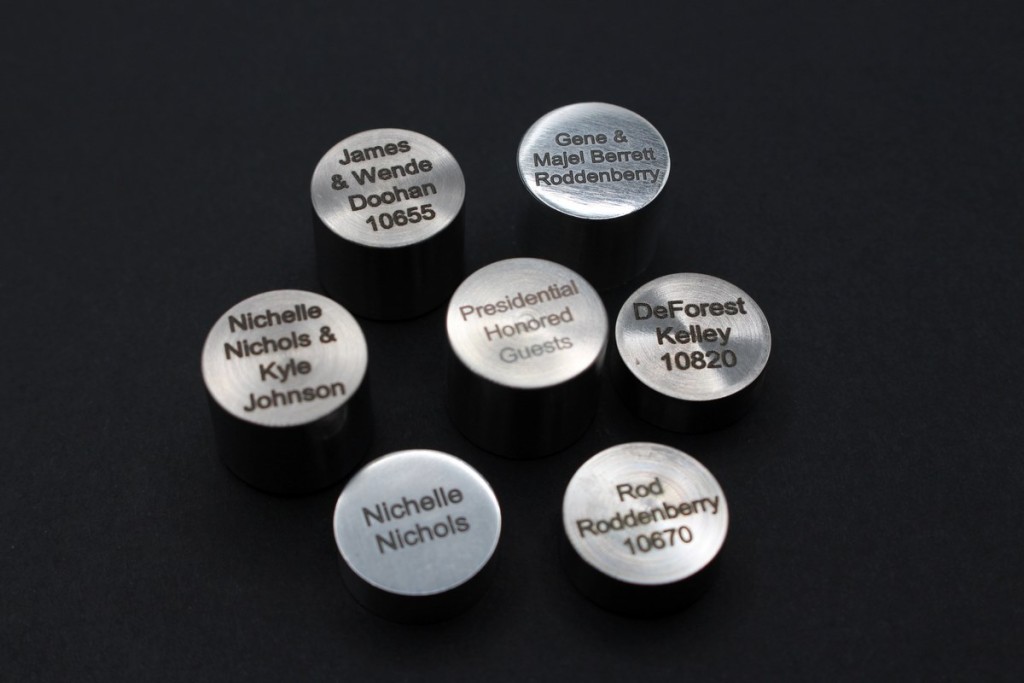
When Star Trek creator Gene Roddenberry died in 1991, it was 6 years later that some of his ashes were launched into deep space by Celetis in what most people found a fitting end for the science-fiction titan.

Now his wife, Majel Barrett Roddenberry, who passed away in 2008, will join her husband’s ashes floating around space when hers are launched aboard a “Vulcan” rocket.

As well as being sent up to space with the ashes of Star Trek actor, James “Scotty” Doohan, Nichelle Nichols, a DeForest Kelly, the mission will also be sporting a state-of-the-art moon lander designed by Astrobotics for payload missions to the moon.

US presidents’ and Star Trek founder’s DNA samples – SWNS

In total 150 ash-containing capsules will be launched into space, which also include the  Apollo astronaut Philip Chapman and special effects master Douglas Trumbull, who worked on 2001: A Space Oddysey, and Close Encounters of the Third Kind. 

MORE SENTIMENTAL SPACE TRAVEL: Artwork That Can Exist Only in Space Delights Everyone Aboard the International Space Station–LOOK

Altogether the payload is one that celebrates fiction and fact, as well as the unquenchable enthusiasm of space-bound firms and sci-fi fans, two groups that largely intersect; evidenced by the fact that the rocket is called a Vulcan, and the mission is called Enterprise.

“We’re very pleased to be fulfilling, with this mission, a promise I made to Majel Barrett Roddenberry in 1997 that one day we would fly her and husband Star Trek creator Gene Roddenberry together on a deep space memorial spaceflight,” said Celestis Co-Founder and CEO Charles M. Chafer. “The mission is named Enterprise in tribute to them”.

MORE ALTERNATIVE FUNERALS: Amid the Green Funeral Movement, Scattering Ashes Ensures These Forests Remain Pristine Forever

Later this year, a United Launch Alliance (ULA) Vulcan Centaur rocket on its maiden voyage will lift off from Cape Canaveral, Florida, and after putting the Peregrine 1 lunar lander on course for its rendezvous with the Moon, it will continue into a heliocentric (solar) orbit around the sun.

The Enterprise Flight will be renamed Enterprise Station once it arrives to become humankind’s furthest outpost, where it will journey endlessly, “perhaps awaiting discovery by a distant in time civilization,” says Celestis.

SHARE This Pretty Epic Memorial Service With Your Friends (Maybe Trekkies)…

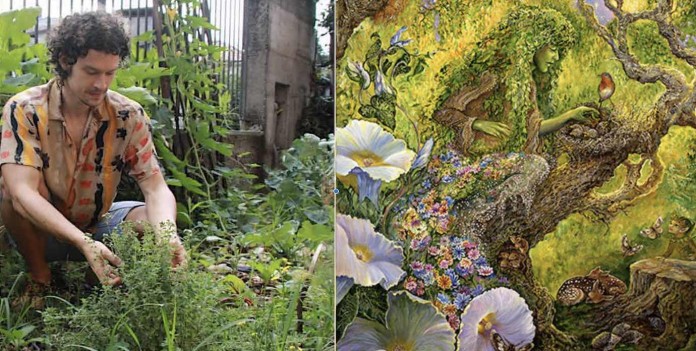
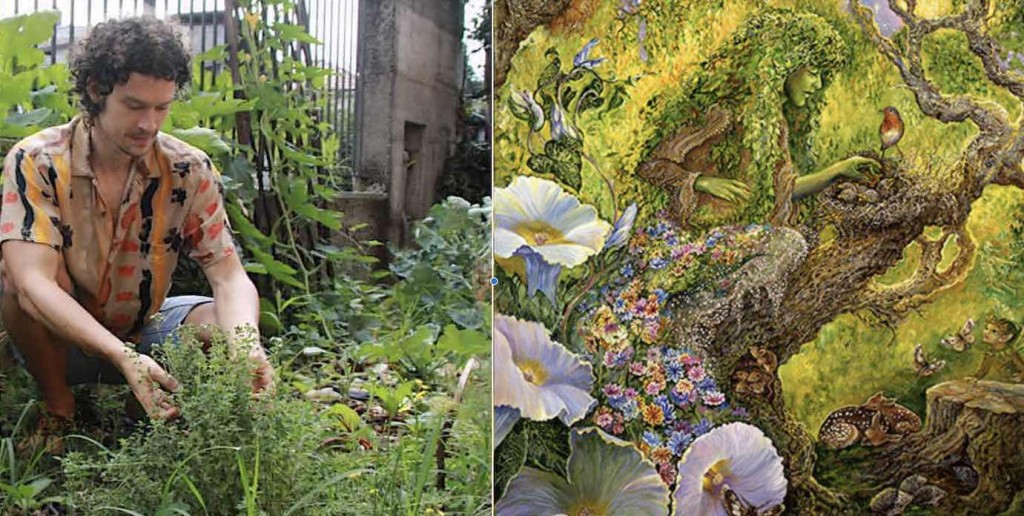
Good Gardening—A New Year: How Do You Prepare, When Do You Start Seeds?

Painting by Josephine Wall – CC 3.0

Welcome back to Good Gardening! It is my great joy to restart this community and our discussions for the year 2023. After a mild winter, Italy is moving rapidly into an early spring, yet no doubt some of you are already seeding or starting in warmer climes.

For those in America’s northern reaches which proved themselves this winter to be a tundra, perhaps your seed cells, pots, and beds remain empty. But don’t worry, because as they say in Italy, “Forza e coraggio perche dopo Aprile viene Maggio!” (Strength and courage because after April comes May!”

With no reader-submitted content to share, I will open the discussion with one of my favorite gardening influencers, stealing a march on March with a February planting guide.


“More beings than most – Awake but one time a year – and with that are glad,” – Andy Corbley

Topic Week 13: How do you start your season?

Question 1: How do you prepare your garden for the growing season?

Question 2: Do you like to risk planting early or waiting until all fear of frost is gone?

Question 3: When does your growing season start, has it changed over time?

Tell Us Here in The Comments… or, send your questions, tips, and photos to [email protected]Join our Facebook Good Gardens thread every Friday on the GNN Facebook Page

Good gardening rules

  • Green thumbs can help novice greenhorns.
  • Share your gardening photos and resources.
  • Garden jargon encouraged!

INVITE Friends to our Gardening Discussion on Social Media–And Share Your Photos and Tips!

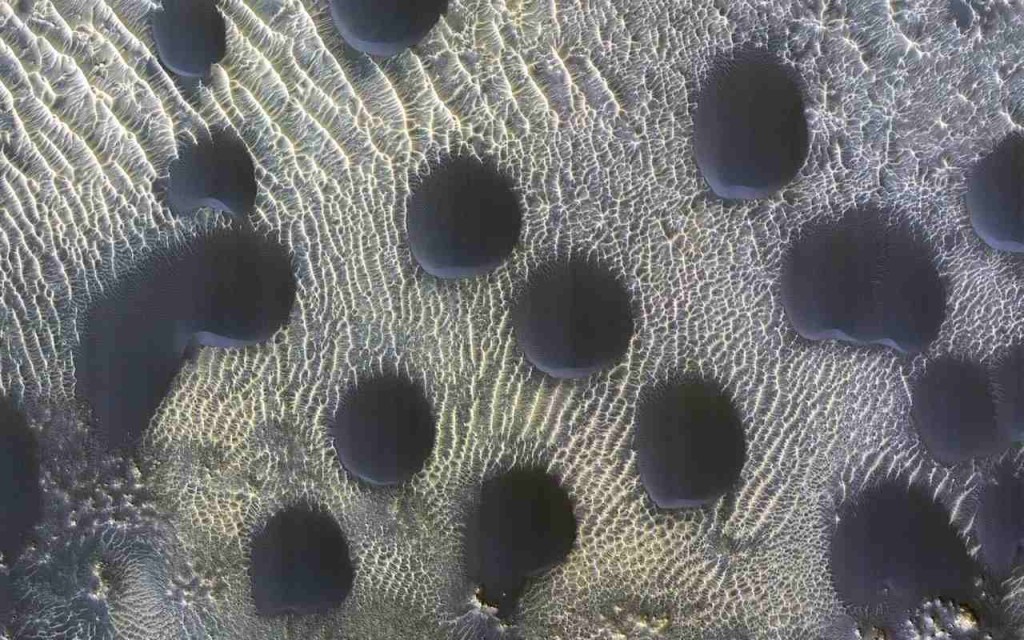
‘Unusual’ Circles Spotted on Mars by the Reconnaissance Orbiter

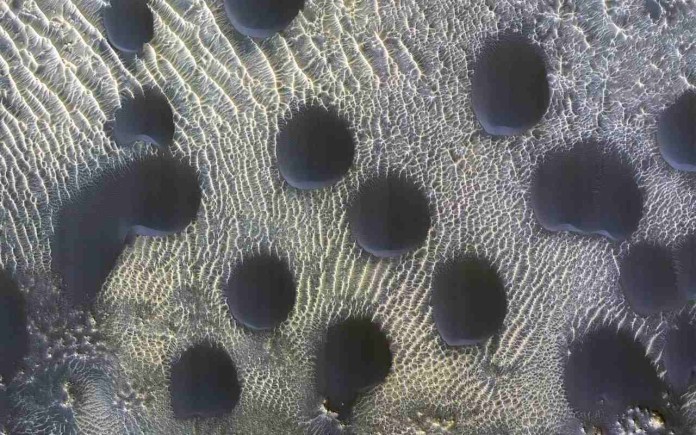
Mars circles seen from Reconassaince Orbiter - SWNS
Mars circles seen from Reconassaince Orbiter – SWNS

Scientists are scratching their heads after large gray circles were spotted on Mars by the Reconnaissance Orbiter.

NASA reported the unusual sand dunes on the Red Planet, which they say are “almost perfectly circular,” and just another of the strange phenomena that NASA has observed over a decade of thoroughly surveying Mars.

The space agency’s Mars Reconnaissance Orbiter spotted the shapes as it studied how frost thaws at the end of Martian winter.

“Sand dunes of many shapes and sizes are common on Mars. In this example, the dunes are almost perfectly circular, which is unusual,” the agency explains. “They are still slightly asymmetrical, with steep slip faces on the south ends. This indicates that sand generally moves to the south, but the winds may be variable.”

MORE FROM THE RED PLANET: The Mars InSight Lander Signs Off on Social Media With Encouragement for Humanity – LOOK

“This is part of a series of images to monitor how frost disappears in the late winter; this observation appears to be free of frost.”

This is the second set of publicized images from the Reconassaince Orbiter of Martian winter sand. In December, the orbiter found a remarkable group of frosty talons thawing out after a long winter.

Also earlier this year, the orbiter reported what looked like the face of a bear on the barren surface.

Taken in December from a height of 251 km, with NASA asking “a Bear on Mars? This feature looks a bit like a bear’s face. What is it really?”

The photo shows a hill with a V-shaped collapse structure (the nose), two craters (the eyes), and a circular fracture pattern (the head). The circular fracture is probably a layer of dust covering the rim of another, larger impact crater.

The Mars Reconassaince Orbiter has been in action since 2006 studying the geology of mars. These are just three of its many and important contributions to science.

SHARE These Bizarre And Wonderful Space Images With Your Friends… 

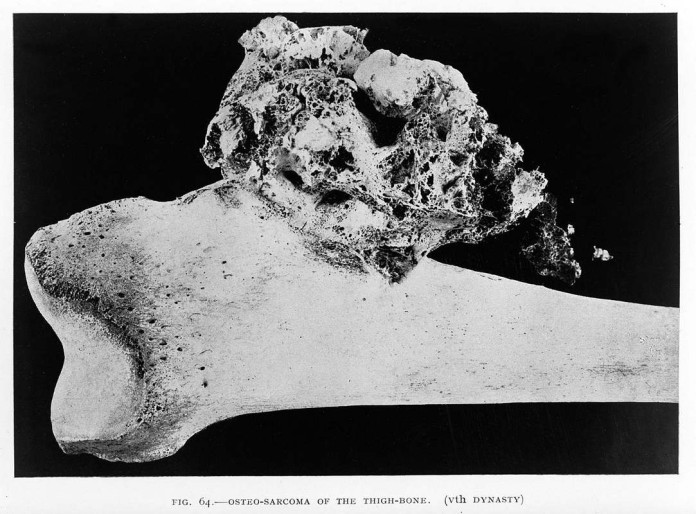
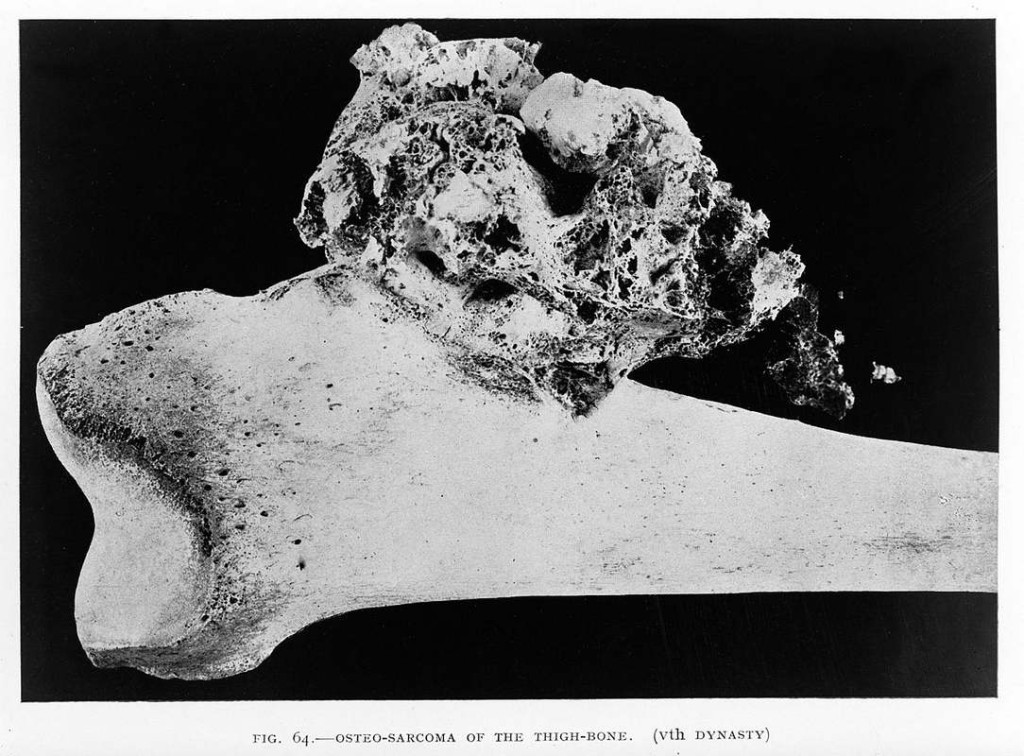
Protein Key to Osteosarcoma May Unlock Treatments for Deadly Bone Cancers That Affect Kids

Osteosarcoma on a thigh bone of a 5th Dynasty Egyptian - credit: Wellcome Trust UK, CC 4.0.
Osteosarcoma on a thigh bone of a 5th Dynasty Egyptian – credit: Wellcome Trust UK, CC 4.0.

Treatments for deadly bone cancers that mainly affect children may be on the horizon after experiments identified a protein that promotes cell death in osteosarcomas.

Researchers at Shanghai Jiao Tong University said the discovery could lead to a cure for all types of skeletal tumors.

Osteosarcoma is the most common bone cancer, but it occurs mainly in children. They are linked with rapid bone growth and tend to develop in boys more often than girls due to average height differences.

Osteosarcoma has a 55% survival rate, which has unfortunately not improved this century, and scientists are keen on developing potential medicines since surgical removal of the osteosarcoma tumors is often impossible.

At Shanghai’s Jiao Tong University School of Medicine, researchers have identified a bone matrix protein called secreted phosphoprotein 24 kD (Spp24) that binds to and neutralizes a protein called bone morphogenetic protein 2, which has properties that help the tumors grow and proliferate.

MORE CHILD CANCERS: New Hope as Groundbreaking Cancer Treatment Could Save Child With Extremely Rare Condition

“Cell proliferation, migration, and invasiveness were all inhibited by Spp24. Treatment with Spp24 reduced tumor growth,” said Dr. Haijun Tian at Jiao Tong. “These results confirm the potential of Spp24 as a therapeutic agent for the treatment of osteosarcoma and other skeletal tumors.”

“Like many other bone matrix proteins, the more we look into the function of Spp24, the more surprising roles we find even though the primary function of Spp24 remains uncertain,” he added.

MORE BREAKTHROUGH TREATMENTS: Prostate Cancer Breakthrough Could Stop the Tumor Spreading After It Becomes Resistant to Current Therapy

Medicine and biology are like that sometimes: drugs and proteins have therapeutic functions, even if the reason behind them is unclear.

The research was published in the journal Orthopedic Research. 

SHARE This Potential Child Cancer Breakthrough On Social Media… 
Lovebirds Tie the Knot in Their 80s After Meeting on a Dating Website–Bride ‘Highly Recommends’ it

Tricia and Ian at their Glendower Hotel wedding / SWNS

A pair of geriatric lovebirds tied the knot in their 80s after they fell for each other on an internet dating site.

The besotted 85-year-old Tricia Shaw admitted she was smitten “at first sight” when she went online and found her “toy boy” 82-year-old Ian.

Ian felt there was “something about her,” and had to accept her offer of meeting up, and Tricia, who’d previously met four potential suitors online, said she was left “wobbly at the knees” when she first tucked into a fish supper with him.

The couple, who now live together, went ahead with their wedding in February after Ian was diagnosed with heart disease and needed a risky bypass operation.

Tricia now believes more octogenarians should embrace online matchmaking after the pair enjoyed a “magical” wedding in front of 115 guests.

“I highly recommend online dating because you tick so many boxes before you even meet,” said Tricia, who worked at times as a private detective. “You can tell you’ve got a lot in common.”

“The wedding was the most magical time of my life. Everything was spot on, and I couldn’t have imagined anything as wonderful.”

Great-grandmother-of-five Tricia, from Lancastershire, England, came across Ian’s profile after going on the dating platform Plenty More Fish seven years ago.

She joined the site after losing her previous husband of 33 years and had met a handful of men before messaging Ian, who had been previously married for 35 years and was originally from Glasgow.

MORE LOVEBIRDS: Cemetery Posts Personal Ad for Lonely Goose Whose Mate Died–and they Find a Match

The relationship got off to a rocky start when Ian ignored her first text at the start of his seven-day walking holiday.

But he was intrigued when Tricia asked to get “in touch” and wrote again after completing his hike.

Glasgow-born Ian arrived in a kilt – SWNS

“The message arrived just as I was getting on a train, and I thought, ‘Well this will keep until I get back home,” said Ian. “But later, I got a message from Tricia saying ‘I can’t believe you haven’t been in touch’. And I thought ‘this one has got something about her.'”

“Tricia said it was love at first sight,” he said “She fell for me straight away, and I also liked her from the word go. The wedding meant everything to me.”

The love-struck pair moved in together 14 months later and had made plans to marry sometime in the future.

MORE LIVELY SENIORS: Old Friends Go On the Adventure of a Lifetime: Around the World in 80 Days (LOOK)

But when Ian got the news he would need a heart-bypass operation, they decided to press ahead with their wedding, which eventually took place on February 10th this year.

Over a hundred friends and family showed up for the wedding, where Tricia was given away by her son Timothy and grandson Henry.

“I have no family, but Tricia has an enormous family. All of them came and loads of friends. There were 115 eventually.”

SHARE This Story With Anyone Who Needs Reminding It’s Never Too Late For Love…
Tasty Burgers and Steaks Made of Mycelium Are New Healthy Food Alternative to Plant-Based Meats

Mycelium steak and Meati Founder Tyler Huggins

In an effort to renew alternatives to meat in the wake of collapsing shares and sales of veggie meat and their companies, one man is looking at mycelium—the fibrous root structure of a lifeform much more similar to beef than soy: mushrooms.

In fact, of the 5 classic taste profiles, umami has really only 2 members—meat, and mushrooms, so making the first from the second is only logical.

That’s why Meati is using its nationwide distribution deal with Sprouts grocery store to market mycelium steaks, burgers, and more.

The mycelium is the part of the mushroom we never see, and is composed of thousands of tiny filaments. It’s cultivated in big steel tanks of sugar, water, and heat at the 125,000 square foot “Mega Ranch” in Meati Founder Thomas Huggins’ home state of Montana

“My point of view? We need more diversity in our food system, not less,” Huggins told Fast Company Magazine. “More resilience, more options that resonate with people that are really enjoyable.”

There are a lot of reasons why using fungi as a sustainable food option is much better than soy, corn, or any other meat alternative. These monocrops come from highly genetically-modified seed stock and need to be kept alive with millions of acres of prime farmland, billions of gallons of water, hundreds of thousands of gallons of pesticides and herbicides, and millions of pounds of ammonium-nitrate fertilizers—the epitome of unsustainability.

Grilling Mycelium burgers – Meati

By contrast not one inch of farmland needs to be used to cultivate mycelium, which is typically grown on sawdust and other waste wood products, (though Meati uses other starters like sugar).

MORE IDEAS IN FOOD: These Superfoods Can Provide Important Nutrients With a Single Bite

Products like Impossible Burger and Beyond Burger are what the Harvard School of Medicine defines as “ultra-processed foods,” meaning an edible product that is many times removed from its natural state. Most veggie meats are actually composed mainly of ultra-processed seed oils and other fillers rather than vegetables in order to keep costs down and improve shelf life.

This means their nutritional profile is principally highly-inflammatory and oxidized polyunsaturated fats, not to be confused with heart-healthy monounsaturated fats

By contrast mycelium meat would be composed mostly of fiber, provided there aren’t too many additives, while nonetheless containing that umami flavor that makes grilled mushrooms and steak so similar in taste.

On the subject of taste, Huggins describes a story of showing up at Sprouts headquarters for a tasting and the investors “were kind of rolling their eyes”.

MORE MUSHROOM STORIES: Morel Mushrooms Have Finally Been Reliably Cultivated Indoors For the First Time

“’Oh, another plant-based product,’” he said jokingly. “It wasn’t exactly enthusiastic. But then they took their first bites, looked at each other, and grabbed another cut. In an instant, it became: ‘who else are you talking to? Can we be first?'”

Unlike the CEOs of Impossible Foods and Beyond Foods, Huggins is a meat eater who enjoys bow hunting, and his parents run a bison and elk meat company in Montana. He is looking for something to produce that consumers can really sink their teeth into and be satisfied, along with trying to help reduce emissions from the food system.

SHARE This Alternative To Soy Burgers With Your Veggie Friends…