A vast array of 12,000 solar panels are set to become Europe’s largest floating solar park when they finish taking position atop the Alqueva reservoir this year.
Supplying a third of the electricity to the nearby towns of Moura and Portel—they look to continue taking advantage of Portugal’s exceptional year-round weather that has seen the nation become one of the leading renewable-powered nations in Europe.
Built by EDP, the country’s principal utilities provider, the panels will be mounted on pontoons in an area the size of four European soccer pitches, equipped with lithium-ion batteries to store a total excess of 1.5 gigawatts.
The advantage of floating solar is that it doesn’t take up limited land space in the small country. Unused electricity that can’t be used pumps water into the reservoir, which can be fed through the hydropower system of the dam to create additional power.
“This project is the biggest floating solar park in a hydro dam in Europe, it is a very good benchmark,” said Miguel Patena, group director for EDP who is in charge of the project.
By 2030, EDP hopes to offer 100% renewable electricity across all infrastructure, and currently produces 78% of EDP’s 25.6 GW of installed capacity from solar, wind, and hydropower.
(WATCH the video for this story below.)
POWER Up the Good News; Share This Story From Portugal…
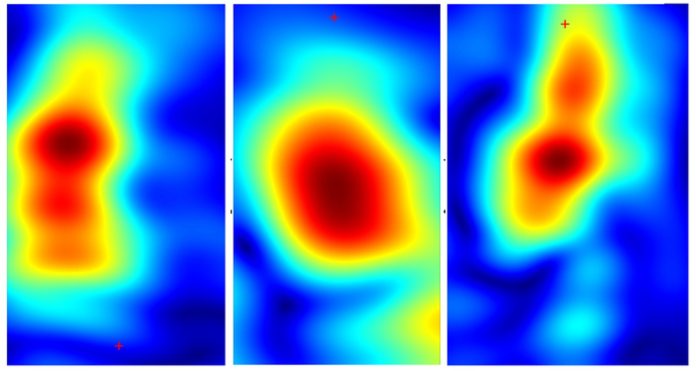
Carcinoma (left), squamous cell carcinoma (middle), and actinic keratosis (right)/Stevens Institute of Technology
Skin biopsies are no fun: doctors carve away small lumps of tissue for laboratory testing, leaving patients with painful wounds that can take weeks to heal. That’s a price worth paying if it enables early cancer treatment. However, in recent years, aggressive diagnostic efforts have seen the number of biopsies grow around four times faster than the number of cancers detected, with about 30 benign lesions now biopsied for every case of skin cancer that’s found.
Researchers at Stevens Institute of Technology are now developing a low-cost handheld device that could cut the rate of unnecessary biopsies in half and give dermatologists and other frontline physicians easy access to laboratory-grade cancer diagnostics. “We aren’t trying to get rid of biopsies,” said Negar Tavassolian, director of the Bio-Electromagnetics Laboratory at Stevens. “But we do want to give doctors additional tools and help them to make better decisions.”
The team’s device uses milimeter-wave imaging—the same technology used in airport security scanners—to scan a patient’s skin. (In earlier work, Tavassolian and her team had to work with already biopsied skin for the device to detect if it was cancerous.)
Healthy tissue reflects milimeter-wave rays differently than cancerous tissue, so it’s theoretically possible to spot cancers by monitoring contrasts in the rays reflected back from the skin. To bring that approach into clinical practice, the researchers used algorithms to fuse signals captured by multiple different antennas into a single ultrahigh-bandwidth image, reducing noise and quickly capturing high-resolution images of even the tiniest mole or blemish.
Spearheaded by Amir Mirbeik Ph.D. ’18, the team used a tabletop version of their technology to examine 71 patients during real-world clinical visits, and found their methods could accurately distinguish benign and malignant lesions in just a few seconds. Using their device, Tavassolian and Mirbeik could identify cancerous tissue with 97% sensitivity and 98% specificity—a rate competitive with even the best hospital-grade diagnostic tools.
“There are other advanced imaging technologies that can detect skin cancers, but they’re big, expensive machines that aren’t available in the clinic,” said Tavassolian. “We’re creating a low-cost device that’s as small and as easy to use as a cellphone, so we can bring advanced diagnostics within reach for everyone.”
Because the team’s technology delivers results in seconds, it could one day be used instead of a magnifying dermatoscope in routine checkups, giving extremely accurate results almost instantly. “That means doctors can integrate accurate diagnostics into routine checkups, and ultimately treat more patients,” said Tavassolian.
Unlike many other imaging methods, milimeter-wave rays harmlessly penetrate about 2mm into human skin, so the team’s imaging technology provides a clear 3D map of scanned lesions. Future improvements to the algorithm powering the device could significantly improve mapping of lesion margins, enabling more precise and less invasive biopsying for malignant lesions.
The next step is to pack the team’s diagnostic kit onto an integrated circuit, a step that could soon allow functional handheld milimeter-wave diagnostic devices to be produced for as little as $100 a piece—a fraction of the cost of existing hospital-grade diagnostic equipment. The team is already working to commercialize their technology and hopes to start putting their devices in clinicians’ hands within the next two years.
“The path forward is clear, and we know what we need to do,” said Tavassolian. “After this proof of concept, we need to miniaturize our technology, bring the price down, and bring it to the market.”
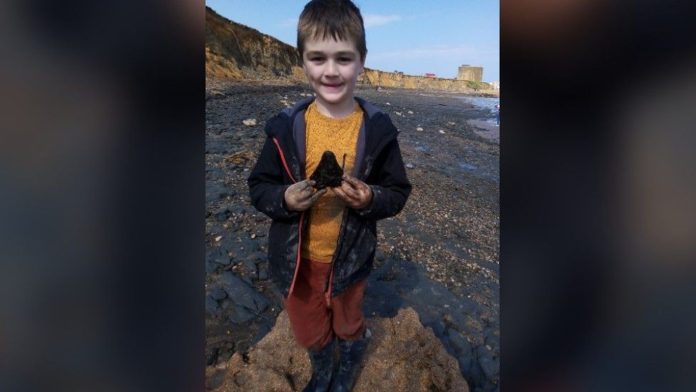
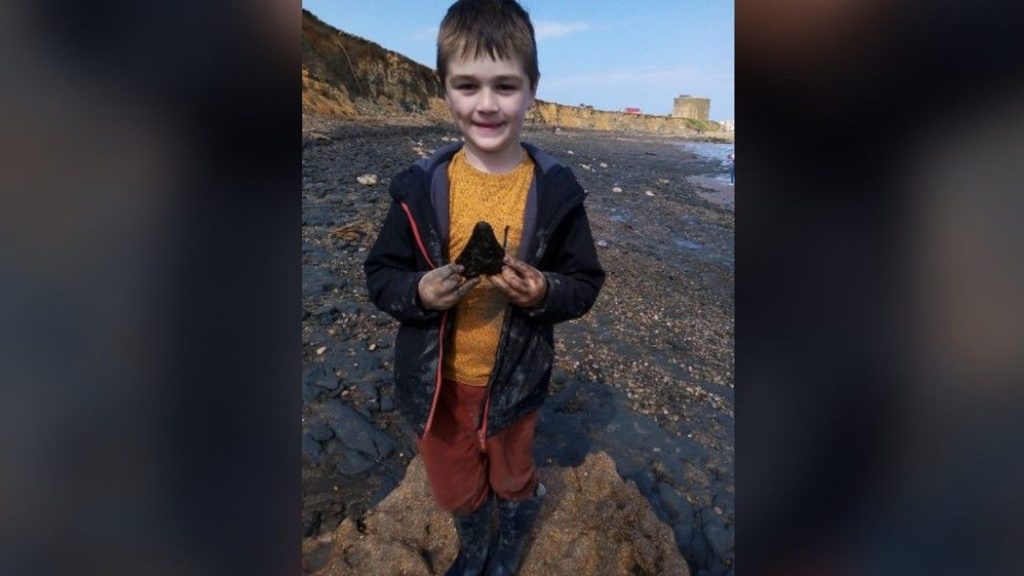
A six-year old sifting for shark teeth on a British beach found the four-inch long tooth of a megalodon, buried for at least three million years.
Sammy Shelton found the tooth with his dad Peter on Bawdsey Beach, at Gorleston-on-Sea in Suffolk; it’s a spot where many people come to look for different shells, sharks’ teeth, and fossils from recent times and those long gone.
Semi-professional fossil hunters with trowels and knee pads for kneeling in the mud told the father and son it’s nearly unheard of to find megalodon teeth in Great Britain, despite the fact they have been found nearly everywhere on Earth.
“Sammy was very excited as we’d seen fragments of shark teeth on the beach, but nothing as big and heavy as this,” Mr. Shelton told the BBC, adding that the little boy had become “very attached to it” and that he even sleeps with it.
“Now that Sammy has found this it has really piqued his interest [in paleontology] and he took it to school to show his class,” Mr. Shelton told the Great Yarmouth Mercury.
Megalodon didn’t live alongside the dinosaurs, but evolved as Earth returned to flourishing from the catastrophe that caused them to go extinct. They were three-times bigger than a great white shark, hypothesized as having the most powerful bite of any animal, land or sea, to ever live, and cruised the sea between 23 and 3 million years ago.
Such a massive body guarantees that nobody can chow down on you, but with a diet that consisted of animals as large as whales, it’s life was greatly dependent on there being equally enormous sea creatures around—a status quo which will never last forever, as Earth’s history bears witness.
When megalodon (meaning big tooth) did go extinct, it did so not only from a position at the top of the food chain, but one of extreme distribution, propagating all the world’s seas apart from Antarctica’s with its 60 ton, 18 meter-long bulk.
TV scientist personality and author Ben Garrod shared little Sammy’s excitement, as the tooth was so well preserved that one could even see the enamel inside of it. Garrod added that he had looked for a megalodon tooth throughout his life, but never found one, and that maybe two or three a year are found in Britain—and they’re normally very eroded.
Quote of the Day: “I am so busy. I am practicing my new hobby of watching me become someone else.” – Jennifer Willoughby
Photo by: Paul Skorupskas
With a new inspirational quote every day, atop the perfect photo—collected and archived on our Quotes page—why not bookmark GNN.org for a daily uplift?
Scientists can now create new hearing cells that can overcome deafness caused by aging.
Considered a “major hurdle” to reversing hearing loss, the gene discovery allows the production of inner or outer ear hair cells.
Hearing loss due to aging, noise, and certain cancer therapy drugs and antibiotics has up until now been seen as irreversible when there is the death of such cells—which develop in the embryo and do not reproduce.
But scientists have discovered a single master gene, TBX2, that can change ear cells into either outer or inner sensory hair ones.
The outer hair cells expand and contract in response to the pressure of sound waves and amplify sound for the inner hair cells. The inner cells transmit those vibrations to the neurons to create the sounds we hear.
Currently, scientists can produce an artificial hair cell, but it does not differentiate into an inner or outer cell, which provide different essential functions to produce hearing.
About 8.5 percent of adults aged 55 to 64 in the U.S. have disabling hearing loss—so this discovery could be revolutionary to many.
Hearing works
“We have overcome a major hurdle,” Professor Jaime Garcia-Anoveros, of Northwestern University explained in a statement. Describing the coordinated movement of the inner and outer cells, he said, “It’s like a ballet… The ear is a beautiful organ. There is no other organ in a mammal where the cells are so precisely positioned with micrometric precision. Otherwise, hearing doesn’t occur.”
The study was published in the journal Nature, and complements recent research by MIT which has a new drug candidate that stimulates the growth of hair cells in the inner ear.
It was a case of ‘all’s wool that ends wool’ for five sheep who found themselves on the rooftop of a house in Yorkshire—and were successfully rescued by local firemen.
While goats are famous for appearing on all fours in places that boggle the mind, these five farm sheep had apparently leapt from a nearby field onto the roof, where they then found themselves quite stuck.
West Yorkshire Fire and Rescue were called to Barnsley Road in Newmillerdam, England— where rescue officer Damian Cameron worked with a local landowner to create a makeshift bridge the sheep could use to escape from the roof.
Cameron reckoned that one sheep noticed that he could make the leap from the paddock to the roof.
This Rambo then dragged the other four there instinctually, as the flock animals prefer to stay as a team.
Fortunately it all turned out well, as all five sheep alighted the bridge and back into the paddock.
The Lesson: Prisons in the U.S. bury people. And they rely on the burying of those people to sever the connection they have with society’s knowledge that they exist, which in turn allows the prisons to bury them in a vicious cycle. But it turns out that even if it’s mere voices that escape those walls; poems, songs, art, all escaping without a person on stage or on the street attached to them, that’s enough to create a two-way connection with society that leads to a life and a voice beyond prison, and restorative justice, and not justice by diminishment.
Notable Excerpt: “I would say ‘yeah I’m starting this program in a prison,’ and the first question everyone asks is ‘are you scared?’ and I’m like ‘why would I be scared?’ So seeing this disjunction between what people were thinking about what I was doing, and what I was experiencing in there, for me I started to think this whole system of burying people, like “the disappeared”, depends on people not knowing who these people are in a deeper way, and so it became a kind of calling really to say ‘how can I play some small part in, not shining a light on, but allowing this light to come out?”
The Guest: Bidhan Roy received his Ph.D. at Goldsmith College, University of London, where he studied English literature and post-colonialism He is the founder of Words Uncaged, an organization which provides a platform for incarcerated artists and writers to engage with the public through book publishing, art exhibits and digital media. Words Uncaged has programs in 5 prisons and on death row in the U.S., serving more than 2,000 men and women, and uses storytelling to foster empathy for and understanding of, others, and to promote collective and individual healing. Dr. Roy is also the director of the Calstate Prison Graduation Initiative, which allows incarcerated men and women to receive BA degrees while serving time.
The Podcast: Livin’ Good Currency explores the relationship of time to our lives. It gives a simple, straight-forward formula that anyone can use to be present in the moment—and features a co-host who knows better than anyone the value of time (see below). How do you want to spend your life? This hour can inspire you, along with upcoming guests, to be sure you are ‘Livin’ Good Currency’ and never get caught running out of time.
The Hosts: Good News Network fans will know Tony (Anthony) Samadani as the co-owner of GNN and its Chief of Strategic Partnerships. Co-host Tobias Tubbs was handed a double life sentence without the possibility of parole for a crime he didn’t commit. Behind bars, he used his own version of the Livin’ Good Currency formula to inspire young men in prison to turn their hours into honors. An expert in conflict resolution, spirituality, and philosophy, Tobias is a master gardener who employs ex-felons to grow their Good Currency by planting crops and feeding neighborhoods.
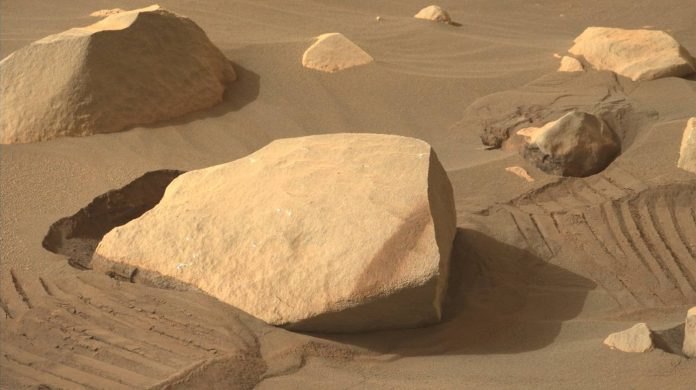
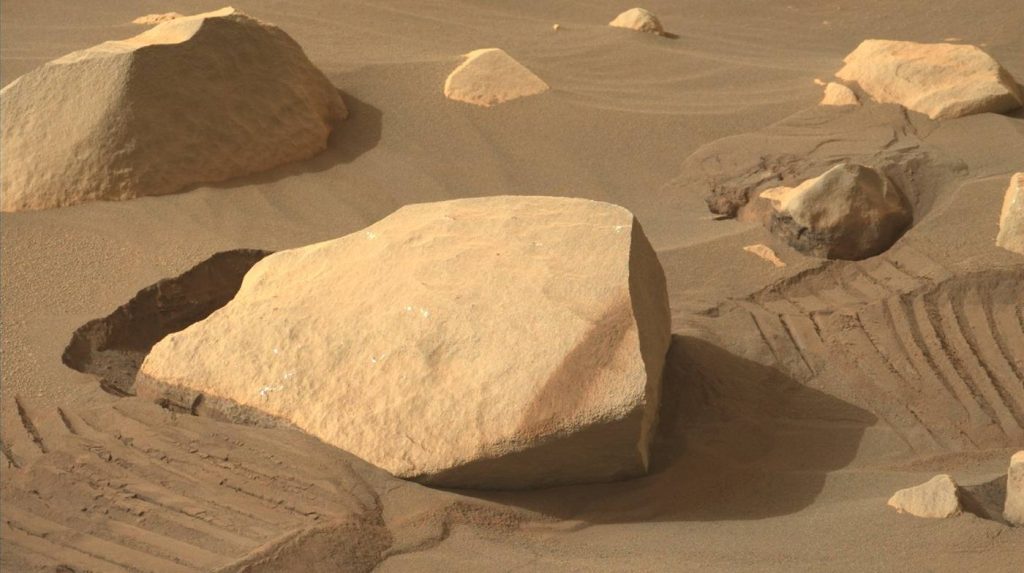
The Red Planet just got even more peaceful, as the Mars rover made an accidental Zen garden.
NASA’s Perseverance rover left some picturesque track marks around a rock—creating a scene resembling a meditation landscape in Japan.
Zen gardens usually feature carefully composed arrangements of rocks, water features, moss, pruned trees, and bushes, and use gravel or sand that is raked to represent ripples in water.
They are intended to imitate the essence of nature, not its actual appearance, and to serve as an aid for meditation.
What is NASA’s latest rover actually up to there on the Red Planet? Its mission is to look for signs of past microbial life, cache rock and soil samples, and prepare for future human exploration.
NASA/JPL-Caltech/MSSS
That’s exciting indeed—and GNN will continue to update you with its latest positive developments.
BRING Your Chums Closer to a Zen State of Mind; Share This Story…
Helping to sweep 200 explosive devices in Ukraine, Patron the Jack Russel recently received a presidential medal from President Zelenskyy.
Meaning “Ammo” in Ukrainian, Patron’s handler, Mykhailo Iliev of the Civil Protection Service, accepted the medal on the two-year-old pooch’s behalf in a news conference that included Canadian prime minister Justin Trudeau.
“Today, I want to award those Ukrainian heroes who are already clearing our land of mines. And together with our heroes, a wonderful little sapper—Patron—who helps not only to neutralize explosives, but also to teach our children the necessary safety rules in areas where there is a mine threat,” Zelenskyy said in a statement after the ceremony.
The famous dog #Patron, who daily saves #Ukraine from the "gifts of the #Russian world", fell asleep at a briefing with journalists.
Patron has become well-known since the conflict began, appearing in dozens of stories across a variety of news networks and outlets. His Instagram boasts 220,000 followers.
As a Jack Russel terrier, he’s one of the ultimate workhorse breeds. Bred for fox catching, and later for rat catching and travel, his powerful snout, endless energy, and smaller appetite make him ideal for mine sweeping—yet that wasn’t supposed to be his destiny, as NPR reports that Iliev bought him originally to be nothing more than a loyal friend for his young son.
(WATCH Paton in action in the video below.)
Patron the dog keeps working hard — just yesterday, he helped defuse 262 items of explosive ordnance near #Chernihiv. We are very proud of our very good boy. pic.twitter.com/hw4zyA8S9R
— Stratcom Centre UA (@StratcomCentre) May 1, 2022
RAISE a Paw for This Hero’s Story; Share It On Social Media…
Quote of the Day: “Don’t ever go with the flow. Instead, be the flow.” – Jay-Z
Photo by: Mor Shani
With a new inspirational quote every day, atop the perfect photo—collected and archived on our Quotes page—why not bookmark GNN.org for a daily uplift?
Haim Zinger site almog 3d Bar-Ilan University released
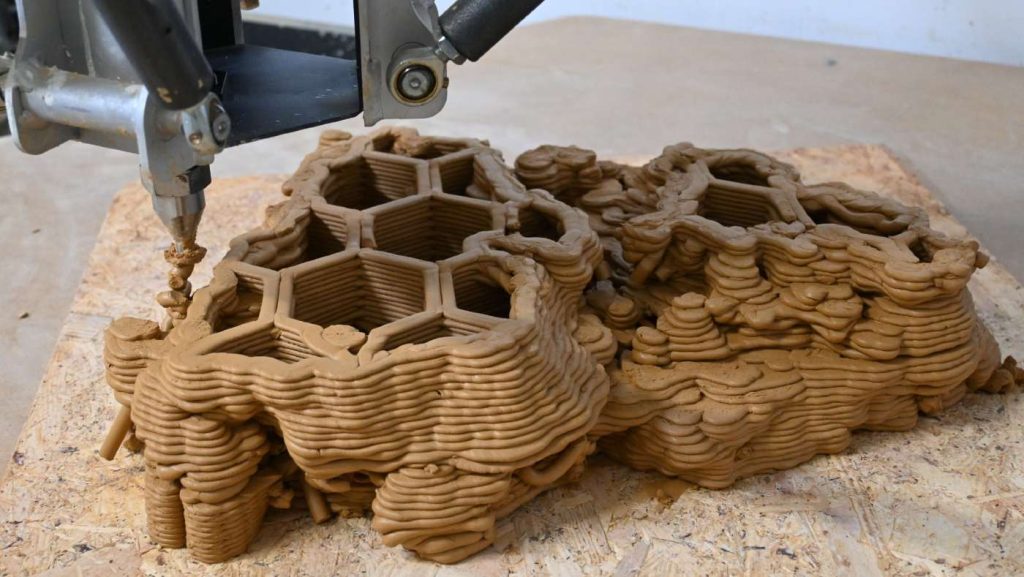
3D Printer printing the reef; Ofer Berman, Bar-Ilan University
An innovation interface tailors 3D-printed reefs to their marine environment and may curb reef devastation plaguing global coral ecosystems.
In a new paper, researchers from four of Israel’s leading universities highlight a 3D printing method they developed to preserve coral reefs. Their innovation is based on the natural structure of coral reefs off the southern coastal Israeli city of Eilat, but their model is adaptable to other marine environments.
The 3D process begins by scanning underwater photographs of coral reefs. From this visual information, a three-dimensional model of the reef is assembled with maximum accuracy. Thousands of images are photographed and sent to the laboratory to calculate the complex form of the reef and how that form encourages the evolution of reef species diversity.
Next, the researchers use a molecular method of collecting environmental genetic information which provides accurate data on the reef’s organisms. This data is incorporated with other parameters and is fed into a 3D technology algorithm, making it possible to build a parametric interactive model of the reef. The three-dimensional model can be designed to precisely fit the designated reef environment.
The final stage is the translation and production of a ceramic reef in 3D printing. The reefs are made of a unique ceramic that is naturally porous underwater and provides the most ideal construction and restoration needs to the affected area, or for the establishment of a new reef structure as a foundation for the continuation of life. “Three-dimensional printing with natural material facilitates the production of highly complex and diverse units that is not possible with the usual means of mold production,” says Prof. Ezri. Tarazi.
The process combines 3D scanning algorithms, together with environmental DNA sampling, and a 3D printing algorithm that allows in-depth and accurate examination of the data from each reef as well as tailoring the printed model to a specific reef environment.
Haim Zinger; Bar-Ilan University
In addition, data can be re-fed into the algorithm to check the level of effectiveness and efficiency of the design after it has been implemented, based on information collected in the process.
“Existing artificial reefs have difficulty replicating the complexity of coral habitats and hosting reef species that mirror natural environments. We introduce a novel customizable 3D interface for producing scalable structures, utilizing real data collected from coral ecosystems,” explains Natalie Levy, a Ph.D. student at Bar-Ilan University in Israel.
Ofer Berman adds, “The use of three-dimensional printing allows extensive freedom of action in reality algorithm-based solutions, and the assimilation of sustainable production for the development of large-scale marine rehabilitation.”
This study meets two critical needs to save coral reefs, according to the researchers. The first is the need for innovative solutions that facilitate large-scale restoration that can be adapted to support coral reefs worldwide.
The second is the recreation of the natural complexity of the coral reef—both in size and design—that will attract reef species such as corals, fish, and invertebrates that support the regrowth of natural coral reefs. The researchers are currently installing several 3D printed reefs in the Gulf of Eilat. They believe that the results they obtain will help them apply this innovation to other reef ecosystems around the world.
The joint research was led by Prof. Oren Levy and Ph.D. student Natalie Levy, of the Mina and Everard Goodman Faculty of Life Sciences at Bar-Ilan University, Prof. Ezri Tarazi and Ph.D. student Ofer Berman, from the Technion’s Architecture and Town Planning Faculty, Prof. Tali Treibitz and Ph.D. student Matan Yuval from the University of Haifa, and Prof. Yossi Loya of Tel Aviv University. Their study has been recently published in the journal Science of the Total Environment.
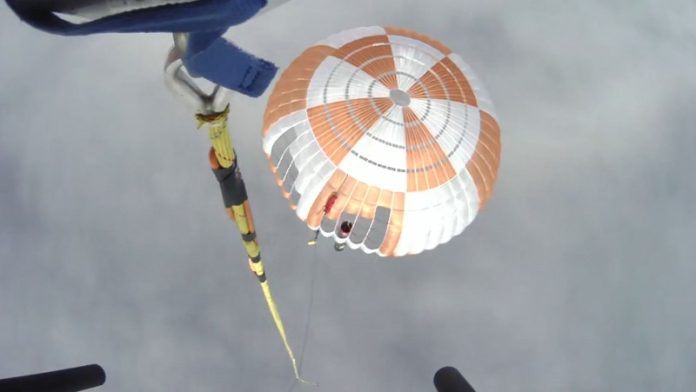
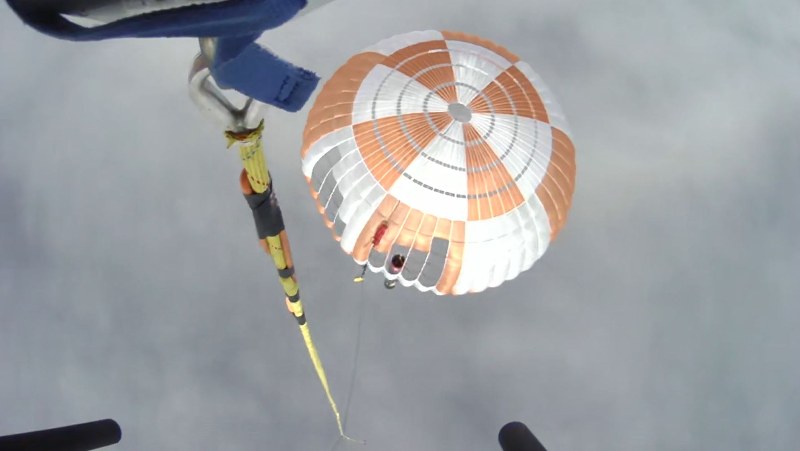
A space company has successfully caught an Earth-bound rocket—by helicopter.
The launch, last Monday, saw Rocket Lab deploying 34 satellites to orbit before the ‘Electron booster stage’ was successfully snagged on its return to Earth.
The mission eventually saw the helicopter release the booster into the sea after the “pilot detected different load characteristics than previously experienced,” and is being counted as a success.
The launch originated from Rocket Lab’s complex on New Zealand’s Mahia Peninsula.
Rocket Lab reports, “At 6,500 ft, Rocket Lab’s Sikorsky S-92 helicopter rendezvoused with the returning stage and used a hook on a long line to capture the parachute line.
“The mid-air capture is a major milestone in Rocket Lab’s pursuit to make Electron a reusable rocket to increase launch frequency and reduce launch costs for small satellites.
“After the catch, the helicopter pilot detected different load characteristics… and offloaded the stage for a successful splashdown.
SWNS
The big launch
The There and Back Again mission was Rocket Lab’s 26th Electron launch and deployed satellites to a sun-synchronous orbit for a variety of customers.
The mid-air capture comes after successful recovery operations from Rocket Lab’s 16th, 20th, and 22nd missions, which saw Electron’s first stage execute a controlled ocean splashdown before being returned to Rocket Lab’s production complex.
Like those missions, a reaction control system re-oriented the first stage to an ideal angle for re-entry during the mission, enabling the stage to survive the incredible heat and pressure during its descent back to Earth.
A drogue parachute was deployed to increase drag and to stabilize the first stage as it descended, before a large main parachute was deployed in the final kilometres of descent.
There and Back Again is the first time a helicopter catch attempt was introduced to recovery operations, and today’s mission will inform future helicopter captures.
“Bringing a rocket back from space and catching it with a helicopter is something of a supersonic ballet,” said Rocket Lab founder and CEO, Peter Beck.
“A tremendous number of factors have to align and many systems have to work together flawlessly, so I am incredibly proud of the stellar efforts of our Recovery Team and all of our engineers who made this mission and our first catch a success.
“From here we’ll assess the stage and determine what changes we might want to make to the system and procedures for the next helicopter catch and eventual re-flight.”
SWNS
Rocket Lab’s next mission is scheduled for this month, with more details to be released very soon.
(WATCH the Al Jazeera video for this story below.)
MAKE a Splash; Capture the Far Out News and Share It With Pals…
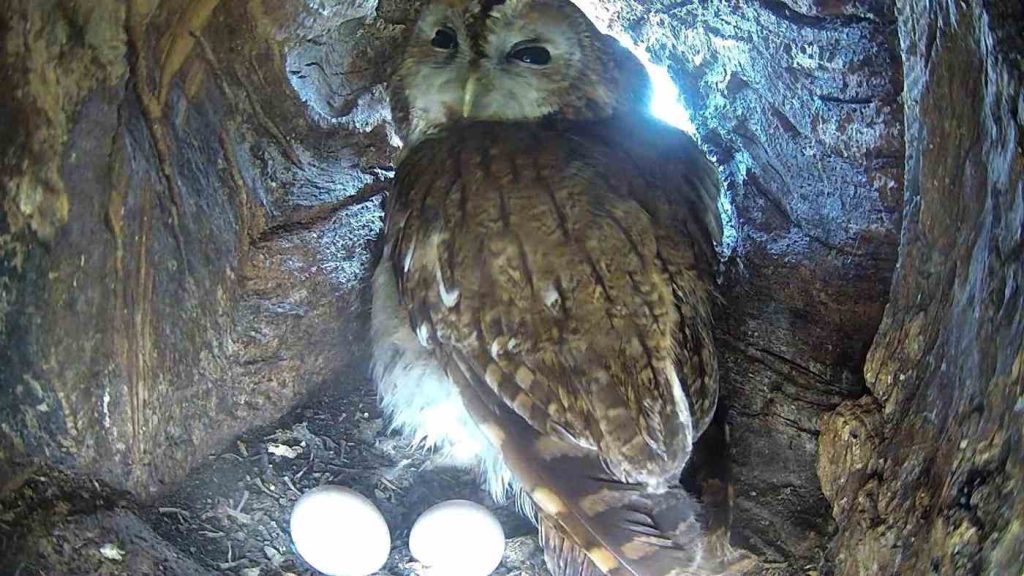
A wildlife artist in Britain captured on film the very moment when, seeing a pair of owlets in her nest, a tawny owl whose eggs had failed immediately adopts them with a cuddle and a clean.
Raptors are often some of the animal kingdom’s most devoted parents, spouses, and homemakers—and the video is a touching reminder of that.
Robert Fuller is one of the UK’s premier painters of wild creatures, and a devoted observer of their behavior.
His website contains blog articles written about the wildlife that visit his garden and the area around it, which includes several tawny owls who nest in boxes and hollows which Fuller has rigged with nest cams.
Fuller has seen Bomber and Luna raise six owlets at once before, and rates them as highly devoted parents. Bomber, in particular, will attack anything that comes close to his nest.
“Not only did her eggs fail to hatch this year, but she also lost her clutch last year,” Fuller explains on his YouTube video. “Luna the tawny owl is finally a mom.”
Luna herself is a rescue owl, and her story therefore completes the circle in many ways.
(WATCH Robert Fuller’s video for this story below.)
A new community housing development in the Bronx will feature a cool piece of kit: an on-site aerobic digester that can turn 1,100 pounds of food scraps into 220 pounds of high-quality fertilizer every single day.
Built by Harp Renewables, it’s basically a big stomach filled with bacteria that breaks down food scraps and wasted food into their component parts, and in the future could be a standard part of all apartment units as the amount of food waste in American reaches 30% of the total mass of all trash collection.
The Peninsula, organized by Gilbane Development Company, will feature 740 units of affordable housing, 50,000 square-foot light industrial space and equal sized green space, and 15,000 feet of commercial space, all of which will send their castaway comestibles right into the digester.
Fast Company reports that Christina Grace, founder of a zero-waste food management company, helped plan the design and implementation of the digester into The Peninsula, and helped organize a 40% grant from the city to pay the $50,000 upfront cost.
“The goal is for this material to work its way into the community garden network in the Bronx,” Grace told the magazine, adding that she expects it to pay for itself over just a few years. “We see this as highly replicable in both commercial and residential venues. We know there’s a need for fertilizer.”
Producing fertilizer right there in the city reduces the need for it to be trucked in from afar, chipping away, even if just a bit, at NYC traffic.
Big problem solver
Rendering; Gilbane Development Company
Perhaps uniquely beneficial to New York City compared to other spots in the U.S. is that the digester will have a significant impact on the Bronx’s share of the city’s rodent problem.
Those who’ve watched the Morgan Spurlock documentary Rats will understand why that’s significant—while those that haven’t will have to imagine what living in a megacity where rats outnumber people by around 8 or 10 to 1 looks like.
Another big problem the bio-digesters could potentially help is pollution and greenhouse gas emissions. Fertilizer is a big emitter of all three of the most-targeted GHGs. Fertilizer, like quarry dust and ammonia is, like so many commodities, often imported from countries who specialize in its production, such as Norway, but also Russia and Ukraine, whose conflict has recently highlighted the fragility of the supply chain with sharp increases in prices.
This importation means thousands of tons of CO2 gets emitted during transportation, while producing ammonia is also one of the larger CO2 emitting processes due to the use of fossil fuels to create it. Also produced in huge amounts from natural fertilizer production and landfill decomposition is methane.
Bio-digesters by design keep the CO2 and methane in the fertilizer produced, rather than it entering the atmosphere.
For these reasons and more, the aerobic bio-digester is slowly making its way into residential and industrial spaces around the country.
GNN reported on an enormous bio-digester at the heart of the D.C. advanced resource (sewage) recovery center outside the capital, and on the use of bio-digesters on Australian pig farms which are helping reduce the environmental and psychological impact of the effluent produced from such operations.
Harp Renewables tweeted how happy they were to have installed their bio-digester in the town of Cashel, Ireland.
Another successful installation was completed by @Nuplanetss at Cashel Palace Hotel.
The Harp CX2 Biodigester can digest up to 2000L of waste per week. Our industry-leading technology reduces the waste volume and weight by up to 85% in less than 24h. pic.twitter.com/lZwSYB9h8i
Quote of the Day: “Just because things hadn’t gone the way I had planned didn’t necessarily mean they had gone wrong.” – Ann Patchett
Photo by: Elena Koycheva
With a new inspirational quote every day, atop the perfect photo—collected and archived on our Quotes page—why not bookmark GNN.org for a daily uplift?
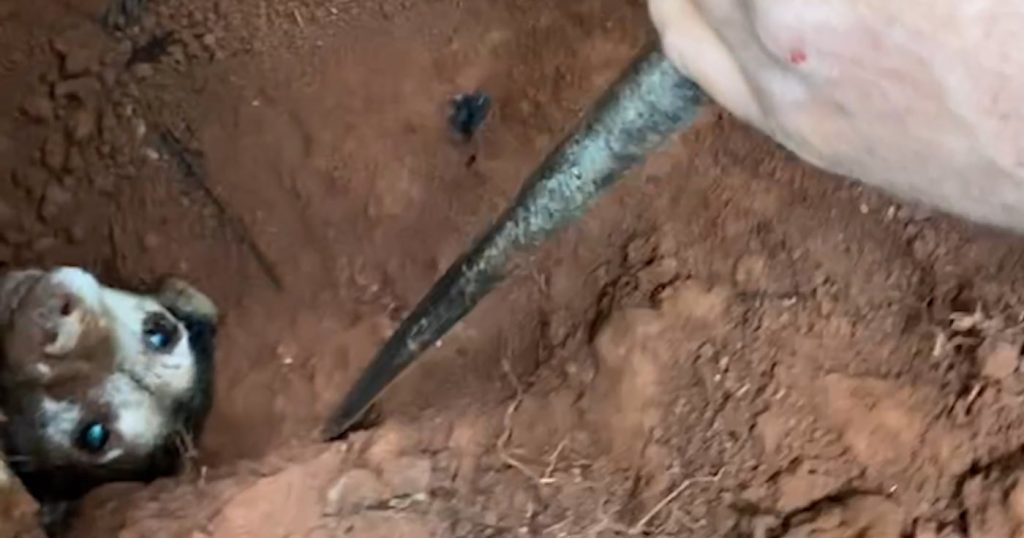
Flossie the pooch suddenly vanished from her home in Devon, England—and several days went by before anyone heard anything.
On Monday, Bracken Jelier posted a plea on Facebook, telling friends and family to keep an eye out.
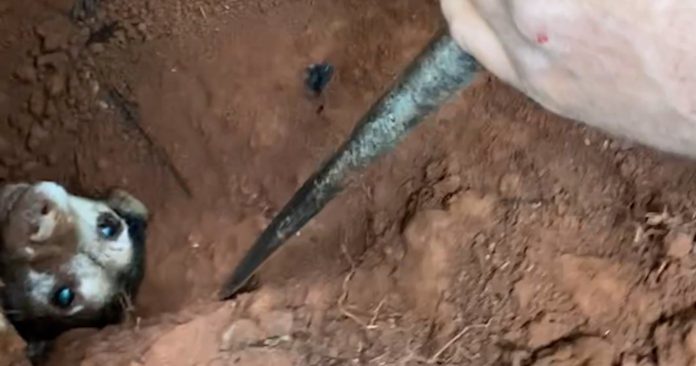
Finally, on Thursday afternoon, Flossie was located—but she was stuck down a rabbit hole in a neighbor’s garden in Crediton.
The video below shows the little pup being dug out with a spade and reunited with her grateful owner, thanks to the work of a member of the Mid Devon Hunt club.
Bracken posted on social media that her beloved dog had been returned, after being buried underground for two nights.
“We are over the moon,” wrote Bracken on Facebook. “It’s a very long story with some unbelievable coincidences that led to her being discovered after 56 hours buried underground.”
More than half of Americans feel they handle their finances better than their parents, according to a surprising new survey.
The poll of 2,000 adults looked at how different generations perceive money and found that 58% believe they’re better financial managers than their parents.
But 65% admitted being uncomfortable when talking to their parents about money. This may be because nearly 60% believe their parents had previously judged their financial habits.
But that hasn’t hindered people in achieving their financial goals or teaching others about their tips, hits, and misses.
Regardless of age, almost six in 10 respondents said they’re confident enough in their financial habits to pass them down to their children.
Conducted by OnePoll on behalf of BOK Financial, the survey revealed that 77% of people are generally confident in their ability to save money—especially millennials (86%).
Meanwhile, a majority of Gen Xers (60%) admitted they lacked the skills when it comes to saving money.
Saving money during the pandemic proved tougher for most everyone, with 58% saying they spent money more casually than in previous years. (Perhaps on interior upgrades and renovations to their home?) But a previous poll showed that 60% are more financially confident than before the pandemic.
Despite inflation, it’s not all bad news: younger workers are more likely to see their wages rise to keep pace with inflation
Seven in every 10 respondents believe that their age group has the most responsibility to make good financial decisions, but 78% of Gen Z reported feeling the most need to be financially responsible to help look out for generations to come.
“The best day to start saving for tomorrow is today,” said Brandy Marion, of BOK Financial. “Most of us wish we had started saving sooner.”
In 2003, video gamers began learning about World War II battles from the realistic launch of Call of Duty. Released to universal acclaim, the ongoing series holds the Guinness World Record as the best-selling games of their kind.
But the charity work done by the game’s publisher Activision Blizzard is also deserving of a Congressional medal.
Last month the Call of Duty Endowment reached its goal of placing 100,000 veterans into meaningful employment two years ahead of schedule.
To mark the occasion—and the start of Military Appreciation Month—Activision Blizzard has committed an additional $30 million in funding to support the program moving forward.
Over the last twelve years, the Call of Duty Endowment says it has partnered with the most effective nonprofit veterans organizations in both the US and UK to deliver high value job placements—which is the service most requested by veterans.
“To put 100,000 placements in perspective, the entire active-duty Marine Corps is made up of more than 178,000 people,” said General James Jones, United States Marine Corps (retired) and Co-Chair of the Endowment. “While reaching 100,000 placements two years earlier than our goal is an accomplishment to be proud of, there is much more we can and should be doing to support our veterans as they transition to civilian employment.”
“To date, we have invested over $60 million in support of veterans employment initiatives,” said Bobby Kotick, CEO of Activision Blizzard and Co-Founder of the Endowment. “With our even more efficient programs we expect to generate another 50,000 job placements through Call of Duty Endowment grants.”
With its first donation of $125,000, presented to the Paralyzed Veterans of America in 2009, the Endowment created thousands of career opportunities for veterans returning from the Middle East.
One of the leading charities supported by the grants is VetJobs. Their mission has received funding that led to more than 48,000 of its 77,000 placements.
“There is no better, more supportive resource for veteran job placement than the Call of Duty Endowment,” said VetJobs CEO Rear Admiral Dan Kloeppel, U.S. Navy (retired).
The Endowment also released a white paper in April detailing veteran employment over the organization’s 12-year history. “Lessons Learned for the Future of Veteran Employment” contains recommendations for veterans, employers, policy makers, and philanthropic donors.
It shows that modest, individualized assistance such as improving interview skills and resume coaching have a dramatic impact, as veterans are nearly three times more likely to find a job if they practice interviewing with a coach or mentor. Veterans are also twice as likely to find a job if an experienced mentor or coach helps them with resume writing.
Quote of the Day: “There’s no way to be a perfect mother and a million ways to be a good one.” – Jill Churchill (Happy Mother’s Day!)
Photo by: ketan rajput
With a new inspirational quote every day, atop the perfect photo—collected and archived on our Quotes page—why not bookmark GNN.org for a daily uplift?