Quote of the Day: “You can’t do anything about the length of your life, but you can do something about its width and depth.” – H. L. Mencken
Photo: by Nithin P John
With a new inspirational quote every day, atop the perfect photo—collected and archived on our Quotes page—why not bookmark GNN.org for a daily uplift?
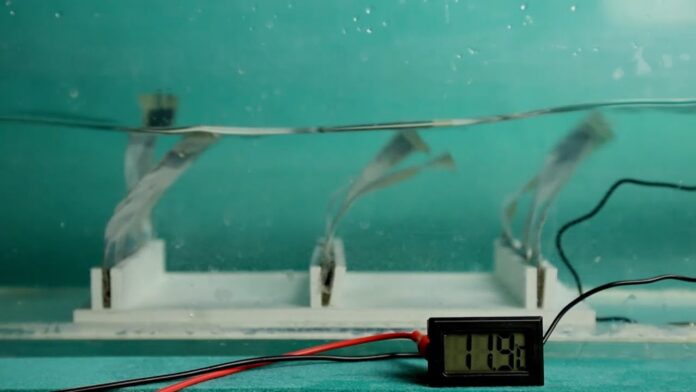
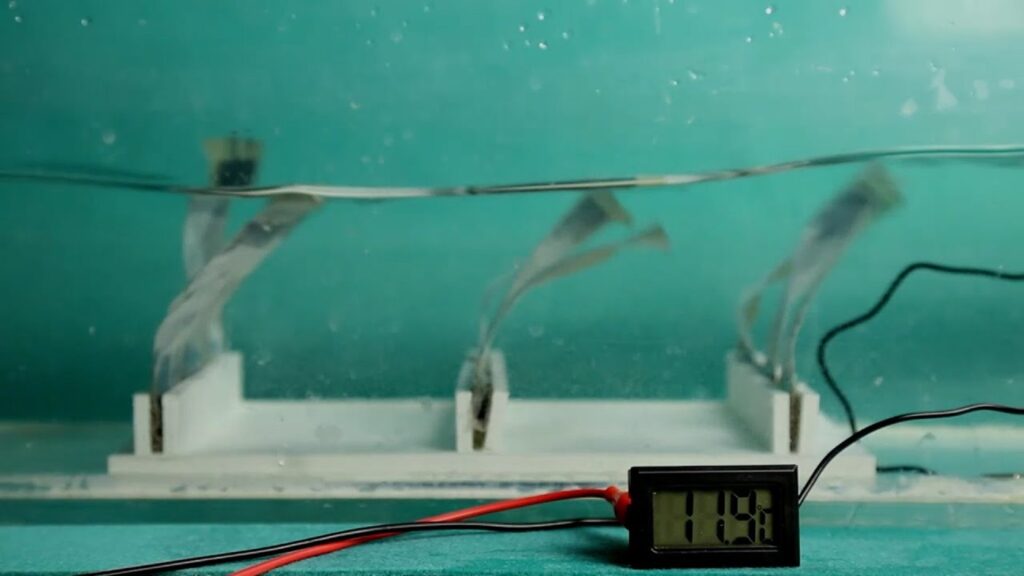
A prototype renewable energy device modeled after seaweed generates kinetic energy while it gently lolls about under the waves.
While only a proven concept, at a large enough scale the small filaments could provide energy to power major electrical appliances in coastal habitations such as floating buoys, coastal power stations, submerged devices, water monitoring equipment, or even a lighthouse.
Renewable energy doesn’t always look like something created from nature, but it certainly sometimes is inspired by nature. Already there are intelligent solar panels that track the sun across the sky like sunflowers, “tidal kites” that swim about like fish, and now these energy-generating seaweed strips.
The way they generate power is through triboelectric nanogenerators, or (TENGs) which harvest the excess energy from the transfer of electrons from one surface to another such as with static electricity.
After four years, a pair of scientists working to develop a seaweed-mimicking power supply settled on using FEP, a copolymer used to make flexible tubing around cables, and PET, one of the most common plastics, both coated in conductive ink.
As the waves move the seaweed TENGs back and forth, the coating is repeatedly connected and disconnected, generating electricity. In a recent paper describing their success, the scientists showed how just a few of these seaweed TENGs were able to power a string of 30 LED lights.
As they don’t produce heat, light, or sound, they may have no impact at all on their marine environment. Some tidal energy generators are big heavy machines full of right angles which the salt of the sea can bite into, but since these effortlessly swing back and forth, corrosion is suspected to be low.
Minyi Xu, a professor in marine engineering at and visiting scholar to Georgia Institute of Technology who helped develop the seaweed TENGs, estimates that, provided the underwater energy is enough to stimulate the TENGs two or three times a second, a tidal farm equaling the size of Georgia could meet the entire world’s energy needs, and while that’s enormously impractical due to the infrastructure that would be needed to transport that energy to say, Iowa, one can infer that a much smaller area of seaweed TENGs could provide the energy of a coastal city.
Every insured American citizen will be able to be reimbursed for eight at-home COVID-19 tests per month starting Saturday the 15th, as a part of a new White House order to improve testing.
Since the current evidence shows Omicron is proving much more contagious for the vaccinated and those without the vaccine, but also less severe the Biden team are working to ensure that people can easily test themselves.
“We are requiring insurers and group health plans to make tests free for millions of Americans. This is all part of our overall strategy to ramp-up access to easy-to-use, at-home tests at no cost,” said U.S. Department of Health and Human Services (HHS) Secretary Xavier Becerra, in a statement.
Products containing multiple tests count as one of eight for purposes of coverage. Any tests ordered and administered by a physician don’t count towards the eight, and a list of FDA-approved and deductible PCR tests can be found here, and antigenic tests here.
Claims are made through a primary insurer, provided the consumer keeps the testing receipt. Reimbursements up to $12.00 are authorized for testing done outside of an insurer’s network.
SHARE This Information With Others Who’d Love to Know About It…
There’s a dynamic duo of divers out there that can’t seem to keep to stop finding tentacled animals in the deepest of undersea zones, where pressure and temperature prohibit the vast majority of ocean life from surviving.
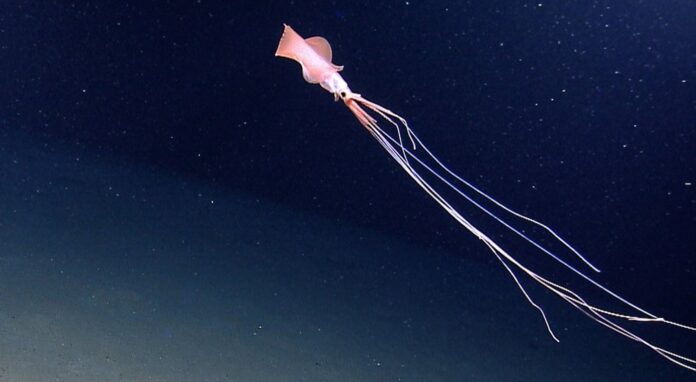
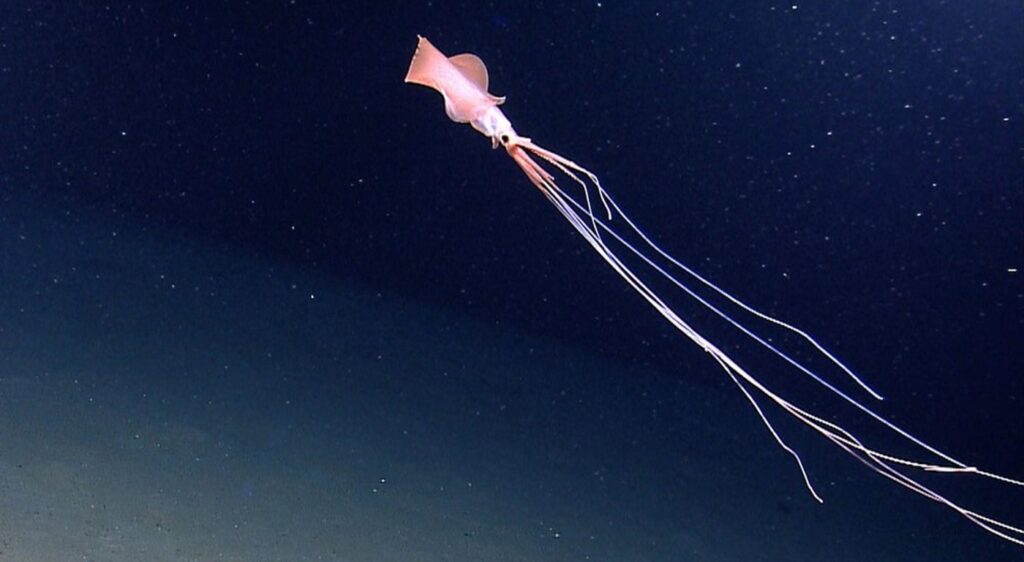
Whilst poring over film from their submersible’s recent dive to the bottom of the Philippines Trench, deep sea researcher Alan Jamieson noticed a squid that was gliding past the camera a mile below the deepest previously-recorded squid sighting.
The species in question is known as a magnapinnid or big-finned squid. The individual they saw was probably a juvenile, which suggests that there is an ecosystem down 6,200 meters, or nearly four miles below the surface, with which to sustain prominent predators.
“They’re really weird,” says Mike Vecchione, a Smithsonian Institute researcher and who Jamieson first forwarded the footage to. “They drift along with their arms spread out and these really long, skinny, spaghetti-like extensions dangling down underneath them.” Microscopic hooks and stickers catch unwary sea life which stray too close to the tentacles, and are thus eaten.
The dive was part of an expedition sponsored by Caladan Oceanic to discover the 1944 wreck of the USS Johnston which sank during the largest naval battle in history.
The wreck was found, and looked as if it “came down yesterday” remarked Caladon’s founder Victor Vescovo, the pilot of the submersible which found both the wreck and the squid.
Zoning regulations
The Abyssopelagic Zone was long-considered the deepest part of the ocean. With fewer words more severe than “abyss” to name the proposed subsequently-deeper marine zone, scientists settled on “Hadalpelagic” from the Greek word for the underworld, “Hades.”
This zone is reserved for ocean trenches and other depressions at a depth of 6,000 meters to 11,000 meters.
Last year, the same scientists, Mike Vecchione and Alan Jamieson, along with Vescovo, recoded the deepest-living octopus, a discovery which expanded the total marine mileage in which octopuses can live to 99% of the world’s oceans.
No octopus had been found at a depth greater than 5,100 meters (around 3 miles) since 1971, but during a dive into the Java Trench they found a Dumbo octopus, named for its big ear-like fins, at just shy of 7,000 meters down (4.3 miles), at which point the pressure becomes about the same as a Tyrannosaurus’s jaws on your head.
NOAA
In 2020 Vecchione and Jamieson discovered the deepest-dwelling jellyfish, which swam by the camera on Vescovo’s submersible at 9 kilometers, or 5.4 miles below the surface.
Vescovo would video tape another jellyfish in 2021—a trachymedusa at 10 kilometers, or a mind-boggling six miles straight down. At this depth the pressure is around 1,100-times greater than the pressure enforced by the Earth’s atmosphere, and would be like if your head was somehow being bitten by both Tyrannosaurus rex, and a smaller Tyrannosaurus rex.
(WATCH a video for this story below.)
Just two weeks ago, it appears we beat our own 2020 record of 9000m for the deepest jellyfish ever filmed. This clip is from 10,000m in the Philippine Trench, a gorgeous trachymedusae called Crossata. (Identified by Prof. Alan Jamieson, our Chief Scientist) pic.twitter.com/eBhKlYvAi2
Kentucky Fried Chicken has kicked off the new year across the U.S. this week by rolling out a plant-based chicken that is ‘still finger lickin’ good.’
Called Beyond Fried Chicken, the bucket of nuggets contain a non-meat ‘chicken’ that was developed by the Beyond Meat company. Created exclusively for KFC, the company says it is “packed with delicious flavor and the juicy satisfaction that you’d expect from KFC.”
“The mission from day one was simple – make the world-famous Kentucky Fried Chicken from plants,” said Kevin Hochman, president, KFC U.S. “And now over two years later we can say, ‘mission accomplished.'”
The move follows a test run two years ago in Atlanta that was an overwhelming success, and sneak peeks in select restaurants in Nashville, Charlotte, and Southern California in 2020 that sold out in days.
“We couldn’t be prouder to partner with KFC to offer a best-in-class product that delivers the delicious experience consumers expect from this iconic chain,” said Ethan Brown, Founder and CEO, Beyond Meat. “We are truly thrilled to make it available to consumers nationwide.”
Burger King is currently piloting similar nuggets created in collaboration with Impossible Foods, but KFC launched its product first.
One of the reasons why the product has sold-out, with good reviews, is that it is “crunchy, crunchy, crunchy,” and does not lack for seasoning. However—and KFC points this out with an asterisk—it is fried in the same oil as the real chicken, so hard-core vegetarians may not be willing to try it.
Beyond Fried Chicken is served with a choice of your favorite KFC dipping sauce– Honey BBQ, Ranch, Honey Mustard and KFC Sauce. It is available as a combo meal with fries and a medium drink, or à la carte in six or 12-piece orders. Prices will start at $6.99—and availability may vary by location.
Quote of the Day: “Happiness is pretty simple: someone to love, something to do, something to look forward to.” – Rita Mae Brown
Photo: by Ekaterina Shakharova
With a new inspirational quote every day, atop the perfect photo—collected and archived on our Quotes page—why not bookmark GNN.org for a daily uplift?
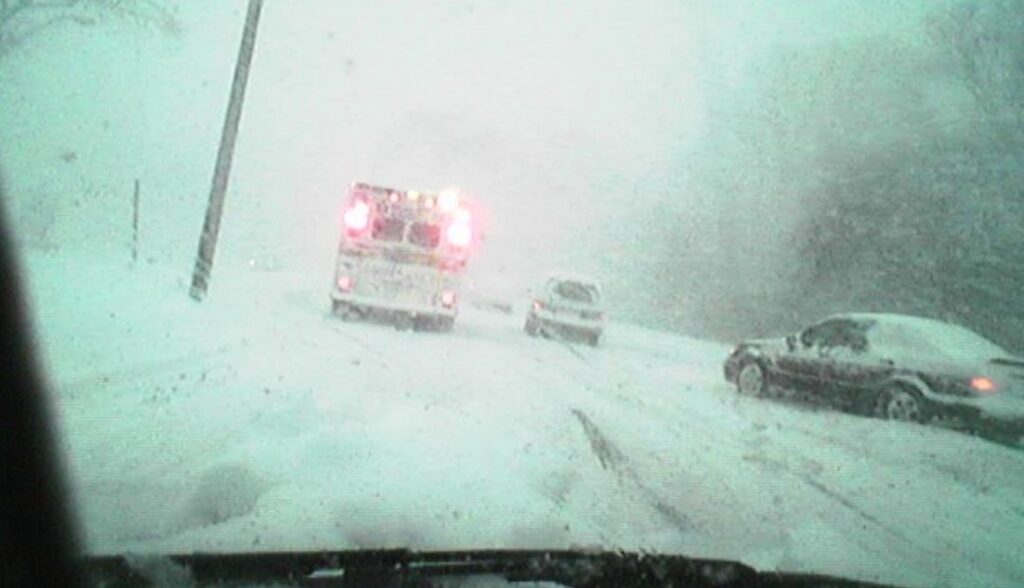
Recently, winter storms left drivers stranded on interstate highways in their cars— sometimes without food or water—for up to 48 hours. What can you do to prepare for such an emergency?
One hour of fair-weather shopping can spare you hours of misery if you found yourself stuck in your car during flooding or snowstorms. Furthermore, what may cost a few dollars at a gas station or general store could save hundreds in towing fees or thousands in hospital bills.
Make yourself a car emergency kit, and you may want to keep it in a canvass bag, or plastic storage container to allow for easy transfer between vehicles.
The 7 basics
The Organic Crave Company
Water bottles, gallons of them
Non-perishable high energy foods (nuts, granola, sardines, beef jerky, power bars, etc.)
Battery-powered flashlight (with extra batteries) and a car phone charger
Jumper cables (if your car battery dies)
Ice scraper (to clear the windows before the traffic gets moving again)
Personal hygiene products
Blankets and warm clothing, like extra socks, hats, hand warmers—also a candle and matches to provide heat if gas is low
These items will prepare you for normal conditions as well, especially if we accidentally leave the lights in our car on, and the battery dies (and you are grateful for the jumper cables).
Water is not only great to have in case you need to quench your thirst. A gallon can save your car from overheating in case something goes wrong with the coolant.
Paper towels, period products, diapers, soap, and bags to stow trash can be important for several reasons. Soap not only allows one to stay germ-free, but scrubbing long enough will remove gasoline if it gets on your hands.
Jumper cables – Daniel at bestjumpstarterreview.com
The Five Cs
An old preparatory rule is to follow the Five Cs: “Cutting, Combustion, Covering, Container, Cordage.”
A cutting tool is more important on a hiking trip than a car emergency, but the second C, a combustion device, (matches or a lighter) is vital as it leads to fire, which is the ticket to warmth, rescue, and comfort in almost any emergency situation. Be sure to put a candle and plenty of matches in the car, which can provide heat if your car needs to be shut down to preserve gas.
Covering could mean a winter coat and hat, a blanket, or even a tarp. Remaining warm is key, but what you don’t need to wear can be used to insulate the windows. If you think keeping a blanket in your car is overdoing it, just imagine sleeping in January without a blanket on your bed. Store several blankets for passengers and yourself.
Containers are arguably the most important tool in a car emergency. Without a funnel for example, it’s difficult to pour gasoline or other important oils into a car tank or engine if you don’t have a gas can. A container to melt snow into water, if stuck on a wintery highway for 48 hours, is also important.
Cordage in a lost hiker scenario would mean simple nylon rope, but in a car breakdown one is probably better off with something capable of towing, or lashing something down to a roof rack: think tow lines and bungie cords.
Ready if your car gets stuck in the snow
By abbyladybug – CC license
For those who live in remote areas, this kit may not be enough. Here are some things for the motorist who needs to prepare for roads that remain snowed over for weeks.
Portable battery or crank-powered radio
Tire chains for icy roads
Tire inflator
Solar-powered device charger
Water purifying supplies
Bag of cat litter or sand
It’s difficult, especially for younger people, to remember the utility the radio once had. If cell towers are down, how will you get information on weather or emergency services? Running your car radio will draw battery away, so a battery or crank-powered radio can keep the stranded motorist informed.
Winter tires or tire chains are actually obligatory in some locales, and are sold in a 12×12 box to stow in the truck. They are a bit expensive, but cheaper than a tow, and cheaper than a set of winter tires. Plus they can turn nearly any car no matter how dinky into an ice road warrior.
Portable compressors to re-inflate tires may not save you the cost of changing your tire, but can offer a 10 minute to two-hour mobility boost, depending on the size of the puncture, to get out of a tough situation like falling into a ditch.
Water purification tablets often contain iodine, and are usually pretty cheap. The homesteader may opt for a more permanent solution like the Sawyer Squeeze Water Filtration system that can fit onto the threads of most water bottles, and is guaranteed to filter 99.9% of bacteria and heavy metals across a lifespan of 8 million liters.
In case your car needs traction on a patch of ice to get out of jam, carry some cat litter or sand—they can be poured around the wheels to provide better traction on slick roads.
SHARE This Vital Survival Guide With Those in the Know…
Black hole illustration by Alain r (CC license on Wikipedia)
Black holes really are giant fuzzballs, a new study says.
Alain r, CC license
The study attempts to put to rest the debate over Stephen Hawking’s famous information paradox, the problem created by Hawking’s conclusion that any data that enters a black hole can never leave. This conclusion accorded with the laws of thermodynamics, but opposed the fundamental laws of quantum mechanics.
“What we found from string theory is that all the mass of a black hole is not getting sucked in to the center,” said Samir Mathur, lead author of the study and professor of physics at The Ohio State University. “The black hole tries to squeeze things to a point, but then the particles get stretched into these strings, and the strings start to stretch and expand and it becomes this fuzzball that expands to fill up the entirety of the black hole.”
The study, published Dec. 28 in the Turkish Journal of Physics, found that string theory almost certainly holds the answer to Hawking’s paradox, as the paper’s authors had originally believed. The physicists proved theorems to show that the fuzzball theory remains the most likely solution for Hawking’s information paradox.
Mathur published a study in 2004 that theorized black holes were similar to very large, very messy balls of yarn – “fuzzballs” that become larger and messier as new objects get sucked in.
“The bigger the black hole, the more energy that goes in, and the bigger the fuzzball becomes,” Mathur said. The 2004 study found that string theory, the physics theory that holds that all particles in the universe are made of tiny vibrating strings, could be the solution to Hawking’s paradox.
With this fuzzball structure, the hole radiates like any normal body, and there is no puzzle.
After Mathur’s 2004 study and other, similar works, “many people thought the problem was solved,” he said. “But in fact, a section of people in the string theory community itself thought they would look for a different solution to Hawking’s information paradox. They were bothered that, in physical terms, the whole structure of the black hole had changed.”
Studies in recent years attempted to reconcile Hawking’s conclusions with the old picture of the hole, where one can think of the black hole as being “empty space with all its mass in the center.” One theory, the wormhole paradigm, suggested that black holes might be one end of a bridge in the space-time continuum, meaning anything that entered a black hole might appear on the other end of the bridge – the other end of the wormhole – in a different place in space and time.
In order for the wormhole picture to work, though, some low-energy radiation would have to escape from the black hole at its edges.
This recent study proved a theorem – the “effective small corrections theorem” – to show that if that were to happen, black holes would not appear to radiate in the way that they do.
The researchers also examined physical properties from black holes, including topology change in quantum gravity, to determine whether the wormhole paradigm would work.
“In each of the versions that have been proposed for the wormhole approach, we found that the physics was not consistent,” Mathur said. “The wormhole paradigm tries to argue that, in some way, you could still think of the black hole as being effectively empty with all the mass in the center. And the theorems we prove show that such a picture of the hole is not a possibility.”
The researchers have also published an essay showing how this work may resolve longstanding puzzles in cosmology; in the International Journal of Modern Physics.
If you’re having a hard time seeing the light at the end of the COVID-19 tunnel, we suggest trying the view from a different tunnel—the Lincoln Tunnel to be exact.
It’s there, on the New Jersey side, that one compassionate motel worker is making sure people have a roof over their heads by offering free rooms to folks in need.
North Bergen’s Lincoln Tunnel Motel has been in Brian Arya’s family for years. Although he harbored aspirations of an acting career, Arya began working the night shift there in 2012—then his father gifted him partial ownership five years ago.
At the onset of the pandemic, Arya saw firsthand the rising need for affordable places to stay. “People started getting quarantined, lockdowns starting happening, and then we started seeing an influx of unhoused people. You know, they just couldn’t afford rent anymore and so, they’d come to our motel,” he told CBS News.
Now, thanks to its creative co-proprietor, the humble hostelry is “internet famous.”
Tapping into his theater roots, Arya put together a steady stream of humorous, and often poignant videos and posted them to TikTok. The satirically dubbed “Motel Hell” series currently boasts a fan base of more than 880,000 followers.
With such a sizable audience, Arya was struck with a notion: What would happen if he made free rooms available to TikTok followers who needed a place to stay?
Rather than simply ponder the notion, Arya turned it into a reality, launching a “Free Room for You” program offering accommodations at no charge to anyone without viable housing.
From there, he says, his good deed simply “snowballed.”
Donations of food, toiletries, and funding to front room charges started pouring in. Local college students trucked over a stack of supplies from their food pantry. Arya’s Amazon Wish List was quickly maxed out with generous donations from supporters nationwide.
As winter’s chill set in and temperatures began to fall, the motel’s “pay it forward brigade” rose to the challenge. About the time the thermometer tipped a chilly 18°, Arya cites the efforts of one anonymous donor who dropped off about 20 homemade care packages filled with the necessities, which he was then able to distribute to motel residents as well as people who come in off the street seeking help.
Arya estimates he’s given away in the neighborhood of between 50 to 60 free rooms so far. He notes that those long-term guests whose housing evaporated at the pandemic’s onset have formed a bond that’s akin to family. “There’s definitely a community there,” Arya told CBS. “[You’ve] just got to get to know people, get to know their stories. And I’m fortunate I get to do that.”
With new coronavirus variants in the picture, there may still be dark days ahead. Until such times pass, however—to paraphrase the famous Motel 6 slogan—at this one New Jersey motel at least, “We’ll leave the light at the end of the tunnel on for you.”
(WATCH the video for this story below; Editor’s Note: Viewers outside the U.S. can watch the CBS video here.)
SHARE This Story of Awesome Generosity With Friends on Social Media…
Quote of the Day: “At times our own light goes out and is rekindled by a spark from another person… Think with deep gratitude of those who have lighted the flame within us.” – Albert Schweitzer
Photo: by Moodywalk
With a new inspirational quote every day, atop the perfect photo—collected and archived on our Quotes page—why not bookmark GNN.org for a daily uplift?
From the lowland forests of Madagascar to Easter Island’s coral reefs, dozens of new flora and fauna were added to the scientific tree of life in 2021, proving that our vast and dynamic planet still contains unexplored places with never-before recorded plants and animals.
Researchers at the California Academy of Sciences announced the 70 new plant and animal species, including 14 beetles, 12 sea slugs, nine ants, seven fish, six scorpions, five sea stars, five flowering plants, four sharks, three spiders, two sea pens, one moss, one pygmy pipehorse, and one caecilian.
More than a dozen Academy scientists and several dozen international collaborators described the new species, which were discovered on five continents and three oceans.
Researchers sifted through forest floors, ventured into vast deserts, and dived to extreme ocean depths.
“Our relationship to nature improves with each new species, deepening our understanding of how our planet works,” said Dr. Shannon Bennett, Academy virologist and Chief of Science.
Among the new discovery was Pachyrhynchus obumanuvu, a brightly colored Easter egg weevil from the forested mountaintops of the Philippines.
Easter egg weevil by Analyn Cabras
At 3,000 feet (914 meters) above sea level, the weevils live in the canopy of the moist, moss-covered cloud forest. Unlike most weevils, which tend to be a single color, P. obumanuvu boasts complex patterns of iridescent yellows and greens. Its coloration mimics the traditional garments of its namesake, the Indigenous Obu Manuvu tribe.
Dr. Cabras, who named the species, believes the power of a name can instill a sense of pride and stewardship for a species within a community.
“How can we teach conservation and wildlife regeneration if we can’t put a name to a face?”
P. obumanuvu was found in a small patch of primary forest – one of few remaining in the region due to centuries of farming and over-logging.
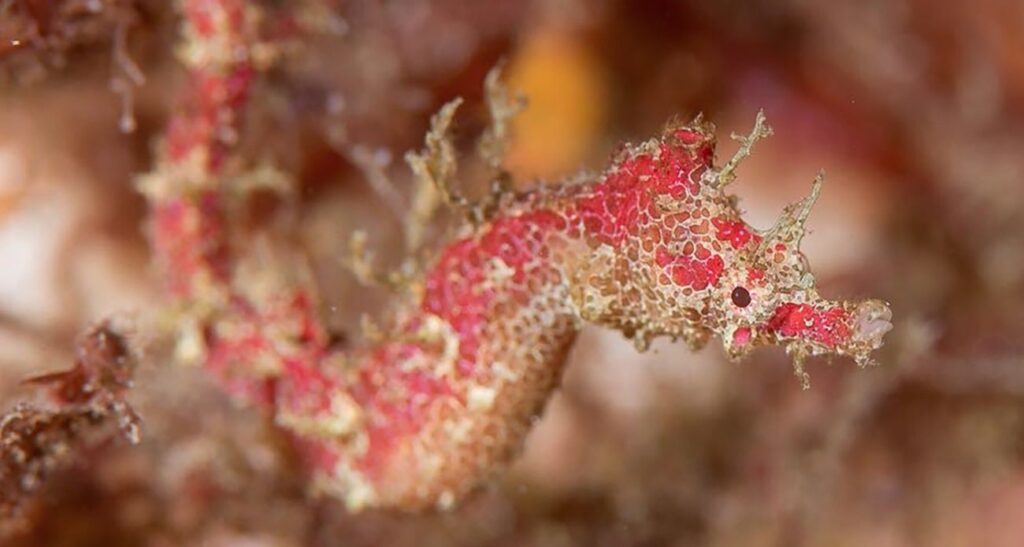
Cylix tupareomanaia, a new species of pygmy pipehorse and close cousin to seahorses, was the first new genus of pipehorse to be reported in New Zealand in 100 years.
Academy Research Associate Dr. Graham Short noted, “This discovery underscores how little we know about the reefs of New Zealand we’ve been exploring for centuries.
“If you dive a little deeper, I expect we’ll identify several more new species of fish.”
Blue-spotted guitarfish
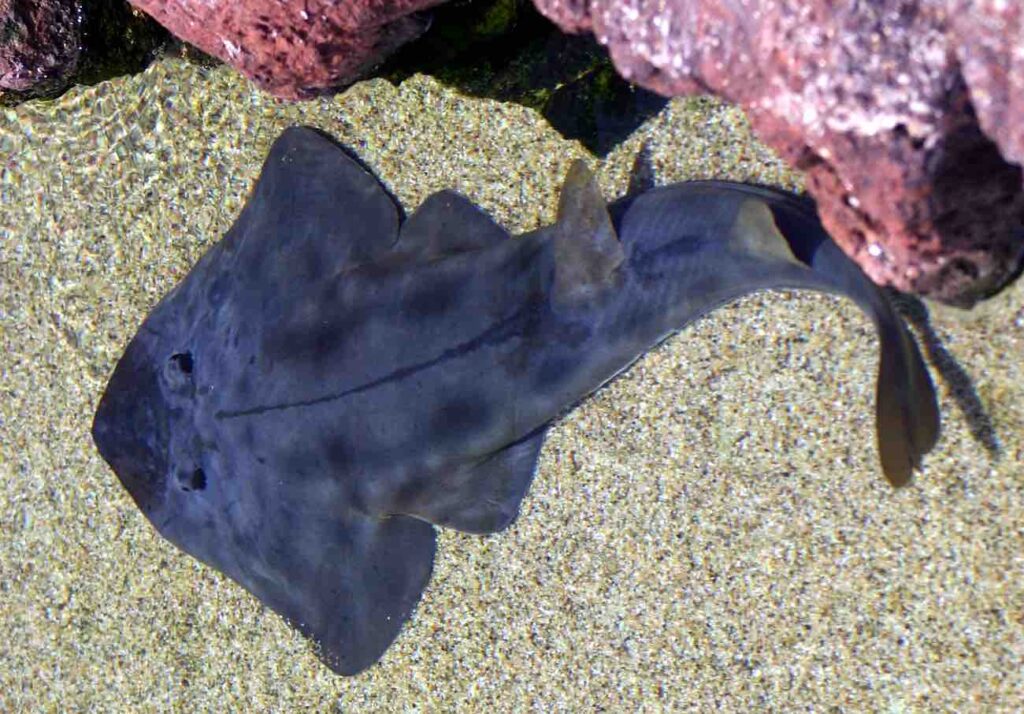
Ichthyology Research Associate Dr. David Ebert described two blue-spotted guitarfish from Madagascar (Acroteriobatus andysabini) and Socotra (Acroteriobatus stehmanni).
Guitarfish by Jot Powers, CC license on Wikimedia
These are coastal rays with elongated bodies and flattened heads that resemble guitars.
Because of their close proximity to humans and ability to be easily fished, these shark-like rays are among the most endangered of all cartilaginous fish, a class that contains sharks, rays, and chimeras.
Dr. Ebert’s conclusion that there are in fact two distinct species has helped to spur Madagascar’s first national plan of action to protect sharks and rays.
Collaborating with local fisheries to incorporate species identification in their practice, Dr Ebert is hopeful for harmony between guitarfish and the neighboring coastal communities they sustain.
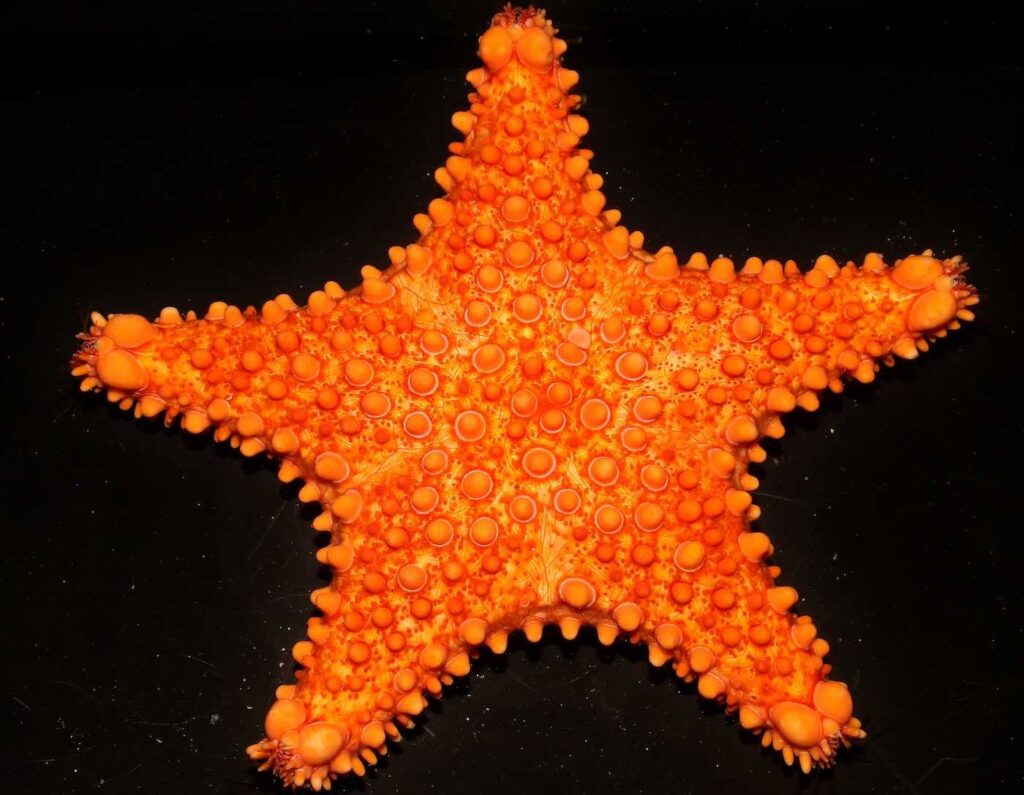
‘Fire’ sea star
Over the past year, Invertebrate Zoology Research Associate Dr. Christopher Mah described five new-to-science echinoderms—a group of marine animals that includes sea stars, sea urchins, and sea cucumbers—from Easter Island and New Caledonia.
After careful examination of images from a remotely-operated vehicle and sea star specimens, Dr Mah described the Indo-Pacific sea star Uokeaster ahi.
Setting the reef ablaze with its bright orange color, U. ahi is aptly named for its fiery hue—ahi, meaning ‘fire’ in the Rapa Nui language.
‘Uokeaster’ is derived from the mythological sea deity Uoke, who, according to legend, submerged the once-continental Rapa Nui beneath the sea, leaving only its tallest mountain peaks exposed. U. ahi resides in the reefs just beneath the surface.
Dr. Mah explained that sea stars are important contributors to healthy coral reefs. Remove them, and the ecosystem falls out of balance.
“You never know what benefit will come of studying the unknown,” said Mah. “Whether that’s a tangible benefit like an anti-cancer drug or an ecological benefit in protecting coral reefs.”
SHARE This Shiny Good News With Nature Lovers on Social Media…
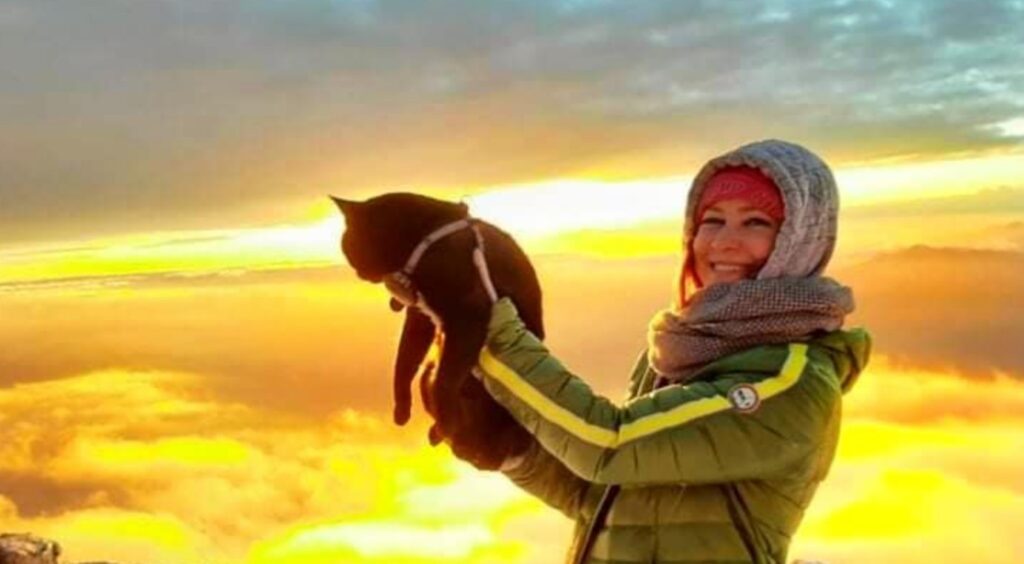
Bounty is a traveling cat who loves to discover new places. Snuggled up in his special backpack slung over owner Doina Muravschi, he has enjoyed cycling tours of Italy, mountaineering, and camping, all the while seeing sights that would make the front page of National Geographic.
Just recently, Bounty has presumably become the first house cat to summit La Grignetta, a 7,100-foot mountain in the Italian Alps, “without even a meow of protest,” as La Repubblica reports.
Four months ago, Muravschi saved Bounty as a one-year-old kitty heading to a cat sanctuary. As in America, black cats in Italy suffer the lowest adoption rates, and many have to wait until adolescence to find homes.
“I handmade a special pouch for him, because cat carriers are not adapted to certain journeys,” joked Muravschi, who documents her travel with Bounty on her Facebook page.
“Together we’ve already gone on trips of more than a month—last autumn, when we went from Ballabio to Matera by bike,” she told La Repubblica. For those unfamiliar with Italian geography, that is cycling the entire length of the Italian peninsula from the knee-line to the instep of the ‘boot’.
“At the start Bounty was a little agitated, but after the first few days started to enjoy himself. While I peddled, he slept in the carrier.”
The objective of her journey, and that of her Facebook page devoted to their travels, is to educate those who believe that cats only long for the sofa—and that the only pawed-companion for long journeys is a dog.
(WATCH the Facebook video to meet Bounty in his pouch below.)
SHARE This PAWsome Story With Your Friends on Social Media…
A kangaroo was saved after taking a dunk in the ocean off the coast of Australia by a rookie lifeguard.
Onlookers enjoying the surf and scenery on a rock shelf over-hanging the ocean in Bundjalung National Park were surprised to see an eastern grey kangaroo jumping across rock pools and tumbling into rough surf.
“My other workmate, Carissa and I, we were sitting on the tractor and she goes, ‘Oh my God, there’s a kangaroo jumping off the rocks!'” said 17-year old Lillian Bee-Young, a new lifeguard who had a surfboard nearby. “We were just figuring out what we should do… because we’ve never had that happen before.”
There were rough conditions that day on the north coast of New South Wales. Lillian believed the kangaroo was trying to avoid some fishermen and just “got wiped out by a set (of waves).”
Lillian told ABC News Australia that she didn’t quite know how to proceed as she paddled out with the rescue board. She didn’t know whether to try and get it onto the board, for example, or if that would put her in danger and stress the marsupial out even more.
It was just managing to keep its head above the water, but didn’t want to come ashore due to a gathering crowd.
Her friend Carissa cleared an avenue to allow Roo to feel comfortable, and after a few stumbles, it made it back onto dry land and immediately went off into the bushes.
“It was quite special. There were people cheering and clapping… and then [the kangaroo] was just sitting there up in the bushes, almost, I thought, as a thank you… It was really serene,” Lillian said.
(WATCH the video of the daring rescue below.)
SHARE This Hopping Good News With All Your Buddies…
For the entire history of human civilization, entrepreneurs have found that the easiest way to sell a brand new technology is to adapt it into the existing ones: hence the evolution from solar panels to solar roofs.
GAF Energy
Now the largest roofer in America is taking that one step further, by turning a solar roof into solar shingles, installed with nothing more than a nail gun, and which costs the same as rack-mounted panels.
A normal family home can be shingled with solar-celled roof material that’s fireproof, waterproof, and tough enough to walk over, in just two days due to their similarity with regular shingles.
The producer of Timberline Solar Energy Shingle, GAF Energy, is owned by Standard Industries, the largest and longest-lived roofer in the country.
This familiarity with the business and access to resources allowed the company to use materials available only on a wide-scale, and avoid specialist components that are more expensive and harder to source.
“We’re half the cost of a Tesla solar roof,” said Martin DeBono, President of GAF Energy, to Fast Company. “But we are in line with traditional solar rack mounted solar. And this really makes the decision for a homeowner who is thinking about going solar very easy to get a solar roof—it’s a superior product.”
The aesthetics are much better than regular panels, as the shingles are smaller and lower, and can’t be seen close-up.
GAF Energy
However they generate just as much electricity as regular solar. GAF Energy has its own software to calculate where the sun will be and how much energy a roof can generate.
It’s won a whole bunch of awards, too, including Best of Innovation in “Smart Cities” at the Consumer Electronics Show, and is approved compliant, safe, and effective by one of the world’s largest third-party compliance testers, UL.
GAF Energy
Currently roofing and solar installation are different industries, but DeBono believes that by tapping into a market which sees five million roofs replaced every year, solar shingles have a chance to rapidly eclipse market share compared to the bulkier panels.
ENERGIZE Those News Feeds With the Good News; Share This Article…
Quote of the Day: “Let the root of love be within. Of this root can nothing spring but what is good.” – Augustine of Hippo
Photo: by engin akyurt
With a new inspirational quote every day, atop the perfect photo—collected and archived on our Quotes page—why not bookmark GNN.org for a daily uplift?
When a good Samaritan took notice of a boy’s overt fondness for a particular guitar in a Colorado music store, he decided to buy the instrument for him as an anonymous gift.
J.B. Hart Music Co.
Fallon often came in to J.B. Hart Music Co. in Grand Junction, Colorado, with a request to play “the Pantera guitar” referring to a model made iconic by the guitarist for the heavy metal band Pantera.
“Fallon is impacted by Williams Syndrome and has an excellent knowledge and a love for music,” the music store wrote in a Facebook post. “His dream was to own this guitar.”
“Eight months ago, when he was in the store playing it, another customer took notice of Fallon. It moved this customer so much that he returned to the store later, and asked us to give the guitar to Fallon anonymously the next time we saw him.”
He purchased the $800 Dean “Dimebag” Darrell ML Guitar, and they waited for the boy to return, but Fallon didn’t come into the shop for eight months.
His family had moved to Texas, but when they were back in Colorado they popped into the store, and were shocked by the surprise that awaited them..
“His mom burst into tears, and Fallon beamed with excitement. It was a special moment,” they wrote. “There are still good people in this world.”
That special moment drew the attention of the remaining members of Pantera themselves, seeing as it was the guitar made famous by the dearly departed “Dimebag” Darrel, whose music Fallon was so admired.
Not only that, according to the music store, band manager Kim Davis contacted the family with news that Pantera’s Philip Anselmo and Rex Brown would be sending him a rocking care package.
WATCH his reaction moments after receiving the gift…
SHARE This Rocking Generosity With Your Friends on Social Media…
At the headquarters of China’s most powerful nuclear fusion reactor, Chinese scientists rang in the new year by setting a world record for the longest-sustained operation of such a reactor, beating a world record they set last year 10 times over.
China’s record-breaking Experimental Advanced Superconducting Tokamak (EAST) in Heifei managed to heat plasma to 120 million Fahrenheit, or 70 million Celsius, for around 17.5 minutes—the longest any nation has ever been able to contain a super-heated plasma.
The relevance is two-fold. First, the longer the plasma can be contained in the reactor, the more electricity is produced, and the greater the volume of these successful tests around the world, the more the case for nuclear fusion power grows. Second, the jump in magnitude between the record set by EAST in July of 2021, and that of December 2022, shows just how fast this technology is advancing.
“We achieved a plasma temperature of 120 million degrees Celsius for 101 seconds in an experiment in the first half of 2021. This time, steady-state plasma operation was sustained for 1,056 seconds at a temperature close to 70 million degrees Celsius, laying a solid scientific and experimental foundation toward the running of a fusion reactor,” said Gong Xianzu, a researcher at the Chinese Academy of Sciences Plasma Institute.
How it works
Nuclear fusion reactors are often called “artificial suns” in the media, as they replicate the way stars form and continue to generate matter. A heavy ionized gas called plasma, that makes up most of the stars in the universe, is formed in the reactor by different methods for different reactors. Currently there are many institutions pushing different models of fusion power.
EAST fires a supercharged laser at heavy hydrogen isotopes like deuterium and tritium. If ice is hydrogen in a solid form, water is liquid, and vapor is gas, plasma is what happens when you really turn the heat up. The plasma would normally dissipate and rapidly cool, but superconducting magnets replicate the intense gravitational pressure at the center of the sun to keep it contained.
Once contained under this pressure, which is tens of thousands of times stronger than the Earth’s, the atomic nuclei of the hydrogen atoms overcome their magnetic resistance and push against each other under the heat to fuse, hence the name fusion.
In order for this process to generate electricity, four hydrogen atoms must fuse together to create a helium atom. Energy is released during this process which in the sun is bled off into the solar system, but in the confines of the reactor is collected for energy.
Considering the gravity and price tag of these experiments it seems valuable to question why. Nuclear fusion power generates no emissions expect for helium. Most operators are preparing to adapt seawater as a fuel source rather than uranium or plutonium, as seawater contains a bit of deuterium and tritium. Furthermore the output is extraordinary, with one liter of seawater expected to generate the same amount of electricity as 300 liters of oil.
“It’s probably the last energy source we’ll ever tame,” Dennis Whyte, a Canadian scientist who is director of plasma science fusion center at MIT, told the Financial Post last year.
“I think of the trajectory from taming fire and it finally completes in fusion, because we’ll have tamed the energy source of the stars.”
HELP Good News Ignite–Share This Story With Others…
“With loyalty, I will endeavor to aid the physician in his work, and devote myself to the welfare of those committed to my care.”
Every day, nurses take these words from the Florence Nightingale oath to heart, striving to ensure their patients’ welfare—but some, like registered nurse Jennifer Smith, take that commitment to care a step further.
Last November, Smith got a panicked call from John Burley, one of her patients from the adult day health care program at Rome, New York’s Grand Rehabilitation and Nursing Center. He’d been hospitalized with pneumonia, and with no nearby family to step in to help, his dog Boomer had been taken to an animal shelter.
“I came into work the Monday after Thanksgiving to the phone ringing at 7 a.m.,” Smith recalled in an interview with CNN. “John was calling from his hospital room saying, ‘Boomer is in the pound! Boomer is in the pound!’”
Aware that the 12-year-old dog he’d had since it was a pup meant the world to him, when Burley asked Smith if she would take care of Boomer, her immediate response was a resounding, “Of course, I will!”
The first thing Smith had to do was track Boomer down, finally finding him at the Rome Humane Society. The following day, she drove to the shelter and put the adoption in motion, letting Burley know Boomer was doing well and he’d be coming home soon.
Smith was given the green light to bring Boomer to work with her. She says that knowing his beloved canine companion was safe and they’d be able to see one another made a huge positive impact on Burley’s recovery.
Grand Healthcare
During his stay in the rehab wing, Smith brought Boomer to visit his doggy daddy several times a day. The cute pooch soon became a favorite with staff and patients alike.
To Smith, keeping 60-year-old Burley and Boomer together is just a natural extension of her life’s goal of helping people. “There are just so many worries in the world right now. If I can take one worry away from John, that’s the least I can do,” she told CNN.
“I can’t cure diseases. I’m not a miracle worker [but] I made a promise to John to take care of Boomer. I will take care of him as long as he needs me to. John knows that. Right now the focus is on John getting better and taking it one day at a time.”
Burley has speech issues as a result of his illness, so sometimes it can be difficult for him to put his thanks into words. However, there’s one sentiment he’s managed to express loud and clear: “I love Jennifer,” he’s declared.
We’re sure Boomer seconds that emotion with a hearty, “Woof!”
RAISE Your Paws For True Generosity; Share This Story…
The Flame Nebula, captured in radio waves. Photo Credit - ESO/Th. Stanke & ESO/Digitized Sky Survey 2.
The Flame Nebula region as seen in infrared with APEX and VISTA;ESO/Th. Stanke & ESO/J. Emerson/VISTA
There’s an adage in astronomy about how there’s always something new to find in the constellation of Orion—well, astronomers just found his fireplace.
In a new series of images, the aptly-named “Flame Nebula” located in Orion appears like a raging inferno, as radiation released by young stars causes clouds of gases and dust to glow.
The spectacular image was snapped by the Atacama Pathfinder Experiment at the European Southern Observatory in Chile’s Atacama Desert, the perfect place for professional stargazing due to it being very far from any light pollution and located at a very high altitude.
It’s a composite image, with instruments that view in radio waves providing the blazing oranges, and a second infrared spectrum telescope providing the precise background.
Optical light can’t make it through the dense nebulae, but infrared light can, so using both allows scientists to have an unobstructed view.
Orion is one of the most famous regions in the sky, and the image contains the iconic Horsehead Nebula in the top right in addition to the Flame Nebula. The lighter colored swirl in the middle-right is the reflection of another nebula NGC 2023. The team even discovered one new nebula, a small object, remarkable because of its almost perfectly circular appearance, which they named the Cow Nebula.
“As astronomers like to say, whenever there is a new telescope or instrument around, observe Orion: there will always be something new and interesting to discover!” ESO Thomas Stanke said in a statement.
The Flame Nebula, captured in radio waves.; ESO/Th. Stanke & ESO/Digitized Sky Survey 2
Nebulae are often referred to as cosmic nurseries, and are areas in which clouds of gases and dust coalesce into stars. This makes them extremely photogenic places, and the clouds in the image are known as the Orion Molecular Cloud Complex.
Located between 1,300 and 1,600 light-years away from Earth, they contain the most active stellar nursery in the Solar System’s neighborhood.
Unlike what the “fire” of this image might suggest, these clouds are actually cold, with temperatures typically just a few tens of degrees above absolute zero.
“The different colors indicate the velocity of the gas,” ESO officials wrote in the statement. “The Flame Nebula and its surroundings are moving away from us, with the red clouds in the background receding faster than the yellow ones in the foreground.”
WATCH ESO stack their images atop one another in the video below.
Quote of the Day: “The fears are paper tigers. You can do anything you decide to do. You can act to change and control your life.” – Amelia Earhart
Photo: by Alexander Krivitskiy
With a new inspirational quote every day, atop the perfect photo—collected and archived on our Quotes page—why not bookmark GNN.org for a daily uplift?