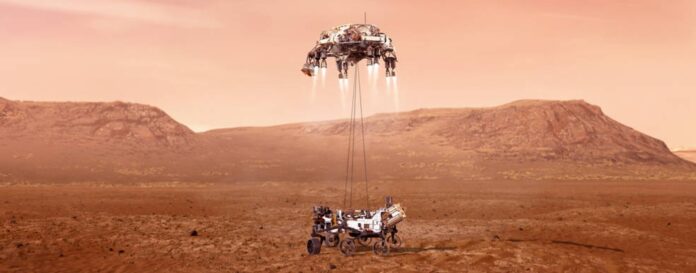
NASA/JPL-Caltech, illustration of the rover landing
After its harrowing touchdown on Mars ten months ago left NASA engineers cheering, a six-wheeled scientist named Perseverance has been achieving its key objectives.
The rover has been searching for signs of ancient microbial life on the Red Planet and is at the heart of NASA’s goal to complete the first mission to collect and cache Martian rock and dust.
Now, all that it has accomplished so far has been captured in a new video.
Surface Operations Mission Manager Jessica Samuels reflected on the year filled with groundbreaking discoveries from the Jezero Crater on Mars.
In the 10 months since it landed with a parachute by working with gravity, the car-size rover has driven 1.8 miles (2.9 kilometers), set a record for the longest rover drive in a Martian day, taken more than 100,000 images, and collected six samples of Martian rock and atmosphere that could eventually be brought to Earth for further study.
And then there’s NASA’s Ingenuity Mars Helicopter, which hitched a ride to the Red Planet with Perseverance.
It proved that powered, controlled flight is possible in Mars’ thin atmosphere, and the 4-pound (1.8-kilogram) rotorcraft has logged 18 flights and counting.
Samuels, the Perseverance surface operations mission manager at NASA’s Jet Propulsion Laboratory in Southern California, also explains the next phase of Perseverance’s mission: to explore the delta that formed in Jezero Crater billions of years ago from sediment that an ancient river carried into the lake that once existed in the crater.
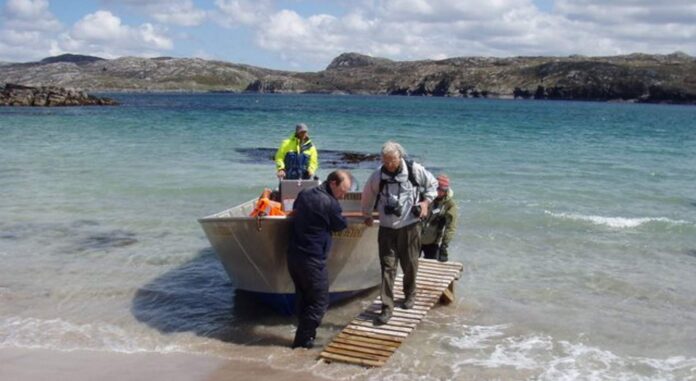
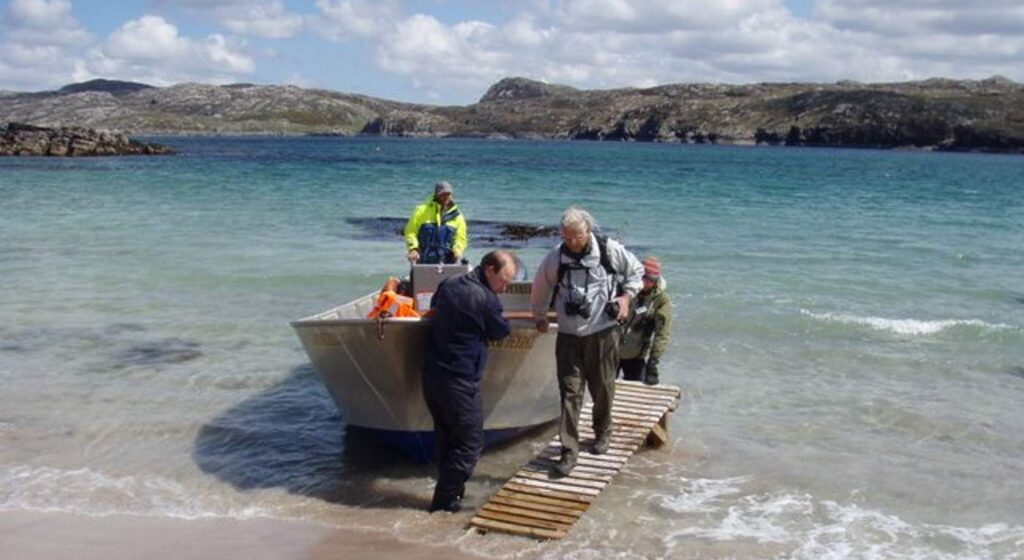
Roger McLachlan _ Landing on Handa Island _ CC BY-SA 2.0 wikimedia commons
Roger McLachlan;CC license
A wildlife ranger is being sought for an idyllic island off the north coast of Scotland—and a free cottage to live in is included.
The Scottish Wildlife Trust is looking for someone to take over the position of Handa Island Ranger on the remote island off the coast of Sutherland in the Highlands.
The successful candidate will be treated to stunning sandy beaches, spectacular views from the 394-feet-high cliffs, and getting to know the 100,000 breeding seabirds living on the island.
Handa is so small it only takes two and a half hours to walk around, but the candidate will need a driver’s licence and a vehicle to make weekly trips to the nearest village, Scourie, over on the mainland.
Those interested will need to have a good knowledge of the local marine and terrestrial natural history, excellent people skills, and organizational abilities.
The six-month fixed term contract is from March to September 2022, and pays £17,290 ($23,458) FTE per annum pro rata.
Applications opened last month and are due to close on January 17 at 2pm–if you’re looking for a wild adventure, it sounds like it’s time to get applying.
SHARE This Opportunity With Those Who’d Love to Hear About It…
“The mole on the back of your neck is possibly cancerous. Please go see a doctor!”
It was a strange thing for Vancouver Canucks assistant equipment manager Brian Hamilton to see on the screen of a cell phone belonging to a fan who had pressed it against the glass separating fans from players.
Fans do all kinds of strange things at sporting events, but Nadia Popovici was following her medical training when she noticed that the dark spot on the back of Hamilton’s neck was discolored, raised, and had irregular borders: all potential signs of the skin cancer melanoma.
As it turns out, Hamilton had the mole removed which was subsequently confirmed to be a melanoma tumor.
“… She saved my life,” Mr. Hamilton said at a press conference. “The words out of the doctor’s mouth were if I ignored that for four to five years I wouldn’t be here. How she saw it boggles my mind. It wasn’t very big, I wear a jacket, I wear a radio on the back of my jacket… She’s a hero.”
The team wanted to reach out to Popovici somehow, and so set up a social media campaign to reunite the two before the Canucks played Seattle Kraken on January 1st, which succeeded.
An act of kindness towards another human that Brian (Red) will forever be grateful for.
As a way of saying thank you, during the second commercial break it was revealed for everyone in the Seattle Climate Fund Arena to see, that both teams had raised $10,000 to send Popovici to medical school.
What Popovici described in her diagnosis of the melanoma was a method of identification called the “ABCDE Rule,” an acronym for Asymmetry, Border, Color, Dark, and Evolving, five signs that anyone’s mole might be a common yet dangerous skin cancer.
“After that moment I kind of regretted it,” Popovici told Sky News of her typed-out phone warning. “I thought, ‘you know, that was inappropriate it, I shouldn’t have brought it up, maybe he already knows about it and it’s a sensitive topic.'”
“To not know for so many months what happened to this man and to finally put a name to the face and a story, it’s been incredible and truly life-changing,” she added.
HELP Spot Great Stories for Friends; Share This Story…
NASA’s James Webb Space Telescope officially launched on December 25. Its mission? To seek the light from the first galaxies in the early universe and to explore our own solar system, as well as planets orbiting other stars, called exoplanets.
“The James Webb Space Telescope represents the ambition that NASA and our partners maintain to propel us forward into the future,” said NASA Administrator Bill Nelson. “The promise of Webb is not what we know we will discover; it’s what we don’t yet understand or can’t yet fathom about our universe. I can’t wait to see what it uncovers!”
Ground teams began receiving telemetry data from Webb about five minutes after launch.
The Arianespace Ariane 5 rocket performed as expected, separating from the observatory 27 minutes into the flight.
The observatory was released at an altitude of approximately 870 miles (1,400 kilometers). Approximately 30 minutes after launch, Webb unfolded its solar array, and mission managers confirmed that the solar array was providing power to the observatory.
Thomas Zurbuchen, associate administrator for the Science Mission Directorate at NASA Headquarters in Washington, said, “Webb’s scientific promise is now closer than it ever has been. We are poised on the edge of a truly exciting time of discovery, of things we’ve never before seen or imagined.”
The world’s largest and most complex space science observatory will now begin six months of commissioning in space. At the end of commissioning, Webb will deliver its first images.
Webb carries four state-of-the-art science instruments with highly sensitive infrared detectors of unprecedented resolution. Webb will study infrared light from celestial objects with much greater clarity than ever before. The premier mission is the scientific successor to NASA’s iconic Hubble and Spitzer space telescopes, built to complement and further the scientific discoveries of these and other missions.
“The launch of the Webb Space Telescope is a pivotal moment—this is just the beginning for the Webb mission,” said Gregory L. Robinson, Webb’s program director at NASA Headquarters. “Now we will watch Webb’s highly anticipated and critical 29 days on the edge. When the spacecraft unfurls in space, Webb will undergo the most difficult and complex deployment sequence ever attempted in space. Once commissioning is complete, we will see awe-inspiring images that will capture our imagination.”
The telescope’s revolutionary technology will explore every phase of cosmic history—from within our solar system to the most distant observable galaxies in the early universe, to everything in between. Webb will reveal new and unexpected discoveries and help humanity understand the origins of the universe and our place in it.
Sunshield success
On January 4, the telescope team announced it fully deployed the spacecraft’s 70-foot sunshield, a key milestone in preparing it for science operations.
“This is the first time anyone has ever attempted to put a telescope this large into space,” said Thomas Zurbuchen, associate administrator for NASA’s Science Mission Directorate at the agency’s headquarters in Washington. “Webb required not only careful assembly but also careful deployments. The success of its most challenging deployment – the sunshield – is an incredible testament to the human ingenuity and engineering skill that will enable Webb to accomplish its science goals.”
The five-layered sunshield will protect the telescope from the light and heat of the Sun, Earth, and Moon. Each plastic sheet is about as thin as a human hair and coated with reflective metal, providing protection on the order of more than SPF 1 million. Together, the five layers reduce exposure from the Sun from over 200 kilowatts of solar energy to a fraction of a watt.
This protection is crucial to keep Webb’s scientific instruments at temperatures of 40 kelvins, or under minus 380 degrees Fahrenheit – cold enough to see the faint infrared light that Webb seeks to observe.
“Unfolding Webb’s sunshield in space is an incredible milestone, crucial to the success of the mission,” said Gregory L. Robinson, Webb’s program director at NASA Headquarters. “Thousands of parts had to work with precision for this marvel of engineering to fully unfurl. The team has accomplished an audacious feat with the complexity of this deployment—one of the boldest undertakings yet for Webb.”
The world’s largest and most complex space science observatory has another 5 1/2 months of setup still to come, including deployment of the secondary mirror and primary mirror wings, alignment of the telescope optics, and calibration of the science instruments. After that, Webb will deliver its first images.
We’ll keep you updated as news from the Hubble telescope’s successor–a joint effort with ESA (European Space Agency) and the Canadian Space Agency–continues to unfold.
(LEARN more about this historic launch in the video below.)
Quote of the Day: “Yet he who reigns within himself, and rules passions, desires, and fears, is more a king.” – John Milton, Paradise Regained
Photo: by Pro Church Media
With a new inspirational quote every day, atop the perfect photo—collected and archived on our Quotes page—why not bookmark GNN.org for a daily uplift?
The solstice sun shines in Soulton Hall by Andrew Fusek Peters - SWNS
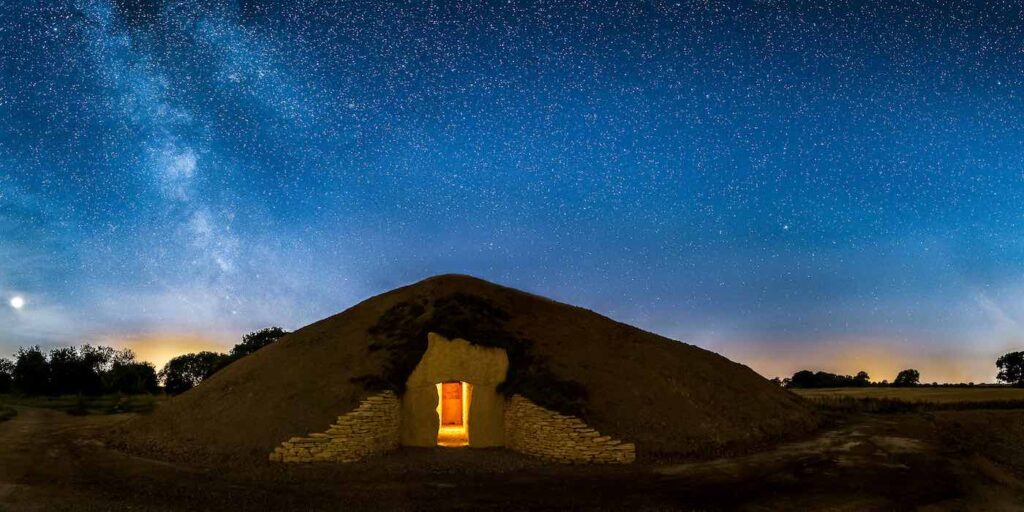
Incredible photos show the beam of the setting sun through a stained glass window at a Neolithic burial barrow creating a mesmerizing rainbow of light.
The solstice sun shines in Soulton Hall by Andrew Fusek Peters – SWNS
Wildlife photographer Andrew Fusek Peters, 56, captured the colorful spectacle at the Soulton Long Barrow in Shropshire on the evening of December 29.
The recently completed burial site has been aligned to capture the sun at the midwinter solstice as it passes through a stained glass window, illuminating the burial chamber.
Andrew had been on a walk in the Shropshire Hills when he spotted the opportunity to capture the atmospheric phenomenon and “drove like a maniac” to get there in time.
His breathtaking dusk images show beams of blue, purple, orange, red and green light flooding the reimagined ancient chamber with spectacular color.
“I’d heard about this colorful light display caused by the window but it really has to be seen to be believed,” said Andrew.
“Colorful is an understatement, and I don’t think the pictures even do it justice. I felt honored to be there to see it.
“I feel like at the end of the year, these pictures tell a story of hope. There is still beauty in the world.
The recently completed long barrow at Soulton Hall by Andrew Fusek Peters – SWNS
The monuments were created around 5,000 years ago for people to lay the ashes of their beloved ones.
The modern-day Soulton Hall long barrow contains the largest stone corbelled ceiling in modern times, over the height of two double decker buses and can seat 80 people.
It is only the third of its kind to be opened as part of an a Stone Age tradition being resurrected across Britain.
The main chamber is aligned so that at winter solstice and for a few weeks after, the sun sets directly through the stained glass door.
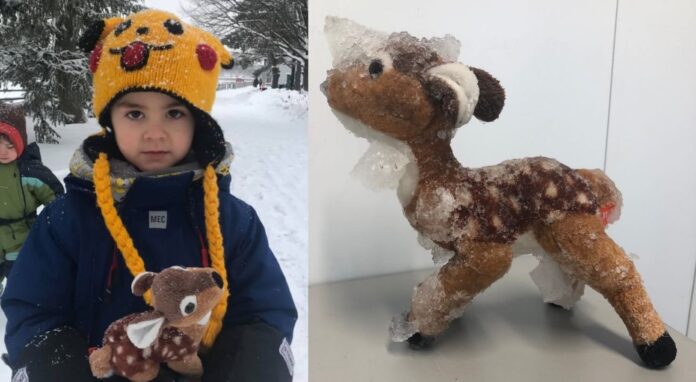
Everyone knows Santa’s favorite red-nosed reindeer knows how to fly. Unfortunately, his namesake, Rudolph, a beloved stuffed toy fawn belonging to 4-year-old Nico Lavallée, did not.
Brenda Duke
Sadly, Nico found that out the hard way while on a walk with his mom, Brenda Duke, and siblings 2-year-old Santiago and 6-year-old Sebastian when his little brother decided to test his pitching arm by tossing the “stuffie” over the railing next to the frozen waters of Ottawa’s Rideau Canal.
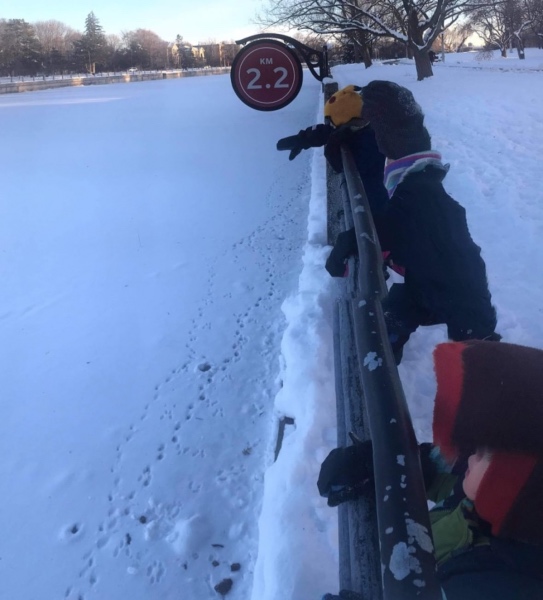
Unable to retrieve his best buddy, Nico and his family returned to visit Rudolph more than once. Luckily, the plush Bambi landed in close proximity to a distance marker sign, so he wasn’t too hard to find, but prospects for a homecoming didn’t look good.
Brenda Duke
After several days’ of falling snowflakes, the forlorn fawn began to slowly disappear beneath a blanket of white, leaving behind only a telltale bump.
That’s when older brother Sebastian came up with an idea. During the pandemic, neighborhood social media had become a lifeline to a community isolated by the lockdown. Sebastian urged his mom to reach out to neighbors to see if anyone might be able to help retrieve Rudolph.
Duke was skeptical at first. “I didn’t want to bother anyone. I don’t think anyone would care,” she told CBC News.
But Sebastian convinced her to give it a shot, so she took to Twitter.
“If anyone happens to see a ‘stuffie’ reindeer (I think it’s a fawn actually) when the canal opens my kids would be grateful,” she tweeted with an accompanying photo showing Rudolph’s last known whereabouts circled in red.
“Toddler brother threw it in. I know it’s unlikely since they clear snow now and it will be even more buried but my 6-year-old asked me to post here. They come visit it on our daily walks now; it’s the little mound you see.”
As hard as it was to believe, a mission to rescue Rudolph was quickly mounted. Even the National Capital Commission (NCC), signed on, pledging to put its skateway squad on the lookout.
After several hours of relentless searching, our courageous NCC Skateway team saved a stuffed baby deer from a most tragic end. He is now safe and sound while he defrosts!
Lo and behold, in the twinkling of one vigilant crew member’s eye, Rudolph was—though frozen and a bit soggy—MIA no more.
After he’d been thawed and groomed, the prodigal stuffie was reunited with a joyful Nico and his grateful family at NCC headquarters.
All thawed out and headed home! 💛 The stuffed deer heroically rescued by the NCC Skateway Team has now been reunited with its best friend. Smiles all around! pic.twitter.com/kSZqTpkaVv
In a world rife with so many negatives, it can be easy to lose sight of the positive ones. Sometimes it takes focusing on small acts of kindness to put things in perspective.
“You just have to just have to ask,” said Duke. “People do care. Assuming that they don’t is something that adults do… [My kids] are growing up knowing that other people have our backs and other people care, and that’s really heartwarming.”
“This stuffed baby deer isn’t the only thing melting,” a watcher named Monica Ward seconded from her perch in the Twitterverse, “so is my cold, cold heart.”
A fan showing up to watch the latest movie by Dwayne ‘The Rock’ Johnson had the shock of a lifetime—first by meeting the star himself, and then when the wrestler turned actor handed over the keys to his personal truck.
Johnson knew he would be treating the movie-goers to a meet and greet as well as free popcorn and ice cream at concession stands, but he also did a bit of research into those in attendance, and it was Rodriquez’s big heart that caught his eye.
“Oscar Rodriguez’s story moved me” Johnson wrote on his Instagram, explaining the gift, which was enough to make Rodriquez break down and cry.
A Navy veteran, personal trainer, and sole caretaker of his 75-year old mother, Rodriquez is also a leader of a local church group, and runs a charity to help victims of domestic violence.
“My original idea was to give away the Porsche Taycan that I drive in the movie, Red Notice,” Johnson wrote. “So we reached out to Porsche, but they said no.”
Meeting Hollywood’s highest paid actor on any occasion is a cause to be excited. The Rock has a reputation of being extremely positive, motivational, and prone to bouts of kindness.
After calling Rodriquez down from the seats in the theater to introduce him and share his story, he led the man out to the parking lot and handed him a card that said, “Thank you for your service brother, enjoy your new truck.”
Robert W. Boessenecker via Wikimedia under CC By-SA 4.0
Robert W. Boessenecker, CC license
A tooth found nearly fifty years ago has recently been re-examined and found to contain the remains of a land-going whale from an extinct family found only in Pakistan.
A cousin of other walking whales in the family of Remingtonocetidae, it’s the first discovery of this ancient animal in North America, and gives a tantalizing prospect of a potential distribution of these creatures across the entire world.
It’s strange to think that as mega as so many of the dinosaurs became, the largest example of the advantages of enormity to a complex life form is alive with us today in the form of the blue whale.
Yet the whale lineage had to take many twists and turns before it arrived at a blowhole and flippers, which because of its mammalian origin, also involved feet and a long, almost crocodilian snout.
In 1973, a premolar of a new species of walking whale was found at a stone quarry in Castle Hayne, North Carolina.
In 2020, a team of researchers found it matched more closely the fossils found in Pakistan of Remingtonocetidae and not other extinct whale genera that were known to live along the coast of what would become North America.
Remingtonocetids lived in the Tethys Ocean, a body of water that existed for half a billion years along the shore of an ancient super-continent called Gondwana which contained all the land that would form Africa, India, Australia, South America, and Antarctica. By the time of the Eocene, when this new species was discovered, the Tethys Ocean was a tiny fraction of what it once was, perhaps allowing the normally coastal animal to leave its Indo-Pakistan territory and venture as far as North Africa.
Paleontologists from Egypt discovered a walking-whale in North Africa in 2008, and in 2019 another specimen was found in Peru. The animals tended to average around 10 feet, or 3 meters in length, and have powerful jaws that are suggested to have been enough to allow the beasts to prey on crocodiles.
“This fossil really starts to give us a sense of when whales moved out of the Indo-Pakistan ocean region and started dispersing across the world,” Professor Jonathan Geisler told Live Science about Phiomicetus, the Egyptian-based walking-whale, after its discovery.
Rather than phiomicetus, Uhen believes the closest dental-match is drawn with Remingtonocetus harudiensus, discovered in the 1980s by a pair of scientists who first described these unique legged-whales. This would mean, if true, that while other whales crossed the Tethys to arrive near Egypt, or crossed the whole of the Eocene Atlantic Ocean to arrive in Peru, some of these proto-whales arrived in North America straight from Pakistan.
“The first phase of cetacean evolution is, for the most part, the story of adaptation to the aquatic environment,” writes author and paleontologist Mark Uhen at George Mason University. “Changes in feeding, sensory systems, and locomotor systems are apparent in all of the lineages of middle Eocene cetaceans.”
“The potential discovery of a remingtonocetid from North America extends a third family of [proto whales] across the Atlantic and suggests that the aquatic abilities of remingtonocetids may have been better developed than previously thought.”
SHARE This Fascinating Story of Evolution With All Your Friends…
Quote of the Day: “What seems nasty, painful, and evil, can become a source of beauty, joy, and strength, if faced with an open mind.” – Henry Miller
Photo: by Roberta Sorge
With a new inspirational quote every day, atop the perfect photo—collected and archived on our Quotes page—why not bookmark GNN.org for a daily uplift?
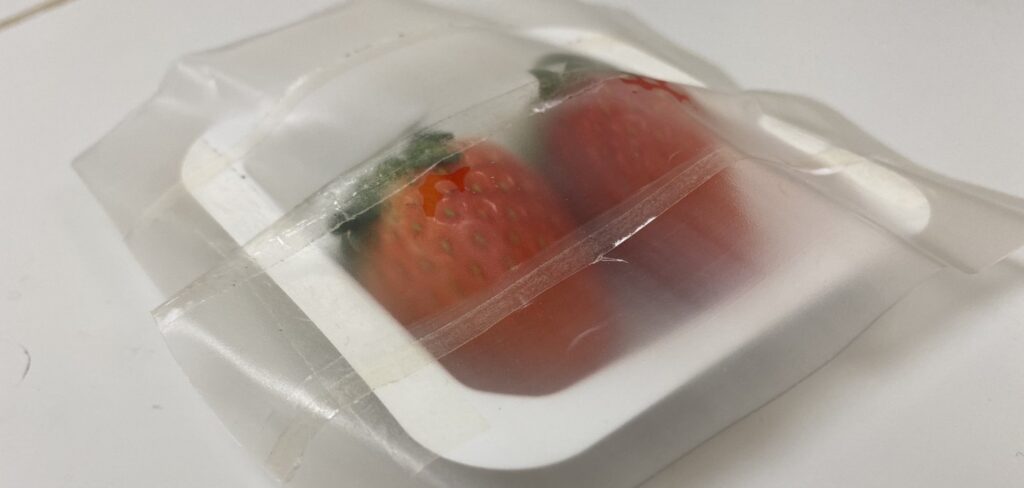
A new ‘smart’ form of packaging could eradicate food poisoning, according to a new study.
Scientists say it kills harmful bugs—such as E.coli, Salmonella, and listeria—keeping meat, fish, fruit, and veg fresh for longer.
The waterproof wrapping may also help save the planet by reducing waste, according to the research team. It looks just like plastic—but is biodegradable.
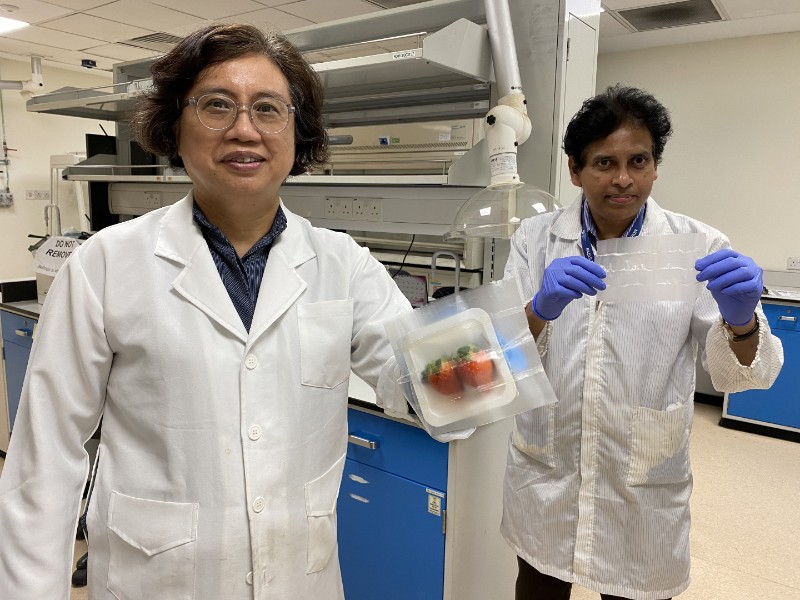
Project co-leader Professor Mary Chan, of Nanyang Technological University, Singapore, said, “This invention would serve as a better option in the food industry.
“It has demonstrated superior antimicrobial qualities in combating a myriad of food-related bacteria and fungi that could be harmful to humans.
“The smart release of antimicrobials only occurs when bacteria or high humidity is present.
“It provides protection when needed—thus minimizing the use of chemicals and preserving the natural composition of foods packaged.”
The transparent material is made from starch, a type of corn protein called zein, and other naturally derived biopolymers.
It’s also infused with a cocktail of anti-microbial compounds found in plants.
They include oil from thyme, a common herb used in cooking, and citric acid found in oranges and grapefruits.
In experiments tiny amounts were only released when exposed to humidity or enzymes from bacteria and fungi that contaminate food.
This ensures the packaging can endure several exposures—and last for months.
The chemicals destroy any bacteria that grow on the surface—as well as on the product itself.
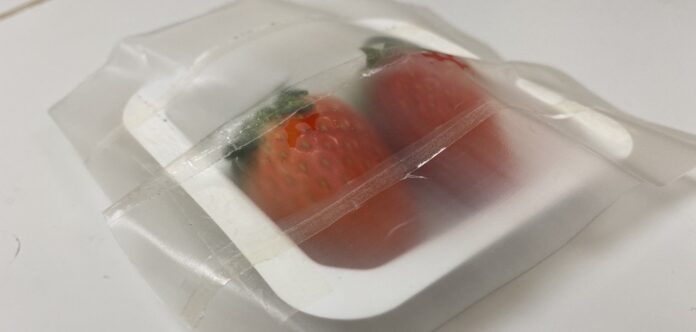
Strawberries stayed fresh for seven days before developing mould—three days more than counterparts in mainstream plastic boxes.
Co-project leader Prof Philip Demokritou, of Harvard TH Chan School of Public Health, Boston, said, “Food safety and waste have become a major societal challenge of our times with immense public health and economic impact which compromises food security.
“One of the most efficient ways to enhance food safety and reduce spoilage and waste is to develop efficient biodegradable non-toxic food packaging materials.
“In this study, we used nature-derived compounds including biopolymers, non-toxic solvents and nature-inspired antimicrobials and develop scalable systems to synthesize smart antimicrobial materials.
“They can be used not only to enhance food safety and quality but also to eliminate the harm to the environment and health and reduce the use of non-biodegradable plastics at global level and promote sustainable agri-food systems.”
SWNS
The packaging industry is the larges consumer of synthetic plastics derived from fossil fuels.
It accounts for the bulk of plastic waste that is polluting the environment.
Peter Barber, CEO of ComCrop, a Singapore company that pioneered urban rooftop farming, said, “The NTU-Harvard Chan School food packaging material would serve as a sustainable solution for companies like us who want to cut down on the usage of plastic and embrace greener alternatives.
“As ComCrop looks to ramp up product to boost Singapore’s food production capabilities, the volume of packaging we need will increase in sync, and switching to a material such as this would help us have double the impact.
“The wrapping’s antimicrobial properties, which could potentially extend the shelf life of our vegetables, would serve us well.
“The packaging material holds promise to the industry, and we look forward to learning more about the wrapping and possibly adopting it for our usage someday.”
Prof Chan said it has enormous implications—serving as an environmentally friendly alternative.
The aim is to replace conventional plastic packaging with the new material that will also double the shelf life of produce.
Prof Chan said, “Vegetables are a source of wastage because even if they are refrigerated, they will continue to respire, leading to spoilage after a week or two.
“With the anti-microbial packaging, there is a chance to extend their shelf life – and also make the vegetables and fruits look fresh with time.”
The team hope to scale up the technology with an industrial partner—with the aim of commercialization within a few years.
A senior has been reunited with his long lost brother and sister after more than 20 years—thanks to the publicity he received because his dog picks up litter.
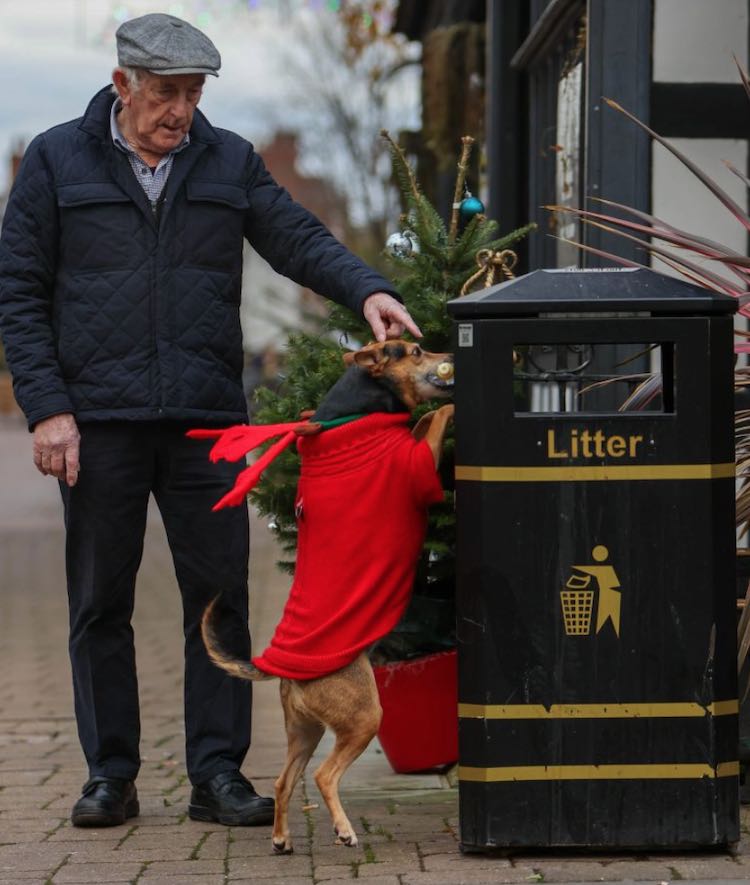
80-year-old Alfie Kitson and his five-year-old Spanish Podenco were featured in a video just before Christmas with the pup tidying up rubbish and putting it into the bin.
Kitson and Millie have become a familiar sight on the streets of Hereford. It was after the filming of one of these regular rounds that Alfie was spotted by his sister’s husband as Millie was helping clean up the streets.
The family was then able to track down Alfie to the village of Ulingswick, where he lives with his wife Judy.
Delighted, Alfie has reunited with brother Dave, who’s 84, and 71-year-old sister Anne for the first time in more than two decades.
The grandad-of-seven had drifted apart from his siblings after moving to Coin in Málaga two decades ago.
As for her trick, he says, “All I have to say is ‘put that litter in the bin’ and she will pick it up and do it. Passers-by seem to love it and she always gets a little round of applause.
“She isn’t just part of the family, she is the family and we are glad we can show her off to others as she really is an amazing dog.”
RAISE A Paw For This Beautiful Story; Share It With Your Besties…
Rogue planets are elusive cosmic objects that have masses comparable to those of the planets in our Solar System but do not orbit a star, instead roaming freely on their own.
Not many were known until now, but a team of astronomers, using data from several European Southern Observatory (ESO) telescopes and other facilities, have just discovered at least 70 new rogue planets in our galaxy. This is the largest group of rogue planets ever discovered, an important step towards understanding the origins and features of these mysterious galactic nomads.
“We did not know how many to expect and are excited to have found so many,” says Núria Miret-Roig, an astronomer at the Laboratoire d’Astrophysique de Bordeaux, France and the University of Vienna, Austria, and the first author of the new study.
Rogue planets, lurking far away from any star illuminating them, would normally be impossible to image. However, Miret-Roig and her team took advantage of the fact that, in the few million years after their formation, these planets are still hot enough to glow, making them directly detectable by sensitive cameras on large telescopes.
They found at least 70 new rogue planets with masses comparable to Jupiter’s in a star-forming region close to our Sun, in the Upper Scorpius and Ophiuchus constellations.
To spot so many rogue planets, the team used data spanning about 20 years from a number of telescopes on the ground and in space. “We measured the tiny motions, the colours and luminosities of tens of millions of sources in a large area of the sky,” explains Miret-Roig. “These measurements allowed us to securely identify the faintest objects in this region, the rogue planets.”
The team used observations from ESO’s Very Large Telescope (VLT), the Visible and Infrared Survey Telescope for Astronomy (VISTA), the VLT Survey Telescope (VST) and the MPG/ESO 2.2-metre telescope located in Chile, along with other facilities. “The vast majority of our data come from ESO observatories, which were absolutely critical for this study. Their wide field of view and unique sensitivity were keys to our success,” explains Hervé Bouy, an astronomer at the Laboratoire d’Astrophysique de Bordeaux, France, and project leader of the new research. “We used tens of thousands of wide-field images from ESO facilities, corresponding to hundreds of hours of observations, and literally tens of terabytes of data.”
The team also used data from the European Space Agency’s Gaia satellite, marking a huge success for the collaboration of ground- and space-based telescopes in the exploration and understanding of our Universe.
The study, published in Nature Astronomy, suggests there could be many more of these elusive, starless planets that we have yet to discover. “There could be several billions of these free-floating giant planets roaming freely in the Milky Way without a host star,” Bouy explains.
By studying the newly found rogue planets, astronomers may find clues to how these mysterious objects form. Some scientists believe rogue planets can form from the collapse of a gas cloud that is too small to lead to the formation of a star, or that they could have been kicked out from their parent system. But which mechanism is more likely remains unknown.
Further advances in technology will be key to unlocking the mystery of these nomadic planets. The team hopes to continue to study them in greater detail with ESO’s forthcoming Extremely Large Telescope (ELT), currently under construction in the Chilean Atacama Desert and due to start observations later this decade. “These objects are extremely faint and little can be done to study them with current facilities,” says Bouy. “The ELT will be absolutely crucial to gathering more information about most of the rogue planets we have found.”
Quote of the Day: “The grass is not, in fact, always greener on the other side of the fence. It is greenest where it is watered.” – Robert Fulghum
Photo: by visnu deva
With a new inspirational quote every day, atop the perfect photo—collected and archived on our Quotes page—why not bookmark GNN.org for a daily uplift?
digital unwrapped Mummy Amenhotep I-S. SALEEM AND Z. HAWASS
Saleem and Z. Hawass, CC license
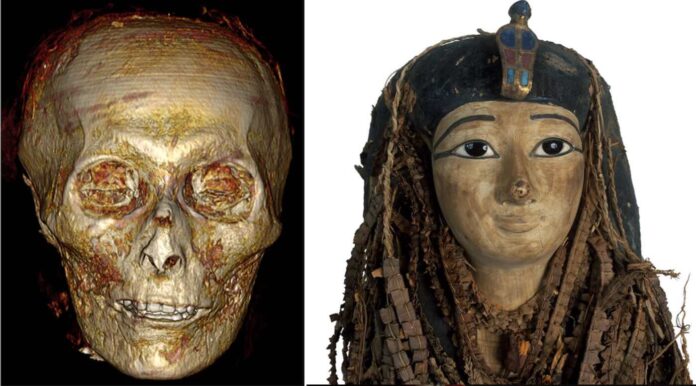
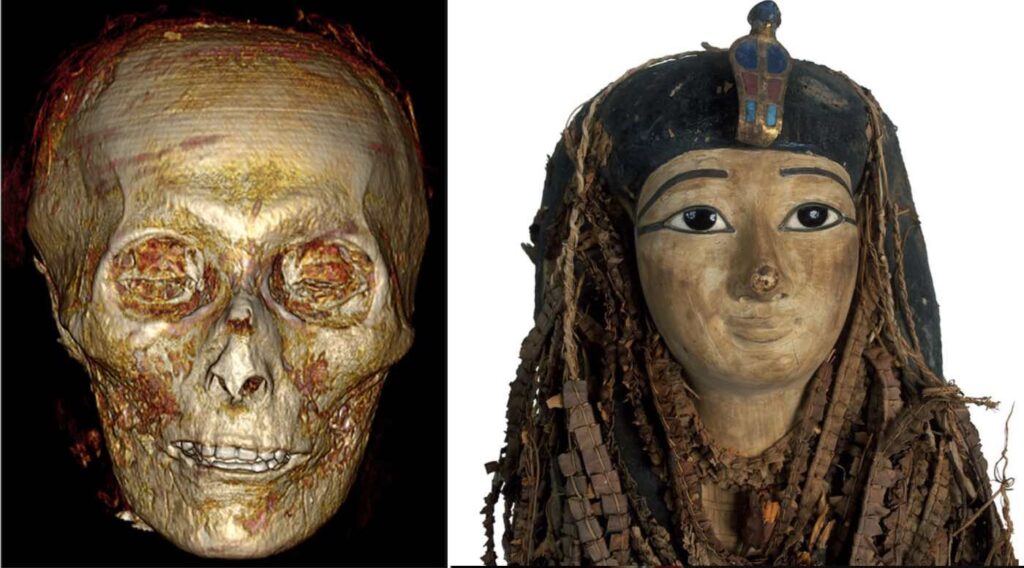
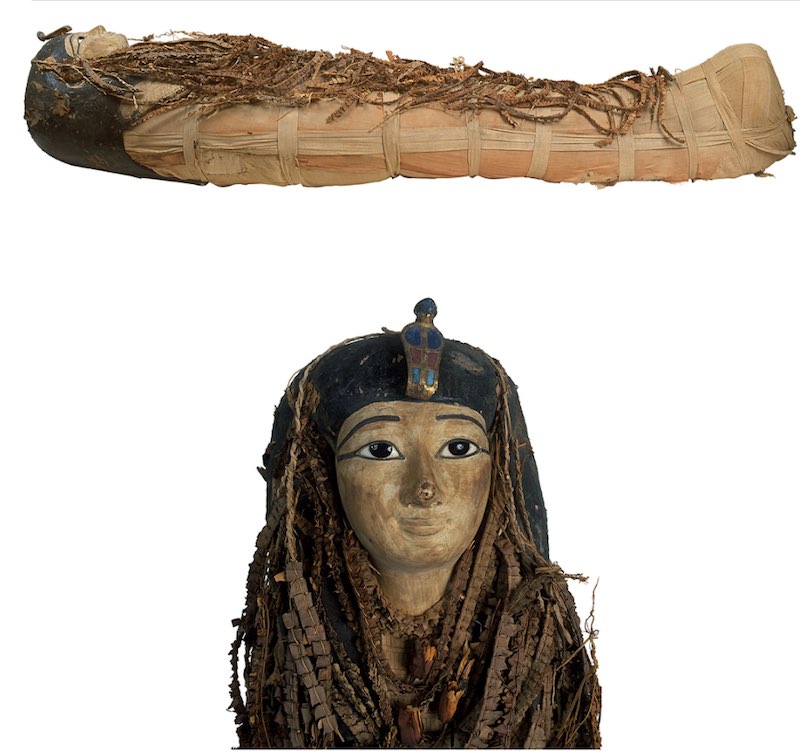
All the royal mummies found in the 19th and 20th centuries have long since been opened for study. With one exception: Egyptologists have never been bold enough to open the mummy of Pharaoh Amenhotep I. Not because of any mythical curse, but because it is perfectly wrapped, beautifully decorated with flower garlands, and with face and neck covered by an exquisite lifelike facemask inset with colorful stones. But now for the first time, scientists from Egypt have used three-dimensional CT (computed tomography) scanning to ‘digitally unwrap’ this royal mummy and study its contents.
This was the first time in three millennia that Amenhotep’s mummy has been opened. The previous time was in the 11th century BCE, more than four centuries after his original mummification and burial.
Hieroglyphics have described how during the later 21st dynasty, priests restored and reburied royal mummies from more ancient dynasties, to repair the damage done by grave robbers.
“This fact that Amenhotep I’s mummy had never been unwrapped in modern times gave us a unique opportunity: not just to study how he had originally been mummified and buried, but also how he had been treated and reburied twice, centuries after his death, by High Priests of Amun,” said Dr Sahar Saleem, professor of radiology at the Faculty of Medicine at Cairo University and the radiologist of the Egyptian Mummy Project, the study’s first author.
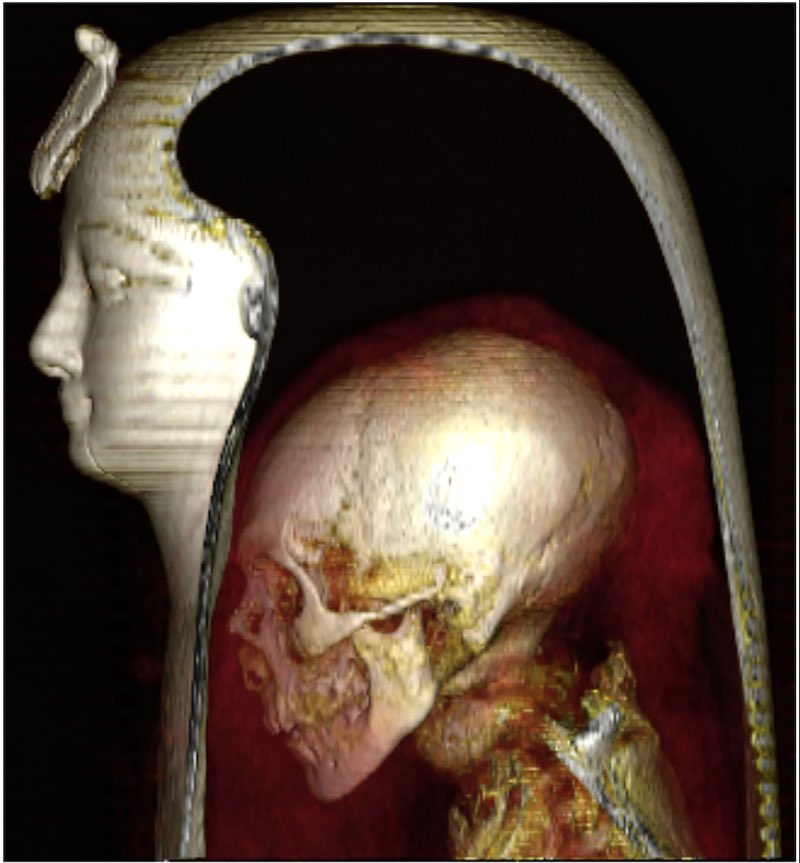
“By digitally unwrapping of the mummy and ‘peeling off’ its virtual layers—the facemask, the bandages, and the mummy itself—we could study this well-preserved pharaoh in unprecedented detail,” said Saleem.
“We show that Amenhotep I was approximately 35 years old when he died. He was approximately 169cm tall, circumcized, and had good teeth. Within his wrappings, he wore 30 amulets and a unique golden girdle with gold beads.”
“Amenhotep I seems to have physically resembled his father: He had a narrow chin, a small narrow nose, curly hair, and mildly protruding upper teeth.”
Saleem and Z. Hawass, CC license
Saleem continued, “We couldn’t find any wounds or disfigurement due to disease to justify the cause of death, except numerous mutiliations post mortem, presumably by grave robbers after his first burial. His entrails had been removed by the first mummifiers, but not his brain or heart.”
The mummy of Amenhotep I (whose name means ‘Amun is satisfied’) was discovered in 1881—among other reburied royal mummies—at the archeological site Deir el Bahari in southern Egypt.
The second pharaoh of Egypt’s 18th dynasty (after his father Ahmose I, who had expelled the invading Hyksos and reunited Egypt), Amenhotep ruled from approximately 1525 to 1504 BCE. His was a kind of golden age: Egypt was prosperous and safe, while the pharaoh ordered a religious building spree and led successful military expeditions to Libya and northern Sudan. After his death, he and his mother Ahmose-Nefertari were worshipped as gods.
Sahar Saleem and her co-author egyptologist Dr Zahi Hawass, had previously speculated that the main intention of the restorers from the 11th century was to reuse royal burial equipment for later pharaohs. But here they disprove their own theory–as evinced in their study, published in Frontiers in Medicine.
“We show that at least for Amenhotep I, the priests of the 21st dynasty lovingly repaired the injuries inflicted by the tomb robbers, restored his mummy to its former glory, and preserved the magnificent jewelry and amulets in place,” said Saleem.
Saleem and Z. Hawass, CC license
Hawass and Saleem studied more than 40 royal mummies of the New Kingdom in the Egyptian Antiquity Ministry Project that was launched since 2005. Twenty-two royal mummies, including that of Amenhotep I, were transferred in April 2021 to a new museum in Cairo. The face of the mummy of Amenhotep I with its mask was the icon of the spectactular ‘Royal Golden Mummy Parade’ on March 3rd, 2021 in Cairo.
“We show that CT imaging can be profitably used in anthropological and archeological studies on mummies, including those from other civilizations, for example Peru,” concluded Saleem and Hawass.
With new major spending packages investing billions of dollars in electric vehicles in the U.S., some analysts have raised concerns over how green the electric vehicle industry actually is, focusing particularly on indirect emissions caused within the supply chains of the vehicle components and the fuels used to power electricity that charges the vehicles.
Sparkcharge Unit With Electric Car
But a recent study from the Yale School of the Environment found that the total indirect emissions from electric vehicles pale in comparison to the indirect emissions from fossil fuel-powered vehicles.
This is in addition to the direct emissions from combusting fossil fuels—either at the tailpipe for conventional vehicles or at the power plant smokestack for electricity generation—showing electric vehicles have a clear advantage emissions-wise over conventional vehicles.
“The surprising element was how much lower the emissions of electric vehicles were,” says postdoctoral associate Stephanie Weber. “The supply chain for combustion vehicles is just so dirty that electric vehicles can’t surpass them, even when you factor in indirect emissions.”
Weber was part of the study led by Paul Wolfram ’21 PhD—now a postdoc with the Joint Global Change Research Institute at the University of Maryland—and that included YSE economics professor Ken Gillingham and Edgar Hertwich, an industrial ecologist from the Norwegian University of Science and Technology and a former YSE faculty member.
The research team combined concepts from energy economics and industrial ecology—carbon pricing, life cycle assessment, and modeling energy systems—to find if carbon emissions were still reduced when indirect emissions from the electric vehicle supply chain were factored in.
“A major concern about electric vehicles is that the supply chain, including the mining and processing of raw materials and the manufacturing of batteries, is far from clean,” says Gillingham. “So, if we priced the carbon embodied in these processes, the expectation is electric vehicles would be exorbitantly expensive. It turns out that’s not the case; if you level the playing field by also pricing the carbon in the fossil fuel vehicle supply chain, electric vehicle sales would actually increase.”
The study also considered future technological change, such as decarbonization of the electricity supply, and found this strengthened the result that electric vehicles dominate when indirect supply chain emissions are accounted for.
The research team gathered data using a National Energy Modeling System (NEMS) created by the Energy Information Administration, which models the entire U.S. energy system using detailed information from the current domestic energy system and a forecast of the future of the electric system.
Wolfram completed a life cycle assessment that provided outputs of indirect emissions, which were then plugged into the NEMS model to see how a carbon tax on these indirect emissions would change the behavior of consumers and manufacturers. Weber assisted in modifying the NEMS code.
According to Wolfram, the study, published in Nature Communications, shows that “the elephant in the room is the supply chain of fossil fuel-powered vehicles, not that of electric vehicles.” He notes that the faster we switch to electric vehicles, the better—at least in countries with a sufficiently decarbonized electricity supply, like the U.S.
Gillingham, whose research has focused extensively on alternative energy adoption in transportation, says this research provides a better understanding of how comprehensive carbon pricing—which includes the full supply chain—can shift consumers toward electric vehicles.
A Chinese agronomist has helped Canadian greenhouse technology move forward, curiously by moving backward.
Dong Jianyi uses only materials and the laws of thermodynamics to grow cucumbers, peppers, lettuce, tomatoes, and more—even in the frigid Alberta winter—all without using a single watt.
A geologist who abandoned the oil industry due to crashing oil prices, Dong Jianyi’s Fresh Pal Farms is believed to be the largest “passive greenhouse” in Canada.
Growing vegetables in China’s cold north necessitates innovation, and passive greenhouses which don’t use electricity are common in that part of the country.
“In north China, it also gets really cold and pretty dark in winter, but people can grow year-round,” Dong told CBC. “Where I lived in China, there were so many passive solar greenhouses. But in Canada, I didn’t see any on the commercial scale,” he said.
The 300-foot long, 30-foot wide greenhouse is constructed out of a steel frame with two polyolefin plastic roofs. An electric motor allows operators to extend and retract an insulating blanket to trap heat absorbed during the day. This keeps the 10,000-square foot interior space at 82°F (28°C) compared to outside December temperatures of 20°F (-7°C).
On the north side lies a 24-inch thick clay wall, which captures light more easily from a south-lying sun. At night the clay radiates heat into the space, further ensuring the plants can survive winter temperature that in Olds, Alberta can fall to -31°F (-35°C).
Fresh Pal Farms/Dong Jianyi; YouTube
Last year Dong grew 29,000 pounds of tomatoes alone last year while saving $30,000 in energy and heating costs.
Fresh Pal Farms/Dong Jianyi; YouTube
The passive solar greenhouses have a high upfront cost, Dong admits, but they pay back the investment in subsequent years through energy savings, as greenhouses tend to be powered by natural gas.
Last Supper of Ledbury Church – Courtesy of Ronald Moore (Fair Use)
Reprinted with permission from World at Large, an independent news outlet covering travel, conflict journalism, science, conservation, and health news.
Last Supper of Ledbury Church – Courtesy of Ronald Moore (Fair Use)
Light is shining once again on many lost works of art that were recovered in 2021. From Titian to Picasso, it seems incredible to think that sometimes 400 years after a famous artist’s death, we could be still finding their paintings, drawings, and sculptures, lying in attics, hidden behind walls, or buried underground
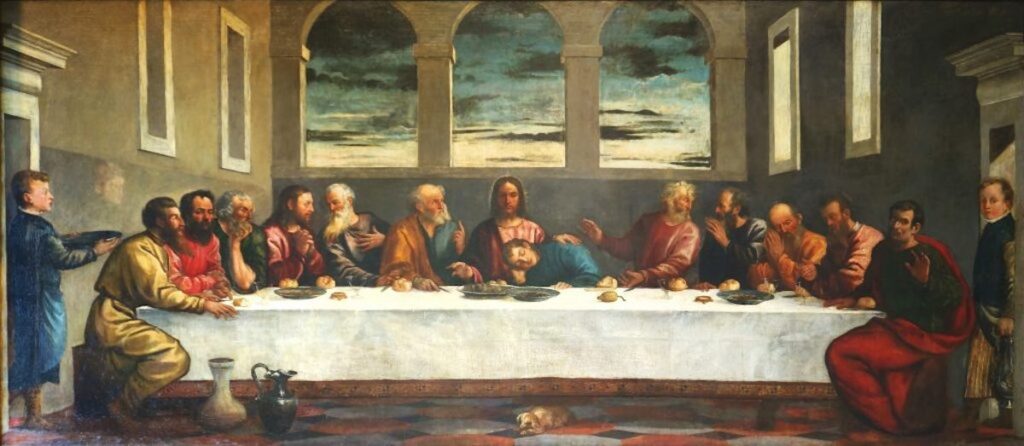
In March, art historian Ronald Moore was approached by the All Saints Church at Ledbury, England about the possibility of restoring a massive depiction of the Last Supper. Moore believed it could be a work by Venetian master Titian.
He and his assistant spent 11,000 hours attempting to link the painting, which Moore described as “always [having] a feel of Titian about it,” to the artist. After the striking comparison of a Titian self portrait to one of the apostles in the painting, and an ultralight breakthrough revealing the artist’s signature in the corner, there seems to be little doubt in the art world that one of the master’s canvases has returned to us.
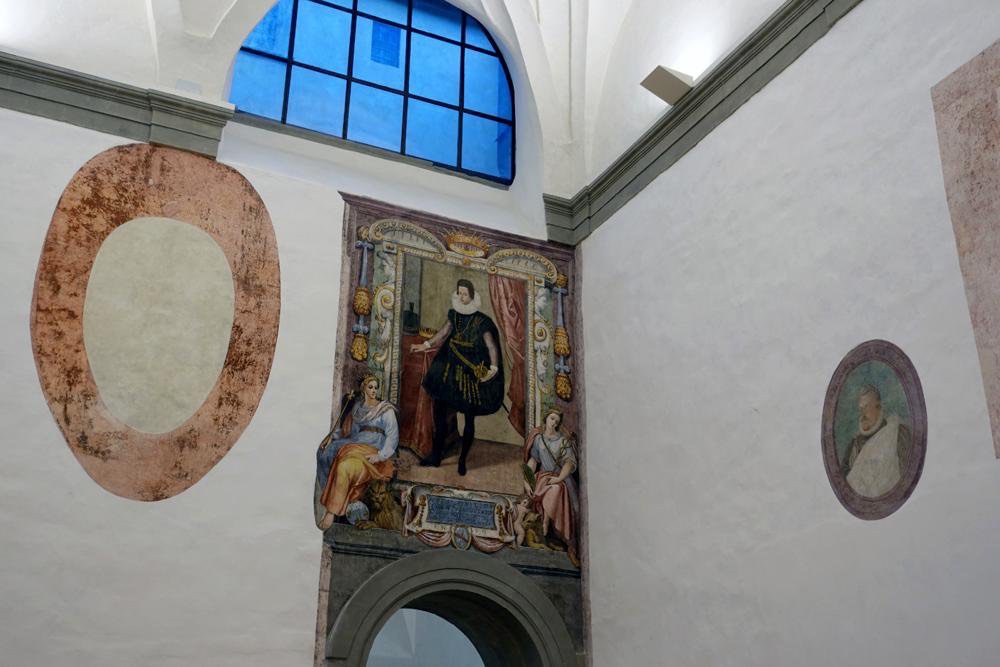
One month later, another revelation. During refurbishments at the world renowned Uffizi Gallery in Florence, renovators moving piles of debris in the understory stumbled across two Renaissance-era frescoes. They also found skeletons from a church cemetery that had originally been united into the building, and the remains of a 16th century stable which was commissioned along with the gallery.
The frescoes depict Cosimo Di Medici I, head of the famous banking dynasty that filled the Uffizi with beautiful sculptures and paintings, built the Duomo, and generally turned the city into one of the economic and cultural powerhouse of Europe. The Cosimo fresco is stunningly preserved on a previously buried Medieval-period wall.
New Uffizi Gallery frescoes of Cosimo De Medici II – Uffizi Gallery (Fair Use)
Sometimes one doesn’t have to dig in the earth or comb thrift stores to find great art.
A new Bernini
In May of 2021, a white marble sculpture sitting in the reserves of the Dresden State Art Collection, which was “unattributed,” was confirmed to be crafted by Gian Lorenzo Bernini, and commissioned by Pope Alexander VII. Bernini often worked for the Papacy, and carved the Sant Angelo Bridge angels, as well as many parts of St. Peter’s Basilica. He is considered one of the finest wielders of the hammer and chisel in history.
Bernini marble skull – Courtesy Staatliche Kunstsammlungen museum in Dresden
The work is a life size and totally-realistic human skull, and went on display as part of a series called “Bernini, the Pope, and Death,” detailing the effects of the plague on Rome in the late 1600s.
A Picasso promise
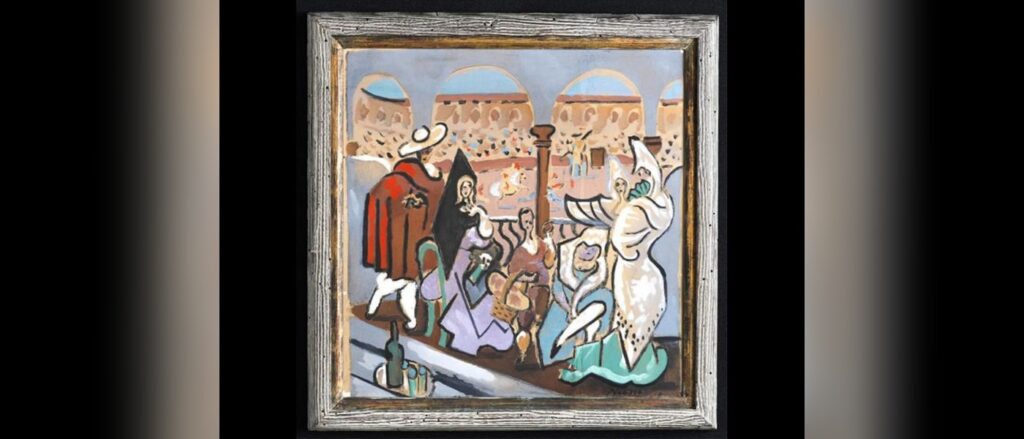
More great art was discovered tucked into a home’s attic. GNN reported in July that a sketch by Pablo Picasso was found that way in Maine. The brilliant work was uncovered by next of kin after the death of a Europe-trekking art enthusiast.
John McInnis Auctioneers
The 16×16 image on paper is believed to be a preliminary mock-up for the curtain that would act as the backdrop to the Ballet Russe production of Le Tricorne, which debuted at the Alhambra Theater in London after World War I.
An Irish immigration tale
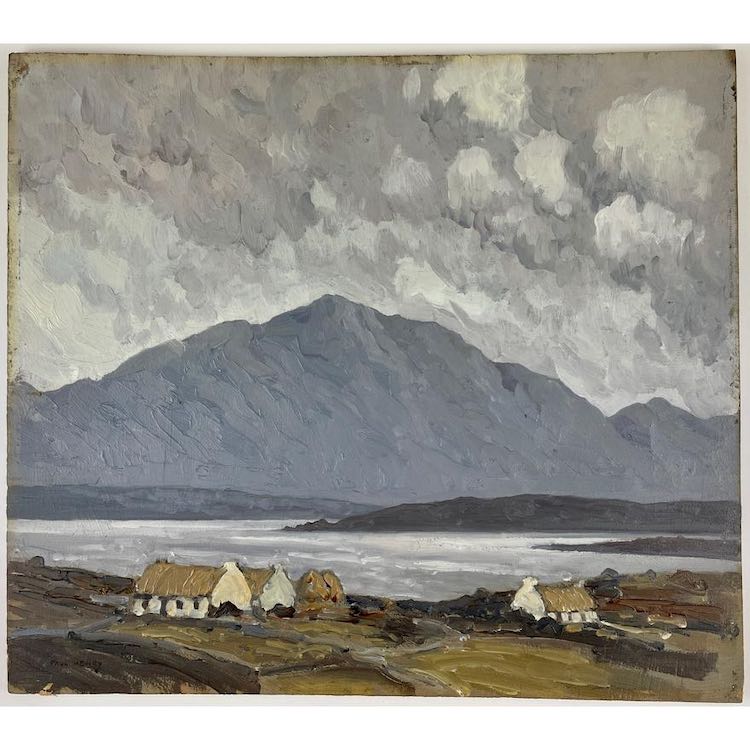
Speaking of deceased great-grandparents, two works from one of Ireland’s most celebrated landscape painters, Paul Henry, were discovered in a storage unit and sold at an auction in Cincinnati for $217,000.
Paul Henry painting – Courtesy Caza Sikes Fine Art Appraisers
They were found by Irish immigrant Sir Patrick McGovern’s great-grandson, who believed them to be prints, and therefore worth “nothing”. They had been framed under glass by an expert New York City framing guild at the time, and have remained totally pristine.
A church mystery
In September a college professor specializing in Baroque Italian religious art wandered into a church for a moment of quiet reflection and happened to glimpse the noteworthy excellence of Cesare Dandini’s Holy Family with the Infant St. John. The 1630 painting had been in the church, unaccounted for, for 60 years, and no one knows how it got there.
It was part of a four-painting set called Charity. Two of the works are hanging in world renowned museums—the Met in NYC and the Hermitage in Russia. The fourth has never been seen.
A Dürer drawing worth a fortune
Albrecht Dürer’s The Virgin and Child with a Flower on a Grassy Bench- Agnews Gallery (Fair Use)
In 2016, a man walked into an estate sale and bought “a wonderfully rendered piece of old art.” Despite the fact that it carried the watermark of Albrecht Dürer, a German Renaissance master, neither the buyer nor seller believed it to be genuine.
Quote of the Day: “It is not your business to determine how good (your passion) is, nor how valuable it is. It is your business to keep it yours clearly and directly.” – Martha Graham
Photo: by Gift Habeshaw
With a new inspirational quote every day, atop the perfect photo—collected and archived on our Quotes page—why not bookmark GNN.org for a daily uplift?
A devoted fan got the experience of a lifetime when he had an up close-and-personal encounter with The Wolverine.
We just saw this video yesterday and it was too good not to share, even though it happened 24 months ago.
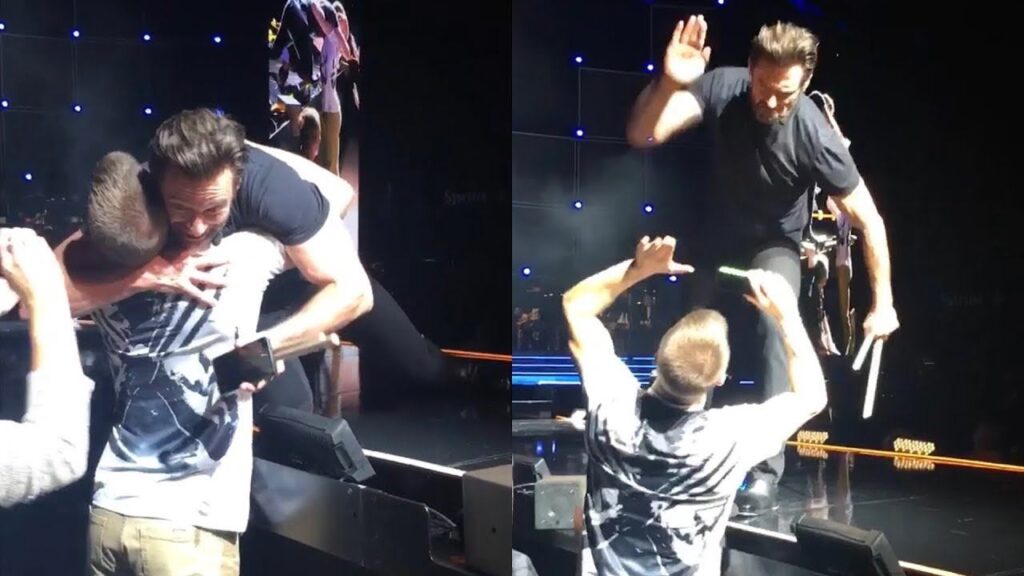
At a concert performing material from his Broadway production “The Greatest Showman,” Hugh Jackman showered a front row fan with high fives and monstrous Wolverine poses before giving him a big bear hug.
Caught on camera by another fan behind him, it was a reminder that seemingly-aloof Hollywood actors can have rich humanities too.
In terms of career success, staring as a comic book superhero is about as good as it gets in cinema these days, but by all accounts Hugh Jackman hasn’t let it go to his head, and despite having the fortune of portraying Wolverine 7 times, fans and colleagues alike have no bad words to say about Jackman.
Jackman is one of Hollywood/Broadway’s notable philanthropists. He supports fair trade coffee growers in Ethiopia with a not-for-profit coffee shop franchise, has raised more than a million dollars for HIV/AIDS research, is a patron for the Bone Marrow Institute and supporter of Nobel Laureate Muhammed Yunus’s microcredit program that offers small loans to entrepreneurs in impoverished countries.