All News - Page 413 of 1715 - Good News Network
Home Blog Page 413

“Good friends, good books, and a sleepy conscience: this is the ideal life.” – Mark Twain

Quote of the Day: “Good friends, good books, and a sleepy conscience: this is the ideal life.” – Mark Twain

Photo: by Mariia Zakatiura

With a new inspirational quote every day, atop the perfect photo—collected and archived on our Quotes page—why not bookmark GNN.org for a daily uplift?


Dunkin’ Donuts Customer Gives Employee a New Home So She Can Continue Excellent Customer Service

WCPO/YouTube
WCPO/YouTube

A Dunkin’ Donuts employee in Ohio recently received a huge surprise from one of her loyal customers—a fully furnished home.

Employee Ebony Johnson met customer Suzanne Burke at the drive-thru window she was serving at three years ago. They chatted every time Burke came for her coffee in the mornings, and the two became friendly.

When Burke found out that her acquaintance, a mother of three, had fallen on difficult times and been evicted from her home in Mount Healthy, she made it her mission to help—reaching out to organizations that help people difficulty.

Now enjoying a fully decorated, cozy place to stay, Johnson is finally looking forward to the upcoming holidays.

MORE: They Got Married At the Dunkin’ Drive-thru Window Where Every Morning They Fell More in Love

“I’m just so thankful we’re back in our home,” Johnson said to WCPO News. “The Lord really looked out for me because I kept praying and saying, ‘Could I be at home before Christmas?’”

(WATCH the video to meet the family or read more from WCPO News…)

Serve Up This Sweet Story To Your Friends By Sharing It To Social Media…

Surviving the Nazis and Fire, 2000-Year-old Caligula Mosaic Finally Returns to Museum

60 Minutes/YouTube
60 Minutes/YouTube

Built in the Roman Empire, buried for two millennia under a lake, uncovered by a dictator, then stolen by the Nazis, recovered—only to be sold as a coffee table in a Park Avenue apartment, the whirlwind life of a Caligula-era mosaic has finally reached its appropriate conclusion, with the stunning piece going on display in an Italian museum.

Decorated in forest green, brick red porphyry, and creamy white, the mosaic decorated Emperor Caligula’s famous “pleasure barges,” which were two enormous Iron-Age yachts that were excavated from the depths of Lake Nemi near Rome after Benito Mussolini drained the lake in 1920.

In 2013 Dario Del Buffalo, an Italian expert in Roman stone art, was signing copies of his recent book Porphyry in a New York jewelry store when, according to an interview with 60 Minutes Overtime, he heard the most astonish conversation in front of him.

“There was a lady, with a young guy with a strange hat, that came to the table and told her ‘What a beautiful book, and oh! Helen look, that’s your mosaic!'” recounts Del Buffalo. “And she said, ‘Yes that’s my mosaic,’ so I finished my last signature and I went after them.”

“I saw the young guy and I said, ‘Excuse me you were talking about the mosaic on my book, can you tell me is this the mosaic you were talking about?'” said Del Buffalo. “‘Yes this is the mosaic Helen has in her house on Park Avenue!'”

The surprised author described it as a one-in-a-million chance, and as much as he felt sorry to do so, he had to report it to the Italian consulate authorities, sure as Del Buffalo was that Helen’s mosaic belonged originally to Caligula, who put it on his giant boats.

Piazze and Nazis


These boats were essentially massive floating piazze, commissioned in the year 40CE as a testament to the greatness of Caligula, and the mosaic is believed to have been used as a dance floor on the boats which were so big they never sailed.

The mosaic was thought to have originally been housed along with the barges’ remains in the Museum of the Roman Boats, completed in the 1930s, but that was converted into a bomb shelter during WWII, and which tragically suffered a fire that destroyed the pleasure barges.

However the mosaic has no fire damage of any kind, which had Manhattan prosecutors wondering if it had been spirited away before the fire, perhaps by the notorious art “collectors” of the Third Reich.

MORE: English Teenager Discovers Hoard of 3,300 Year-Old Axes and Becomes Metal Detecting Celebrity

Helen Fioratti, the mosaic’s former-owner, was never charged with the crime of possession of the artifact which was considered to have been stolen, and she has never filed a claim to it, believing it would be too long and expensive even though she feels she could win it back.

Fioratti, an American art dealer who had lived in Italy for a period with her Italian journalist husband, claims she bought it from an aristocratic Italian police official with a well-established reputation for recovering lost art stolen by the Nazis.

Artist’s depiction of Nemi ship

“It was an innocent purchase,” Fioratti told the AP. “We were very happy with it. We loved it. We had it for years and years, and people always complimented us on it.”

RELATED: Amateurs Claim to be ‘On the Verge’ of Uncovering Long Lost Treasure Horde Worth Over $20 Billion

The mosaic, which just went on exhibition, has now returned at long last to the museum from which it was so fortuitously stolen, avoiding the fire which destroyed so many of its sister artifacts, after finding itself a pair or perhaps trio of very loving owners in the proceeding 70 years.

(WATCH the video for this story below; Editor’s Note: Viewers outside the U.S. can watch the CBS video here.)

RETURN Fascinating Stories Like This to Their Rightful Place; With Friends…

Eco-friendly ‘Jelly Ice Cube’ Could Transform Cold Storage: No Plastic and Doesn’t Melt

elly ice cube released Gregory Urquiaga_UC Davis
Gregory Urquiaga/UC Davis

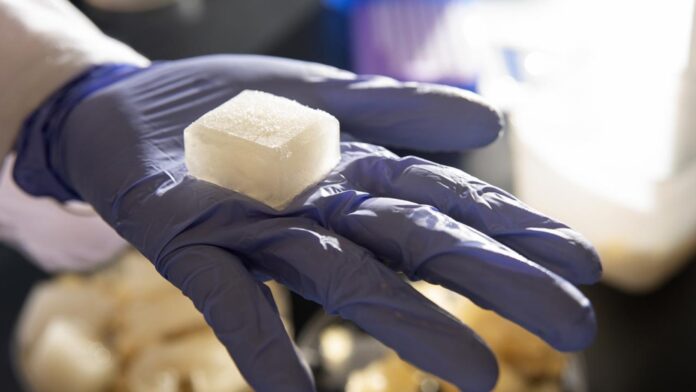
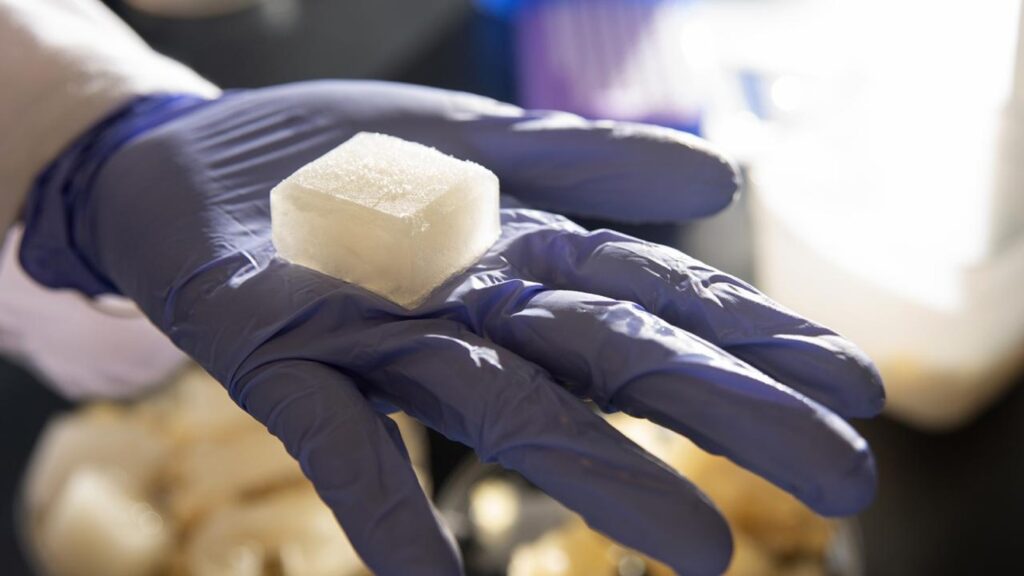
Researchers at the University of California, Davis, have developed a new type of cooling cube that could revolutionize how food is kept cold and shipped fresh without relying on ice or traditional cooling packs.

These plastic-free, “jelly ice cubes” do not melt, are compostable and anti-microbial, and prevent cross-contamination.

“When ice melts, it’s not reusable,” said Gang Sun, a professor in the Department of Biological and Agricultural Engineering. “We thought we could make a so-called solid ice to serve as a cooling medium and be reusable.”

The cooling cubes contain more than 90% water and other components to retain and stabilize the structure. They are soft to the touch like a gelatin dessert and change color depending on temperature.

Reusable and flexible

These reusable cubes can be designed or cut to any shape and size needed, said Jiahan Zou, a Ph.D. graduate student who has been working on the project the past two years.

RELATED: Design Students Use Art to Reimagine Plastic Recycling – Creating Lamps, Seat Covers, and More

“You can use it for 13 hours for cooling, collect it, rinse it with water and put it in the freezer to freeze again for the next use,” Sun added.

A patent for the design and concept was filed in July.

The researchers hope to eventually use recycled agriculture waste or byproduct as the coolant material.

“We want to make sure this is sustainable,” said Luxin Wang, an associate professor in the Department of Food Science and Technology.

Fish market wastewater, moldy ice blocks spurred idea

The researchers began working on the coolant cubes after Wang saw the amount of ice used at fish-processing plants and the cross-contamination that meltwater could spread among products or down the drain.

“The amount of ice used by these fish-processing sites is massive,” Wang said. “We need to control the pathogens.”

Sun also lamented mold found in the plastic ice packs used with school lunches for kids and frequently found in shipping packages.

MORE: This ‘Floating Continent’ Could Collect and Recycle Plastic from the Ocean in Future

Early tests have shown the cubes can withstand up to 22 pounds without losing form. They can be reused a dozen times—just a quick wash with water or diluted bleach—and then disposed of in the trash or with yard waste.

Alternative to ice

The jelly ice cubes offer an alternative to traditional ice and could potentially reduce water consumption and environmental impact. They also offer stable temperatures to reduce food spoilage and could be ideal for meal prep companies, shipping businesses and food producers who need to keep items cold.

The application could potentially reduce water consumption in the food supply chain and food waste by controlling microbial contaminations. The research was published in the American Chemical Society’s journal, Sustainable Chemistry & Engineering.

(WATCH the video for this story below.)

Source: UC Davis

MELT the Bad News in Those Social Feeds; SHARE This Innovative Design…

“He who takes offense when no offense is intended is a fool.” – Brigham Young

Quote of the Day: “He who takes offense when no offense is intended is a fool.” – Brigham Young

Photo: by Pablo-Fernández

With a new inspirational quote every day, atop the perfect photo—collected and archived on our Quotes page—why not bookmark GNN.org for a daily uplift?


Spectacular Geminid Meteor Shower Tonight – See Up to 120 Shooting Stars Per Hour

Channone Arif, CC license

There are lots of celestial events to look out for this December, from Venus being at its brightest to the arrival of the Full Cold Moon on December 18.

One phenomenon that has astronomers extra excited? 

Peaking on the night of December 13—on this coming Monday, until Tuesday at sunrise—one of the most active meteor showers of 2021 will take place in the form of the Geminids.

Farmers’ Almanac reports that, with a clear sky, “free of moonlight, you can easily spot 50 or more meteors per hour. On an optimum night for the Geminids, it may even be possible to see up 100 meteors per hour.” Other sources, including the BBC, cite a peak of up to 120 meteors per hour.

The best time to view fireballs hurtling through the sky? At the darkest hour, that is, just before dawn. 

To find out when the exact best viewing time is exactly where you live, head to TimeandDate.com for specific data.

What are the Geminids?

According to NASA, these shooting stars are “caused by a stream of debris left by the asteroid, 3200 Phaethon.

“When the Earth passes through the trails of dust every December left by 3200 Phaethon, we see the Geminid meteor shower as the dust (meteoroids) burn up in Earth’s atmosphere creating meteors.”

Visible all over the world, though seen most impressively in the Northern Hemisphere, there’s no need to look in a particular direction to spot these burning specks of dust.

Just bundle up, find a dark spot in your area, a large patch of open sky, and look up. 

MORE: A Rare ‘Christmas Star’ is Coming This December for the First Time in 800 Years

Because the Geminids are so bright, many people say these meteors show color. Look out for shooting stars that appear yellow, green, and blue as you gaze—and do let us know which hues you see.

SHARE This News With the Night Sky Watchers in Your Life… 

Club-Tailed Dinosaur Found in Chile Had Weapon Unlike Anything Seen Before: ‘Entirely Unprecedented’

Stegouros elengassen illustration courtesy of Mauricio Alvarez

A unique, and entirely unprecedented specimen of ankylosaur has been discovered in southern Chile that has paleontologists throwing out the old textbooks.

The dinosaur famous for its hard, hammer-like lump of bone on the end of its tail and its scaly armored skin has a new cousin named Stegourus elengassen, which sports a flat section of bone on the end of its tail shaped like a cricket bat, surrounded by seven protruding frond-like blades.

Along with carrying totally unknown weaponry, the animal itself has cranial characteristics of a classic ankylosaur, but the pelvic and leg structure of a stegosaur, which the scientists who discovered it have used to base a new lineage of animals, separate from both, which inhabited the southern Gondwana supercontinent 72 million years ago.

Among the dinosaurs children grow up learning about, two closely-related genera are always present: the tail club-swinging ankylosaurs and the spikey stegosaurus. Both of these creatures lived during a time when theropods like T-Rex presented a ferocious predatorial danger, and so evolved unique tail weapons to defend themselves.

The new confusingly named fossil, Stegourus, looks more like ankylosaurus than stegosaurus. It was found in Patagonia where a river’s fine sediments had exquisitely preserved around 80% of the skeleton.

MORE: Map Lets You See How Your Hometown has Moved Across 750 Million Years of Continental Drift

It was in 2017 when a team from the University of Texas went down to Chile looking for dinosaur bones that they found some of particular interest in the Rio de las Chinas Valley. Passing a tip off to Alexander Vargas, a paleontologist at the University of Chile, Vargas went down the year after to investigate.

The bones, National Geographic reports, were lodged at the top of a steep hillside, and required them to be brought back to the lab in a plaster and stone block in sub-zero temperatures.

Careful cleaning revealed the tail blade, which was reminiscent of weaponry made by pre-metallurgical warrior societies like the Aztec or the Maori, who would fasten shark’s teeth or obsidian flakes to the edge of a sculpted wooden club, which the Aztecs, and thus Vargas, called a macuahuitl. 

“The rest of the day, I was in shock,” Vargas told National Geographic of the discovery.

MORE: Dinosaur Unearthed in Argentina Could Be the Largest Animal That Ever Walked the Earth

Patagonia would have formed part of a supercontinent called Gondwana which consisted of South America, Africa, Antarctica, the Arabian Peninsula, the Indian Subcontinent, and Australia. Here only two armored dinosaur like ankylosaurus have ever been found—mostly cranial remains in Australia, and some small fragments from Antarctica which bear a striking resemblance to the obsidian-like tail blades on Stegourus’ peacekeeper.

Revealed in a recent paper in Nature journal, the scientists took the similarities between these three unique specimens, and the inability of them to be neatly fit into the lines of ankylosauria, to propose a new clade of armored Gondwanan dinosaurs called parankylosauria, including Stegourus, but not ankylosaurus or stegosaurus.

SHARE the Jurassic News With Your Best Buddies…

Chewing Gum Could Reduce the Spread of Covid-19 By Cutting the Virus in Saliva, Says New Study

Scientists have stuffed sticks of chewing gum with plant-based copies of the receptors on our cells which SARS-CoV-2 uses to get the drop on us, demonstrating that the gum can reduce the viral load in the saliva by a significant margin.

They also confirmed participants’ breath was “minty fresh.”

The angiotensin-converting enzyme 2 (ACE2) receptors line the cell walls in many tissues like the lungs, kidney, GI tract, heart, and liver. COVID-19 uses its infamous “spike” like a key, and the ACE2 as a door.

Looking, chewing, and tasting like any old chewing gum one would get in a convenience store, the gum trapped a lot of the viral particles of an infected person’s saliva; 95% when tested with a powdered form of the gum.

It is still very early stages, and many details have to be worked out. But the hypothetical gum could be extremely cheap, and sold to countries where vaccines aren’t widely available, or be a great defense for those who have chosen not to take it.

University of Pennsylvania researchers have published the details of their study this month in the journal Molecular Therapy.

MORE: Promising Results From Antiviral Pill May Change the Game for COVID-19 Effects, Finds Clinical Trial

Furthermore, there’s no reason to suspect, other than a lack of available data, that the gum would not be just as effective for any future variants, since they all more or less use the same method and tool of entry.

SHARE the Latest COVID-19 Research on Social Media…

Making Terrariums at Home: They’re Beautiful AND Good for the Mind

Gardeners “tend” to be happier than most, because among other reasons like getting more vitamin D or being in nature, they always have something to look forward to.

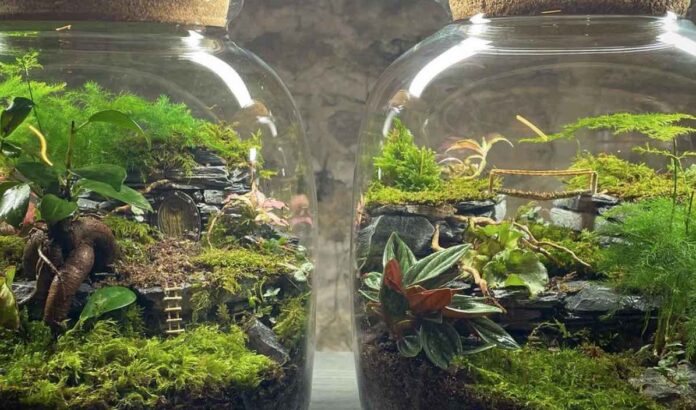
But one of the most fascinating gardening trends is undoubtedly the popular advent of building and maintaining terrariums—little slices of tropical climate encased in glass jars, bottles, or fish tanks which if prepared correctly can last for decades.

NASA describes a terrarium as a “forest enclosed in its own little world,” but there’s no particular rulebook for how big a terrarium should be or what should be kept inside. The Subreddit “Let’s Talk Terrariums” bears witness to that.

This Redditor managed to compress that forest enclosed within its own little world into the pendant on a necklace, while this one 3D printed a special enclosure with beautiful lighting.

Far from being simple eye-candy, tending a terrarium can actually improve one’s mood—even the simple act of having a plant or two around will decrease anxiety, and can help refresh one’s mind after a period of focusing on work.

This was particularly poignant, one terrarium business owner told the BBC, during lockdowns.

CHECK OUT:  10 Ornamental Flowers You Can Cook With or Eat in Salads

“I saw a real influx in people wanting to get into horticulture and grow their green thumb,” says Emma Terrell, from Ottawa, Canada. The Great White North also experienced a boom in cultivating mushrooms at home.

Terrell runs Urban Botanist where she sells DIY supplies for making terrariums of all kinds.

“People saw it as a way to relax, unwind, get creative, and engage with that innate need within us to engage with nature.”

RELATED: Redefining ‘Rich’ and Reorienting Life Towards Your Own—Not Others’—True North

There’s also a natural geometry, or so it’s thought, of plants that make them appealing to look at. All humans tend to prefer things in symmetry, or in consistent patterns like a spiral, and so plant leaves or fern stalks may be nice to look at for reasons involving fractals and mathematics rather than just ‘simple’ beauty.

Doing a terrarium at home

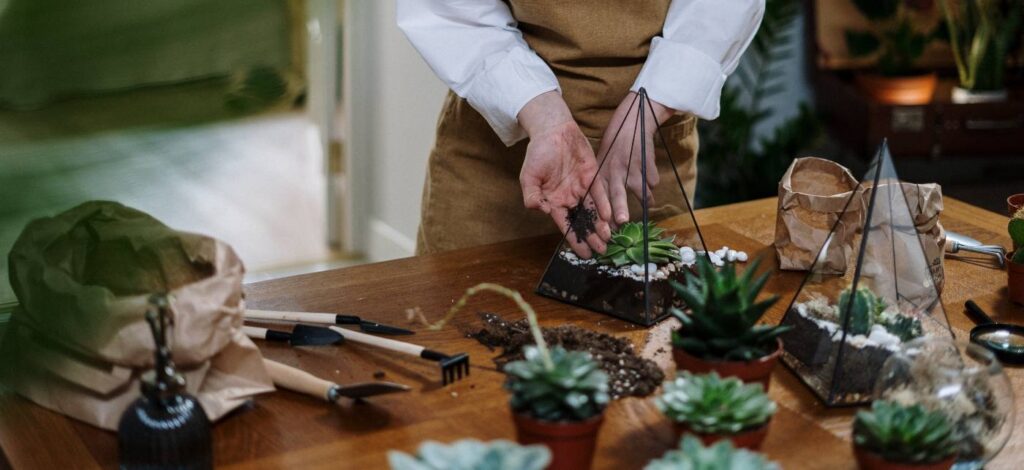
To get started, you can buy terrarium kits on Amazon. Making your own terrarium begins with first deciding whether one wants an open-air terrarium or a closed-off version.

For a closed-off terrarium, pick a soil substrate that wont cultivate mold. James Wong, a botanist and author told the BBC to use kurodama soil, which is typical of bonsai trees, a species that can also be at home in a terrarium. This Redditor used a Fukien tea/carmona bonsai.

Next, pick plants that would be at home on the forest floor in the tropics. Simple species like moss and ferns work well.


“I’ve researched all the different species [of moss], there’s only one that’s easily accessible and very reliable. It’s called Leucobryum glaucum, sold by florists as ‘bun moss,” Wong said.

There’s a limit in a closed ecosystem to how many plants can be sustained, so fill in gaps using decorative objects like stones, driftwood, or maybe a garden gnome.

MORE: 9 Unique Ways to Use Rosemary – Backed by Mom and Science

NASA for kids suggests using a layer of activated charcoal above a strata of rocks at the bottom of the terrarium, under the soil, to help filter water and prevent the growth of mold. They say to put the terrarium in indirect light, but Wong says you can use a growing light to help if the room is too dark.

TAKE This Good Green News Over to Those News Feeds…

“Rules for happiness: something to do, someone to love, something to hope for.” – Immanuel Kant

Quote of the Day: “Rules for happiness: something to do, someone to love, something to hope for.” – Immanuel Kant

Photo: by Toa Heftiba

With a new inspirational quote every day, atop the perfect photo—collected and archived on our Quotes page—why not bookmark GNN.org for a daily uplift?


This ‘Floating Continent’ Could Collect and Recycle Plastic from the Ocean in Future

Rendering, Lenka Petráková

A large, self-sustaining, floating research lab as big as an island could be the next big thing in ocean cleanup.

The 8th Continent, as it’s called, has won the 2020 Grand Prix prize for architecture and innovation of the sea, and is designed to allow the operators to live, work, eat, sleep, and study there full-time.

Looking like something out of Thunderball, the 8th Continent is a water lily-like marine station that’s chained to the bottom of the sea, but designed to float in the ocean currents.

It’s modeled to be a “living organism that is fully self-sustainable,” the chief designer said, and to host a number of activities along with its chief mission of cleaning up the Great Pacific Garbage Patch.

A 900,000-square-mile area characterized by a high-density of plastic waste (think trillions of individual pieces), the Great Pacific Garbage Patch is currently being cleaned by large nets that use the currents to help them collect.

“I was looking into marine species, animals as well as plants. And I was studying how they really interact with water environments, how they can harvest energy and how they work with nutrition, for example,” said Senior Designer Lenka Petráková at Zaha Hadid Architects in London, who won the award.

RELATED: This Cabin’s Flexible Design Can Open To Nature or Enclose into Cozy Space Again (Watch)

The three long legs, or maybe they should be called tentacles or fins, collect passing plastic waste as well as tidal energy to convert into electricity. Sitting on top are three research and education centers underneath three tall, spiraling greenhouses containing hydroponic gardens and a water desalination plant.

Rendering, Lenka Petráková

The spine of the facility will house the living and working quarters, where collected waste is sorted and recycled, while the underwater draft spire will contain a viewing platform.

Stirworld reports that there will be biodegrading infrastructure onboard to break down the plastic.

MORE: Design Students Use Art to Reimagine Plastic Recycling – Creating Lamps, Seat Covers, and More

At the moment it’s a big dream, as it’s so early in the conceptual stage that materials haven’t even been hypothesized yet, but that didn’t stop Petráková in an interview saying that she believes Elon Musk, with his penchant for super-scientific machines and sleepless enthusiasm (and billions), would be the ideal patron to bring the project to life.

Even if it never cleaned up a single water bottle, the design is still fascinating and gorgeous to see; a better place to study the ocean, one could never find.

(WATCH the EuroNews video for this story below.)

SHARE This Stunning Concept With Design-Minded Friends…

A Real Moby Dick: Mythic White Sperm Whale Captured on Film Near Jamaica

YouTube
YouTube/Leo van Toly

A white sperm whale was recently spotted off the coast of Jamaica. The video, recorded by a Dutch merchant sailor, brings to life Herman Melville’s classic Moby Dick, except for the fact that this white whale seemed totally relaxed.

Almost drifting near the surface, the white of the whale’s back is unmistakable and wonderful, but the reasons for its whiteness is not what one might think.

Albino animals are fascinating, and generally speaking, white animals are almost always more charismatic than forest-colored ones. White horses, white lions, white tigers, white wolves, albino pythons, snow leopards, polar bears—these animals capture our imagination in unique ways.

Normally grey or black, a white sperm whale, like those other animals mentioned, isn’t necessarily an albino. Like horses, many sperm whales can have patches of white on their back, head, stomach or flanks, but indeed they can even be all white and not be albino. It’s called Leucism, an irregular distribution of melanin pigments in the skin that affects many animals, like tigers, lions, and horses, but which doesn’t include the pink or red eyes of a true albino.

The advantage of a whale being white is that whales are, even on the scale of the world’s oceans, very big, and scientists often see and meet individuals many times over during their lifetimes swimming around. One such whale, an albino sperm whale who shows up occasionally on the Italian coast of Sardinia, was seen in 2006, and then again nine years later.

MORE: Zero Humpbacks Off Seattle Coast 25 Years Ago – Now 500 Return With Record Number of Calves

“Migaloo” was first sighted off Byron Bay, Australia in 1991, and is thought to be the only pure white humpback whale alive today.

The name Migaloo was given to the whale, which DNA testing revealed was a true albino, by Aboriginal Australians, and means “white fella.”

The elders explained the connection we have to white or albino animals is the feeling inside that all creatures must be respected regardless of their perceived “normality.”

RELATED: Incredible Video Shows a Husband and Wife’s Amazing Encounter With a Group of Humpback Whales

Sperm whales have the biggest teeth in the animal kingdom. They also have the biggest brains, and can pass down a unique cetacean culture that includes dialects of their clicking language.

In Melville’s book, the white whale Moby Dick bites off Captain Ahab’s leg, sending him on a worldwide quest for vengeance.

The book is special for many reasons, not least because of how much powerful imagery Ahab, and by extension Melville, imbue into the whale.

(WATCH the video for this story via the Guardian…)

MAKE a Giant Splash in Those News Feeds—Share This Story…

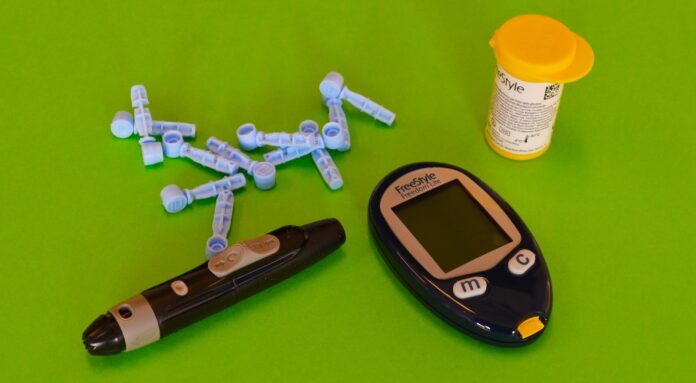
A New Stem-Cell Treatment Looks to Have Cured a Man of Type 1 Diabetes

Diabetesmagazijn.nl

Growing new pancreas cells from unprogrammed stem cells has possibly cured a man of type 1 diabetes.

One doctor told the New York Times that this is the biggest development in treatment for the disease since the discovery of exogenous insulin production 100 years ago.

64-year-old Brian Shelton got an infusion of insulin-producing cells in the pancreas—the kinds which can’t function properly in diabetes victims, after his wife signed him up for a trial run by Vertex Pharmaceuticals.

Before, his life had been governed by the levels of his blood sugar. Now, his daily insulin requirements are down 91%, accompanied by robust improvements in glucose control.

“It’s a whole new life, it’s a miracle,” Shelton told the Times. The trial was organized by a Harvard scientist who had two children join the 1.5 million Americans who suffer from type 1 diabetes.

This is the first of five years in which the trial of 17 patients with severe type 1 will be running. The results of the first stage have not been peer reviewed, and so expectedly, the scientists that are excited about the results are also urging caution because it’s still early days.

MORE: Patch Inspired by Cactus Eliminates Need for Diabetics to Prick Skin for Blood, Collects Sweat Instead

“These results from the first patient treated with [the stem cells] are unprecedented,” said Bastiano Sanna, Ph.D., Chief of Cell and Genetic Therapies at Vertex in a statement. “What makes these results truly remarkable is that they were achieved with treatment at half the target dose.”

20 years of work

Funded by the Howard Hughes Medical Institute, Harvard’s Dr. Doug Milton took 20 years to convert stem cells into islet cells, the insulin-producing pancreatic denizens.

RELATED: People Who’ve Tried Psychedelics Have Lower Risk of Heart Disease and Diabetes

In 2014 Milton partnered with Dr. Sanna at his previous job to start a company called Semma for the purpose of bringing to market a potential stem cell treatment, and along with other biologists, was able to demonstrate that for the first time, there was a repeatable, scalable method for growing islet cells and that they could cure diabetes in rodents.

Next, Milton and his partners and colleagues closed a $950 million sale of Semma to Vertex Pharma, who put up the money for the trials as they needed to see if injections of the manufactured islet cells could be done at scale, safely, and if the immunosuppressant drugs, typical of anyone receiving any kind of transplant, did not cause long-term adverse health outcomes.

READ: No More Pricks: Scientists Are Rolling Out First-of-its-Kind Blood Sugar Test for Pain-Free Delivery to Diabetics

The night the trial results came in, Mr. Shelton was taken to dinner by Dr. Milton, who revealed that Shelton was at least for the moment, cured of the disease.

The Times touchingly reports that at that moment Shelton checked his blood sugar levels, which were perfect, and then had dinner, after which they were still perfect.

SHARE This Medical Breakthrough With Friends… 

Impact-Absorbing Traffic Light Poles Could Save Lives

University of South Australia

Things which bend but don’t break tend to be revolutionary, and an Australian firm hopes that the nation’s drivers will agree the next time they smash their car into a traffic light.

Australians pay close to $90 million a year in damage and injuries from collisions with traffic lights, but a new flexible one that can protect the driver as well as the pole should help to reduce that figure when they’re ready for use next year on the roads Down Under.

Streetlights and traffic light poles tend to be rigid and unyielding—bad news for an oncoming driver, and for the pole, as if the collision is strong enough, without any flexibility the pole will snap.

Not only does this mean an expensive repair process and traffic cop duty for the state’s officers, but it often means the pole will fall down, like a tree towards the axe that fells it, towards the injured motorist and the roof of their car.

University of South Australia’s Dr. Mohammad Uddin is working to replicate this revolution and create a flexible version of the bottom, collision-risk section of the basic streetlight, and is partnering with an Australian company to help him manufacture it, reports New Atlas. 

As an example, during the Middle Ages iron swords were rigid, and they snapped in men’s hands if bent in battle. Steel changed everything, as suddenly the sword could bend but return to its original shape.

MORE: Hundreds of Roundabouts in Two U.S. States are Saving Lives, Reducing Injuries, and Lowering Carbon Emissions

The streetlight is mounted into a bollard which is buried under the concrete of the roadside.

Turning the bottom reaches of the bollard into a cone-shaped cavity, with the wide-end of the cone at the top, the outside of the cavity is filled with polyurethane foam.

At rest it stands up straight, but if hit by a car, the foam compresses which allows for the pole to move and tilt with the impact, reducing damage to the pole, the car, and most importantly, the driver.

Uddin hopes the technology will be ready next year, and for traffic light poles.

POPULARAirless Tires: These Puncture-Proof Michelin Marvels Are Even Made From 47% Recycled Resources

“We expect these new energy-absorbing traffic lights (EATL) will be the standard model going forward, not only for new installations but also to gradually replace existing lights,” said Uddin.

SHARE This Hopeful Safety News; Share This Article…

“Creativity is like driving a car at night. You never see further than your headlights, but you can make the whole trip that way.” – E. L. Doctorow

Quote of the Day: “Creativity is like driving a car at night. You never see further than your headlights, but you can make the whole trip that way.” – E. L. Doctorow

Photo: by Timothy Perry

With a new inspirational quote every day, atop the perfect photo—collected and archived on our Quotes page—why not bookmark GNN.org for a daily uplift?


See the Incredible Images in the Wildlife Photographer of the Year Contest – And Vote on the Peoples Choice Award

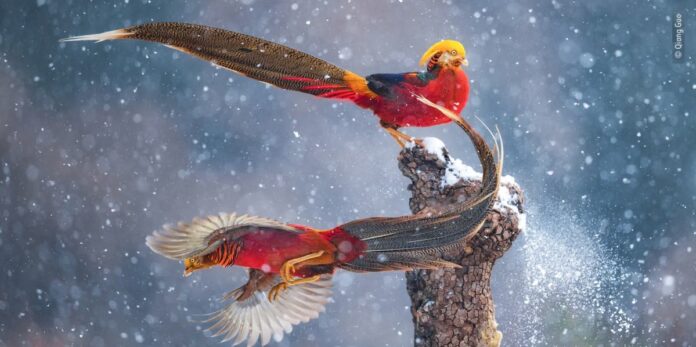
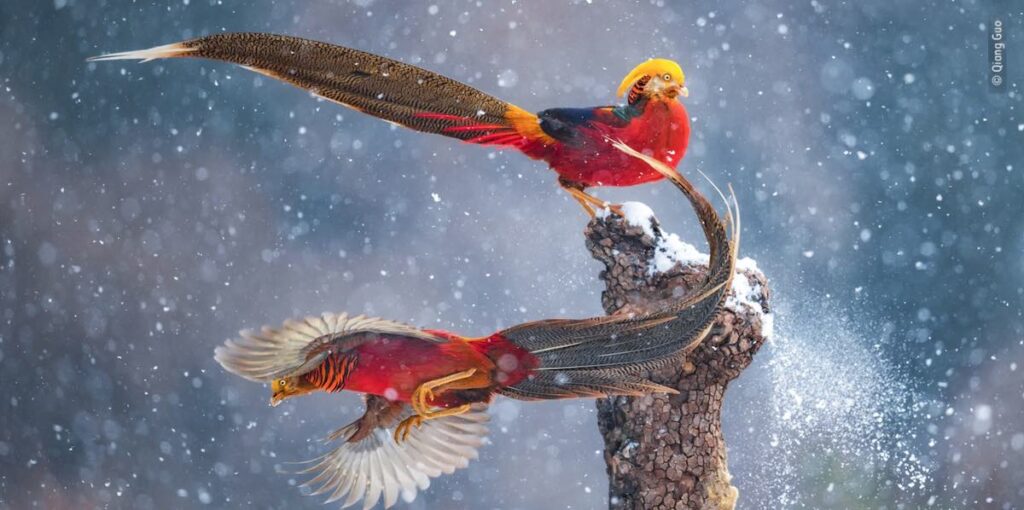
© Qiang Guo – Wildlife Photographer of the Year Peoples Choice Award

The 58th Wildlife Photographer of the Year competition is underway with sumptuous entries from photographers of all ages, nationalities, and experience levels.

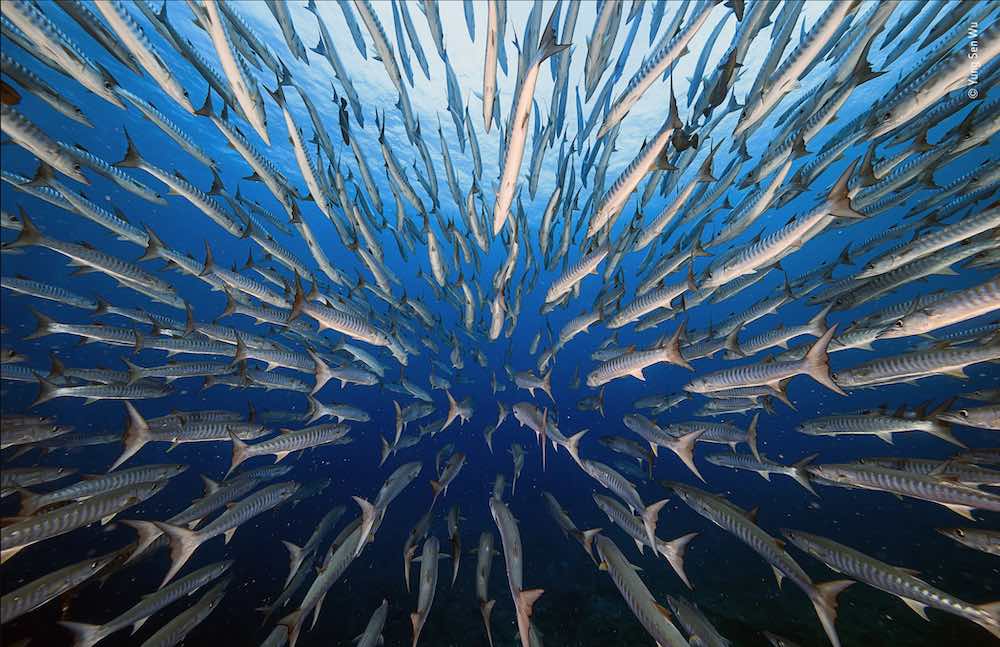
This year’s 25 unforgettable scenes include a pair of golden pheasants (above), a breathtaking school of barracudas, and a kangaroo with her baby joey framed by a fire’s destruction.

London’s Natural History Museum hosts the annual photo competition and is inviting fans to vote online to choose the winner of the People’s Choice Award.

And, based on our favorite images below, it will not be easy to choose just one.

From over 50,000 image entries from 95 countries, these 25 images are currently on display at the highly acclaimed Wildlife Photographer of the Year exhibition at the museum in London.

The winner will then be showcased until the exhibition closes on June 5th. The top five People’s Choice Award images will also be displayed online, joining the winners chosen by the esteemed panel of judges that were announced earlier this year.

LOOK: Mom’s Zoo Pic is Hilariously Photo-bombed by Stingray With Remarkable Resemblance to Her Daughter

Barracudas © Yung Sen Wu – Wildlife Photographer of the Year Peoples Choice Award

“It’s an incredible challenge to pick just one of these images,” said Dr Natalie Cooper, researcher at the Natural History Museum and member of the judging panel. “We’re looking forward to discovering which wild moment emerges as the public’s favorite.”

Breaths of an Arctic fox ©Marco Gaiotti – Wildlife Photographer of the Year Peoples Choice Award

The photos of animal families are particularly moving. Check out these grebes, lions, and monkeys…

Clark’s grebes © Ly Dang – Wildlife Photographer of the Year Peoples Choice Award

Displayed alongside insights from Natural History Museum scientists and experts, the 100 images will be showcased in spectacular lightbox displays at the Wildlife Photographer of the Year exhibition at the Museum until June 5, 2022.

orangutan baby © Maxime Aliaga –Wildlife Photographer of the Year Peoples Choice Award
Lions in the rain © Ashleigh McCord – Wildlife Photographer of the Year Peoples Choice Award
monkey cuddle © Zhang Qiang – Wildlife Photographer of the Year Peoples Choice Award

The exhibition will also be touring across the UK, Australia, Belgium, Canada, Denmark, Germany, USA and more.

© Jo-Anne McArthur-Wildlife Photographer of the Year Peoples Choice Award

LOOK: Mesmerizing Aerial Photos Are Winners in the 2021 Drone Photo Awards

Vote online for the winner of the People’s Choice Award. Voting ends on February 2, 2022.

DON’T Forget to Share The Feels With Your Friends on Social Media…

Pittsburgh Woman’s Food Rescue App Diverts 20 Million Pounds of Surplus into 17mil Meals For Those in Need

Donations from the Good Food Project-by Patrick Hogan / 412 Food Rescue

In a recent episode of the Food Network competition Chopped, contestants were challenged to make a dish using a basket of random ingredients like bacon, mangoes and banana bread. Imagine the same challenge, except that the basket has been replaced by 1000 pounds of discarded food.

Photo by Sri Lanka

This was the challenge confronting the Pittsburgh nonprofit 412 Food Rescue. They had connected with hundreds of local businesses, discovering hundreds of pounds of good surplus food available for donation every day. And, using its own app, the group had created the largest volunteer-led food transport network in a single urban region.

But there was no kitchen in the region that could accommodate the really large gifts coming from big donors and turn those into single-serving meals.

So in 2019, the organization came up with a solution by opening its own kitchen, the Good Food Project. Paying no money for food and creating zero waste, the kitchen is a model for effective food recovery and distribution.

Food waste makes up about 25% of all material in landfills—more than any other single source of waste—and when it rots, it’s a leading cause of greenhouse gas emissions.

The Good Food Project prevents waste by transforming food that might go to the landfill into healthy, heat-and-eat meals and shelf-stable items packaged in compostable containers. These meals are then distributed to nonprofit partners serving the needy.

The donations come from partners like Gordon Food Service, which may find themselves with food that is still perfectly good to eat, but cannot be sold due to aesthetic standards, sell-by timelines, or transit mishaps.

RELATED: 13-Year-old Boy Granted a “Make-A-Wish” Uses It to Feed the Homeless Every Month for a Year

Donations from the Good Food Project-by Patrick Hogan / 412 Food Rescue

The Biggest Food Hero

Leah Lizarondo launched 412FoodRescue.org in 2015 to redirect food from the waste stream directly to households and nonprofits. To make that pivotal connection, she created an app that gives volunteers pick-up locations and delivery destinations, so they can jump in their car and close the gap between the food surplus and those who need it.

The app, FoodRescueHero is now used by a growing team of 25,000 volunteer drivers in 15 cities.

Together with 800 food retailers, they have turned more than 70 million pounds of surplus into nearly 57 million meals—and mitigated more than 30 million lbs. of CO2.

RELATED: Charity Rescues So Much Food From Landfill, It Opens a ‘Pay What You Feel’ Grocery Store To Share Tons of Produce

Meanwhile, their kitchen in Millvale, on the outskirts of Pittsburgh, has produced over 17,000 meals, and is currently creating upwards of 600 meals per week—all with zero cost for food.

While the kitchen—which is solar-powered to help offset energy use—has been expanding its reach, it has also been reducing its waste – all the way to zero. The project stabilizes and uses every ounce of food that it can, and the remainder is composted.

LOOKApp Lets You Buy Leftover Food From Your Favorite Restaurants—Saving 150k Meals a Day Globally

Good Food Project volunteers cooking – 412 Food Rescu

The kitchen project is just the latest in the garrison of good news emanating from Leah’s determination to solve 3 problems at once—food waste, food insecurity, and the climate crisis.

WATCH her video about her volunteer app to see how heroes are born…

FEED Your Friends With Some Good News – SHARE on Social Media…

Doctor’s ‘Miraculous’ Remedy for Nonstop Coughs is Curing People With a YouTube Video

Dr. Miles Weinberger and Bethany - Courtesy habitcough.com
Dr. Miles Weinberger and Bethany – Courtesy habitcough.com

The cure for ‘coughing without a cause’ has been hiding in plain sight for years, and now people can discover it on YouTube, thanks to Dr. Miles Weinberger, MD, a cough researcher, immunologist, and pediatric pulmonologist.

Until The Weinberger Procedure there had never been a quick and effective cure for ‘habit cough’—and certainly never a free treatment that so many could use without going to a doctor’s office.

One father was so relieved to witness his 12-year-old daughter cured via a Skype tele-conference with Weinberger after only 30 minutes, that he has done all he can—including posting the video session online— to publicize and publish information on this revolutionary treatment for refractory unexplained chronic cough.

One study published in 2020 of more than 9,000 adults over age 45 showed that 10 percent reported a chronic cough. Many patients have respiratory causes for their coughs, and they should seek medical care, but the study also found that many patients with chronic cough do not have any identifiable underlying cause.

Dr. Weinberger’s remedy for those unexplained disorders utilizes the power of suggestion, which was first described as a possible treatment for children in 1966, but Weinberger, who directed the Pediatric Allergy and Pulmonary Clinic at the University of Iowa Hospital for 40 years, has put the idea into practice to benefit hundreds of patients, perfecting a system that has cured adults and children after only a short session.

POPULAR: Colorado Doctor Discovered Natural Way To Treat Common Vertigo

The Weinberger ‘Suggestion Therapy’ is so easy and rewarding, that the diagnosed adult or child can “self cure” by watching the video (below) and sipping from a tall glass of water while concentrating on breathing, as instructed. Full recovery to ‘cough zero’ has occurred within days for 95% of children who were treated by Weinberger and practiced the procedure.

Dennis Buettner, who videotaped the session two years ago that cured his daughter Bethany, called it “the most unexpected, unintended, and unprecedented discovery in medical history—since the accidental discovery of penicillin.”

Buettner assisted Weinberger in publishing a peer-reviewed scientific paper in the journal of the American College of Allergy, Asthma, and Immunology. Buettner says the treatment is now being routinely used by Johns Hopkins Medicine, the Mayo Clinic, and Kaiser Permanente, and by health experts around the world.

RELATED: Cure for Osteoarthritis Could Be ‘No Further Than the End of Your Nose’, Researchers Find

“They typically and routinely refer their most hopeless, helpless, and forsaken chronic cough patients here [to habitcough.com] when all other options failed.”

Also, Buettner tells GNN that they’ve had volunteers translate the video script into Spanish, Mandarin, Turkish, and German.
​​
“The child in the video below is our sweet daughter. Had we not filmed her instant and permanent cure, even we would not believe what we saw.”

By listening to Dr. Weinberger’s soothing instructions and following his directions in the immediate hours following, these habitual coughs, which had afflicted people sometimes for years, can be suppressed and eliminated.

A young boy from Connecticut became one of the latest to be rescued by the video. Ryan had been violently coughing since September, for 16 hours each day. He was so sad thinking he would never be able to sing again, but then he watched the video and spoke to Dr. Weinberger. He wrote in an email: “Hi Bethany! Yes, I am super excited to FINALLY be done with my cough! Dr. Weinberger is like a miracle worker and my family and I are so grateful to have had the chance to meet him. Once and awhile a single cough slips through but for the most part it is gone!!”

RELATED: New Treatment For Eczema Could Emerge After Possible Cause Was Identified by ‘Surprised’ Scientists

The original video is held in the permanent video library of The American Thoracic Society. The free availability of it on YouTube is Dr. Weinberger’s gift to the world.

In the video, Bethany’s father gives some background on her cough and all the remedies and pharmacological avenues they had tried before hearing about Weinberger. The actual Skype session with the doctor begins at 4:25, when he began filming after realizing something special was happening.

Contact habitcough.com with all your questions.

​​MULTIPLY the Healing – SHARE This Incredible Information on Social Media…

“Our heritage and ideals–the things we live by and teach our children–are preserved or diminished by how freely we exchange ideas and feelings.” – Walt Disney (born 120 years ago today)

Quote of the Day: “Our heritage and ideals–the things we live by and teach our children–are preserved or diminished by how freely we exchange ideas and feelings.” – Walt Disney (born 120 years ago today)

Photo: by NeONBRAND

With a new inspirational quote every day, atop the perfect photo—collected and archived on our Quotes page—why not bookmark GNN.org for a daily uplift?


This Week’s Inspiring Horoscopes From Rob Brezsny’s ‘Free Will Astrology’

Our partner Rob Brezsny provides his weekly wisdom to enlighten our thinking and motivate our mood. Rob’s Free Will Astrology, is a syndicated weekly column appearing in over a hundred publications. He is also the author of Pronoia Is the Antidote for Paranoia: How All of Creation Is Conspiring To Shower You with Blessings. (A free preview of the book is available here.)

Here is your weekly horoscope…

FREE WILL ASTROLOGY – Week beginning December 3, 2021
Copyright by Rob Brezsny, FreeWillAstrology.com

SAGITTARIUS (Nov. 22-Dec. 21):
“All my days I have longed equally to travel the right road and to take my own errant path,” wrote Norwegian-Danish novelist Sigrid Undset. I think she succeeded in doing both. She won a Nobel Prize for Literature. Her trilogy about a 14th-century Norwegian woman was translated into 80 languages. I conclude that for her—as well as for you in the coming weeks and months—traveling the right road and taking your own errant path will be the same thing.

CAPRICORN (Dec. 22-Jan. 19):
Capricorn author Susan Sontag unleashed a bizarre boast, writing, “One of the healthiest things about me—my capacity to survive, to bounce back, to prosper—is intimately connected with my biggest neurotic liability: my facility in disconnecting from my feelings.” Everything about her statement makes me scream NO! I mean, I believe this coping mechanism worked for her; I don’t begrudge her that. But as a student of psychology and spirituality, I know that disconnecting from feelings is, for most of us, the worst possible strategy if we want to be healthy and sane. And I will advise you to do the opposite of Sontag in the coming weeks. December is Stay Intimately Connected with Your Feelings Month.

AQUARIUS (Jan. 20-Feb. 18):
In some small towns in the Philippines, people can be punished and fined for gossiping. Some locals have become reluctant to exchange tales about the highly entertaining things their neighbors are doing. They complain that their freedom of speech has been curtailed. If you lived in one of those towns, I’d advise you to break the law in the coming weeks. In my astrological opinion, dynamic gossip should be one of your assets. Staying well-informed about the human comedy will be key for your ability to thrive.

PISCES (Feb. 19-March 20):
“Originality consists in thinking for yourself, and not in thinking unlike other people,” wrote Piscean author James Fitzjames Stephen (1829–1894). Another way to say it: Being rebellious is not inherently creative. If you primarily define yourself by rejecting and reacting against someone’s ideas, you are being controlled by those ideas. Please keep this in mind, dear Pisces. I want you to take full advantage of your astrological potential during the next 12 months, which is to be absolutely original. Your perceptions and insights will be unusually lucid if you protect yourself from both groupthink and a compulsive repudiation of groupthink.

ARIES (March 21-April 19):
It’s a favorable time to get excited about your long-range future—and to entertain possibilities that have previously been on the edges of your awareness. I’d love to see you open your heart to the sweet dark feelings you’ve been sensing, and open your mind to the disruptive but nourishing ideas you need, and open your gut to the rumbling hunches that are available. Be brave, Aries! Strike up conversations with the unexpected, the unknown, and the undiscovered.

TAURUS (April 20-May 20):
Now is a ripe time for you, Taurus, to interweave your subconscious mind with the subconscious mind of an ally you trust. The two of you could generate extraordinary healing energy for each other as you lie together, dozing in the darkness. Other recommended activities: meditating together; fantasizing together; singing together; making spiritual love together. (PS: If you have no such human ally, sleep and meditate with a beloved animal or imaginary friend.)

GEMINI (May 21-June 20):
Gemini author Chuck Klosterman writes, “It’s far easier to write why something is terrible than why it’s good.” That seems to be true for many writers. However, my life’s work is in part a rebellion against doing what’s easy. I don’t want to chronically focus on what’s bad and sick and desolate. Instead, I aspire to devote more of my energy to doing what Klosterman implies is hard, which is to write sincerely (but not naively) about the many things that are good and redemptive and uplifting. In light of your current astrological omens, Gemini, I urge you to adopt my perspective for your own use in the next three weeks. Keep in mind what philosopher Robert Anton Wilson said: “An optimistic mindset finds dozens of possible solutions for every problem that the pessimist regards as incurable.”

CANCER (June 21-July 22):
An organization in Turkey decided to construct a new building to house its workers. The Saruhanbey Knowledge, Culture, and Education Foundation chose a plot in the city of Manisa. But there was a problem. A three-centuries-old pine tree stood on the land. Local authorities would not permit it to be cut down. So architects designed a building with spaces and holes that fully accommodated the tree. I recommend you regard this marvel as a source of personal inspiration in the coming weeks and months. How could you work gracefully with nature as you craft your future masterpiece or labor of love? How might you work around limitations to create useful, unusual beauty?

LEO (July 23-Aug. 22):
Author Melissa Broder wrote a preposterous essay in which she ruminated, “Is fake love better than real love? Real love is responsibility, compromise, selflessness, being present, and all that shit. Fake love is magic, excitement, false hope, infatuation, and getting high off the potential that another person is going to save you from yourself.” I will propose, Leo, that you bypass such ridiculous thinking about love in the coming weeks and months. Here’s why: There’s a strong chance that the real love at play in your life will feature magic and excitement, even as it requires responsibility, compromise, selflessness, and being present.

VIRGO (Aug. 23-Sept. 22):
Virgo author Andre Dubus III describes times when “I feel stupid, insensitive, mediocre, talentless and vulnerable—like I’m about to cry any second—and wrong.” That sounds dreadful, right? But it’s not dreadful for him. Just the opposite. “I’ve found that when that happens,” he concludes, “it usually means I’m writing pretty well, pretty deeply, pretty rawly.” I trust you will entertain a comparable state sometime soon, Virgo. Even if you’re not a writer, the bounty and fertility that emerge from this immersion in vulnerability will invigorate you beyond what you can imagine.

LIBRA (Sept. 23-Oct. 22):
“The problem with putting two and two together is that sometimes you get four, and sometimes you get 22.” Author Dashiell Hammett said that, and now I’m passing it on to you—just in time for a phase of your cycle when putting two and two together will probably not bring four, but rather 22 or some other irregularity. I’m hoping that since I’ve given you a heads-up, it won’t be a problem. On the contrary. You will be prepared and will adjust faster than anyone else—thereby generating a dose of exotic good fortune.

SCORPIO (Oct. 23-Nov. 21):
In her poem “Is/Not,” Scorpio poet Margaret Atwood tells a lover, “You are not my doctor, you are not my cure, nobody has that power, you are merely a fellow traveler.” I applaud her for stating an axiom I’m fond of, which is that no one, not even the person who loves you best, can ever be totally responsible for fixing everything wrong in your life. However, I do think Atwood goes too far. On some occasions, certain people can indeed provide us with a measure of healing. And we must be receptive to that possibility. We shouldn’t be so pathologically self-sufficient that we close ourselves off from tender help. One more thing: Just because that help may be imperfect doesn’t mean it’s useless and should be rejected.

WANT MORE? Listen to Rob’s EXPANDED AUDIO HOROSCOPES, 4-5 minute meditations on the current state of your destiny — or subscribe to his unique daily text message service at: RealAstrology.com

(Zodiac images by Numerologysign.com, CC license)

SHARE The Wisdom With Friends Who Are Stars in Your Life on Social Media…