









All News - Page 439 of 1716 - Good News Network
Home Blog Page 439

Clever Cockatoos Craft 3-Piece Tool Set to Extract Fruit – Becoming Only 4th Animal Species to Do So

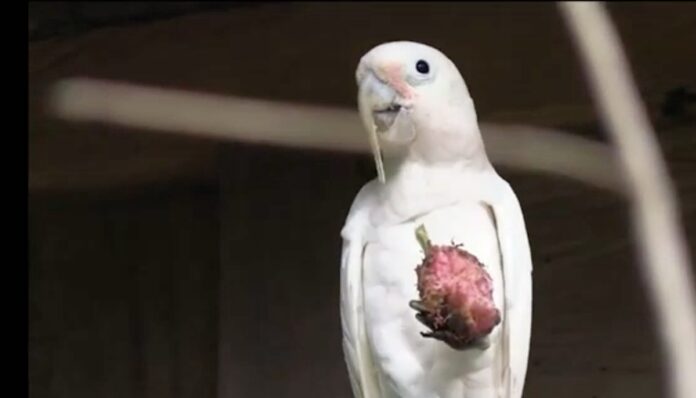
Goffin’s Cockatoo uses medium sized tool to penetrate seed. – Messerli Institute video

Truly astonishing behavior has just been recorded in a pair of wild Goffin’s Cockatoos, who like expert bandits, manufactured an entire three-piece set of tools to burgle their way into the pit of a mango.

Caught wild and held for a short time in a research aviary in Indonesia, it is the kind of behavior that typifies the most advanced tool users in the animal kingdom, and solidifies the Goffin’s Cockatoo as one of the avian group’s major bird-brainiacs.

Perhaps the most delightful part of this discovery was that it happened serendipitously, while Mark O’Hara and Berenika Mioduszewska were studying a new group of wild birds in their research aviary on the island of Tanimbar.

“I’d just turned away, and when I looked back, one of the birds was making and using tools,” O’Hara, of the Messerli Research Institute in Vienna Austria, tells Science. “I couldn’t believe my eyes!”

Before the capture of the canny cockatoos, O’Hara and Mioduszewska had spent an eye-watering 900 hours watching them feed high in the canopy without ever once witnessing tool use.

A few other bird species, like the New Caledonian Crow and Hyacinth Macaw, have been documented making stick tools, and even hook tools.

Goffin’s Cockatoos are well-documented as intuitive social learners that can solve a variety of problems and puzzles. The Messerli Institute has, in fact, shown how one individual was able to teach his mates how to craft and use tools. That, however, was just one tool, for one purpose.

This new observation is the first time any bird species has been seen creating and using a set of tools in a specific order

RELATED: Research Shows Why Crows Are So Intelligent and Even Self-Aware—Just Like Us

The bird-brained bandit

While researching the cockatoos, the team would regularly provide them with food they found about the island, including the wawai, or sea mango, which is poisonous to humans but nutritious for birds. At the center of the mango a hard pit protects a large, nutritious seed.

For awhile it seemed there was nothing special about the bunch of birds they captured, but two individuals, upon getting their talons onto the pits, began to craft not one, not two, but a set of three different tools to work their way into the fruit pit.

“Repeated provisions of the fruit allowed us to analyze the behavior in detail, and to collect and trace some of the manufactured tools,” explains O’Hara in a video abstract. “Using a structure-from-motion technique we could create 3D models and gather detailed measurements such as size and volume…[of the tools used]. Based on the physical properties, the function analysis classified three types of tools; we discovered that each tool type seemed to serve a different purpose.”

LOOK: Man is Stunned After He Sets Up Camera Inside Bird Box and Attracts 41 Million Fans Worldwide

With a thicker section of branch, they would use their beak to push and pry open one end of the pit, while with a second, medium-fine implement, they punctured the membrane surrounding the seed. Lastly, they would make a scoop-like tool which when maneuvered with their mouth, allowed them to extract the seed material.
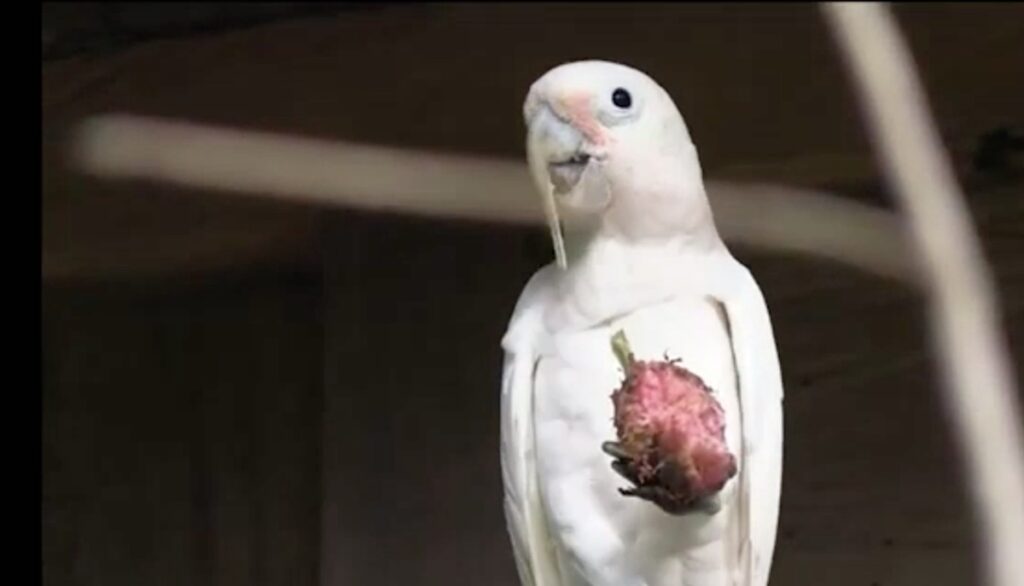
Goffin’s Cockatoo uses medium sized tool to penetrate the seed. – Messerli Institute video

This making of tool sets has been seen in humans, chimpanzees, and capuchin monkeys; full stop. Chimps use between two and five tools for termite and beehive raids.

Tool use has been proposed in the parrot lineage as having a strong captivity bias, so whether the behavior was tied to their stay in the aviary or whether they use tools in the wild is something O’Hara and Mioduszewska discuss in their research paper in Cell. 

“If they had a genetic predisposition to use tools, all the birds would do it,” O’Hara tells Science. “Since only a few make these, it’s more likely they invented them independently,” which would be even more likely as the two individuals displayed immediate and exceptional proficiency.

RELATED: ‘Like a Beautifully-tuned Instrument’: 2000 Microphones Unlock the Mystery of Why Hummingbirds Hum

They believe that it is not species-wide but acquired by individuals through opportunistic innovations, or by watching and learning from others. A number of intriguing details emerge in the Discussion section, such as that tools tended to be crafted to specifications before use, rather than through a trial-and-error process.

Another detail is that around the island they had found fruit underneath wawai trees that appeared to had been foraged on with tools. One actually contained a wooden fragment inserted into the fissure of the pit, which provided enough years go by, could be the first-ever instance of “avian-archaeology.”

CHECK OUT: New Bird Song That ‘Went Viral’ Across a Sparrow Species Was Tracked by Scientists For the First Time

O’Hara and Mioduszewska’s paper is filled with videos that are stunning to watch, and can be accessed here for free.

FLY This to Your Bird-Loving Flock on Social Media…

11-year-old Girl Drummer, Nandi Bushell, Finally Joins Foo Fighters on Stage – LOOK

“It Happened!!!,” Nandi Bushell wrote on the YouTube video shot by her dad which tallied 1.1 million views this week.

In her grunge flannel shirt, the 11-year-old drummer took the stage at the Los Angeles Forum to finally meet her rock star idol in person—and play alongside Dave Grohl and his world-renown Foo Fighters.

Nandi accepted the invitation and traveled with her parents from Ipswich, England, where she’s been playing since she was five-years-old.

It was a bright spot during the pandemic in August 2020 when she made a video challenging Grohl to an epic drum battle during lockdown.

Her drumming is so superlative that multiple friends of the former Nirvana drummer were texting him, saying he had to respond with a video of his own.

Over several weeks they went back and forth with dueling videos, and in September, Grohl, a Grammy Award-winning singer, drummer and guitarist, penned a song just for Nandi, the wunderkind who also plays guitar and bass. (The video is incredible, with Dave’s daughters, hereby known as “the Grohlettes,” joining him as back-up singers.)

On August 26, near the end of the California show, Dave introduced the girl who had initiated their drum-off by playing her cover version of the Foo Fighters hit Everlong. Now it was time to join the big boys playing that song for the encore.

Nandi Bushell’s YouTube channel

The crowd began chanting ‘Nandi. Nandi. Nandi.’

“It was EPIC!!!,” she wrote on her Twitter page.


Her dad, John, who was screaming for joy throughout the video from the side of the stage, was truly living the Everlong lyrics as he was hearing them:

And I wonder… If everything could ever feel this real forever.
If anything could ever be this good again.

See the full video of her time on stage via her YouTube channel. below..

WATCH: Dog Howls For Joy as New Back-up Singer in Baby’s Band

SHARE This With All Your Rock-n-Roll Fans on Social Media…

This Week’s Inspiring Horoscopes From Rob Brezsny’s ‘Free Will Astrology’

Our partner Rob Brezsny provides his weekly wisdom to enlighten our thinking and motivate our mood. Rob’s Free Will Astrology, is a syndicated weekly column appearing in over a hundred publications. He is also the author of Pronoia Is the Antidote for Paranoia: How All of Creation Is Conspiring To Shower You with Blessings. (A free preview of the book is available here.)

Here is your weekly horoscope…

FREE WILL ASTROLOGY – Week beginning September 3, 2021
Copyright by Rob Brezsny, FreeWillAstrology.com

VIRGO (Aug. 23-Sept. 22):
“I often wonder who I am and where is my country and where do I belong and why was I ever born at all,” wrote Virgo author Jean Rhys (1890–1979). I don’t think you will be agitated by those questions during the next eight weeks, Virgo. In fact, I suspect you will feel as secure in your identity as you have in a long time. You will enjoy prolonged clarity about your role in the world, the nature of your desires, and how you should plan your life for the next two years. If for some inexplicable reason you’re not already enjoying these developments, stop what you’re doing and meditate on the probability that I am telling you the bold truth.

LIBRA (Sept. 23-Oct. 22):
Several states in the US have statutes prohibiting blasphemy and such cursing could theoretically get you fined in Massachusetts, South Carolina, and Wyoming. In the coming days, it’s best to proceed carefully in places like those, since you’ve been authorized by cosmic forces to curse more often and more forcefully than usual. Why? Because you need to summon vivid and intense protests in the face of influences that may be inhibiting and infringing on your soul’s style. You have a poetic license to rebel against conventions that oppress you.

SCORPIO (Oct. 23-Nov. 21):
Everyone dreams at least three dreams per night. In a year, your subconscious mind generates over 1,100 dreams. About this remarkable fact, novelist Mila Kundera writes, “Dreaming is not merely an act of coded communication. It is also an aesthetic activity, a game that is a value in itself. To dream about things that have not happened is among humanity’s deepest needs.” I bring this to your attention, Scorpio, because September is Honor Your Dreams Month. To celebrate, I suggest the following experiments. 1. Every night before sleep, write down a question you’d like your dreams to respond to. 2. Keep a notebook by your bed and transcribe at least one dream each time you sleep. 3. In the morning, have fun imagining what the previous night’s dreams might be trying to communicate to you. 4. Say prayers of gratitude to your dreams, thanking them for their provocative, entertaining stories.

SAGITTARIUS (Nov. 22-Dec. 21):
In her autobiography Changing, Sagittarian actor Liv Ullmann expresses grief about how she and a loved one failed to communicate essential truths to each other. I propose we regard her as your anti-role model for the rest of 2021. Use her error as your inspiration. Make emotionally intelligent efforts to talk about unsaid things that linger like ghostly puzzles between you and those you care about.

CAPRICORN (Dec. 22-Jan. 19):
“I could do with a bit more excess,” writes author Joanne Harris. “From now on I’m going to be immoderate—and volatile,” she vows. “I shall enjoy loud music and lurid poetry. I shall be rampant.” Let me be clear, Capricorn: I’m not urging you to be immoderate, volatile, excessive, and rampant every day for the rest of your long life. But I think you will generate health benefits and good fortune if you experiment with that approach in the coming weeks. Can you think of relatively sane, sensible ways to give yourself this salubrious luxury?

AQUARIUS (Jan. 20-Feb. 18):
While wading through the internet, I found a provocative quote attributed to the ancient Greek philosopher Socrates. He supposedly said, “My ultimate goal is to look totally hot, but not be unapproachable.” I confess that in the past I have sometimes been fooled by fake quotes, and this is probably one. Still, it’s amusing to entertain the possibility that such an august personage as Socrates, a major influencer of Western thought, might say something so cute and colloquial. Even if he didn’t say it, I like the idea of blending ancient wisdom with modern insights, seriousness with silliness, thoughtful analysis with good fun. In accordance with astrological omens, I recommend you experiment with comparable hybrids in the coming weeks. (PS: One of your goals should be to look totally hot, but not be unapproachable.)

PISCES (Feb. 19-March 20):
“If you don’t know what you want,” writes Piscean novelist Chuck Palahniuk, “you end up with a lot you don’t.” Very true! And right now, it’s extra important to keep that in mind. During the coming weeks, you’ll be at the peak of your ability to attract what you want and need. Wouldn’t you prefer to gather influences you really desire—as opposed to those for which you have mild or zero interest? Define your wants and needs very precisely.

ARIES (March 21-April 19):
Aries poet Anna Kamienska wrote, “I’ve learned to value failed conversations, missed connections, confusions. What remains is what’s unsaid, what’s underneath. Understanding on another level of being.” In the coming weeks, I suggest you adopt her perspective as you evaluate both past and present experiences. You’re likely to find small treasures in what you’d assumed were wastelands. You may uncover inspiring clues in plot twists that initially frustrated you. Upon further examination, interludes you dismissed as unimportant or uninteresting could reveal valuable wrinkles.

TAURUS (April 20-May 20):
After studying your astrological omens, I’ve decided to offer you inspiration from the ancient Roman poet Catullus. I hope the extravagant spirit of his words will free you to be greedy for the delights of love and affection. Catullus wrote, “Give me a thousand kisses, then a hundred; then another thousand, then a second hundred; then yet another thousand.” I’ll add the following to Catullus’s appeal: Seek an abundance of endearing words, sweet favors and gifts, caresses and massages, and help with your work. If there’s no one in your life to provide you with such blessings, give them to yourself.

GEMINI (May 21-June 20):
Gemini author Elif Batuman writes that the Old Uzbek language was rich in expressions about crying. There were “words for wanting to cry and not being able to, for loudly crying like thunder in the clouds, for crying in gasps, for weeping inwardly or secretly, for crying ceaselessly in a high voice, for crying in hiccups, and for crying while uttering the sound ‘hay hay.'” I recommend all of these to you in the coming days, as well as others you might dream up. Why? It’s prime time to seek the invigorating release and renewal that come from shedding tears generated by deep and mysterious feelings.

CANCER (June 21-July 22):
A blogger named MythWoven imagines an “alternate universe where I literally go to school forever (for free) so I can learn about art and literature and history and languages for 100 years. No job skills. No credit requirements. No student loans. Just learning.” I have longings like hers. There’s an eternal student within me that wants to be endlessly surprised with exciting information about interesting subjects. I would love to be continually adding fresh skills and aptitudes to my repertoire. In the coming weeks, I will give free rein to that part of me. I recommend you do the same, my fellow Cancerian.

LEO (July 23-Aug. 22):
In 2016, the International Garden Photograph of the Year depicted lush lupine flowers in New Zealand. The sea of tall purple, pink, and blue blooms was praised as “an elegant symphony” and “a joy to behold.” What the judges didn’t mention is that lupine is an invasive species in New Zealand. It forces native plant species out of their habitat, which in turn drives away native animal species, including birds like the wrybill, black stilt, and banded dotterel. Is there a metaphorically comparable phenomenon in your life, Leo? Problematic beauty? Some influence that’s both attractive and prickly? A wonderful thing that can also be troublesome? The coming weeks will be a favorable time to try to heal the predicament.

WANT MORE? Listen to Rob’s EXPANDED AUDIO HOROSCOPES, 4-5 minute meditations on the current state of your destiny — or subscribe to his unique daily text message service at: RealAstrology.com

(Zodiac images by Numerologysign.com, CC license)

SHARE The Wisdom With Friends Who Are Stars in Your Life on Social Media…

“The secrets of making dreams come true summarized in four Cs: Curiosity, confidence, courage, and constancy, and the greatest of all is confidence. When you believe in a thing, believe in it all the way, implicitly and unquestionable.” – Walt Disney

Quote of the Day: “The secrets of making dreams come true summarized in four Cs: Curiosity, confidence, courage, and constancy, and the greatest of all is confidence. When you believe in a thing, believe in it all the way, implicitly and unquestionable.” – Walt Disney

Photo: MD Duran

With a new inspirational quote every day, atop the perfect photo—collected and archived on our Quotes page—why not bookmark GNN.org for a daily uplift?


Neighbors Secretly Plan a Hokey-Pokey Birthday Flash Mob for 93-Year-old Super Fan of the Song (WATCH)

This 93-year-old woman has an obsession. It’s not an unusual collection of plates or a passion for exotic reptiles. It’s a song, and one song only—The Hokey Pokey.

“You put your right foot in. You put your right foot out.
You put your right foot in, and you shake it all about.
You do the Hokey Pokey, and you turn yourself around,
That’s what it’s all about…”

For Phyllis Brinkerhoff—Mrs. B. as she’s affectionately known around the town in Prairie Village, Kansas—that really is what it’s all about.

“It’s just a fun, joyous song,” Mrs. B recently told CBS’s Steve Hartman. And Mrs. B wanted to share the love, even if it became a bit annoying to her neighbor.

She gave Melanie Mendrys a copy of a Hokey Pokey CD—and anxiously awaited her friend’s conversion—from someone who merely knew the song to a die-hard fan who wanted to do the dance.

When proof of such a change in sentiments wasn’t forthcoming, the enthusiastic senior became something of a nudge, often calling Mendrys to see if she’d experienced her Hokey Pokey epiphany yet.

WATCH: Dick Van Dyke Celebrates 90th Birthday With Flash Mob of Chimney Sweeps

Mendrys admits the corny song was never likely to make it to the top ten of her personal hit parade—but, then, the neighbor did something extraordinary for Mrs. B’s upcoming 93rd birthday.

Mendrys and her daughter secretly created special invitations and passed them out to the community inviting them to a one-in-a-million surprise party—a Hokey Pokey flashmob.

RELATED: Flash Mob of Child Musical Prodigies Wows Crowd in Paris

The neighbors donning birthday hats assembled on the front lawn of Mrs B’s home where they put their ‘whole selves in’ and broke out in a performance of her favorite song.

And, the huge smile on her face? That’s what it’s all about.

WATCH the video from our friends at On the Road… **NOTE: International viewers can see it at CBS)

Put Your Right Hand on the Share Button, and Send This Tear-jerker to Friends…

Barnacle Glue Inspired MIT Scientists to Make a Paste that Can Stop Heavy Bleeding in Seconds

Debbie Boyt

Attempting to save some of the 1.9 million people who die from blood loss every year, researchers at MIT are using barnacles as inspiration to craft a glue that can seal a wound in just 15-seconds.

Debbie Boyt

Barnacles are strange old creatures which can glom onto virtually anything in the ocean, whether that’s the smooth metal hull of a ship, the flexible porous skin of a whale, or the craggy surface of a rock. It was drawing inspiration from the barnacles’ oil that the team came up with the potentially-groundbreaking substance.

Whether in an operating theater or administration of first aid, rapid blood loss is a hugely frightening situation. Wound adhesives tend not to work well with major injuries. They rely on coagulants which can take minutes to work, time the patient may not have. Furthermore, they rely on dry-enough skin to be able to hold a wound closed; again hardly the ideal conditions when a patient is bleeding heavily, or if you have to close an internal wound.

Hyunwoo Yuk, a mechanical engineering scientist at MIT, and his colleagues based their barnacle-inspired glue on the cocktail of lipids (fats) that the animals use before clinging to surfaces. This oil they secrete sweeps away contaminants, and primes the surface for glomming onto with a bio-cement that would otherwise not take as well if the surface wasn’t cleared before hand.

When secreted onto a cut in the heart of a rat, it stopped the blood-loss and sealed it within 10 seconds, and proved to withstand 8-times the breaking pressure compared to commercial alternatives.

“My overall impression of this material is that it’s incredible,” says Hanjay Wang to Wired Magazine, a resident in Stanford University’s Cardiothoracic Surgery Department who was not involved in the study. “It definitely fills a need, especially in the emergency setting, when you need to just get control.”

Another surgeon said she’d never seen anything like it in her career.

POPULAR: Student Builds Life-Saving Device that Can Instantly Stop Bleeding from Stab Wounds

There are still some details that must be flushed out, such as how long the bond lasts. Ideally it should last even after the wound has healed on its own, but not forever, and the toxicity levels still need to be carefully calculated.

Another physician speaking to Wired about the trials brought up a problem which the glue solves that is simply not being met by any other product in the medical tech market.

“With aging populations, you have more and more patients that have either acquired bleeding disorders or are ultimately on blood thinners; the problem of bleeding, and bleeding control is substantial,” Christoph Nabzdyk, a cardiologist and critical care physician from Mayo.

CHECK OUT: Robert Downey Jr. Showed His True Heart to a Bleeding Stranger in the 90’s

Dr. Yuk has an interesting way of looking at problems, reasoning the animal kingdom’s principal task is survival, so whatever you’re looking to do, heal, or fix, there’s probably an organism that has already solved it.

His use of barnacles as inspiration typifies that behavior, and could very well revolutionize the medical field.

MORE: Superglue Used to Stop Newborn Baby’s Brain Bleeding

Cold Planets Exist Throughout Our Galaxy, Even in the Galactic Bulge, Scientists Discover

An artist’s conception of cold planet distribution throughout the Milky Way/Osaka University
An artist’s conception of cold planet distribution throughout the Milky Way. The inset shows an artistic conception of a planetary system in the Galactic bulge./Osaka University

Although thousands of planets have been discovered in the Milky Way, most reside less than a few thousand light years from Earth. Yet our Galaxy is more than 100,000 light years across, making it difficult to investigate the Galactic distribution of planets. But now, a research team has found a way to overcome this hurdle.

Researchers led by Osaka University and NASA have used a combination of observations and modeling to determine how the planet-hosting probability varies with the distance from the Galactic center.

The observations were based on a phenomenon called gravitational microlensing, whereby objects such as planets act as lenses, bending and magnifying the light from distant stars.

This effect can be used to detect cold planets similar to Jupiter and Neptune throughout the Milky Way, from the Galactic disk to the Galactic bulge—the central region of our Galaxy.

“Gravitational microlensing currently provides the only way to investigate the distribution of planets in the Milky Way,” says Daisuke Suzuki, co-author of the study. “But until now, little is known mainly because of the difficulty in measuring the distance to planets that are more than 10,000 light years from the Sun.”

To solve this problem, the researchers instead considered the distribution of a quantity that describes the relative motion of the lens and distant light source in planetary microlensing. By comparing the distribution observed in microlensing events with that predicted by a Galactic model, the research team could infer the Galactic distribution of planets.

RELATED: Astronomers Spot Light From Behind a Black Hole for the First Time – Proving Einstein Right Again

The results show that the planetary distribution is not strongly dependent on the distance from the Galactic center.

Instead, cold planets orbiting far from their stars seem to exist universally in the Milky Way. This includes the Galactic bulge, which has a very different environment to the solar neighborhood, and where the presence of planets has long been uncertain.

“Stars in the bulge region are older and are located much closer to each other than stars in the solar neighborhood,” explains lead author of the study Naoki Koshimoto, which was published in The Astrophysical Journal Letters. “Our finding that planets reside in both these stellar environments could lead to an improved understanding of how planets form and the history of planet formation in the Milky Way.”

MORE: Massive Balloon the Size of a Soccer Stadium to Launch Telescope to Edge of Space to Study How Stars Form

According to the researchers, the next step should be to combine these results with measurements of microlens parallax or lens brightness—two other important quantities associated with planetary microlensing.

Source: Osaka University

SHARE This Far-Out News With the Space Fans in Your Life…

Watch Photographer Stumble Onto Sunset Marriage Proposal and Excitedly Give Amazing Pics to the Couple

SWNS
SWNS

A romantic couple have become a TikTok sensation after their sunset engagement was unknowingly caught on camera by a passing photographer.

31-year-old Dan Rutterford popped the big question to partner Kay Lewis in what he thought was a totally secluded spot on the Cornish coastline of England.

But photographer Lui Gazzard happened to be passing by when he spotted Dan go down on one knee in the distance.

He quickly took some stunning snaps of the couple standing on a headland at Tintagel, Cornwall, with a gorgeous pink and purple sunset behind them.

Lui then approached stunned Dan and Kay to say he’d captured the engagement—a moment that was recorded on a TikTok video—and has since garnered more than a million views and 191,000 likes.

Holidaymakers Dan and Kay, from Romford in Essex, were staying in Tintagel with Kay’s three kids when they headed out for their weekly date night on Monday evening.

MORE: Watch an Astonishing Heart Being Formed By Sheep, As Australian Farmer Pays Tribute to His Beloved Aunt

The couple, who met four years ago, set up a picnic in a secluded spot on a headland looking out to the Atlantic Ocean before Dan mustered up the courage to propose.

Afterwards, the couple celebrated with Kay’s three children and shared a bottle of prosecco.

Lui was on holiday with his family in nearby Boscastle when he captured the pictures on an evening walk.

He said, “It was one of those moments where everything came together. The guy was already down on one knee, then he got up and they were hugging.

RELATED: Daughter Can’t Stop Laughing About Her Mom’s Exercise Routine – WATCH

“It was nice that it was just the two of them on that headland. Normally there are people around watching the sunset.”

Lui waited half an hour before telling the couple he’d caught their engagement on camera.

“They were really thankful that someone was there to capture the moment.”

(WATCH the extremely sweet Tiktok video below.)

SHARE This Romantic Story With Your Best Friends on Social Media…
Is Your Goal to Walk 10,000 Steps? Science Shows We Need A Lot Fewer

Registering 10,000 steps a day with a pedometer is a fine goal that deserves celebration, but far from being a doctor-recommended dose of activity, it’s actually a complete myth.

The good news is that for most people whose physical activity is limited to walking, one need only accumulate between 4,500 and 7,000 steps a day to reduce, sometimes dramatically, their chance of dying young.

Most governments, and we can start with the CDC at home, recommend 150 minutes of moderate-intensity physical activity per week. The measurement is made with a unit of time and not of repetitions, which has its limits, as some studies show number of steps correlates more strongly with lower disease risk than did time spent walking.

According to Gretchen Reynolds writing for the New York Times, the goal of accumulating 10,000 steps in a day for fitness’ sake is actually based on a fad invented by a Tokyo watchmaker in the wake of the 1964 Tokyo Olympics, when more and more people in the city became interested in health and fitness.

Like a harmless version of the other falsehoods in eastern medicinal practices (rhino horn tea anyone?) the idea that somehow 10,000 steps was the threshold for some exceptional therapeutic results spread across the globe.

MORE: Just Go Walk: Studies Show Normal Walking Can Add Years to Your Life and Reduce Disease Symptoms

In reality 10,000 steps is almost 5 miles, a lot more than is necessary for lowering your disease risk. Reynolds points to a 2019 study that found woman in their 70s who managed just 4,500 steps a day lowered their risk for premature death of any cause by 40%, compared to those who walked just 2,700 steps or less.

In a Japanese study cohort in 2020, it was found that among 4,840 adults aged 40 and up, walking 8,000 steps per day was enough to reduce risk of premature death by 49%.

However the critical detail is that between 4,000 to 8,000 steps, the benefit was immense, but between 8,000 and 12,000, the benefit diminished, suggesting there is fast-approaching upper limit of how much benefit the mere act of walking will confer.

RELATED: Study Says Combining a Daily Protein Shake With Exercise Doesn’t Just Make You Stronger, It Makes You Smarter Too

It’s actually a good thing, probably, to suggest not trying to walk 10,000 steps, but rather to walk between 6,000 to 8,000 steps, and use the time one saved to do other physical activities of equal importance such as weight training or stretching—both key factors in preventing various pathologies of morbidity like muscle and bone-density loss, or the loss in flexibility.

WALK a Dose of Good News Over to Your Friends on Social Media…
“I try to avoid looking forward or backward, and try to keep looking upward.” – Charlotte Bronte

By Bobby Stevenson

Quote of the Day: “I try to avoid looking forward or backward, and try to keep looking upward.” – Charlotte Bronte

Photo: Bobby Stevenson

With a new inspirational quote every day, atop the perfect photo—collected and archived on our Quotes page—why not bookmark GNN.org for a daily uplift?

Cure for Osteoarthritis Could Be ‘No Further Than the End of Your Nose’, Researchers Find

Credit: cottonbro
Credit: cottonbro

A cure for osteoarthritis could be no further than the end of your nose—as nasal cells can relieve chronic inflammation in the knee, according to new research.

Doctors say the treatment could revolutionize therapy for a crippling condition that impacts 8.5 million people in the UK alone.

The cells originate from embryonic brain and spinal cord tissue—known as the neuroectoderm. Co-lead author Professor Ivan Martin, of Basel University in Switzerland, described them as “amazing.”

He explained, “Unlike the cartilage tissue in the joints, these cartilage cells originate from precursor cells of the neuroectoderm. They therefore have a distinct regenerative and adaptive capacity—or plasticity. Tissue grown from nasal cartilage cells seems also to retain these special properties.”

Unlike other tissues cartilage that cushions the surface of joints has little capacity to grow back.

Osteoarthritis, the most common form of arthritis, can lead to damage. Knee replacement surgery is often the only option.

Now clinical studies have shown cartilage cells from the nasal septum, the partition that divides the nostrils, combat the disease.

Orthopaedic and plastic surgeons took a tissue sample from the noses of two patients—and cultivated them in the lab.

They then used them to grow a cartilage layer that was then implanted into the knee joint.

The young volunteers had severe osteoarthritis due to misalignment of the leg bones. They faced having a whole knee prosthesis.

A hopeful path

But following implantation of the engineered cartilage both reported a reduction in pain, and increased quality of life.

MORE: Sufferers Living With Severe Arthritis Could be Given Lasting Pain Relief Thanks to a New Technique

MRI (magnetic resonance imaging) scans showed the bones in the knee of one of the patients were further apart than previously.

This was an indication of the joint’s recovery. The other volunteer could only be interviewed for a subjective assessment owing to the pandemic.

The bones in both volunteers could be surgically corrected—and the most likely cause of their osteoarthritis eliminated, said the researchers.

They are confident patients will be able to manage without knee joint prostheses, at least for some time.

Martin said, “Our results have enabled us to lay the biological foundation for a therapy, and we are cautiously optimistic.”

Unlike knee traumas caused by sports injuries and falls, an osteoarthritic knee suffers persistent inflammatory reactions.

Martin said, “First we had to test whether the cartilage replacement was attacked and degenerated by the inflammatory factors.”

The international team initially tested human cartilage tissue in the presence of inflammatory factors.

Experiments were carried out in mice and various other models of the disease.

Martin said, “First we had to test whether the cartilage replacement was attacked and degenerated by the inflammatory factors.”

The durability of the tissue was also tested under stress and inflammation in sheep.

Cartilage cells were taken from the nose of the animals and transplanted into their osteoarthritic knee joints.

The tissue proved to be extremely robust—and also seemed to counteract the inflammatory reactions.

Further analysis suggested the effect was caused by a chemicals fuelled by osteoarthritis, known as the WNT signaling pathway.

CHECK OUT: Molecule Combo Actually Reverses Arthritis in Human Cartilage and Rats, Says ‘Exciting’ New Study

The study, published in the journal Science Translational Medicine, found it was dampened by by the presence of the nasal cartilage cells.

Next steps

In-depth clinical trials using the approach for the treatment of patellofemoral osteoarthritis are now being planned.

It’s caused when the articular cartilage wears out and the bone ends rub on one another,  causing extreme pain.

The researchers also aim to further develop the method for other types of osteoarthritis to treat a broader spectrum of patients.

They pioneered nose-to-knee cartilage transplants a decade ago in nine patients who had suffered sports injuries, falls or other accidents.

RELATED: First Ever Study Shows Chair Yoga is Effective Arthritic Treatment

It followed successful experiments in goats. This is the first time it has been used for osteoarthritis.

Globally it affects more than 300 million people. It occurs when the protective cartilage that cushions the ends of the bones wears down over time.

Osteoarthritis can damage any joint but is usually found in the hands, knees, hips and spine.

Osteoarthritis symptoms can usually be managed—although the damage to joints can’t be reversed.

Staying active, maintaining a healthy weight and receiving certain treatments might slow progression and improve pain and joint function.

SHARE This Hopeful News With Your Chums…

Good Samaritans Rescue 60 Cows From Hurricane Ida Floodwaters

Twitter/@kennylopez

It might be “herd” to believe, but some Louisiana cowboys recently undertook a very different kind of cattle drive after Hurricane Ida left grazing lands flooded—and they’ve been using airboats to do get the job done.

“We got about 300 head of cattle… out here that we couldn’t get out from the back pastures in time before the storm came in, being that it was a quickly developing storm,” lead volunteer Derek Billiot told WGNO News.

In storms past, Billiot routinely employed his airboat to rescue people rather than livestock. This time, luckily, since most folks who found themselves in Ida’s path heeded advance evacuation orders, he didn’t have to.

So far, Billiot and his water-skimming crew have rounded up about 60 head of cattle in Parish Plaquemines.

The exhausted bovines aren’t always 100% cooperative, but at present, the rescuers are taking a “no cow left behind” attitude.

Many of the stranded animals are mired in mud and trapped by marsh debris.

The volunteers have been attempting to coax the heifers to higher ground when possible, but mostly, they’ve had to resort to roping the flood victims and dragging them to safety.

MORE: Houston’s Mattress Mack and Lakewood Church Open Doors to Hurricane Ida Refugees, Send Truckloads of Supplies

While this good Samaritan-led cattle drive is a serious business, Billiot can’t help but see the lighter side of the roundup. “Welcome to south Louisiana,” he quipped. “Real rodeoing.”

(WATCH one of the im-moo-vable cows below.)

HOLY COW! It’s Time To Share the Good News…

Judge Throws Out Trump-era Rule That Allowed Filling Streams, Marshes, and Wetlands for Development

In the face of a legal challenge mounted by six Native American Tribes, a district court judge in Arizona has thrown out a Trump-era interpretation of the Clean Waters Act (CWA) that would allow actors to fill in, pollute, or dredge wetlands, streams, and marshlands,

District Judge Rosemary Marquez noted that there were numerous “serious errors” in the regulation that was passed to help states better identify and manage waters that are legally protected by the CWA.

It was in June that the Biden Administration announced they would revisit Trump’s Navigable Waters Protection Rule (NWPR), but it was Marquez who felt that leaving it in place while new rules were made risked causing “serious environmental harm.”

Marquez’s decision applies nationwide, according to the Washington Post, and will protect drinking water and wildlife habitat for millions of Americans and billions of animals.

As with most legal challenges in this country, the battle arose over unclear language.

“To restore and maintain the chemical, physical, and biological integrity of the Nation’s waters,” reads the purpose of the CWA, defining the nation’s waters as “navigable waters of the United States, including territorial seas.”

Navigable waters could mean a number of things. For starters, navigable by whom, humans or fish? Based on that lack of clarity, farmers and industry pushed the Trump Administration to allow the states to determine the fate of as many bodies of water as could be found without clear federal protection. These included feeder streams, marshes, and wetlands.

In 2006, Justice Antonin Scalia authored a four-justice opinion which stated waters of the United States should be “relatively permanent, standing or continuously flowing bodies of water forming geographic features,” adding that “only those wetlands with a continuous surface connection to bodies that are ‘waters of the United States’.”

However the Obama Administration’s revisiting of the CWA added federal protection for waters that were not “standing or continuously flowing,” like marshes that might feed a river far away, or even streams which only come alive during periods of heavy rainfall, such as a desert wash.

It was these protections Trump acquiesced to eliminate. Indeed report from the Army Corps of Engineers, whose job it is to grant permits for dredging or filling waterways, stated that 333 currently-submitted projects would have required environmental review under the Obama rules, but not under Trump’s.

MORE: Florida is Purchasing 20,000 Acres of Everglade Wetlands to Protect It From Oil Drilling

The lawsuit was launched on behalf of six Native American Tribes by Earth Justice, who noted that between June 22, 2020 and April 15, 2021, the Corps approved
jurisdictional determinations under the NWPR of 40,211 aquatic resources or water
features, and found that approximately 76% were vulnerable under the NWPR.

In states like Arizona and New Mexico where water resources are exceedingly precious, they found that almost every one of the 1,500 assessed ephemeral streams and washes were non-jurisdictional of the CWA.

Marquez ruled that the potential ruination of these waters while the Biden team conduct their review could have “cascading and cumulative downstream effects,” invalidated and remanded the NWPR, and sent it off to the Corps and the EPA for review.

RELATED: One Year Since Bipartisan Bill Funds Repairs at National Parks: See What Projects are Underway in 40 States

“The sacred waters that were put at risk by the Trump administration are essential to our cultural and religious lives as indigenous people,” said Tohono O’odham Nation Chairman Ned Norris, Jr., whose tribe participated in the lawsuit. “This decision by the court rightfully vacates a grievous error.”

CONSERVE the Good News—Share This Story…

Archaeologists in Egypt Discover Mummy With Gold Tongue

Egyptian Ministry of Tourism and Antiquities

The English phrase about someone being “silver-tongued” clearly runs cross-culturally, as recently a set of mummies were unearthed in Egypt, and one was buried with a golden tongue.

The mummies date to the Greco-Roman period of Egypt after it had come under the thumb of the Northern Mediterranean following the conquests of Alexander the Great, and were found in gilded sarcophagi buried in rock-cut “wall-hole” tombs in the Temple of Taposiris Magna in the Classical-Era city of the same name.

Within these small chambers, the mummies were in a poor state of preservation, which highlights, according to a press release from the Ministry of Tourism and Antiquities, the characteristics of mummification in the Greek and Roman periods.

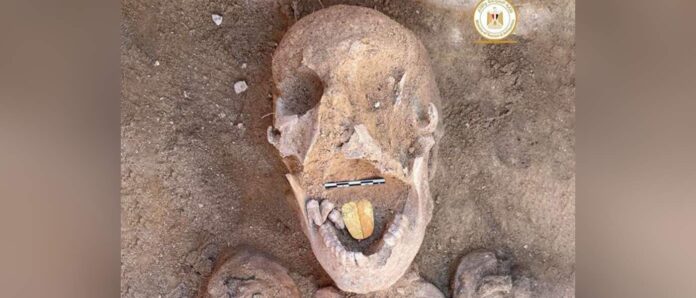
A gold foil amulet, shaped in the form of a tongue, was found placed in the mouth of a mummy in a special ritual to ensure their ability to speak before the Osirian court in the afterlife.

MORE: 1,500-Year-Old Skeletons Found Locked in Loving Embrace Might Have Been ‘Romeo and Juliet’ Ending in China

Osiris was the god of the underworld, and it would be considered vital for people to have a way to speak with him. It’s not clear, but the gold tongue might have been related to that idea, although Smithsonian brought up that perhaps the deceased had a speech impediment.

The two most important mummies were wrapped in golden bonds of papyrus. One bore decorations characteristic of Osiris, while the other wore an Atef crown, sporting horns and a coiled cobra around the head, and a falcon design on their chest to honor the god Horus.

RELATED: Archaeologists Discover ‘Dazzling’ 3,000-Year-old Egyptian City, Left ‘As if it were yesterday’

The discovery was made by a joint Egypt-Dominican team, led by Dr. Kathleen Martinez.

They also discovered eight marble masks depicting faces of the Roman and Greco influence in the region with striking detail, and a near-body-length female funerary mask.

“In the last 10 years, the mission has found several important archaeological finds that have changed our perception of the Temple of Taposiris Magna,” read the statement on the Ministry’s website. “A number of coins bearing the name and image of Queen Cleopatra VII were found inside the temple walls, in addition to many parts of statues.”

HELP the Dazzling News Stick Out by Sharing This Story…

First Galápagos Study of Pink Iguanas Reveal New Details – And Rangers Believe They Can Be Saved

Copyright Joshua Vela/ Galápagos Conservancy

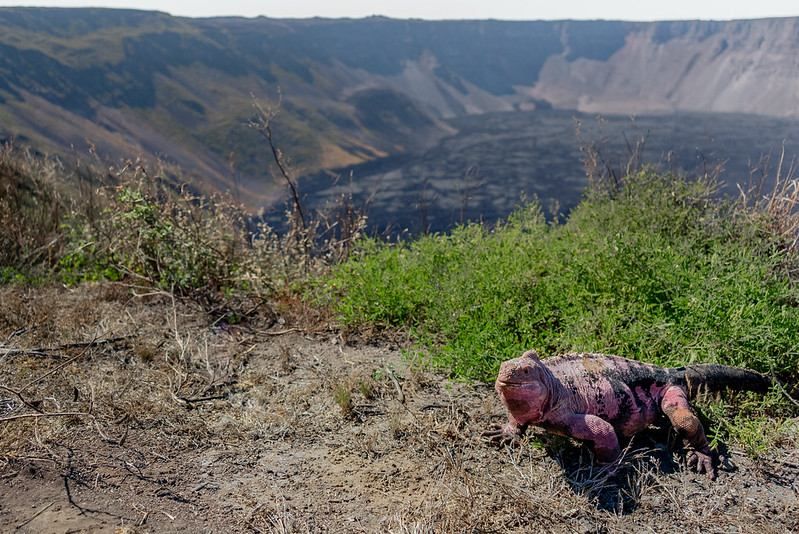
In concluding their expedition to Wolf Volcano on Isabela Island in the Galápagos, scientists have finished the first survey of the pink land iguana, a Critically Endangered species that lives nowhere else on Earth.

The survey used camera traps and involved 30 scientists spreading out over nearly 1,000 acres of the “most inhospitable places in Galápagos,” positively identifying 53 adult pink land iguanas, but no juveniles.

The effort which took place through early-to-mid August was led by Conservation Manager Jorge Carrión and Conservation Director Washington Tapia at the Galápagos Conservancy, who have overseen some remarkable close shaves at their hugely successful Giant Tortoise Restoration Initiative.

The pair recently reported on their expedition, and how with a little data, and a little hope, they believe they can rescue this quite recently-discovered species from the brink on which it was found teetering over.

“They are iconic as much for being recently discovered and limited to a small geographic area, as for the inherent challenges of managing the future of an animal of which we know very little about,” Carrión wrote, at the Conservancy’s website.

The challenges of conserving them are partly the terrain, as Carrión details, for Wolf Volcano is as unwelcoming as a wolf or a volcano. The iguanas nest at 5,600 feet above sea level, where there is little shade, and the temperatures can rise to 100 °F in the air and 160 °F at the level of the ground. At night however, the temperature plummets to 50 °F with a strong, constant and freezing wind.

The steep, mountainous ground is littered with cacti, and there are more ticks on Isabella than any other island. Finally, the iguanas can easily bite a finger off if they get the opportunity, so handling them is kept to a minimum.

MORE: Iguanas Successfully Reintroduced to Galapagos Island After They Were Last Seen By Darwin 184 Years Ago

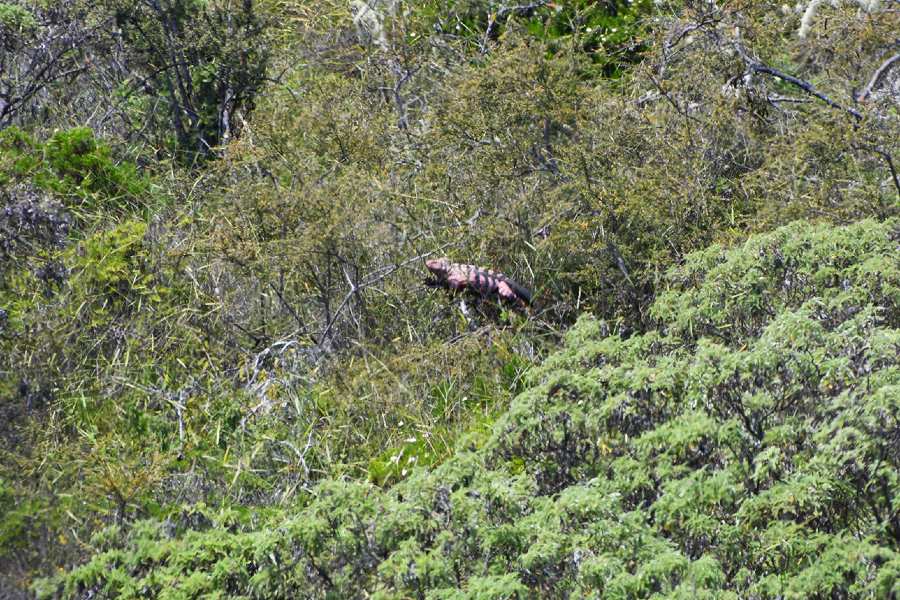
“During the expedition, we documented never-before-seen behavior such as the symbiotic relationship with Darwin’s finches, which feed on parasites on the iguana’s body, and the unusual sight of an iguana seeking out the sun on a tree branch in an area where the sunlight couldn’t penetrate the dense undergrowth.”

Copyright Jorge Carrión/Galápagos Conservancy

The last juvenile was spotted in 2014, just five years after the species was first officially described as different from both the normal, and yellow land iguanas of the famous islands.

Using the mark and recapture method of analysis, the Conservancy believes that 211 individuals may remain on Isabella.

Copyright Joshua Vela / Galápagos Conservancy

Iguana experts from around the world, at the behest of the Galápagos National Park Directorate, arrived for a brainstorming event on the data gathered during the expedition in late August. With their help, the Directorate and the Conservancy hope to craft the first action plan for saving the pink iguana.

(WATCH the video below.)

KEEP Good News From Becoming Endangered; Share This Story…

“Life is like a movie, write your own ending. Keep believing, keep pretending.” – Jim Henson

Quote of the Day: “Life is like a movie, write your own ending. Keep believing, keep pretending.” – Jim Henson

Photo: Alex Litvin

With a new inspirational quote every day, atop the perfect photo—collected and archived on our Quotes page—why not bookmark GNN.org for a daily uplift?


Quick-Thinking Teen Rushes to Save People Trapped In Burning Building, Inspired by Her Favorite Show

SWNS
SWNS

A hero schoolgirl who saved people trapped in a burning apartment raised the alarm after being inspired by a TV show about the emergency services.

14-year-old Lily Swanson is obsessed with the Disney+ show 9-1-1, so when she noticed a strong burning smell she immediately stopped to investigate.

She had been on a walk with her Rottweiler Isobel near her home in Leyland, Lancashire, but decided to try and find the source of the smell.

The quick-thinking teenager looked around and finally spotted black smoke billowing out of an apartment window on Hough Lane.

Lily ran home to wake her dad Mike Swanson and rang 999.

Mike grabbed his ladders and ran to the scene to help those trapped inside before the building was engulfed in flames.

Lily said, “As soon as I called the fire brigade, we ran back outside and we could see people hanging out the window.

“It had only been a minute or two since I first saw the smoke but as we were running over to help them, one of the windows blew off and fell into the street.

SWNS

“That’s when me and my dad saw the flames. I told my dad we should try and get everyone out of the other window above the barber’s next door.

MORE: Thirsty Butterfly Fleeing Wildfire Drinks Water Straight From Aid Worker’s Hand –WATCH

“We opened the ladders and leaned them against the building and there were two or three people trying to climb out. They were desperate.”

Thankfully, everyone was evacuated safely after emergency services arrived at the scene just minutes later.

Lily added, “But then the fire brigade showed up very quickly and took over. We couldn’t believe how fast they got there.

“We did everything we could do and thankfully everyone got out safely, which is the best that could have happened.”

Lily and her dad stayed at the scene while fire crews evacuated the building and ensured everyone was safe.

Mike said, “It was a proud dad moment for me, as it could have been a lot worse if it wasn’t for Lily’s quick response.

“She’s been obsessed with this TV programme on Disney+. It’s about emergency services in America who deal with things like this.

“Then this happened practically on our doorstep and she handled it brilliantly. I’m very proud.”

Leyland fire station manager Jonny Nottingham, who was the incident commander on the night of the fire, praised Lily for her quick and calm response.

Mr Nottingham said, “We’d like to thank Lily for calling us so quickly after spotting the fire in the apartment.

RELATED: Teen Invents Clever Fire Extinguisher to Save Your Home When You’re Away – and He’s Donating All the Profits

“We have seen in the past that people can have lots of different reactions to seeing a fire but Lily showed maturity and calmness beyond her years to quickly and effectively notify us.”

DIAL UP the Good News In Those Feeds By Sharing This Story…

Irrigation System Talks to Plants to Find Out When they Need Water — Cutting Water Use by 30-50%

Responsive Drop Irrigation
Responsive Drip Irrigation

If only plants could talk, what tidings they could share! Fortunately for farmers, an agricultural company has ‘translated’ the biochemical signal related to certain plant behavior, allowing them to ‘listen’ to plants cries for water when they’re thirsty.

It has the capacity to reduce water use in any system, from a well-manicured lawn to a rural vegetable farm in North Africa, and compared to drip irrigation which is based on a similar idea, it can reduce water use by 30-50%, revolutionizing the science and methods of irrigation in the face of a warming climate, longer droughts, and water shortages.

Responsive Drip Irrigation (DRI) has designed a watering system that installs tubes under the earth filled with pore-like depressions. As plants begin to get thirsty they produce a certain chemical in their roots. The micropores in the tubes in turn detect this chemical and release a water drip that will continue until it detects the plants have drunk their fill.

MORE: Huge Supply of Water is Saved From Evaporation When Solar Panels Are Built Over Canals

In the United Arab Emirates near Abu Dhabi, farmers are growing vegetables in the desert, and DRI won the startup of the year 2019 at the Global Forum for Innovations in Agriculture, while in Pakistan near the dry area around Islamabad, vegetables like tomatoes and bok choy were grown 81% faster and twice as large, respectively, than with regular drip irrigation.

In fact, DRI is established in 14 countries, from rural Zimbabwe to lawns in Utah and Los Angeles in the U.S.

RELATED: Scientists Create World’s First Truly Biodegradable Single-use Plastic That ‘Eats Itself’ in Just 2 Weeks

The biggest hurdle stopping RDI from changing the industry is that existing methods of irrigation are already established and paid for. Convincing farmers to make the switch could be difficult, especially in certain areas, like California, where the irrigation systems have not only been around for decades, but link multiple farms and orchards like a spider’s web.

Yet “wherever there’s an issue with water scarcity and food security, we want to be there,” Jan Gould, founder of Responsive Drip Irrigation, told Fast Company.

IRRIGATE Your Chums’ Feeds With the Innovative News…

Nightclub in Scotland Will Capture Energy From Dancers to Power the Venue

One Glasgow nightclub is working to sustainably harness the energy released from its partiers on the dance floor. The pioneering system at SWG3 could save the popular nightspot up to 70 tons of CO2 per year.

In the run-up to the UN’s COP26 climate conference in Glasgow this November, BODYHEAT turns the energy from dancing bodies into a source for heating and cooling outlets.

A statement from the club says, “We’re hugely excited to reveal our plans to introduce a state-of-the-art renewable heating and cooling system to the SWG3 complex, transforming body heat from clubbers and gig-goers into a source of energy to be used again.”

The first of its kind to be installed in Scotland, BODYHEAT uses heat pumps and fluids to capture body heat generated by SWG3’s crowds, channeling their combined energy into twelve 150m-deep bore holes drilled beneath the venue.

This heat can then either be used immediately to cool the audience, or stored under the ground until it’s needed to heat the building.

Idly mingling, a human body radiates about 100 watts of excess heat, which can add up fast in confined spaces, and the enormous amount of heat that people dancing at clubs or gigs generate is currently ejected into the atmosphere as waste.

RELATED: Buy Some Wind Power With Your Furniture? IKEA is Now Selling Renewable Energy

“With this new system in place,” says the club, “we’ll be able to utilize that warmth, consuming minimal electricity and gas on site, and in turn minimizing our carbon emissions”

“There’s no doubt that the COVID-19 pandemic has brought huge challenges to the events sector around the world,” said Andrew Fleming Brown, Managing Director, “but it has also created a seismic jolt across businesses, underlining the need for a stable and sustainable future.”

MORE: Football Fans Can Now Eat Their Coffee Cups After They’re Done Sipping

“BODYHEAT is our innovative contribution to a global issue, and will help us to dramatically decrease our energy consumption, bringing us one step closer to becoming a carbon neutral venue in the not so distant future.”

GENERATE HEAT in Friends’ Feeds by Sharing This Story…

Dog is Given Her Own Billboard So She Might Finally Get Adopted and Leave the Shelter After 2 Years

Scott Poore
Scott Poore

Sally-Sue has been waiting a long time to get adopted. The 11-year-old pit bull’s been sitting in a shelter for two years, hoping to find her furever home. Now one man is on a mission to see that she does—and in a minute, you’ll sense a theme.

Animal advocate Scott Poore’s company, Mission Driven Goods, is a pet-centric venture promoting products aimed at helping long-term shelter pets get adopted.

Poore recently took out a 30-foot billboard—located where else but Mission, Kansas—featuring Sally-Sue’s smiling face and a plea to potential pet parents to make room in their hearts and homes for the loving senior fur baby.

“On social media, we tend to promote the same story to the same people,” Poore told KMBC News. “A billboard, especially on I-35, it’s going to get thousands of views… All we need is that one right person to go by, make eye contact with the billboard, and we’re saving another life.”

MORE: Devious Dog Fakes a Coma to Avoid Toilet Duty in the Rain –And it’s So Cute (WATCH)

Since the billboard is a rental, Poore is working to find the permanent funding he’ll need to keep long-term shelter pets large in the public eye. Right now, he’s taking a one pooch at a time approach.

When Sally Sue—currently at the Always & Furever Midwest Animal Sanctuary—gets adopted, the next hopeful doggo candidate will get their shot at the “big time.”

“The dogs that’ll be on the billboard are the ones that have been homeless the longest,” Poore told KMBC.

“The goal is to find her not just a home, [but] the perfect home. As quickly as we do that, [we] move onto the next shelter pet that deserves to be up there.”

RELATED: Man Spots His Dog on Television That Was Missing For 2 Years – He Knew That Infamous Underbite

While a billboard might be an unorthodox approach to pet adoption, every time another dog finds a home as a result, we’ll count that as mission accomplished.

(WATCH the video for this story below.)

SHARE the PAWsome News With Pooch-Loving Pals…