














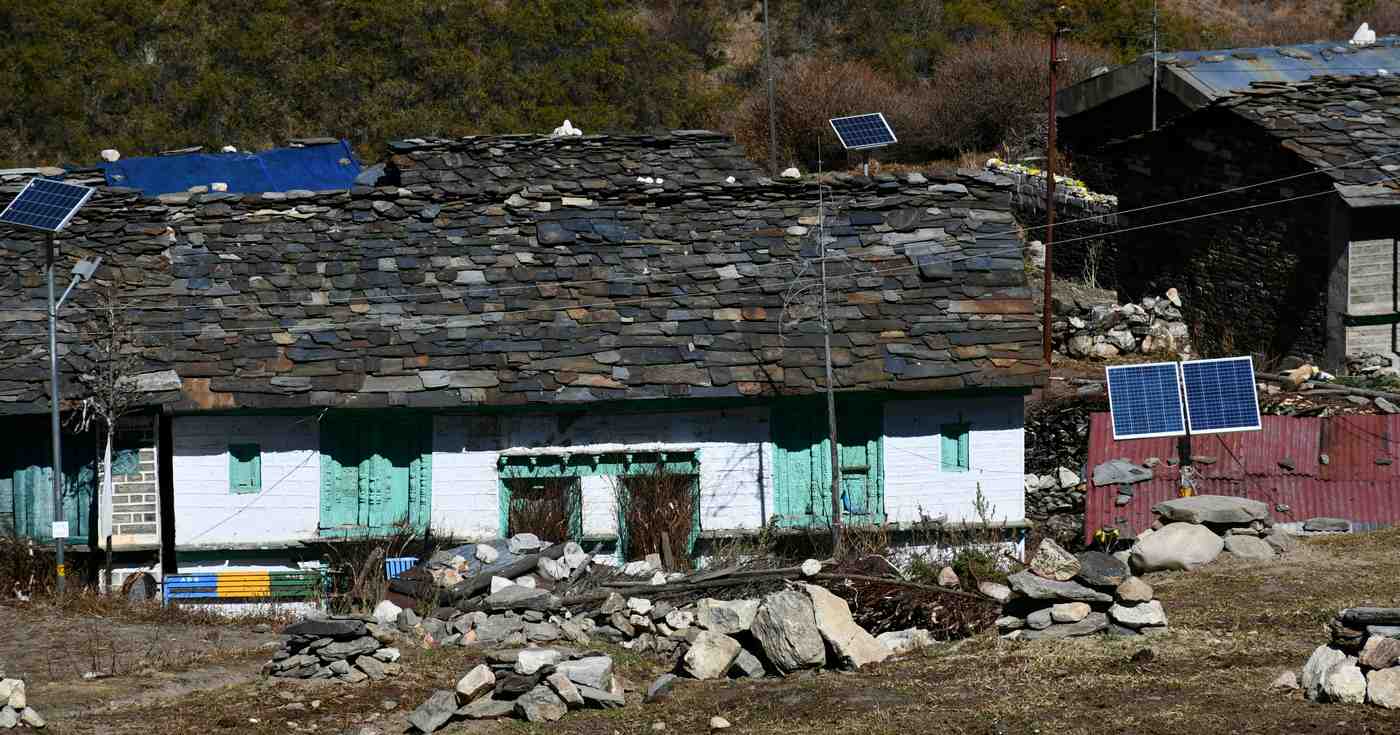
Battered by energy shocks, private Pakistani investment in rooftop solar panels has skyrocketed to the point that they now contribute one-fifth of the total national power supply.
The Guardian reviewed data on Pakistan’s energy sector from a variety of research-oriented think tanks, and found that Pakistan’s 150 million-plus population could lean on solar when there were few other shoulders around.
It started in the aftermath of Russia’s invasion of Ukraine, when established natural gas supplies and contracts were upended. Millions in Pakistan were left without power or forced to pay burdensome energy bills.
Yet thanks in no small part to its northeastern neighbor China, the global solar panel industry had been driving costs down for consumers for a decade through to economies of scale, determined long-term investment decisions, and incentivized markets in various parts of the world.
Suddenly, a private Pakistani household could just buy a few solar panels and put them on their roof, and free themselves, at least partially, from higher energy prices and blackouts.
“People who could afford to do it at that time realized that it was much cheaper and cost-effective and better for them in the long run to do a one-time investment in rooftop solar as opposed to keep paying high electricity bills from a grid that is also unreliable,” Nabiya Imran, an associate at Renewables First, a Pakistani thinktank, told the Guardian.
The country reached the point where cargoes owing to a long-term agreement with Qatar to supply liquified natural gas had to be diverted because of a lack of demand. As of February 2026, the country avoided about $12 billion in oil and gas imports by generating electricity from solar panels.
Then, having spent 3 years growing its solar potential, the Pakistani population watched as the US launched an attack on Iran in the Persian Gulf, driving the costs of oil above $100 per barrel, and virtually ending those LNG shipments.
Haneea Isaad, an energy finance specialist at the Institute for Energy Economics and Financial Analysis (IEEFA), said that distributed solar has been “a blessing for Pakistan,” preventing at least any immediate supply crunches in the gas sector.
SOLAR AROUND THE WORLD: The Sunniest, Windiest Country Announces Renewables Project to Power 6 Million Homes
“Pakistan serves as a great case study as to how renewables can provide a hedge against dependence on fossil fuels.”
The country still faced an economic blow from the war due to reductions in oil imports for other purposes than electricity generation.
SOUTH ASIAN STORIES: Record Low Child Mortality Rates Recorded in Both India and China
Imran would later add that to whatever degree solar panel adoption worldwide was driven by concerns about climate change, the unescapable reality now, and especially in a country like Pakistan that spends the equivalent of 10% of its GDP on fossil fuel imports, is that solar power is also a matter of energy security.
Isaad suspected that the conflict in the Gulf would probably convince more people to adopt solar panels, and some of the percentage of current existing utility providers to adopt storage methods as well to reduce the grid impact of peak hours in the evening.
As the U.S. retreats from alternative energy support, other countries are stepping up to fill the void.
Unfortunately, as the rest of the world embraces technological evolution, turning from third world and second world nations into first world nations, America is devolving back to the dawn of the original industrial revolution, which is a devolution into a second and eventually a third world nation.