














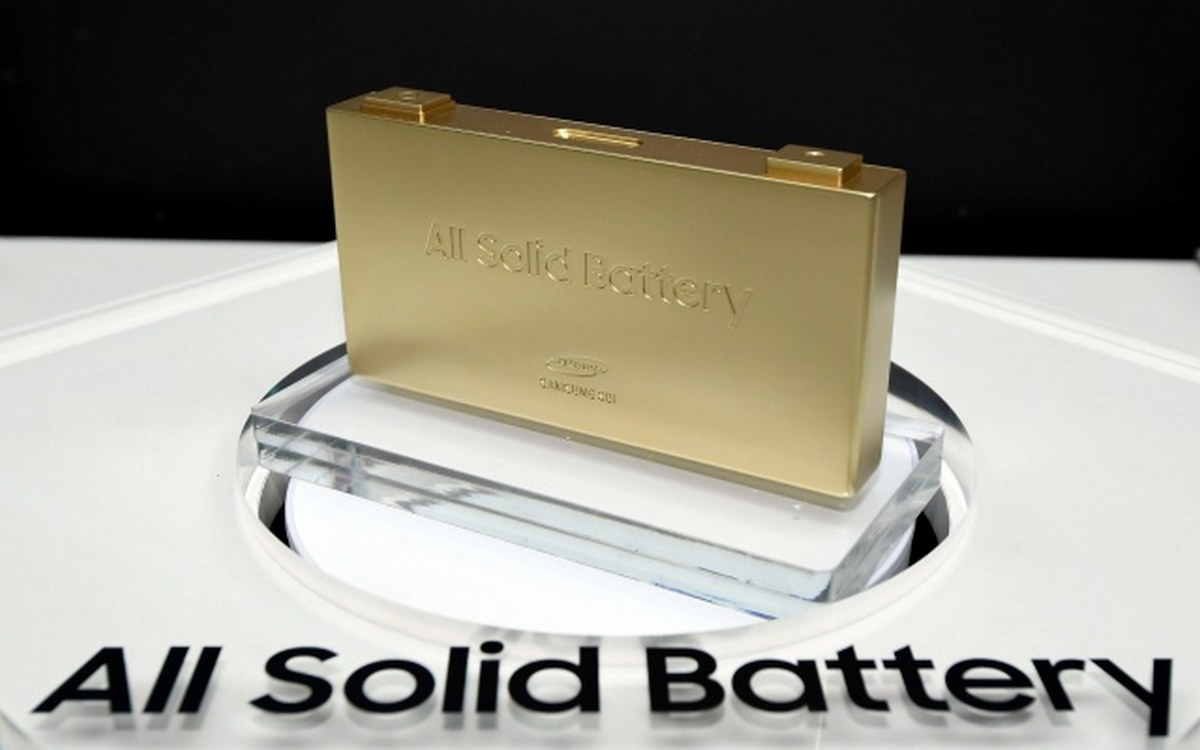
In late October, Samsung announced that it was preparing to take its long-anticipated solid-state batteries to market with a trilateral agreement between itself, BMW, and American battery expert Solid Power.
It was January of last year that industry outlets began to get some of the promises that all-solid-state batteries (ASSBs) developed by Samsung SDI would bring. With an energy density of 500 watt-hours per kilogram, they’re twice as dense as conventional lithium-ion batteries.
Samsung claimed they were smaller, lighter, and safer, capable of driving 600 miles, and charging within 9 minutes. Typically, a lithium-ion battery pack in a modern EV charges from 10% to 80% in around 45 minutes, and has a limit of around 300 miles of range.
“Samsung SDI’s preparations for mass-producing next-generation products of various form factors such as an all-solid-state battery are well underway as we are set to lead the global battery market with our unrivaled ‘super-gap’ technology,” said Samsung SDI CEO Yoon-ho Choi.
ASSB cells use solid electrolyte instead of liquid electrolyte found in a lithium-ion battery. They offer superior safety, as they aren’t flammable, and last for 20 years, or 2,000 charge-discharges, equating to 1.2 million miles.
Under the trilateral agreement, Samsung will supply ASSB cells featuring the solid electrolyte developed by Solid Power to the German automotive group BMW, which will then develop modules and packs for ASSB cells to fit into their next-generation evaluation vehicles, expected in late 2026.
BETTER BATTERIES:
- Man Wracks Up 250,000 EV Miles Driving Neighbors in Need–and the Battery Still Has a Capacity of 92%
- World’s First Diamond Battery Could Power Spacecraft and Pacemakers for Thousands of Years
- This Innovation Could Extend Little-Used Zinc Battery Lifespan Hundreds of Times to Create Battery Revolution
Metal Tech News reported in January that ASSBs will also debut in some smaller Samsung devices during 2026, including the Galaxy Ring fitness tracker, as a way of testing the new power supplies in the real world before incorporating them into smartphones, laptops, and other devices.
Samsung’s ASSBs use a silver-carbon layer as the anode and a nickel-manganese-cobalt material for the cathode. Silver is not only the most electrically conductive metal available, it’s also substantially more plentiful in the Earth’s crust than lithium.
SHARE This Revolutionary Technology That’s Right Around The Corner…
Meanwhile it takes my Samsung phone hours to fully charge. 🙄