













Arizona State University researchers are testing ways to neutralize mining’s biggest environmental liabilities.
At present the mining sector is experiencing a surge in interest and investment, as America has seemingly woken up to the dearth of Western supply for various minerals critical to a modern economy.
At the same time, soaring precious metals prices have rapidly increased operating margins on gold and silver mines beyond 100%, turning dozens of tight operations into some of the most profitable businesses in the country.
As part of the ASU Mining Innovation Initiative, scientists and innovators are looking for ways to stabilize mine waste and reduce environmental contamination resulting from them as America prepares to enter a new mining boom.
The largest source of mine waste in the industry is known as tailings, or tails. Consisting of crushed and milled stone mixed with water from the process of separating the stone from the valuable mineralized ore, tailings often contain deleterious elements like arsenic and lead, or even residues from the process of using cyanide in the case of gold extraction.
Often stored as a slurry in ponds or dams, tailings are the most hazardous aspect of mine infrastructure. Tailings can also be dry stacked: the ubiquitous mine-site image of a long conveyor belt depositing fine gravel onto the top of a conical mound is the visual behind this very method. Today, dry stack facilities are sophisticated, engineered sites with contingencies built in to prevent environmental contamination.
They weren’t always built this way though, and many American and Canadian mining towns are still ringed with free-standing stacks of dry tailings that exist as a constant, low-level environmental hazard.
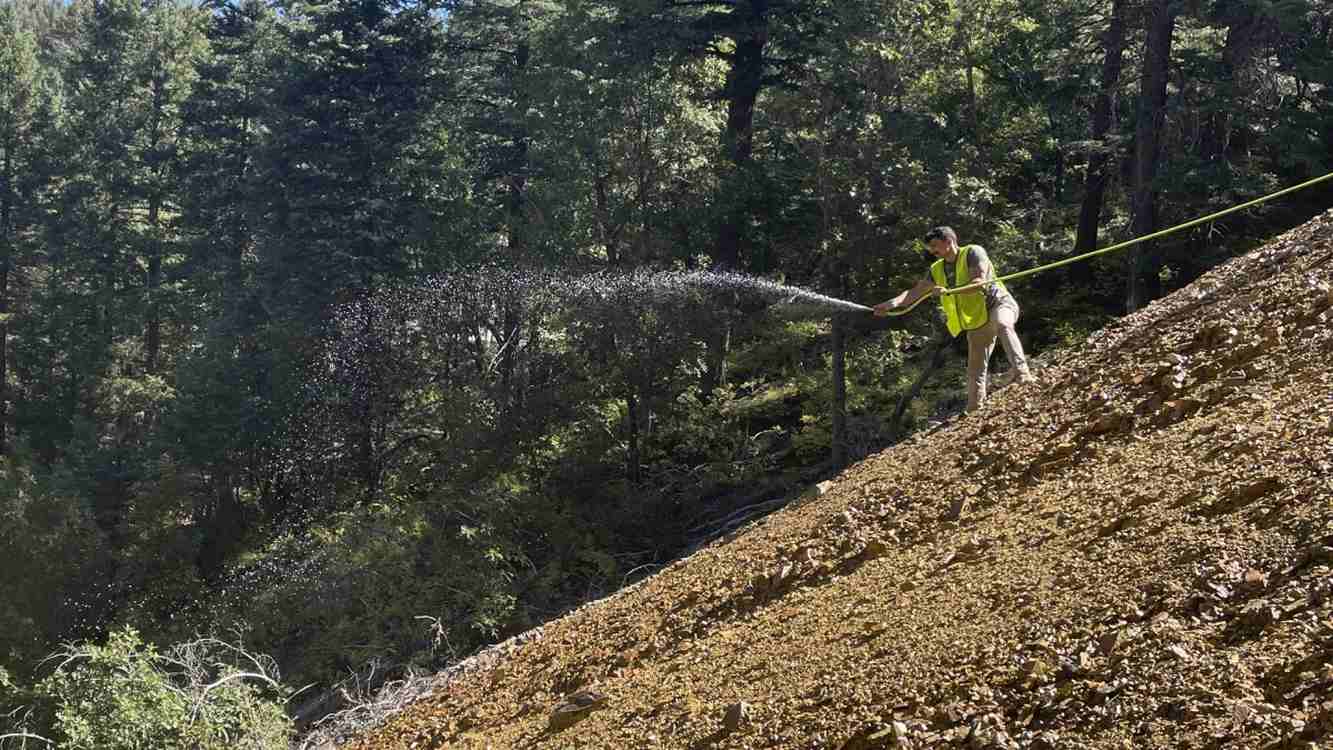
One ASU team has created an enzyme-based treatment to stabilize these tailings and reduce the erosion that could carry contaminants into nearby waterways. The process can immobilize environmentally harmful substances, preventing them from reaching nearby rivers and groundwater. It also has more flexibility compared with other solutions.
The work is led by Hamed Khodadadi Tirkolaei, an assistant professor of civil, environmental and sustainable engineering. He and his team are collaborating with ASU professors to develop nature-inspired methods to achieve these goals.
CLEANING UP MINING: Quebec Firm Pioneers Cyanide-Free Gold Extraction and Arsenic-Capture to Clean up Mining Industry
“By using an enzyme-based process to form natural mineral bonds within the soil, we can create a protective crust that helps limit erosion and dust generation while avoiding more chemically intensive treatments,” said Khodadadi Tirkolaei, who leads the ASU Mining Innovation Initiative.
Supported by the Arizona Department of Environmental Quality, the project is testing the enzyme treatment at Cash Mine, an abandoned mining site near Prescott, Arizona.
A WORLD OF LESS POLLUTION: ‘Mushroom Mining’ Could Be Cheap Way to Recover Rare Earth Minerals from Industrial Waste
“The treatment solution can be prepared on site and implemented without the need for specialized equipment or heavy machinery, making it readily deployable in remote areas, including many abandoned mine sites, where conventional solutions may be difficult or impractical to implement,” said Tirkolaei.
“We have also developed a plant-based biopolymer technology that can be used in situations where enzyme-based treatment may be limited, such as mine wastes with high concentrations of the heavy metals that could suppress enzyme activity.”
SHARE This Important Research Step Towards Resolving Environmental Contamination…