














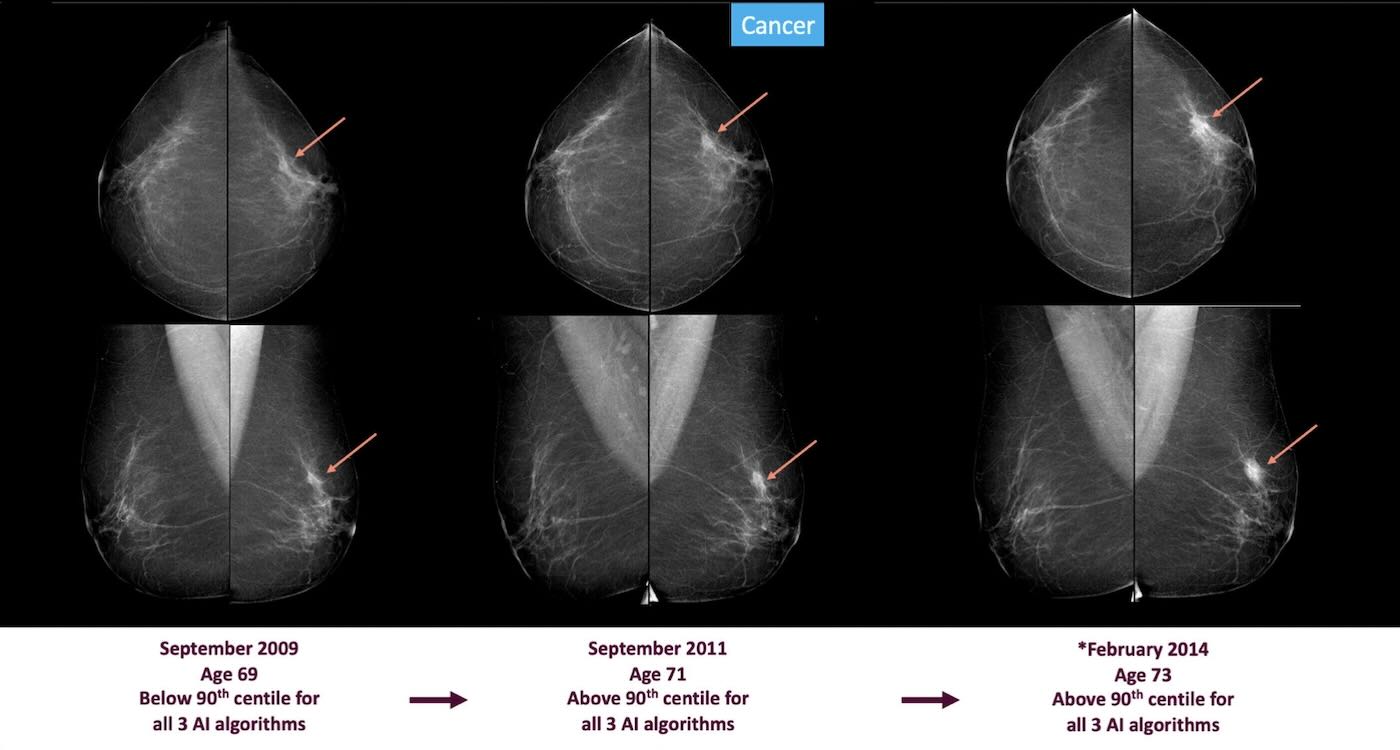
Early warning signs of breast cancer could have been spotted years in advance using AI, suggests a new study that analyzed 88,963 mammograms performed during a 10-year period on over 31,000 patients.
The researchers showed that the latest artificial intelligence technology can provide an “early alert” for the disease up to six years before a diagnosis.
Swedish researchers tested three commercially available AI-based computer-assisted detection (AI-CAD) radiology systems on the mammogram data.
The findings, published in the journal Radiology, showed that cancer prediction scores issued by AI-CAD were elevated, on average, for people who were eventually diagnosed with breast cancer, while scores were low for those who remained cancer-free.
“Approximately 20% of breast cancer cases demonstrate mammographic signs that are already visible to AI around six years before diagnosis,” said senior co-author Professor Fredrik Strand, of Karolinska University Hospital, Stockholm.
“Our study confirms the potential of AI to, in some cases, find signs of cancer in the mammograms much earlier than when radiologists detected it.”
AI-based systems have shown promise for predicting 5-year risk of breast cancer and identifying women at risk of “interval” cancers between regular screening mammograms, but Prof. Strand’s team looked at their potential to flag mammographic signs that were present up to 10 years (in advance), after collecting mammograms from volunteers aged 40 to 74 across Sweden.
After these volunteer screening exams, two radiologists analyzed each mammogram, which was scheduled every two years—taken between 2008 and 2019.
Across that period, 12,072 of the participants (38.5%) were diagnosed with cancer by radiologist readers.
The AI-CAD systems successfully identified many of those cancers at earlier screening points.
It achieved 90% “specificity” (able to distinguish between a true positive and a true negative result) in nearly 20% of participants six years before their recorded diagnosis, up to 25% of individuals four years before diagnosis and up to nearly 40% two years before diagnosis.
“This study aims to add to the growing literature regarding the application of AI in breast cancer screening and how it can help play a role in earlier detection of breast cancer,” said Strand.
SWEET CANCER PREVENTION? Manuka Honey Reduces Breast Cancer Cell Growth by 84% in Human Cells and Mice
“Analyzing the AI scores of screened individuals over time could provide insight into how early detectable changes arise, potentially allowing for earlier intervention.”
PROVE THAT AI IS ALSO USED FOR GOOD–By Sharing This on Social Media…