












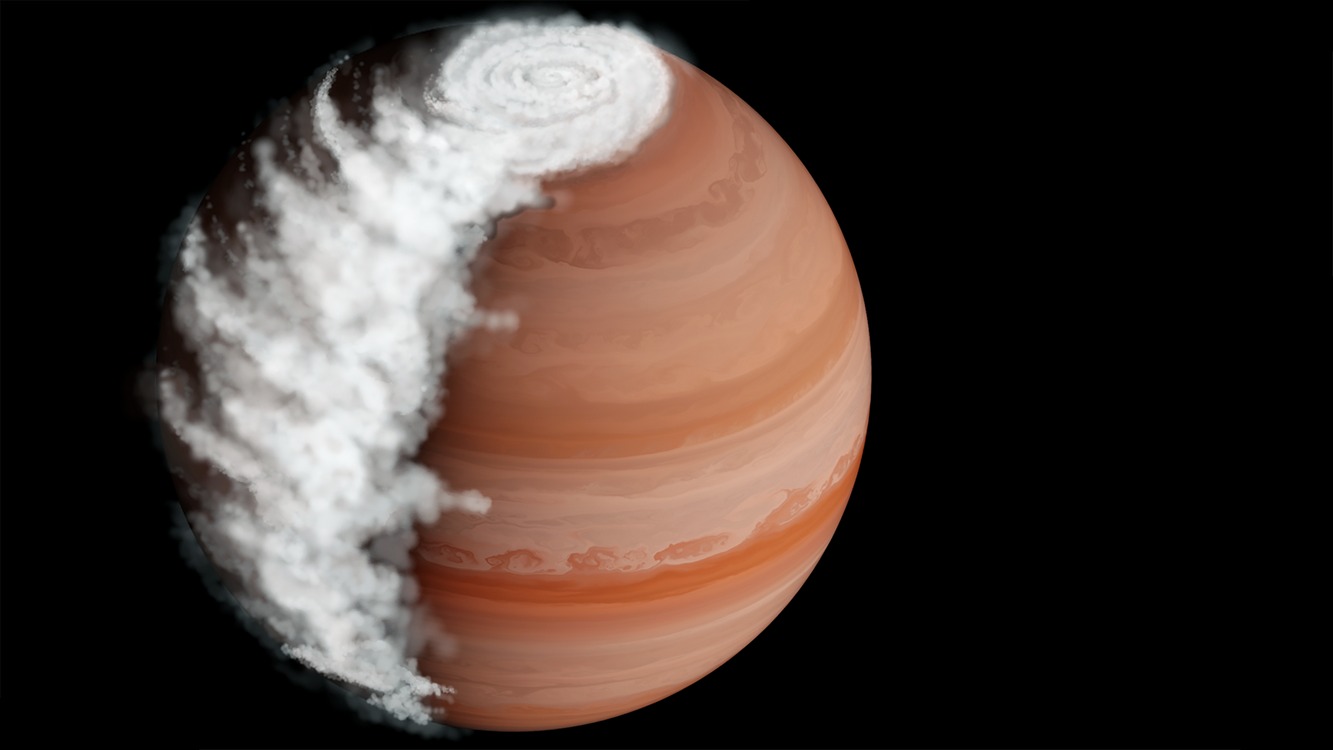
Welcome to WASP 94A b, where clouds made of rock melt every morning like the June gloom in Southern California.
Powered by the James Webb Space Telescope, humanity’s study of exoplanets marches on as a team from Johns Hopkins University explored the atmospheres of several “Hot Jupiters” out in the Microscopium constellation.
Inside is WASP-94A, a star located 700 lightyears from Earth that hosts a gas giant planet which orbits it at a closer proximity than Mercury does to our Sun.
This has created a unique set of planetary conditions that David Sing, a distinguished professor of earth and planetary sciences at Johns Hopkins, was eager to study.
By isolating the planet’s clouds, Sing and his team were able to more accurately measure the atmosphere and provide one of the clearest pictures to date of the planet’s composition—a significant advance in planetary science that will provide important context and correlations in future research.
“I’ve been looking at exoplanets for 20 years, and general cloudiness has been a thorn in our side. We’ve known for quite a while that clouds are pervasive on Hot Jupiter planets, which is annoying because it’s like trying to look at the planet through a foggy window,” said Sing.
“Not only have we been able to clear the view, but we can finally pin down what the clouds are made out of and how they’re condensing and evaporating as they move around the planet.”
Though long theorized to exist, the first exoplanet was detected in 1991. Since then, their known diversity has increased exponentially.
Humanity has identified an exoplanet almost as big as its star, another that orbits two stars like Tatooine from Star Wars, some which don’t rotate and have permanent dark and daytime sides, one with the density of a marshmallow, and one that’s shaped like a lemon where it rains diamonds.
To study WASP-94A b, Sing and his team leveraged the James Webb Space Telescope to capture several transits which the planet made in front of its host star.
They took separate measurements of WASP-94A b’s leading edge as it started to cross in front of the star and the trailing edge as the planet completed its transit. At the leading edge, the air flows from the night side of the planet to the day side, effectively making it the morning. Air flows from day to night at the trailing edge, making it the evening.
NEW ASTRONOMY TOOLS: Greatest Spectroscope Ever Built Can Tell What 2,400 Cosmic Objects Are Made of Every 20 Mins.
Observations revealed that mornings and evenings on WASP-94A b have extremely different weather patterns, with mornings that are riddled with clouds made of magnesium silicate, a common mineral found in rocks, while the evening has clear skies.
The phenomenon may be akin to morning fog burning off on Earth, but on an extreme scale. Clouds would form in the darkness of the planet’s nightside. As they drift into the scorching heat of more than 1,000 degrees on the day side, the chemicals that make up the clouds boil away, and the clouds simply vaporize.
Alternatively, powerful winds might lift clouds high into the sky on the cooler side of the planet and then plunge downward on the hotter dayside, dragging the clouds deep into the planet’s interior.
EXOPLANET RESEARCH: James Webb Space Telescope’s First Look at an Atmosphere on Habitable Zone Exoplanet
Because the evenings are clear of clouds, the researchers could look to the trailing edge specifically to see what the atmosphere of the planet looked like—something the Hubble telescope could not provide, said first-author Sagnick Mukherjee.
When the researchers looked at the clear evening sky, they found that WASP-94A b was much more like Jupiter than they thought. Previously, when the clouds were averaged in, the data suggested the planet was made of hundreds of times more oxygen and carbon than Jupiter—a finding that baffled researchers given it couldn’t be explained by planet formation theory. Instead, the team found just a comparatively small amount of extra oxygen and carbon.
TOP SPACE STORIES: Astronomers Spot Interstellar Visitor: a Comet Blazing Through Our Solar System, Just the Third Ever Seen
Using WASP-94A b as a benchmark, the team looked at eight other hot gas giants and discovered the same distinctive cloud cycle on two other worlds: WASP-39 b and WASP-17 b.
The research was able to establish two early hypotheses, that Jupiter-like compositions (even in Hot Gas Giants) and WASP-94A b’s cloud cycling are both not uncommon in the galaxy. Next, Sing plans to compare his study of hot gas giants to other gas giants that are known to orbit the Habitable Zone of their host stars.
SHARE This Bizarre Gas Giant With Your Friends Who Love Space Stories…