













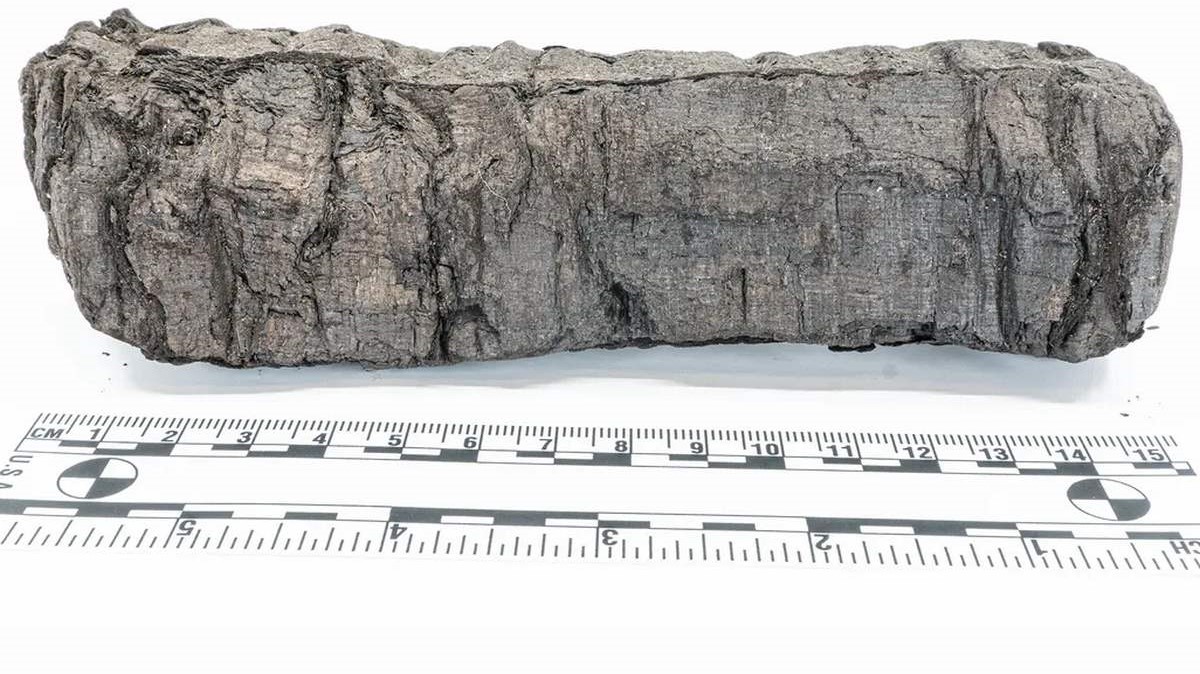
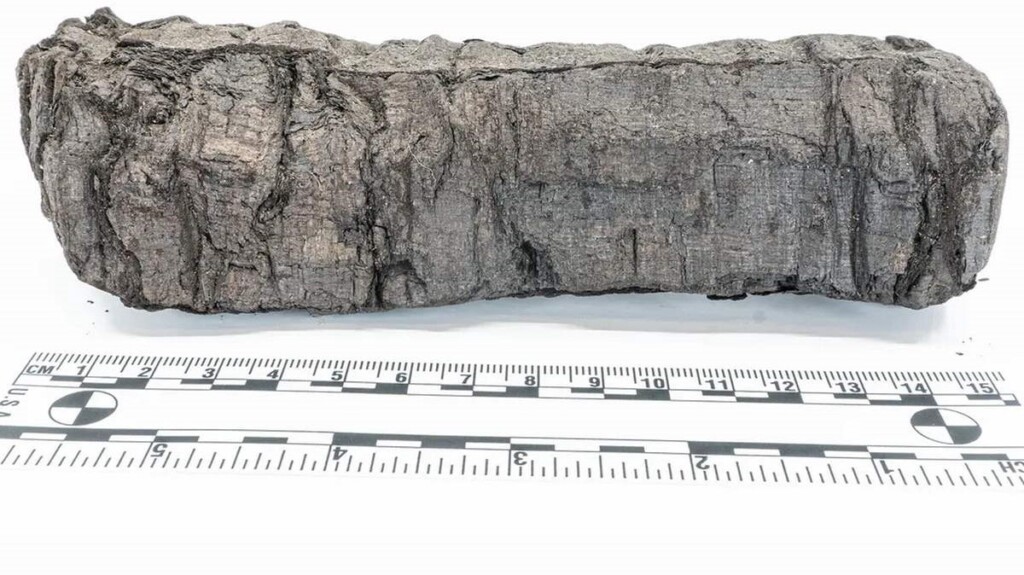
More insights into Classical literature have been recovered from the burned papyrus scrolls destroyed in the same eruption that buried Pompeii.
They include ruminations on Stoic philosophy by an unknown author, and the title “Book 8” from a work called On Gods, by the Greek philosopher Philodemus.
Fruits of major scientific advancements in particle acceleration and AI, the discoveries shed light on what people were reading at the time, of the bibliographies themselves, and the philosophical content.
The papyrus scrolls in question were found in Herculaneum, a city destroyed by Vesuvius’ eruption in a villa that may have belonged to Julius Caeser’s father-in-law.
The collection of 800 scrolls was found 275 years ago, and represents the only intact library known from the Classical World. Many archives of thousands of clay tablets from the ancient kingdoms of Assyria and Babylon have been found, but being made of clay, they tend to last longer than papyrus.
Many scientists have attempted over the years to safely unravel them, or utilize chemical methods to duplicate some of the writing, but all such efforts were met with not only failure, but irreparable damage to the scrolls in some cases.
Today though, using a combination of CT scans and machine learning, a distributed series of efforts are managing to recover bits and pieces of this ancient literature.
None of these efforts have gone farther than the Vesuvius Challenge, which sought to inspire young people to use AI technology to decode the burnt scrolls which started in 2023.
The Challenge’s grand prize was collected by Youssef Nader, Luke Farritor, and Julian Schilliger, splitting a $700,000 bounty for their efforts.
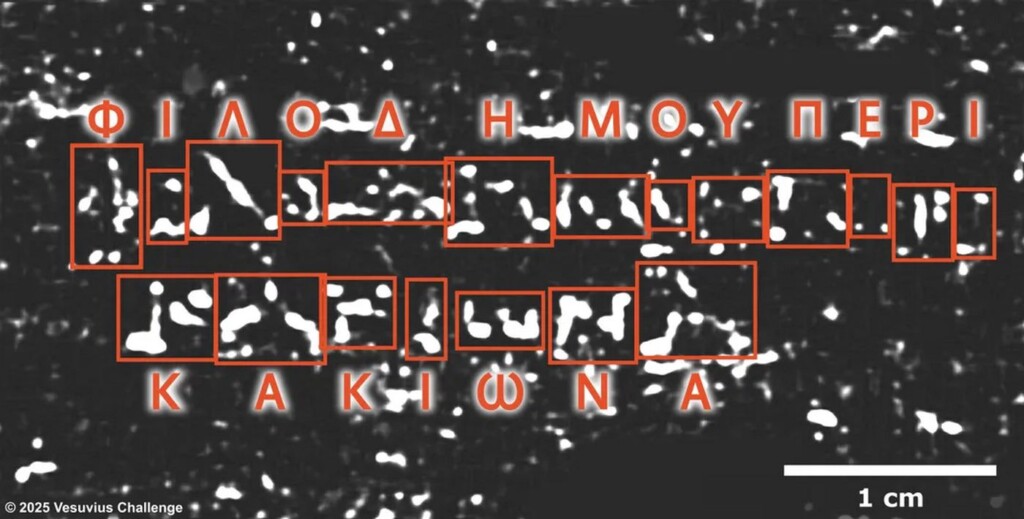
The trio was able to create a deep learning program that took a rolled-up scroll of papyrus that was turned to charcoal in the Vesuvius eruption and decode 4 passages of 140 characters each, with at least 85% of characters legible.
Silicon Valley figures Daniel Gross and Nat Friedman created the Vesuvius Challenge in coordination with Brent Seales, a computer science professor at the University of Kentucky, in March of 2023. They offered up to $1 million in cash prizes to any engineers who could program AIs to read the carbonized papyrus.
The scrolls can’t be unrolled—they would simply turn to ash—but some of them held at the Institut de France were imaged at the Diamond Light Source particle accelerator near Oxford by Gross and Friedman. These high-resolution CT scans of the scrolls were then released to anyone who wanted to try to decode them.
Nader, Ferritor, and Schilliger, recovered a page from On Vices, written by Epicurean philosopher Philodemus, a Greek who lived at Pompeii nearly 200 years before Vesuvius’ eruption, and several centuries after the life of Epicurus himself, a prominent Athenian thinker whose ideas have been discovered among the scrolls before.
On Vices has received special attention over the decades, not only because of its philosophical content, but also because in one of its books, Philodemus addresses some of his friends, namely Quintilius Varus, Varius Rufus, Plotius Tucca, and the great Vergil.
Now, scientists led by the University of Naples Federico II have succeeded in fully unwrapping one scroll—almost 1.5 meters (4.9 feet) of text. Work to render legible the 20 columns of text is ongoing. Lead researcher from the university Federica Nicolardi, an assistant professor in papyrology, shared the status of the scroll in a statement released at an international press conference.
“While a few isolated letters were visible, overlapping layers obscured the writing, and the scroll was assigned a readability score of zero. But now, with virtual unwrapping, we can follow sustained arguments across multiple columns. That’s a transformational shift.”
AI IN HISTORY AND ARCHEOLOGY: Mystery of Nazca Lines Deepens as AI Survey Doubles Number of Geoglyphs and Alters Their Meaning
“The scroll’s handwriting and internal references suggest the artifact dates from the second century BC or possibly from the late third century BC—making it one of the oldest scrolls in the collection.”
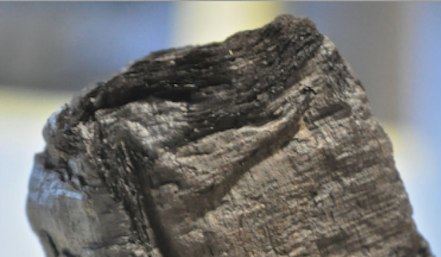
Legible parts so far include references to two concepts of Greek philosophy: “horme” and “phronesis,” the first translated as something like impulse and the second as practical wisdom.
Horme is something to guard against, while phronesis is considered one of the highest virtues in Greek and Stoic philosophy.
“We will inquire into something, but we will not grasp it, if in some way we depart from ourselves and from our own nature,” the scroll reads.
MORE ANCIENT LITERATURE: Lost Page from Archimedes Manuscript Found in Museum with Hidden Text Beneath Illustration
Additional work was done on another scroll which offered up the tantalizing headline On Gods: Book 8. On Gods was not known as a book series, nor was it known to be anywhere long enough to fill up another 7 installments.
Undoubtedly more of these scrolls will be decoded as the years progress as the yet-young methods of their decoding are refined further.
SHARE This Latest Chapter In An Ongoing Effort To Recover Lost Literature…