














From that magical island called Borneo comes the story of a bottom-up, pay-per-pic program that’s making a significant impact for the conservation of endangered birds and orangutans.
Across the Indonesian province of West Kalimantan, members of 9 different villages can earn supplemental income by taking pictures or audio recordings of wildlife.
A villager may earn as much as $200 a month, but could earn much more if they observe a rare species. Before, locals would often hunt birds with colorful plumage, or exterminate deer and wild boar that poach their crops. Now “we really, really want to protect them.”
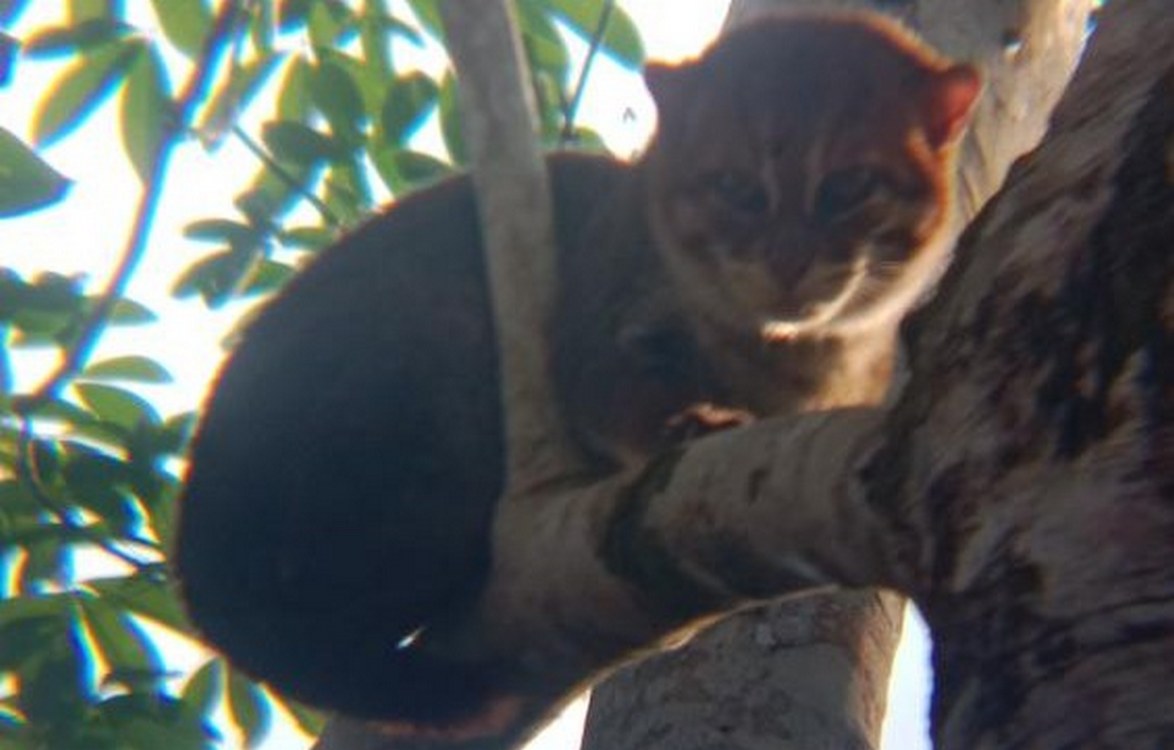
That was Imelda, a 72-year-old farmer in Labian, who goes with her friends into the woods daily to see if they can photograph an orangutan—the top prize, though the flat-headed cat pictured above isn’t too far behind. It’s one of the least-understand cats in the world.
The program, funded through 2028, is called KehatiKu, and run through the international conservation consultancy Borneo Futures.
Over 800 local people take part, and their contributions have led to 378,000 confirmed observations, including of Critically-Endangered and Endangered flagship species such as the Bornean orangutan (Pongo pygmaeus) and Abbott’s gibbon (Hylobates abbotti).
“People have started to realize that where previously they caught one bird and it was worth 50,000 rupiah, now they just need to take a photo, send it to us, and they can receive a payment of 5,000 to 10,000 rupiah,” Borneo Futures Indonesia director Nardiyono told AFP.
GETTING THE LOCALS ONSIDE: Passionate ‘Tortoise Guardians’ Help Critically-Endangered Giant Tortoise Slowly Return to India
Octavius, a 50-year-old farmer of kratom and cacao, said the money helps him afford college educations for his children.
The program has so far received philanthropic funding of $300,000, which has gone to developing a mobile app for villagers to upload their sightings and recordings to, an AI companion to aid staff in identifying the observations, and also to pay the villagers at the end of every month.
YOU MAY ALSO LIKE: Vietnam Swiftly Protects Forests Containing the Last of the World’s Most-Endangered Monkey
“The program is very popular and has resulted in spontaneous wildlife protection,” wrote Erik Meijaard the Managing Director of Borneo Futures, in a presentation of KehatiKu for the IUCN. “We have evidence that now forests and wildlife is valued more for conservation than exploitation.”
AFP reports that next month, 2 more villages will join the program. Between the hundreds of thousands of observations, scientists have been able to estimate population densities, track animals’ ranges, and get better insights into diurnal behavior.
SHARE This Great Idea Already Providing Critical Information To Conservationists…