














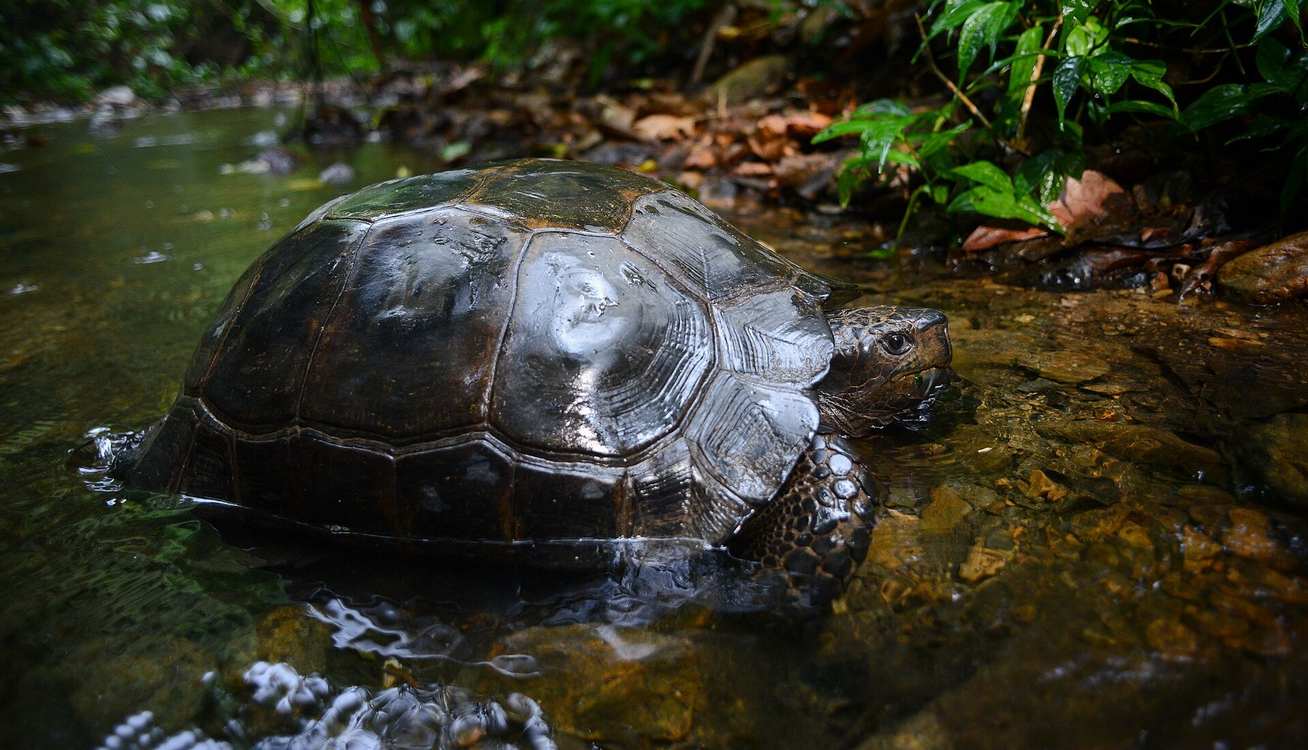
In the far-eastern Indian state of Nagaland, locals are protecting mainland Asia’s largest tortoise species, an animal they used to hunt.
Governments around the world struggle to effectively govern or manage their frontier borderlands, and few borderlands feel as frontier as Nagaland, being more than two-day’s drive from New Delhi on the border with Myanmar and Nepal, and populated by diverse ethnic groups speaking diverse languages.
But this is now proving to be a strength, not an impediment, as local tribal reserves replace government reserves as the reintroduction sites for the tortoise, and local youths replace professional conservationists as the scaly animal’s “guardians.”
The Critically-Endangered Asian giant tortoise was heading towards population collapse and extinction until the Nagaland Zoological Park began a captive breeding program that saved the population.
Shailendra Singh, Director of the Turtle Survival Alliance Foundation India which oversees the animal’s reintroduction along with the Nagaland Forest Department, explains that the program started with 13 turtles, some of which were seized from Nagaland markets where they were destined to be eaten, and others that had been kept as pets.
“The program reached its turning point when some villagers voluntarily donated tortoises they had kept as pets in their homes for captive breeding, and the community that once exploited them was sensitized to restore and nurture the species back in the wild from the brink,” Singh told the Relevator.
From those 13 tortoises, 7 female and 6 male, 114 individuals have been born—half as many as the entire wild population in all of Asia, according to some estimates. Previous reintroduction efforts by the federal government failed both to protect the tortoises or to keep track of them.
By contrast, the over 100 tortoises released into the Nagaland tribal reserves—small but numerous—are closely tracked by young men and women trained in basic conservation strategies.
This almost one-to-one involvement by locals creates a unique attachment to the animal.
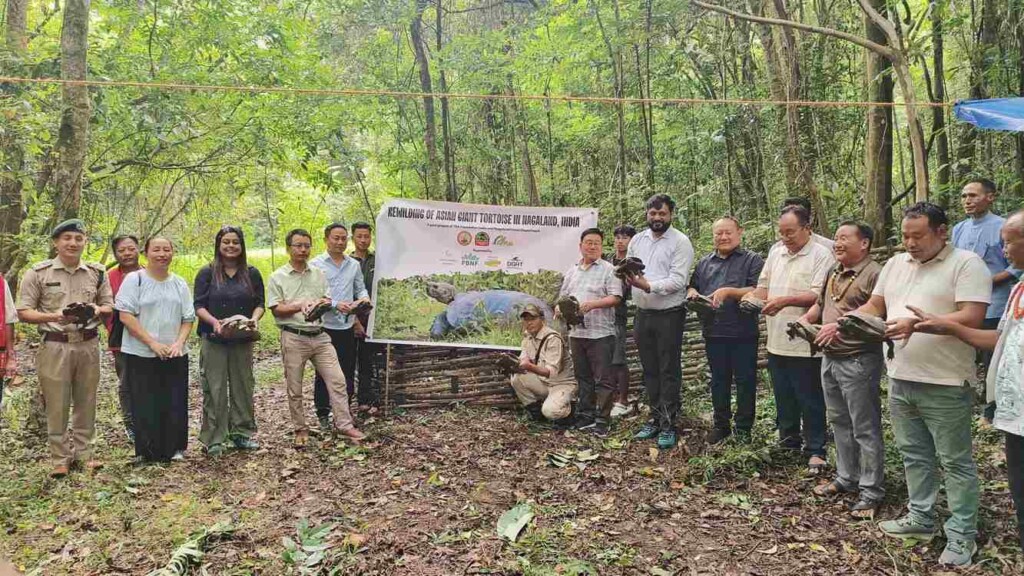
“We started by simply tracking them, but today we realize how important they are in keeping our forest vibrant and alive with their unique ways,” says Iteichube, a 33-year-old resident of the 370-hectare Old Jalukie Conservation Reserve.
LEVERAGING THE LOCALS: Spectacular New Species Found in Cambodia’s Limestone Caves–Asia’s ‘Little Laboratories’
80% of Nagaland territory is made up of these community forest reserves. There are 407 of them, amounting to 50% of all such reserves in India.
Iteichube proudly wears an olive drab t-shirt labeled “Tortoise Guardian” when he leaves home at 8 a.m. every morning to go look for signs of the tortoises’ activity. Nibbled leaves and depressed ground indicate foraging behavior.
The Asian giant tortoise displays a unique-in-the-world nesting strategy by building a mound of leaves between 2 and 7 feet in height in laying its eggs therein.
TORTOISE CONSERVATION: 158 Giant Endangered Tortoises Released on Galápagos Island Where They’d Been Extinct for 180 Years
The success of the Nagaland model is now hopefully going to be replicated in the neighboring state of Manipur, which recently hatched their first clutch of artificially incubated Asian giant tortoises at the Manipur Zoological Gardens.
Local elders told the Revelator stories of whiling away their childhood riding these tortoises along the forest paths, and that these days are long gone. Perhaps they spoke too soon. Thanks to this collaboration between zoo and community, the next generation of these forest dwelling communities may recapture this storybook privilege.
SHARE This Great Conservation Story From Far Eastern India…
A cheer for their efforts. Little by little our planet is healed when people rediscover their intrinsic connection with nature.