









All News - Page 236 of 1716 - Good News Network
Home Blog Page 236

NASA Sends Data Over 10 Million Miles for the First Time Using a Laser

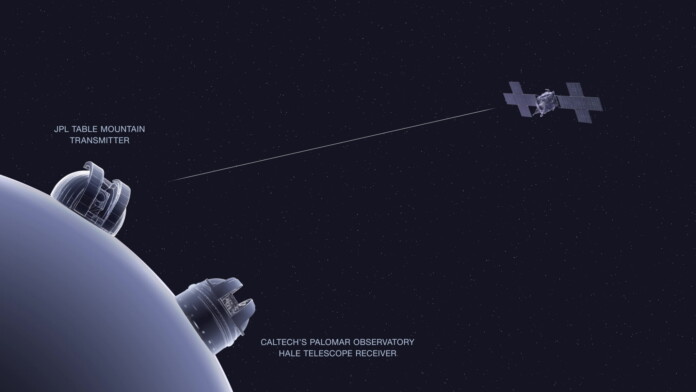
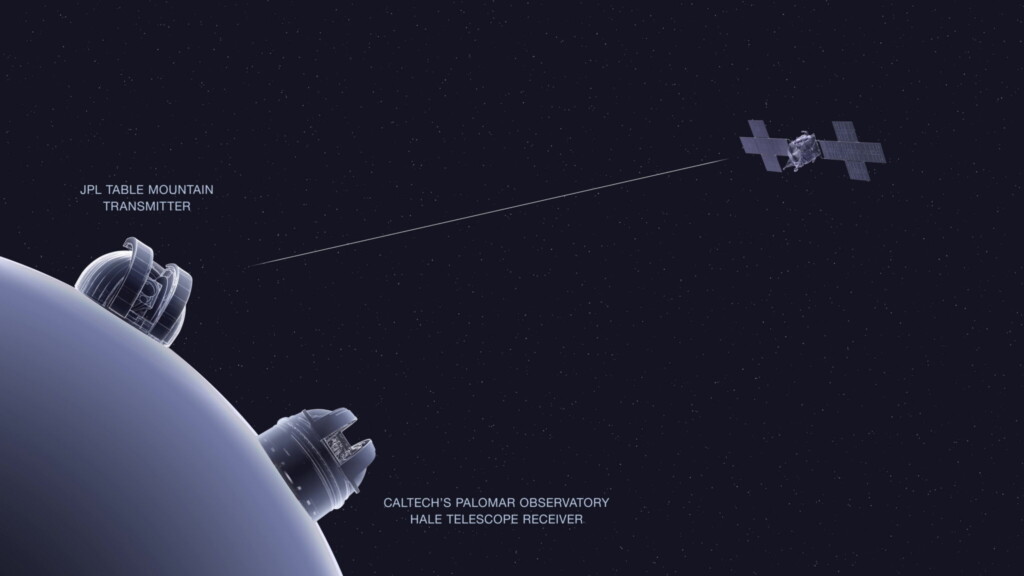
Illustration of the DSOC flight laser transceiver communicating with the ground systems - NASA/JPL/Caltech, via SWNS.
Illustration of the DSOC flight laser transceiver communicating with the ground systems – NASA/JPL/Caltech, via SWNS.

NASA’s Deep Space Optical Communications (DSOC) experiment has succeeded in sending and receiving communications via laserbeam, and is now set to transform how spaceships communicate with each other and with Earth in the spacefaring future.

The test data was beamed about 40 times farther than the Moon is from Earth, from the recently-launched Psyche spacecraft to the Hale Telescope at Caltech’s Palomar Observatory in San Diego County, California.

The DSOC experiment aims to demonstrate data transmission rates 10 to 100 times greater than the state-of-the-art radio frequency systems used by spacecraft today, and NASA says this is the farthest-ever demonstration of optical communications.

The DSOC demo achieved “first light” in the early hours of 14 November, after its flight laser transceiver—a cutting-edge instrument aboard Psyche capable of sending and receiving near-infrared signals—locked onto a powerful uplink laser beacon transmitted from the Optical Communications Telescope Laboratory at NASA’s Jet Propulsion Laboratory’s (JPL) Table Mountain installation in California.

Test data was sent simultaneously via the uplink and downlink lasers, a procedure known as “closing the link” which was a primary objective for the experiment.

“Achieving first light is one of many critical DSOC milestones in the coming months, paving the way toward higher-data-rate communications capable of sending scientific information, high-definition imagery, and streaming video in support of humanity’s next giant leap: sending humans to Mars,” said Trudy Kortes, director of Technology Demonstrations at NASA Headquarters in Washington.

Radiowave communications from spacecraft like the Martian rovers for example take many hours to arrive back on Earth, which is just not fast enough for an industry that may have humans operating permanently on the Moon and traveling to Mars over the next two decades.

DSOC is configured to send high-bandwidth test data to Earth during its two-year technology demonstration as Psyche travels to the main asteroid belt between Mars and Jupiter as part of its primary mission objective to study a metallic asteroid.

At Psyche’s farthest distance from our planet, DSOC’s near-infrared photons, the particles of light containing the megabytes of data in transit, will take about 20 minutes to travel back (they took about 50 seconds to travel from Psyche to Earth during the 14 November test). In that time, both spacecraft and planet will have moved, so the uplink and downlink lasers need to adjust for the change in location.

“Tuesday morning’s test was the first to fully incorporate the ground assets and flight transceiver, requiring the DSOC and Psyche operations teams to work in tandem,” said Meera Srinivasan, operations lead for DSOC at JPL.

“It was a formidable challenge, and we have a lot more work to do, but for a short time, we were able to transmit, receive, and decode some data.”

BEAMING DOWN FROM MARS: Mars Rover Discovers Liquid Salt Water on the Red Planet For the First Time

With the successful first light, the DSOC team will now work on refining the systems that control the pointing of the downlink laser aboard Psyche’s transceiver. Once achieved, the project can begin its demonstration of maintaining high-bandwidth data transmission from the transceiver to Hale Mountain at various distances from Earth.

This data takes the form of bits (the smallest units of data a computer can process) encoded in the laser’s photons—quantum particles of light. After a special superconducting high-efficiency detector array detects the photons, new signal-processing techniques are used to extract the data from the single photons that arrive at the Hale Mountain telescope array.

MORE SPACE NEWS: Europe’s First-Ever Private Rocket Blasts Off to Space Thanks to Spanish Company PLD

Both radio and near-infrared laser communications utilize electromagnetic waves to transmit data, but near-infrared light packs the data into significantly tighter waves, enabling ground stations to receive more data.

“Achieving first light is a tremendous achievement. The ground systems successfully detected the deep space laser photons from DSOC’s flight transceiver aboard Psyche,” said Abi Biswas, project technologist for DSOC at JPL. “And we were also able to send some data, meaning we were able to exchange ‘bits of light’ from and to deep space.”

SHARE This Big Step Towards Humanity’s Interplanetary Adventure… 
New 10 Minute Treatment Restores Sense of Smell and Taste in Patients with COVID Parosmia

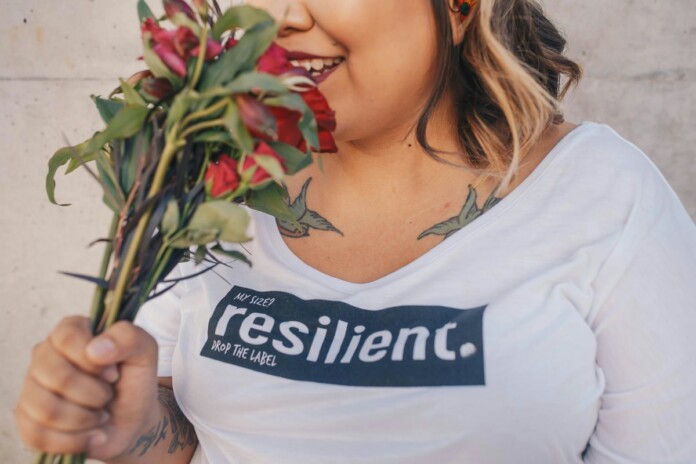
- credit Drop The Label
– credit Drop The Label

Using an image-guided, minimally invasive procedure, scientists may be able to cure the loss of smell, known as parosmia, occasionally found in people who were infected with COVID-19.

While most COVID patients did recover their sense of smell over time, some patients however continue to have these symptoms for months, or even years, after infection.

Lead author professor Adam Zoga said that post-COVID parosmia is increasingly being recognized, and that patients can develop distaste for foods or drinks they used to enjoy.

“Parosmia has previously been reported as a rare disorder occurring after brain trauma, brain surgery, stroke, viral syndromes, and with some head and neck tumors,” said Zoga. “We were not entirely confident that the procedure would work for parosmia.”

The treatment involves injecting anesthetic directly into the stellate ganglion on one side of the neck to stimulate the autonomic nervous system, which is accurately achieved with CT guidance.

The minimally invasive procedure takes less than 10 minutes, and no sedation is necessary. It’s been used to treat several other conditions including cluster headaches, phantom limb pain, Raynaud’s and Meniere’s syndromes, angina, and cardiac arrhythmia.

For the study, 54 patients were referred by an ear, nose, and throat specialist after at least six months of post-COVID parosmia that was resistant to pharmaceutical and topical therapies.

The researchers added a small dose of corticosteroid to the anesthetic, suspecting that the COVID virus may be causing nerve inflammation.

Follow-up data was obtained for 37 patients, with 22 of the 37 reporting improved symptoms at one week post-injection. Of these 22, 18 reported significant progressive improvement by one month post procedure.

No complications or adverse events were reported.

MORE POST-COVID NEWS: Stolen Van Gogh Returned by Sherlock Holmes of the Art World–Seized from Museum During COVID

“The initial patient had a tremendously positive outcome, almost immediately, with continued improvement to the point of symptom resolution at four weeks,” said Professor Zoga.

“We have been surprised at some outcomes, including near 100% resolution of phantosmia, a condition that causes people to detect smells that aren’t there, in some patients, throughout the trial,” he said, adding that this injection is working where other treatments have failed.

SHARE This Hopeful Story With Anyone Who May Have Such A Condition… 

“Countless as the sands of the sea are human passions.” – Nikolai Gogol

Quote of the Day: “Countless as the sands of the sea are human passions.” – Nikolai Gogol

Photo by: Aaron Burden

With a new inspirational quote every day, atop the perfect photo—collected and archived on our Quotes page—why not bookmark GNN.org for a daily uplift?

After Teen Dies, Friends Visit His Grandma for Breakfast Every Wednesday to Ease Their Loss

courtesy of Peggy Winckowski

It’s Wednesday morning in St. Louis. Outside Peggy Winckowski’s house, it’s not just the Sun or the song of the birds that arrive at her front door, but a horde of hungry teenagers.

They’re all students from Bishop DuBourg High School, ready to enjoy a hug with ‘grandma’ and a plate of hot food as part of what they together term the Wednesday Breakfast Club.

But it hasn’t always been bacon, banter, and bright eyes; the Breakfast Club took on a new meaning when ‘Grandma Peggy’ lost her grandson Sam Crowe, a Bishop Dubourg sophomore, to a hit and run last year.

It was the young mister Crowe who first started the Breakfast Club, which used to meet at a nearby diner. One day he announced “my grandma can cook better than this,” and so it was that the mediocre diner was abandoned in favor of Grandma Peggy’s.

Every Wednesday, a baker’s dozen teens would show up for bacon and eggs, until the fateful July day when the group learned of Sam’s death, and breakfast became the last thing anyone felt like thinking about.

YOU MAY ALSO LIKE: Teens Step in to Rebuild a Jeep After Sentimental Family Project Stalled With Dad’s Death

That is, until the very next Wednesday, when hoping to make the spirit of her grandson proud, Peggy was up before dawn warming skillets, cracking eggs, and whipping batter.

And not wanting to be poor guests, the teens came back, in greater and greater numbers just about every Wednesday afterwards.

“They came here every day for the whole week,” said Winckowski. “They just wanted to make sure that I was OK.”

MORE STORIES LIKE THIS: High School Teens Swoop in to Support 6th Grade Stranger When No One Would Sign His Yearbook

“Sam would be so proud,” she told CBS News’ Steve Hartman. “Look at what he started, it melts my heart.”

“We benefit from her, she benefits from us,” added Breakfast Club member Mya Dozier. “It’s like we feed off each other.”

WATCH the story below, or for those outside the US: View the video at CBS.com…

SHARE This Heartwarming Helping Of Healing On Social Media… 

A Forgotten Masterpiece Was Hanging Above a French Woman’s Hot Plate–Now, it’s Heading to the Louvre

Christ Mocked by Cimabue - The Louvre
Christ Mocked by Cimabue – The Louvre

A few years ago, the art world was abuzz with news that a painting by the 13th-century master Cimabue was discovered and was going up for auction.

At the time, it was found in the house of a 90-year-old French woman hanging above her hot plate. Christ Mocked also known as The Derision of Christ, was identified only because one of the elder’s children decided to bring an appraiser into the house whilst they were preparing to help her move.

The elder had originally planned to find a new home for the painting in the nearest wastebasket, assuming the 10 x 8 painting to be a simple Greek icon.

Going up at auction in 2019, it sold for over $25 million, four times its predicted amount. Smithsonian reports that Fabrizio Moretti, the buyer who was working on behalf of two other collectors, believed it to be of inestimable value.

“It’s one of the most important old master discoveries in the last 15 years,” he told the New York Times after the sale. “Cimabue is the beginning of everything. He started modern art. When I held the picture in my hands, I almost cried.”

Cimabue is believed to be the pseudonym of Fiorentino painter Cenni di Pepo, who was born in 1240 and may have been the teacher of the celebrated Italian master, Giotto.

YOU MAY ALSO LIKE: Painting of Jesus’ Birth Valued at $15K Turns Out to Be Monumental Rembrandt Worth $18 Million

The Derision of Christ of Cimabue is a crucial milestone in art history, marking the fascinating transition from [iconograpy] to painting,” the French Ministry of Culture stated after it, in collaboration with the Louvre, managed to buy the painting for its collection.

“Cimabue lays the foundations for a new way of painting and addresses questions that will be central to the Renaissance: the illusionist representation of space, the body, light, and human feelings.”

OTHER NEWS LIKE THIS: A Thrift Store Shopper Joked She’d Found a Famous Artist’s Work for $4 – and Actually She Really Had

The painting is part of a diptych that included 8 different altar paintings; only two of which are known today.

Merely fifteen works of Cimabue are known, and these are mainly frescoes. Christ Mocked will join the monumental Maestà, another masterpiece of Cimabue whose restoration is currently ongoing for an exhibition event in spring 2025 at the Louvre.

SHARE The Return Of This Master’s Legacy With Your Friends… 

‘No-Kill Caviar’ Method Produces Superior Product While Boosting Endangered Sturgeon Population

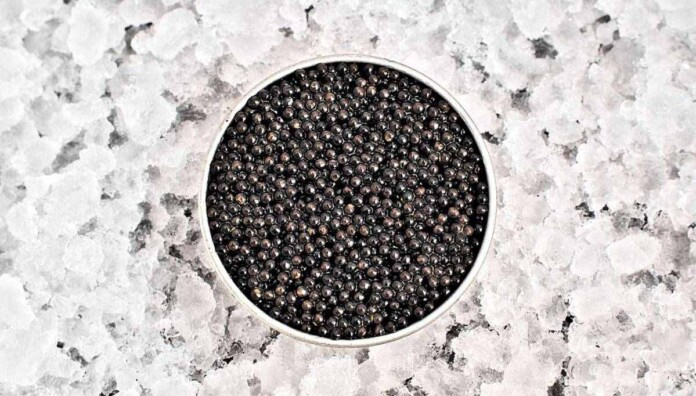
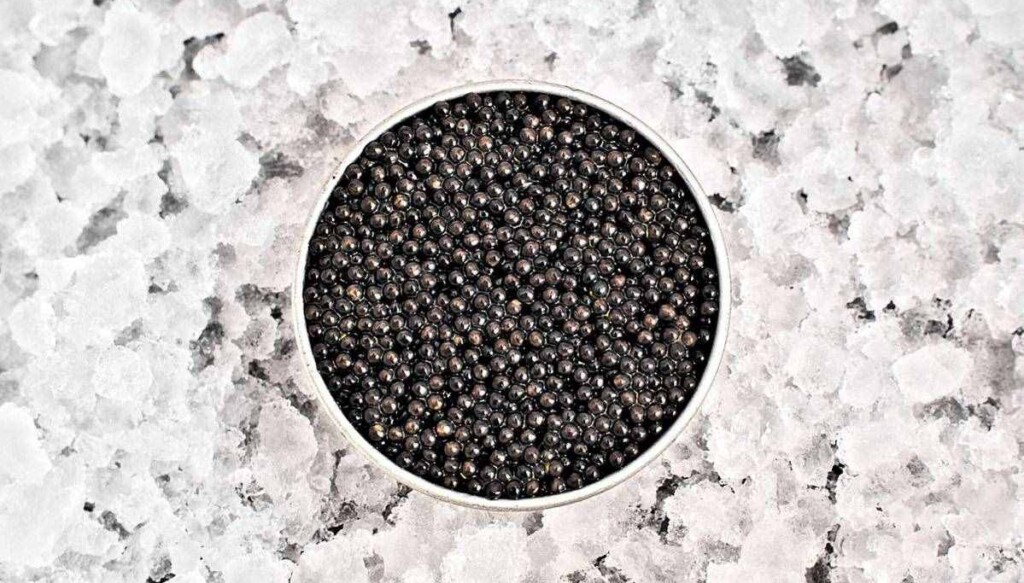
No kill caviar, harvested according to the Köhler method - credit AWI.
No kill caviar, harvested according to the Köhler method – credit AWI.

A long-destructive industry is now experiencing a sustainable revolution thanks to a determined German scientist.

The industry: caviar. The revolution: harvesting those tiny black pearls of culinary glory without harming the sturgeon gestating them.

The eggs of a female sturgeon, caviar is a treasured commodity, but even though this ancient fish survived the extinction event that killed the dinosaurs, all 27 species are Endangered or Critically Endangered in the wild according to the IUCN. All commercial caviar production today is from aquaculture.

In the early 2000s, there was a caviar crisis, leading to a depletion of wild stocks, and an increase in illegally sourced caviar. According to one caviar supplier, by 2004 consumers and chefs had lost confidence in the industry, as they couldn’t be sure it wasn’t taken from a wild fish, or processed in a garage somewhere using Borax as a preservative.

Enter “no-kill caviar,” a licensed aquaculture technique developed by polar and marine scientist Angela Köhler from the Alfred Wegener Institute (AWI) in Germany.

She had gone to the Caspian Sea as part of her research into understanding the threat to sturgeons there from pollution. During her work, she went to attend a caviar conference where she saw a fully mature female fish killed only for the caviar harvesters to find the eggs were too close to spawning and therefore not suited for sale.

Now, the AWI offers a license to caviar-culturalists to use their patented method of harvesting caviar from live sturgeon in a method more akin to work in a maternity ward than a slaughterhouse.

MORE SUSTAINABLE FOOD SOLUTIONS: Tasty Burgers and Steaks Made of Mycelium Are New Healthy Food Alternative to Plant-Based Meats

Female sturgeon, who bear eggs at around 8 years of age, are monitored with ultrasounds until their eggs are ready, after which they’re gently massaged until their eggs are released naturally. In AWI’s innovative process, signaling molecules in very small natural concentrations activate a machinery of enzymes within the eggs that stabilize their membranes in milliseconds.

“If conducted correctly, the quality of the caviar is superb,” AWI writes on their website. “The caviar produced according to the AWI method is also particularly clean and pure as has been shown in high-resolution microscopy images.”

“There are no blood vessels and follicle cells sticking to the eggs’ surface. Thus, the caviar does not need any preservatives (Borax), has a long shelf life of up to 9 months, and exhibits a fine fresh marine taste.”

Slow-growing, predatory fish that can grow up to 1.5 tons, sturgeon are a marvel of riverine evolution, but have suffered as a result of overfishing and development, particularly of dams that isolate their territory and dirty the sections of river they live in.

MORE STORIES LIKE THIS: True ‘River Monster’ of the Amazon Has Recovered Thanks to New Sustainable Fishing

Consequently, trading sturgeon products is strictly controlled by the CITES Treaty, and no wild catches are permitted in most areas of the globe.

In America, there’s already a no-kill caviar operation supplying a number of exclusive restaurants. The California Caviar Company, or the CCC, was the first in the country to license the patented method from Köhler, and today owns 20,000 sturgeon for sustainable caviar production.

“We visit the farms and have a look at whether they are candidates for an AWI license,” Köhler told The Guardian. “We also give advice on how to install a caviar lab, apply the patented processes, and train the staff.”

Having already licensed farms in the UK, Iceland, Sweden, and Ireland, Köhler has received requests from China, Iran, Russia, and other Caspian countries.

Long thought of as cuisine of the rich and haughty, a new breed of caviar-culturalists are looking to carry on the enjoyment of this time-honored culinary treat while saving a legendary and fantastical fish from extinction.

SHARE This Inspiring Change Of Fortunes With Your Friends… 

New Medicines May Lie Under the Sea–This Device Sniffs Them Out

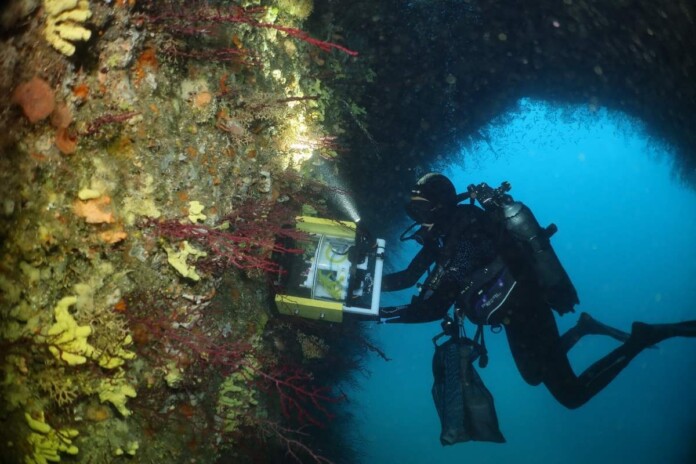
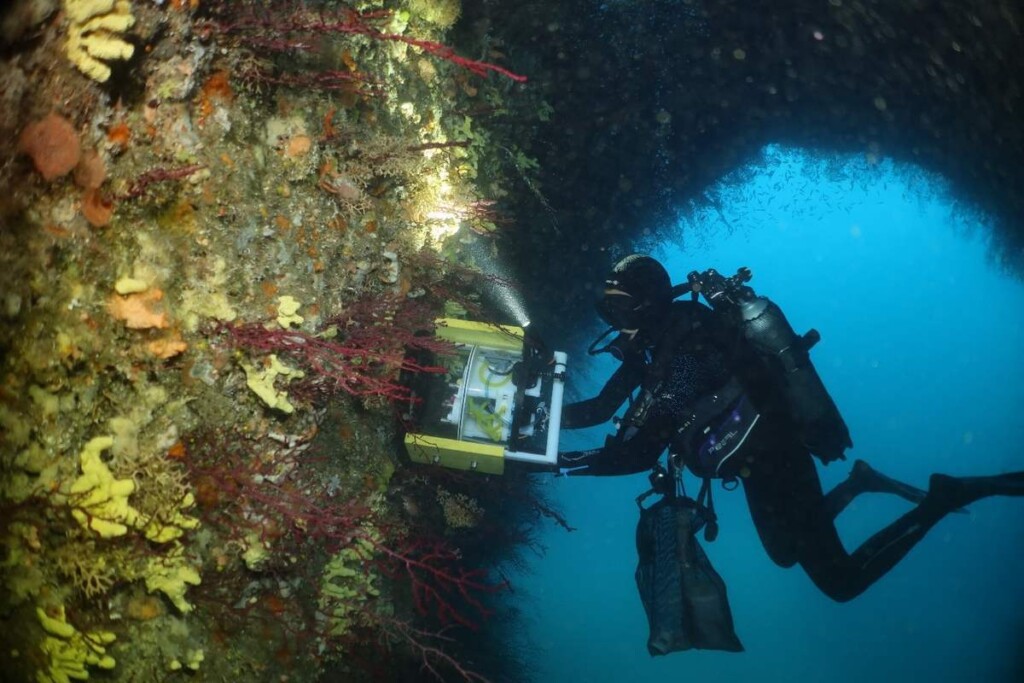
credit Dr. Thierry Perez, ACS Central Science via SWNS

Marine organisms are constantly releasing invisible molecules under the ocean’s surface, and much like a million anonymous plants in the Amazon, scientists believe that some of these compounds could be the medicines of the future.

A study team at the Mediterranean Institute of Marine and Continental Biodiversity and Ecology has developed a proof-of-concept device that sniffs, in a way, seawater, trapping dissolved compounds for analysis.

They have shown that it could “easily” concentrate molecules that are present in underwater caves and that it holds promise for drug discovery in fragile ecosystems, such as coral reefs.

“A drop of seawater is like a spoonful of dilute soup: it’s a complex broth of dissolved molecules from ocean-dwelling organisms,” said study co-author Doctor Thierry Pérez.

To identify what’s in the mixture, scientists need to be able to observe concentrations of those molecules in isolation.

Dr. Pérez and his colleagues wanted to develop an underwater instrument that captures and enriches dissolved compounds produced by sponges and other marine organisms without harming their ecosystem.

They created a waterproof device that could be easily handled by an underwater diver and that could pump seawater through disks, which have a similar feel and thickness as make-up remover pads.

The team tested the instrument—called the In Situ Marine moleculE Logger, or “I-SMEL” – in 65-feet-deep Mediterranean sea caves that contained a variety of massive sponges.

NEW DRUG DISCOVERIES: In World First, AI System Develops New Drug, Cuts R&D Costs By 80%, Moving it to Trials For OCD Patients in 1/5 the Time

After sampling the water, the researchers assessed the captured compounds via mass spectrometry. The compounds had diverse elemental compositions, and many had molecular structures that are unknown, according to the findings published in the journal ACS Central Science.

The researchers say it’s “promising” for the discovery of new natural products.

Several metabolites, including brominated alkaloids and furanoterpenoids, captured from seawater were present in three sponge species that the researchers had examined in detail, but surprising variations existed between the sponges and the water around them.

MORE STORIES LIKE THIS: The Steve Irwin of Mushrooms: Paul Stamets Works to Save Rare Ancient Fungus to Protect Us From Pandemics

“For example, aeroplysinin-1 was approximately 20 times more abundant in the extracts from seawater than within a yellow cave-sponge extract,” said Dr. Pérez

The research team says that “I-SMEL” represents a non-invasive way to capture molecules of interest to provide insights into an ecosystem’s health or detect new molecules for future drug discovery efforts.

SHARE This Smelly Story With Your Friends Who Love A Good Invention…

“The teacher comes when the soul calls, and thank goodness.” – Clarissa Pinkola Estésv

Austin Distel

Quote of the Day: “The teacher comes when the soul calls, and thank goodness.” – Clarissa Pinkola Estésv

Photo by: Austin Distel

With a new inspirational quote every day, atop the perfect photo—collected and archived on our Quotes page—why not bookmark GNN.org for a daily uplift?

Houston Good Samaritan Steps up to Drag Wounded Officer Away from Gunfight

credit Inside Edition - fair use
credit Inside Edition – fair use

If you thought you had a crumby Monday commute this morning, check out this video of a hero from Houston getting out of his car and dragging a wounded cop out of a gunfight.

Resident John Lally was not planning on being a hero when he was driving to work up Highway 59, but he came upon an active shoot-out between police and a man who was driving what was believed to be a stolen car.

It all started when Officer John Gibson had tried to pull the man over on this suspicion, but a chase started when the driver failed to stop. After crashing into several cars, Gibbons approached the vehicle with commands to get out and get on the ground when the suspect started shooting and hit Gibson in the leg.

“As soon as I jump out of the car there’s gunshots going off,” Mr. Lally told Fox 26. “Then I looked to my left and saw that cop get shot.”

“That’s when I grabbed that cop by his vest and dragged him all the way back to my work truck,” he said. “I just didn’t want him to get shot again, that was my main focus,” he told Inside Edition.

MORE NEWS LIKE THIS: Cop Saves Unconscious Driver From Burning Truck, ‘I’m either going to die here with him or get him out’ –WATCH

Lally sat with Gibson while officers applied a tourniquet to his leg. He comforted the wounded man, taking his hand and saying “I love cops dearly, bro.”

The suspect tried to escape but died from gunshot injuries.

WATCH the incredible footage below from Inside Edition… 

SHARE This Outrageous Rescue Footage With Your Friends On Social Media…

470,000 Glass Bottles Turned into Coating for Slashing Heat – Just Won a 2023 James Dyson Award

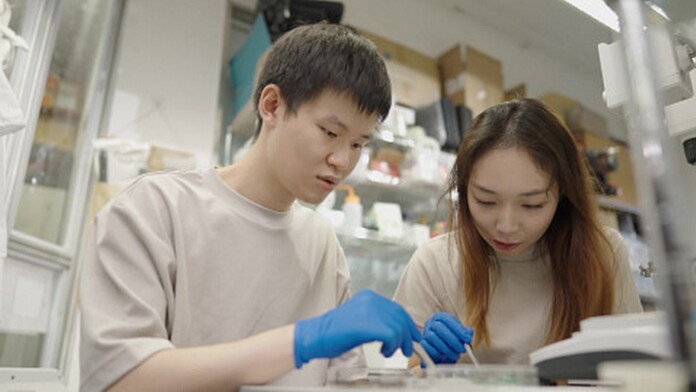
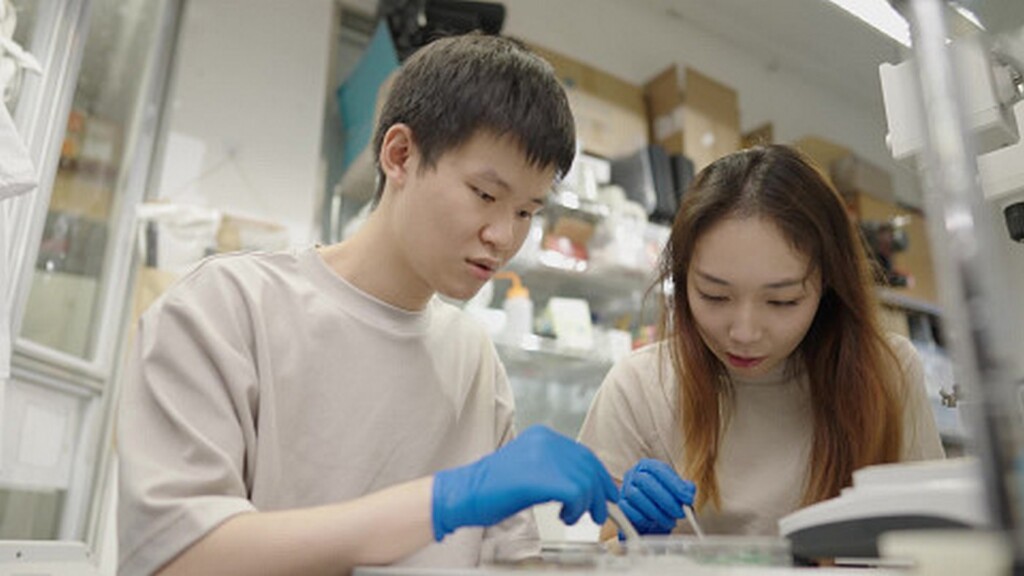
James Dyson Award Winners Ronaldo and Jovial - James Dyson Foundation, released.
James Dyson Award Winners Ronaldo and Jovial – James Dyson Foundation, released.

In Hong Kong SAR, air-conditioning to drive away the muggy sub-tropical heat accounts for almost a third (31%) of total electricity consumption.

In this megalopolis of 7.4 million, two young engineers looked for a greener solution to cooling buildings, and won the admiration of legendary inventor Sir James Dyson.

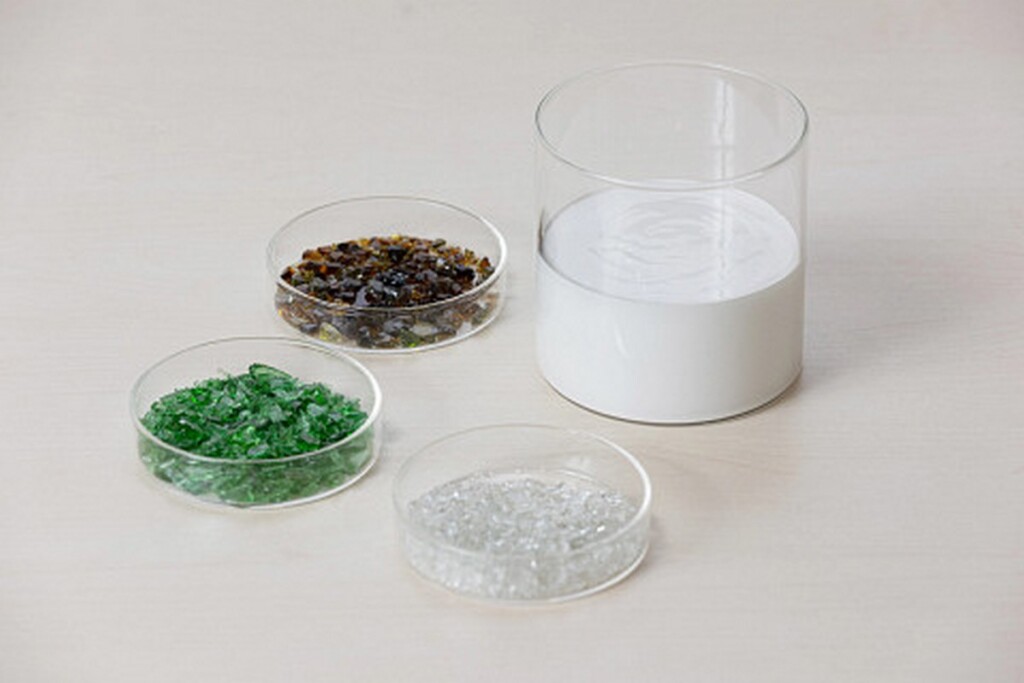
Hoi Fung Ronaldo Chan and Can Jovial Xiao created E-COATING, an eco-friendly solution that solves two problems in one. It takes advantage of the 470,000 glass bottles that end up in landfills every day to create a reflective coating that reflects the sun’s rays.

Made from recycled waste glass, it can be applied to exterior roofs and walls, thereby tackling the problem of throwaway glass while also reducing the amount of electricity consumed on cooling solutions like air-conditioning.

“Based on my program calculation, you can save about 30% energy usage on air conditioning systems,” said Ronaldo.

“Ronaldo and Jovial have come up with a clever way to turn waste into something much more valuable,” said Sir James Dyson, Founder and Chief Engineer at Dyson, who co-awarded to two inventors the 2023 James Dyson Award for Sustainability.

Ronaldo and Jovial’s recycled glass coating – James Dyson Foundation, released.

“E-COATING uses recycled glass to create a coating to put on exterior walls. This reflects the sun’s rays, and therefore saves a substantial proportion of the electricity needed to cool the building. It is a dual solution that is good for the environment and saves money.”

The Award will support the team’s plans to advance E-COATING’s adhesion and ease of application. They will also investigate new E-COATING formulas for indoor use.

“We invented E-COATING with a desire to help tackle the serious environmental problems our planet is facing,” Ronaldo and Jovial said. “The prize money will allow us to further our research and development goals and start a company to take our invention to the next level.”

WATCH Dyson phone the pair and spill the beans that they’ve won… 

SHARE These Clever People And Their Just Rewards With Your Friends…

Portugal Runs on 100% Renewables Dropping Consumer Electric Bills to Nearly Zero for 6 Days in a Row

Wind farm at Lousã
Wind farm at Lousã

Sunny, windy, wavy, and small, Portugal is uniquely suited to renewable energy; which it just proved by powering the nation of 10 million entirely with the forces of nature for 6 straight days.

It all started on Friday the 27th of October when the largest energy company in the nation, Redes Energéticas Nacionais, reported that conditions of wind and waves were generating the entirety of the nation’s energy supply.

They predicted the conditions would carry on through Saturday, but they actually kept on going for the next 5 days, including some periods when the nation’s grid was exporting renewable electricity to the grids in Spain.

In total, there were 149 hours of total renewables generation, 95 of which saw the Portuguese grid exporting to Spain, a run that broke the previous record for consecutive days of 100% renewable use.

While solar power is often seen as the most important renewable electricity source, the record began and carried on for many days in rainy, windy weather. That’s because, according to Canary Media, many turbines were built in the 1990s when solar panel installations were not cost-effective.

Even before that, many hydroelectric dams had been built after the fall of Portugal’s dictatorship in 1974.

MORE NEWS LIKE THIS: Renewables Met 100% of the Increase in Global Electricity Need This Year in 2022

This is important since in the country sunny days tend to be windless, and windy days tend to be cloudy.

The next step, a reporter in the energy sector said, is going to be the development of deepwater offshore wind farms.

SHARE This Great Renewables News With Your Climate-Concerned Friends…

World’s First Whole-Eye Transplant Gives Arkansas Man New Hope After Terrible Accident

First whole-eye transplant – NYU Langone Health

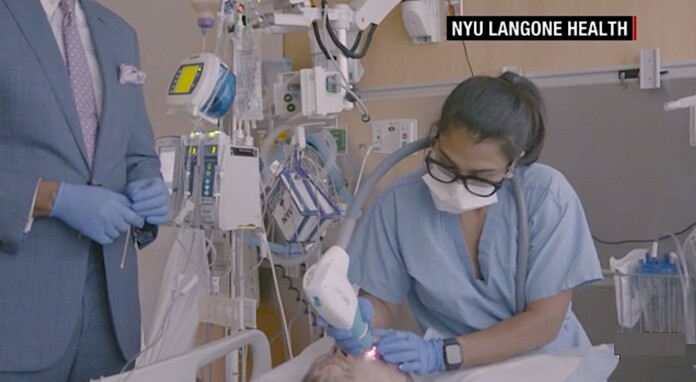
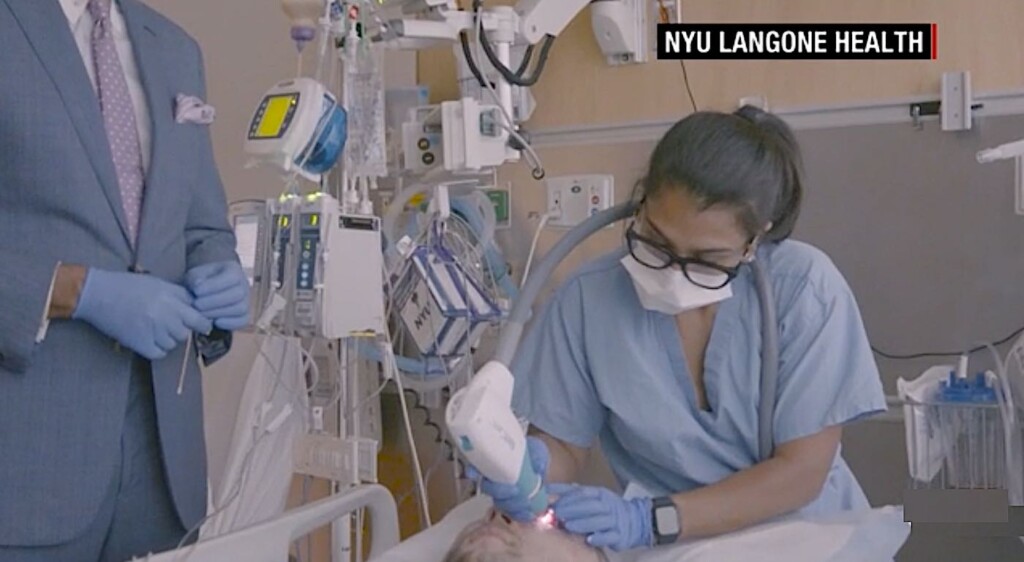
In a 21-hour procedure, 140 surgeons and attendants completed the first whole eyeball transplant on a military veteran who had suffered a near-fatal electrocution.

Replacing the better part of his entire face, and connecting a donor eyeball to the optic nerves, the surgery was declared a success, and though it isn’t clear whether the patient will be able to see out of his eye again, it has meant an enormous step forward for transplantation science and incredible peace of mind for his family.

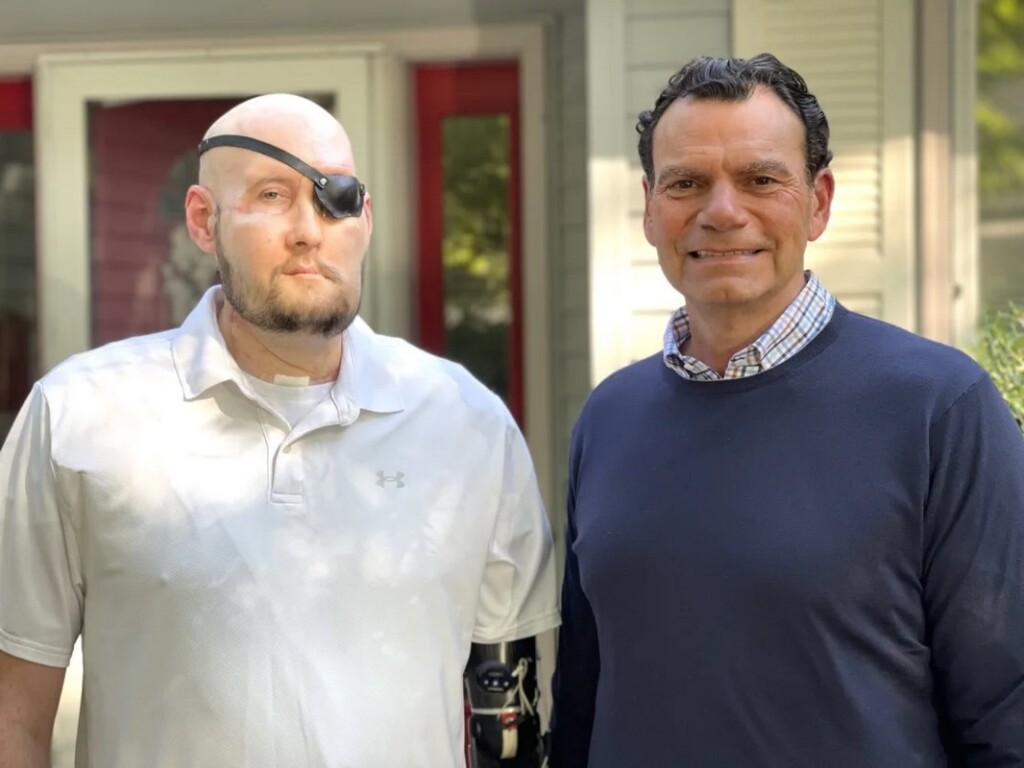
Aaron James was working on a powerline in Mississippi when he accidentally touched a live wire and received a 7,200-volt shock in June 2021. His wife was called at their home in Arkansas and was told only that her husband wouldn’t be dead by the time she reached the hospital where he was admitted.

James remembers only getting up to go to work, and then waking up days later in a Dallas hospital burn ward where he was flown. He felt okay, he told CNN, so he knew he was going to be okay, but he was missing his face, and taking a selfie allowed him to see inside his own skull.

Dr. Eduardo Rodriguez, director of the Face Transplant Program at NYU Langone Health was briefed about James’ case, and after hearing that he was going to require his left eye amputated, told the surgeons to leave as much of the optic nerve intact for a possible transplant.

MORE PIONEERING EYE RESTORATION: World’s First 3D-Printed Eye Offers Digital Prosthetics

He remembers talking to Rodriquez and hearing that he may never see out of the donor eyeball.

“But I said ‘even if it don’t work, I’ll have an eye, and it will be at least normal-looking, and then you all could learn something off of this,’” Aaron told CNN. “You have to have a patient zero,” he said sportingly.

After donor tissue was acquired, James was treated at NYU Langone Health in two separate theaters. For the eye transplant, stem cells were injected into the optic nerve and the area around it in hopes of gradually restoring communication between the brain and the eye.

Aaron James and Dr. Rodriques – Langone Health NYU

Over time, the donor tissue gradually took and mended, and a much more human visage appeared in the mirror. Beard stubble began to grow through the skin, and Meagan, Aaron’s wife of 20 years, said it was a bag of emotions.

OTHER STUNNING SURGERIES: First of its Kind Brain Surgery on Baby Inside the Womb has Successfully Prevented Heart Failure

“It was a crazy, great, weird, strange, ecstatic, happy feeling,” Meagan said. “I was just happy he made it through, and everything was good in the moment.”

SHARE This First Ever Whole Face + Eyeball Transplant With Your Friends…

“Nothing can cure the soul but the senses, just as nothing can cure the senses but the soul.” – Oscar Wilde

Quote of the Day: “Nothing can cure the soul but the senses, just as nothing can cure the senses but the soul.” – Oscar Wilde

Photo by: Victor Malyushev

With a new inspirational quote every day, atop the perfect photo—collected and archived on our Quotes page—why not bookmark GNN.org for a daily uplift?

Cutting Calories by 12% Can Help People Live Healthier, Longer Lives, Says Study

Cutting calorie intake by 12 percent can extend your life by boosting energy and rejuvenating muscles.

Curbing calories while maintaining vitamin and mineral levels, known as a calorie restriction diet, also lowers inflammation and increases metabolism, according to a new long-term study.

Calorie restriction, has long been known to delay the progression of age-related diseases in animal models. This new study, published by the National Institute on Aging (NIH), suggests the same biological mechanisms may also apply to humans.

The diet appears to stimulate healthy aging genes, allowing us to live longer and healthier lives.

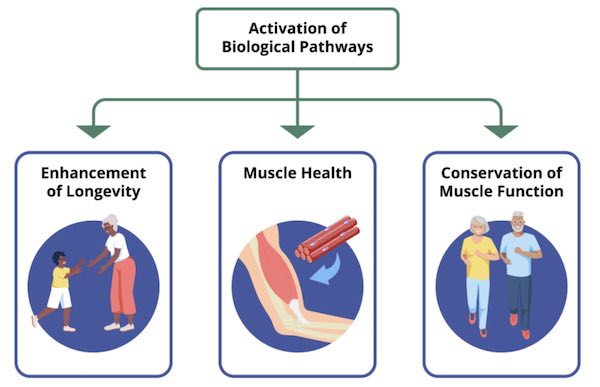
Researchers analyzed data from the Comprehensive Assessment of Long-Term Effects of Reducing Intake of Energy (CALERIE), a two-year study supported by the NIA that found that when the group was able to reach a 12% reduction in calories, it was enough to activate most of the biological pathways that are important in healthy aging.

“A 12% reduction in calorie intake is doable and may make a big difference in your health,” said corresponding author and NIA Scientific Director Luigi Ferrucci, M.D., Ph.D.

POPULAR: 8 Habits to Take Up by Age 40 if You Want to Live Decades Longer

The research team sought to understand the molecular underpinnings of the benefits seen in limited, previous research of calorie restriction in humans. One study showed that individuals on calorie restriction lost muscle mass and an average of 20 pounds of weight over the first year and maintained their weight for the second year.

However, despite losing muscle mass, calorie restriction participants did not lose muscle strength, indicating calorie restriction improved the amount of force generated by each unit of muscle mass, called muscle specific force.

Courtesy of NIA

For the current study, scientists used thigh muscle biopsies from CALERIE participants— a randomized controlled group of young and middle-aged non-obese healthy men and women—following up at one-year and two-year intervals.

The researchers confirmed calorie restriction affected the same gene pathways in humans as in mice and nonhuman primates. For example, a lower caloric intake upregulated genes responsible for energy generation and metabolism, and downregulated inflammatory genes leading to lower inflammation.

PREVENTION TIP: MIND and Mediterranean Diets are Associated with Fewer Alzheimer’s Plaques and Tangles

“Since inflammation and aging are strongly coupled, calorie restriction represents a powerful approach to preventing the pro-inflammatory state that is developed by many older people,” said Ferrucci.

Support Better Diets By Sharing This on Social Media…

Fishermen Rescue Young Dolphin While its Mother Held it Afloat as it was Trapped in Anchor Line-WATCH

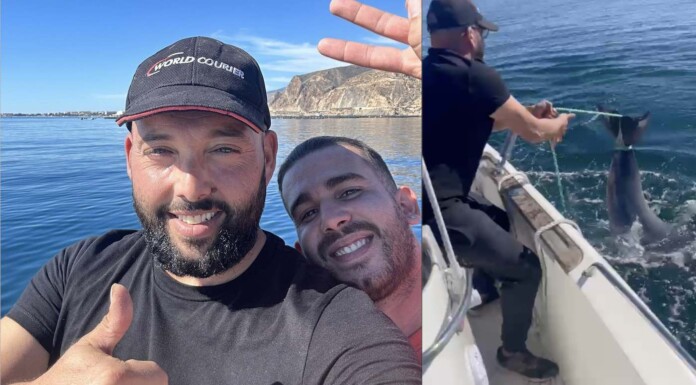
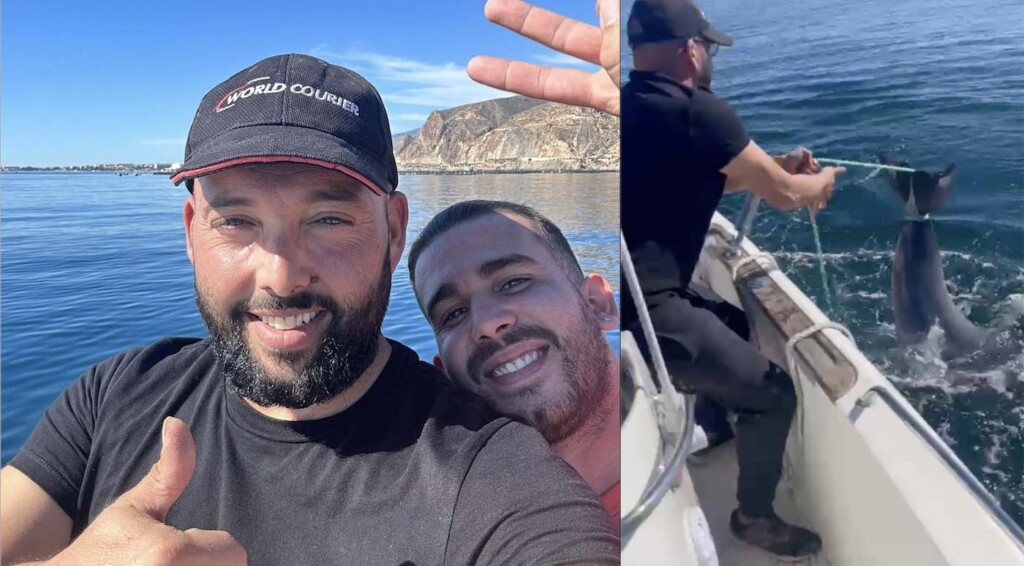
Jose Ramón Pérez and Miguel Rodríguez after their dolphin rescue -SWSN

A video captured a heartwarming rescue after a pair of fishermen happened upon a juvenile dolphin tied up in fishing line.

Jose Ramón Pérez and Miguel Rodríguez were boating 10km off the coast of Almería, Spain when they found the animal tangled up, with its mother desperately trying to keep it afloat.

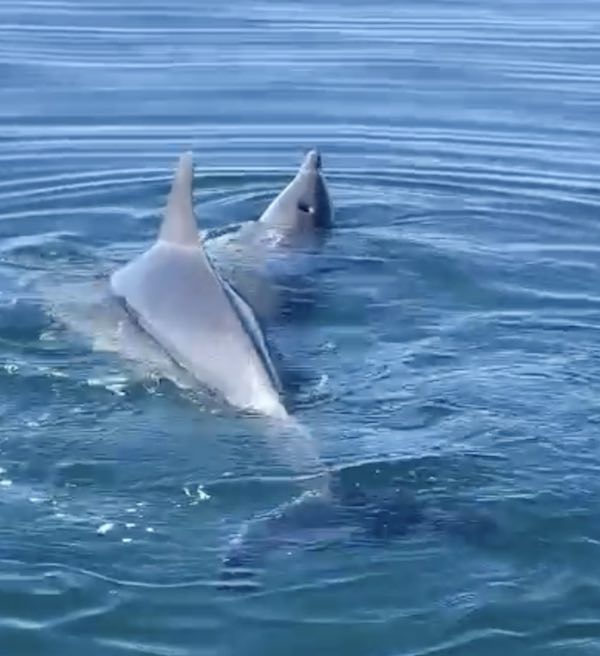
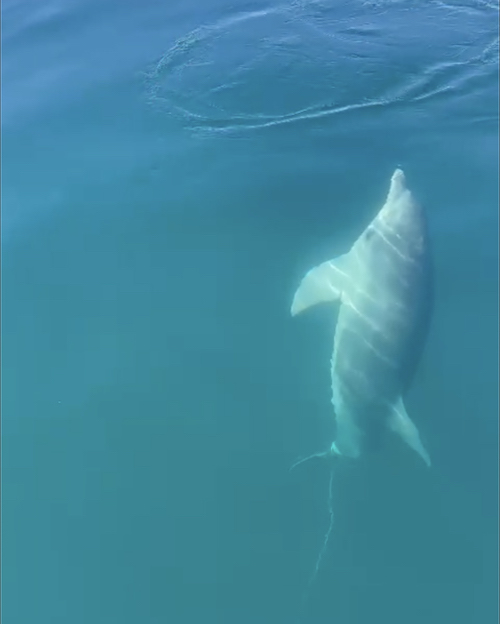
The baby’s tail was tangled in a rope that was pulling it underwater but the two men said its mother would not leave its side and kept trying to lift it up so it could breathe.

José Ramon, a warehouse worker, and Miguel, a greenhouse owner, wanted to help so they called local authorities, who put them through to Equinac, a local conservation charity.

“I saw something floating but it wasn’t actually floating at the surface. It was underneath,” said Ramón. “Miguel said it was a dolphin but I thought it was strange because it hadn’t moved at all.”

“The mother was trying to call us. When we got there she didn’t leave (the dolphin’s) side for a second.”

“She was holding its head up the whole time and the rope was even chewed.”

Mother dolphin attempts to keep her calf afloat – SWNS

Equinac concluded that the situation was too dire to wait for their arrival, so assisted the fishermen over the phone.

The rope was tied to an anchor and the dolphin, but with guidance from the charity the pair was able to cut the rope.

Ramón continued: “It was so hard to pull it up. I could feel it chafing our hands as we did it. They were panicked. The baby was thrashing around and screaming.

“When it did that, the mother seemed like she was scolding it and trying to calm it down.”

CHECK OUT: Researchers Capture Rare Video of ‘Mourning’ Mother Dolphin Staying with Deceased Calf for Days (WATCH)

Little dolphin calf is seen trapped by anchor line – SWNS

“As much as I try I can’t express how it felt to be there. I will remember this for my whole life. it was a truly magical moment.”

DID YOU KNOW? Dolphin Moms Use ‘Baby Talk’ with Their Calves, Research Shows

Eva María Morón, a coordinator at Equinac, said, “If those boys hadn’t been there, the baby would have died. This animal owes them its life.”

Watch the video below…

SHARE THE HEARTWARMING Moment With Friends on Social Media…

New Coral Adoption Program by 4ocean to Help Save Reefs–Every Bracelet Plants a Coral and Removes Ocean Plastic

4ocean
4ocean

Today, 4ocean announced a new partnership to help restore damaged coral reefs while removing trash from oceans, rivers, and coastlines.

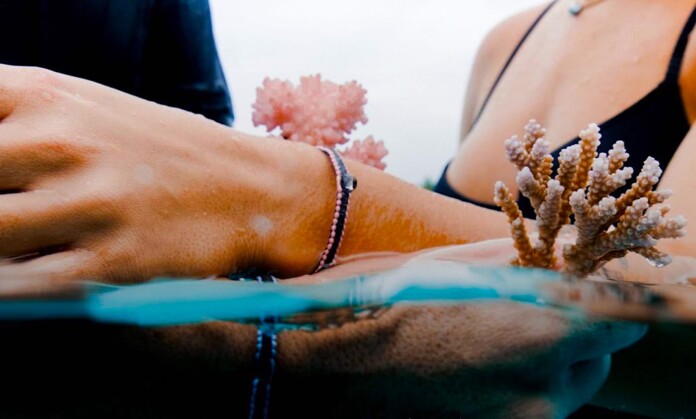
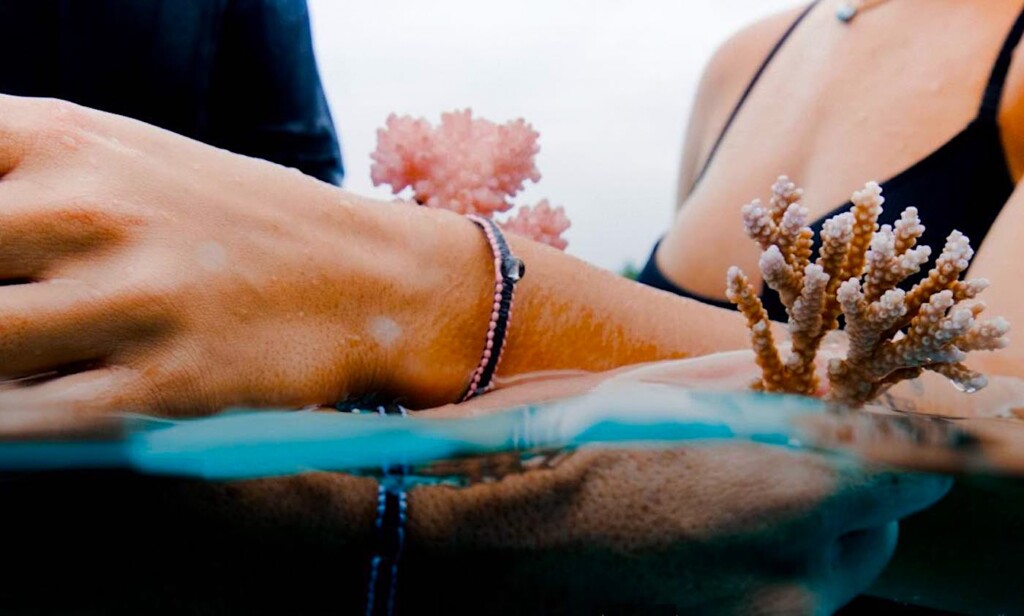
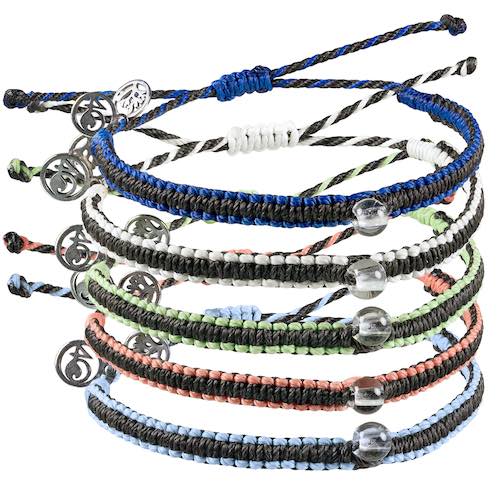
4ocean has been making bracelets from the 30 million pounds of plastic they’ve remove from waterways—and now Coral Gardeners will plant a baby coral onto a damaged reef with every bracelet purchased. Choose one of five colors, each representing a different coral species to be planted—and with a live streaming camera you can watch them grow.

In fact, you will be able to track its growth until it is outplanted onto the reef in French Polynesia. The money for each bracelet will also pay for the removal of 5 lbs of trash.

Coral reefs are known as the rainforests of the sea and play a critical role in global ocean health. Unfortunately, scientists estimate that climate change and other human-induced factors have led to the loss of many of the planet’s coral reefs in the past 30 years.

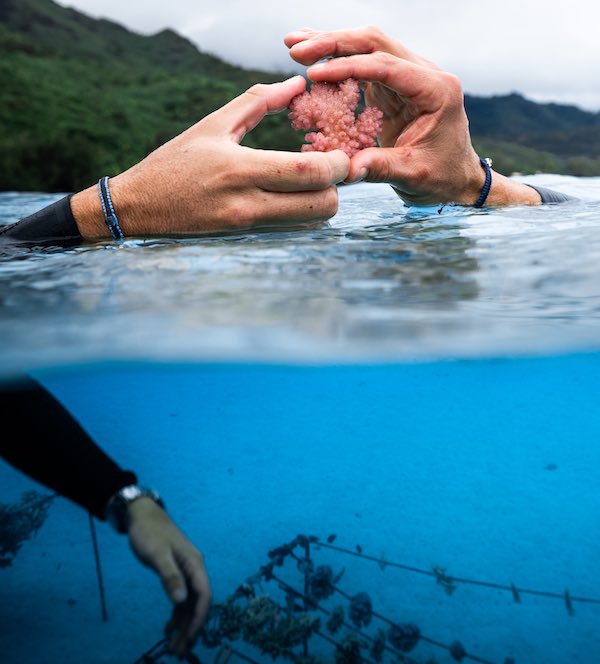
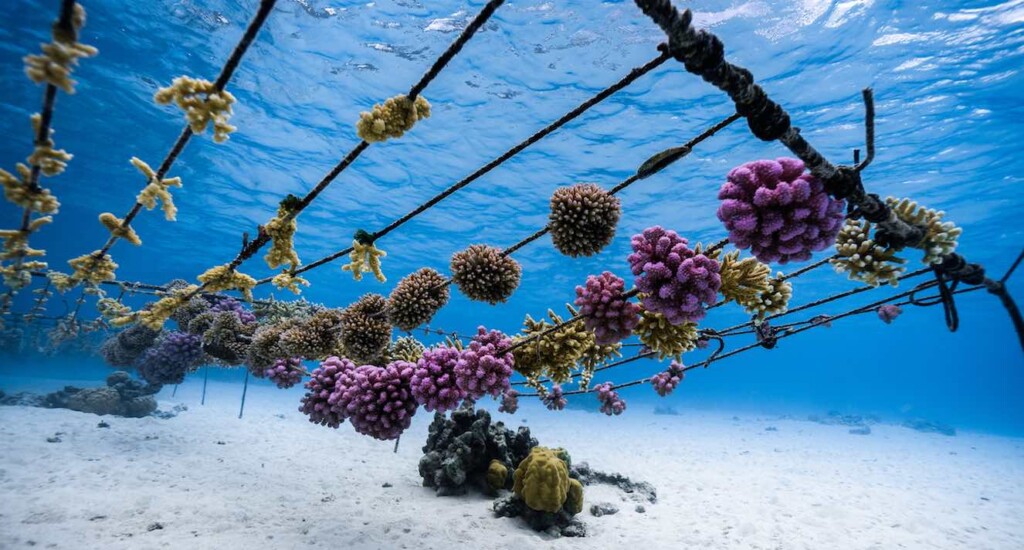
The Restoration Collection from 4ocean and Coral Gardeners will help restore some of these damaged reefs through a coral adoption program. Every bracelet sold will plant a specific species of coral on the island of Mo’orea in French Polynesia, where customers can track its growth through regular Impact Reports and a live streaming underwater camera in the coral nursery.

The bracelets are handmade by 4ocean artisans in Bali using 100% recycled ocean plastic cord collected by 4ocean captains and crews. Each bracelet features a recycled glass bead and secondary colors that represent each planted coral.

4ocean

“The Restoration Collection is one of the most exciting campaigns that 4ocean has been a part of to date and will have a huge impact on the ocean,” said 4ocean CEO and Co-founder Alex Schulze.

Florida-based 4ocean is a cleanup company dedicated to ending the ocean plastic crisis. Since 2017, its professional, full-time captains and crews have removed more than 32 million pounds of plastic waste and other man-made debris from the world’s oceans, rivers, and coastlines.

Since 2017, the nonprofit organization Coral Gardeners have planted over 50,000 heat-resistant coral fragments across French Polynesia and are on a mission to plant 1 million around the world by 2025.

“We are thrilled to join forces with 4ocean to protect and restore the ocean. With this collaboration, everyone can join the movement and be able to watch their coral grow via our nursery livestream.” said Titouan Bernicot, Founder of Coral Gardeners.

4ocean / Coral Gardeners

The name and color of each bracelet is inspired by the five unique species of coral fragments available in the collection, including Verrucosa Pink, Grisea Glacier, Retusa Green, Muricata Blue, and Globiceps for a Glow-in-the-dark bracelet. Every bracelet from The Restoration Collection includes premiere packaging on sustainable wood, a limited edition bracelet, a collectible information card with frameable poster, a detailed campaign booklet, and a sticker.

GOOD NEWS: Pristine Coral Reefs Discovered Are Thousands of Years Old And Teeming With Life
CHECK OUT: 4 Decades of Data Suggests Pacific Coral Reefs Can Acclimate to Warming Oceans and Resist Future Bleaching

The Restoration Collection of four bracelets start at $34 each—or as a box set for $150. Watch their campaign video below and visit 4ocean.com to order and learn more.

HELP SAVE the Oceans By Sharing the Gift Opportunity on Social Media…

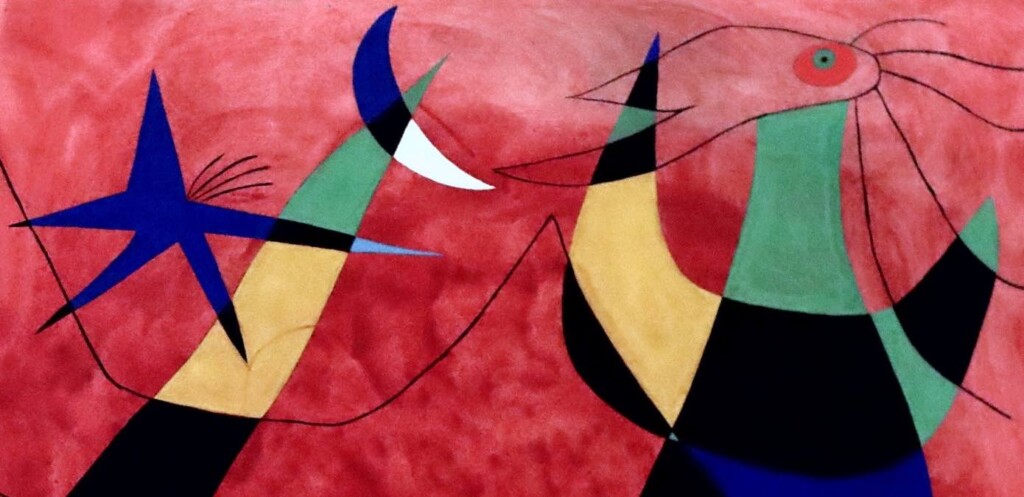
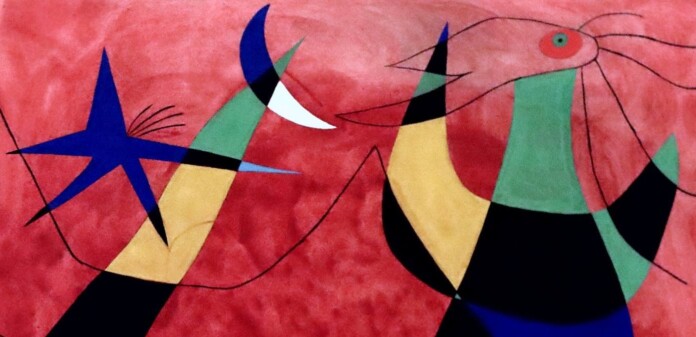
“The work must be conceived with fire in the soul but executed with clinical coolness.” – Joan Miró

Quote of the Day: “The work must be conceived with fire in the soul but executed with clinical coolness.” – Joan Miró 

Photo by: jean louis mazieres – CC license (Joan Miró artwork cropped)

With a new inspirational quote every day, atop the perfect photo—collected and archived on our Quotes page—why not bookmark GNN.org for a daily uplift?

Astronauts ‘Shoot’ For the Moon, Trying Out New Camera Made For Space in the Lunar-Like Terrain of Spain

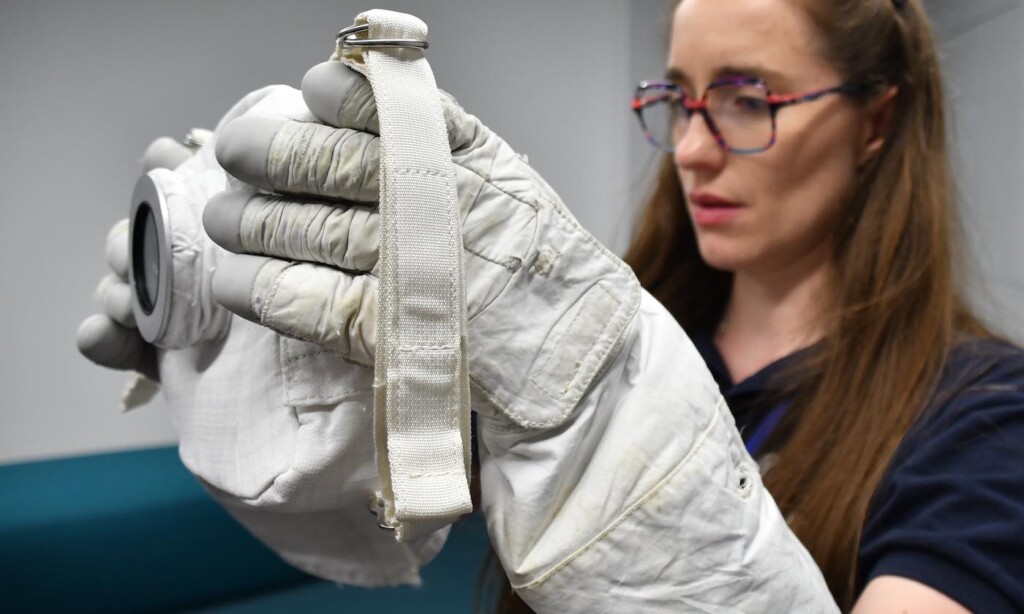
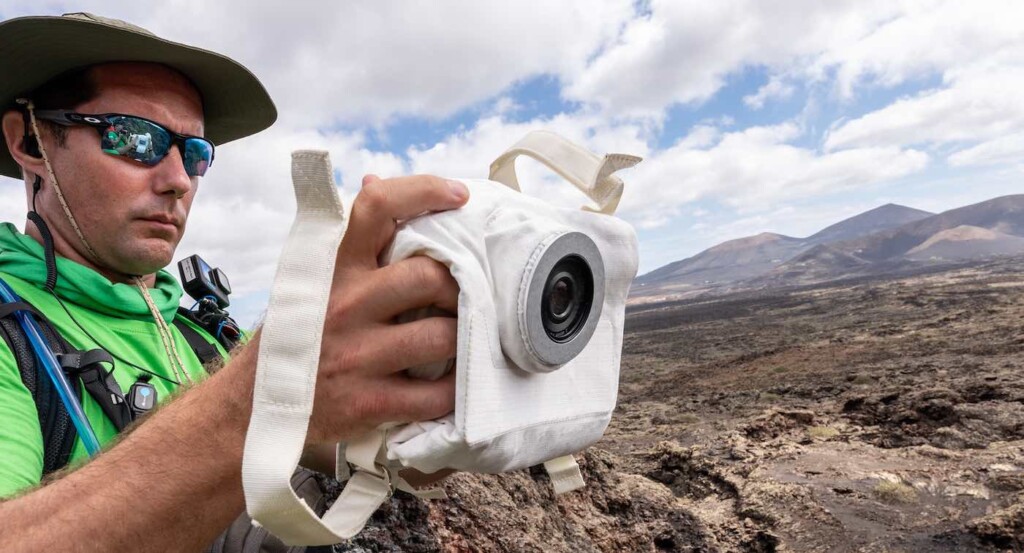
ESA career astronaut Rosemary Coogan holds the Handheld Universal Lunar Camera – ESA / NASA / SWNS

Astronauts are ‘shooting’ for the Moon as they try out a new hi-tech space camera here on Earth.

The scientists from the European Space Agency have partnered with NASA’s Artemis imagery team to try out the kit.

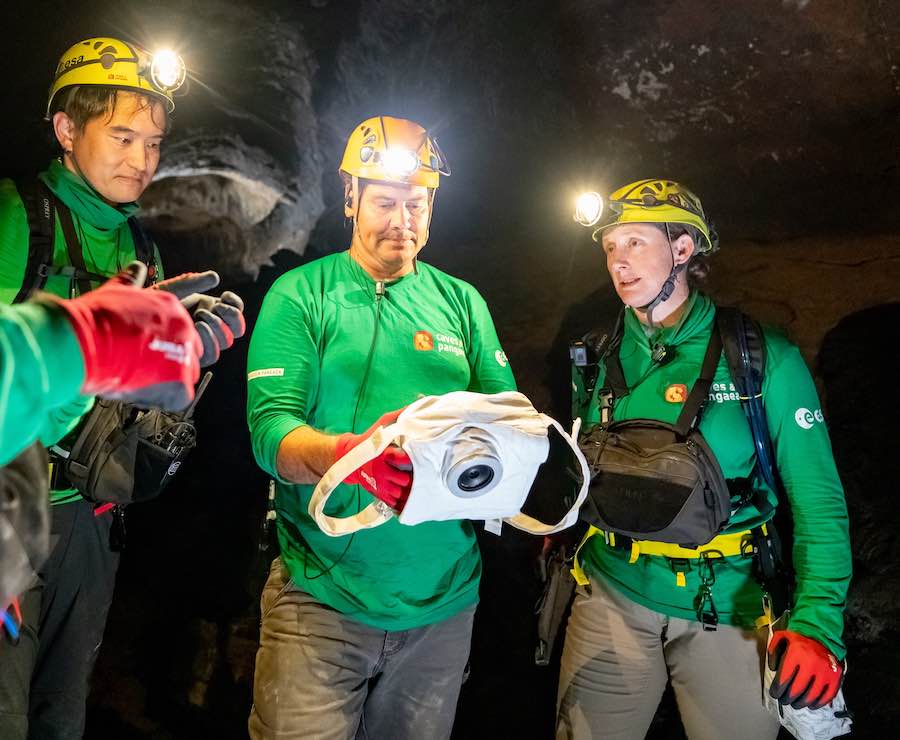
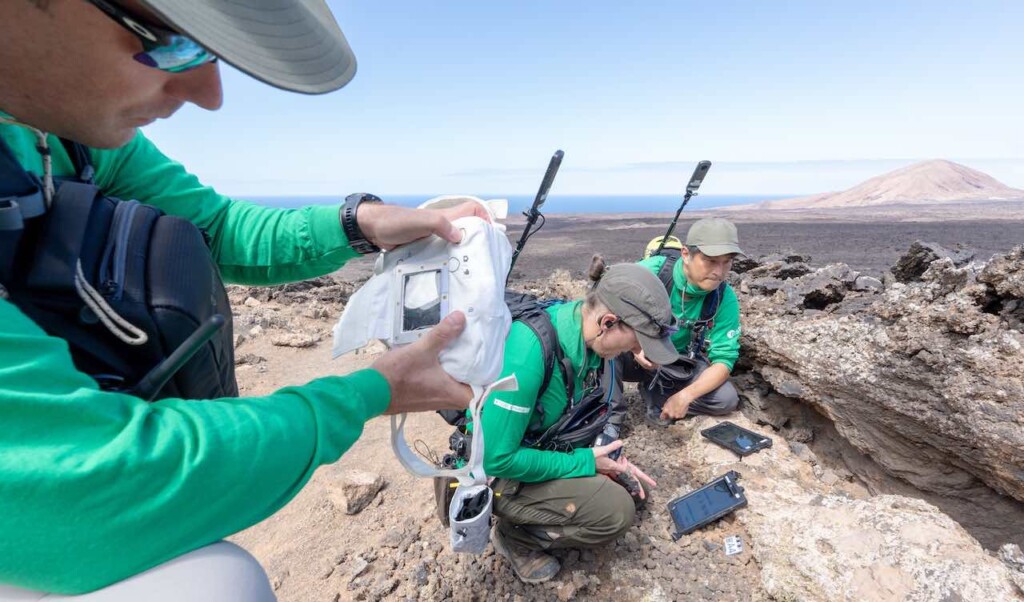
Engineers behind the Handheld Universal Lunar Camera (HULC) tested it within the lunar-like landscapes of Lanzarote, Spain, putting the new camera through its paces during the PANGAEA training program.

PANGAEA prepares astronauts to become effective field scientists for future missions to the Moon.

During the geological field trips, astronauts document their exploration work using the ESA tool that allows geology instructors at a base station to follow and support the crew with live audio and video in real time.

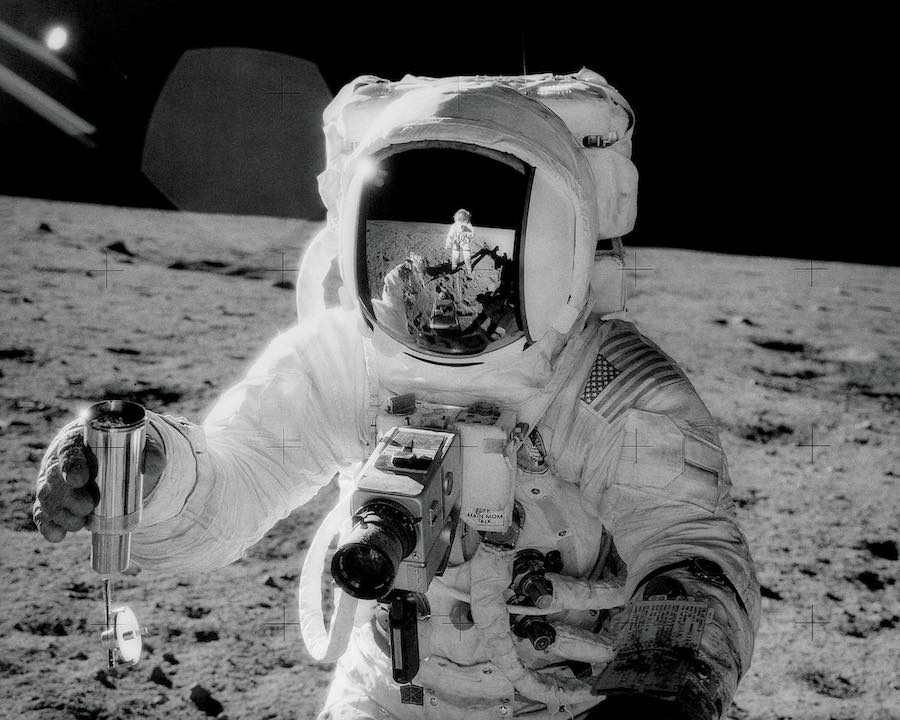
Astronauts of the Apollo 11 mission took iconic images of the Moon with a very different camera—a standalone, mechanical Hasselblad camera with a Harrison Schmidt 60 mm lens. During that mission, the astronauts collected 1,407 photos from four of these cameras on tripods.

Camera equipment attached to Apollo 12 lunar module pilot on the moon in 1969 – NASA / SWNS

The next time astronauts return to the Moon, they’ll take more pictures of the luner surface than ever—after this realistic taste of lunar surface exploration.

The new camera is built from professional off-the-shelf cameras with great sensitivity to light and state-of-the-art lenses, but with modifications from NASA—including adding a blanket for dust and thermal protection for temperatures which range from minus 200 to 120 degrees Celsius. A new set of ergonomic buttons now make it easy for astronauts in space suits to shoot pics wearing bulky gloves.

ESA astronaut Thomas Pesquet with Handheld Universal Lunar Camera in PANGAEA test program in Spain – ESA / NASA / SWNS

The teams have done extensive testing for the three major challenges of space: thermal, vacuum and radiation effects. On the Moon, one added challenge will be the abrasive nature of lunar dust. Last year, the camera was part of simulated moonwalk with the JETT 3 mission in Arizona, USA.

One of the most prolific European photographers in orbit, ESA astronaut Thomas Pesquet, praised the design after using it at the PANGAEA test course. “The engineers have done a really good job reconfiguring the buttons and arranging a simple yet reliable protection for the camera.”

One objective of PANGAEA was to select the most suitable lenses. Pesquet and NASA astronaut candidate Jessica Wittner, along with Japanese space agency’s Takuya Onishi used the camera in broad daylight, but also in the darkness of volcanic caves to simulate extreme conditions for lunar photography.

It will be the first mirrorless camera for handheld use in space. Mirrorless cameras provide excellent image quality in low light situations, making it well suited to the challenging high contrast environment of the Moon.

MORE PHOTOGRAPHY IN SPACEWatch a Stunning Solar Eclipse on Mars in Video Captured By NASA’s Perseverance Rover

“It was very useful to have the geologists’ point of view to make sure the photos had the right resolution, depth of field and exposure to maximize the science results,” explains Jeremy Myers, NASA’s lead for the HULC camera.

Jeremy Myers, NASA’s lead for the Handheld Universal Lunar Camera (HULC), gives an overview of the design to astronauts during the PANGAEA training program in Spain – ESA / NASA / SWNS

“It should be easy to use. The human factor is a big deal for us, because you want the camera to be intuitive and not taxing on the crew,” he adds.

ARTEMIS LUNAR PICS: NASA’s New ShadowCam Reveals Mysteries of Moon’s Darkest Corners in Stunning Glimpses

The camera will also record videos, which ESA will “provide situational awareness to the ground teams and help document the exploration of our nearest cosmic neighbor”.

Scientists with the Handheld Universal Lunar Camera in PANGAEA test program – ESA/NASA/SWNS

The Artemis III mission will land on the South Pole of the Moon, close to permanently shadowed craters where the crew will look for evidence of water ice. “Conditions for photography will be tricky in many ways, from operating the camera with the gloves on, to very low light levels and big contrast between bright and dark sources,” says Pesquet.

LOOK: Watch a Stunning Solar Eclipse on Mars in Video Captured By NASA’s Perseverance Rover

“We want astronauts to be able to take a detailed image of a crystalline structure in a rock and to capture landscapes, all with the right exposure,” explained Myers.

One version of the camera will soon fly to the International Space Station for additional testing in the near future.

SEND YOUR Photo Pals OVER the Moon By Sharing on Social Media…

National Geographic Unveils Top ‘Pictures of the Year’ Captured From Nat Geo Photographers in 2023

Photo by David Doubilet (For Nat Geo)
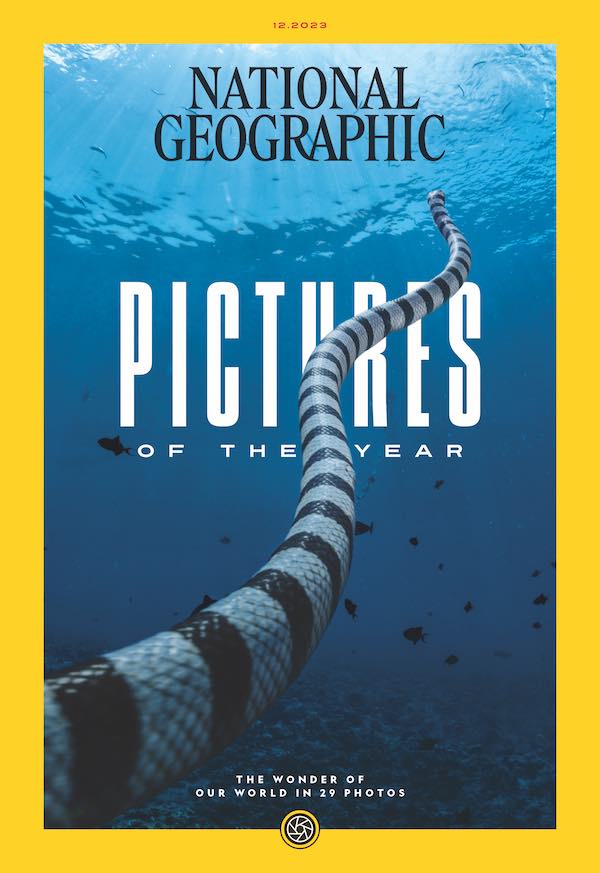
Photo winner of a venomous sea krait is featured on the December 2023 magazine cover – Credit: National Geographic

Each year, National Geographic photographers canvass the globe to uncover stories that offer a new understanding of our world; and every day, Nat Geo’s photo editors comb through their images, choosing those that “compel the eye and inspire the heart.”

This year, more than 160 National Geographic photographers working across every continent, even Antarctica, submitted 2.1 million images. From those, 29 were selected for PICTURES OF THE YEAR 2023.

“These are images that aren’t just striking—they tell a story and reveal something that makes you see and understand the world in a new way,” said National Geographic Editor-in-Chief Nathan Lump.

From venomous sea kraits in Palau to monarchs wintering in Mexico, the PICTURES OF THE YEAR 2023 take audiences behind these rarely seen subjects and rarely felt moments. The result is a curated collection that’s designed to incite curiosity and inspire a greater understanding of our world.

Their online edition also features videos and a series of tips from top Nat Geo photographers to help audiences take better pictures, including wildlife, portrait, nighttime and underwater photographs.

ALSO CHECK OUT: Otherworldly Images Show Breathtaking Beauty of Oceans in Photo Contest Winners

We chose our favorite five photos from the brand’s annual retrospective, which is available online now and on print newsstands.

Here’s Our Five Favorite Photos

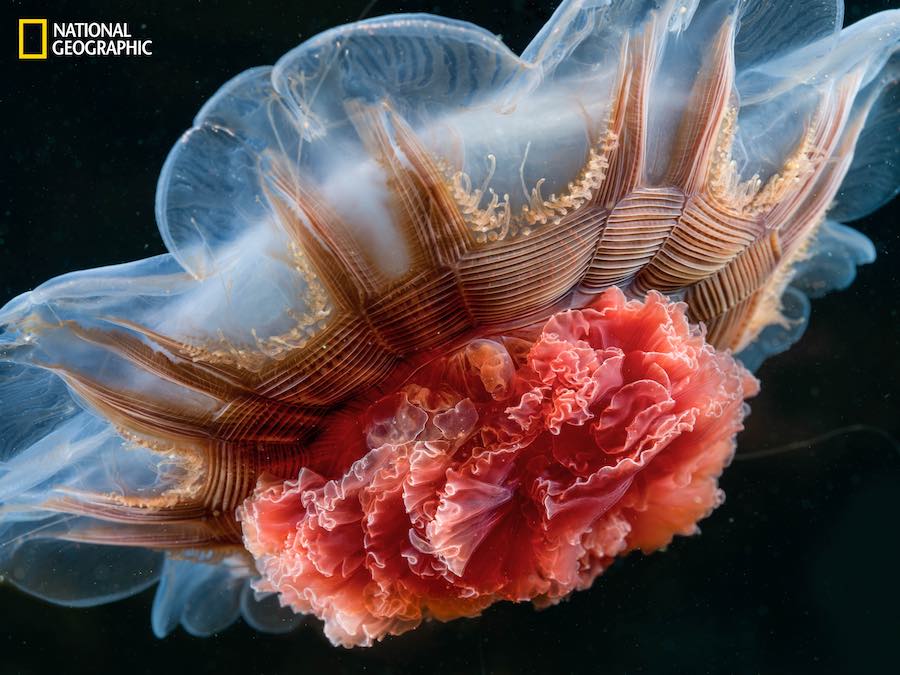
Marine biologist Alexander Semenov calls the lion’s mane jellyfish the queen of the Arctic seas. He photographed this regal specimen in its final stage of life: Having reproduced, it has shrunk in size, digested or shed its hundreds of long tentacles, and become, in Semenov’s words, an “alien flower.” (Photo by Alexander Semenov)

Marine biologist Alexander Semenov calls the lion’s mane jellyfish the queen of the Arctic seas. He photographed this regal specimen in its final stage of life: Having reproduced, it has shrunk in size, digested or shed its hundreds of long tentacles, and become, in Semenov’s words, an “alien flower.” (Photo by Alexander Semenov)

Caver Valentina Mariani (top), National Geographic Explorer Kenny Broad (center), and Nadir Quarta prepare for a dive into the dark, toxic waters of Lago Verde. Such sunlight-starved ecosystems could offer a glimpse into the chemistry of life in alien seas. (Photo by Carsten Peter)

In the Canary Islands, National Geographic Explorer Kenny Broad joined Caver Valentina Mariani and Nadir Quarta preparing for a dive into the dark, toxic waters of Lago Verde. Such sunlight-starved ecosystems could offer a glimpse into the chemistry of life in alien seas. (Photo by Carsten Peter)

Pilgrims sing, dance, and play flamenco during a stop along their spring journey to the Virgin of Rocío shrine. Photographer Aitor Lara says that the group’s lyrics “reflect the magical experience of the pilgrimage and the joy of being able to present their fervor to the Virgin.” (Photo by Aitor Lara)

In Spain, pilgrims sing, dance, and play flamenco during a stop along their spring journey to the Virgin of Rocío shrine. Photographer Aitor Lara says that the group’s lyrics “reflect the magical experience of the pilgrimage and the joy of being able to present their fervor to the Virgin.” (Photo by Aitor Lara)

Streaked with sunlight and crowded together for warmth in winter, monarch butterflies blanket fir trees in El Rosario Sanctuary. Rojo received special permits to work outside the sanctuary’s operating hours. He made this photograph shortly before sunset. (Photo by Jaime Rojo)

In Mexico, monarch butterflies blanket fir trees in El Rosario Sanctuary, crowding together for warmth during the winter. The photographer received special permits to work outside the sanctuary’s operating hours, and made this photograph shortly before sunset. (Photo by Jaime Rojo)

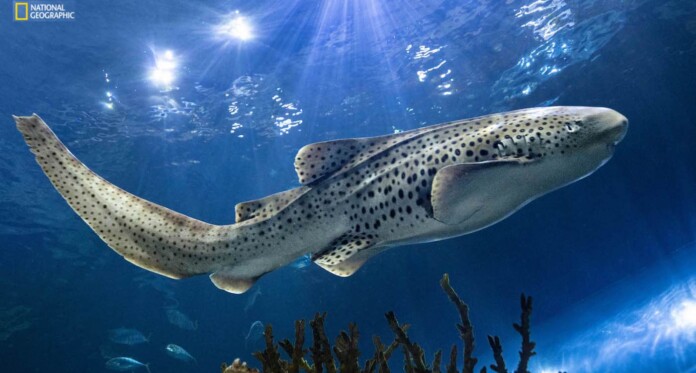
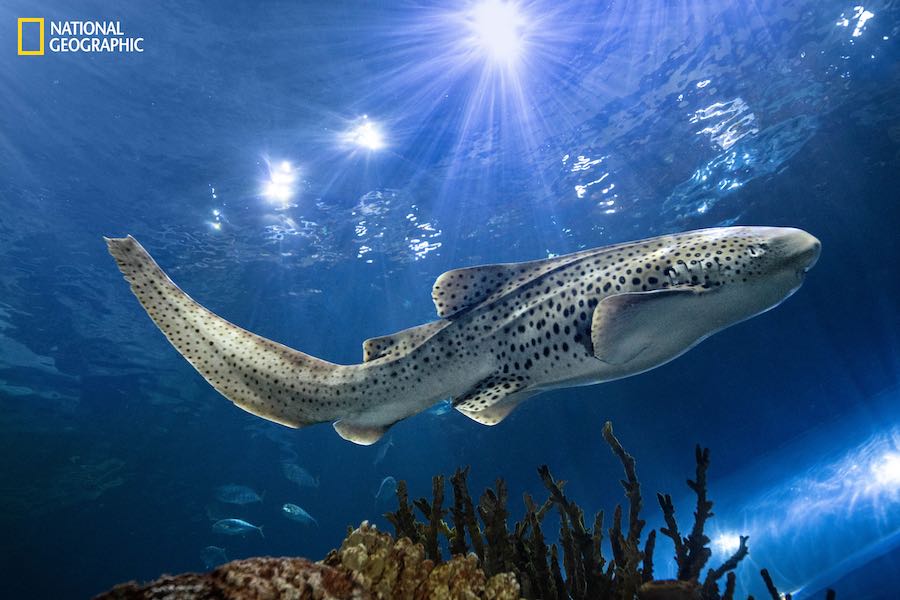
A seven-foot-long zebra shark glides through an exhibit at Shedd Aquarium, one of several aquariums where endangered zebra sharks are breeding to produce eggs for shipment to Indonesia. They will be raised and released into a marine protected area in Raja Ampat to rebuild its wild population. (Photo by David Doubilet)

This beautiful image of a seven-foot-long zebra shark depicts the story of extraordinary conservation. It glides through an exhibit at Shedd Aquarium in Chicago, one of several institutions where endangered zebra sharks are breeding to produce eggs for shipment to Indonesia. There, they will be raised and released into a marine protected area in Raja Ampat to rebuild the wild population. (Photo by David Doubilet)

LOOK: Couple Get ‘Best Ever’ Wedding Pictures When Northern Lights Break Out Over their Big Day

For more on this story, visit Natgeo.com.

SHARE the Beautiful Images of Our People and World On Social Media… 

Texas Grandmas are ‘The Knit Wits’ Who Craft Homemade Hats and Toys For Children in Hospitals and War Zones

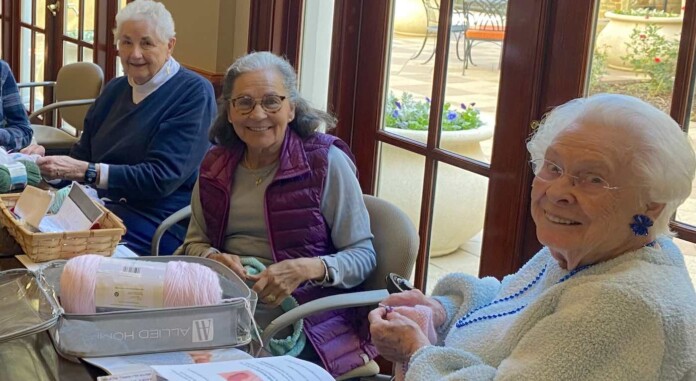
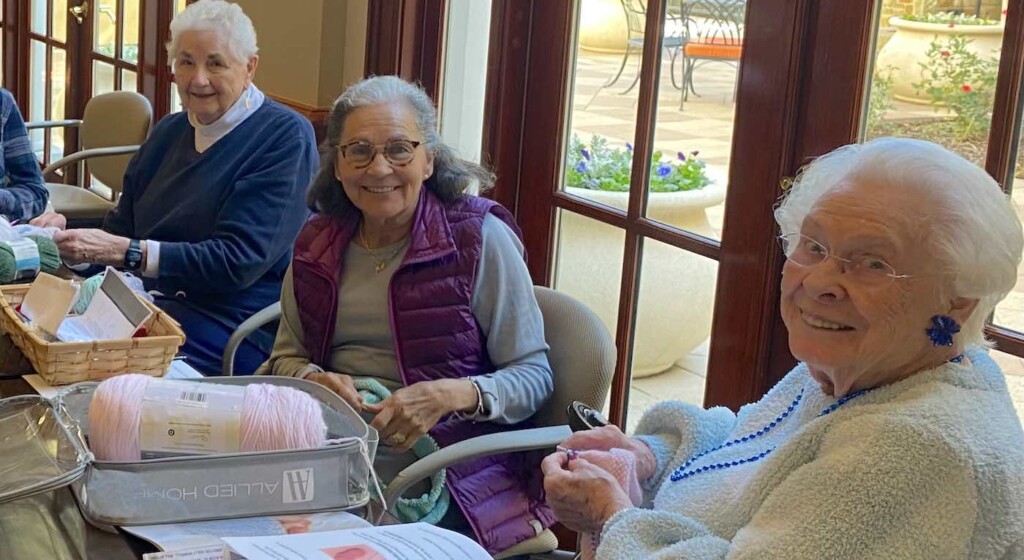
Three Knit Wits – Credit: Edgemere

For over twenty years, a colorful collective of ladies residing at a senior living community in Dallas have crafted thousands of hand-knit items, bringing warmth and support to children both in Texas and overseas.

And, with sass and swing, they call themselves the Knit Wits.

Every Friday, they gather around a long table with yarn and knitting needles to lend a hand from their home at Edgemere—and their latest project is a collaboration with Children’s Health in Dallas to create homemade caps for infants facing heart problems.

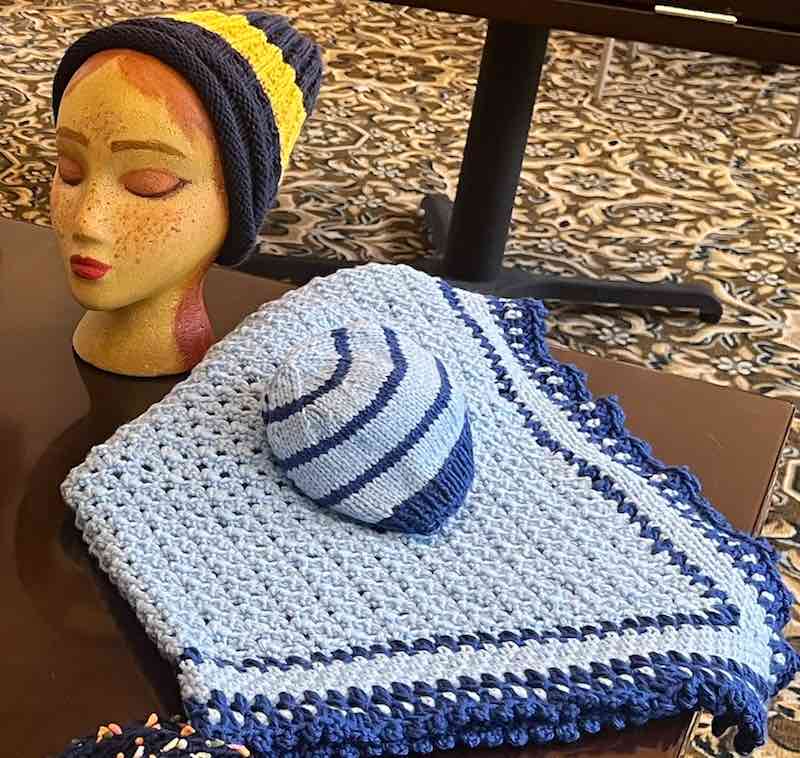
Knit Wits member Mary Ann Stover got the idea while talking with her daughter, a cardiologist at the hospital, and for the past year, the group has sent dozens of beanies for the babies.

“The caps are themed around the holidays,” Stover says, with designs evoking autumn, Thanksgiving, Christmas, the Fourth of July, St. Patrick’s Day, Easter, and Spring. (See the video at the bottom…)

“They have become a colorful symbol of hope and joy for the center’s littlest patients and their families,” said Betsy Beall, the hospital’s child life specialist.

The Knit Wits – Credit: Holly Gaddy

The mini hats also can play a role in fostering the bond between infants and caregivers, preserving the scent of the adult next to baby’s skin.

“Caregivers are able to wear the hat on their body to transfer their scent before placing the hat back on the baby, encouraging bonding and easing the infant’s stress.”

AMAZING: Volunteer Knitters Are Finishing Craft Projects for Loved Ones Who’ve Passed

Beall said the collaboration has had an “overwhelmingly positive impact” on the center’s infant population, noting one example of a tiny patient who’d been treated for nearly a year.

Throughout the infant’s admission, many holidays were celebrated, but often the infant was too critical to be dressed up for photos the family had planned. Thanks to the generosity of the Knit Wits, the infant hat provided the perfect festive touch.

“When we started this group we were making helmet liners for the troops that were in Afghanistan,” Marianne Mead told NBC’s KXAS-TV this week. She was in her 80s then. Today, she’s 102 years old and still knitting. “Being creative, being busy, and having something good to think about.”

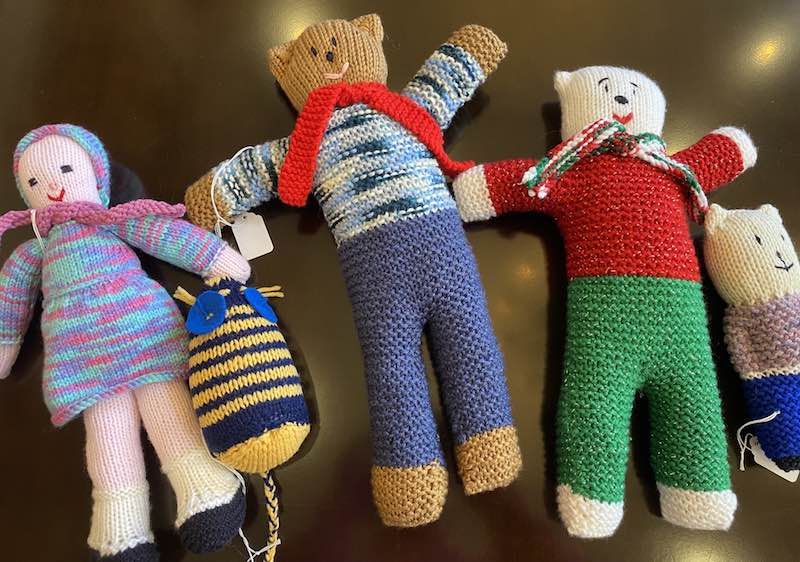
The Knit Wits toys – Credit: Edgemere

The Knit Wits also sent cuddly knit dolls to orphans from Ukraine—interlacing love with service, one yarn loop at a time.

The executive director of their Edgemere home said, “They’ve proven that a simple act of kindness can make such a difference in the lives of those facing challenging circumstances.”

LOOK: Hospital Crochets ‘Mr. Rogers’ Sweaters for All the Newborns in Honor of World Kindness Day

Watch a sweet video from local NBC news coverage…
WARM SOME HEARTS By Sharing the Inspiration With Friends on Social Media…