












All News - Page 246 of 1716 - Good News Network
Home Blog Page 246

Wiener Dog Gives Birth to So Many Puppies it Might Be a World Record: ‘She’s Such a Great Mum’

Winnie the dachshund and her 11 puppies – By Emma Trimble / SWNS
Winnie’s pups at 4 weeks old – Rayma Jones / SWNS

A dachshund has given birth to what could be a world record litter for her species—11 puppies at one time.

Three-year-old Winnie bore the huge brood at home near Leicester, England in September.

Also known as a wiener dog or sausage dog, the short-legged but long-bodied hound normally gives birth to a litter of between one and six babies, due to its small size.

Another dachshund, Cheesecake, gave birth to 10 puppies in September 2021, which made headline news. But Winnie has beaten that number and her owner thinks it may be a world record, although Guinness World Records does not keep records for individual dog breeds.

“I was amazed by the litter,” said stay-at-home dog mom Rayma Jones. “I just kept counting them over and over.”

“I was so surprised that I kept expecting her to pop out another one when I wasn’t looking.

“She’s such a great mum. I’m overwhelmed that she could have had a world record number of puppies. I looked online and I couldn’t believe it.”

A scan at 35 days of the nine-week pregnancy showed six puppies in Winnie’s belly.

The super dog birthed her first pup at 11:30pm, so Rayma sat up with her. The second came at 1:30am followed by four more, 20 minutes apart. Numbers seven, eight and nine then came around seven minutes apart, followed by a 40-minute gap until number 10.

Rayma went to bed at 6:30am believing Winnie had all her pups. But when she checked in on her four hours later, she couldn’t believe her eyes.

She said: “I thought 10 was amazing. She’d stopped panting and lay down feeding them. I really thought she’d finished, but when I came back I counted them and there were 11.

Rayma Jones with 3-year-old Winnie and her her 11 pups – SWNS

LOOK: Man Cajoles His 17 Dachshunds into Christmas Sweaters So They Can Pose for Best Family Photo in History

“There was no mess, she’d just washed it and lined it up with the others. She’s so clever.”

“Winnie’s a natural. She even has ten nipples so she can nearly feed them all at the same time. It’s very sweet to watch.

WATCH: Family’s Dachshund and Speedy Tortoise Play Football Together

“She never wants to leave them, and if she hears a dog she’s right there next to them. She’s the best mum ever.”

Winnie has been with Rayma’s family since she was seven-months-old, when her original owners were moving abroad.

MORE: Determined Dachshund Tries to Pull His Teddy Bear Into a Small Carrier (WATCH)

Winnie’s color is reportedly rare for a wire-haired dachshund.

“She’s silver dapple and five of her puppies are completely silver with black spots. Another three are chocolate, and three are black and tan.”

Rayma admitted she will have to sell them. “I can’t live with eleven puppies or I’ll become the crazy dog lady!”

SHARE This Hot Dog of a Story on Social Media With Dog-Loving Friends Everywhere…
Wash. D.C’s ‘Weed Warrior’ Volunteers Tackle ‘Mile-a-Minute’ Invasives to Save the Capital’s Trees

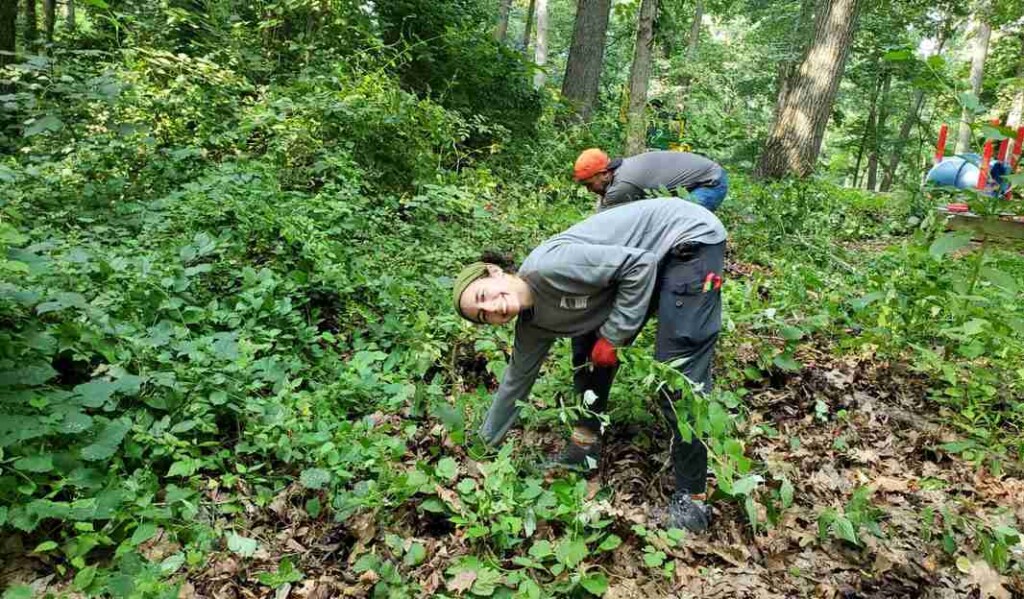
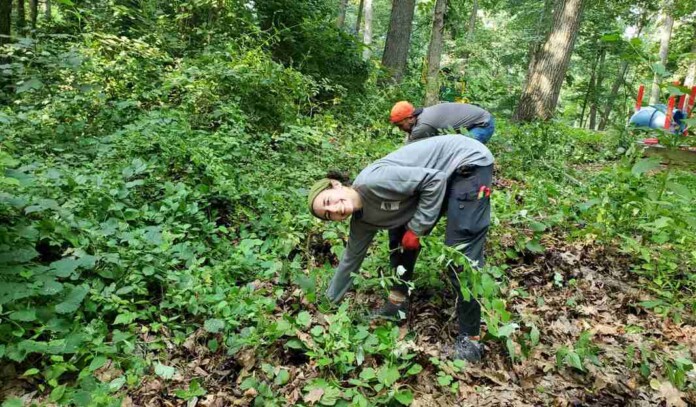
Weed Warriors in Action - credit, Montgomery County Parks.
Weed Warriors in Action – credit, Montgomery County Parks.

Around the capital beltway or Washington’s famous Rock Creek Park, you may see a group of people ripping up vines along the treeline beside the roads.

If you have then you’ve glimpsed superheroes who traded in their capes for gardening gloves and their time for the satisfaction of terminating an invasive species and saving a native tree.

Washington D.C’s “Weed Warriors” are a group of volunteers going back to 1999 that work for free to keep hundreds of species of invasive shrubs, vines, and climbers from taking over native ecosystems.

Among the 600 or so non-native invasive plant species found in and around our nation’s capital, some like Polygonum perfoliatum, also known as “mile-a-minute” vine, can be devastating. Suffocating trees by overgrowing the leaves in their canopy branches, mile-a-minute can kill thousands of trees every year.

Since 1999, Weed Warrior volunteers have logged over 135,000 hours of time weed whacking in Montgomery County alone. Anyone can become a Weed Warrior; the group works in units for two-hour spaces removing weeds or planting native species in their place.

These invasive species management events are led by specially-trained volunteer Weed Warrior Supervisors and/or staff from the Montgomery Parks Dept. Warriors can get certified to de-weed in their spare time, or lead events on their own. They can even have their own unique patch of ground in the D.C.-Metro area to control.

Why would anyone want to trade their free time or laboring hours away for free doing something our tax dollars are supposed to do for us? The answer is simple: it’s addicting.

“If I have any good mental health, it’s due to Weed Warrioring,” said 74-year-old area resident Barbara Francisco. “You have a sense of accomplishment.”

OTHER GREAT VOLUNTEER FORCES: Volunteers ‘De-seaweeding’ Results in Dramatic 600% Improvement of Coral Regrowth

Francisco spoke to Justin Moyer of the Washington Post, who found the volunteer groups were filled with people who were happy to get out into nature and make a meaningful impact on biodiversity.

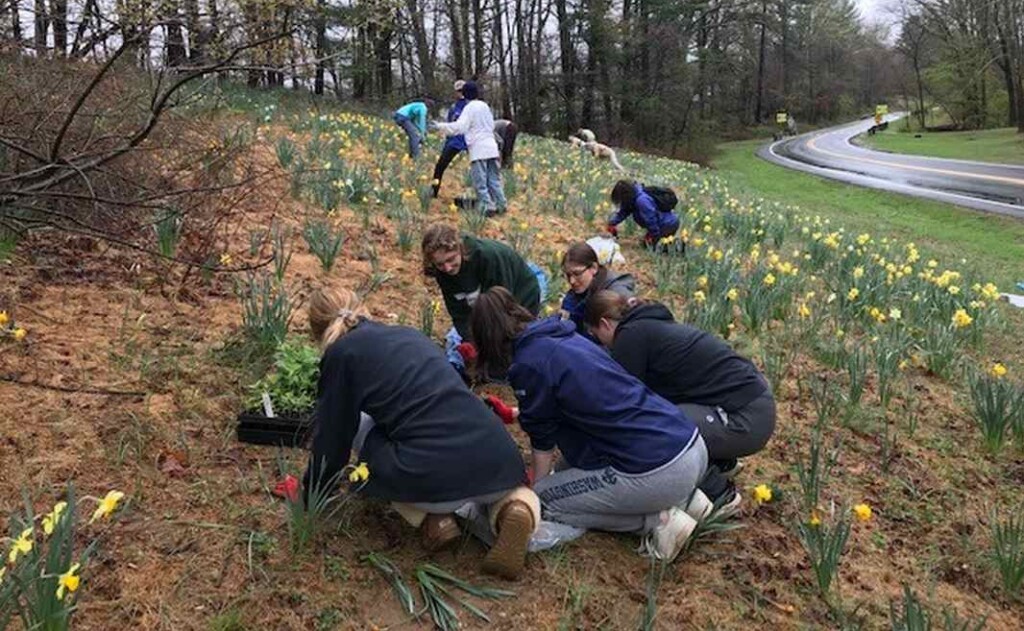
Weed Warriors planting native species – retrieved from Montgomery County Parks

The Weed Warriors website states that non-native, invasive plant species (NNIs) can alter the complex webs of plant-animal associations that have evolved over thousands of years to such a degree that plants and animals once familiar to us are eliminated.

In meadows, for example, NNI monocultures can threaten butterfly populations because they can no longer find the native host plants they depend on for survival. In forests, NNI vines can strangle and smother trees. NNI shrubs can displace and shade out native plants that provide birds and other wildlife with food and shelter.

MORE NEWS LIKE THIS: Eagle Scout Leads Volunteers to Build Accessible Path Up to Beautiful Popular Overlook

Recent research has even shown that NNIs can alter soil chemistry and disrupt the growth of the mycorrhizal fungi on which healthy forests depend.

Anyone who feels this is something they want to contribute their time to can go to the Montgomery County Parks website here and look at the upcoming Weed Warrior events—the next one is October 21st.

SHARE This Awesome Opportunity To Get Out In Nature With Neighbors… 

“There is more pleasure in loving than even being beloved.” – Thomas Fuller

Quote of the Day: “There is more pleasure in loving than even being beloved.” – Thomas Fuller

Photo by: Copyright ABC

With a new inspirational quote every day, atop the perfect photo—collected and archived on our Quotes page—why not bookmark GNN.org for a daily uplift?

Swedish Firm Will be Mailing Flat-Packed Car with Top Speed of 55 for Urban Commuting

Luvly O
Luvly O

It isn’t likely to be your next home DIY project, but there is a company that’s looking to turn IKEA’s flat-packed furniture design into cars.

The Swedish vehicle start-up Luvly is finishing up its inaugural model, the O, which is designed to be so light and modular that it can be flat-packed to save thousands of tons of emissions from vehicle shipping.

Designed for urban commuting, the Luvly O will have two 35-pound battery packs that can be switched out to extend its small range of just 62 miles. With a top speed of 55 miles per hour, the car is 37 inches shorter than the already-small Fiat 500.

It has also been designed with a key safety feature to fortify the drivers of these small cars against crashes.

“For light vehicles to compete with cars, and hopefully out-compete cars, they must be safe. People will not accept that you switch from driving an SUV to driving what is essentially a scooter with a shell,” Håkan Lutz, CEO and co-founder of the car firm, told CNN. 

Taking inspiration from Formula-1 cars’ light yet rigid aluminum chassis, Luvly has created a dual layer of foam on the outside and inside of the vehicle’s skeleton to help absorb kinetic force.

Priced at €10,000 ($10,500), the car isn’t flat-packed and shipped to you, but to an authorized dealer for assembly, but Lutz told CNN that it isn’t just the car they’ll be sending to other firms.

They will be licensing their patented flat-packed technology to big automobile manufacturers in the hope that the design will catch on and that they might even continue to innovate the concept and drive it forward towards a more sustainable future.

OTHER SUSTAINABLE INVENTIONS: How a Tiny Injured Kitten Kickstarted an Entire Sustainability Initiative to Eliminate Plastic

“We don’t envision that we will be major producers of vehicles, but we anticipate we will be minor producers of vehicles, to advocate for and develop the technology,” says Lutz. “Despite wanting to license this to others, we also wish to stay on top of the game and be the best at our platform.”

The company claims that the Luvly O is 80% more environmentally friendly to manufacture even than other EVs, and that most of the components are recyclable, and can be manufactured from already existing sustainable materials.

SHARE This Billy Bookshelf On Wheels With Your Friends… 

Mom and Daughter Reunite With Nurse Who Saved Their Lives 30 Years Ago–Now as Co-Workers

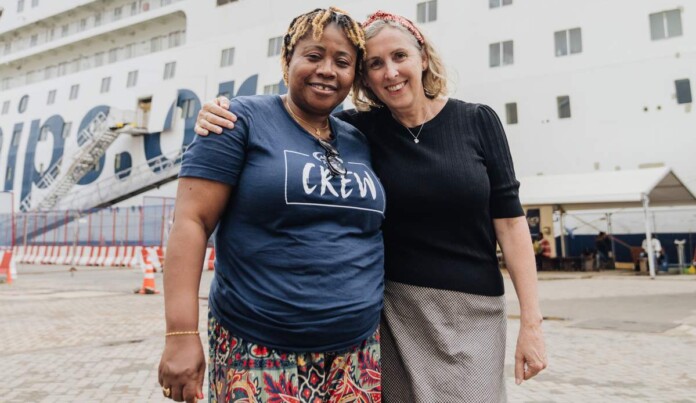
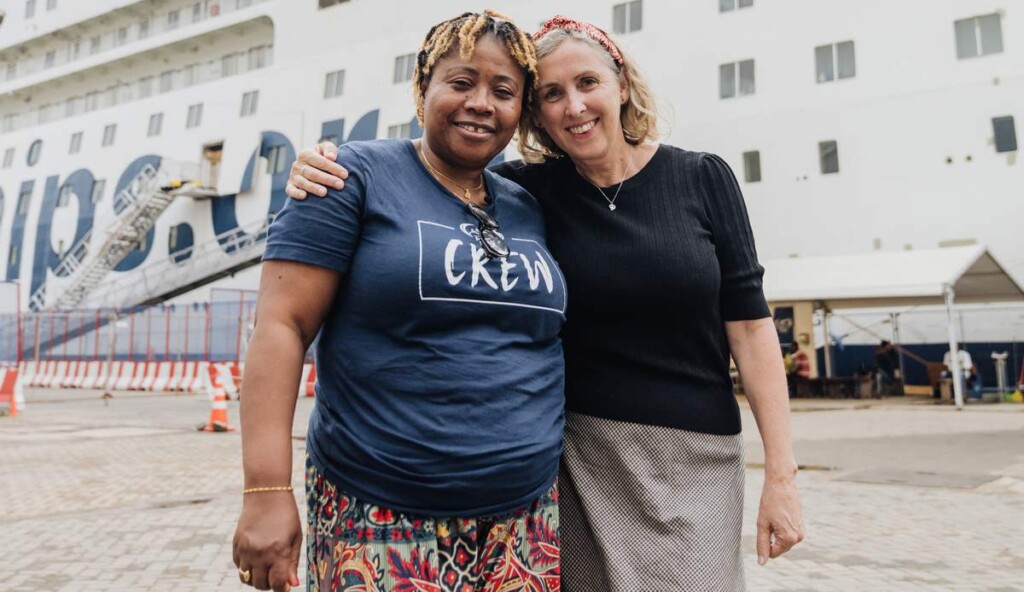
Catherine and Aly meet after 30 years - SWNS
Catherine and Aly meet after 30 years – SWNS

30 years and a continent separated Catherine Conteh, her daughter Regina, and a nurse named Aly who was visiting their home in Sierra Leone and saved her life by funding an emergency surgery.

Regina wasn’t born on the day of that fateful meeting, technically, because Catherine was dying after four days in labor. Unable to afford a Caesarean section, that might have been the end if not for Aly Hogarth-Hall, then in her 20s, who was visiting the hospital from a nearby charity.

She managed to acquire the £70 cost for the surgery in 1993 and formed a close bond with Catherine and her new baby Regina, but lost touch.

Then 18 months ago, as Catherine and Regina prepared to go to work aboard a charity called Mercy Ships, which operates a hospital ship on the coast of Sierra Leone, they got to see Aly—now 52—as she climbed aboard for a stint of volunteer work.

“To see Catherine again, it’s very surreal really,” said Aly, who is working in the dining room with her while Regina is on nursing duties. “It’s not something I ever expected until we made contact again, 18 months ago or so, so it was overwhelming.”

“We just sobbed. We cried and cried,” Catherine quickly added.

Daughter Regina – SWNS
The Mercy Ships boat like the one where Catherine and Aly Met – SWNS

Mercy Ships operates hospital ships that deliver free surgeries and other healthcare services to those with little access to safe medical care, and it’s where she had originally met Catherine all those years before.

MORE HEARTWARMING REUNIONS: Rapper’s Insistence on Featuring Homeless People in Music Video Results in Family Reunion

“The nurse told me that she would die, and the baby would die,” Aly recalls.

Aly informed a colleague, a British anaesthetist Dr. Keith Thomson who was part of her tour group, who paid for the surgery.

“Then the nurses came up to me and explained, ‘Look, these strangers who came in are going to pay for your Caesarean section,'” recalls Catherine.

OTHER HUMAN INTEREST STORIES: NICU Nurse Adopts 14-Year-Old Teen Patient with Triplets, to Keep Their Family Together

Whilst visiting Catherine in the hospital was easy enough, they lost touch when Aly returned home to New Zealand and Regina gained asylum in Australia.

Catherine followed Regina there and they both became nurses, inspired by Aly.

They stayed in Perth, Australia, but Catherine regularly returns to Sierra Leone to serve her local community—even fundraising to found her own school.

The pair will spend the next month volunteering aboard the Mercy Ship while the ship’s crew carry out surgeries and train more than 200 Sierra Leonean healthcare professionals. Their bond remains as strong as ever, and this time they have no plans to lose touch ever again.

WATCH them reunited below from SWNS… 

SHARE This Heartwarming Meeting And Tear-Jerking Reunion… 

Europe’s First-Ever Private Rocket Blasts Off to Space Thanks to Spanish Company PLD

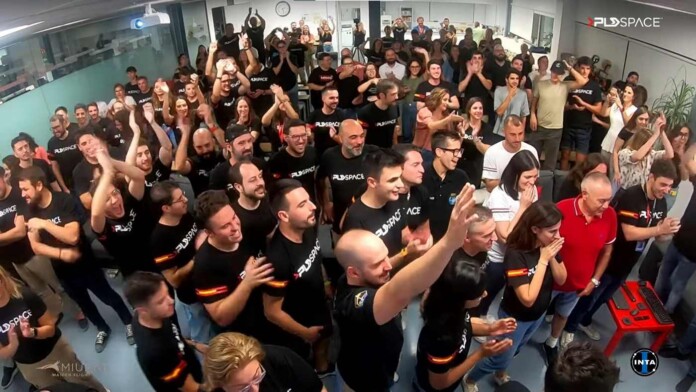
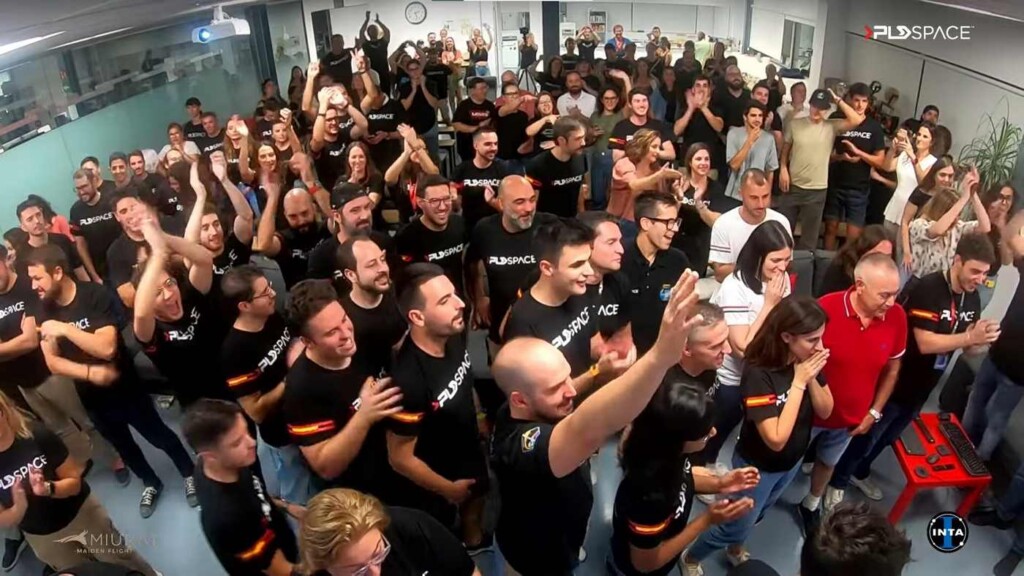
PLD team going nuts after their rocket test succeeded - credit PLA, retrieved from YouTube
PLD team going nuts after their rocket test succeeded – credit PLA, retrieved from YouTube

When was the last time American headlines read positive about the Spanish economy? Well now, thanks to the successful test flight of a Spanish reusable space rocket, let the presses ring out that Spanish innovation is alive and well.

Private astronautics company PLD has successfully proved the Miura-1 reusable rocket is capable of space flight, and that Spain is now the 10th country on Earth with direct access to space.

The rocket, named after a type of fighting bull from which an old Lamborghini model also took its name, flew 28.6 miles (46 kilometers) into suborbital space on a flight lasting 306 seconds.

Designed as a lighter, cheaper way for governments and companies to put satellites into orbit, the Miura has a payload of 220 pounds (100 kg).

“This launch is the result of more than 12 years of hard work, but it is only the beginning of what is to come,” PLD founder and Launch Director Raul Torres said in a statement.

“Thanks to this experimental flight, we will be able to extract a large volume of information that will allow us to validate a large part of the design and technology that will serve as the basis for developing our orbital launcher, MIURA 5.”

The mission ended with a splash in the Atlantic Ocean, with the company saying they were ready to retrieve it hours after the test launch concluded.

FROM THE SPACE ECONOMY: This Asteroid is a $10,000-Quadrillion Lump of Iron and a Potential Opportunity to Study an Exposed Planetary Core

Even though the hopes for the test flight were for an 80-kilometer journey and 12 minutes in microgravity, the success in other fields for the Miura-1 comes at an interesting time when the premier launching vehicle for European space entrepreneurs and agencies, the Ariane 5, is now unavailable as the Ariane 6 comes into the final stages of development.

GOOD SPANISH NEWS: Spain Generates 50% of its Power From Renewables in 2023, With Portugal Set to Hit 100%

However the Ariane 6 has faced delays, and the Russian Soyuz vehicle used occasionally by Europe is also unavailable due to the sanctions from the Ukraine invasion. These factors, coupled with a failed test from the UK’s Virgin Orbit, and a delay in perfecting Italy’s Vega-C rocket, have convinced PLD that Spain, seemingly out of nowhere, is now the leader in economic space flight in Europe.

The company will use the launch data to push toward a 2025 test date for the Miura-5, PLD’s finished product, with several launches in between to test various systems.

WATCH the launch below… 

SHARE This Spanish Innovation And Technical Triumph With Your Friends… 

Scientists Have Created Natural Sponges That Soak Up Nano-Plastics

By Sören Funk
By Sören Funk

Chinese scientists have created some experimental sponges out of starch and gelatin that can soak up microplastics which could be adopted in various places to reduce plastic pollution from entering the oceans.

The sponges are literally as light as a feather, and inside their pores, not only microplastics, but nanoplastic particles of less than one micron in size—or 1 millionth of a meter—can become trapped.

Sponges already serve a dozen purposes in society, but researchers at the College of Food Science and Engineering in the city of Qingdao, wanted to see if they could be applied to cleaning up microplastic pollution, which these days is a topic eternally close to the headlines for good reason.

Having been found in mass quantities at the deepest depths of the ocean, swirling around in the jetstream, raining down on national parks, and blowing over remote mountain peaks, microplastic pollution is everywhere on Earth. Scientists are still trying to study the adverse health effects of ingesting and inhaling as much as 50 credit cards worth of plastic per year.

The key, scientists speaking with Hakai Magazine say, is to cut out the microplastic pollution at its source. That’s where these sponges come in.

In testing their simple invention made from gelatin and corn starch, it was able to remove around 90% of micro and nano plastic particles from environmental and food matrices, including seawater, tap water, soil surfactant, and even take-out lunch soup.

MORE MICROPLASTIC SOLUTIONS: 

Christian Adlhart, a chemist at Zurich University of Applied Sciences in Switzerland, told Hakai that one of the best ways to use these sponges would be to throw a couple into your washing machine loads of synthetic clothing since it has been proven that tiny fibers shed during the rinse cycle enter the water supply.

“I think it would absorb a large fraction of the fibers,” said Adlhart, who published a similar paper in 2021 with sponges made of chitosan from crustacean shells.

OTHER GREAT IDEAS: Revolutionary Filter Uses Moss to Capture Pollutants And Microplastics Before You Drink Them

A big advantage to the sponges made by the team from Qingdao is that they are biodegradable, and so can be used liberally. They are also extremely light—weighing less than a flower petal, meaning they should be extremely cheap to produce. However, the chemical process they used to make them included formaldehyde, which the authors admit is a serious environmental drawback.

They believe that if their continued research to turn up an alternative to formaldehyde succeeds, then their plastic-absorbing sponges could be an effective means of reducing microplastic pollution in manufacturing and laundry applications.

SOAK Up This Good News And Expunge It On Social Media…

“The world is round so that friendship may encircle it.” – Pierre Teilhard de Chardin

Quote of the Day: “The world is round so that friendship may encircle it.” – Pierre Teilhard de Chardin

Photo by: NASA

With a new inspirational quote every day, atop the perfect photo—collected and archived on our Quotes page—why not bookmark GNN.org for a daily uplift?

Scientists Prove Gingers Are Totally Normal–Having Been Around for Millions of Years in Other Species

By Timothy Meinberg
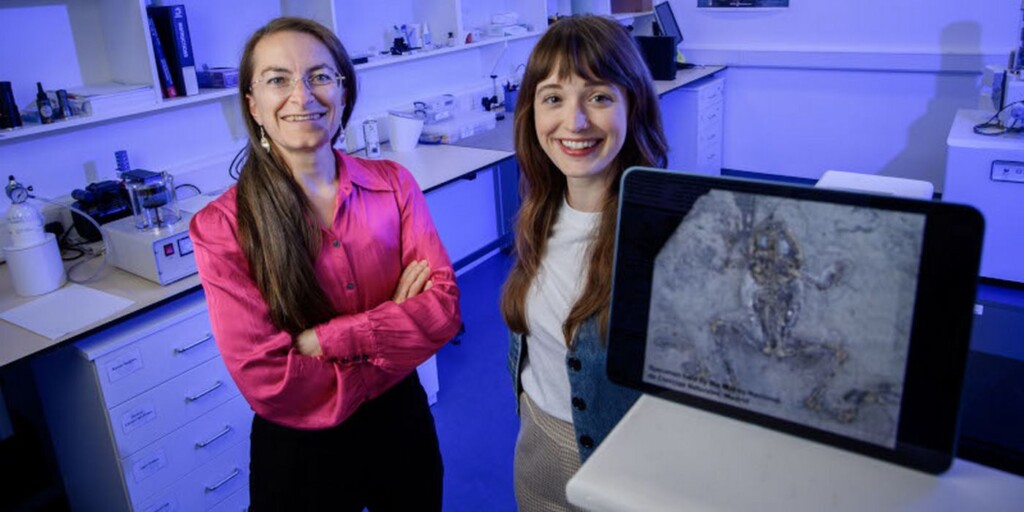
Prof. Maria McNamara (left) and Dr Tiffany Slater pictured at the School of Biological, Earth and Environmental Sciences at University College Cork. credit Daragh McSweeney/UCC

A pair of scientists have found fragments of ginger pigment molecules in fossilized frogs which they take to mean that most famous of genetic mutations has been around a long time.

University College Cork (UCC) paleontologists discovered molecular evidence of pheomelanin, the pigment that produces ginger coloration, in the amphibians dating back 10 million years.

On a more serious note, the findings of their study published in Nature Communications will enable scientists to better reconstruct the original colors of extinct organisms.

The research was led by UCC’s Dr. Tiffany Slater and Professor Maria McNamara who collaborated with Swedish, Japanese, and Chinese scientists.

“This finding is so exciting because it puts paleontologists in a better place to detect different melanin pigments in many more fossils,” said Dr. Slater. “This will paint a more accurate picture of ancient animal color and will answer important questions about the evolution of colors in animals.”

“Scientists still don’t know how or why pheomelanin evolved because it is toxic to animals, but the fossil record might just unlock the mystery.”

The team performed a series of lab experiments on black, ginger, and white feathers to track how pheomelanin pigments degrade during the fossilization process, which backs up their interpretations of the fossil chemistry.

MORE NEWS FROM IRELAND: The ‘Luck of the Irish’ is Real: Residents of Ireland Report More Good Fortune and Lucky Charms

“There is huge potential to explore the biochemical evolution of animals using the fossil record,” said. Dr. MacNamara.

In humans, red hair is specifically mentioned in peoples as far back as Ancient Greece. Over time, red hair has always been pointed out as a defining feature, particularly in Northern Europe and Central Asia.

By Timothy Meinberg

MORE VIEWS INTO OUR PAST: Some Generous Apes May Help Explain The Evolution Of Human Kindness

While thought to be typically Celtic, red hair was not uncommonly found in Kipchaks, Azeris, Uyghurs, Kyrgyz, and even Mongolians—in fact, some accounts put red hair and green eyes on the head of Genghis Khan himself.

However it’s Ireland where the concentration of pheomelanin is highest in humans, where roughly 10% of the population are gingers or red-headed.

SHARE This Fun Bit Of Science With Any Redheads You Know… 

Oldest Fossilized Human Footprints in North America Over 20,000 Years Old: New Study

White Sands footprints - SWNS
White Sands footprints – SWNS

It has long been hypothesized that humans arrived in North America while the last Ice Age was beginning to wane perhaps between 13,000 and 16,000 years ago, but after rigorous study and debate a new dating method for a set of fossilized human footprints found in White Sands, New Mexico shows humans were already here at least 21,000 years ago.

This was a time when the geographic extent of the ice sheet and glacier coverage on Earth’s surface peaked, known as the Last Glacial Maximum.

When the first set of results was published in 2021, it kicked off a global conversation among the science community as to the accuracy of the ages. Using radiocarbon dating of seeds from the common aquatic plant Ruppia cirrhosa found among the fossilized impressions, the team came up with 21,000 years ago.

However aquatic plants can acquire carbon from dissolved carbon atoms in the water rather than ambient air, which can potentially cause the measured ages to be too old.

Co-lead author of the new study on the same footprints, Dr. Jeff Pigati at the US Geological Survey, says the latest findings back up what they found originally.

“The immediate reaction in some circles of the archaeological community was that the accuracy of our dating was insufficient to make the extraordinary claim that humans were present in North America during the Last Glacial Maximum,” said Dr. Pigati.

MORE FOOTPRINTS: Prehistoric Human Footprints Unearthed in Spain are Nearly 300,000 Years Old and Unique in All of Europe

“But our targeted methodology in this current research really paid off.”

For the follow-up study the research team focused on radiocarbon dating of conifer pollen, because it comes from terrestrial plants and therefore avoids potential issues that arise when dating aquatic plants such as Ruppia.

The team used painstaking procedures to isolate around 75,000 pollen grains for each sample they dated. The pollen samples were collected from the exact same layers as the original seeds, so a direct comparison could be made.

In each case, the pollen age was statistically identical to the corresponding seed age.

YOU MAY ALSO LIKE: Much Like Stonehenge, Solstice Sunlight Would Have Danced on the Walls of This Neolithic Spanish Tomb

“Even as the original work was being published, we were forging ahead to test our results with multiple lines of evidence,” said Pigati’s co-author, Kathleen Springer, also at the USGS. “We were confident in our original ages, as well as the strong geologic, hydrologic, and stratigraphic evidence, but we knew that independent chronologic control was critical.”

The USGS team also used a different type of dating called optically stimulated luminescence, which dates the last time quartz grains were exposed to sunlight.

OTHER PALEOLITHIC FINDS: Early Man Was Building Lincoln Log-like Structures 500,000 Years Ago, New Preserved Wood Shows

Using that method, they found that quartz samples collected within the footprint-bearing layers had a minimum age of around 21,500 years, providing further support to the radiocarbon results.

White Sands National Park writes the following about the footprints found in the park thus far, which along with human imprints include those of the dire wolf and giant ground sloth.

In 2018, researchers discovered what they believe to be footprints of a female. They tell a story that may seem familiar today; her footprints show her walking for almost a mile, with a toddler’s footprints occasionally showing up beside hers. Evidence suggests that she carried the child, shifting them from side to side and occasionally setting the child down as they walked. The footprints broadened and slipped in the mud as a result of the additional weight she was carrying.

Based on stature and walking speed, it appears that most of the footprints in [the 2021 papre] come from teenagers and children. As reported in the journal Science,

“One hypothesis for this is the division of labor, in which adults are involved in skilled tasks whereas ‘fetching and carrying’ are delegated to teenagers. Children accompany the teenagers, and collectively they leave a higher number of footprints that are preferentially recorded in the fossil record. This pattern is common to all excavated surfaces.”

SHARE And ADD This National Park And Footprints To Your Travel Plans…

Painting of Jesus’ Birth Valued at $15K Turns Out to Be Monumental Rembrandt Worth $18 Million

Rembrandt painting detail-The Adoration of the Kings-released Sotheby's
Rembrandt painting detail – The Adoration of the Kings. Released from Sotheby’s

A new Rembrandt has been discovered—disguised as another artist’s work, potentially making the owners millionaires as it goes up for auction at Sotheby’s.

While unknown or lost works from the Dutch master painter have been found occasionally over the last three decades, they are mostly head portraits or character studies. This large Adoration of the Magi marks the first opportunity to learn more about the famous artist in a long time.

It is believed to date from Rembrandt’s very early professional days as a painter in Leiden.

Bought in 1985 and auctioned at Christie’s in Amsterdam in 2021, the auction house’s experts identified the painting as coming from the “Rembrandt circle,” and it was presumed to be from an apprentice or artist from the same time and place.

The buyer shelled out $860,000 even though the opening price was around $15,000. Set up for auction again—this time at Sotheby’s, a long and complex verification process that included multiple forms of scientific imaging has placed the painting not at the feet of an apprentice, but of the master himself, jacking the price up to around $18 million.

“I would say that it’s particularly significant because it adds to our understanding of Rembrandt at this crucial date in his development and career, when he was clearly very ambitious and developing very quickly as an artist,” George Gordon, co-chairman of Old Master Paintings Worldwide at Sotheby’s, said in a phone call with CNN.

The monochrome painting measures less than 10 inches tall.

A bit strangely, the historical research done on the painting showed it turned up in the 18th and 19th centuries when it was referenced as a painting by Rembrandt van Rijk.

The Adoration of the Kings by Rembrandt – Sotheby’s

Reappearing in the 1950s, it was still recognized by scholars as a Rembrandt work—and it even hung in museum collections, until a German art scholar who knew the painting only from a black and white photograph, referred to it as one of the “Rembrandt school” and omitted it from the critical art review catalog he was compiling—and it vanished from memory after.

MORE NEWS LIKE THIS: Painting Assumed to Be a Copy is Real–After Note is Found Hidden in Frame Making it Worth Thousands

MORE HIDDEN MASTERWORKS: Artwork Found in Shed Covered in Bird Droppings Turns Out to be Early Van Dyck Now at Auction for $3 Million

“Very few narrative paintings by Rembrandt remain in private hands, making this an opportunity for a private collector or an institution that is as rare as it is exciting,” Gordon said in a news release.

“This sophisticated painting is in equal measure a product of Rembrandt’s brush and his intellect. All the hallmarks of his style in the late 1620s are evident both in the visible painted surface and in the underlying layers revealed by science, showing multiple changes in the course of its creation, and casting fresh light on how he thought,” he added.

SHARE This Exciting Addition To The Story Of The Great Man On Social Media…

“Our lives are not moving straight ahead; instead, hovering, wavering, returning, renewing, repeating.” – James Hillman

Quote of the Day: “Our lives are not moving straight ahead; instead, hovering, wavering, returning, renewing, repeating.” – James Hillman (We highly recommend his book, The Soul’s Code…)

Photo by: Tom Dils

With a new inspirational quote every day, atop the perfect photo—collected and archived on our Quotes page—why not bookmark GNN.org for a daily uplift?

Snowy Husky Pups Get Adopted Together After Being Thrown Over Shelter Fence

credit Jackson County Animal Shelter

A couple of beautiful puppies have found a new home after a difficult start to life.

Workers at an animal shelter in Jackson, Michigan were shocked when in early September they found a pair of snow-white husky puppies in their facilities.

Security footage showed a pickup truck arriving at the Jackson County Animal Shelter fence and dropping the two animals, one male and one female, over the top.

At 6 months old, Ryder and Rayne should have been around 25 to 30 pounds, but weighed in at just 8 and 11 respectively.

However, things soon began to look up for the siblings, who managed to move up to a healthy weight and recover their puppy energy before entering foster care last Monday.

“From suffering from neglect, malnutrition and parasites then being thrown over a fence… these two survivors are now ready to live their best life in a loving home!” the shelter shared on social media.

According to the shelter, the team ultimately found the person responsible for abandoning the dogs with an investigation continuing.

SHARE This Sweet Pair Of Handsome Survivors And Their New Home…

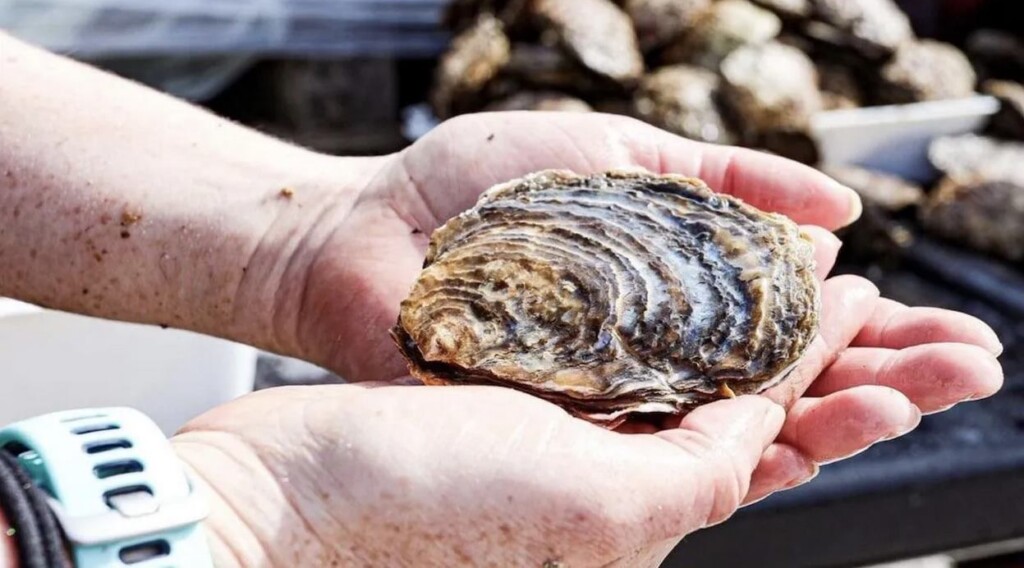
10,000 Native Oysters Released on Homemade Reef off England’s Coast to Filter Pollutants, Block Storm Damage

wild_oysters_project / Instagram

Britain was once a paradise of oysters, and one conservation group hopes that if they continue their pioneering work, it can be so again.

The Wild Oysters Project in the UK just released 10,000 oysters to live wild, undisturbed lives off the northeast coast of England near Newcastle-upon-Tyne.

Oysters are a vital part of marine ecosystem health because of the amount of water they can filter every day in search of simple sustenance. A single oyster can filter 50 gallons of water per day, or over 100 liters, cleaning out nitrogen and other pollutants.

Their reefs also form natural and important breakwaters that reduce storm impacts on the shore.

With such a dirth in oyster populations, the Wild Oysters Project built up an artificial reef made of 827 tons of scallop shells and stones to mimic the natural materials of oyster reefs before releasing the bivalves.

MORE BRITISH MARINE LIFE: Once Biologically Dead, the River Mersey in England is “Best Environmental Story in Europe”

“Native oysters are ecosystem engineers, which means they change and improve the environment around them,” said Matt Uttley, restoration project manager at the Blue Marine Foundation, according to a press release from the Zoological Society of London. “Native oysters create a structurally complex three-dimensional habitat, which supports an abundance of other marine life and is intrinsically linked with ecosystem biodiversity.”

The oysters on the new reef are not intended for human consumption but for their services as ecosystem engineers.

ANOTHER STORY LIKE THIS: Sustainable Seagrass High in Omega-6 and Protein is Better Than Rice For This Master Chef

“Today marks an important milestone in our journey to restore native oyster reefs to British coastlines,” said Wild Oysters Project Manager Celine Gamble.

“We’re optimistic that the 10,000 oysters will thrive, reproduce, and grow on the new reef, which is the size of a football pitch, and we look forward to carefully monitoring their progress over the coming months.”

Wild Oysters Project has so far released more than 1 billion oyster larvae, and they maintain restoration reef sites in 6 marinas around England.

WATCH the story below from the ZSL… 

SHARE This Inspiring Rewilding Effort With Your Friends… 

Watching Symphonies Can Synchronize Heart, Lungs, and Even Electrical Impulses of the Listener

credit Manuel Nageli

The perfect synchronicity of a classical symphony has the power to similarly synchronize the movement, heart rate, breathing rate, and the electrical conductivity of skin between audience members,

The beautiful finding comes from a study of 132 people and three classical pieces: Ludwig van Beethoven’s “Op. 104 in C minor,” Brett Dean’s “Epitaphs,” and Johannes Brahms’ “Op. 111 in G major.”

Previous studies, the authors note, have shown that music may be able to induce synchronization in listeners, but there has been little investigation into whether concert audiences become synchronized.

Most synchronization in humans is caused by a direct social interaction with another person and is typically found in breathing or walking.

Professor Wolfgang Tschacher and his colleagues at the University of Bern in Switzerland observed 132 people whilst they listened to a string quintet of the three pieces whilst monitoring them in several ways.

Participants’ movement was tracked with overhead cameras and their physical responses with wearable sensors. They were also asked to fill out a questionnaire about their personality and mood.

The authors observed significant synchronization between audience members for movement, heart rate, breathing rate, and the electrical conductivity of skin (which indicates arousal of the sympathetic nervous system). The greatest level of synchronization was seen in the breathing rate.

Additionally, the personality traits of a listener were associated with their likelihood of synchronizing physical responses—those with agreeableness or openness traits were more likely to become synchronized, whilst those with neurotic or extravert traits were less likely to become synchronized.

These are four of the “Big Five” personality traits, with openness being typical of creative types, and agreeableness found in people who find tension and conflict very difficult.

MORE INTERESTING STUDIES: Metabolism Does Not Slow Down in Mid-Life as is Commonly Believed, Says Study

The authors note that they experienced gaps in data collection due to prioritising wearer comfort over data quality when choosing sensors, and suggest that more reliable data collection methods are necessary for future studies.

Music in general is a fascinating phenomenon. While frequencies can vary significantly between sounds, all sounds we detect in our reality fall essentially within 12 music notes, or more fractionally, on microtones between those 12.

OTHER SURPRISING POWERS OF MUSIC: Children Do Much Better in Math When Music is Added to the Lesson: New Study

Some of those 12 notes will at certain times blend frequencies with other notes in a non-disruptive way. “Off-pitch” or “out of tune” notes are deeply disturbing in a musical ensemble as complicated as a symphony, and humans have the ability to pick them out with ease.

With each additional musician and instrument into the ensemble, the task of ensuring all notes arrive with one another in harmony increases in difficulty, and is perhaps why attentive listeners begin to follow the music with their physiology—the necessity of all parts fitting together is imperative to an enjoyable performance.

SHARE This Fascinating Finding With Your Musically-Inclined Friends…

Massachusetts Innovators Aim to Turn Ocean Plastic into Fuel–Right Onboard the Ship

WPI Chemical Engineering Professor Mike Timko at work in his lab. (Photo Business Wire)

Chemical engineers are pioneering a process to equip diesel ships with the onboard capacity to turn collected plastic garbage into fuel.

The result has been dubbed “blue diesel” and would save time, money, and emissions in both the trips necessary for ocean-cleaning vessels to reach the mainland to offload and in running fuel use.

Millions of tons of plastic enter the oceans every year and tend to accumulate in the ocean “gyres”—specific zones where several currents meet, but which can still be thousands of square miles.

Even though the ocean does the work of rounding up the trash for cleanup organizations like The Ocean Cleanup to then collect, it still requires a lot of time to sail back and forth from these gyres to offload plastic on land and to refuel.

Professor Nikolaos Kazantzis and Michael Timko at the Worcester Polytechnic Institute in Massachusetts took a lot of inspiration and perseverance in their work of developing blue diesel from the fact that the chemical bonds of plastic and those of fossil fuels are essentially the same.

“Our research team is modeling a specialized reactor that converts harvested waste plastic using an innovative chemical process called hydrothermal liquefaction (HTL),” Kazantzis told Cambridge press last year. “This compresses the plastic at high temperature and high pressure into “blue diesel” (the name emphasizes its marine origins).”

Their work was funded by a two-year, $259k grant from the National Science Foundation’s (NSF) 2026 Idea Machine competition.

MORE GOOD CLEANING NEWS: Apple Co-Founder Steve Wozniak Launches Company to Clean Up Space Debris

Team member and fifth-year Ph.D. candidate Elizabeth Belden said that the technology would also be exceptionally useful on rivers, since they would require less fuel to navigate on, and since the overwhelming majority of plastic in the ocean enters it via major river systems.

They modeled the economics of the project based on existing datasets of the Great Pacific Garbage Patch in the Pacific Ocean, one that’s already being cleaned by several groups using large ship-mounted booms and nets.

“The project is still in the early stages,” Nikolaos says, “but it appears that economically, the HTL system is a modest additional cost relative to the clean-up vessel and boom system.”

MORE GREAT INNOVATIONS: Robots That Look Like Manta Rays Will Sink Seaweed to Ocean Floor–Will Help Absorb Carbon

“The next challenge will be to creatively structure the portfolio of the public policy responses of collecting and removing waste plastic – including the impact on marine and human health. We will have to have reliable rigorous scientific responses to inform and incentivize.”

WATCH the story from NBC News 10 Boston… 

SHARE This Radical Idea Of A Plastic Powered Plastic Clean-Up… 

“To begin, begin.” – William Wordsworth

Quote of the Day: “To begin, begin.” – William Wordsworth

Photo by: Glenn Carstens-Peters

With a new inspirational quote every day, atop the perfect photo—collected and archived on our Quotes page—why not bookmark GNN.org for a daily uplift?

Born Without an Arm She Now Has a Realistic Prosthetic With Painted-on Freckles and Acrylic Nails

SWNS
SWNS

A student born without a left arm has a “new lease of life” thanks to her prosthetic limb with painted-on veins, freckles and acrylic nails.

Zahra Tabibniya says she felt embarrassed during her school years and wanted to hide the truth.

She tried different prosthetics–including a heavy limb made of silicone–but now she has a lightweight one that looks real and allows her to tie her laces and do her hair.

The $850 (£700) silicone prosthetic looks natural with painted-on veins, freckles, moles and acrylic nails. The 23-year-old even got a color touch-up to match her summer tan.

“Prosthetics started off as a disguise for my disability, a shield against the bullying, but it’s just a part of me now.”

“People think it’s just a cosmetic thing because it looks natural, but it actually has most of the function an actual arm has.”

Zahra is delighted to be able to carry her own luggage, check her phone and tie her laces thanks to her prosthetic arm—and says it has given her much more freedom.

LOOK: Woman Who Lost Eye As Baby Wears Glitter Eyeballs to Own Her Difference

SWNS

“So many of the ones I used to have really hindered the way I moved, especially if they were heavier,” said the pharmacy student from Iran studying at the University of Rome in Italy.

But at the age of 21, Zahra was introduced to her current doctor, Dr. Khaghani, at the Behboodteb Clinic, in Tehran.

She says he was the “first doctor in the world” to use the type of silicone prosthetic Zahra has—and she only needs to get it replaced every two years.

Zahra says it is fun to watch it being customized. Acrylic nails are attached to the hands which can be painted.

SWNS

“They’re the exact same material you get done when you go to the nail salon.

“You can get moles and freckles spray-painted on there; you can actually tattoo them as well, if you want.”

FUN: Woman Shocked to Be Reunited With Prosthetic Leg After Scuba Diver Happened to Find It the Next Day

Zahra feels like she’s gained “around 60 percent” of function in her new left arm—and can now do a number of everyday tasks with much more ease than before.

Zahra now takes time to educate people about her disability and documents the making of her prosthetic arm on TikTok.

“For a long time, I just wouldn’t tell people I was disabled,” she said. “I would tell people after a week or two. That way, they’d get to know me before judging me.

AWW, CUTE: When Prosthetic Makers Said it Couldn’t Be Done, Dentist Gives Orphaned Koala a New Foot

“But being open about it has actually given me the opportunity to educate people about my disability.

“The kids who bullied me were influenced by the adults around them, just as much as their friends.

“Kids are always going to speculate—their imaginations go wild. But parents and teachers just told them not to ask questions.

“I want people to ask questions. The more questions they ask, the more educated they become.”

BUST A STEREOTYPE By Sharing The Uniqueness on Social Media…

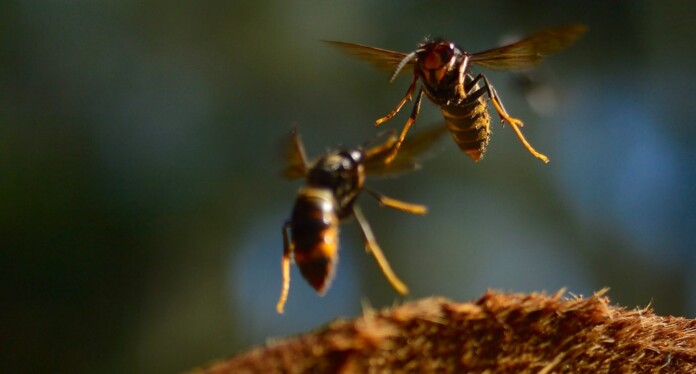
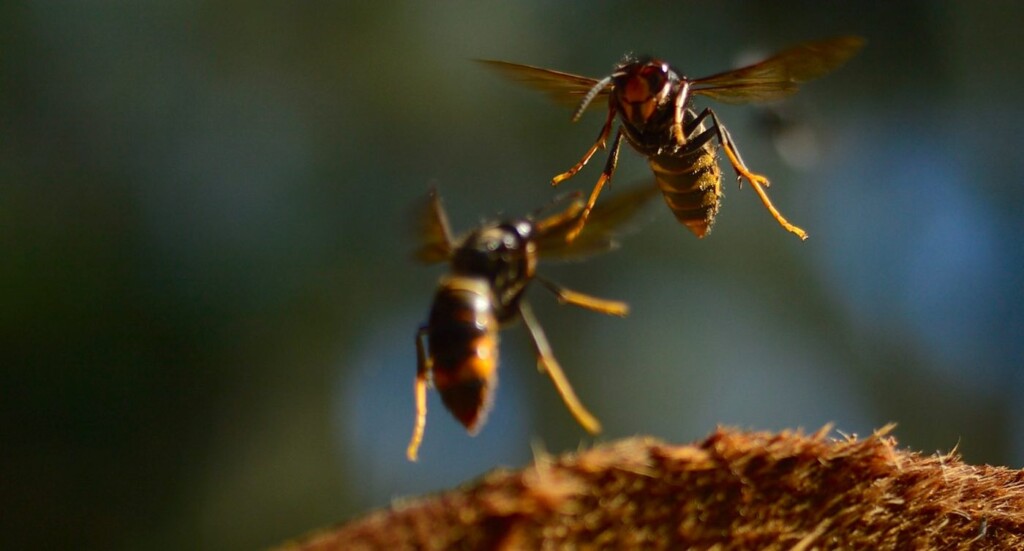
Bumblebees are Hitting Back at Asian Hornets With Top-Tier Combat Skills, Reveals Research

Asian hornets by Sandra Rojas-Nossa – University of Exeter

Bumblebees have top-tier combat skills when targeted by Asian hornets, reveals new research.

Buff-tailed bumblebees drop to the ground when hornets attack—carrying the pests down with them, according to the findings.

Hornets lose their grip as they drop, or the bee raises its sting and fights until the hornet gives up.

“Stunned” scientists at University of Exeter witnessed 120 attacks that took the same course, with the bee triumphing each time.

The invasive pests, also known as yellow-legged hornets, have already invaded large portions of mainland Europe and parts of east Asia and have for the first time been spotted in the US. Sightings in the UK and mainland Europe are at an all-time high this year—but people are fighting back, fearing for pollinators such as bees.

“With honey bees, the hornets do something called ‘hawking’—hovering outside the bees’ nest and attacking returning foragers as they fly past,” said Dr. Thomas O’Shea-Wheller at the University of Exeter.

RELATED: French Beekeeper Invents a Trap to Take on Asian Hornets Decimating Bee Populations in Europe

“(But) we recorded hornets doing the same thing to bumblebees, but with the surprising difference that in our observations, they were entirely unsuccessful.”

“Although the attacks we witnessed at colony entrances were unsuccessful, defending against such attacks is likely energetically costly,” said Dr. O-Shea-Wheller, whose team published the study in Communications Biology. “And when hornet abundance is high, this could be a major problem for bees out foraging.

“Hornets also consume nectar from flowers, meaning they compete directly with bees for food and harass them at flower patches.

The team placed commercially reared colonies of buff-tailed bumblebees, Bombus terrestris, in 12 locations across the province of Pontevedra, Spain, with varying densities of Asian hornets.

FASCINATING: Bumblebees Learn New ‘Trends’ for Their Behavior by Watching Each Other and Learning

SHARE the Positive Buzz With Bee Lovers on Social Media…

Largest Dam Removal in History Begins Restoring Salmon and California Tribal Way of Life

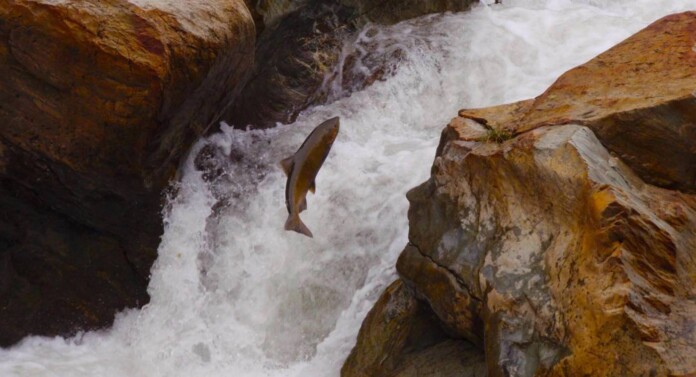
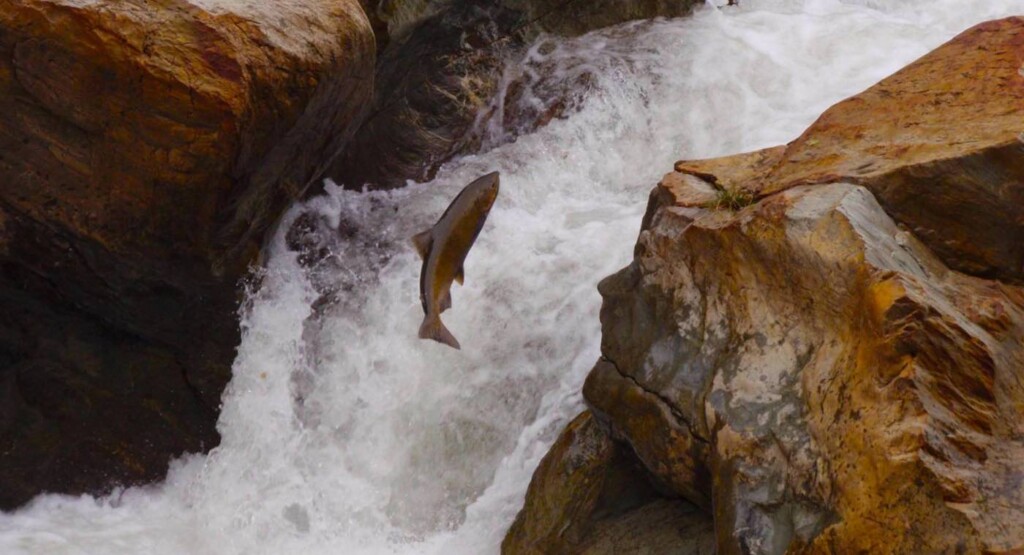
Leaping Salmon by Mid-Klamath Watershed Council

After 20 years of advocacy and legal challenges, the largest dam removal in history is returning the Klamath River in California to its natural state.

In partnership with tribal nations, the demolition of four hydroelectric dams will allow wild salmon from the Pacific to run upstream and spawn again as they haven’t done for 100 years.

This week, the Klamath River Renewal Corporation began preparing a stretch of the river to flow freely for the first time in a century.

The soon-to-be dismantled Klamath Hydroelectric Project has blocked fish passage and altered river flows in a place sacred to the Shasta Indian Nation.

In 1925, the construction of Copco No. 2 dam was completed, diverting the river, and in the absence of sustained flows, a dense stand of trees colonized the riverbed within the steep canyon. The Yurok Tribe joined the partnership to clear the alder and cottonwood trees from the river corridor, while leaving all floodplain vegetation intact.

“It fills my heart to know that salmon will migrate through this river reach on their way to spawn in the upper basin,” said Yurok Vice Chairman Frankie Myers. “For the last century, we have watched the dams suffocate the life out of the river (and) I would like to thank the KRRC and the Shasta Indian Nation for the opportunity to help our salmon runs and our river recover for our children and the next generations.”

The Klamath dam removal project broke ground in June 2023, after the Federal Energy Regulatory Commission (FERC) issued the approval that allowed construction crews to get to work on the deconstruction of Copco No. 2 dam, due to be fully removed by the end of September. Iron Gate, JC Boyle and Copco No. 1 dams will be deconstructed next year in what is considered the largest salmon restoration project in history.

“Seeing the revitalization of this river canyon is incredible,” exclaimed Mark Bransom, CEO of the Renewal Corporation.

ALSO CHECK OUT: Chinook Salmon Introduced to Mountain Streams Not Inhabited for 100 Years

Iron Gate Dam – Credit: Michael Wier for CalTrout / Klamath River Renewal

Prior to construction of the dams, the Klamath supported one million spring and fall Chinook or king salmon as well strong populations of steelhead trout, sturgeon, Pacific lamprey and many other native fish species. This fall, it is predicted that less than 25,000 Chinook will return to the river.

But, after the dams are removed, fisheries experts expect fish numbers to gradually increase in response to renewed access to historic spawning grounds and improved ecosystem health.

The four dams had denied salmon access to hundreds of miles of historical habitat, degraded water quality, and fostered the spread of fish diseases. Scientific studies and dam removal efforts in other watersheds demonstrate that removing dams can reverse these trends.

LOOK: 13-Foot Sawfish Spotted Farther North Than Any in Decades Hints at Recovery of Species

This month’s demolition work is promising not only the return to ancestral ways of life for the various tribes on the Klamath River, but a robust increase in commercial salmon fishing because the salmon runs are less than 5% of their historical abundance.

“The Klamath salmon are coming home,” proclaimed Yurok Chairman Joseph James. “The people have earned this victory and with it, we carry on our sacred duty to the fish that have sustained our people since the beginning of time.”

SPLASH SOME GOOD NEWS on Fishing Lovers Using Social Media…