What began in 2008 as a single life jacket loaner booth for boaters to borrow any size preserver before going on the water, has now turned into the world’s largest life jacket loaner program.
And, they crossed a huge milestone last month, setting up location number 1,000 at the beach in Clearwater, Florida.
The program now operates loaner stations in all 50 states, plus Washington, D.C., American Samoa, and the Virgin Islands—all thanks to a Long Island, New York captain.
Capt. Joe Frohnhoefer kept seeing boating accidents and tragedies that could have been prevented, so he decided to start the nonprofit Sea Tow Foundation in 2007 to provide the education and resources to eliminate them.
He started the Life Jacket Loaner program the following year to prevent drowning by providing free life jackets that boaters of any size can borrow and return at the end of their outing.
The lifelong seafaring New Yorker passed away in 2015, but his legacy lives on through the efforts of the foundation and his daughter Kristen, who is now president of the board.
“Since 2008, we’ve distributed over 90,000 life jackets,” said Gail Kulp, the group’s Executive Director.
Sea Tow Foundation
“We believe that financial struggles or lack of access to resources should never be an obstacle to safety.”
“It’s truly game-changing when someone puts on a life jacket,” according to Capt. Kahle, the Commander of US Coast Guard in St. Petersburg. “The statistics don’t lie—life jackets save lives.”
“This means an awful lot from an outreach and education standpoint,” said Brian Rehwinkel, Florida Fish & Wildlife Conservation Commission. “If you don’t have a life jacket, you can’t wear one. With this program there’s no reason for someone to go out on the water without one.
American biotech company Biogen announced the results of a phase 3 clinical trial that showed a new Alzheimer’s drug slowed the rate of cognitive decline for early onset patients by 27%.
The Alzheimer’s Association (AA) called the robust study of lecanemab, which is a monoclonal antibody designed to clear clumps of amyloid protein from the brain, “the most encouraging results in clinical trials treating the underlying causes of Alzheimer’s to date.”
The CEO at Eisai—the Japanese pharmaceutical company partnering with Biogen—claims the results of the lecanemab study, named Clarity AD, “proves the amyloid hypothesis, in which the abnormal accumulation of Aβ in the brain is one of the main causes of Alzheimer’s disease.”
Eisai believes these findings will create new horizons in the diagnosis and treatment of Alzheimer’s disease as well as further activate innovation for new treatment options.
The study enrolled 1,800 patients with early stage Alzheimer’s, with half receiving placebo and half receiving twice-weekly infusions of the lecanemab. Results showed the drug did reduce toxic amyloid plaque in the brain and slow patients’ memory decline, while improving their ability to perform day-to-day tasks.
The full analysis of the trial has yet to be released.
Alzheimer’s advocates and researchers look forward to learning more about the data at a meeting in November, including participant safety and the percentage of patients who experienced any brain swelling.
“If those data are consistent with what we saw today regarding efficacy and safety, we strongly support FDA approval and full [Medicare] coverage,” added the AA in a statement.
“Today’s announcement gives patients and their families hope that lecanemab, if approved, can potentially slow the progression of Alzheimer’s disease, and provide a clinically meaningful impact on cognition and function,” said Michel Vounatsos, Chief Executive Officer at Biogen.
The U.S. Food and Drug Administration (FDA) has agreed that the results of the 18-month trial can serve as the confirmatory study to verify the clinical benefit of lecanemab, setting a date of January 6 to announce its decision.
However, researchers say that amyloid is only one component of Alzheimer’s disease—and some are calling the benefits measured in this trial “small”.
Amyloid is “associated with the problem, but it isn’t ‘the’ problem”, a neurobiologist at the University of Texas and a sceptic of the amyloid hypothesis told NATURE. “If you modulate it, of course you can have some small benefit.”
But others are chiming a much more hopeful note.
“This is a historic moment for dementia research, as this is the first phase 3 trial of an Alzheimer’s drug in a generation to successfully slow cognitive decline,” said Dr Susan Kohlhaas, the director of research at Alzheimer’s Research UK.
“Many people feel Alzheimer’s is an inevitable part of aging. This spells it out: if you intervene early you can make an impact on how people progress.”
HOPEFUL? Then, Share the Results on Social Media to Spread the Optimism
Quote of the Day: “Conduct your blooming in the noise and whip of the whirlwind.” – Gwendolyn Brooks
Photo by: Daniel Weiss
With a new inspirational quote every day, atop the perfect photo—collected and archived on our Quotes page—why not bookmark GNN.org for a daily uplift?
Being given an illicit drug called ketamine and then looking at smiling faces could help end depression, according to a new study.
Researchers found that reading happy words and looking at happy faces, including one’s own, can prolong ketamine’s antidepressant effects for months.
Besides its use as an illicit party drug, ketamine was approved by the US FDA in 1970 for use as an anesthetic to kill pain, and was used in treating injured soldiers on the battlefields in the Vietnam War.
Doctors began to realize that the drug had powerful effects against depression and suicidal thoughts: Called ‘the speedster of antidepressants’ because it works within hours, emergency responders sometimes give it to agitated people rescued from suicide attempts.
In a new therapy developed at the University of Pittsburgh for those suffering with treatment-resistant depression, just one ketamine injection was followed by automated computer-based training that used positive words and imagery to improve how a person sees themselves.
Words such as “sweet”, “lovable” and “worthy” will flash on a screen alongside the patient’s photo and pictures of smiling people.
The scientists behind the plan have found depression can be kept at bay for at least a month if the digital techniques are used when ketamine has prepared the brain’s plasticity.
“Using simple conditioning during the period after ketamine treatment, when the brain is receptive to soaking in new information, allows us to go after key features of depression,” reports Dr. Rebecca Price, an Associate Professor of Psychiatry at the school.
“Training the brain to link perceptions of yourself with positive ideas during this ketamine-primed plasticity window exceeded my expectations.
“I was surprised and amazed to get such clear findings from an intervention that was so minimal.”
The results of the double-blind, randomized clinical trial conducted locally in Pennsylvania were published last month in the American Journal of Psychiatry.
According to a National Institute of Mental Health analysis, nearly 21 million American adults experienced at least one major depressive episode in 2020–and nearly 3 million of those diagnosed do not respond to traditional antidepressant medication. For people with such treatment-resistant depression, psychoactive drugs, such as ketamine, offer an alternative chance at long-term remission.
Though symptom relief can be felt just two hours after a ketamine infusion, the drug’s effects often wear off after a couple of weeks meaning patients go back for more. It’s not an easily accessible treatment either: In the US, ketamine infusions often come with high out-of-pocket costs and long waiting lists.
As a result, Dr Price and her team are reorienting their goals to improve access to intravenous ketamine treatment and boost its effect by pairing the drug with digital therapies.
“We are interested in creating an automated intervention that any computer or device can run, making it as accessible as possible.
“Our goal is to leverage digital technologies and develop a strategy that will efficiently extend time between appointments, save patients money and get more patients effective depression care.”
The clinical trial enrolled more than 150 adults with treatment-resistant depression. Following a ketamine infusion, one group of patients completed eight 20-minute trainings over four days, and another group received a non-therapeutic version of the computer tasks. A third group received a saline infusion followed by the active training. In the following month, people in the ketamine-plus-training group reported feeling fewer depression symptoms for longer than those who did not receive training or who did not receive ketamine, suggesting that the neuro-cognitive training extended ketamine’s antidepressant effects.
Based on the findings, Pittsburgh’s Innovation Institute filed a provisional patent for the treatment method, to benefit those who have exhausted all other options.
Currently the team are figuring out how they could get the content on an iPad or smartphone and bring patients the same benefits that they receive on a computer in a clinic.
Ongoing research is also exploring how similar techniques could help ease suicidality, and future research may expand to anxiety, disordered eating, and more.
“This automated intervention is so simple that it could be repurposed to address a variety of mental health conditions and easily tweaked to match the needs of an individual patient,” said Price, who was among the first to show that intravenous ketamine can reduce suicidal thoughts
“If playing little digital games is what it takes to maintain a response and reliably get one month of depression relief, that’s already an improvement over the status quo.”
SHARE The Hope With Depression Warriors on Social Media…
Complimenting a stranger in the street is the top thing adults would most like to do in public, but don’t have the guts, according to a poll from the UK.
The poll of 2,000 adults found 40 percent ‘consciously limit’ themselves in life because they fear being criticized when doing things more freely.
Well over half of respondents feel more alive when they push themselves out of their comfort zone, but they are often too scared to take the leap.
One in three (34 percent) worry what other people would think if they were to be so adventurous—and 43 percent hold so much of themselves back that they believe others would be shocked to learn their true personality.
Pavan Chandra from Peperami, which commissioned the poll as part of a new campaign to encourage spontaneity, said, “We as a nation are traditionally known as being a bit stiff and reserved.
“However, if everyone went outside of their comfort zone once in a while, they’ll start seeing the fun and exciting side of life.”
The survey, carried out by OnePoll, revealed that going to the cinema alone, singing aloud, and walking barefoot are other unconventional activities we are too embarrassed to indulge in.
However, while 62 percent believe everyone should be able to feel like their most expressive self without judgement, 24 percent feel judged on a daily basis.
Many reckon those closest to them would be shocked to see them doing something they wouldn’t normally do.
Trying something new, visiting a new place, or something fun that makes you laugh, were the things that encouraged people to break out of the ordinary in everyday life—and most people reported being happy, free, or excited as a result of stepping out.
“We want to encourage people to let go of their shyness and do what they want more freely without embarrassment,” added Chandra.
How many things from this top 10 list have you done in public? (Sans No.6, we would encourage you to transfer these to your bucket list—and, try doing five and ten at the same time!)
TOP 10 THINGS ADULTS WISH THEY COULD DO FREELY IN PUBLIC
1. Compliment a stranger
2. Go to the cinema alone
3. Walk down the street singing loudly
4. Tell someone they love them
5. Listen to something without headphones
6. Fart or burp openly
7. Walk barefoot
8. Do yoga stretches in the park
9. Adjust your underwear
10. Dance in the street
To encourage the nation to break boundaries and have a moment of spontaneous joy, YouTuber Yung Filly, the new brand ambassador for the snack creators, is encouraging his close friends to let go of their inhibitions in a three-part video series, at @peperamitv via social channels.
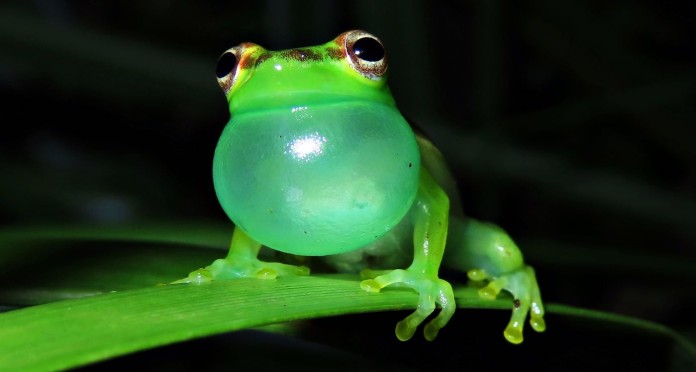
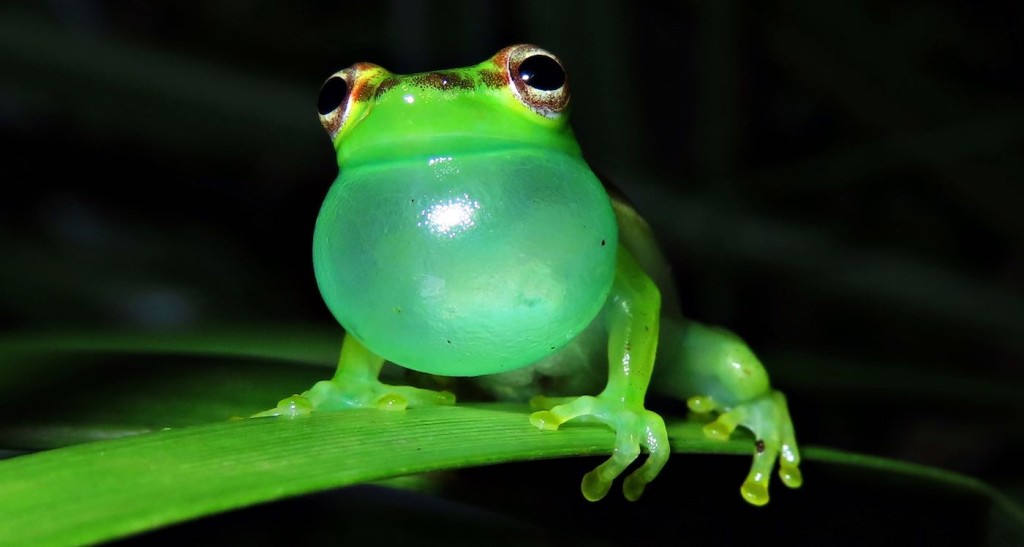
Inflated vocal sacs produce mating call
- by Juan Abarca
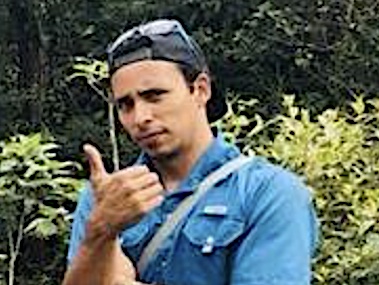
Juan Abarca
A nature-lover’s well-trained ears led to the discovery of a new species of frog, after the Costa Rican man searched for six months to find the source of a mysterious sound.
The tiny green frog was discovered by Donald Valera Soto, a naturalist and co-owner of Tapir Valley Nature Reserve, a cattle ranch that he turned into a wildlife reserve.
“We as country boys, we know sounds,” said Soto. “I grew up in the forests walking around learning to identify species of trees, birds and frogs. I listened to this little frog and it was almost impossible to find it, it was so well camouflaged.”
“I was really happy when I found it,” said Soto, who chose the frog’s common name—tapir valley tree frog—to honor its 20-acre wetland home.
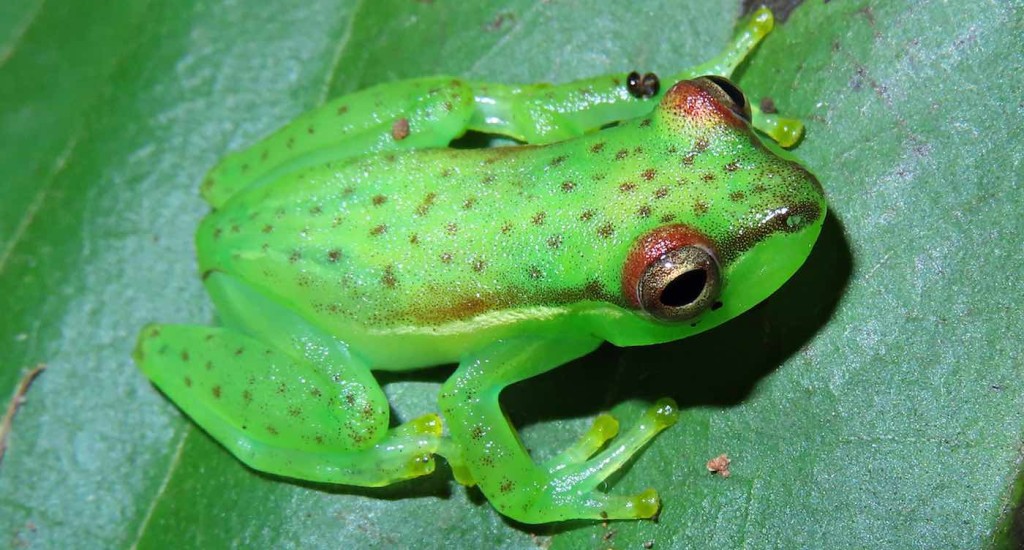
The biggest clue that it was a new species was a yellow line, which runs about halfway down the frog’s flanks then abruptly stops. The Canal Zone Tree Frog (Boana rufitela) also has a yellow line, but the line continues the entire length of the frog’s body. The team looked through books and scientific literature, but the characteristics didn’t match any other known species of frog.
Soto first heard the tapir valley tree frog’s shrill call among the sounds of more than 10 other frog species, while he was working around a wetland pond after the first heavy rains of the year in late March 2018. He had been planning to expand the wetland area to make it more hospitable to migratory species of birds during their journeys between North America and Central and South America. The unfamiliar frog call stopped him in his tracks as he was walking through the wetland and prompted him to investigate which frog was making it.
Inflated vocal sacs produce the mating call – by Juan Abarca
After months of nighttime walks and surveys when the frog is most active, Soto and a small team that included his two young daughters, Kira and Ellie, herpetologist Juan Abarca, and biologist Valeria Aspinall, finally spotted one of the frogs. It measured only 2 centimeters (8/10 of an inch) and was camouflaged in the tall grasses around the pond, making it difficult to spot—even from a few feet away.
The frog, which also features a blue armpit and red spots, was described for the first time in a paper published two months ago, in the journal Zootaxa, with Soto as the paper’s lead author.
The frog’s scientific name (Tlalocohyla celeste) honors Río Celeste, a tourism favorite in Costa Rica with blue lagoons and waterfalls, and is only the fifth species to be discovered within the genus Tlalocohyla.
“We needed to determine how morphologically, or physically, similar or different this species is to other more common species,” said Abarca. “The adult morphology is very important, but one of the things that is very hard is to find the tadpoles. The tadpoles can help identify the genus.”
Eventually, the team was able to find two of the adult frogs in a mating embrace.
“That’s when we also finally were able to identify or pinpoint which eggs or which egg masses belong to the species,” said Aspinall. “Before that, we couldn’t just assume it, because there’s 15 other species laying eggs within the same environment, so we couldn’t actually tell them apart until after we found the eggs attached to the leaf.”
Juan Abarca
The team monitored the eggs the female laid on the underside of a leaf until they hatched and the tadpoles dropped into a container with water, allowing them to describe the morphology of the tadpoles. In addition to the physical description of both adults and tadpoles, the team analyzed the frog’s DNA. It didn’t match any other known species of amphibian and had to be a new species.
Love of tapirs started it all
Tapir Valley Nature Reserve was originally a cattle ranch that Soto and Melvin Rodriguez have been rewilding for 18 years, returning it to lush forest habitat. After moving cattle and other domesticated livestock out of the reserve, they let native plant species and trees grow unchecked. The forest has since attracted endangered peccaries, jaguars and Baird’s tapirs.
Baird’s tapirs are known as “gardeners of the forest” because they disperse the seeds of plants widely and are the only animals that are capable of dispersing the seeds of one tree species that sequesters large amounts of carbon.
Donald Valera Soto
“I love this frog, because it tells a larger story,” said Esteban Brenes Mora of Re:wild. “When Donald started Tapir Valley Nature Reserve, it was to protect tapirs and help them move between forests. He didn’t know that there were completely new species to science living on the reserve, but if he hadn’t protected this place for tapirs we might not have ever discovered this little frog.”
HOP OVER to Social Media to Share This Glorious and Inspiring Story…
FREE WILL ASTROLOGY – Week of October 1, 2022
Copyright by Rob Brezsny, FreeWillAstrology.com
LIBRA (Sept. 23-Oct. 22):
Buddhist monk Thich Nhat Hanh was born under the sign of Libra. He said, “The root-word ‘Buddha’ means to wake up, to know, to understand; and he or she who wakes up and understands is called a Buddha.” So according to him, the spiritual teacher Siddhartha Gautama who lived in ancient India was just one of many Buddhas. And by my astrological reckoning, you will have a much higher chance than usual to be like one of these Buddhas yourself in the coming weeks. Waking up will be your specialty. You will have an extraordinary capacity to burst free of dreamy illusions and murky misapprehensions. I hope you take full advantage. Deeper understandings are nigh.
SCORPIO (Oct. 23-Nov. 21):
I invite you to be the sexiest, most intriguing, most mysterious Scorpio you can be in the coming weeks. Here are ideas to get you started. 1. Sprinkle the phrase “in accordance with prophecy” into your conversations. 2. Find an image that symbolizes rebirth and revitalization arising out of disruption. Meditate on it daily until you actually experience rebirth and revitalization arising out of disruption. 3. Be kind and merciful to the young souls you know who are living their first lifetimes. 4. Collect deep, dark secrets from the interesting people you know. Employ this information to plan how you will avoid the trouble they endured. 5. Buy two deluxe squirt guns and two knives made of foam rubber. Use them to wage playful fights with those you love.
SAGITTARIUS (Nov. 22-Dec. 21):
There’s an ancient Greek saying, “I seek the truth, by which no one ever was truly harmed.” I regard that as a fine motto for you Sagittarians. When you are at your best and brightest, you are in quest of the truth. And while your quests may sometimes disturb the status quo, they often bring healthy transformations. The truths you discover may rattle routines and disturb habits, but they ultimately lead to greater clarity and authenticity. Now is an excellent time to emphasize this aspect of your nature.
CAPRICORN (Dec. 22-Jan. 19):
Let’s imagine you are in your office or on the job or sitting at your kitchen table. With focused diligence, you’re working on solving a problem or improving a situation that involves a number of people. You think to yourself, “No one seems to be aware that I am quietly toiling here behind the scenes to make the magic happen.” A few days or a few weeks later, your efforts have been successful. The problem is resolved or the situation has improved. But then you hear the people involved say, “Wow, I wonder what happened? It’s like things got fixed all by themselves.” If a scenario like this happens, Capricorn, I urge you to speak up and tell everyone what actually transpired.
AQUARIUS (Jan. 20-Feb. 18):
To honor your entrance into the most expansive phase of your astrological cycle, I’m calling on the counsel of an intuitive guide to offer the following advice. 1. Cultivate a mindset where you expect something unexpected to happen. 2. Fantasize about the possibility of a surprising blessing or unplanned-for miracle. 3. Imagine that a beguiling breakthrough will erupt into your rhythm. 4. Shed a few preconceptions about how your life story will unfold in the next two years. 5. Boost your trust in your deep self’s innate wisdom. 6. Open yourself more to receiving help and gifts.
PISCES (Feb. 19-March 20):
It was said, “Every time partners slake their thirst in the strange waters of the other’s identity, they glimpse the immensity of their freedom.” I love this way of understanding, and recommend you try it out for a while. You’re entering a phase when you will have extra power to refine and expand the way you experience blending and merging. If you’re fuzzy about the meaning of the words “synergy” and “symbiosis,” I suggest you look them up in the dictionary. They should be featured themes for you in the coming weeks.
ARIES (March 21-April 19):
Poet Susan Howe describes poetry as an “amorous search under the sign of love for a remembered time at the pitch-dark fringes of evening when we gathered together to bless and believe.” I’d like to use that lyrical assessment to describe your life in the coming days—or at least what I hope will be your life. In my astrological opinion, it’s a favorable time to intensify your quest for interesting adventures in intimacy; to seek out new ways to imagine and create togetherness; to collaborate with allies in creating brave excursions into synergy.
TAURUS (April 20-May 20):
Social reformer Frederick Douglass (1817-1895) had a growlery. It was a one-room stone cabin where he escaped to think deep thoughts, work on his books, and literally growl. As a genius who escaped enslavement and spent the rest of his life fighting for the rights of his fellow Black people, he had lots of reasons to snarl, howl, and bellow as well as growl. The coming weeks would be an excellent time for you to find or create your own growlery, Taurus. The anger you feel will be especially likely to lead to constructive changes. The same is true about the deep thoughts you summon in your growlery: They will be extra potent in helping you reach wise practical decisions.
GEMINI (May 21-June 20):
“Conduct your blooming in the noise and whip of the whirlwind,” wrote Gemini poet Gwendolyn Brooks. I love that advice! The whirlwind is her metaphor for the chaos of everyday life. She was telling us that we shouldn’t wait to ripen ourselves until the daily rhythm is calm and smooth. Live wild and free right now! That’s always good advice, in my opinion, but it will be especially apropos for you in the coming weeks. Now is your time to “endorse the splendor splashes” and “sway in wicked grace,” as Brooks would say.
CANCER (June 21-July 22):
“Don’t look away,” advised novelist Henry Miller in a letter to his lover. “Look straight at everything. Look it all in the eye, good and bad.” While that advice is appealing, I don’t endorse it unconditionally. I’m a Cancerian, and I sometimes find value in gazing at things sideways, or catching reflections in mirrors, or even turning my attention away for a while. In my view, we Crabs have a special need to be self-protective and self-nurturing. And to accomplish that, we may need to be evasive and elusive. In my astrological opinion, the next two weeks will be one of these times. I urge you to gaze directly and engage point-blank only with what’s good for you.
LEO (July 23-Aug. 22):
Tips to get the most out of the next three weeks: 1. Play at least as hard as you work. 2. Give yourself permission to do anything that has integrity and is fueled by compassion. 3. Assume there is no limit to how much generous joie de vivre you can summon and express. 4. Fondle and nuzzle with an eager partner as much as possible. 5. Be magnanimous in every gesture, no matter how large or small. 6. Even if you don’t regard yourself as a skillful singer, use singing to transform yourself out of any mood you don’t want to stay in.
VIRGO (Aug. 23-Sept. 22):
In the coming weeks, you should refrain from wrestling with problems that resist your solutions. Be discerning about how you use your superior analytical abilities. Devote yourself solely to manageable dilemmas that are truly responsive to your intelligent probing. PS: I feel sorry for people who aren’t receptive to your input, but you can’t force them to give up their ignorance or suffering. Go where you’re wanted. Take power where it’s offered. Meditate on the wisdom of Anaïs Nin: “You cannot save people. You can only love them.”
WANT MORE? Listen to Rob’s EXPANDED AUDIO HOROSCOPES, 4-5 minute meditations on the current state of your destiny — or subscribe to his unique daily text message service at: RealAstrology.com
Quote of the Day: “If I have the belief that I can do it, I shall surely acquire the capacity to do it even if I may not have it at the beginning.” – Mahatma Gandhi
Photo by: Ifrah Akhter
With a new inspirational quote every day, atop the perfect photo—collected and archived on our Quotes page—why not bookmark GNN.org for a daily uplift?
A mother dolphin was seen carrying her deceased calf on her back in the middle of the Mediterranean sea.
The tragic and rare moment was captured by 29-year-old Margarita Samsonova, an environmental content creator.
Margarita, who lives in Lisbon, believes this is the only time this behavior has been witnessed in Europe, and represented an incredible insight into animals experiencing grief.
She had been out on the water for approximately five hours and was on her way back with her team to port when they saw the dolphin pod.
“It was very mixed emotions,” Margarita said. “Instantly, I cried, it was really heartbreaking and really painful to watch this.”
“At the same time it was really exciting, because this was something new, we realized that this was something that had never been documented before.”
Margarita studied Zoology at Oxford Brookes University and captured the moment while accompanying a research team.
The group, lead by the researchers from AIMM, a marine research association from Portugal, was on an expedition off the coast of Albufeira.
Margarita explained that they were drawn to the pod of approximately 25 dolphins due originally to the strange behaviors that they were demonstrating.
“The dolphins were behaving very unusually, they were jumping higher than normal and making very strange vocalizations,” she remembered. “Then we noticed a mother with a calf, and the calf was dead, and it was clear that she was trying to bring the baby to the surface.”
“It really seemed like a moment of grief that was expressed both by the mother and other dolphins.”
Margarita explained that it is uncertain what exactly this behavior might mean.
However, she said that the head of the research team speculated that it shows a true expression of grief from the part of the mother. That might be knee-jerk reaction, and humanization of the animal on the part of the scientist. Occam’s Razor would suggest the mom simply didn’t realize the calf was dead, but that the pod was on the move and so she had to move the calf.
This behavior has been documented before in dolphins in the Atlantic Ocean. Dr. Joan Gonzalvo of the Ionian Project, funded by the Tethys Research Institute, has seen bottlenose dolphins attending to a dead calf on three occasions.
“So my hypothesis is that when the mothers carried their calves for several days, it was because the calves were newborn, so the death was unexpected and sudden,” Dr. Gonzalvo told the BBC. “The mothers needed more time to grieve.”
“But when the pod had to care for an animal that had been struggling for some time already, in some ways it was a relief when it died, so they could move away that day rather than carrying the body for a week.”
WATCH the behavior and decide for yourself…
SHARE This Remarkable Moment With Your Nature-Inclined Friends…
Welcome back to Good Gardening! In our Week 9 discussion, we wanted to know how many of our Good Gardeners had a big fall harvest coming up. As always we took the conversation to social media to see what the response was like…
This week’s discussion represented my own autumn experience: barren. Evidently the droughts spoiled many opportunities for a rich harvest time, though not all of them.
Joanie Elbourn has frost-tolerant greens to look forward to like kale, chard, and collards. She will also continue to enjoy a wide variety of herbs, and some carrots and pole beans. Thomas signed off on our Facebook discussion with a single green tomato. Maybe next year Tom!
Professional permaculturalist Monica Richards wrote into the email address to tell us that her garden is just now coming to life after a weather phenomenon called a “heat dome.”
Green tomatoes from Monica Richards’ garden
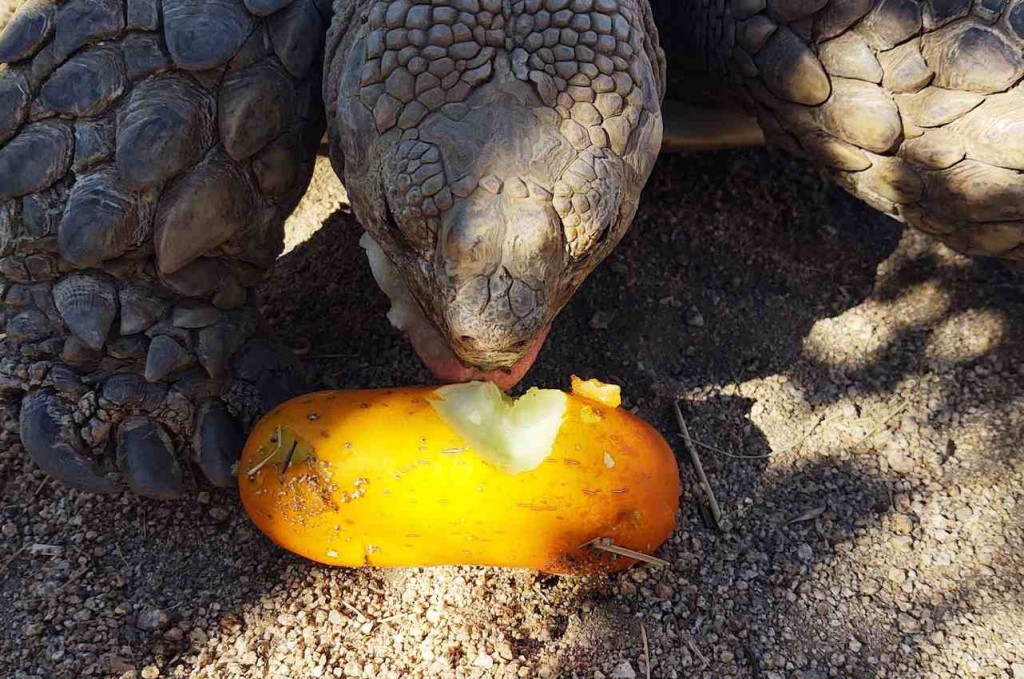
Many of our plants literally hung in there through August, and I’m now seeing new tomatoes, cucumbers and peppers begin to come in since the cooler weather started. So on many plants, not much happened since June, but now we can begin a whole new harvest! Attached are photos of new tomatoes that started last week, and our tortoise, Gil, with a golden cucumber.
The aforementioned Gil
For Fall, my plan has been “It’s cooler now, let’s get a bunch more baby trees and shrubs into the ground before Winter!” Fall has become my perennial planting time, as I find many of them do well to establish roots before frost and begin their true growth starting the following year!
Monica writes in every week from California, so her advice should be considered per zone.
“Two sounds of autumn are unmistakable…the hurrying rustle of crisp leaves blown along the street by a gusty wind, and the gabble of a flock of migrating geese,” — Hal Borland
Topic Week 10: Fall To-Do List
Question 1: What’s on your garden to-do list every fall
Question 2: Do you tend to clear your garden of annuals at the end of the year?
Question 3: What kind of preparations do you make for next year starting in fall?
Tell Us Here in The Comments… or, send your questions, tips, and photos to [email protected]. Join our Facebook Good Gardens thread every Friday on the GNN Facebook Page…
Good gardening rules
Green thumbs can help novice greenhorns.
Share your gardening photos and resources.
Garden jargon encouraged!
INVITE Friends to our Gardening Discussion on Social Media–And Share Your Photos and Tips!
Down in southwest Texas, a unique-in-the-world style of ancient rock art is bringing to life a culture of hunter-gatherers with a penchant for incredible art, spiritual journeys, and wild imaginations.
Archeologists studying the site for more than 30 years have discovered much about this strange culture dating from 2,500 BC to 600 AD—and digital renderings of their rock art reveal their Animistic belief systems as never before.
Down where the Pecos River flows into the Rio Grande, an archeological site called the White Shaman rock shelter includes a 26-foot-long rock wall facing west. It’s long been known that this wall has been the site of pictographic art, but it wasn’t until Carolyn Boyd arrived in 1989 that the true extent of the White Shaman wall would be revealed.
At that time, Boyd was, of all things, a professional muralist who painted for commission. Once thought to be unconnected scribbles made by hunter-gatherers in the Pecos River area over long periods of time, Boyd needed only a short look to figure out all the drawings were connected.
“I could tell at once that it had been planned and conceived as a single composition,” Boyd told Archaeology Magazine, reporting on her discoveries at the site. “And because I was a muralist, I knew the skill it took to produce something like this, and to do it so beautifully. I was awed.”
For one thing, the height of the rock wall would require scaffolding to reach the upper sections of the drawings. Secondly, it would have required time to gather all the minerals, plants, and animal fats to create the pigments. For these reasons she was sure all the images were linked.
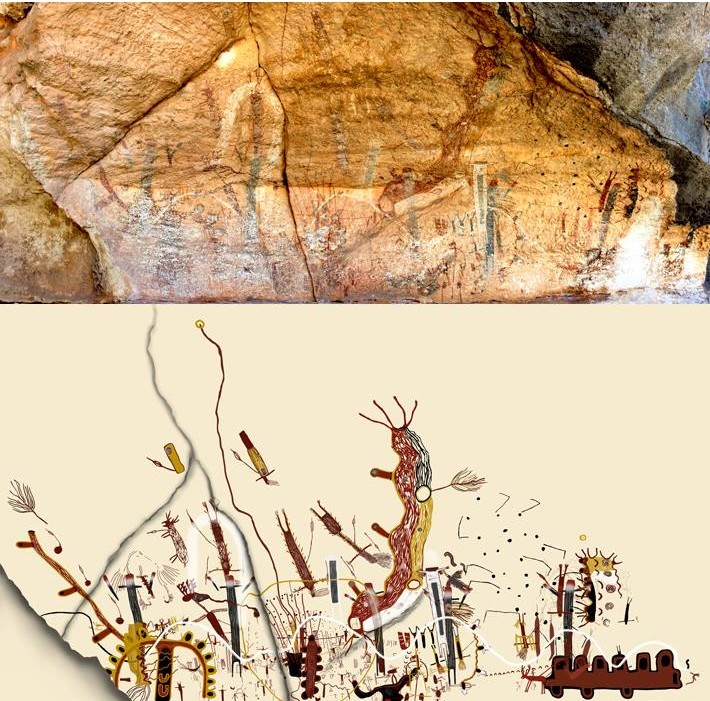
White Shaman Mural Depicting Birth of Time – courtesy of Shumla Center
A mysterious culture
White Shaman rock shelter is only one site in the area. Rattlesnake Canyon has a rock wall 100 feet long with depictions in the same style, now called the Pecos River Style, and other archeologists working in the area have documented 300 such murals containing this kind of art, which Boyd and her teams at the Shumla Archeological Research and Education Center describe as the “oldest books in North America.”
Boyd noticed that three vertical levels covered the White Shaman wall, which she interpreted as the underworld, middle-world, and upper world, a foundational belief across many Mesoamerican cultures. She also noticed that the deer had black-colored antlers, a motif found in the art of the Huichol, who still live in the mountains of western Mexico today.
A series of clues were connected. Studying the Huichol, Boyd learned that their shamans go on a 600-mile pilgrimage to gather the hallucinogenic cacti peyote, and that they do this by following deer, believed to be an animal-manifestation of the plant, with a bow and arrow. At the end of the pilgrimage, the shaman shoot the cactus with their bow, metaphorically sacrificing the deer and the plant, before gathering the peyote “buttons.”
Black-antlered deer depicted with arrows coming out of them surrounded by small button-shaped dots have been recorded on White Shaman’s walls, nearby to which arrowheads and peyote residue have been recovered from digs.
Boyd later concluded that not only was the entire painting a visual guide on how to carry out the peyote pilgrimage, but that it displays the creation myth of several ancient cultures including the Pecos River people, the Huichol, and the nearby Nahua, simultaneously. (See the video below.)
The Master Narrative
In painting the depictions of the the creation of the sun and the dawn of time, through the creation of mankind and other events on the wall at White Shaman, Boyd noted that all the pigments were laid down in precise strata; in the sense that all the black pigment was applied first across the whole mural.
Black was the primordial color of shadow and femininity. Next, all the red pigments were put down, symbolizing not only masculinity, but also the color of the sky at dawn. Then came all the yellows—the color of the sun, and then white, the shadow-less world and perhaps also the world of gods.
Moon Goddess Composite – Courtesy of Shumla Center
The Dawn Arch, a fundamental symbol of other Mesoamerican beliefs, is seen on the left, after which the peyote pilgrims from the ritual story become the five godlike ancestors in the Huichol and Nahua traditions—walking towards the arch with torches to stoke the flames of the first sunrise.
The largest pictograph is the Mother Goddess of the Huichol belief system: a half-serpent half-catfish being rising up to the meet the sun at noon.
Her colleagues consider her work ground-breaking.
“This style is the oldest large group of pictographs in the New World and it’s been overlooked by Mesoamericanists,” Texas Tech art historian Carolyn Tate, who is an authority on Olmec art, told Archaeology Magazine. She’s making us pay attention to the idea that this could be the northern frontier of Mesoamerica.”
“Some of the motifs she’s identified—such as the crenellated arch—these are visual patterns you see in Nahua manuscripts.”
Protecting them for all time
In January, Sect. of the Interior Deb Haaland designated the Lower Pecos Canyonlands a National Historic Site, to fall under the protection of the National Parks Service as recognition for the incredible value of the rock art at places like White Shaman.
Work on the sites continued. 6-months later, Boyd outlined the presence of the Pecos River style’s “Speech-Breath” motif in a scientific paper.
“Artists used this graphic device to denote speech, breath, and the soul. They communicated meaning through the image-making process, alternating brushstroke direction to indicate inhalation versus exhalation or using different paint application techniques to reflect measured versus forceful speech,” she explains in the journal Latin American Antiquity.
“The choices made by artists in the production of the imagery reflect their cosmology and the framework of ideas and beliefs through which they interpreted and interacted with the world.”
Boyd founded the aforementioned Shumla Center in Comstock TX, who are trying to protect and make this information known to the world. They run guided tours through the canyon lands, and have used digital renderings to database, and to bring the rock art to life in a way that hasn’t been seen since the age they were painted.
WATCH their own creation story below…
BE a SHAMAN for Your Friends By Sharing The Magic On Social Media…
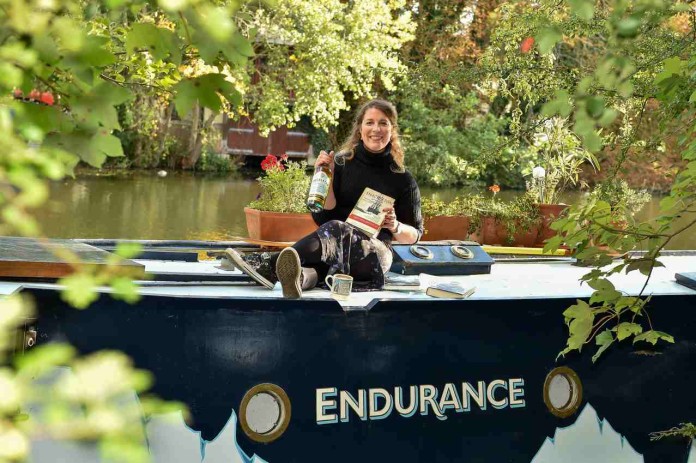
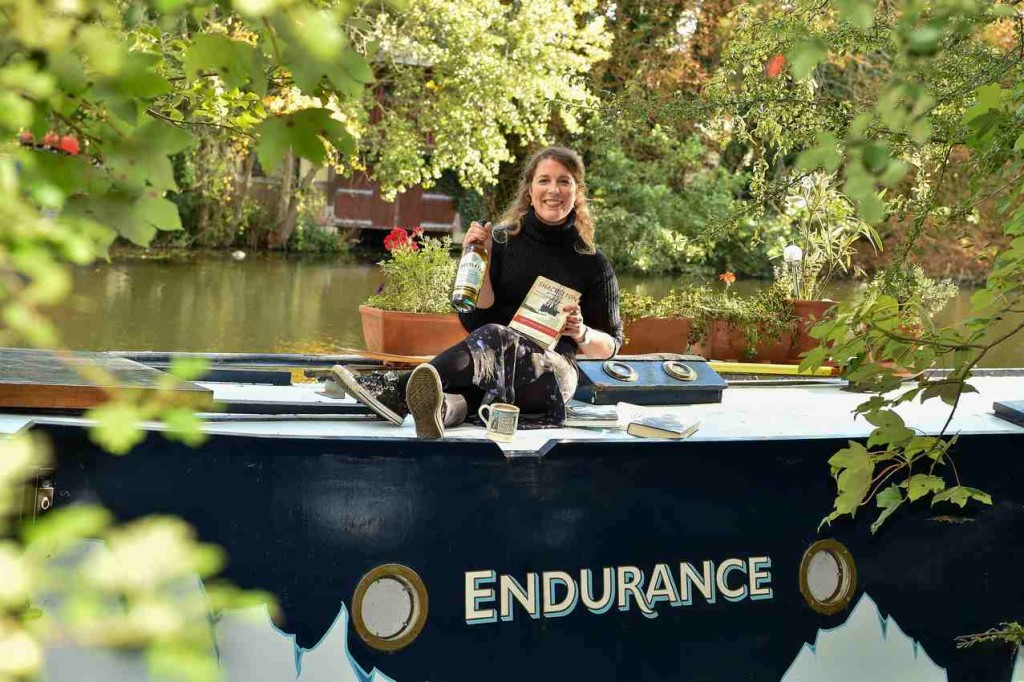
Anna Shackleton, on her very own Shackleton Boat Cafe, with bit of Shackleton whisky.
The great-great niece of legendary explorer Sir Ernest Shackleton has been granted permission to name her café boat Endurance, after the ship Ernest sailed and lost during an expedition to Antarctica.
Be it salty or fresh, no English water has moored a boat by the name Endurance for more than a 100 years, but when the registration office heard who was making the request, they thought they’d make an exception.
Anna Shackleton is a singer/café owner in the small town of Sutton Courtenay. She refurbished her own narrow boat after purchasing it six years ago from her neighbor.
“I naively took on the project, it wasn’t something I had planned my whole life for,” Shackleton said. “But our family motto is, ‘by endurance we conquer,’ so I thought if Sir Ernest can take his crews on expeditions I can do up this boat.”
She thought she would name her own boat ‘Endurance II.’
“I thought I would call it ‘Endurance‘ as a joke, but when I called the registration office they said it was already taken by a police vehicle,” she recounts. “They offered me ‘Endurance 14‘ but that wasn’t as funny. I said I was a Shackleton and the phone line went silent.”
“After an age, they said I could have ‘Endurance‘ without any numbers—so it was meant to be.”
Between 1914 and 1917, Sir Shackleton led the Imperial Trans-Antarctic Expedition when disaster struck and his ship, Endurance, became trapped in pack ice and sunk.
The crews escaped by camping on the sea ice in one of the greatest rescue operations in the history of world exploration.
Check out Anna’s video below…
SHARE This Quaint Story Of Family History With Your Friends..
Quote of the Day: “Entertain possibilities! …Better to create prophecy than live prediction.” – Caroline Casey
Photo by: Nandhu Kumar
With a new inspirational quote every day, atop the perfect photo—collected and archived on our Quotes page—why not bookmark GNN.org for a daily uplift?
After the Juno spacecraft used 3D rendering to process some images it took of clouds covering Jupiter, they appeared like the flourished frosting atop of queenly cupcake.
What’s more, JunoCam’s renderings came in the visible-light spectrum, so the animations of the relative heights of the cloud tops in the our solar system’s largest planet are exactly as we would see them.
The results have been presented by citizen scientist, professional mathematician, and software developer, Gerald Eichstädt, at the Europlanet Science Congress (EPSC) 2022 in Granada.
Understanding the relative heights of the spiky pillars within the swirls will help scientists to unveil in more detail the elements that compose them, and better create the concept art for Disney’s next Frozen movie.
Juno arrived at Jupiter on July 4th, 2016, after a 5-year, 1.7-billion-mile journey, and settled into a 53-day polar orbit stretching from just above Jupiter’s cloud tops to the outer reaches of the Jovian magnetosphere.
Put onboard initially to increase public engagement around the exploration of Jupiter and its moons, Eichstätd has demonstrated that JunoCam can also provide valuable science.
“The Juno mission provides us with an opportunity to observe Jupiter in a way which is essentially inaccessible by Earth-based telescopic observations,” Dr. Eichstätd explains. “We can look at the same cloud features from very different angles within only a few minutes.”
“This has opened up a new opportunity to derive 3D elevation models of Jupiter’s cloud-tops. The images of the wonderful chaotic storms on Jupiter seem to come to life, showing clouds rising at different altitudes.”
Jupiter clouds rendered-from JunoCam.
Using the different ways in which sunlight is reflected and scattered by clouds, the team has succeeded in pinpointing the elevation of the cloud-tops observed.
Solar illumination is most intense for clouds in the upper atmosphere. Deeper in the atmosphere, more light is absorbed—particularly by methane—before being scattered back up to the camera by the cloud tops.
“From theoretical models, the clouds are expected to be composed of different chemical species, ammonia, ammonium hydrosulphide, and water ice from top to bottom,” said Dr. Eichstädt.
“Once we calibrate our data thanks to other measurements of the same cloud tops, we will test and refine the theoretical predictions and have a better 3D picture of the chemical composition.”
The pictures from Juno have been some of the most awe-inspiring to ever come out of observations is space, and the colors, patterns, and textures of the Jovian atmosphere surmounts the creativity of even the most excitable painter.
WATCH a video of the renderings from the spacecraft’s perspective.
SHARE These Unbelievable Pictures On Social Media…
An incredible hybrid high-speed yacht-seaplane vehicle has completed successful flight tests and is ready now for production.
Designed for sustainable maritime travel, the fully-electric seaglider operates a few meters off the water’s surface on hydrofoils until it needs to fly.
Rhode Island-based company REGENT say it couples the high speed of an airplane with the low operating costs of a boat.
“With orders totaling over $7 billion, REGENT will commercialize seagliders for sustainable high-speed, regional mobility with first passengers boarding in 2025,” the company stated along with the announcement that they achieved an initial series of test flights of the craft.
Their test was of a 1/4 scale model, and will now focus on developing the full-scale prototype with a 65-feet wingspan to start testing flights with passengers in 2024.
“People have been attempting to make [these] vehicles viable for 60 years, and in 15 months we have gone from a drawing on a napkin to the first successful flight,” said Mike Klinker, REGENT CTO and co-founder.
With a range of 180 miles (290 km) and able to fly at 180 mph (290 kph), REGENT have plans to service coastal communities such as New York City and Tokyo.
By last year, REGENT’s founders had raised almost $10 million from investors, which have included Mark Cuban and Peter Thiel.
“Seagliders will bring welcome relief for travelers seeking an alternative to traditional air travel servicing coastal communities such as New York City, the Hawaiian Islands, Barcelona, Tokyo, and many more worldwide,” said Billy Thalheimer, CEO and co-founder of REGENT.
WATCH the Reuters News video showing electric planes taking off around the world, and continue reading below that… (NOTE: GNN is not affiliated with any possible ads shown in this video.)
REGENT stresses that the last time a new mode of transportation was invented was the helicopter, and that the seaglider breaks this dry spell with it’s first-ever utilization of three modes of maritime operation—floating, foiling and flying, in a single craft.
“40% of the world’s population lives in coastal communities. These successful flights give us full confidence in our ability to apply this technology at full scale and bring seagliders to global commercial service by 2025.”
The seaglider operates in three modes: from the dock, the vehicle first drives on its hull like a traditional boat.
As it leaves the harbor area and speeds up, it rises on its hydrofoil, a key maritime technology popularized by the America’s Cup sailing competitions.
The hydrofoil offers significant wave tolerance and a smooth ride as the seaglider leaves a crowded harbor.
Upon reaching open water, the seaglider takes flight, retracting the foil and accelerating up to cruise speed—all while staying within a wingspan of the water’s surface. This gives the advantages of numerous aerodynamic and operational efficiencies, enabling increased payload capability and greater range than other electric aircraft concepts.
WATCH more of the seaglider in action…
SHARE This Ultimate Maritime Transportation Breakthrough With Your Friends…
American actor and WWE superstar John Cena has set a new record for the most wishes granted through the Make-A-Wish Foundation with 650.
The Make-A-Wish Foundation helps fulfill the wishes of children who have been diagnosed with a critical illness. As the most wished-for celebrity, nobody else has ever granted more than 200 wishes in the 42-year existence of Make-A-Wish.
Targeting children between the age of 2 and 18, they can choose to meet a celebrity, go to an event or even give a gift to someone else, and were “thrilled” to honor Cena as the man who has fulfilled the most wishes.
“If you ever need me for this ever, I don’t care what I’m doing, I will drop what I’m doing and be involved because I think that’s the coolest thing,” Cena said in an interview after being honored for 500 wishes granted. “I just drop everything, [and] if I can offer a fantastic experience, I’ll be first in line to do my part.”
Cena began his career in professional wrestling back in 1999 and has since gone on to become one of the most popular athletes of all time; he is a 16-time world champion in WWE.
A crowd favorite character and the face for WWE’s “Be a Star” anti-bullying campaign, he granted his first wish for the Foundation in 2002. In 2012, Cena granted Make-A-Wish’s 1000th wish to a fan named Cardon.
Once receiving the opportunity to meet Cena, children take photos and hang out with their favorite wrestler and sometimes even venture inside the ring.
Cena is usually accompanied by one of his championship belts: he has held the WWE Championship 13 separate times, and often lets the kids try it on.
WATCH A look back at his 650 wishes, but keep a tissue handy!
SHARE This Heartwarming Achievement With Your Friends…
An illustration of the orbit of the strange gas cloud.
An illustration of the orbit of the strange gas cloud.
Scientists recently spotted a hot bubble of gas orbiting the supermassive black hole at the center of the Milky Way at 200 million miles an hour, or around 1/3 the speed of light.
The observations suggest that not only can these gas bubbles be imaged in X-ray and infrared wavelengths, but also radio waves, which should allow for more to be imaged more quickly and more easily.
The discovery was made using the ALMA Telescope high in the Chilean Atacama Desert to make the recordings in radio waves, and part of a network of telescopes called the EHT Collaboration that resulted in the first ever image of Sagittarius A*—the famous in April of 2017.
“We think we’re looking at a hot bubble of gas zipping around Sagittarius A* on an orbit similar in size to that of the planet Mercury, but making a full loop in just around 70 minutes. This requires a mind-blowing velocity of about 30% of the speed of light!” says Maciek Wielgus of the Max Planck Institute for Radio Astronomy in Bonn, Germany, who led the study published today in Astronomy & Astrophysics.
Dr. Wielgus and colleagues used ALMA data recorded simultaneously with observations of Sagittarius A* made by the EHT.
Serendipitously, some observations of Sag. A* were done shortly after a burst of X-ray energy was emitted from the center of the Milky Way that was detected by NASA’s Chandra Space Telescope.
These kinds of bursts, previously observed with X-ray and infrared telescopes, are thought to be associated with these gas bubbles.
“What is really new and interesting is that such flares were so far only clearly present in X-ray and infrared observations of Sagittarius A*. Here we see for the first time a very strong indication that orbiting hot spots are also present in radio observations,” says Wielgus.
This hot gas is believed to have a magnetic origin, and the authors agree that their findings support this hypothesis.
Furthermore, they are believed to be the source of the occasional X-ray bursts from the center of the galaxy, but not only is it clear they can be viewed in radio waves, but also that they come from clumps of this superfast, super heated gas, offering insight into the innerworkings of an object in Sag. A* that’s about ten billion times bigger than the sun.
SHARE This Interesting Astro-Phenomenon With Your Space Nerd Friends…
Quote of the Day: “The greatest thing about dreams is they don’t expire. They can lay dormant for years and when you pull them out and dust them off, they shine like new.” – Casi McLean
Photo by: Jr Korpa
With a new inspirational quote every day, atop the perfect photo—collected and archived on our Quotes page—why not bookmark GNN.org for a daily uplift?
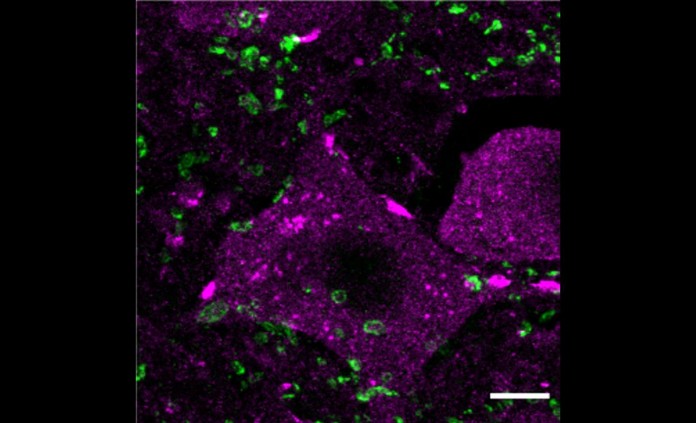
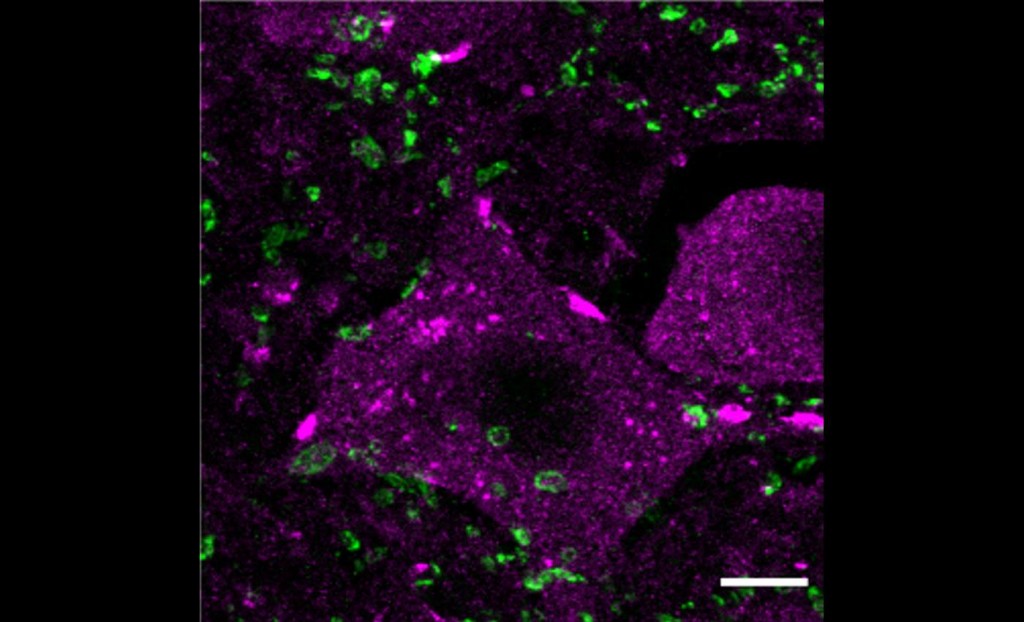
The green colors are increased synapses resulting from a regeneration in nerve axons - SWNS
The green colors are increased synapses resulting from a regeneration in nerve axons – SWNS
A revolutionary treatment that could repair spinal cord injuries has been developed by scientists which regrew nerves in paralyzed mice within three months.
The medication triggers cells of long spindly parts of the severed nerves called axons to regenerative themselves.
Currently, spinal cord injury does not have any effective treatments that involves a repairing of what was damaged. Physical rehabilitation can help patients regain some mobility, and a number of electrical stimulation technologies can stimulate nerves and muscles to act as before, but never with the precision of the real thing.
“This work shows a drug called TTK21 that is administered systemically once a week after a chronic spinal cord injury in animals can promote neuronal regrowth and an increase in synapses that are needed for neuronal transmission,” said lead author Dr. Simone Di Giovanni, of Imperial College London.
“This is important because chronic spinal cord injury is a condition without a cure where neuronal regrowth and repair fail.”
Damage to the spinal cord interrupts the constant stream of electrical signals from the brain to the body. It can lead to paralysis below an injury.
The study published in the journal PLOS Biology showed TTK21 aided the regrowth of sensory and motor neurons when given to mice 12 weeks after severe injury.
It belongs to a group of therapies known as epigenetic activators which target damaged DNA.
In experiments, lab rodents with severe spinal cord injury lived in an enriched environment with opportunities to be physically active—as is encouraged in human patients.
Treatment lasted for 10 weeks. Several improvements were identified, the most noticeable being the sprouting of more axons in the spinal cord. Retraction of motor axons above the point of injury was also halted, and sensory axon growth increased.
The next step will be to boost the effects even more and get regenerating axons to reconnect to the rest of the nervous system so animals can regain their ability to move with ease.
“We are now exploring the combination of this drug with strategies that bridge the spinal cord gap such as biomaterials as possible avenues to improve disability in SCI patients,” said Di Giovanni.
For decades, this has remained a major challenge. Our body’s central nervous system, which includes the brain and spinal cord, does not have any significant capacity to repair itself.
In the U.S., an estimated 300,000 people and another 50,000 in the UK are living with a spinal cord injury.
Last year GNN reported that Yale had used stem cells to repair patients’ injured spinal cords, which could be another future avenue to repairing nerves and axons.
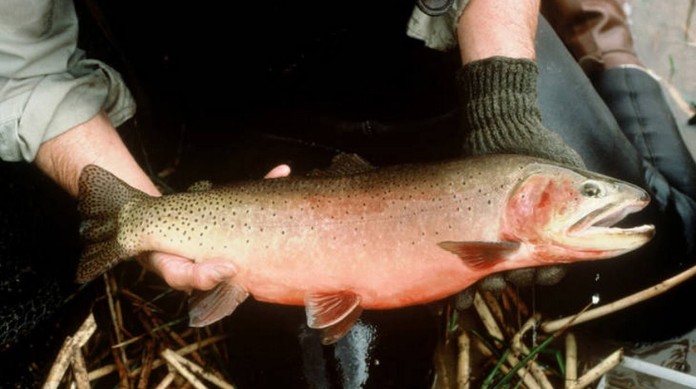
The greenback cutthroat trout, Colorado’s state fish, is reproducing in the wild again after a period where it was actually believed to have been lost.
Presumptively listed as extinct in the 1930s, small populations were found in various parts of the state’s river systems, though they were thought of as hybrids.
In 2012 along a 3.5 mile section of Bear Creek, Colorado Parks & Wildlife conservationists found a small population of purebred greenback cutthroat trout, sparking a flurry of activity.
Usually when a Critically Endangered species recovers, it’s because of a nail-biting intervention to try and get a handful of captive individuals to breed in a zoo, and this is no different.
“Each spring, CPW aquatic biologists have strapped on heavy electro-fishing backpacks to painstakingly hike up Bear Creek to catch greenbacks and collect milt and roe—sperm and eggs,” CPW said.
Taking the goodies, CPW have successfully managed to breed the fish in a trout hatchery, and by 2016 they started a repopulating effort in Herman Gulch, which are now adults and reproducing on their own.
“This is just another affirmation that our conservation practices work and that we can save species on the brink,” Kevin Rogers, an aquatics researcher for Colorado Parks and Wildlife, told CPR.org.
The Colorado chapter of Trout Unlimited is also having success with a breeding program, having released 13,000 small fry back in 2017 into four sites around Loveland Pass and Cameron Pass.
Introduction of non-native rainbow, brown, and brook trout in Colorado streams have pushed the native greenback cutthroat out of much of its old habitat, although sometimes the relationship isn’t so negative. Rainbow trout have spawned with greenback cutthroat and created fertile hybrids called “cutbows.”
Sickly green with rusty spots, the state fish can grow up to around 18 inches and 10 pounds. It is reputed to have the most brilliant spawning coloration of any cutthroat trout species.
SHARE This Great Fisherman’s News On Social Media…



















 American biotech company Biogen announced the results of a phase 3 clinical trial that showed a new Alzheimer’s drug slowed the rate of cognitive decline for early onset patients by 27%.


 Being given an illicit drug called ketamine and then looking at smiling faces could help end depression, according to a new study.