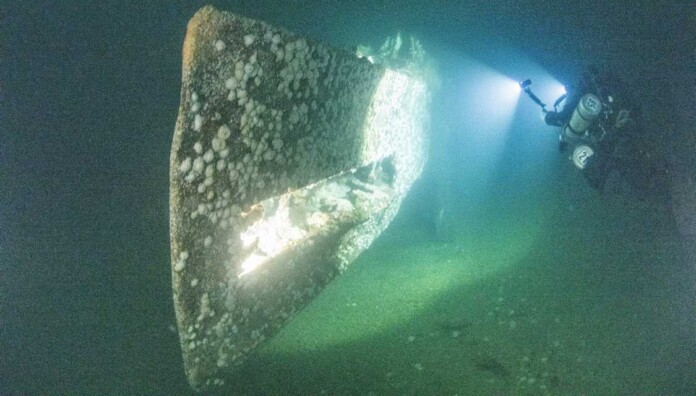
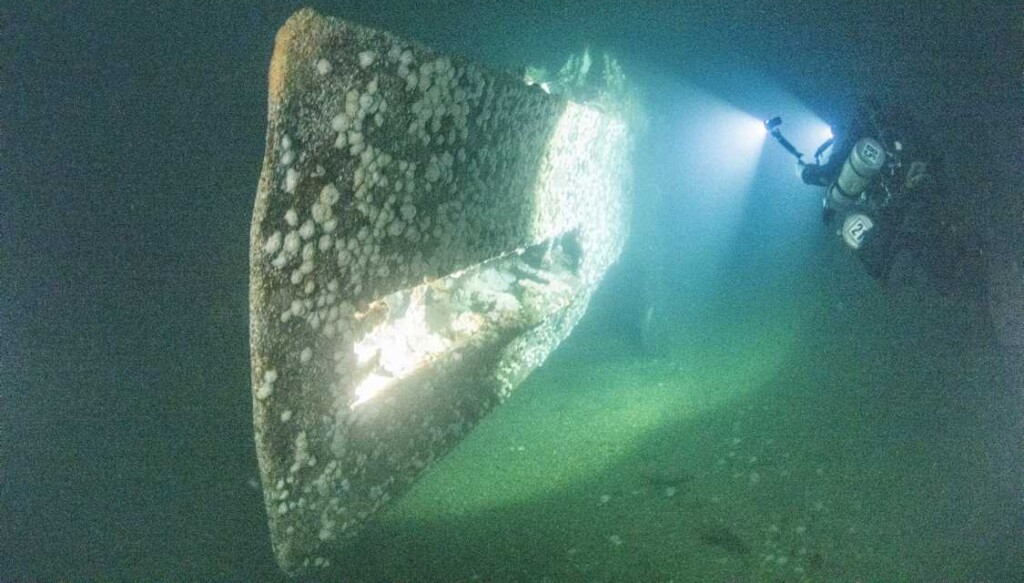
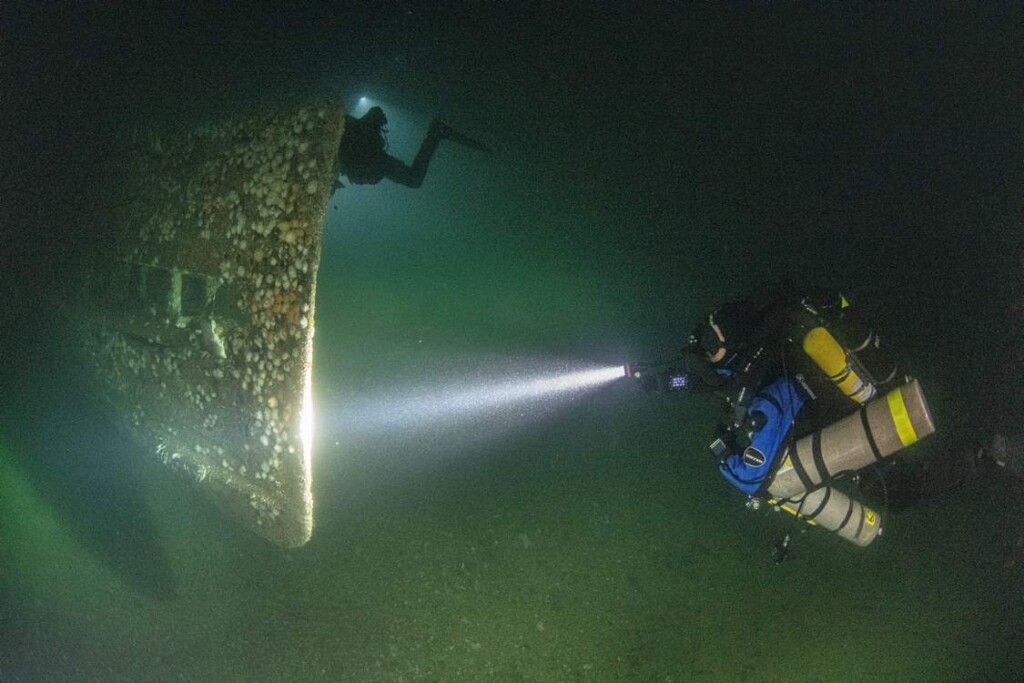
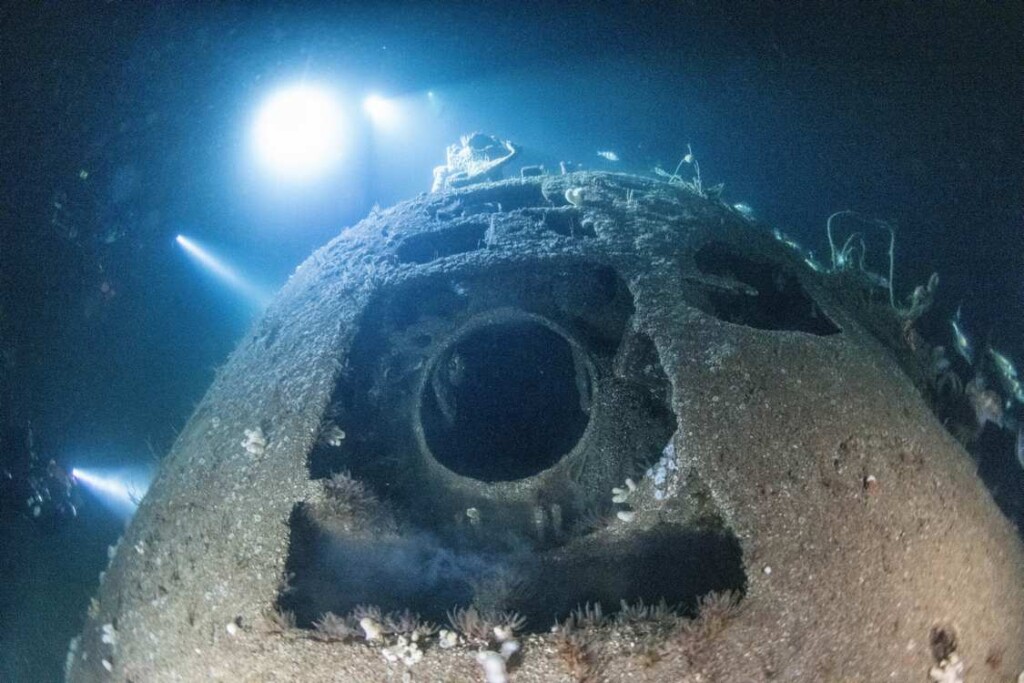
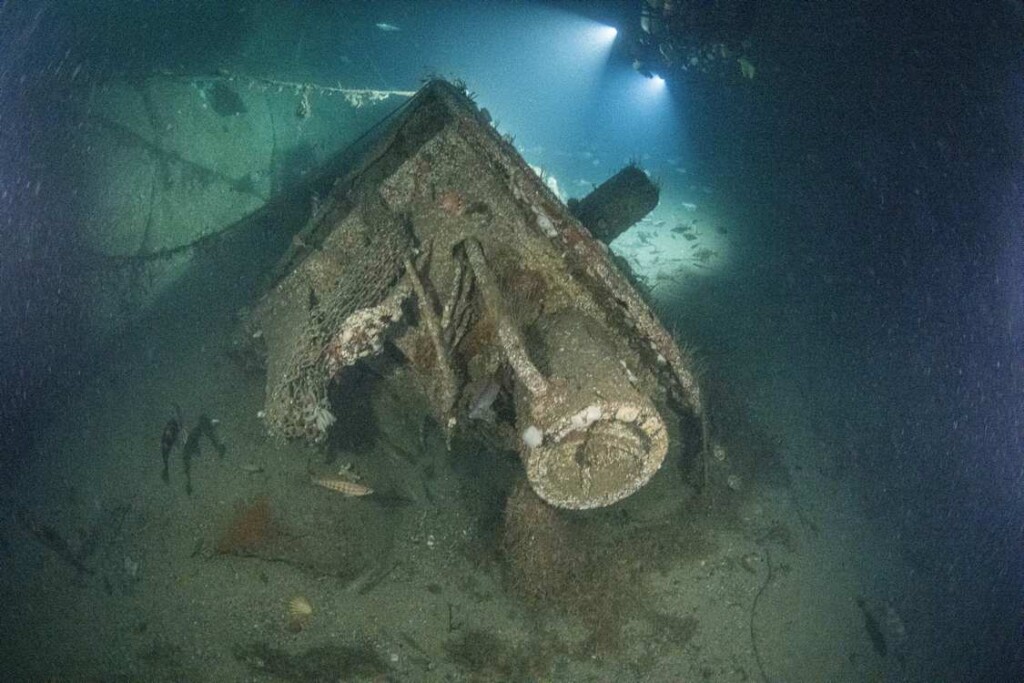
A group of divers have explored the wreckage of a First World War-era Royal Navy submarine 100 years after it sank.
Professional shipwreck diver and YouTuber Dominic Robinson and a team of 10 dived down to check out the century-old M1 sub 20 miles off the coast of Plymouth in mid-August.
Dominic Robinson / Rick Aryton / SWNS
They found her in a wreck, missing the famed 12-inch gun—typical of the era’s battleships—which she apparently carried as armament.
The HMS M1 was constructed during WW1 but was never used in combat due to fears the Germans would copy its revolutionary design.
The sub sank in 1925 when a Swedish ship, the SS Vidar, is believed to have accidentally struck her while she was submerged—leading to the loss of all crew—another little tragedy amid the tragic, inconclusive European conflict.
It was missing until a salvage team located it in 1967 and was then formally identified by a dive team in 1999.
Described by Robinson in a film made of the dive as “one of the most incredible submarines ever built.”
“We were on the water for about three hours so it’s a fairly significant effort for about 25 minutes of diving to look around the wreck,” Robinson told England’s Southwest News Service. “The general view is the collision knocked the gun off the mount, and I think the weight of it has carried it into the sand beneath the main wreckage.”
Dominic Robinson /Rick Aryton / SWNSDominic Robinson / Rick Aryton / SWNSDominic Robinson / Rick Aryton / SWNSDominic Robinson / Rick Aryton / SWNS
Robinson claims that diving like this is rare and “well beyond” what many divers will do.
“If you were to go Egypt or somewhere like that they would take you to 20 meters, advanced would be 30 meters, and if you really pushed it 40 meters. This is 74 meters. so it’s well beyond what 99% of divers will do, but we want to see things that people don’t see.”
Robinson’s YouTube channel—Deep Wreck Diver—has 13,500 subscribers and is dedicated to showing viewers deep shipwrecks.
“I want to help people understand and the history of these things that are forgotten,” he said.
WATCH a 40-minute film of the dive….
SHARE This Interesting Underwater History Experience With Your Friends…
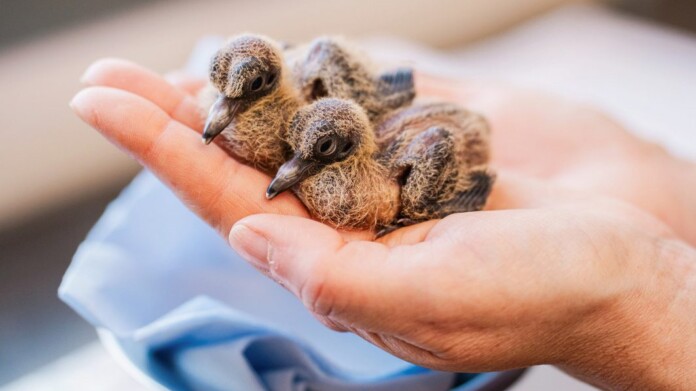
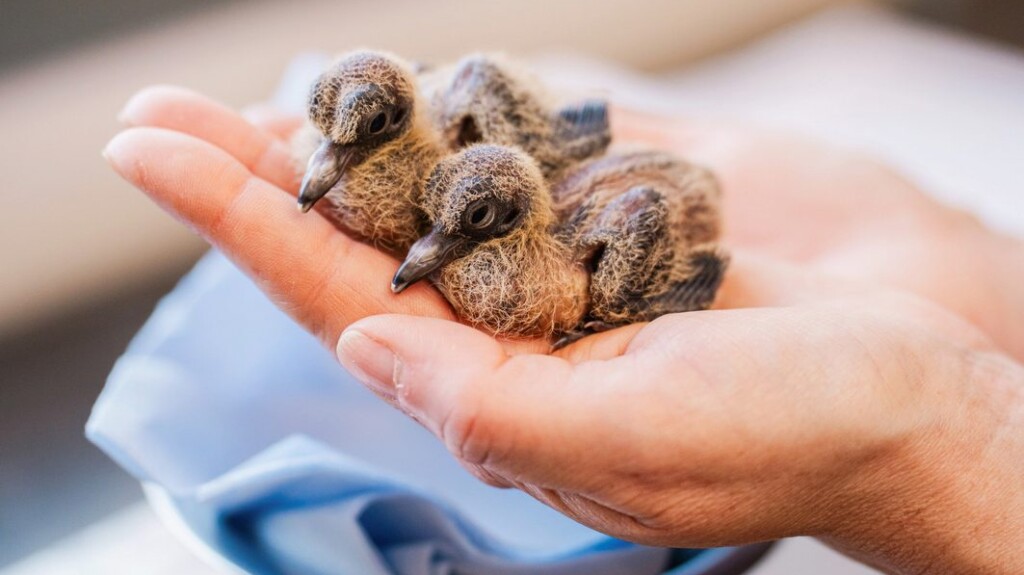
The Socorro dove chicks - credit, Chester Zoo SWNS
The Socorro dove chicks – credit, Chester Zoo SWNS
Conservationists have successfully hatched 8chicks in a bid to save an ultra-rare species of dove which has been extinct in the wild for over half a century.
Socorro doves are only cared for in zoo conservation-breeding programs across Europe and North America after they became extinct in 1972.
Experts at the Chester Zoo are now celebrating the arrival of 8 chicks, known as squabs, bringing fresh hope the species can be brought back from the brink.
Approximately 200 birds represent the entire surviving population and the zoo hopes another clutch of eggs might now also be on the way.
Chester Zoo cares for two breeding pairs and the chicks will bolster the insurance population of Socorro doves looked after by avian specialists.
“We have several chicks which have successfully reached independence, and the others are on the verge of being fledged,” said the zoo’s Clare Rafe, assistant team manager for birds. “We’ll keep looking after these amazing birds. They might look quite plain and brown from a distance, but they have what looks like shimmery blusher on their heads.”
“They have big personalities, too, with the males being a bit aggro—they certainly aren’t peace doves!”
Unlike other species of doves, Socorro doves do not live in flocks, preferring to pair off or live individually. They also share chick-rearing duties.
“It’s a 50-50 arrangement most of the time, but we have found the females will raise their chicks up to a point and then become ready to mate again, so they’ll start raising a new clutch of eggs before the first have fledged.”
“In the wild, they would only have perhaps a two or three-month nesting window between storms and heat waves. When that happens, the fathers take over with the older chicks, feeding them and caring for them.”
An adult Socorro dove in captivity – credit, Chester Zoo SWNS
Socorro doves originally lived on Socorro Island off the coast of Mexico, but a mixture of factors led to their extinction in the wild.
Andrew Owen, head of the bird department at Chester Zoo, said that historically, the Socorro dove had few natural predators as the island remained uninhabited by people.
“Sheep introduced in the 1800s caused extensive damage to the wild vegetation and in 1957 a naval base was established on the island,” said Owen.
“Naval staff and their families brought domestic cats which became feral and caused tremendous damage to the native wildlife, including the Socorro dove population…”
“Sadly, the Socorro dove was overlooked by conservationists for many years and if it wasn’t for the efforts of a group of German aviculturists, who created a breeding program for the species, it would have been lost forever.”
“In 1995, the Socorro dove conservation breeding program was formally established when the European Association of Zoos and Aquariums (EAZA). Without the valuable work zoos do, these species would be lost forever.”
It’s not the only dove species that Own has recently been involved in saving. A trio of blue-eyed ground dove chicks were successfully hand-reared in Brazil with help from Owen and his Chester Zoo team. Fewer of these birds remain on Earth than even the Socorro dove.
SHARE Chester Zoo’s Great Work With Our Planet’s Dove Species…
In 2021, researchers at the Massachusetts Institute of Technology (MIT) tried to build a robot pollinator based on the anatomy of bees.
Bees’ flight capabilities are quite sophisticated, but strangely, the MIT roboticists ended up building a robot that sported 8 wings and 4 bodies.
Now, a new design, closer to nature’s own model, is proving substantially superior. Capable of 17 minutes of flight time, the new robotic bee is 100-times more efficient.
Demonstrated in a paper published recently in Science Robotics, the scientists suggest that an artificial hive of these robobugs could give bees a break and pollinate plants kept in vertical indoor farms with fluorescent lighting; a very difficult environment for bees.
Additionally they could be used in more harmful environments such as space, or areas contaminated with radiation.
“The amount of flight we demonstrated in this paper is probably longer than the entire amount of flight our field has been able to accumulate with these robotic insects. With the improved lifespan and precision of this robot, we are getting closer to some very exciting applications, like assisted pollination,” says Kevin Chen, an associate professor in the Department of Electrical Engineering and Computer Science (EECS), head of the Soft and Micro Robotics Laboratory.
Part of the flight success was down to splitting the 4 bodies down to just 2
“In our old design, the performance of each individual unit was always better than the assembled robot,” Chen told MIT press.
Whereas 8 wings generated counterforces that slowed the bee robot down, 4 has proven much better, and the new model can even perform aerial flips. Each wing is connected to a mechanical set of muscles called actuators.
These are formed from small layers of elastomer stuck between two very thin carbon nanotube electrodes. The actuators rapidly compress and elongate, generating mechanical force that flaps the wings.
A longer hinge—the greatest challenge in building the new model, reduced the torsional stress experienced during the flapping-wing motion.
“Compared to the old robot, we can now generate control torque three times larger than before, which is why we can do very sophisticated and very accurate path-finding flights,” Chen says.
Moving forward, they want to push the design to the limit of its performance, with a target of 10-times longer flights, as well as precise, controlled take-off and landing maneuvers that could be done from the center of a flower.
SHARE This Mechanical Hazmat Bee With Your Friends…
A rural village has led the transformation of a barren ravine into a flourishing forest mosaic in one of the least-habitable parts of their country.
When Deng Xiaoping took control of Communist China in the 1970s, the land around the Mo Us desert was described by visiting environmental scientists as a heavily desertified landscape unfit for human habitation.
Given to large social engineering projects, there were discussions among Party bosses about moving the entire Youyu county population away from the hostile land, where yellow sands would whip through towns, darkening the sky.
You’d never know that now if you passed through the Shipaogu area, where tree-planter Wang Zhanfeng lives today. Cloaked in grasses, Mongolian pine, and larch trees, as well as orchards, animal pastures, and soccer fields, the landscape has been completely reversed.
“In my childhood, we had to cover our bowls while eating, otherwise they would be filled with sand,” Wang told China Daily.
Wang, his father, and his father before him, all worked on the Youyu county afforestation movement, where the county’s villages rejected the fate seemingly dealt to them by nature, and began pursuing a radical and complicated method of afforestation.
China Daily writes that Youyu had been a meeting point of agricultural and grassland civilizations, as well as a crucial passage for Shanxi merchants traveling to Mongolia. However, continuous wars had ravaged its ecology.
With the arid soil incapable of holding water, it wasn’t possible to simply plant trees where they needed them most. Instead, the villagers would grow seedlings on the nearby mountain sides—where they also fetched water necessary for manual irrigation of each individual tree.
Teams of women would carry the water, while men would dig pits with shovels and line the bottom with river silt to improve its holding capacity. While China was experimenting with market capitalism, while she was becoming the workshop of the world, this backbreaking labor continued until the method for cultivating trees on the harsh land was perfected.
That work eventually spanned over 240,000 acres.
The Youyu afforestation program was recognized by the UN as one of the world’s finest examples of human desert control and ecological restoration, winning the New Sustainable Cities and Human Settlements Award in New York City last October.
The return of workable land meant the return of economic opportunity. Youyu county is now one of the largest horse-breeding centers in all of China, as well as one of the great centers of soccer talent production. Sheep wool, fruit, and tourism all bolster the local economy, generating tens of millions in revenue.
SHARE This Incredible Effort From The Northern Chinese With Your Friends…
Quote of the Day: “How prompt we are to satisfy the hunger and thirst of our bodies; how slow to satisfy the hunger and thirst of our souls.” – Henry David Thoreau
Photo by: Anton Konstantinov
With a new inspirational quote every day, atop the perfect photo—collected and archived on our Quote of the Day page—why not bookmark GNN.org for a daily uplift?
Dr. Ambedkar on a 2015 Indian postage stamp - credit Ministry of Communications GODL India
On this day, 78 years ago, Dr. Bhimrao R. Ambedkar was appointed to chair the Indian constitutional drafting committee. This national hero is responsible for the constitution being one that is largely considered one of the most robust and progressive in all world law, as it guaranteed equal treatment under the law for all members of India’s many castes, something not even Mahatma Gandhi envisioned for a post-Independence India. READ more about his work on the constitution… (1947)
The Brunel Solar team from the Netherlands celebrates victory in Adelaide - credit, Charlie Bliss, Tim Hanley, Riley Williams, Julian Modra, Michael Hurren & Reece Calvert from Swift Hound.
The Brunel Solar team from the Netherlands celebrates victory in Adelaide – credit, Charlie Bliss, Tim Hanley, Riley Williams, Julian Modra, Michael Hurren & Reece Calvert from Swift Hound.
At the Bridgestone World Solar Challenge, innovators and motorsport experts competed to race solar-powered cars 2,000 miles across the Australian Outback.
Reminiscent of the 24 Hours of Le Mans, when Interwar Period engineers tried to balance speed, maneuverability, and durability with wild designs, some of which eventually became road-standard, the World Solar Challenge hopes to push engineers to develop sustainable solutions to challenges facing electric automotion today.
This year, the spirit of innovation and problem solving was pushed even further, as along with racing from Darwin to Adelaide, the challenge took place in the wintertime, with 20% less sun than in other Australian seasons.
When looking at the cars, the first thing one notices is how much they look like aircraft carriers—a necessity for fitting enough solar panels to charge the batteries.
The other boat-like design is their narrow undercarriage and hull-shaped sides which help make them more aerodynamic. Much of the actual horsepower of an average car comes from pushing the air out of its way. The more aerodynamic a car, the less wind it must move, and the less energy it consumes.
This year however, even with these radical body shapes, the contests have had to push further the bounds of aerodynamism and efficiency.
“Fins are the flavor of the month, or certainly the flavor of this event,” said one organizer.
Indeed many of vehicles sported one or even two hi-tech fins. The Millennium car from the University of Michigan team uses its fin like a combination of the rudder and sail on a boat, generating forward thrust while also stabilizing it in crosswinds.
“This event is very relevant to look at the future,” said Bridgestone Vice President Hiroshi Imai, in a report from Reuters. “Even near-future technology may come from this kind of event.”
The Dutch team Brunel Solar eventually won the race, arriving in Adelaide 34 hours after leaving Darwin. Their car, the Nuna 13, had not one but two fins, which it used to achieve higher speeds without extra energy consumption.
WATCH the video below from Reuters…
SHARE This Automotive Innovation With Your Friends On Social Media…
(Left to right) Guatemalan President Bernardo Arévalo, Mexican President Claudia Sheinbaum and Belizean Prime Minister Johnny Briceño - credit, Gob.mx, released.
(Left to right) Guatemalan President Bernardo Arévalo, Mexican President Claudia Sheinbaum and Belizean Prime Minister Johnny Briceño – credit, Gob.mx, released.
Mexico, Belize, and Guatemala have announced the creation of a “biocultural” reserve to protect a trinational area corresponding with the borders of the classical Mayan empire.
The second-largest intact tropical rainforest in the Americas, the Maya Region stretches tens of millions of acres through southern Mexico and her two Central American neighbors.
Its treasures are many and varied, from towering temple pyramids to as-yet undiscovered ruins, and from the Maya’s living descendants who practice traditional craft, sport, and ritual, to the native wildlife like jaguar, tapir, and quetzal birds which live alongside them.
Covering 600,000 hectares in Belize, 2.7 million in Guatemala, and 2.4 million in Mexico, (more than 14 million acres in total) the reserve encompasses the lands and homes of 2 million people, and 7 million plant and animal species.
“We should be proud to be able to tell the world [that] we have united our will to preserve and restore the legacy of this extraordinary biological and cultural wealth,” Mexican President Claudia Sheinbaum said in a statement. “We are not only protecting an ecosystem, but also honoring the legacy of the civilization that once flourished in these territories.”
“Today’s agreement is historic and beautiful. Thank you, President Arévalo, and thank you, Prime Minister Briceño,” she said, referring to the heads of state of Belize and Guatemala.
The agreement was signed at the Grand Mundo Maya Calakmol Hotel, built in Mexico in recent years following the completion of the Great Maya Train Project.
La Jornada reports that the design and governance of the reserve will be overseen by a council of individual protected area authorities appointed by the three member states. Issues and dangers such as transnational crime, logging, and other issues will be addressed collaboratively through cooperative forest monitoring and capacity building projects.
Belizean Prime Minister Johnny Briceño described the project as “a bridge to a future where sustainable development, regenerative tourism, and ancestral wisdom guide our path.”
For his part, Guatemalan President Bernardo Arevalo was more poetic, saying that by signing the agreement, his nation was committing to a shared future.
“We are also located in the heart of one of the natural lungs of the world. The great Mayan jungle is living history, cultural heritage of all humanity and natural heritage of humanity. This territory is an invaluable, infinite and diverse source of life.”
SHARE This Commitment to Protecting A Large Chunk Of The Western Hemisphere…
Ed Jackson (right) stands atop the summit of Tian Shan - credit SWNS
Ed Jackson (right) stands atop the summit of Tien Shan – credit SWNS
A retired rugby star turned quadriplegic has made an unbelievable recovery from a broken neck to reach the peak of a previously unclimbed mountain in Asia.
Ed Jackson became the first person to successfully ascend the unnamed, 15,485-foot-high peak in the Tien Shan Mountains of Kyrgyzstan on August 23rd.
Ed Jackson, the ex rugby player who has recovered from a devastating spinal injury, (moustache and no beard) with his colleagues – credit SWNS
The former professional rugby player for English teams Bath and Wasps was warned he may never walk again after diving into a shallow pool eight years ago and suffering a spinal cord injury.
But after years of rehab from a team of experts, his sights were set higher than a return to the rugby pitch—nothing less than a never-before-climbed peak amid the famous Central Asian range.
After arriving at the foot of the mountain, Ed and his team establish a remote base camp with the support of local shepherds, before tackling the technical ascent across glacial terrain, steep ice, and rock faces.
Jackson was predictably elated when he reached the summit.
“I’ve been working towards this for so long, and for it to finally come to fruition feels incredible,” he said, according to England’s Southwest News Service. “The climb was far more technical and demanding than I could ever have imagined, and it took absolutely everything to reach the top.”
“I felt the strength of everyone who has carried me to this point. This summit isn’t just mine, it belongs to all of them too,” he added.
The expedition was led by Adrian Nelhams, a highly respected mountaineer and guide who Jackson credits as the reason this “ascent was possible”.
The climb marks a milestone not just in exploration but also in adaptive adventure as it is believed to be the first ever first ascent of a high-altitude peak by someone with a disability.
– credit SWNS
In the years leading up to the attempt, Jackson founded the Millimetres to Mountains Foundation (M2M) to support people facing adversity through outdoor challenges. He dedicated the climb to the beneficiaries of the charity, and to the local Kyrgyz children’s organization, CDI Children at Risk, who will have the honor of naming the mountain peak.
Jackson is set to meet the children in the days following after the expedition.
“The fact that the children we’re supporting in Kyrgyzstan will get to name this mountain only seems right to me,” he said, considering how many people helped him reach the summit.
The climb has also raised funds for M2M’s projects in the UK and CDI’s work with children with disabilities in Kyrgyzstan. More information can be found on their website.
SHARE This Staggering Achievement With Your Friends…
A forest on the Olympia Peninsula - credit Danny Novo CC BY-NC-ND 2.0.
A forest on the Olympia Peninsula – credit Danny Novo CC BY-NC-ND 2.0.
In Washington state, a new Public Lands Commissioner has announced that 77,000 acres of special forests will be taken off the state’s logging rotation for conservation purposes.
These “legacy forests,” as they’re being called, are in a state of growth between secondary forests and old growth forests. They’re defined as one which was logged before World War II, but has since been allowed to grow, settle, and diversify, and contains large amount of biodiversity and more space between trees.
They could be thought of a little like a “coming of age forest” or the old growth forests of the 22nd century.
The astonishingly and aptly named Commissioner, David Upthegrove, said that legacy forests conserve more carbon than secondary growth forests, and anchor more of the state’s biodiversity.
“This is the kind of forest we want future generations to inherit,” Upthegrove said of the surrounding forest on Tiger Mountain during a Tuesday news conference.
The 77,000 acres were identified after a new land inventory method was created for the state’s large timber concessions. It’s been suggested for years now that with such vast forest reserves, there would be some areas liable for logging that have reached a state similar to old growth forest.
Foresters, data scientists and forest ecologists updated the inventory model, and identified 106,000 acres of structurally complex forest that met the criteria for legacy forests. Of these, Upthegrove announced that three-fourths would be removed from the state’s logging rotation, and that the governor’s mansion would look for new ways to manage the land, such as offering it up on carbon markets.
The state typically sells forest logging rights to timber companies, and the Seattle Times reports that the proceeds go to fund local governments, schools, and other trust funds.
“I think we’ve struck a good balance that’s going to do more for climate, more for habitat, while still meeting our responsibilities to schools and local governments,” Upthegrove said.
Most of the total and potential legacy forest acreage is found along the Olympic Peninsula and Cascades range.
As is often the case in such decisions, stakeholders were left unsatisfied. Logging interests were not happy with the announcement, and question its legality, while advocates for the protection of legacy forests were disappointed that 29,000 acres were left available for logging.
Regardless of any one entity’s feelings on the announcement, the legacy forest announcement raises an interesting question for forest management and conservation to consider around the world over the next few decades: how to manage biodiverse, mature forests that have previously been logged at some point but were able to return to an almost natural state.
SHARE This Great US Forest News With Your Friends…
Quote of the Day: “The friendship between us, the mutual confidence, the delight of the heart, these things do not perish and can not be destroyed.” – Voltaire
Photo by: Everton Vila
With a new inspirational quote every day, atop the perfect photo—collected and archived on our Quote of the Day page—why not bookmark GNN.org for a daily uplift?
117 years ago today, Roger Tory Peterson, the inventor of the modern field guide, was born. The American naturalist, ornithologist, artist, and educator published his groundbreaking Guide to the Birds in 1934, at age 25, and its first printing sold out in one week. The Peterson Field Guide series eventually included topics ranging from rocks and seashells to reptiles and edible or medicinal plants. He won numerous awards, like the US Presidential Medal of Freedom, after igniting in our hearts a curiosity and love for the natural world. READ a bit more about Peterson and his books… (1908)
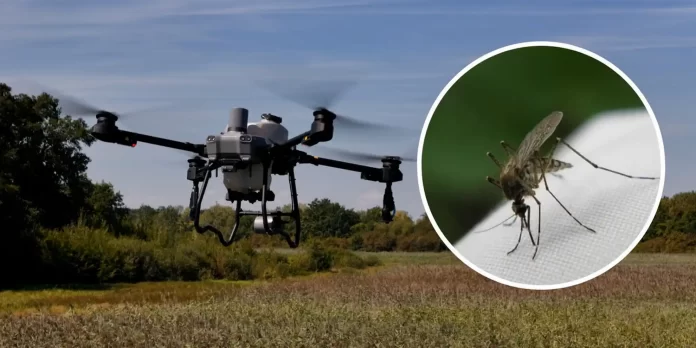
In Ghana, Kenya, Japan, Poland and probably other countries as well, it’s now the mosquitos who fear the sound of buzzing—from drones built to detect and destroy them.
Economies of scale and widespread adoption has reduced the price of drones by around 20% since 2018, putting them under the cost of malaria medication and mosquito-proof bed nets, said one Kenyan malaria policy advisory.
Mosquito-borne diseases like malaria, yellow fever, and West Nile virus kill around 700,000 people every year, and it was recently estimated that 60 billion Homo sapiens have been killed by these diseases since we first evolved—an estimation of half of all the human beings to ever live.
The vast majority of these deaths will have occurred in the tropics, particularly in the countries located in Africa’s malaria belt. These nations are the focus of intense mosquito control efforts, and recently, Japan’s SORA Technologies has been impressing locals with their system of drone-based mosquito eradication.
Kenya sees more than 5 million malaria cases per year and 12,000 deaths from the disease. It’s been a heartbreaking, almost insurmountable impediment to child survival and economic growth for generations.
“I was shocked at how many children still die from malaria, which can be prevented and cured. We thought that if we could add AI and aerial monitoring to the mix, we could end the cycle,” SORA Technology co-founder and CEO Yosuke Kaneko told French outlet RFI. “Drones allow us to access areas that health personnel often have difficulty reaching in a timely manner, safely and with accuracy that does make a real difference”.
SORA Technologies with their local drone program team in Ghana – credit, SORA Technologies, released
The SORA operators send the drones out to scan areas like riverbanks and fields on the lookout for standing water where mosquitoes lay their eggs. When an infestation is found, the drone descends to drop a larvicide agent, ending the potential outbreak before it breaks out.
Kaneko says ministries of health, community leaders, and local drone pilots are always involved in training and dispersal of the method to ensure it has support at both a grassroots and administrative level.
“The technology only works if the people it’s supposed to help trust it”.
Dr. Peter Okeke, a malaria policy advisor who is based in Kenya’s Abuja, believes drones are firmly ensconced in the future of malaria control.
“It’s smart prevention–cheaper than treatment, more humane than reacting to outbreaks and, ultimately, more sustainable,” he told RFI.
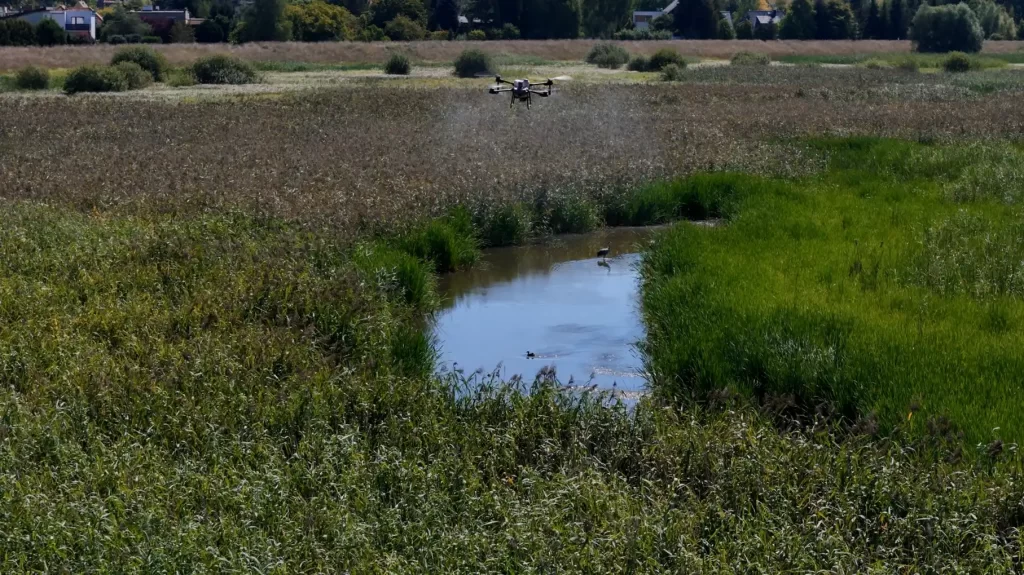
A polish drone spraying a waterway in Wroclaw – credit UMW, released
Battlefield Europe
It isn’t just Africa where mosquito control is done by drone. Every summer in the humid city of Wroclaw, drones patrol the area’s numerous reservoirs, identifying high risk sites of of mosquito breeding and spraying a non-toxic larvicide to quell their numbers.
This has been ongoing for 27 years, where monitoring is undertaken at 300 sites between March and October.
“The drone allows us to reach places where humans have no chance – oxbow lakes, rushes or backwaters. Thanks to this, we can perform procedures faster and more accurately,” says the drone operator, Dr. Piotr Jawień, at ECO Dron. “The preparation we use works only on mosquito larvae and is completely safe for other organisms”.
Both West Nile and chikungunya, two diseases spread by mosquitoes, have “become the normality” in Europe, said Pamela Rendi-Wagner, the director of the European Center for Disease Control.
Record numbers of cases have been reported this year, including 274 in Italy and 35 in Greece. 335 total cases were reported across Europe, resulting in 19 deaths. As a result, efforts to control mosquito populations have increased. A similar phenomenon is occurring in the United States as well.
One drone-based startup is suggesting that their system is perfectly adapted to European lifestyle by avoiding chemicals and working in tight confined areas like private gardens and small towns. Tornyol claims their system is 25x better than CO2 traps, and can protect 14 football fields of space with a single drone.
It uses an array of 380 microphones to detect mosquitoes via sonar. It recognizes the specific wing beat pattern that differentiates mosquitoes from other insects, and then uses AI to detect their flight path; intercepting and ramming the pest. The device is currently available for pre-order for the cost of your average lawnmower.
It’s suspected that rising global temperatures are permitting the spread of tropical diseases beyond the tropics, which if true would mean this is not a temporary problem but one which multiple future generations will face. Indeed, SORA isn’t focusing exclusively on Africa.
The Japanese home islands—hardly tropical—are also experiencing mosquito-borne viral infections which a press release from the company mentioned was potentially due to climate changes.
At the Osaka-Kansai Expo, SORA deployed their drones for mosquito control around the convention center. The operating team of 5 were able to not only to map the locations of drainage systems, but also detect puddles on the rooftops of national pavilions and other structures, thereby identifying potential mosquito breeding sources. WaL
SHARE This Great Revolution In Mosquito Control With Your Friends…
- credit, Parco Archeologico di Morgantina e Villa Romana del Casale, released
– credit, Parco Archeologico di Morgantina e Villa Romana del Casale, released
A Roman mosaic at the bottom of a bathing pool has come to light after 1,600 years, and seems to show that the modern “flip-flop” sandal has an archaic origin story.
Far from being invented by Havianas, it seems they were long-established as standard bathhouse footwear during the late imperial period.
In a statement by the Villa Romana del Casale archaeological park and museum, recent excavation activity has brought back to light a rich mosaic in one of the villa’s bathing rooms that “enriches the already vast patrimony of the site.”
“The mosaic reminds one of the modern infradito,” or ‘between toe,’—the Italian word for flip-flop. “It wasn’t treated like simple decoration, but as a refined work of art from a master mosaic artist,” the statement added.
It was found by Isabella Baldini, reports Smithsonian, an archeologist at the University of Bologna, who was leading the fourth edition of the Summer Series ARCHlab, which takes up to 40 archaeology students from 11 countries and brings them to Italy for field work.
The Villa Romana of Casale, located in central Sicily, is a UNESCO World Heritage Site, and described by the organization as “one of the most luxurious of its kind… especially noteworthy for the richness and quality of the mosaics which decorate almost every room.”
The flip-flops were found at the bottom of the pool in the villa’s frigidarium, or cold room—a space typical to wealthy Roman bathing complexes. Once believed to be owned by royalty, it was later confirmed to be the property of a wealthy citizen. In addition to the frigidarium, the bathing area contains a massage room, lavatory, and gymnasium—the latter of which sporting the famous “bikini girls” mosaic.
The mosaics are believed to not only have been installed as art works, but also as representative, inspirational instructions for the purpose of each room. For example, in the massage room, an athletic man is depicted receiving an oil massage.
Evidently, just as the sandals depicted 1,600 years ago are reminiscent of the modern flip-flop, their placement in the pool area is reminiscent of modern Italian gym regulations of never going barefoot in or around pools and bathhouses.
Yet the discovery, while brilliant, isn’t the only time such sandals have been depicted.
“The flip-flop is a recurring motif in late Roman baths, also attested in Spain, Cyrenaica, Cyprus, Jordan and Asia Minor,” Baldini tells Artnet. “As in other cases, the depiction of such a subject serves to characterize the building in question within its aristocratic and international dimension.”
Nor is it the first time in recent memory that Italy saw a Roman-era depiction of something suspiciously modern. In 2023, a fresco was unearthed in Pompeii that showed a banquet table which included an unmistakably Italian food item.
SHARE This Awesome Reason To Go To Sicily Or Study Archaeology…
credit - Evelina Sabaliauskaite and Lukas Gruseckas, retrieved from Facebook
credit – Evelina Sabaliauskaite and Lukas Gruseckas, retrieved from Facebook
In Lithuania, Welsh Corgi owners from around Europe came to celebrate the breed “and life in general” at the annual Corgi Race.
Held in Vilnius for the fifth time, the Corgi Race is about as joyful an event as one could hope to see.
The race is followed by a costume contest, if the cute-o-meter wasn’t overloaded during the race event.
As the gates open, most of them dash down a short green course toward their owners, although some get totally distracted.
“Today is a big day for corgis in all Baltic countries,” said Jekatirina Ivitska, “and every year were are going here to take part in the performance, to run, to join other corgis, and to show how beautiful my corgi is!”
“It’s cherishing the breed of the corgis and its just celebrating life in general,” Edvinas Miskas, the 2025 edition event organizer, told Reuters. “Dogs are our best friends—they’ve always been and this is just a testament to that.”
WATCH Reuters’ coverage below…
SHARE This Adorable Story With Dog Lovers And Corgi Owners You Know…
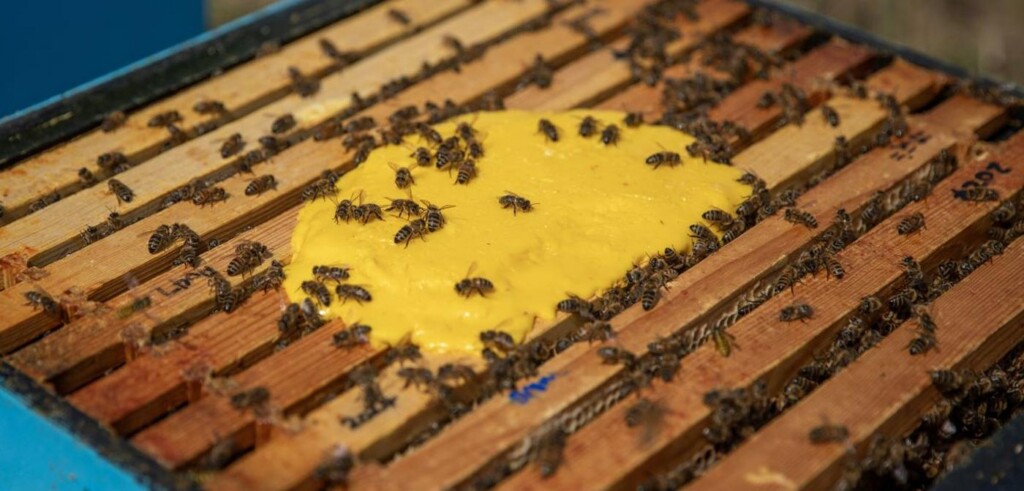
Bees feeding on a synthetic pollen substitute - credit, Caroline Wood, Oxford U news
Bees feeding on a synthetic pollen substitute – credit, Caroline Wood, Oxford U news
A study team from Oxford University has identified a fermentation method that creates the perfect balanced diet for honey bees who can’t get enough natural pollen.
Synthetic pollen substitutes are often fed to bees as a dietary supplement to natural pollen, but until now it’s been difficult to replicate the blend of lipids, called sterols, found in pollen that they need to thrive.
But with Oxford’s bees rearing 15-times more larvae, the scientists from England and Denmark are confident they’ve perfected this sterol recipe.
While it would obviously be preferable for bees to get all their essential nutrients from wildflowers, declines in flowering native plants across Europe are making this harder and harder. At the same time, honey bees aren’t exactly native either, in fact they often crowd native, solitary bee species and other pollinators out of local ecosystems.
If humans are going to unleash thousands of extra pollinators on a pollen-deficient landscape, it’s only right we help provide for their nutrition.
Scientists from Oxford, the Royal Botanic Gardens Kew, the University of Greenwich, and the Technical University of Denmark, engineered the yeast species Yarrowia lipolytica to produce the 6 essential sterols bees need to thrive, and fed it to a study colony enclosed in a greenhouse.
A control colony was fed a commercially-available synthetic diet.
Oxford University news reported that by the end of the study period, colonies fed with the sterol-enriched yeast had reared up to 15 times more larvae to the viable pupal stage, compared with colonies fed control diets.
Colonies fed with the enriched diet were also more likely to continue rearing larvae up to the end of the three-month period, whereas colonies on sterol-deficient diets ceased brood production after 90 days.
“For bees, the difference between the sterol-enriched diet and conventional bee feeds would be comparable to the difference for humans between eating balanced, nutritionally complete meals and eating meals missing essential nutrients like essential fatty acids,” said study lead author Dr. Elynor Moore. “Using precision fermentation, we are now able to provide bees with a tailor-made feed that is nutritionally complete at the molecular level.”
In order to understand which sterols were missing from the bees’ diet, the team had to employ surgical dissection of individual bees. The authors were then able to identify 24-methylenecholesterol, campesterol, isofucosterol, β-sitosterol, cholesterol, and desmosterol.
Using CRISPR gene editing, they altered a strain of Yarrowia lipolytica yeast to produce these compounds in a sustainable, economic way. Y. lipolytica is already used to produce food-grade products for the supplement industry.
Many commercially-grown fruits require bees and other pollinators to reproduce, and they play a critical role in the supply chains of fruit and nut orchards. Sustaining them with high-quality bee supplement will help guarantee hive resilience and preserve fruit and nut production into the future.
SHARE This Positive News For Bees Hard At Work In Our Orchards…
Quote of the Day: “You will never be able to experience everything. So, please, do poetical justice to your soul and simply experience yourself” – Albert Camus
Photo by: KAL VISUALS
With a new inspirational quote every day, atop the perfect photo—collected and archived on our Quote of the Day page—why not bookmark GNN.org for a daily uplift?
Happy 86th Birthday to Osage-American travel writer William Least Heat-Moon. His debut novel, Blue Highways, (1982) is a chronicle of a three-month-long road trip that Least Heat-Moon took throughout the United States in 1978 after he had lost his teaching job and been separated from his first wife. He tells how he traveled 13,000 miles, as much as possible on secondary roads, and tried to avoid cities. His second work was River-Horse during which he traveled across the US entirely on waterways. READ more about what he encountered… (1939)
- the location of the woman's iPad, transmitted after the device was powered on
– the location of the woman’s iPad, transmitted after the device was powered on
From the popular social media platform Reddit comes the incredible story of a young woman recovering her iPad lost two years before while traveling in the US.
It started on a forum, called a sub-Reddit on the site, for Columbus Ohio—a 23-year-old Australian woman shared a bizarre personal situation “in hopes of, [I don’t know], a miracle.”
An iPad which she said carried hundreds of photos and a 2D animation project she was working on had suddenly sent an alert to her phone, showing her that it was in Columbus, and had just been turned on for the first time in over a year.
It told her with pretty good precision where the iPad was: an address in Hilliard, a suburb of the state’s capital.
“I’m not sure what to do, I’d feel pretty silly calling the local police as I live in Australia,” she wrote, before adding that she did really want to have it returned to her if possible, because she was still upset about losing it. “I’m wondering if anyone has any advice.”
Humor, good advice, words of encouragement, and friendly welcomes began to flood the post. The early general consensus would be that the “OP” or “original post” author, should file a police report with non-emergency services.
Then, a breakthrough. A local in Hillard found the address. Someone suggested it might be in the self-storage facility nearby that location.
Then, people began to suspect that with the address in Hilliard, the iPad had been found by and was now sitting at e-Cycle, a local repair and recycling shop for devices.
Then, 7 days ago, Kylee, an employee at e-Cycle, found the post.
“My company works with used technology and our office is located right there. I can almost guarantee its in my office,” she said.
“Hey guys update! IM SO OVERWHELMED, I can’t believe the response this has gotten…” the Australian woman said. “An employee (@kyleetheshinystealer) saw this post because apparently it’s a used electronics shop and I’ve sent them through my serial number, who they in turn have sent through to their boss, so my fingers are crossed that they will find it and hopefully we can sort something out that it can get posted and make its way back home!!!! Feels very finding Nemo to me right now.”
E-Cycle came through for her. Their employees found the device, confirmed it to be hers with the serial number, and organized its return.
“It is not uncommon for people to email us, having seen their device show up at our location,” said e-Cycle in a statement to an NBC affiliate. “In those situations, we always work with each person to reunite them with their missing devices whenever we can.”
SHARE This Great Example Of Internet Community Lending A Helping Hand…
It was the oldest passenger ship still floating: he turned it into an unforgettable terrestrial hotel experience.
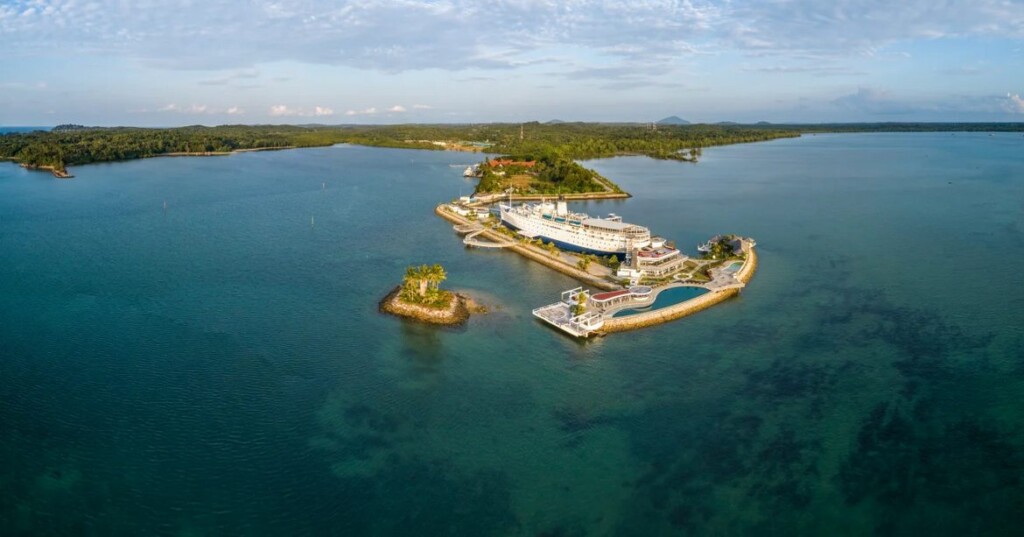
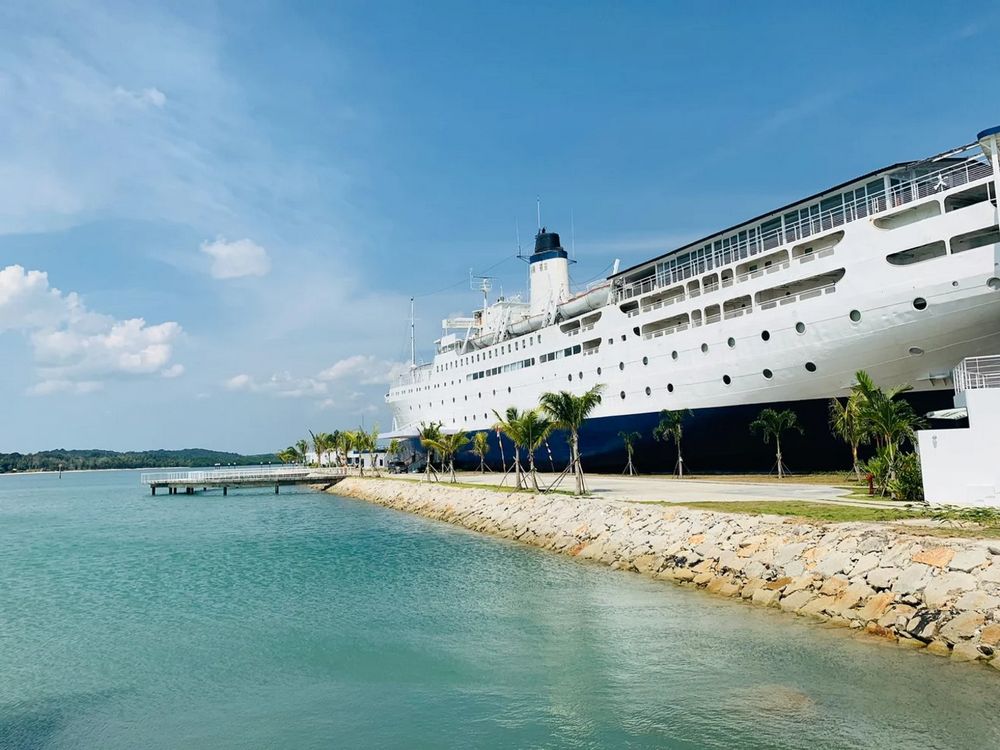
Long since declared unseaworthy, the MV Doulos Phos is now the 5-star Doulos Phos Ship Hotel at the Bintan resort reclamation project in Indonesia.
But if you’re imagining the ship to be merely a prop, thank again. Her new owner, as nautically enthused as an interview with CNN demonstrated him to be, endeavored to keep intact every ounce of heritage that was possible to preserve, from the defunct engine room to the porthole windows.
“If I didn’t have this project, maybe I’d have a Ferrari and a Lamborghini at home, and I’d be sailing around the world every year with my family,” 74-year-old Eric Saw, a devout Christian Singaporean multi-millionaire, and the owner (captain, maybe?) of the boat and the hotel told CNN.
That project took 15 years and $18 million to complete, along with countless headaches and many inches of nails bitten down in anxiety. It was journey that barely holds a candle to the vessel’s long history.
It was 1914, just two years after Titanic sunk when SS Medina rolled off the shipyard in Newport News, Virginia. Over a career spanning 100 years, she transported agricultural goods, then military personnel during the First World War, then passengers again under the name SS Roma. In the mid-20th century, she swapped her steam engine for a diesel one, and her name (again) to MS Franca C. and set sail as a cruise liner.
Her final conversion came when she was purchased as a missionary vessel and floating library in 1977, and renamed the MV Doulos. She docked at over 100 countries, sailed hundreds of thousands of nautical miles, and was at one point the oldest operating passenger vessel on the seas.
But time ends all romances, and with a mountain of maintenance needs that no one would pay for, she was drydocked in Singapore to await bids for new ownership, 4 years shy of her 100th birthday.
Eric Saw already ran a three-story restaurant inside a Mississippi-style paddle steamer, and felt “a calling from god” to buy and repurpose the ship into a new line of work.
After three years of paying dock fees for the vessel, Saw zeroed in on a place of rest on Bintan island in Indonesia. He was offered 3 acres of reclaimed land; he requested that it form the shape of an anchor.
In October 2015, at 101 years-of-age, the newly-renamed MV Doulos Phos, or “servant of light” in Greek, embarked upon her final voyage from the island of Batam to Bintan. There she would rest upon a bed of concrete undergirded with piles extending 130 feet into the bedrock below the seabed.
Inside, the small crew and passenger cabins which were crammed and poorly lit were expanded, but some were left as-is for adventurous visitors. Elevators and fire escapes and other modern building requirements were installed to meet building codes and regs, along with modern electrical and plumbing.
released by Doulos Phos Ship Hotel
Yet every vestige of heritage possible to save was retained, including the four life boats, which still hang from chains along her midship, and tons of material including the original rivets which held her hull together as welding hadn’t been pioneered in shipbuilding in 1914.
Perhaps because he saw it as a mission from god, Saw takes a salary of $1.00 a year, while all operating profit is donated to charitable causes—a servant of the light, in name and nature.
WATCH a tour below…
SHARE The Story Of The Creation Of This Unique Hotel With Your Friends…