











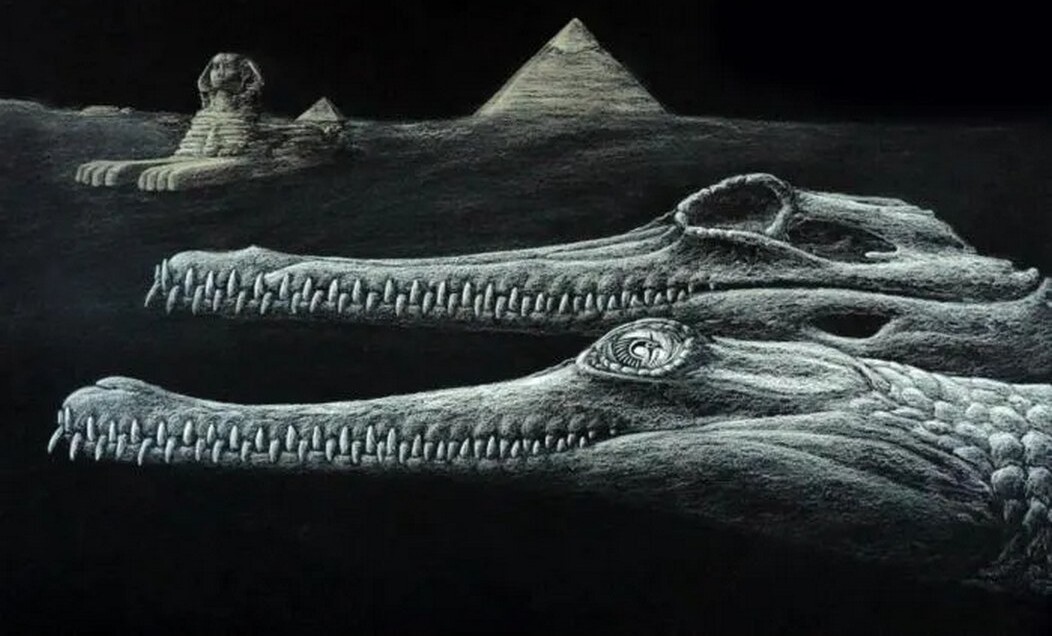
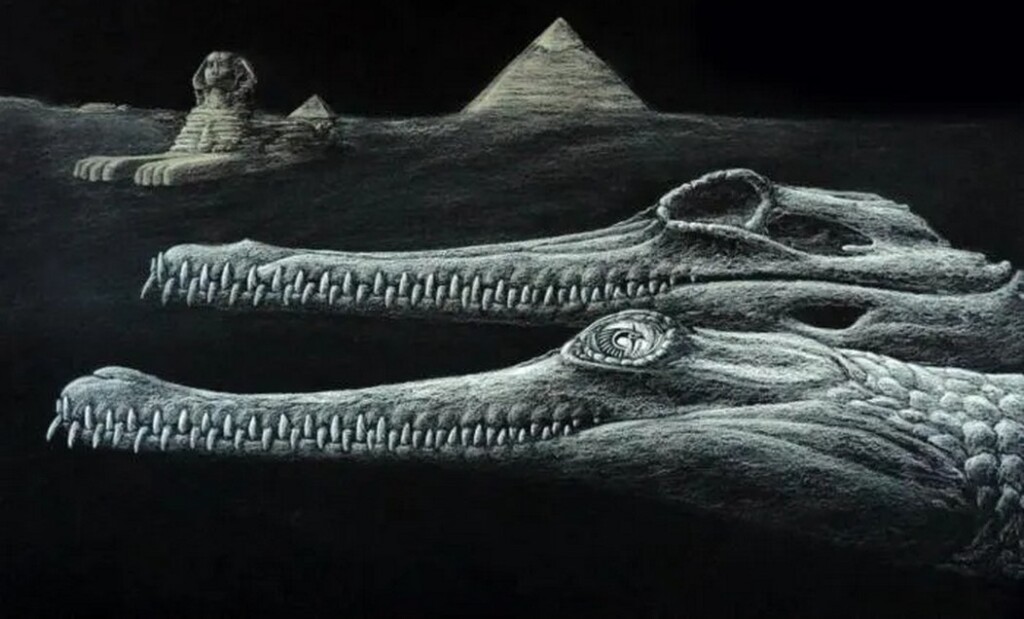
A new crocodilian species has been identified from fossils recovered from a rock layer harvested by ancient Egyptians to build the Sphinx
And funnily enough, just like the iconic Egyptian landmark, this fossilized reptile is missing the tip of its snout.
In the 1920s, several fossils were recovered from the 45-million-year-old Mokattam Formation in Egypt. Those fossils, including a nearly complete skull, were described as belonging to Tomistoma, a genus of gavial crocodile, a cousin of alligators and crocodiles with long thin snouts.
But recent analytical advances in paleontology, including the use of CT scanning to look inside the skull, allowed an international team of researchers to identify several differences between the skull from the Mokattam Formation fossils, and the Tomistoma of their original classification more than 100 years ago.
According to a study published October 7th in the journal Royal Society Open Science, the original, erroneous classification was made despite the fact that T. schlegelii lives today in Indonesia and Malaysia a far cry from the Nile Delta. Later, it was classed into a new Tomistoma species named after Cairo, but this wasn’t to stand either.
The CT scans showed substantial differences between the skull found in Cairo, and anything from Tomistoma, so the researchers now re-describe the creature as Herugavialis cairensis, translated as something like “Heru’s gavial of Cairo.”
There are just two living species of gavial today: Gavialis gangeticus, named for the Ganges and found in Nepal and northern India, and T. schlegelii.
However, the fossil record of gavials documents a near-global distribution, spanning more than 100 million years, with many species living in shallow marine environments.
Scientists from the UK, Sweden, Germany, and Egypt, led by Dr. Paul Burke from the Swedish Museum of Natural History, found that one feature in particular caught their attention: the tip of its snout was missing.
“Given this coincidence with the famously missing nose of the Great Sphinx, we decided to name the new crocodile after the Egyptian god Heru, who was possibly the inspiration for this iconic monument,” said study co-leader Professor Philip Mannion from University College London.
REPTILES THROUGH THE YEARS: A Plant-Eating Croc? Newly Identified Species Demonstrates Crocodilian Versatility
“Crocodiles were part of the Nile ecosystem, which was central to Egyptian life, and they held an important place in ancient Egyptian belief and culture,” study co-author Hesham Sallam, a paleontologist at Mansoura University in Egypt, told the Washington Post.
The shallow marine environments that covered much of the region were also home to at least two other species of gavials.
ALSO CHECK OUT: Fossil Remains of ‘Weird’ Creature with Twisted jaw and Sideways Teeth Discovered
“Throughout much of the last 50 million years, the Mediterranean region hosted a high diversity of crocodiles, including gavials,” said Dr. Burke.
“However, this diversity fluctuated over time, seemingly corresponding to changes in global temperature and sea level, before the loss of all crocodiles in this region as a result of the drying of the Mediterranean approximately 6 million years ago.”
GIVE Your Friends This Good Bite Of News From Cairo…