














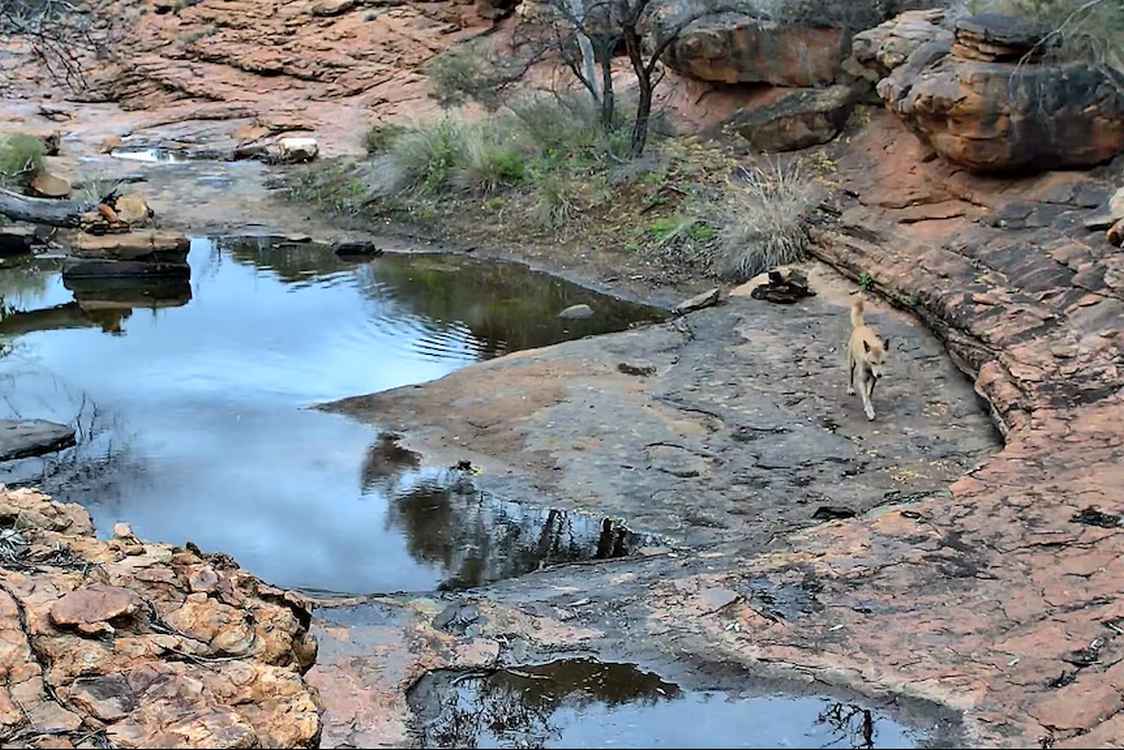
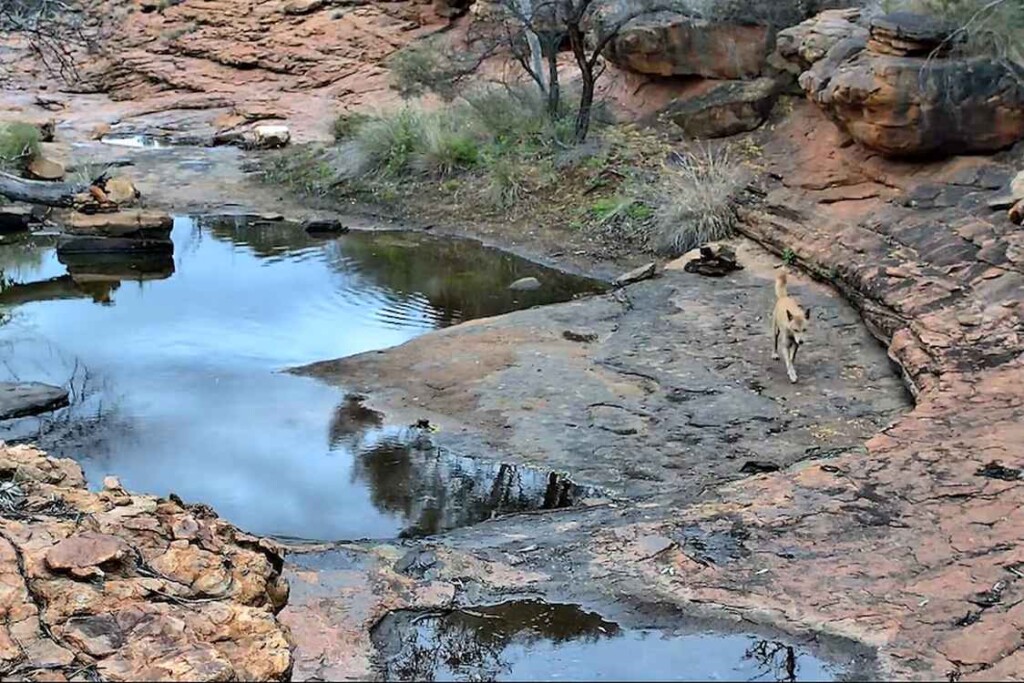
1.2 miles from the nearest car park, down a track which few hikers ply, in a national park few will have the opportunity to visit, a lonely camera livestreams the comings and goings of a desert waterhole to the world.
For the dingoes, wallabies, frogs, occasional feral cat, and even a wedge-tailed eagle who have so far been recorded stopping for a drink, life carries on as it always has. They remain undisturbed even as thousands of people, from Sacramento to Samarkand, have watched them from their devices.
Located in Watarrka National Park, the waterhole livestream was organized by Northern Territories Parks and Wildlife, and Charles Darwin University’s Research Institute for the Environment and Livelihoods.
The idea was dreamt up by fresh water ecologist Jennifer Davis, who had used motion activated cameras to snap photos or clips of passing wildlife at waterholes for years.
She told ABC News AU that it was only recently when advancements in solar power, satellite internet, and compact computing reached the point that she could unite all three—with the help of a little camouflage paint—to take a permanent watch on the waterhole.
“The livestream allows us to see what’s coming in, what’s drinking, what the behaviors are and how they might also change as the planet warms,” Professor Davis told the Australian network.
Watarrka National Park is an ancestrally-important landscape for the Matutjara people, and is internationally renowned for the sandstone walls and gorges surrounding Kings Canyon at the park’s heart. It’s a place of great beauty and ecological importance, but at 818 miles south of Darwin and 201 miles southwest of Alice Springs, it’s a place that few—even Australians—will ever get to visit.
SIMILAR STORIES:
- Students Work to Fundraise to Save Habitat Where They Watch Bald Eagle Chicks on Livestream
- Good Samaritan Saves Farmer’s Pig, Calls 911 After Joining Livestream and Seeing Barn On Fire
Dingoes are spotted more regularly than other creatures, while wallabies are also common visitors. The waterhole is a temporary one, and may vanish after long periods without rain. On the other hand, rain tops up the pool, at which point frogs take up refuge in the water.
The livestream also brings the sounds of nature, such as frogs croaking, birdsong, and the pitter-patter of rainfall.
“As a freshwater ecologist, I’m really keen to see when there’s water present…we’re looking for what’s happening with global warming because, at this site, the only real impact on the amount of water present is going to be climate change,” Davis said.
STREAM This Story Over To Your Friends On Social Media…