














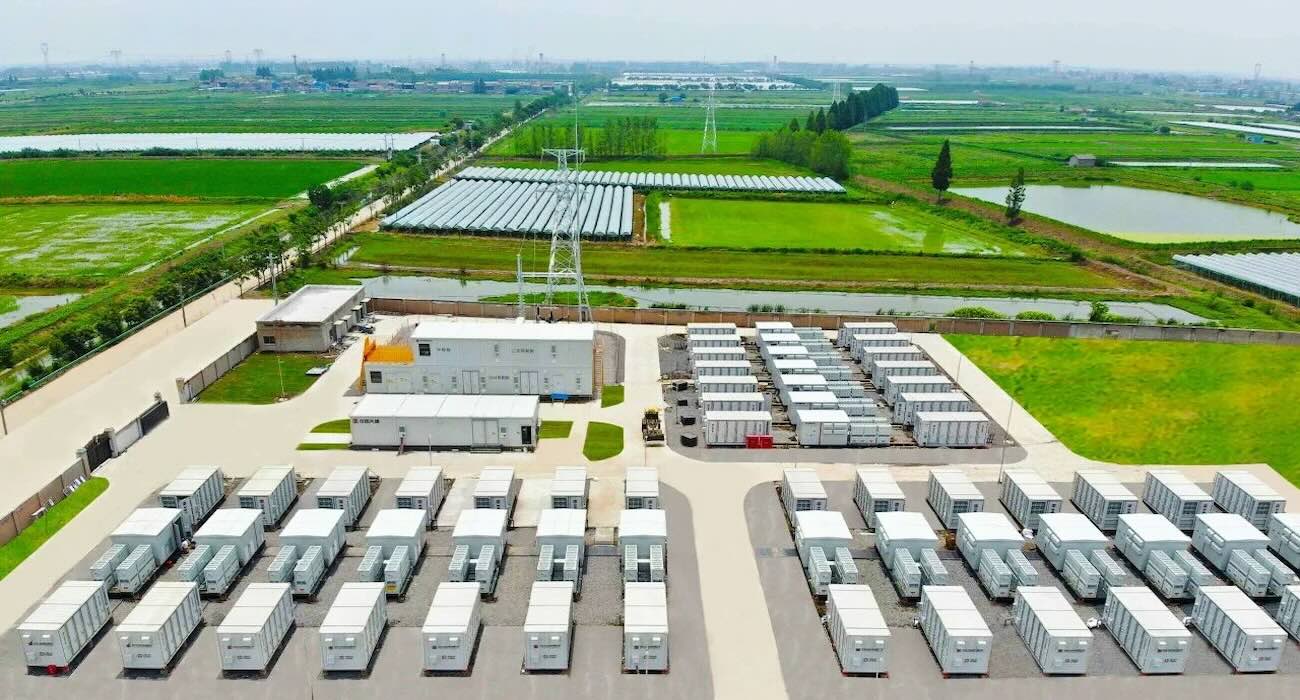
A new study shows that a low-cost sodium-ion battery currently used in cars and large-scale energy storage systems in China matches most performance parameters and production quality found in Tesla’s lithium-ion batteries.
Since sodium is much more abundant and widely available than lithium, using it for batteries could cut raw material costs for manufacturers and reduce supply chain risks that surround critical minerals.
Conducted by a German university, the research published on May 28 in the Cell Press journal Physical Science, looked at the battery designed by Hina, a spin-off company of the Chinese Academy of Sciences that has partnered with automakers like JAC to provide EV batteries.
It shows that “once the sodium-ion (or Na-ion) battery is tweaked to charge more effectively at low temperatures and function better at high energy densities, it could provide a cost-effective alternative for future electric vehicle batteries”.
“The combination of good uniformity, high power capability, and strong low‑temperature performance makes these cells attractive for stationary storage, grid services, and shorter‑range or commercial vehicles where potential lower cost and resource availability matter more than maximum driving range,” said Moritz Schütte, a battery researcher at RWTH Aachen University in Germany.
MORE GREEN ENERGY NEWS:
• Tunisian Solar-Powered Cars Leverage African Sun to Charge 30 Miles for Free Everyday
• Iron-Air Batteries Powered by Rust Could Revolutionize Energy Storage By Using Only Iron, Water, and Air
EDITOR’S NOTE: The following unedited text is taken from the Cell Press media release:
To assess how HiNa batteries compare to more advanced Tesla batteries, Schütte’s team used a non-destructive technique called impedance spectroscopy to measure the uniformity of 120 sodium-ion battery cells. Next, to map out the power and energy performances of individual cells under real-life conditions, the team tested the batteries at varying currents and at temperatures from −20 °C to 45 °C. They also used X-rays to see the battery’s internal structure, then opened up the cells to measure their electrode dimensions, compositions, and microstructures.
They found that the battery uses a tabless (design), a double-aluminum current collector design that reduces resistance and ensures a uniform temperature distribution—and also mirrors the current design of Tesla batteries.
“We were positively surprised by how uniform the cells are,” says Schütte.
However, the sodium-ion battery has some limitations when it comes to energy density and charging at low temperatures. “The high‑power performance was better than one might expect from an early commercial sodium‑ion product,” says Schütte.
“For applications that require frequent charging at low ambient temperatures, appropriate thermal management or operating strategies will be important because low-temperature charging remains a clear weakness.”
The researchers also found unexpectedly high, unevenly distributed levels of copper in certain cathode regions of the battery, which “raises interesting questions about its role in performance and aging,” said Schütte.
“It will be exciting to see future sodium-ion technologies that are free of nickel and copper, as well, while achieving competitive energy density.”
RELATED SUCCESS:
• Sub-Zero Temps Didn’t Affect Wisconsin’s Electric Bus Fleet –A Major EV Milestone
• Sand Batteries Could Be The Next Frontier In Renewable Energy–And it’s Already Heating Homes in Finland
Sodium-ion batteries also perform well under load at low temperatures, making them an appealing option for both stationary power storage and mobile applications in cold climates.
“However, today’s commercial sodium-ion cells generally have lower energy density than the best lithium-ion cells, and the technology is less mature overall,” said Schütte.
Next, the authors plan to better understand and improve upon the battery’s charging capabilities at low temperatures so that they can charge more safely and efficiently below 0°C. Further research should also focus on optimizing the materials used to make sodium-ion batteries, added Schütte.
“Advances in hard‑carbon anodes and electrolyte formulations may be especially promising,” he said.
This work was supported by Germany’s Federal Ministry of Research, Technology, and Space and the Federal Ministry for Economic Affairs and Energy.
CONSIDER POWERING INTEREST ON SOCIAL MEDIA By Sharing the Good News…