














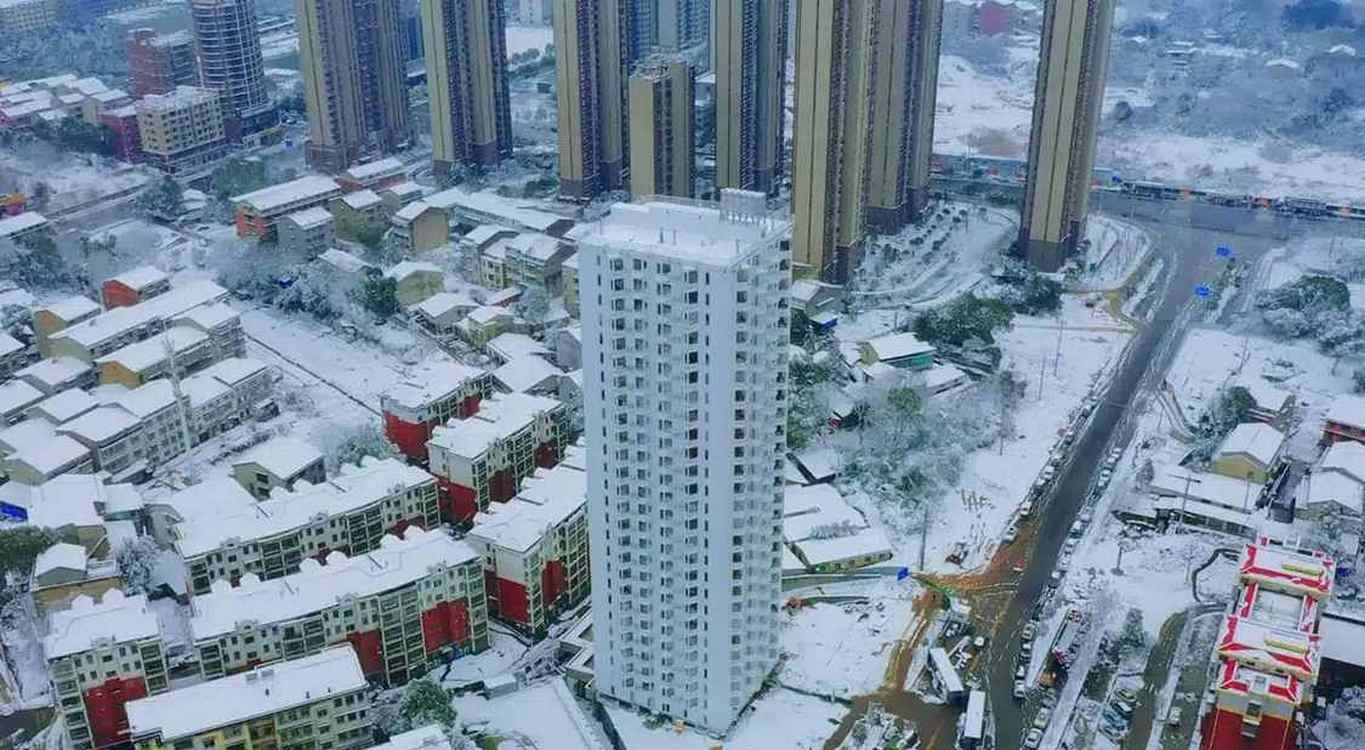
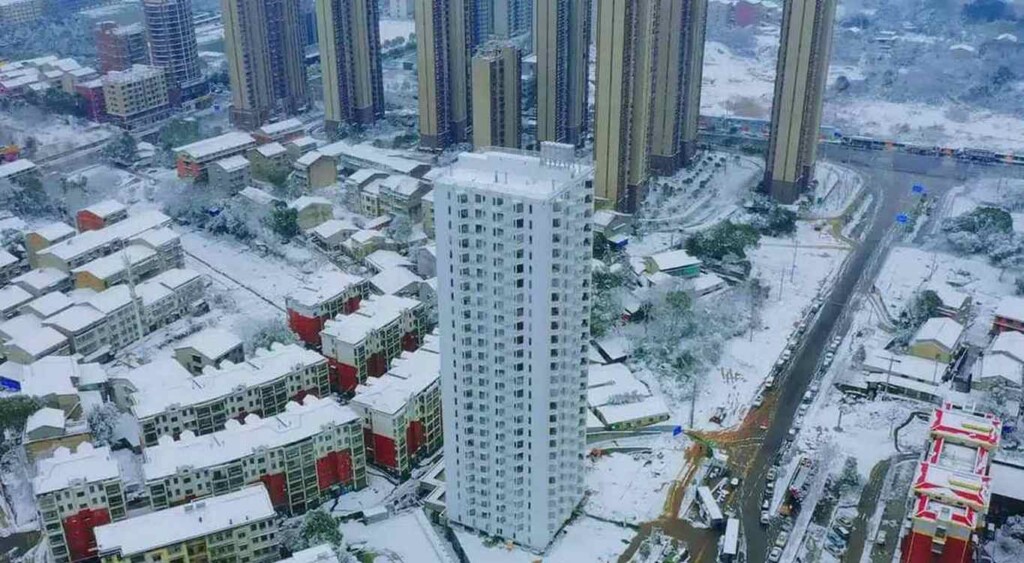
It was a rare snowy day in southcentral China’s Changsha—a city of ancient innovation—when flatbeds loaded with steel arrived at a building site.
On January 7th, 2024, workers began to arrange stainless steel modules on the empty site. Standing in its place just 5 days later was a 26-story high-rise apartment complex.
The nothing-short-of-remarkable demonstration of module construction on the grandest scale yet seen won major international engineering acclaim, but more than that, the Jindu Holon Tower fulfilled a company’s 17-year journey that started amid disaster.
A terrible earthquake rocked the province of Sichuan further south in 2009, killing tens of thousands of people and knocking down reinforced concrete towers in cities like Chengdu as if they were sand castles. Watching on was the founder of the Chinese construction firm BROAD Group. He realized something had to change.
BROAD Sustainable Building was formed as a direct response to the disaster, hoping to pioneer modular construction methods to make towers flexible and resistant to seismic events.
It can take 3 years to pour the concrete and install the utilities of a medium-height apartment building in New York or London. All the while, roads are disrupted, and gas-guzzling trucks move in and out every day bringing in concrete mix and sand, rebar and other components. Risks of accidents compound daily by the sheer number of days—in the rain, in the heat—that workers are assembling the structure.
Then, in 5-7 years, major concrete renovations may already be needed.
In Hunan, the event was totally different. Trucks rolled in carrying stainless steel shipping-container-like modules, each measuring 12 meters long, 3 meters high, and 2.4 meters wide. A crane stacked one atop the other, and workers bolted them into place. No concrete needed to be poured, nothing needed to be welded.
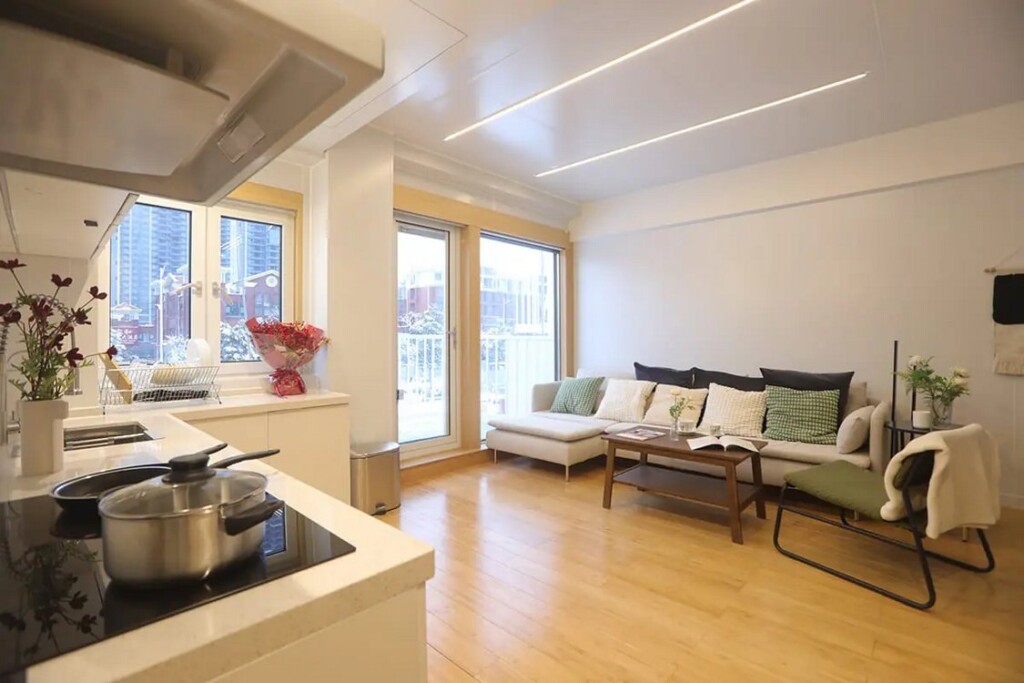
In 5 days they had finished and were ready to start welcoming residents. That’s because each of these stainless steel modules had everything already built in: the plumbing, the windows, the HVAC, the lights, the kitchen cupboards even—all of it was assembled on a factory floor in the space of 21 days.
BROAD Sustainable Building uses a patented stainless steel “sandwich” called B-CORE that boasts high tensile strength that will allow the building to bend not break if faced with another magnitude 8 earthquake like in Sichuan. Stainless steel is also much more resistant to corrosion and weathering.
Andrew Zimman, marketing director at BROAD Group USA, spoke to the French Modular Building Institute, which gave it the Innovation of the Year Award back in 2022, about the decision.
“We switched to stainless steel about five years ago,” Zimman explained, “because we realized that the mechanical properties of stainless steel weren’t limited to corrosion resistance, which is good for facades, but that stainless steel also had great ductility. That’s why we chose stainless steel for our load-bearing elements. We’re the first to do so.”
FUTURE ARCHITECTURE: ‘Sponge’ Cities Combat Urban Flooding by Letting Nature Do the Work
“Even though our volumetric product is only two years old, we’re constantly innovating,” Zimman continued. “For example, in the first Holon building we built two years ago, the beams had to be installed on-site. Now, when we lower the modules, the beams are integrated into the floor system of those modules. So there’s no welding on-site. There are only bolts. The cranes are ready; all you have to do is select and position, stack, bolt, connect the utilities, and you’re good to go.”
Zhang Yanwei, a manager at BROAD Group Holon Jianan Co, which manages the actual building, told China Daily that the company furnished the units before handing them over with everything that isn’t portable. Washing machines, refrigerators, beds, etc. are not included.
There’s another party trick the Holon modular building system boasts that is especially interesting to those of an eco-friendly persuasion. When it’s time to go, there’s no demolition. The whole structure can be unbolted, unstacked, reloaded onto trucks, and driven off. No waste, no noise, no dust, no gas-guzzling excavators working dawn till dusk to clean up a collapsed building, and no landfill waste.
MORE INNOVATION TO EXCITE: Stylish Prefab Home Can Be ‘Dropped’ into Flooded Areas or Anywhere Housing is Needed
This is a game changer for municipalities balancing zoning laws, or insurance firms calculating for various disaster risks. If for legal or safety reasons the building has to go, it can, as it turns out, simply go.
Zimman told the institute that BROAD Group has projects in the pipeline for Ohio, Texas, and California, alongside work in the Philippines and the United Arab Emirates. Like many of the world’s great suspension bridges, the performance of stainless steel suggests that there isn’t a particular height limitation: as far as there is design and demand, their buildings can keep climbing.
SHARE This Achievement In Architecture Towards A World Without Concrete…