














250 years ago today, Thomas Paine published the sensational pamphlet simply entitled Common Sense. Writing in clear and persuasive prose, Paine collected moral and political arguments to encourage common people in the Colonies to fight for egalitarian government. Officially called Common Sense addressed to the inhabitants of America on the following interesting subjects, it was sold mainly from taverns at first in Philadelphia, and it’s estimated between 100K and 500K units were thusly distributed; and as of 2006, it remained the all-time best-selling American title. READ about this famous American document… (1776)
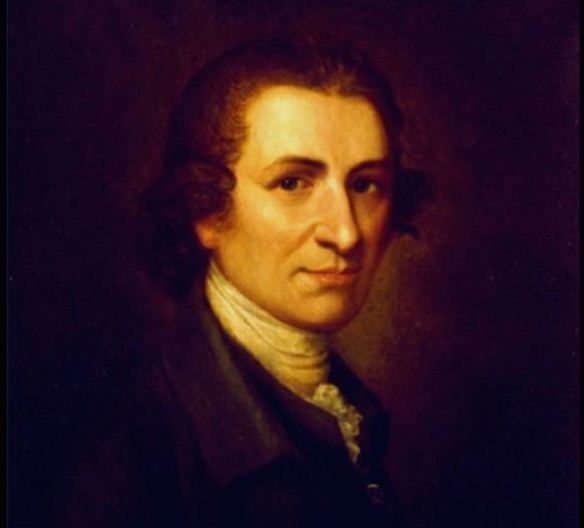
Thomas Paine had only arrived in the Americas from England just two years before the publication of Common Sense, and detected that loyalty to the crown was obstinate among the colonists.
Paine quickly engrained himself in the Philadelphia newspaper business, and began writing Common Sense in late 1775 under the working title of Plain Truth. It began as a series of letters to be published in Philadelphia papers. It grew too long and unwieldy to publish as letters, leading Paine to select the pamphlet form.
The original publisher had either embezzled the profits, or produced the pamphlet in such a wasteful way as to make none at all. Incensed, and fearing the popularity had already reached its peak, and thusly his chance at making money off of it might soon be gone, Paine switched publishers to the owners of the Pennsylvania Evening Post. The second edition, with added appendices, was even more popular than the first print run, moving overseas to France where it was remarkably popular with the small help of cutting out section two where Paine lambasts the idea of monarchy.
Adjusted for population, Common Sense, if achieving the same success in mid-century America, would have seen approximately 6.1 million copies sold in 3 months. In those first 3 months, the anonymous Paine kept his low profile, even through the scandal with the original publisher.
The pamphlet is divided into four sections: (I) Of the Origin and Design of Government in General, (II) Of Monarchy and Hereditary Succession, (III) Thoughts on the Present State of American Affairs, (IV) Of the Present Ability of America.
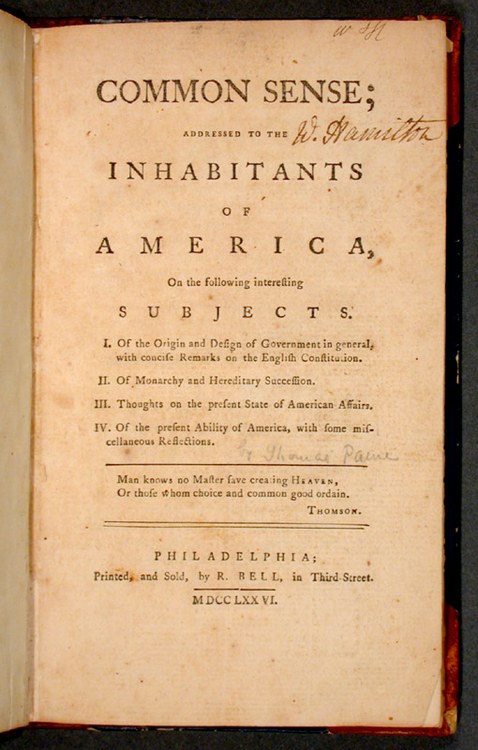
Paine begins the first section by making a distinction between society and government and argues that government is a “necessary evil.” Paine begins the second by arguing that since all men are equal at creation, the distinction between kings and subjects is a false one. In the third section, Paine examines the hostilities between Britain and the American colonies and argues that the best course of action is independence. The fourth section of the pamphlet includes Paine’s optimistic view of America’s military potential at the time of the revolution.
Interestingly should it be to us living today, Common Sense received immense ridicule and declaim from most of the political class in the Colonies at the time, including from John Adams. Both for revolutionaries and loyalists, the critique was the same: Paine was calling for radical, mass democracy: a tyranny as they saw it, of the masses.
His vision, Adams wrote, was “so democratical, without any restraint or even an attempt at any equilibrium or counter poise, that it must produce confusion and every evil work.”
MORE Good News on this Date:
- League of Nations held its first meeting and ratified the Treaty of Versailles ending World War I (1920)
- The first UN General Assembly opened with 51 nations (1946)
- Edward Brooke (R-MA) took his seat as the first black elected to the US Senate by popular vote (1967)
- The United States and the Vatican established full diplomatic relations after 117 years (1984)
- Kareem Abdul-Jabbar of the Los Angeles Lakers scores his 34,000th career point during a 124-102 win over the Indiana Pacers; the only NBA player to reach the milestone at that time, and who remains the all-time leader with 38,387 (1986)
27 years ago today, The Sopranos debuted on HBO. Running for 6 seasons totaling 86 episodes, it is widely regarded as one of the greatest and most influential television series of all time. The series explores the life of Italian-American mob boss Tony Soprano as he attempts to balance family and ‘business’. A lot of the storytelling revolves around Soprano’s conversations with his therapist, as creator David Chase admitted he didn’t want to make a show about the mob in general, but of a particular man and the realities involved in his curious profession that often involves no violence or law-breaking of any kind.
The Sopranos has been credited with kickstarting the Second Golden Age of Television. The series won a multitude of awards, including Peabody Awards for its first two seasons, 21 Primetime Emmy Awards, and 5 Golden Globe Awards.
The President of HBO at the time of the series’ release explained it like this: “I said to myself, this show is about a guy who’s turning 40. He’s inherited a business from his dad. He’s trying to bring it into the modern age. He’s got all the responsibilities that go along with that. He’s got an overbearing mom that he’s still trying to get out from under. Although he loves his wife, he’s had an affair. He’s got two teenage kids, and he’s dealing with the realities of what that is. He’s anxious; he’s depressed; he starts to see a therapist because he’s searching for the meaning of his own life. I thought: the only difference between him and everybody I know is he’s the Don of New Jersey.” (1999)

Happy 78th Birthday to Steely Dan co-founder Donald Fagen, whose vocals, keyboards, and songwriting talents have, for decades, merged the intricacies of jazz with his perfect pop sensibility. Steely Dan’s 2000 LP Two Against Nature won a Grammy for Album Of The Year, and Fagen’s solo album Nightfly became a cult classic. From the hit single, Reeling In The Years, to the smooth and complex sounds of Aja (and the LSD anthem Kid Charlemagne), the Passaic, New Jersey musician deserves two thumbs-up for his brilliant body of work.
As an author, Mr. Fagen penned the book, Eminent Hipsters, writing about the cultural figures that shaped his artistic sensibility, and offering a look at his college days and a hilarious account of life on the road. Already known for his literate song lyrics and elaborate arrangements, Fagen proves himself an equally sophisticated author. (1948)
188 years ago today, the first tea leaves from the Indian state of Assam arrived on a ship in Great Britain, with the effect of bringing tea into the public dietary lexicon. It would transform forever social activities around the West, and dramatically increase the health of Londoners, as a city that had been drinking out of the Thames were finally boiling their water for the first time. The date of the exact shipment is disputed.

One of the chief reasons why India and not China became the tea basket of Europe was that their native tea plants could endure much higher temperatures. The British had found tea in China several decades before, but cultivating them outside the country proved impossible.
A little more than a decade after the first Assam shipments arrived in Britain, production in India was nearing 3.9 million pounds. Today, India is one of the world’s largest producers of tea with 13,000 gardens and a workforce of more than 2 million people involved in its production. (1838)

Happy Birthday to the raspy-voiced British singer-songwriter Rod Stewart who turns 81 today. His fame goes all the way back to his first hit, Maggie May, with its striking mandolin sound, steeped in warmth. The long list of hit songs that followed earned ‘Rod the Mod’ the #59 spot on Rolling Stone magazine’s 100 Greatest Singers of All Time—and made him one of the best-selling music artists of all time, with sales of over 120 million records worldwide.
Stewart toured North America in 2019—and in 2020 had planned to continue his residency at Caesars Palace in Las Vegas to promote his latest studio album, You’re In My Heart: Rod Stewart With The Royal Philharmonic Orchestra. The LP is a retrospective of revamped versions of his classic songs, that use original vocal tracks atop new symphonic arrangements.
He’s got plans for another album that would contain country tunes, folk music, and “older stuff” that helped shape him growing up. WATCH Ronnie Wood join him on stage (his old bandmate from The Faces) for two of his big hits… See more songs from the fine concert series below, on YouTube. (1945)
Also, 44 years ago today “The Catch,” arguably the most iconic play in NFL history was completed to seal a remarkable 28-27 victory over the Dallas Cowboys with less than a minute remaining. Under pressure from 3 opposing players, San Francisco 49ers quarterback and sport legend Joe Montana manages to get off a throw to find Dwight Clark in the Endzone. “The Catch” in the 1981 NFC Championship would see the 49ers advance to and win Super Bowl XVI; their first in franchise history.
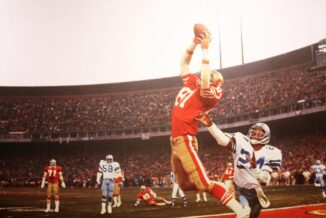
It came at the end of a 14-play, 83-yard drive engineered by Montana, and marked the beginning of the 49ers’ rise as an NFL dynasty in the 1980s, where they made the playoffs 8-times, and going on to win three more Super Bowls, the most of any team during that decade.
The play becomes all the more extraordinary in the examination of it, as it essentially began disastrously. Wide receiver Freddie Solomon, who was responsible for most of the catches during the scoring drive, slipped after the play began, allowing the Cowboys perfect coverage of him. Furthermore, the offensive line collapsed, and seconds into the play Montana had defensive ends Ed “Too Tall” Jones and Larry Bethea, as well as linebacker D.D. Lewis pushing him out towards the sidelines.
A pump-fake bought Montana enough time to make a leaping throw which connected with a leaping Clark, who was subsequently shown in an iconic photograph of the play to have secured the ball with little more than his fingertips. “I saw Dwight’s feet touch the ground. I heard the crowd scream,” said Montana to Sports Illustrated, who didn’t actually see Clark make the catch. (1982)
NOTE: CLICK ‘WATCH ON YOUTUBE’ BELOW (as it is not able to be shown on other websites)…
SHARE the Milestones, Memories, and Music…
[…] Brought to you by:- https://www.goodnewsnetwork.org/events070110/ […]
[…] Source: Good News Network […]
[…] post Good News in History, January 10 appeared first on Good News […]
[…] post Good News in History, January 10 appeared first on Good News […]