











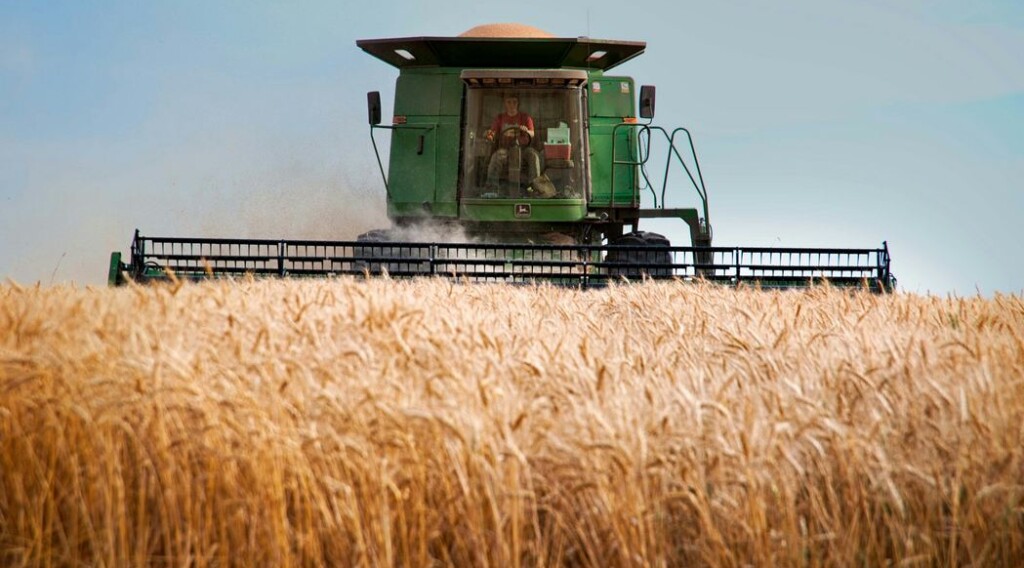
Farming adaptations have seen Canada’s farmers turn out record harvests in the middle of a 5-year drought.
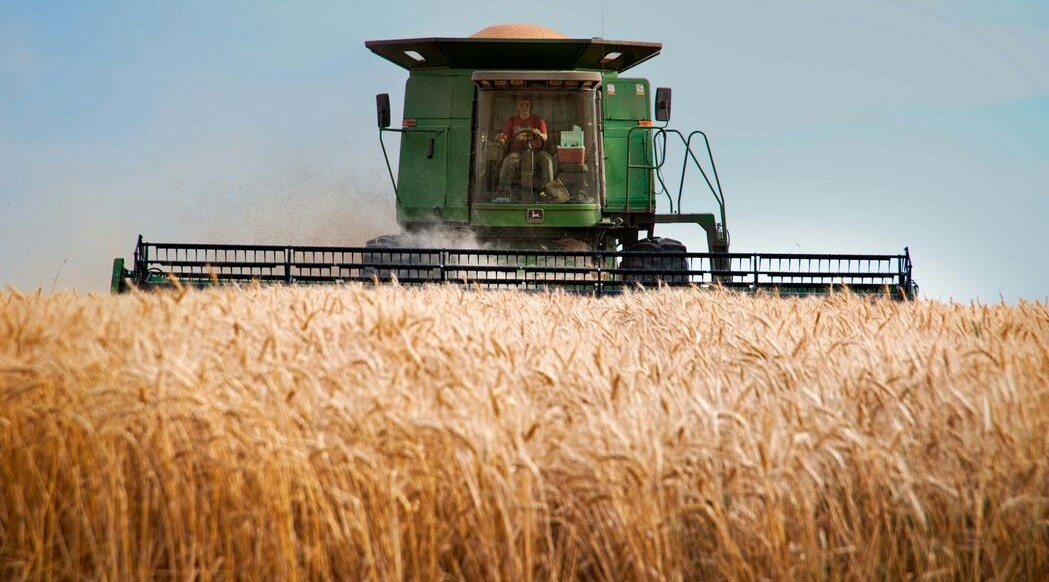
Truly unsavory conditions, like oppressive rainfall followed by an immediate return to drought, would typically have left the wheat on Simon Ellis’ fields shriveled and worthless.
Instead, plump grains were ready to be scooped up by his combine. He contributed the extra grain—almost all of which will be exported abroad to developing countries—to a national harvest total that tops any on record despite a drought that started in 2020.
Spring wheat yielded 58.8 bushels per acre this year, according to a government data release. That’s a gain of 77% from 30 years ago, based on a three-year average, according to Reuters.
“We are constantly making little tweaks,” Ellis told the outlet. “That’s how we’re going to be able to keep fighting the changing climate.”
His farm in Wawanesa, Manitoba, has been the sight of some of those constant tweaks, including an underground system to prevent flooding, slow-release fertilizer, and more precise weedkilling.
But a huge effect will have come from the zero-till method of farming the 4th-generation farmer is employing. Today, 75% of farmers in Saskatchewan, Manitoba, and Alberta don’t till the soil before seeding.
The reason being that ripping up the ground exposes the whole of the soil microbiome to the annihilating rays of the Sun. It also reduces the need for weedkiller and pesticide spraying, because weeds grow rarely and more slowly in an already-grown field. Rip up the clover, grasses, and forbes, and invasive or pioneer weed species have free-rein.
This microbiome is a key part of robust plant health, as the interrelations of bacteria, fungi, and other microscopic life anchors the crop’s immune system, just as it does our own.
Zero-till agriculture is one of the key strategies of what is generally called regenerative agriculture, which means that from the time of the harvest to the next planting season, the fields become even more rich and fertile than the previous harvest. This is often accomplished by a combination of zero-till seeding and running animal herds over the fields before planting.
TECH ON THE FARM: Genetic Mutation Could Pave the Way for Self-Fertilizing Cereal Crops and a Revolution in Agriculture
Other strategies, like intercropping—growing multiple crops at the same time—and cover cropping—growing a harmless plant like clover after harvests to protect the soil from the Sun—as well as self-guided tractors and “tile drainage,” mean that in conditions that would have once produced crop failures, farmers are growing more food than they could in the best conditions two decades ago.
Conditions in the Western Canadian Prairie are notoriously difficult to farm, and would be more difficult still under current changing climatic patterns if not for the incredible success in farming technology. Grain-growing regions in Australia face similar challenges, Reuters reported, but is seeing similar successes thanks to a similar suite of farming advances.
FARMING IN THE FUTURE: This Year’s Nice Rice Price Marks an 18-year Low Amid a Doubling of Per-Acre Yield
At the front end, many of these innovations are really expensive. A smart combine or high-speed-data-enabled tractor/seeding drill can run more than a million dollars, even without insurance. Tile drainage, a system of pipes that takes water and channels it into an underground network rather than letting it pool atop the field, is expensive as well.
At the backend, however, these also save sizable amounts in annual fuel, fertilizer, pesticide, water costs.
SHARE This Blend of Traditional And Cutting Edge Ag Techniques Bringing Massive Yields To Canadian Fields…