













A conservation charity in the UK has turned what was once a dumping ground for material dug up during canal dredging into a nesting habitat for two-thirds of the UK’s black-necked grebes.
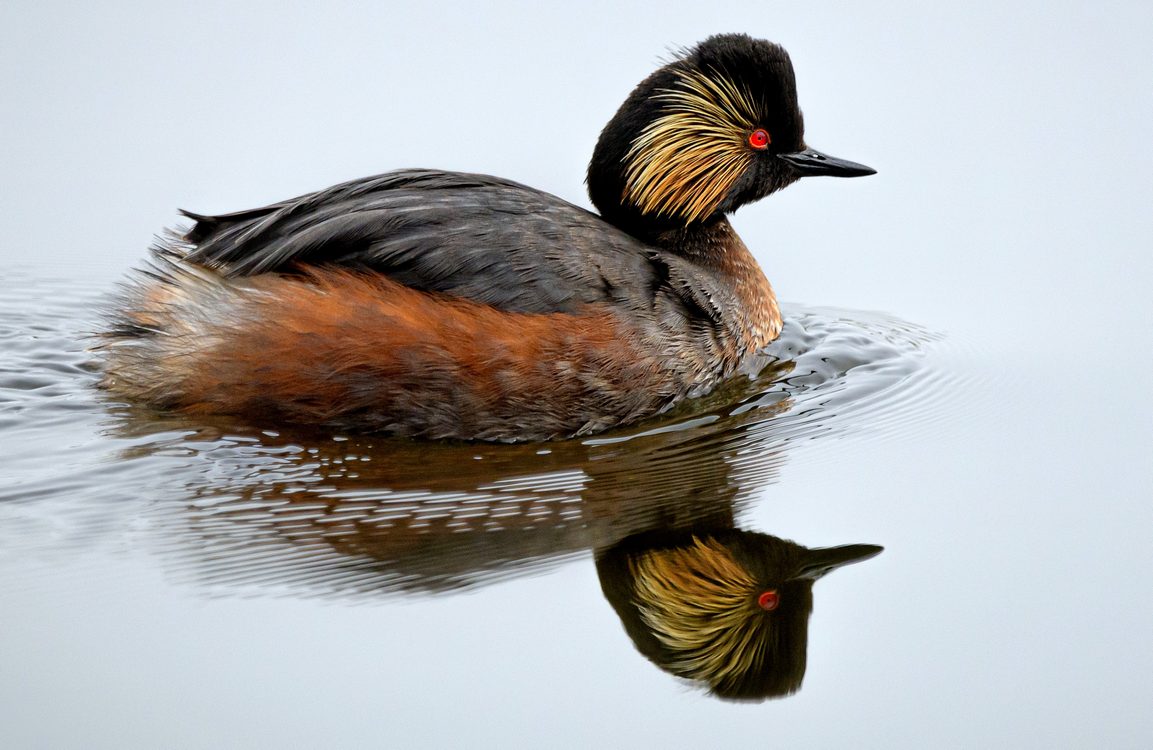
These beautiful waterfowl with thin ochre-golden feathers sashaying away from their ruby-red eyes have a very unusual migratory pattern which in the UK sees them arrive in nesting areas shared by the black-headed seagull.
One place where these 2 species timeshare is Woolston Eyes Nature Reserve. In this nearly 1,000 acre wetland, the Manchester Ship Canal Company organized the dumping of a substantial portion of the 41 million cubic meters of material dug up during the construction of the 36-mile canal which first entered operation in 1894.
In 1979, the company entered into an agreement with the Woolston Eyes Conservation Group to manage the rich and varied wildlife of the area which is still owned by the company.
In 1986, it was declared a site of special scientific interest by the UK government for the wetland ecosystems that had developed over the following 90 years, consisting of “freshwater pools, reedbeds, willow scrub and rough vegetation sandwiched between the River Mersey on its north boundary and the Manchester Ship Canal on its south boundary.”
Since 2021, Woolston Eyes has been extensively improved in a bid to bring more nesting birds like the black-necked grebes and the black-headed gulls. The latter prefer to build their nests on islands in wetland areas, while the former prefer to build their nests next to the gulls for protection.
2023 saw the first arrivals: 4 nesting pairs on some of the new islands produced 15 young.
A NEARBY RIVER RESTORED: Once Biologically Dead, the River Mersey in England is “Best Environmental Story in Europe”
By 2025, 35 pairs of black-necked grebes were recorded, 29 of which nested on the newly restored wetland area, which together make up 64% of all breeding birds in the UK.
“It is fantastic to see black-necked grebe numbers increasing at Woolston Eyes thanks to the hard work of staff, volunteers and partners to create prime habitat for this rare and attractive species,” said Gavin Thomas, an ecologist with the Royal Society for the Protection of Birds.
PROTECTIONS FOR MIGRATORY BIRDS: Bald Ibis ‘the Herald of Spring’ Saved from Extinction in Turkey Thanks to Semi-Wild Breeding
“The rapid growth in numbers shows how effective targeted conservation action can be and is a great example of nature thriving when it is given a chance.”
The Guardian reports that the wetlands have also become home for numerous species of concern in the UK, including the willow tit, grasshopper warbler, and the pochard.
SHARE This Great Landscape Transformation From Dump To Diversity…