












Reprinted with permission from World at Large.
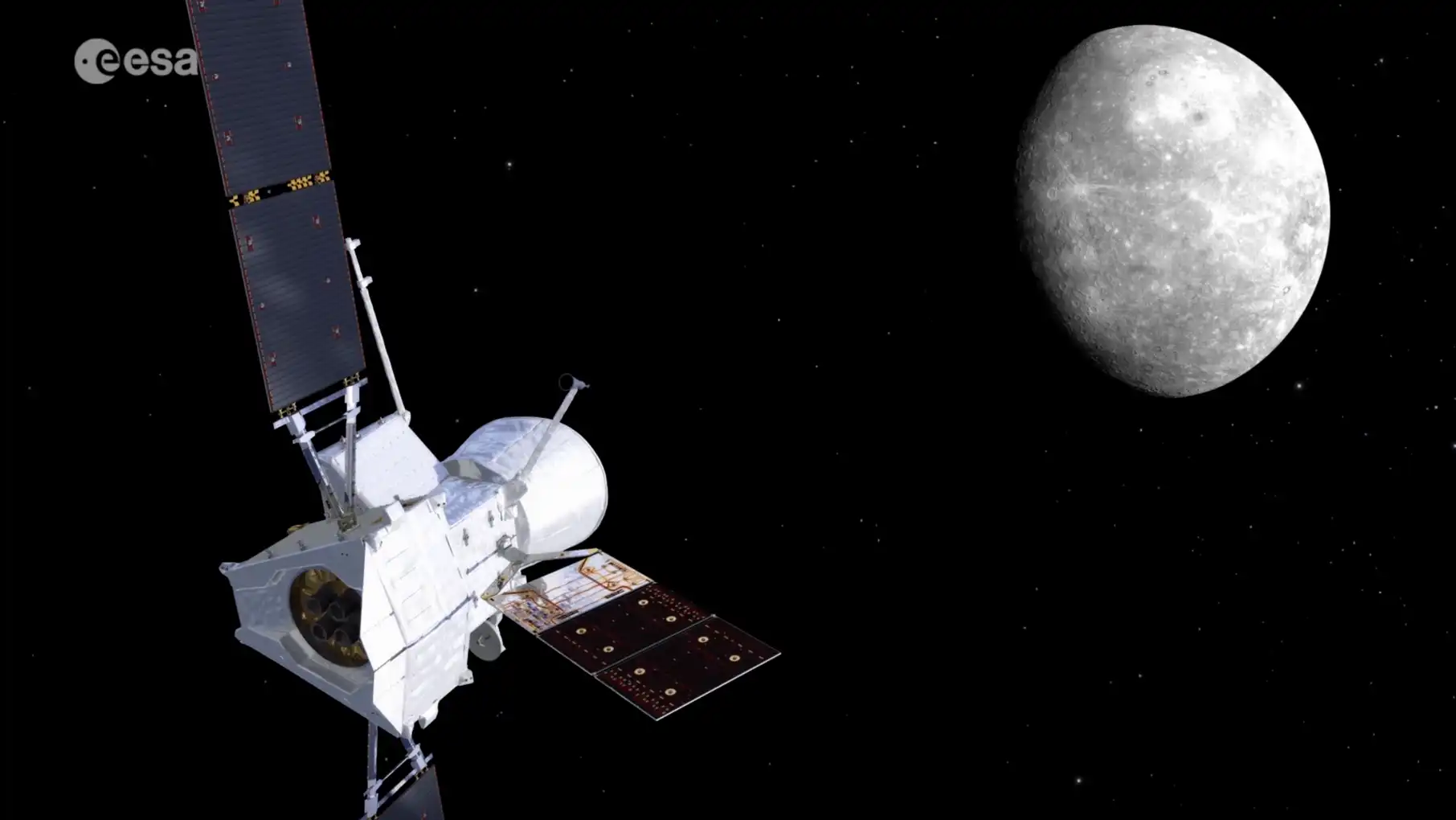
On September 3rd, the European Space Agency marked the successful arrival of its BepiColombo mission to Mercury, just the third spacecraft to ever visit our solar system’s innermost planet.
Despite being so close to Earth, it takes roughly as much time to arrive in orbit around Mercury as it would to arrive at Pluto: more than 8 years. Given the intense gravitational pull of the Sun, any attempt at keeping a flat, straightforward course is impossible without substantial propulsion equipment unsuitable for a science probe like BepiColombo.
Instead, the craft had to rely on constant flybys of other planets, whose gravity could help to apply the brakes. 9 were completed in total on route to Mercury, which had to be approached in a Goldilocks velocity; too fast and the probe would fly right past it; too slow and it would drift permanently off course from the gravitational interferences.
Against the odds, ESA successfully navigated 6 billion miles this way, and, at noon local time from mission control in Darmstadt, Germany, the first arrival phase was completed to the cheers of everyone in the room.
“BepiColombo’s Mercury Transfer Module (MTM) successfully separated from the spacecraft stack,” ESA wrote in a statement. “This landmark achievement for the ESA and Japan Aerospace Exploration Agency (JAXA) mission marks the first step of BepiColombo’s long-awaited arrival at Mercury”.
The MTM contained a combination solar and gas propellant propulsion system that helped power it through the constant gravitational interference. Having come within 1.8 million miles of Mercury, its job was done and the module was left to float away in a process which the agency described as “one of the most complex planetary arrival sequences ever attempted by ESA”.
“We heard it loud and clear in the voice loop from Flight Dynamics Manager, Frank Budnik, that they could clearly see from the Doppler data that MTM had separated. After all this waiting and preparation, we all looked at each other and hugged. It was a very powerful moment,” says Emmanuela Bordoni, ESA BepiColombo B-shift Spacecraft Operations Manager.
The results will, however, offer unprecedented opportunities and quality to study Mercury’s surface, interior, magnetic field, and surrounding environment when the two remaining science modules begin primary mission phases in April of 2027.
“Although we already have great science from the cruise phase and nine planet flybys, it’s fantastic that we’ve taken this first important step towards finally being able to use all the powerful instruments on both MPO and Mio to study Mercury,” says ESA BepiColombo Lead Project Scientist, Geraint Jones.
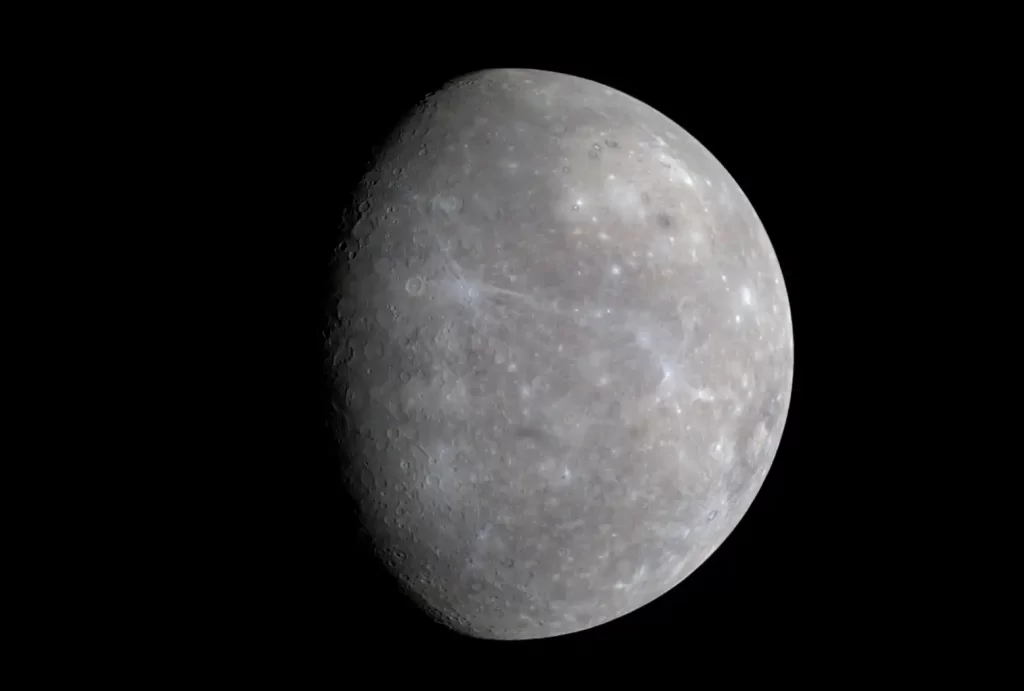
No one knows their neighbor anymore
Despite Venus’ reputation as our nearest neighbor, Mercury’s more rapid orbit actually means it spends more of an Earth year closer to us than Venus does. NASA’s Mariner 10 mission flew by Mercury 3 times in the mid-1970s, and NASA’s Messenger mission orbited it from 2011 to 2015.
Mariner 10 performed the first ever gravity assist, using Venus to flyby Mercury, which it visited on 3 occasions taking 2,700 images of the planet. The spacecraft’s magnetometers revealed a weak magnetic field, while radiometer readings suggested nighttime temperatures of minus 297 degrees Fahrenheit (minus 183 degrees Celsius) and maximum daytime temperatures of 369 degrees Fahrenheit (187 degrees Celsius).
NASA’s MESSENGER spacecraft orbited Mercury for more than 4 years. Among its accomplishments, the mission determined Mercury’s surface composition, revealed some of its geological history, discovered details about its internal magnetic field, and verified its polar deposits are dominantly water-ice.
Among its initial discoveries were finding high concentrations of magnesium and calcium on Mercury’s night side, identifying a significant northward offset of Mercury’s magnetic field from the planet’s center, finding large amounts of water in Mercury’s exosphere, and revealing evidence of past volcanic activity on the surface. It would go on to take 200,000 photos of the planet—visually mapping the whole world.
EXPLORE OUR WORLDS: 4 Exciting Space Missions Launch This Year Including NASA’s Return to Moon, Japan’s Jump to Mars
BepiColombo, a name which honors Italian mathematician and engineer Giuseppe “Bepi” Colombo, will hope to discover more about the least understood planet in the inner solar system. Small and lifeless, the mission hopes to learn how a planet can form so close to its host star, about its planetary interior—are there plate tectonics or volcanism—and details about the exterior and interior magnetic fields.
There are outstanding mysteries that data from BepiColombo could reveal, including the origin of “lobate scarps” or ridges, that can extend several hundred, surprisingly-uniform miles and reach as tall as the 1,500 meters at their highest points. Two theories as to their formation have been proposed, including one which states they formed when the mantle and interior cooled after a point when the crust layer had already solidified.
Another unexplained characteristic of Mercury is why its core has a higher content of iron than any planet in the solar system. Multiple theories have been put forward.
Measurements from both Mariner 10 and MESSENGER have indicated that the strength and shape of Mercury’s global and intact magnetic field are stable, and that around the equator its strength is similar to that of Earth—strong enough to deflect the spaceborne radiation we call the Solar wind, even given its closer proximity to the Sun. MESSENGER did reveal, however, that the field is “leaky” and concluded this by the observation of “magnetic tornadoes”.
MORE FUTURE SCIENCE MISSIONS: Nancy Grace Roman Space Telescope Survives Attempted Budget Cuts to Launch 9 Months Early
These twisted bundles of magnetic fields connecting the planetary magnetic field to interplanetary space were up to 480 miles wide, or a third of the radius of the planet, and presented gaps for the Solar wind to bombard the planet’s surface.
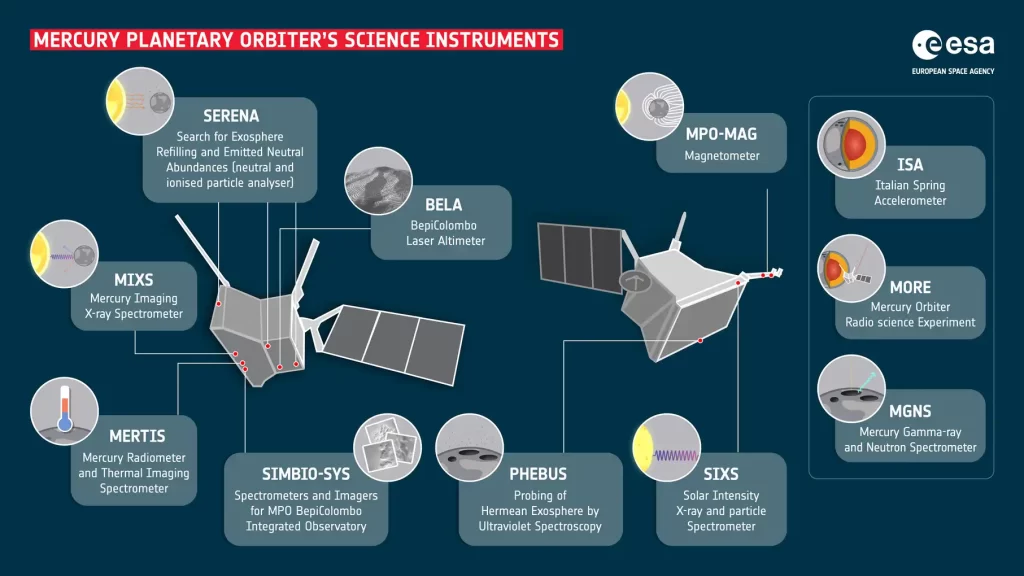
BepiColombo consists of two modules that will study Mercury and hopefully resolve some of these mysteries. Currently still joined together, Mio and MPO will enter polar orbit around the planet on November 26th, before Mio is ejected 2 weeks before Christmas. Designed by JAXA, Mio will study the magnetosphere while the Mercury Planetary Orbiter, carrying an impressive 11 science instruments of every description, will enter final orbit in March. WaL
SHARE This Exciting New Mission To Start Studying Mercury Next Year…