














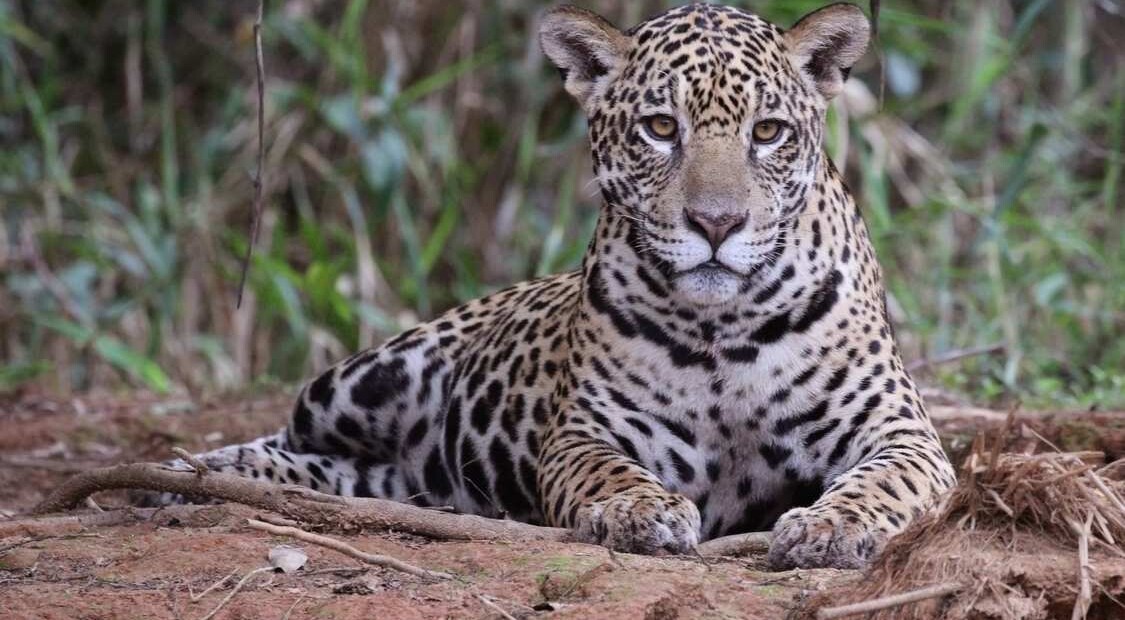
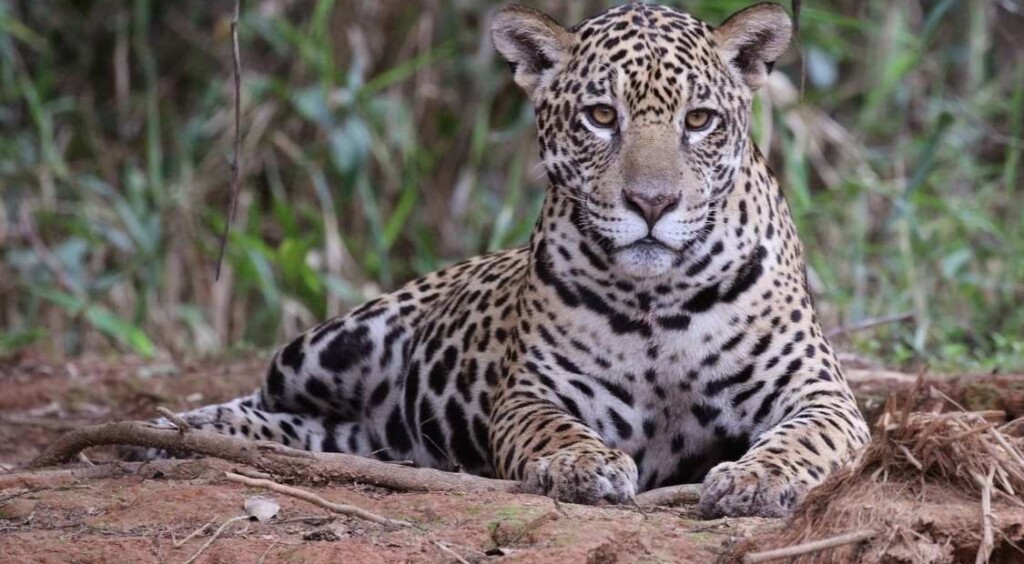
While searching for their cubs, the females of the world’s third-largest feline will make a sound that’s strikingly similar to what you’ve heard your own cat make.
Weighing in excess of 300 lbs., the jaguar is a ferocious predator that can take large caiman and even cattle, but recent video camera trap footage has revealed they possess a softer side as well.
In Brazil’s Iguaçu National Park, a team of British and Brazilian ecologists made this discovery during a camera trap survey, along with that of 2 other abnormal vocalizations, all of which were documented in 2 female cats on 3 separate occasions.
Panthera species, they detail, cannot purr like a housecat because of larger vocal cords and an ossified bone in their necks, but they can produce a sound that’s very close to a ‘meow.’
“Our results suggest that [jaguars’] vocal repertoire is more complex than what is described in the literature,” the study authors write in the paper published in the journal Behavior.
In contrast to other big cat species around the world, the jaguar isn’t endangered, maintains widespread habitat connectivity, and is resilient in the face of human encroachment. Since 2018, biologists monitoring these cats in the UNESCO World Heritage listed Iguaçu, have relied on camera trap surveys to be their eyes and ears. Every 6 seconds, Smithsonian details, the traps will record audio and video for 15 seconds.
Several instances of jaguar meows were recorded, two of which featured an adult female that appeared to be searching for her cub, while the third captured a one-year-old female cub that was possibly looking for her mother.
CAMERA TRAP DISCOVERIES: Nearly 3x More Encounters With Endangered Sumatran Tigers in Camera Trap Photos Than in Past Years
“As far as we know this is the first time that jaguars have been recorded using this kind of communication, which we are incredibly excited about,” said Dr. Marina Duarte, Research Fellow at the University of Salford.
BIG CAT BEHAVIOR: Ocelot and Opossum Identified as Unlikely Friends After Footage Shows Them Strolling About Together
“This research really deepens our knowledge of how big cats can communicate. We think they are making these sounds to help locate their young but they could also be using them for reproductive purposes too, to find a mate perhaps. It does sound very cute to our ears!”.
“These results highlight the value of long-term monitoring efforts for this iconic Atlantic Forest species and show that there is still much to learn about how jaguars interact and communicate in their natural environment,” says Vania Foster, Head of Research of the Project Jaguars of Iguaçu.
LISTEN to the meows below…
SHARE This Top-Notch Ethnology In Brazil’s Atlantic Forests With Your Friends…