












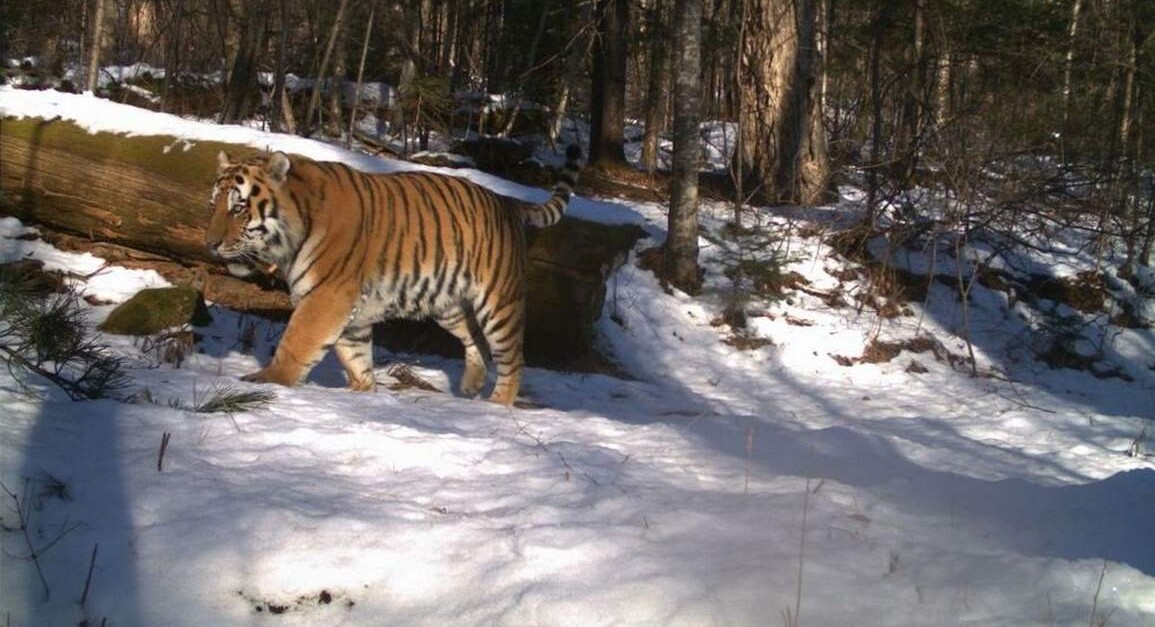
Kazakhstan is preparing to reintroduce the tiger to a special habitat in the country’s south, one of the most ambitious rewilding programs anywhere on Earth.
Arm-in-arm with this has been reforestation efforts of riparian woodland around the Ile River and its delta at Lake Balkhash, which last year amounted to 37,000 young trees.
Between 2021 and 2024, 50,000 trees were planted in the Ile-Balkhash Nature Reserve, which last year also become the temporary haunts of a breeding tiger pair from the Netherlands.
“The results of 2025 are the outcome of many years of painstaking work. We are not simply planting trees, we are laying the foundation for resilient ecosystems capable of sustaining themselves,” said Aibek Baibulov, WWF Central Asia Project Manager for Forest Restoration in Kazakhstan.
“Today, we already see that plantings from previous years have reached heights of up to 2.5 meters, their root systems have reached groundwater, and they are forming natural communities. Restoring tugai forests is the basis for the return of wildlife to the region. Without healthy ecosystems, it is impossible to speak of stable animal populations, including the return of the tiger. We are grateful to all our partners and local residents who are contributing to this work.”
The program is being led by the government of Kazakhstan with support from WWF Central Asia and the UN Development Program.
If successful, it would be the first time that tigers were reintroduced to a range country where they are currently extinct. Genetic studies on bones and furs held in national collections revealed that the population of tigers living between Iran, southern Russia, Central Asia, and the areas around the Caspian Sea was extremely similar to Siberian tigers.
To that end, and with cooperation from the Netherlands, Bodhana and Kuma, a male and female Amur tiger pair, were transported from their sanctuary in the Low Countries to a semi-natural holding facility in Ile-Balkhash Nature Reserve where they’ve been growing accustomed to the climate. It’s hoped, but not known, that they will breed.
Their offspring, once fully grown, will be the second-group of tigers released into the reserve, but as Baibulov said, that will be the final mile of a long journey that started years ago when the country had to begin to secure and grow populations of prey species.
Decades of work have seen populations of the saiga antelope bounce back from a perilously low 48,000 individuals in 2005 to a new high of over 1.9 million. Additionally, in 2019, several Bukhara deer were released into the reserve with hopes of reestablishing a healthy population that can sustain tigers, with another 200, give or take a dozen, released over the following years.
The species of tree seedlings planted over the last two years reflect these animals’ feeding habits, and include 5,000 willow seedlings, 30,000 long-leaved oleasters, and 2,000 native popular trees sacred to Kazakhs called turangas, along a 2.4 mile stretch of the banks of Lake Balkhash, the largest lake in Central Asia after the Aral Sea disappeared.
CENTRAL ASIAN NEWS: Kazakhstan Sees Incredible Progress Scaling Back World’s Worst Environmental Disaster
“Already, wild ungulates have been seen foraging on the restored sites, indicating that the ecosystem is beginning to function,” a spokesperson for WWF Central Asia told Live Science in an email. “Each planted seedling is therefore a direct contribution to the future of the tiger in Kazakhstan.”
The stage is set, (or you could maybe say the dinner table) for the return of the protagonist, and the Astana Times wrote just recently that the first wild Amur tigers would be arriving in Kazakhstan from Russia in the coming months, according to Chairman of the Committee for Forestry and Wildlife of the Ministry of Ecology and Natural Resources, Daniyar Turgambayev.
MORE CENTRAL ASIAN WILDS: Kazakhstan Efforts to Restore Last Wild Equine Species Receive Huge Boost of 150 Horses
Kazakhstan is expecting 3 to 4 tigers before June, and a working group will be formed to develop a program for minimizing human-wildlife conflict.
“The Russian side will train Kazakh specialists to manage conflicts between humans and predators,” Turgambayev noted.
SHARE This Herculean Effort To Return The King Of The Jungle To Kazakhstan…