













By harnessing tiny bursts of plasma—or “mini lightning bolts”—in glass tubes submerged in water, chemists have discovered a new way to turn natural gas into liquid fuel.
Utilizing literal “lighting in a bottle” the team from Northwestern University successfully converted methane directly into methanol in a single step.
Methanol is a versatile, high-demand industrial chemical used to make many products people use every day. It also is commonly used as an industrial solvent and is gaining attention as a cleaner-burning fuel for ships and industrial boilers.
Using just electricity, water, and a copper-oxide catalyst, the new process could offer a cleaner, electrified path to producing one of the world’s most widely used chemical building blocks.
The method bypasses the extreme heat and high pressures required for current industrial processes, which blast apart methane and rebuild it as methanol in a multi-step process. While the current method is reliable, it’s energy intensive and emits millions of tons of carbon dioxide per year globally.
“The extreme temperatures are needed to break the unreactive chemical bonds between carbon and hydrogen in methane,” said Northwestern’s Dayne Swearer, the study’s corresponding author, in a release regarding the paper’s publication in the Journal of the American Chemical Society.
“Then, you must use high pressure to squeeze all those molecules together onto the catalyst in order to make the methanol molecule. It works, but it’s not the most straightforward path to making methanol from methane.”
While researchers have long sought a more energy-efficient, single-step solution, they have struggled to overcome two challenges. Methane is unusually stable and difficult to break apart, requiring extreme reaction conditions. Then, once methanol is formed, it continues to react, rapidly degrading into carbon dioxide. So, the challenge lies in not just starting the reaction but stopping it at exactly the right moment.
To overcome these issues, Swearer and his team turned to plasma, a highly energized state of matter filled with fast-moving, “hot” electrons. Most people might be familiar with plasma as the type of matter that makes up the Sun or lightning bolts. Those are examples of hot plasmas. Swearer’s group works primarily with cold plasmas, in which the gas molecules’ temperature is closer to room temperature, but the electrons are selectively heated to temperatures that can exceed tens of thousands of degrees.
“We’re using pulses of high-voltage electricity,” said Swearer. “If the electrical potential is high enough, lightning bolts form inside of our reactor the way they do during a summer thunderstorm. We’re taking advantage of that chemistry to break methane’s bonds without heating the entire system to extreme temperatures.”
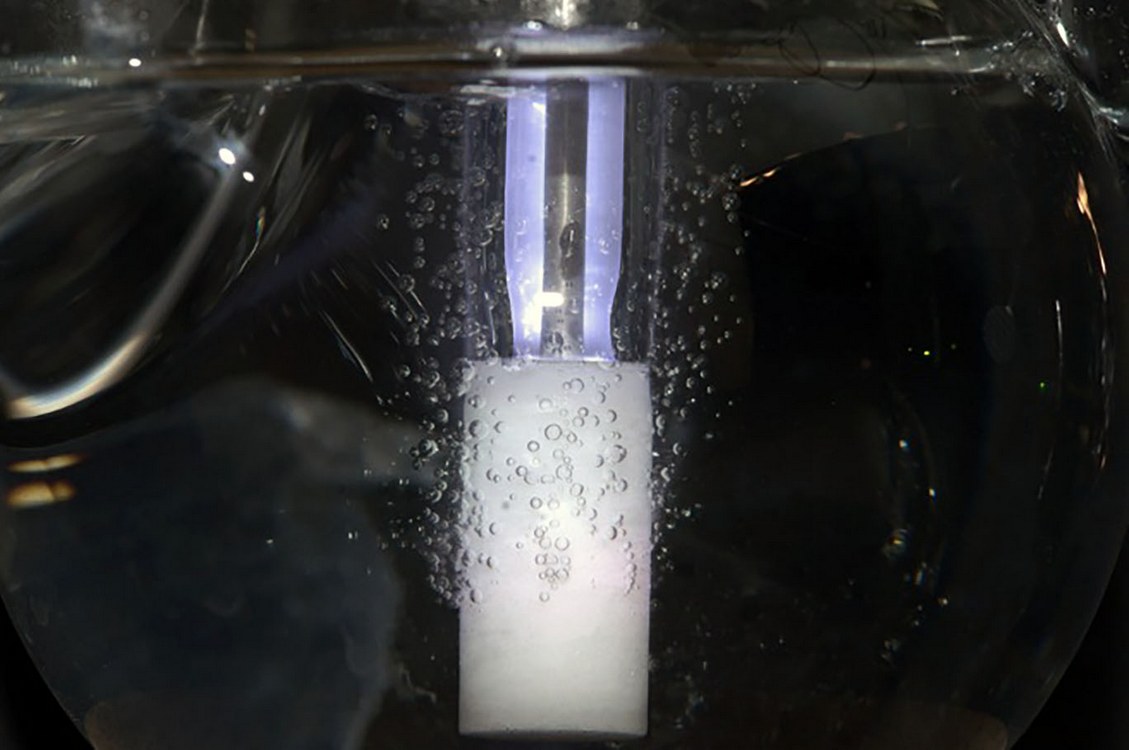
For the new single-step process, James Ho, a PhD candidate in Swearer’s lab, built a plasma “bubble reactor,” which is essentially a porous glass tube coated with a copper oxide catalyst.
Then, the team flowed methane gas through the tube while applying electrical pulses. The electricity transformed the methane gas into plasma, splitting methane and water into highly reactive fragments. Those fragments then recombined to form methanol, which immediately dissolves into the surrounding water. That rapid “quenching” stopped the chemical reaction at the right moment, preventing the methane from decomposing into carbon dioxide.
ALSO CHECK OUT: First Solar Furnace to Recycle Steel Can Melt Metal with Sunshine in 2 Hours
To further enhance the process, the team diluted methane with argon, which is typically an inert noble gas. But, after ionizing argon in the plasma, the chemists discovered it became an active and reactive participant in the chemical process, increasing electron density within the plasma and reducing unwanted byproducts.
Under the optimized conditions with argon present, the system demonstrated 96.8% methanol selectivity in the liquid mixture. In other words, of all the liquid products formed in the process, it was mostly methanol. And, of all the products formed — both gas and liquid—about 57% ended up as methanol.
“We also ended up with ethylene, which is a precursor to plastic production, and hydrogen gas, which is an important commodity chemical and a zero-carbon fuel in its own right,” Swearer said. “So, we took methane, which is a very abundant gas, and turned it into methanol along with ethylene, hydrogen and a bit of propane. These are all intrinsically more valuable products.”
MORE STORIES LIKE THIS: Study Shows Vaporizing E-Waste Makes it Easy to Recover Precious Metals at 13-Times Lower Costs
If scaled, the plasma-driven system could enable smaller, distributed facilities that use electricity to convert methane into liquid fuels.
“We could treat stranded resources, like leaky well heads that naturally emit methane into the environment,” Swearer said. “Right now, the way to deal with leaked methane is to light it on fire to turn it into carbon dioxide, which warms the climate less than methane but is still clearly a problem. Instead, we could take a smaller scale reactor to the place that’s leaking methane and turn it into a transportable liquid fuel.”
SHARE This Impressive Discovery With Your Friends…