














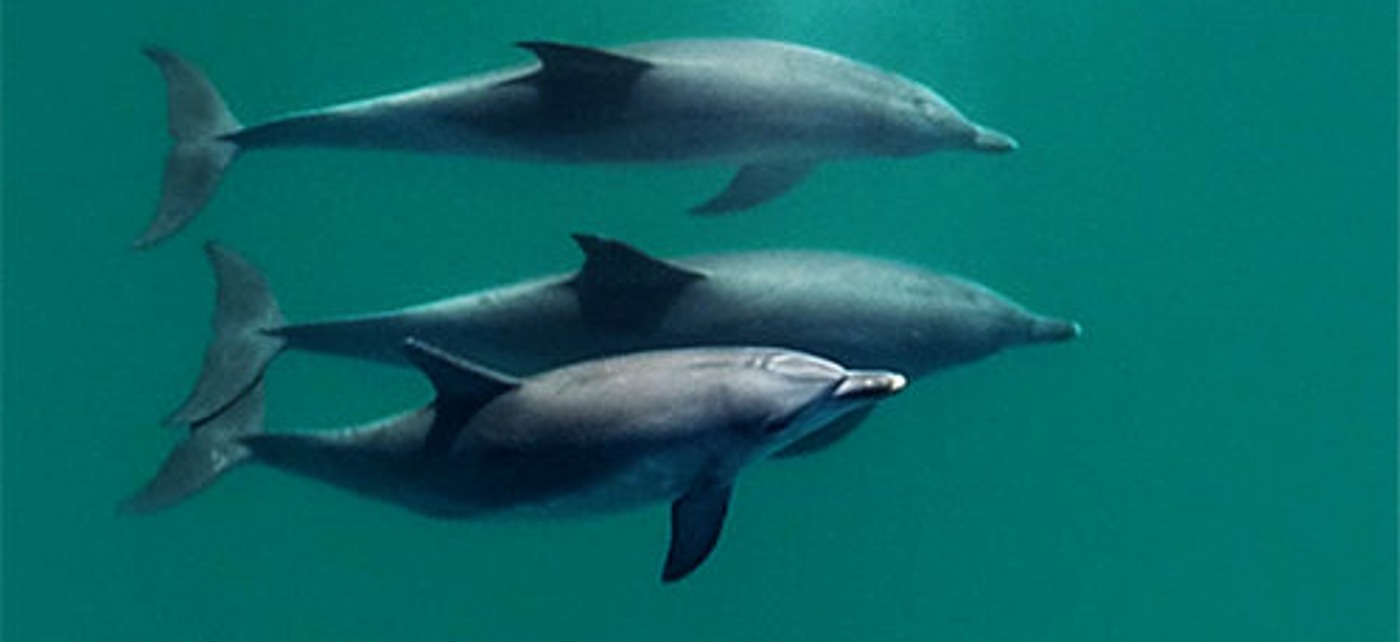
DNA floating in seawater is now enough to let scientists monitor the health of America’s dolphin populations.
Sampling DNA in seawater can show the local presence (or absence) of a species, but until now could give little information about those measures of biodiversity that are the most useful in conservation.
But, scientists in the US have now shown that mitochondrial DNA in water sampled near schools of dolphins contains enough information to measure their local effective population size—and monitor the health of these populations.
DNA is everywhere in the world’s oceans—not only inside cells from skin, scales, mucous, and feces, but also floating freely. Sequencing such ‘environmental DNA’ (eDNA) from open water has long been used as a cost-effective way of gauging the number and identity of species in a region, especially when they are rare and elusive or living at great depths.
But species richness is only the most basic biodiversity measure. Until now, eDNA-based methods could only give limited insight into the variables that are most relevant for conservation: the number of individuals, the evenness of the abundances of co-occurring species, or their within-species genetic diversity.
But that may be about to change, shows a new groundbreaking study in Frontiers in Marine Science.
“Here we show that repeated eDNA sampling can be used to estimate the genetic diversity of dolphins that occur in large schools and have very large populations,” said corresponding author Dr Frederick Archer from the NOAA/NMFS Southwest Fisheries Science Center in La Jolla, California.
MORE DOLPHIN NEWS:
• ‘Superpod’ of More Than 2,000 Dolphins Frolic off California Coast (WATCH)
• World-First Video of Dolphins Stealing From Crab Pots Leaves Scientists Fascinated
“This is important because genetic diversity, its outcome measure, can be used as a measure of population size and how ready a population is to react to changes in its environment.”
Around Santa Catalina Island, located 47 km off Long Beach, California, the researchers followed 15 schools of dolphins with small boats in 2021. They focused on the four most common species locally: long-beaked common dolphins, short-beaked common dolphins, common bottlenose dolphins, and Risso’s dolphins.
Whenever they encountered a school, the researchers collected two-liter samples of seawater from the surface to compare the mitochondrial eDNA with that in public databases.
The scientists found 836 mitochondrial sequence variants in 126 water samples, of which 76% were from cetaceans and 60% from toothed whales. Overall, 29% were from the species of the school, which had been visually identified.
LOOK: Amazing Spectacle as Rare White Risso’s Dolphin Leaps Above the Water For Photographer
Long-beaked common dolphins had the greatest genetic diversity, followed by short-beaked common dolphins, while Risso’s and bottlenose dolphins proved much less diverse around Santa Catalina.
“Our study demonstrates the utility [of eDNA surveys] for efficiently assessing and comparing genetic diversity in social odontocetes,” concluded the authors.
Theory holds water
The authors are eager to put their methods to good use in conservation, now that they have been proven to work.
“It would be good to start eDNA monitoring programs as soon as possible that were not possible before. For example, we will be able to see how species composition in very small areas change over the course of a year – including rarer species that we don’t often detect on visual surveys,” said Archer.
AMAZING!
• Dolphin Moms Use ‘Baby Talk’ with Their Calves, Research Shows
• Friendship Between Species? First-Time Report of Wild Dolphin Changing its Language for Harbor Porpoises
“This can give us a lot of information on habitat use and will also allow us to potentially observe how environmental changes and anthropogenic effects such as pollution or underwater sound affect species distributions.”
SHARE THE BREAKTHROUGH With Dolphin-Lovers on Social Media…