













In an impressive early demonstration of a potentially revolutionary technology, biotech engineers in Zurich used micro-sized robots and stem cells to restore normal movement in a mouse whose spinal cord was entirely severed.
The tech was also demonstrated in zebrafish, and the engineers behind the demonstration say it brings multiple advantages over existing, similar methods.
Spinal cord injuries can have devastating consequences for those affected. Nerve cells in the spinal cord rarely regenerate naturally, while scarring often prevents the regrowth of nerve fibers.
Implantable electrode nerve stimulation is a method that can repair nerve damage in humans and animals by injecting the area with stem cells and using electrical stimulation to promote the growth of new nerve cells.
It can restore some lost movement, but significant challenges exist. It requires implanting electrodes into an extremely sensitive area, and the transplanted cells do not always survive or integrate properly into the existing tissue.
Researchers at ETH Zurich, one of the world’s top 10 engineering schools, are pursuing a new approach, which they have published in the journal Nature Materials.
It involves combining therapeutic stem cells with nanoparticles which can be guided magnetically to the precise site of an injury and stimulate the stem cells to accelerate repair.
The first step is to take a patient’s skin sample and turn it into induced pluripotent stem cells which will then turn into neuro progenitor cells (NPCs) that can take the form of nerve cells. Next, nanoparticles are created with an inner layer that responds to magnetic fields and an outer layer that converts this response into electrical signals.
These are cleverly combined in a culture medium on a laboratory one square centimeter in area, developed by team member and study co-author Professor Salvador Pané i Vidal of ETH Zurich’s Multi-Scale Robotics Lab, to produce “NPCbots”.
MICROROBOTS IN MEDICINE: These Micro-robots Can Clean Teeth By Shapeshifting into Toothbrush or Floss Forms
In about thirty minutes the cells and the nanoparticles combine, and once several million of these are extracted, the therapy is ready.
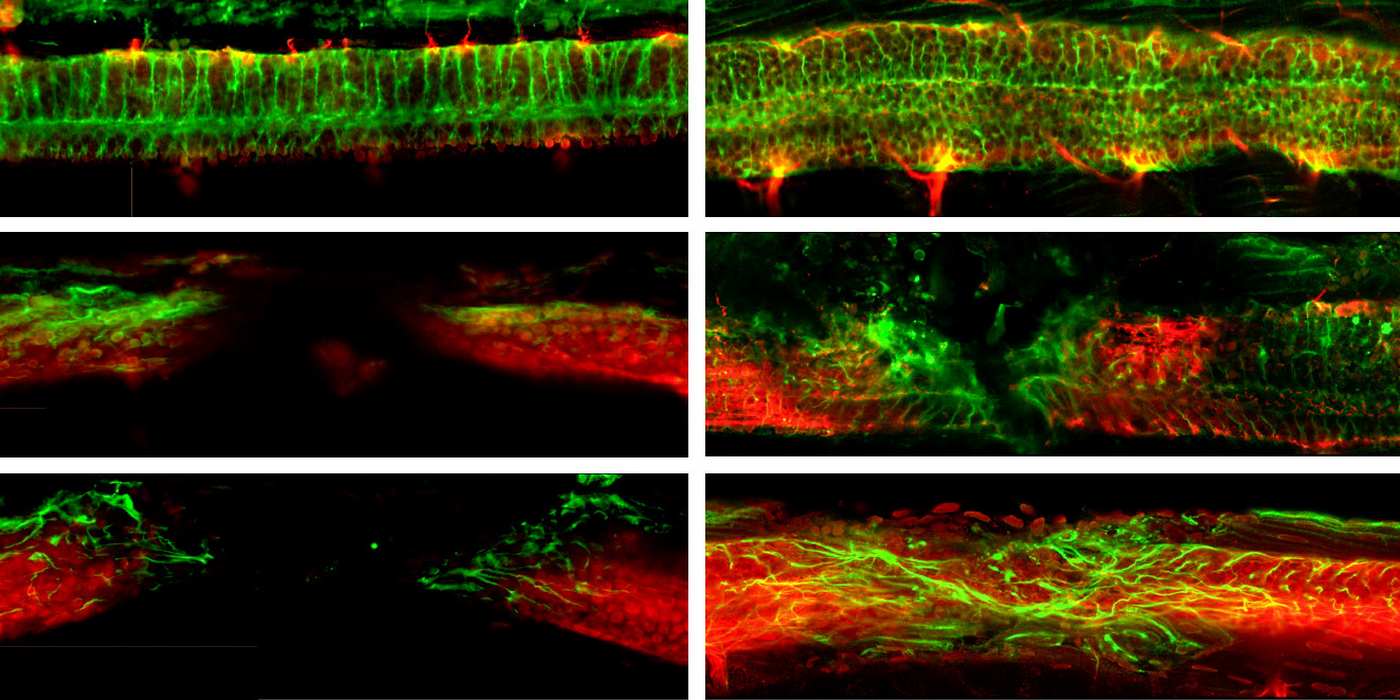
The researchers tested the NPCbots on zebrafish, whose spinal cord can repair itself naturally, and in mice. The zebrafish exhibited quick, substantial, and lasting improvements in movement.
In the mouse model, more relevant certainly for potential human use, the results were very promising. After 28 days, the animals’ nerve cells at each end of the severed spinal column reconnected.
During this period, the treated mice exhibited increasingly normal movement patterns; their gait, stride length, coordination and exploratory behavior improved significantly. The treatment was well tolerated by the animals, with no evidence of any adverse effects or immune reactions.
Will it work in humans? The first step is to continue animal models to test for side effects. The researchers expect the nanoparticles to be stable and minimally reactive thanks to a coating of barium-titanate, and may even go on to dissolve in muscle tissue. They want to see, however, if instead they are excreted in some way.
MORE STORIES LIKE THIS: Injured Spinal Cords Repaired With Breakthrough 3D-printed ‘Scaffolding’–Team Regrows Nerves in Rats
“In addition to many clinical aspects, we first need to test which magnetic fields work best in humans and determine the optimal stimulation duration,” Hao Ye, senior scientist and the study’s first author, said in a news release.
There is currently no sure fire way of repairing nerve damage in the human spinal cord. Should their method be able to translate to our species, it would revolutionize standard of care for spinal cord injuries.
SHARE This Potential Revolution In The Making With Your Friends…