













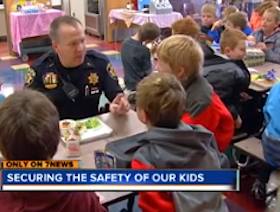
 Inspired to bolster school security by the December shooting inside Connecticut’s Sandy Hook Elementary School, deputies in Douglas County are voluntarily doing their paperwork in parking lots outside their district’s 40-plus elementary schools. The result, they say, is more security without additional resources.
Cops Do Their Routine Paperwork at Schools, a Cheap Way to Add Security
First Black South African Billionaire Donates Fortune to Poor

South Africa’s first black billionaire, Patrice Motsepe, on Wednesday said he has signed up for the Giving Pledge, becoming the first African to join some of the world’s wealthiest people in donating vast sums of personal wealth to the poor.
The Giving Pledge is a philanthropic initiative started by US billionaire Warren Buffet along with Bill and Melinda Gates that has recruited nearly 100 billionaires, mostly Americans, who have pledged to donate the majority of their wealth to charity.
George Clooney Picks Up Stranger’s Tab at Restaurant
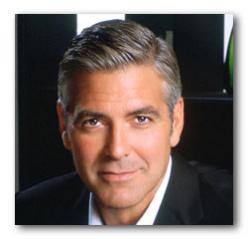
George Clooney has once again shown himself to be the perfect gentleman.
Fearing that he and his party had been too loud while dining at the Grill Royal restaurant in Berlin, the actor picked up the $120 tab for a nearby table, Oliver Hermann, told the newspaper Bild.
Super Bowl: Real Life ‘Blind Side’ Players are Survivors in Life and On Field
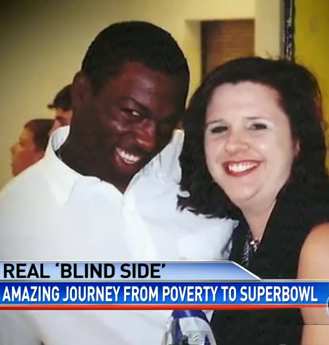
Baltimore Ravens offensive lineman Michael Ohre, who was made famous by the movie “Blind Side”, will be facing a player on the opposing team Sunday, who also was blessed in the same way with a happy ending.
The two, who aren’t brothers by birth, are brothers in survival — both having been adopted by white families showing what love really is.
San Francisco 49er linebacker Patrick Willis (in photo, with his adoptive mom) was Oher’s teammate in college and travelled the same difficult road to Sunday’s game.
Super Bowl: Real Life ‘Blind Side’ Players are Survivors in Life and On Field
Baltimore Ravens offensive lineman Michael Ohre, who was made famous by the movie “Blind Side”, will be facing a player on the opposing team Sunday, who also was blessed in the same way with a happy ending.
The two, who aren’t brothers by birth, are brothers in survival — both having been adopted by white families showing what love really is.
San Francisco 49er linebacker Patrick Willis (in photo, with his adoptive mom) was Oher’s teammate in college and travelled the same difficult road to Sunday’s game.
(WATCH the video below – with ad – from ABC)
Group of Men Played Game of Tag for 23 Years

Mr. Dennehy and nine of his friends have spent the past 23 years locked in a game of “Tag.”
It started in high school when they spent their morning break darting around the campus of Gonzaga Prep School in Spokane, Wash. Then they moved on—to college, careers, families and new cities. But because of a reunion, a contract and someone’s unusual idea to stay in touch, tag keeps pulling them closer, flying around the country surprising each other.
That means players get tagged at work and in bed. Wives are enlisted as spies and assistants are ordered to keep a lookout so they can avoid being caught by other players.
(READ the story from the Wall Street Journal)
Thanks to Chris Cloud for sending the link!
Teen Convinces Gatorade to Remove Additive

A 16-year-old from Mississippi fought one of the largest beverage companies — and won.
The young vegan researched an ingredient in Gatorade to see if it was healthy. Brominated vegetable oil, she learned, had already been banned in Europe and elsewhere after animal studies found it to be dangerous in high doses.
Sarah Kavanagh started an online petition that received 200,000 signatures. PepsiCo, the drink’s manufacturer relented to the social pressure and announced it would be removing the additive from the sports drink.
(WATCH the video below from TODAY or READ the Reuters story in the Denver Post)
Amazing Pep Talk From Little Kid: Never Give Up!
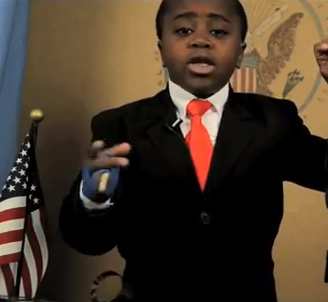
We all need a little encouragement every now and then.
A little boy who wears a suit and calls himself “Kid President” knows this, and has put together a video you can play each morning as you wake up or share with your friend who needs a kick in the right direction.
“It’s everybody’s duty to give the world a reason to dance.”
Watch the video below…
Sperm Whales Take in Outcast Bottlenose Dolphin
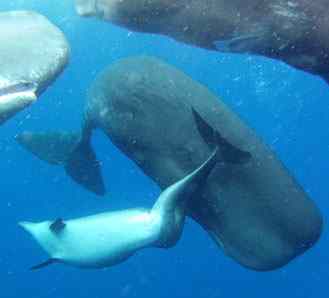
A group of sperm whales appear to have taken in a deformed bottlenose dolphin, marine researchers have discovered.
In the heartwarming scene near the Azores in the North Atlantic, the scientists watched the dolphin six times while it nuzzled and rubbed members of the group, reports the journal Science.
Sperm whales have good reasons not to like bottlenose dolphins, so this has puzzled researchers.
Mystery Bible From Baseball History Found Among Pile of Donated Books
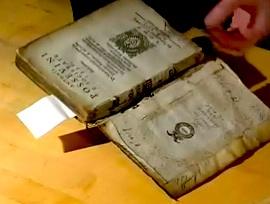
Joanne Murphy didn’t see much in the old Bible that someone donated with a pile of books to the Sacramento Public Library.
The only interesting thing about it was the inscription page. “Pirates,” it said, “1953,” followed by a long list of signatures.
The Bible, it turned out, had been a gift to baseball legend Branch Rickey, the baseball executive who broke the sport’s color barrier in 1947 by hiring Jackie Robinson to be the first African-American player.
French, Mali Troops Retake Timbuktu From Extremists as City Cheers

Residents of the ancient city of Timbuktu erupted in joy as French and Malian troops drove in on Monday after Islamist rebels fled to their last stronghold in the North.
For centuries a cosmopolitan city and a center of Islamic learning, Timbuktu was seized in April 2012 by radical Islamists who outlawed secular music, forced women to wear veils, and stoned in public those who broke their laws. The militants had destroyed ancient Muslim shrines and also burned manuscripts before fleeing.
Mali Locals Saved Some Ancient Manuscripts from Islamists

The preservationists of Timbuktu’s centuries-old artifacts have been holding their breath for weeks.
In interviews with TIME on Monday, preservationists said that in a large-scale rescue operation early last year, shortly before the militants seized control of Timbuktu, thousands of manuscripts were hauled out of the Ahmed Baba Institute to a safe house elsewhere.
Air Force Pilot Takes Boy’s Letter “Closer to Heaven” so Daddy Can Read it
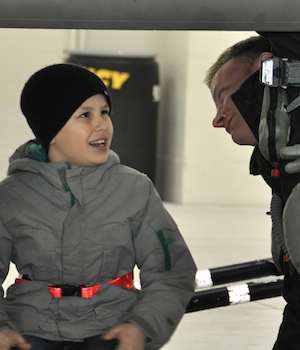
“Mac” Gallegos was only 5 when his father, Army Sgt. Justin Gallegos, was killed in Afghanistan in 2009. Not a day goes by that he doesn’t think about him. On days like Jan. 24, his father’s 31st birthday, he gets a little help to honor his memory.
“I wanted to write my dad a letter and get it as close to heaven as possible,” said Mac.
Mac and his mother Amanda Marr discussed ways to get the letter to heaven but ultimately decided that having someone fly it in a jet airplane would be the best.
“I posted on Facebook that we were looking for a pilot who could fly the letter for Mac,” said Marr.
The co-founders of a veteran’s group, Helping American Veterans Experience Alaska (HAVE Alaska), wrote saying they wanted to help. Since 2010, Kyle and Carla Moxley have been providing opportunities for Veterans to experience hunting and fishing excursions in Alaska. (Photo, below, from their Facebook page)
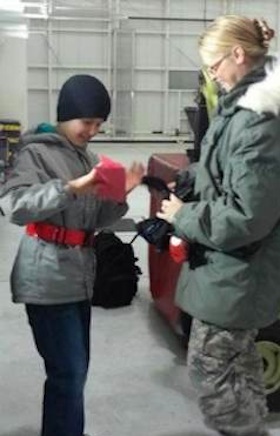 After a few emails and phone calls, Mac and his family were getting a tour of the F-22 Raptor and meeting its pilot, Lt. Col. Brian Baldwin assigned to the 302nd Fighter Squadron. The little boy handed over the letter he had written to his father on red construction paper, his dad’s favorite color. He watched as the plane took off and reached the clouds.
“It is an honor to fly with Mac’s letter,” said Baldwin. “His father gave the greatest sacrifice to our country and I am humbled to be able to do something for him and his family.”
Mac and his family have baked cupcakes waiting at home for a birthday ceremony on the ground.
“Over the years we always had a party for Justin on his birthday,” said Mac’s mother, who grew up in Alaska and resides in Anchorage. “As Mac has gotten older we have turned it into a day where we do “Acts of Service” for others.”
(Thanks to Joel Fortner, Air Force Public Affairs Agency, for sending the story)
Air Force Pilot Takes Boy’s Letter “Closer to Heaven” so Daddy Can Read it
“Mac” Gallegos was only 5 when his father, Army Sgt. Justin Gallegos, was killed in Afghanistan in 2009. Not a day goes by that he doesn’t think about him. On days like Jan. 24, his father’s 31st birthday, he gets a little help to honor his memory.
“I wanted to write my dad a letter and get it as close to heaven as possible,” said Mac.
Mac and his mother Amanda Marr discussed ways to get the letter to heaven but ultimately decided that having someone fly it in a jet airplane would be the best.
Hero Uses Own Money to Buy Groceries for Those Who Can’t Afford to Shop
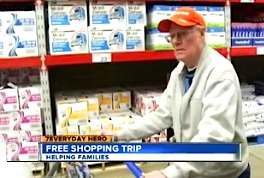
Named an everyday Hero, Don Hanlon achieves that with a simple, but generous gesture.
He walks in the doors and says, “What do you need?”
Once each month for ten years Don has been talking trips to Sam’s Club with people who are dealing with domestic violence and homelessness.
He spends $300 on each family from his monthly Social Security check.
(WATCH the video below or READ the story at the Denver Channel)
Two Science Projects Win Up to $1.3 Billion Each
 Two European science projects—one to map the intricacies of the human brain, the other to explore the extraordinary carbon-based material graphene—won an EU technology contest Monday, getting up to €1 billion ($1.34 billion) each over the next decade.
“European’s position as a knowledge superpower depends on thinking the unthinkable and exploiting the best ideas,” European Commission Vice President Neelie Kroes said.
Merry Pranksters Buy Pizza Delivery for Cold Street People
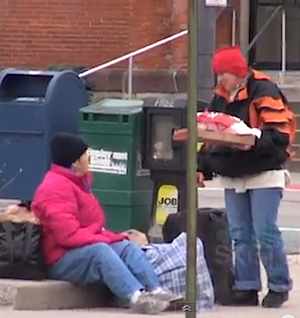
A pair called the Serial Pranksters on YouTube decided to turn their mischief-making into doing something good.
“It was so much fun making a prank that also feeds people in need!” wrote Roman Atwood and Dennis Roady on their web page on YouTube.
(WATCH the video below – after the ad)
Merry Pranksters Buy Pizza Delivery for Cold Street People
A pair called the Serial Pranksters on YouTube decided to turn their mischief-making into doing something good.
“It was so much fun making a prank that also feeds people in need!” wrote Roman Atwood and Dennis Roady on their web page on YouTube.
Cat Born Without Leg Bones Gets Operation Thanks to Facebook Donors
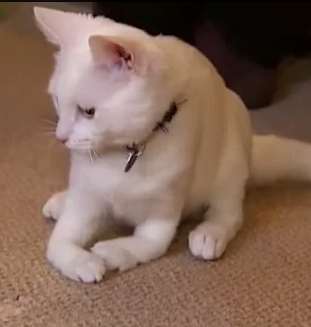
Harvey, a 4-month-old kitten in Scotland born without bones in his front legs, is happy and healthy. But while his rare genetic condition could lead to spinal problems and other health issues later in life, the preventive surgery is expensive.
Doctors, however, will now be able to go ahead and insert metal pins into Harvey’s legs thanks to a successful fundraising effort from cat lovers on Facebook.
Cat Born Without Leg Bones Gets Operation Thanks to Facebook Donors
Harvey, a 4-month-old kitten in Scotland born without bones in his front legs, is happy and healthy. But while his rare genetic condition could lead to spinal problems and other health issues later in life, the preventive surgery is expensive.
Doctors, however, will now be able to go ahead and insert metal pins into Harvey’s legs thanks to a successful fundraising effort from cat lovers on Facebook.