











 US sales of previously occupied homes jumped in August to the highest level in more than two years, adding momentum to the housing recovery.
Sales rose 7.8 percent, said the National Association of Realtors said, the most since May 2010.


US sales of previously occupied homes jumped in August to the highest level in more than two years, adding momentum to the housing recovery.
Sales rose 7.8 percent, said the National Association of Realtors said, the most since May 2010.

Whether treating patients with drug-resistant diseases in the slums of Haiti or trying to reverse the hopelessness of the world’s poor, optimism is essential, insists World Bank President Jim Yong Kim.
“For me optimism is a moral choice,” Kim told Reuters on his first trip to Africa, two months into the job as president of the global development lender.

At first glance, Ein Prat, one of the many natural and historic sites hidden in the northern Judean Desert, looks like any other picnic site around the world.
Large wooden tables and long benches are located strategically under shady trees on either side of a bubbling brook. Clusters of friends and family relax and enjoy each other’s company in the natural surroundings.
What sets Ein Prat – or Wadi Kelt, as it is known in Arabic – apart from other parks is that it is one of the few Israeli-run sites that Israelis and Palestinians can access equally, which has made it an oasis for peace.
The park is a few minutes’ drive from the Jewish neighborhoods in Jerusalem’s northern suburbs and it is almost equidistant from the Palestinian city of Ramallah. Those that descend on the park each weekend seem determined not to allow decades of occupation, violence or mistrust to stop them from enjoying its natural delights.
Surprisingly for the region, and unlike other places where Israelis and Palestinians come into close contact, there are no violent confrontations, angry words or accusations at Ein Prat/Wadi Kelt.
True, there is little interaction between the two groups, and there seems to be an unwritten agreement between the Israelis, who speak only Hebrew, and the Palestinians, whose mother tongue is Arabic, to treat each other like ghosts. And while this lack of interaction should not be mistaken for the simple politeness of strangers giving each other some space, it is a step forward.
The fact that Israeli and Palestinian children splash side-by-side in the natural pools and grown-ups seek relief together from the heat by wading through the cool waters suggests a glimmer of hope and the possibility of breaking down the growing barriers between the two peoples.
One of the main attractions of the park is a large natural pool half way up the mountain ravine. It is here – when the people have left the comfort of their separated picnic tables – that Israelis and Palestinians sit face-to-face around the perimeter of the cool, refreshing water.
Among the splashes of water and squeals of delight, members of the two groups eye one another, trying to determine if their so-called enemies are actually human beings or not.
Are we really all that different? In the natural light of this park, it seems not.
Through the stolen glances, there are some coy smiles and kind gestures. There mostly seems to be an acceptance that all are not only looking for some relief from the scorching midday sun, but also from the madness of an on-going conflict that affects our daily lives.
For just a moment, this park seems to be an ideal place for a peace summit. The thought of our respective leaders dipping in the cold water after negotiating each complicated point in this conflict suddenly seems entirely plausible. Perhaps the shock of the freezing water against burning skin and the realization that the land we are fighting over has been here much longer than any of the humans now inhabiting it might actually be enough to convince them that fighting and violence, oppression and occupation, are not the way to preserve this land for future generations.
While the idea of politicians ditching their suits and ties for swimming gear seems less plausible than their coming together at a negotiating table, the reality is that here in Ein Prat/Wadi Kelt ordinary Israelis and Palestinians do have a rare chance to meet. And although years of conflict have made us wary of one another, maybe it is in this desert oasis that those who appreciate the beauty of nature can find a way to make peace.
Ruth Eglash is Deputy Managing Editor at The Jerusalem Post in Israel. She was invited to be one of the IARJ’s founding members by the International Center for Journalists and was elected to the association’s steering committee. This article was written for the Common Ground News Service. (Reprinted with permission.)

Michael Young was an extreme right-winger and racist who devoted much of his life to propagating a skewed form of biblical fundamentalism. In the estimation of his stepson, Anthony Perry, he was “a pretty dreadful man”.
When Young died in 2000, shortly after his 100th birthday, Perry was a little embarrassed to receive an inheritance. He gave the bulk of it to his daughter, treated himself to a good suit, and then resolved to have some fun with the remaining £10,000. More than a decade later, he is still doing so.
(READ the new story in the Guardian)

Larsen Jay is a man who knows the power of flowers and the joy they can bring.
After falling from a ladder, Larsen was confined to a hospital bed and had to endure a long and painful recovery. Fortunately, he received many visitors and cards. The attention and outpouring did wonders for his mood. His hospital room was filled with flowers. The explosion of color and fragrance brightened his day and his hospital confinement.
Sadly, many of the other hospital rooms in Knoxville, Tennessee were entirely bare of flowers. His solution was to go back to his own room, remove the cards from his bouquets and give them away to flower-less rooms on the ward.
The reaction he received from this simple gesture was overwhelming. Thus, Random Acts of Flowers was born.
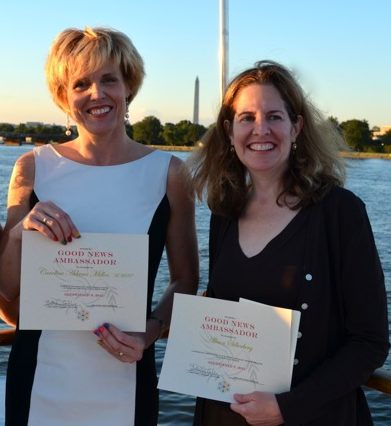
Two notable women were named 2012 Good News Ambassadors last week during a sunset award ceremony aboard a river cruise on the Potomac in Washington, DC.
With a pristine blue sky overhead Caroline Adams Miller (pictured on the left) and Allison Silberberg (right) accepted their awards during a celebration marking the Good News Network’s 15th anniversary as the #1 online source for positive news.
Caroline Adams Miller was chosen because of her strong voice in the emerging positive psychology field.
“A lot of people don’t understand that many of the things we seek out to improve our well-being – like reading articles about good news – are actually supported by science,” she told the crowd.
“There is a tipping point we need to get over every single day in order to predict emotional flourishing, which is a ratio of at least 3:1 (for every negative you need three positive interactions). It is important that we voluntarily bring positive emotions into our lives every day, so starting with the Good News Network could be the boost that starts a domino effect of happiness every day.”
Miller uses positive psychology in her coaching practice and speaks widely on the topic around the world.
“I believe my calling is to spread the science of emotional flourishing, also known as Positive Psychology, to as many people as possible.” she explained. “When we are in a place that is optimistic and contented, the research shows that we predispose ourselves to build relationships with other people, to take in more information about our environment, to pursue our goals with more persistence and zest, and to positively impact others with contagious behaviors.”
 Miller has written articles for the Good News Network including “How The Bucket List Film May Change Your Life & Make You Happier”, which is based on her popular book, Creating Your Best Life: The Ultimate Life List Guide
Allison Silberberg is a writer, advocate, public speaker, and photographer who specializes in philanthropy, community action, social justice, and civic engagement.
Currently a Democratic nominee for City Council in Alexandria, Virginia, she was endorsed by EMILY’s List and is notable for advocating on behalf of the most vulnerable as Chair of the city’s Economic Opportunities Commission.
But it is her storytelling that brought her to the attention of the Good News Network. Her wonderful book, Visionaries In Our Midst: Ordinary People who are Changing our World
 “Their stories demonstrate what is possible in the world today,” she said. “I learned a great deal about how each of us can have impact and create a ripple effect of good outcomes for others as we all pay it forward, and I’ve heard from many readers how the book has changed their lives.”
Miller believes that, like the Good News Network, Silberberg’s book is what’s called a “positive intervention,” and by deliberately putting positive stories in your thoughts you are powerfully priming yourself to notice other good news and behave that way yourself.
Congratulations, to the very first Good News Ambassadors. We look forward to honoring more positive people with these admirable qualities in years to come.
Two notable women were named 2012 Good News Ambassadors last week during a sunset award ceremony aboard a Potomac River cruise in Washington, DC.
With a pristine blue sky overhead Caroline Adams Miller (pictured on the left) and Allison Silberberg (right) accepted their awards during a celebration marking the Good News Network’s 15th anniversary as the #1 online source for positive news.
Caroline Adams Miller was chosen because of her strong voice in the emerging positive psychology field.
“A lot of people don’t understand that many of the things we seek out to improve our well-being – like reading articles about good news – are actually supported by science,” she told the crowd.

Mike and Angie Gagnon, their disabled daughter and two young grandkids were thrilled with the renovations and editions on their home provided by 150 businesses in an Extreme Makeover project organized by Cornerstone Seventh Day Adventist Church.
The Vancouver family can now relax a little and stop feeling like they are constantly treading water.
Although it was one of the church’s biggest projects yet — working at least 18 hour days for 10 days straight — “it’s totally worth it,” said Pastor Steven Mirkovich.
This charitable marathon to help a single family is reminiscent of a recent Methodist congregation’s work in Alabama for a single mother who lost her home in a tornado.
(READ the story from the Province)

Not many folks change their own oil anymore. Fewer still are women.
But it would be nearly impossible to find another woman on the planet who continues to change her own oil at age 102.
Margaret Dunning of Plymouth, Mich., who loves to pamper her Packard, is still sliding under the Roadster with a funnel and oil pan.
Not many folks change their own oil anymore. Fewer still are women.
But it would be nearly impossible to find another woman on the planet who continues to change her own oil at age 102.
Margaret Dunning of Plymouth, Mich., who loves to pamper her Packard, is still sliding under the Roadster with a funnel and oil pan.

The heart-wrenching exchange between a father whose son died in a car crash and the teenage drunk driver who was behind the wheel left witnesses in a Wyoming courtroom in tears on Monday.
The victim’s father pleaded with the judge to show leniency.
Takunda Mavima, 18, had just finished high school and was driving home from a graduation party on May 20 when he crashed into another car full of his classmates at Wyoming Park High School.
(READ the story w/ photos from Daily Mail)

Carmen Dell’Orefice has spent her life in front of the lens since gracing the cover of Vogue magazine in 1947, and as the world’s first octogenarian model, she is still turning heads — most recently on the catwalk for Norisol Ferrari during New York Fashion Week on Monday.
At 81, the stylish senior citizen is three to four times older than today’s models.
In an industry which prizes youth, Dell’Orefice says she’s proof of the nation’s general acceptance of a graying population.
(WATCH the video below, or READ the story w/ photos from Today)
Carmen Dell’Orefice has spent her life in front of the lens since gracing the cover of Vogue magazine in 1947, and as the world’s first octogenarian model, she is still turning heads — most recently on the catwalk for Norisol Ferrari during New York Fashion Week on Monday.
At 81, the stylish senior citizen is three to four times older than today’s models.

The international agreement unveiled 25 years ago on September 16 to phase out chemicals harmful to the Earth’s ozone shield continues to reap results that show the giant hole in the stratosphere is shrinking.
Signed by 197 states and the European Union, the Montreal Protocol on Substances that Deplete the Ozone Layer became a showcase for successful global environmental cooperation.
The international agreement unveiled 25 years ago on September 16 to phase out chemicals harmful to the Earth’s ozone shield continues to reap results that show the giant hole in the stratosphere is shrinking.
Signed by 197 states and the European Union, the Montreal Protocol on Substances that Deplete the Ozone Layer became a showcase for successful global environmental cooperation.

Tissue engineers are building organs using the body’s own cells and letting the body do most of the work.
So far, only a few organs have been made and transplanted, and they are relatively simple, hollow ones — like bladders and windpipes. But scientists around the world are using similar techniques with the goal of building more complex organs. At Wake Forest University in North Carolina, for example, where the bladders were developed, researchers are working on kidneys, livers and more. Labs in China and the Netherlands are among many working on blood vessels.

Countries across the world are continuing to make rapid progress in reducing child deaths, a UNICEF report said this week.
According to the 2012 UN report, trends in child mortality since 1990 include major reductions in all regions of the world for children under five. This has translated into a sharp drop in total deaths from nearly 12 million in 1990 to an estimated 6.9 million in 2011. Last year alone, the total number of global deaths of small children dropped by 700,000.
Countries across the world are continuing to make rapid progress in reducing child deaths, a UNICEF report said this week.
According to the 2012 UN report, trends in child mortality since 1990 include major reductions in all regions of the world for children under five. This has translated into a sharp drop in total deaths from nearly 12 million in 1990 to an estimated 6.9 million in 2011. Last year alone, the total number of global deaths of small children dropped by 700,000.

A bald eagle shot in the face by a poacher in 2005, suffered such damage to her beak that feeding herself became impossible.
Animal rescue workers found her before she starved to death, and volunteers at the nonprofit group Birds of Prey Northwest nursed her back to health.
Seven years later, the eagle named Beauty can now preen and eat on her own, thanks to a little help from technology.
A bald eagle shot in the face by a poacher in 2005, suffered such damage to her beak that feeding herself became impossible.
Animal rescue workers found her before she starved to death, and volunteers at the nonprofit group Birds of Prey Northwest nursed her back to health.
Seven years later, the eagle named Beauty can now preen and eat on her own, thanks to a little help from technology.