Who knew the same delicious brown bean that creates chocolate can also generate clean green power? Cocoa bean shells left over after the chocolate processing are now being used as biofuel. You might wonder where this is happening. West Africa? Brazil?
Actually, it’s in New Hampshire, which is the home of chocolatier Lindt USA. Lindt recently announced a partnership with Public Service of New Hampshire (PSNH) for the burning of cocoa bean shells to produce electricity from one of the three 50MW boilers at PSNH’s Schiller Station power plant in Portsmouth, near the Lindt factory.
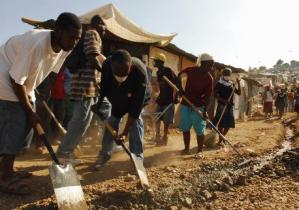
Oxfam has launched several cash-for-work projects, which give those living in camps a chance to earn an income while improving their environment by building latrines and clearing rubble.
Cash in hand helps earthquake survivors stay in the driver’s seat in their own recovery – able to purchase what they most want and need, such as the food that is now available on the streets of Port-au-Prince. Those purchases in turn support local suppliers and begin to bring Haiti’s economy back to life. See the cash-for-work program photos in this slideshow.
An assessment of market conditions in Port-au-Prince showed there is sufficient food, but people do not have the money to purchase it. Oxfam has tested “cash for work” in crises around the world and found it to be more effective than food distribution as long as sufficient food is available on the market. It also helps restores dignity in difficult circumstances.
This “cash-for-work” effort is set to expand across nine sites where Oxfam has recently installed clean water and latrines, serving 80,000 people.
Read more about what OXFAM is doing to aid in the relief of Haiti on their website.
8 year-old Andrew has Cornelia de Lange syndrome, a developmental disorder that affects communication and social interaction. On an almost daily basis, his family and teachers at school would see Andrew cry, bite on his thumbs and lash out as if in pain. But he was unable to let them know what was wrong.
But a new iPhone application Andrew uses on an iPod has opened the doors to Andrew’s mind: offering icons he can press like, “I’m hungry” and “I want to sit on your lap.”
Since Andrew started using the device, his mother has added eight categories of words, emotions, phrases, songs and sentences for him to choose from.
Samuel Sennott, the 31-year-old co-developer at Penn State University who’s been working with children in special education since he was 19, has changed Andrew’s life, and many other people’s lives.
A new game show in India will award prizes to villages that are going green.
India’s state-owned Doordarshan television network will air the new show which will focus on mainly rural institutions leading sustainable development.
The show, modeled after the rags-to-riches game show in the blockbuster film “Slumdog Millionaire,” has received about 250 entries ahead of its March 1 broadcast.
Among the contestants is a village that has rejected use of fertilizers and pesticides and adopted organic farming, he explained. Another competitor is a group of households converting degradable waste into biofuel.
In a rare bit of good news for a beleaguered industry, U.S. airlines posted in 2009 their best on-time performance since 2003.
The numbers released Friday by the Bureau of Transportation Statistics state, “The nation’s 19 largest airlines said 79.5% of their flights arrived on time in 2009, compared to 76% in 2008 and 82% in 2003.”
United was tops among the legacy carriers with a 77.3% on-time rate, topping Delta’s 76%.
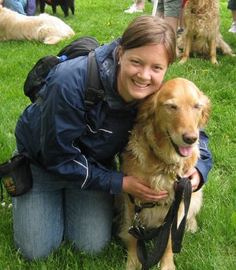
Jennifer Francis credits her steadfast four-legged companion with saving her life: her mental health assistance dog, Spirit.
She and Spirit are proof that the burden of mental illness can be made lighter with the help of a specially trained service dog.
Spirit is not just any working dog. Trained by Hamilton-based Encouraging Paws Service Dogs (encouragingpaws.com), she knows more than 50 commands that help keep Francis safe.
Somewhere next to the inspirational poster of the kitten hanging from a limb (“Hang in there!”) is the poster encouraging you to dream big.
But Mitch Matthews, founder of the Big Dream Gathering, wants to do more than inspire. He wants to spur dreamers to action.
Matthews will bring the Big Dream Gathering to the University of Northern Iowa campus next week, giving Cedar Valley residents the chance to get started living their wildest ambitions.
“It’s been amazing to see what happens when people have a safe environment to think about their big dreams and then possibly get some help with them,” Matthews said.
During the event, those attending will be given a sheet of paper to write down their dream. A person can post as many dreams as they wish. Dream sheets are assigned a number, and names are not written on the sheets. The anonymity allows people to freely express their life goals and ambitions.
Mitch also will share his story on the creation of the Big Dream Gathering as well as stories of those impacted by his work. Watch the video of Mitch telling the story.
When: Tuesday. Registration begins at 5:30 p.m., and the event runs from 6 to 9 p.m.
Where: Maucker Union Ballroom, University of Northern Iowa campus
The event is free and open to the public
Today is Valentine’s Day, and for kids, it means Sweethearts candies — those little heart-shaped wafers with phrases like “LETS KISS” and “MY BABY.”
Now, for the first time in 145 years, the candies have been revamped, with brighter colors, bolder flavors and current expressions like “TWEET ME”, “TEXT ME”, and “YOU ROCK”.
During his three years in Bollywood, Uttam Sanjel, 35, learned that the real heroes of our world are not famous movie stars.
He saw the dismal conditions of poor children in the streets around Kathmandu, and vowed to help them.
Armed with a good education, high ideals and the courage to match, Uttam created a new answer to the problem of child destitution: the construction of schools quickly and efficiently using bamboo. Bamboo is inexpensive (its use lowers the budget for construction by 60 percent), strong, earthquake-proof and easy to find.
Last week, amid news that senior military officials supported ending the policy of Don’t Ask Don’t Tell, a National Guardsman was contacted by his commanding officer with an invitation to rejoin his unit. Months earlier, Dan Choi had been recommended for discharge after his announcement on television that he was gay.
Choi is back with his unit now to receive training on critical infantry skills for a possible upcoming deployment. “It’s Good to be back,” he wrote in an email.
A nonprofit in Chicago is improving the job outlook for people with Asperger’s and high-functioning autism. The company trains people in data entry and computer program testing — skills that come naturally to many with the disorder.
Brenda Weitzberg started the business because she felt frustrated with the lack of job resources for her 30-year-old son.
For his wife this Valentine’s Day, a farmer has created a half-mile wide arrow-pierced heart recognizable from the sky over southern Minnesota.
Following plans he jotted on scratch paper, Bruce Andersland drove his tractor and manure spreader across the white snow in the special shape for his wife, Beth.
For his wife this Valentine’s Day, a farmer has created a half-mile wide, arrow-pierced heart recognizable from the sky over southern Minnesota.
Following plans he jotted on scratch paper, Bruce Andersland drove his tractor and manure spreader across the white snow in the special shape for his wife, Beth.
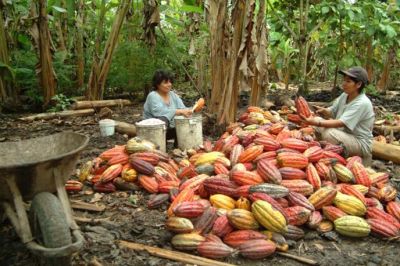
Tapping into a niche market for organic cocoa, some Peruvian farmers have turned away from cocaine in favor of growing beans for high-end chocolate retailers in Europe and the US.
Life is calmer now for the farmers who, just a few short years ago, were dodging bullets and hiding from Peruvian soldiers and Colombian drug traffickers. (Continue reading the story in CS Monitor)
Photo: Preparing Coco Pods for Chocolate Production, by Antonio Martinez – USAID
In search of fulfillment, many workers are now ditching corporate jobs and turning to so-called “encore” careers in non-profit, education or health sectors, each motivated by a similar urge: to give something back.
“When I look at the personal rewards I get, that’s more important to me than money,” said Barbara Higbee, 57, who was a district manager for a Texas merchandising company and often put in 80-hour weeks.
Canada made its mark in the fight against diabetes a century ago with the discovery of insulin, and now, that country may be poised to change the face of diabetes again by creating insulin in a whole new way.
A group of pioneering Canadian scientists is working on a way to make a much cheaper form of insulin using an easily grown plant: the safflower.
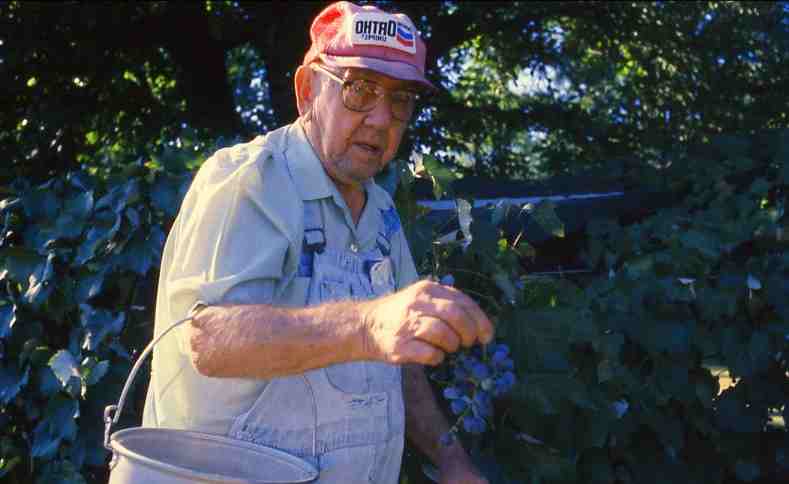
Mother Nature blessed California grape growers with a bountiful harvest in 2009, a record yield that was up 37 percent over the previous year. The 4 million tons of crushed grapes will ensure consumers benefit from high-quality wines at bargain prices.
Here’s a low-cost solution to global warming and a host of other problems: chicken manure.
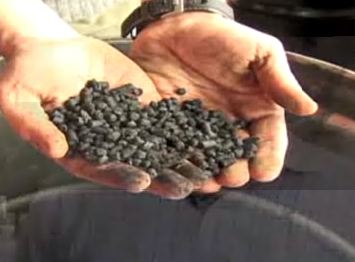
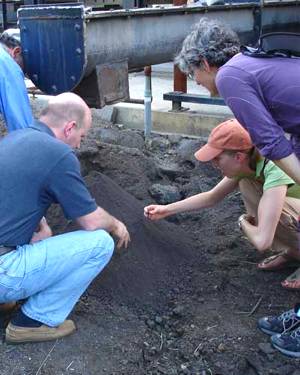
At Josh Frye’s poultry farm in West Virginia, the chicken waste is fed into a large, experimental incinerating machine. Out comes a charcoal-like substance known as “biochar” — which is not only an excellent fertilizer, but also helps keep carbon in the soil instead of letting it escape into the atmosphere, where it acts as a greenhouse gas.
Former vice president and environmental advocate Al Gore calls biochar “one of the most exciting new strategies” available to stop climate change. For Frye, it means that, before long, “the chicken poop could be worth more than the chickens themselves.”
An Argentine man became a hero when he pushed a stalled truck off the train tracks seconds before a train roars in. He had been waiting on a scooter behind the van.
Watch the surveillence film below, which has no audio or reporter narration (or via Reuters)















 Who knew the same delicious brown bean that creates chocolate can also generate clean green power? Cocoa bean shells left over after the chocolate processing are now being used as biofuel. You might wonder where this is happening. West Africa? Brazil?