











A young engineer set up the StairSteady company when she was only 16 to market her innovative idea, a simple device to assist people to go up and down stairs when they don’t need an expensive chair lift. She won an award for her invention, which she designed for her teacher’s father who had suffered a stroke. (See the neat story and photo at BBC)
7 Success Habits to Design a Life you Love
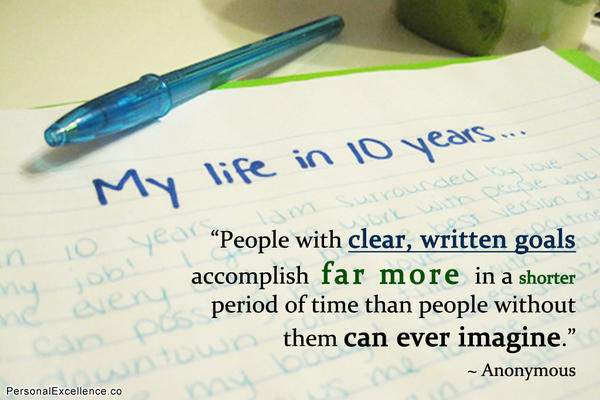
Goal setting is a skill I learned early on in life, and it’s a skill that has helped me immensely in creating a life I love. Did you know that only 4% of the population actually achieves the goals they set? Here are some great ideas about how you can use goals to create a life that you love.
1. Get a buddy!
Everyday at 7:30 am my success partner Janet and I share the one thing we’ll each do that day to be Happy, Healthy and Wealthy. Sometimes we talk for three minutes, sometimes 15. The point is to set tangible action items for the day that get you one step closer to your heart’s desires.
2. Determine what you want in life.
One of my mentors, Brian Buffini taught me to set goals in 5 areas of my life: Spiritual, Personal, Friends & Family, Career, and Finance. What a difference having goals makes! There is no one right way to set goals. Just do it, and when you do, grant yourself permission to think really big.
Consider making weekly, monthly, quarterly and yearly goals. Why not create goals for 2-10 years out? Once all of your goals are set you will have a map ready to lead you to achieving your dreams.
4. Set a Quantum Leap Goal.
Jack Canfield, co-author of the internationally renowned Chicken Soup for the Soul series, taught me to take the time to set a goal so big that it can only be achieved by shifting your thinking and by engaging the Law of Attraction. The Law of Attraction states that what you focus on expands. And it’s true. Throughout my career I’ve leveraged this law for success.
5. Have a quarterly Vision Day with a success partner.
Write your successes from the last 90 days (you’ll be amazed at what you’ve done!). Set goals for the next 90 days in each area of your life (hint: use your annual goals as a guide to determine quarterly goals).
6. Re-purpose your time.
Get really particular about what you do with your time – ALL of your time – especially the time you spend with other people. Leverage your commute into an educational experience! Take one week a month and listen to CD’s on personal development.
7. Record and listen to your goals.
My friend Craig records his goals and then creates play lists in his iTunes that have goals mixed in between his favorite songs. So he listens to music, and then gets to hear himself saying an affirmative goal. Talk about being intentional!
Become part of the minority and take the first step in achieving the goals you set! I guarantee that as you add goals and benchmarks to your new intentional life, you won’t be able to help but pass on the keys to your success to others. This is the beauty of living a life you love – once you get there, you’ll want everyone around you to find the same happiness and success that you have. It’s simply contagious.
 Kristen Marie Schuerlein is a fourth generation entrepreneur who is committed to living intentionally by harnessing the power of affirmations. After 11 years at the helm of a successful graphic design and marketing company she founded Affirmagy, a company that creates fleece blankets silk screened with positive affirmations. Kristen’s positive life force inspires others to design – and live – a life they love. Contact Kristen by email here.
Image by Celestine Chua – CC license on Flickr
Survey Results Are In! …70% of Readers are Ready to Move
I’m so excited! Whether it’s about the new forums opening next week, or the free gifts I’m handing out on Mother’s Day, or the fact that over 800 viewers took my survey — and 70 % confirmed the best of my hopes, that the Good News Network content is so unusually good that it’s worth paying for.
Thanks to everyone who took the survey, especially my longtime readers. Now I have valuable info about your good news preferences, life goals and daily work. It can help me shape the Good News Network, giving you what you want in an inspirational news service… Most exciting for me is the realization that fully 70% of viewers value the daily content enough to pay for the service. Beginning this Sunday, I am moving forward with steps to make this a sustainable website for the long term. You will see more good news and more features that you want, but the best idea came from one of you in the survey! …
UN Goodwill Ambassador Nicole Kidman Calls for Millions to Reduce Violence Against Women

UN Goodwill Ambassador Nicole Kidman called for millions of people to add their name to an online petition for opposing violence against women. “I know that there are millions around the world who care deeply about the issue — and I urge all of them to come on board,” said the Academy Award–winning actress referring to the Say NO to Violence Against Women campaign. (UN Photo of Nicole Kidman at press conference in NY, by Jenny Rockett)
Tree-Lined Streets Cut Asthma

Children who live on tree-lined streets have lower rates of asthma, a New York-based study suggests, finding that asthma rates among young children fell by 25% for every extra 343 trees per square kilometre. (BBC Health News )
Landmark UN Disability Treaty Takes Full Force
The UN Convention on the Rights of Persons with Disabilities entered into force yesterday, one month after the final country of the 20 needed to ratify voted for the landmark treaty to guarantee the rights of some 650 million people worldwide.
Bakery Gives Wheatberries to Customers to Grow Local Flour
A Massachusetts organic bakery joins the ‘local food’ movement and its effort to cut global warming by distributing free wheatberries for customers to grow in small plots at home. Using wheat grown locally instead of in South Dakota cuts CO2 emissions and saves fuel. The Groovy Green Blog has the story.
First Cell Phones, Now Computers Come to Cuba

Cubans can now buy personal computers, the latest freedom offered by Cuba’s new president, Raul Castro, who lifted the ban on cell phones earlier this year.
READ THE STORY AT: The BBC
Tornado Victims Pay It Forward

With all the news of tornados, this story shows the best of what can come from such an event, as victims help other victims pay kindness forward. A middle school teacher in Greensburg, Kansas, the town that was flattened by a twister last year, organized a coin drive with his students and raised over $5,000 to help tornado victims in another state.
Maryland Graduates Can Stay on Insurance Until Age 25
Now a new Maryland law requires large insurance pools to extend coverage to all dependent students up to the age 25. Staying under their parents’ health insurance is a huge benefit to young people who may want to do volunteer work or take a job that doesn’t offer health coverage. (Washington Post)
The Art of Word Fasting: Today’s Word is ‘Complain’

Just like we can choose to take the stairs, rather than the elevator, and strengthen our bodies, we can alter our thinking and create the reality we want. A new columnist on GNN-i joins us every Friday. Today we look at our results when we COMPLAIN, and Jack gives us a helpful acronym to reframe our thinking — and our complaining — so we can build the life we want.
My acronym for complain is: C.O.M.P.L.A.I.N. Creating Only More Problems Living Always in Negativity.
This acronym reveals to me the nature of my attention and how I influence my day to day living by what I focus upon. Complaining is a learned practice that uses a form of discussion to bring about sympathy from a listener. The results of my complaining ends with nothing resolved, or worse, a kind of helplessness arising out of a closing statement such as “That’s just the way life is.”
‘Pixie Dust’ From Pig’s Bladder Regrows Man’s Finger
“With the help of an experimental powder, a man’s severed finger has regrown to its original length in just four weeks. Regeneration, the almost magical property possessed by some animals to regrow whole limbs, tails, other body parts, is now possible with a collagen and cellular mixture made from a dried pig’s bladder.” (UK’s Daily Mail has report and many photos)
Flattened by Tornado Last Year, Greensburg Launches Green Rebirth

Nearly one year after most of Greensburg, Kansas was destroyed by a massive tornado, the city is rebuilding with green environmental standards that will lead the nation. Recycled building materials, energy efficiency, and water savings will save money in the long run and has already attracted investment that will help rebuild.
Airlines Slow Down Flights to Save on Fuel
Airlines are slowing their planes down to save on fuel. Southwest Air began a few months ago to add 2 minutes to each of its flights and estimates it will save $42 million this year on fuel costs. Other air carriers are using software to help determine the best routes to extend flight times.
Thanks for singing it from the hilltops
Your Top 10 good newsletter today was so good. It lifted my spirits more than any other issue. A couple items even choked me up. People need to know the good stuff that is happening, to inspire them to greater heights. We need to know that our efforts are paying off, that we can build a paradise — and we’re doing it. Thank you for singing this from the hilltops… a most valuable, important service. -Tony Milch, Burbank, CA
Tired of hearing people complain, but now I found your site
After being in several very depressing conversations with seemingly EVERYONE about the high price of gas, the state of the economy and upcoming presidential election, I don’t think I’ve even smiled in a few days – until I found your site… You’ve gently reminded me that there is a lot in the world to smile about. Perspective is everything, and despite what appears in mainstream news, good does happen – a lot more than I was lead to believe. – Stacey Long, Hayward, CA
Tired of bad news in Sydney, Australia
I am totally sick of hearing about murders, drugs, and all the rubbish the commercial networks bombard us with. I am not sticking my head in the sand. It’s just that I think, enough is enough. I get depressed as it is, without hearing about all the negative stuff in the world. Thanks for making my day.
– Bruce H.,
Blue Mountains near Sydney Australia
Blue Mountains near Sydney Australia
Moment of Mercy Stuns Crowd at Softball Finals
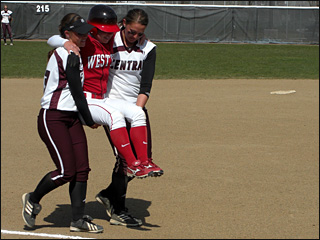
How many teams — with as much to lose — would show the same selflessness? A member of a women’s softball team hit a home run over the fence during the playoffs, but collapsed with a knee injury at first base. Players on the opposing team asked umpires if they could carry her around the remaining bases so that her home run could be counted as her own — her first home run ever. As a result, their team was eliminated from the playoffs, yet it appears that no one on either team is unhappy.
(Four people alerted me to this inspiring news in the past 24 hours! Thanks to Joseph Andorfer, Jeannie Beau, Lisa PB, and Tom.)
Photo courtesy of Athletic Media Relations, Central Washington University
Amputee Vets Get to Race BMWs for Fun (Video)

Giving injured Marines the chance to drive, and drive really fast is the goal of the Semper Fi Fund which is helping to retrofit BMW’s so that injured Iraq veterans can forget their trouble and have a little fun behind the wheel.
Church Groups Rally to Deliver 70 Tons of Food to NH Pantries
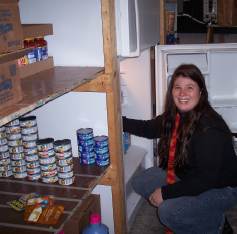
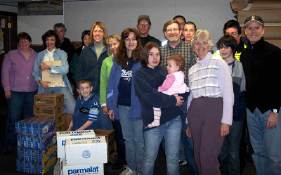
Over 1 ton of food was delivered and stocked on shelves in Raymond, New Hampshire as part of a drive by volunteer church members to restock the shelves of 50 food pantries throughout the seacoast area. Churches of different denominations, from a mega-church (Bethany) in Greenland, to the small congregation in Raymond, worked together to solve the growing shortfalls of donated food in the area.
A tremendous effort by the church groups, the goal was to raise $500,000 to fill the 50 pantries, but in the last minute donations increased bringing the total to 750,000 dollars enough to deliver 70 tons of fresh food within a couple of days.
“Our church is now preparing to do another huge project to try to keep the ball rolling, said Laurie Comp, a member of the New Life Assembly of God. “We want to start a chain of kindness in our community and throughout our country.”
Thanks to Laurie Comp for submitting the story. idea (Photo, right- Laurie stocks the refrigerator at Raymond’s New Life Assembly of God; below-food pantry volunteers in Raymond.)