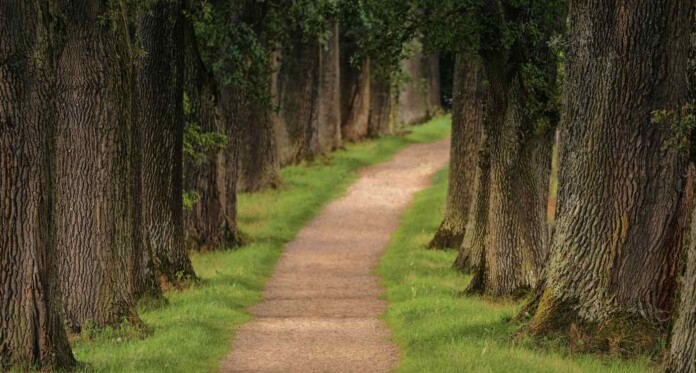
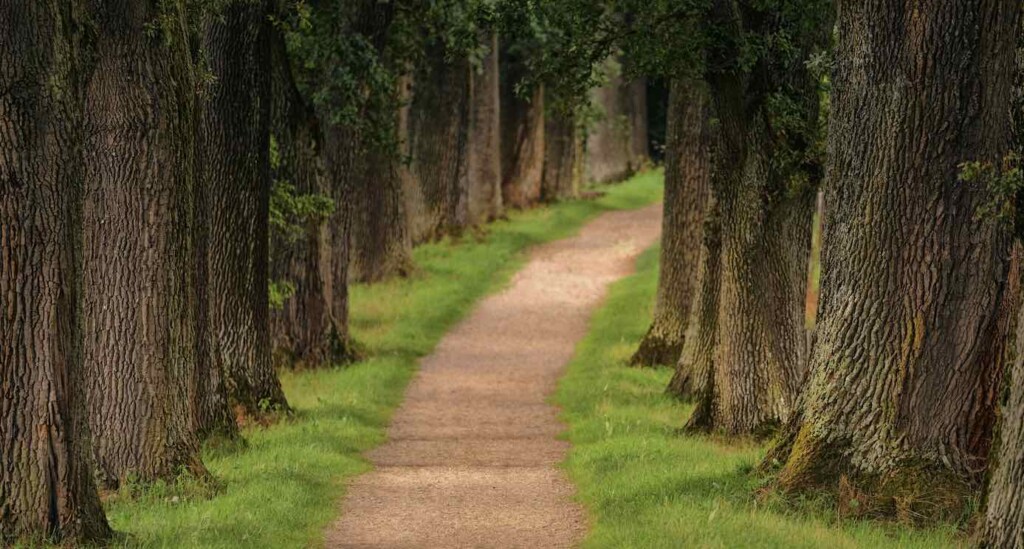
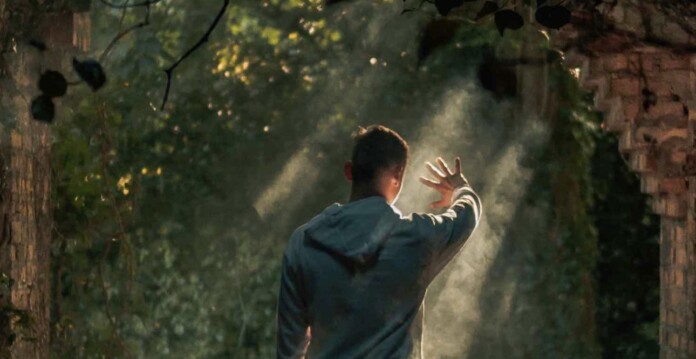
Quote of the Day: “If you would know strength and patience, welcome the company of trees.” – Hal Borland
Photo by: Johannes Plenio @jPlenio (cropped)
With a new inspirational quote every day, atop the perfect photo—collected and archived on our Quotes page—why not bookmark GNN.org for a daily uplift?
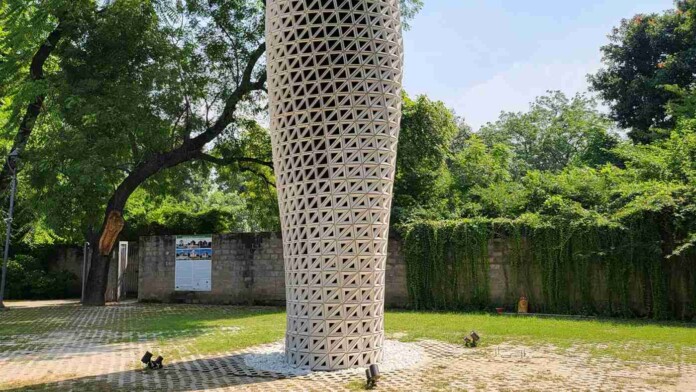
Studio Symbiosis tower - credit Avesh Gaur - released
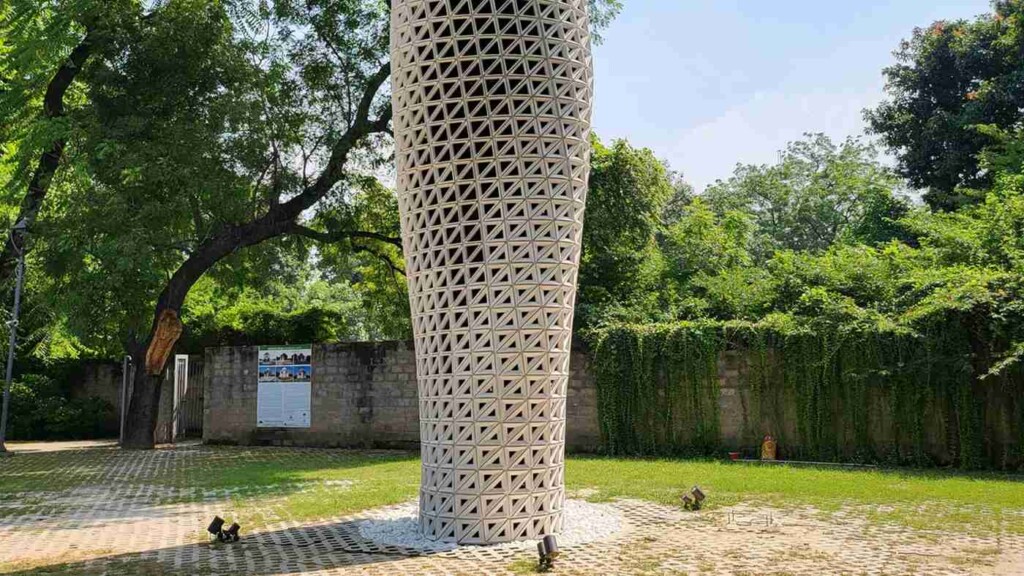
Studio Symbiosis tower – credit Avesh Gaur – released
This installation isn’t a graduate student’s idea of an art piece, it’s a sophisticated air purifier that could be key to making India’s capital more livable.
With the worst air pollution in the world stemming from a variety of factors, New Dehli was recently selected as the home of a husband-and-wife architecture business. But seeing the smog out of their window, Amit and Britta Knobel Gupta from the UK resolved to help fix the problem.
Their offering is the Verto tower, from their business Studio Symbiosis. This sleek and curved, aerodynamic design forces air through the multiple openings where inside lies a stack of air filtration cubes that can clean 600,000 cubic meters of air per day, the equivalent to the contents of 273 hot air balloons.
Amit and Britta imagine the tower as a mass-produced object to frequent city parks around polluted cities of the world, since the whole thing can be flat-packed, and the manufacturing is subdivided.
The cleaning footprint of each tower could be as much as 200 to 500 meters (656 to 1,640 feet) of air in enclosed spaces, and between 100 to 350 meters (328 to 1,148 feet) in outdoor spaces, varying due to wind direction and other factors.
The one pictured here is a prototype from the New Dehli Sunder Nursery.
“Now that (findings from the prototype) are what we expected, we will start speaking to the government authorities about further installation,” Amit told CNN on a video call from New Delhi.
The largest part of the development process was ensuring that air didn’t swirl around the tower, but that every puff was pulled inside, which they accomplished by studying a variety of aerodynamic designs, from car spoilers to aircraft.
The filters, made by the German firm Mann+Hummels, need to be changed every 9 months while the noise generated by the mechanical parts generates the same level of sound as a kitchen blender, which would presumably be fine with city-goers looking for a bit of tranquility in the park as long as each green space was limited to a single tower.
Studio Symbiosis believes that 100 of the towers could clean the whole of central New Delhi, but has also heard from companies in the US who want to use the towers to filter the air in construction sites, as well as potential buyers from France, New Zealand, and Uzbekistan.
THINK These Air-Cleaning Towers Would Catch On In Your City? Share Below…
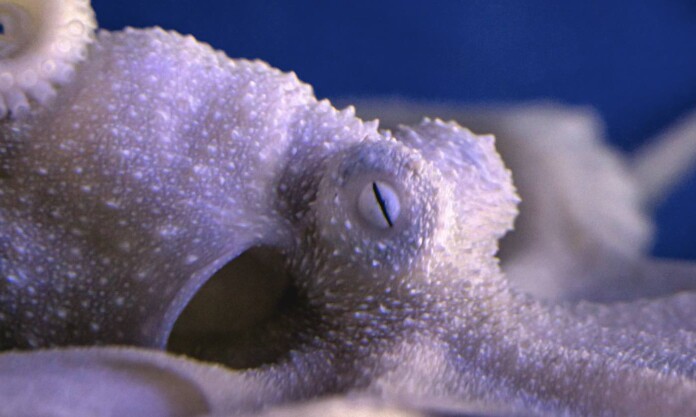
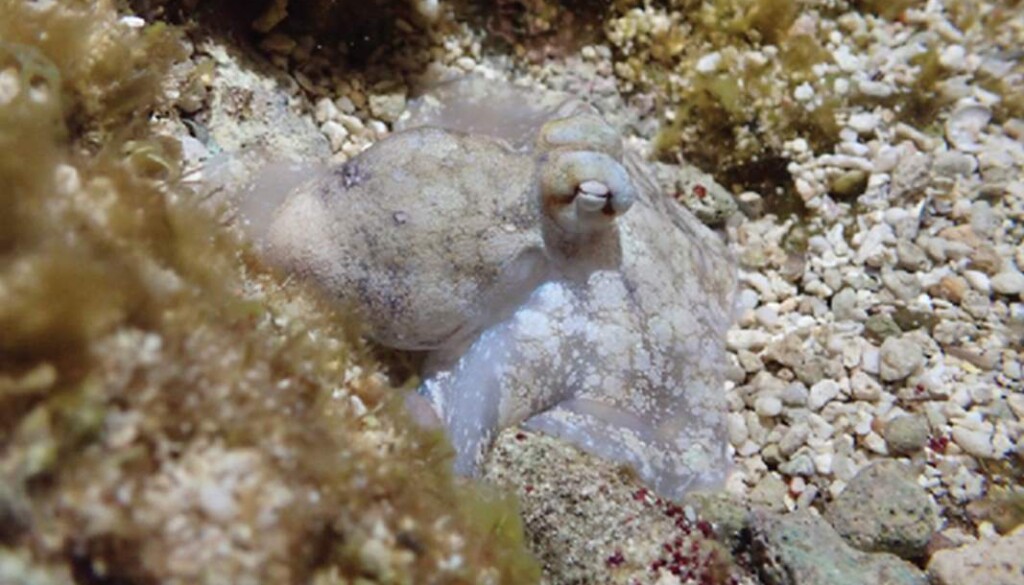
Researchers found that, like us, the octopus transitions between two sleep stages, a “quiet” stage and an “active” stage that resembles REM sleep in mammals.
Their arms and eyes twitch, their breathing rate quickens, and their skin flashes with vibrant colors—which has led scientists to conjecture that they may even be dreaming.
Researchers from the Okinawa Institute of Science and Technology (OIST) in Japan, along with colleagues from the University of Washington in the US, meticulously examined the brain activity and skin patterning in octopuses during that active period of sleep.
Roughly once an hour, the octopuses entered an active sleep phase for around a minute. During that stage, the octopuses’ brain activity very closely resembled their brain activity while awake, just like REM sleep does in humans.
The study also found that while sleeping, the octopuses cycled through the same skin patterns. The scientists theorized that the animals may have been practicing their skin patterns to improve their waking camouflage behavior, or simply maintaining the pigment cells.
Another idea is that the octopuses could be re-living and learning from their waking experiences, such as hunting or hiding from a predator, and reactivating the skin pattern associated with each experience.
The research team said their findings, published in the journal Nature, highlight the remarkable similarities between the sleeping behavior of octopuses and humans.
“All animals seem to show some form of sleep, even simple animals like jellyfish and fruit flies,” said senior author Professor Sam Reiter, head of the Computational Neuroethology Unit at OIST. “But for a long time, only vertebrates were known to cycle between two different sleep stages.”
“The fact that two-stage sleep has independently evolved in distantly related creatures, like octopuses, which have large but completely different brain structures from vertebrates, suggests that possessing an active, wake-like stage may be a general feature of complex cognition,” added co-author Dr, Leenoy Meshulam.
What does this mean to science? In extrapolation, it means that sleeping, and indeed dreaming, was selected for in both humans and octopuses independent of the fact that the evolutionary paths which produced these animals diverged 500 million years ago.
While sleeping, animals in nature are extremely vulnerable. They’re unable to hunt or forage for food, unable to defend themselves against predators, unable to search for a mate, and unable to protect their offspring.
Indeed, sleep overrides all other prime activities of life, the activities most people would suggest to be the most basic and important among multi-celled organisms.
One might conclude then that sleep, and potentially dreaming, is one of the most fundamental needs for life.
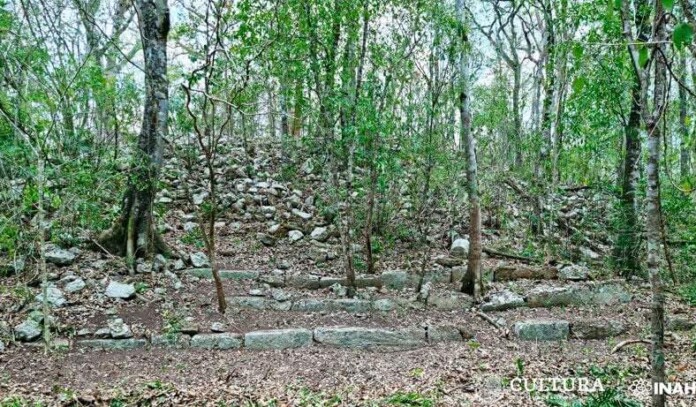
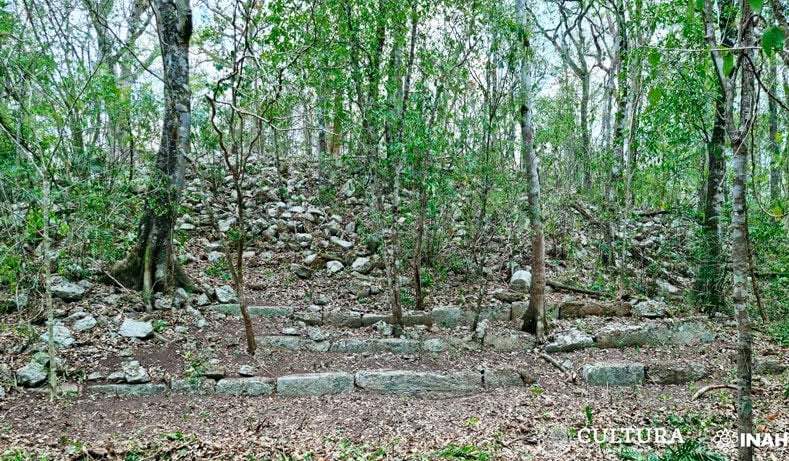
Ocomtún ruins by Ivan Šprajc via National Institute of Anthropology and History
Ocomtún ruins by Ivan Šprajc via National Institute of Anthropology and History
LiDAR has done it again: pyramids, a ballcourt, and columns built by the late Mayan Empire over 1,000 years ago were discovered under the forest canopy thanks to the hi-tech surveying device.
The site is located in the largely-unexplored forested region in the Mexican state of Campeche, an area of 1,150 square miles near the Calakmul Biosphere Reserve.
Named Ocomtún, the word for ‘column’ in the Yucatec Mayan language, the city’s nucleus stretches for 123 acres centered around a stone pyramid.
Several plazas, a ballgame court, and the stone columns that gave Ocomtún its name surround the pyramid, all believed to be built between 250 CE and 1,000 CE.
“The site served as an important center at the regional level, probably during the Classic period,” said Ivan Šprajc, an anthropologist at the Research Center of the Slovenian Academy of Sciences and Arts, who participated in the survey project alongside several Mexican institutions.
“The most common ceramic types that we collected on the surface and in some test pits are from the Late Classic (600-800 CE); however, the analysis of samples of this material will offer us more reliable data on the sequences of occupation”, detailed the doctor in anthropology.
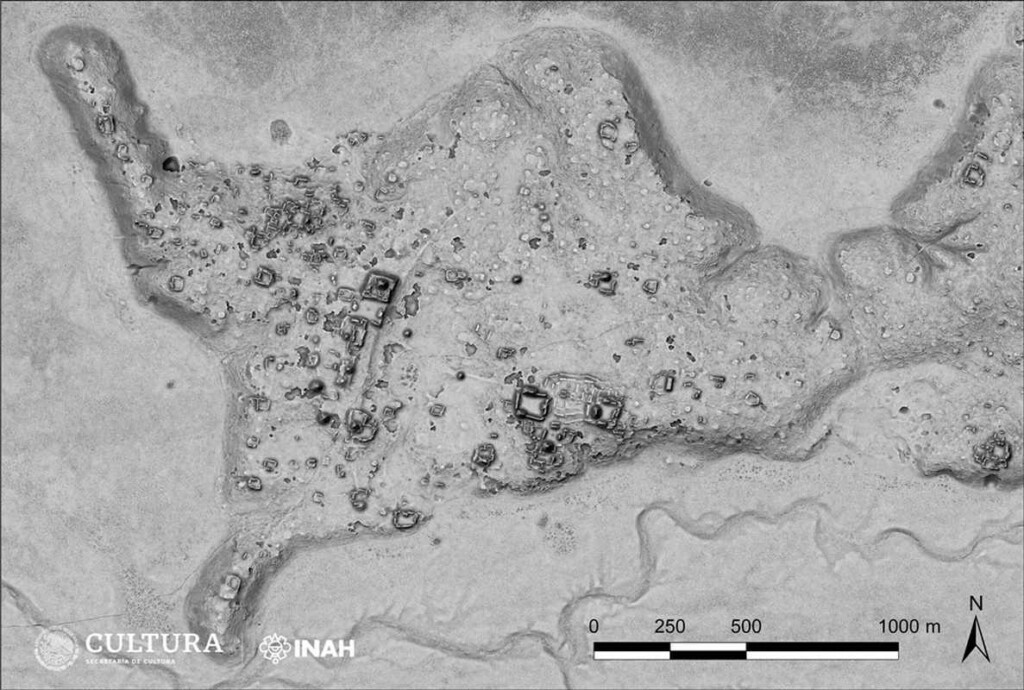
The discovery began with LiDAR surveys in March of 2023, revealing multiple prehispanic structures in an area bigger than Luxembourg.
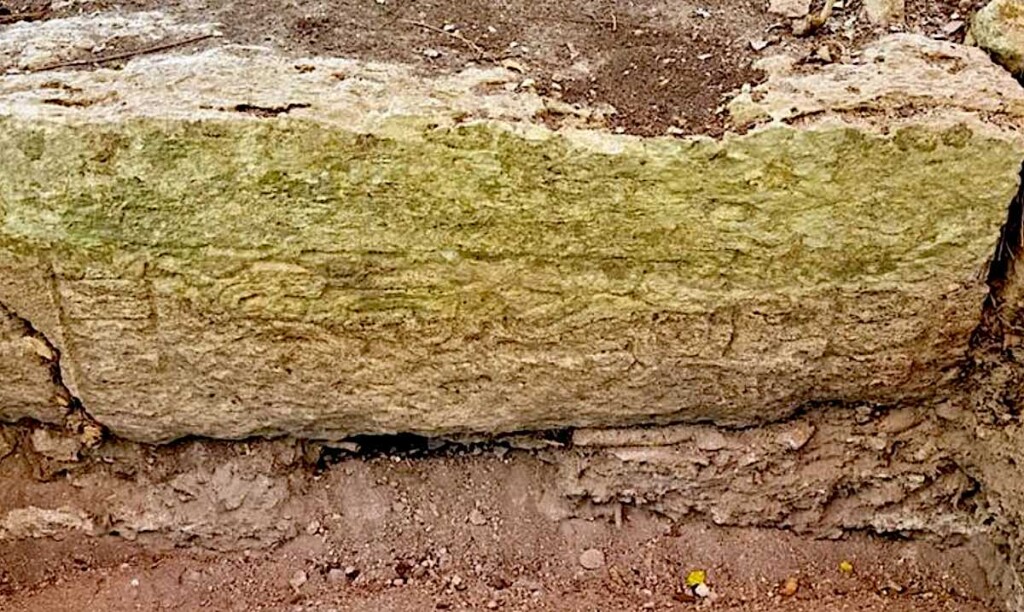
Mayan inscription at the Ocomtún ruins (Ivan Šprajc via National Institute of Anthropology and History)LiDAR survey of the area near Calakmul. (Ivan Šprajc via National Institute of Anthropology and History)
Abbreviating “light detection and ranging,” LiDAR is a laser-survey device that can make detailed maps of the terrain underneath the jungle canopy. Mounted on the front of an aircraft, LiDAR can survey in exquisite detail even if it’s flying at high speeds.
The technology has done so much more than just show archaeologists where to look and dig under South and Central America’s rainforest canopy, it is legitimately re-writing the history of human civilization and placing Meso-america’s people at levels of organization and technological sophistication that surpass that of post-Rome Europe.
For example, thousands of miles south in Bolivia, LiDAR discovered a lost South American civilization called the Casarabe Culture, who built large pyramids, sophisticated irrigation, and road infrastructure, but they did it all with dirt.
“Just imagine you are working 20 years in that region like we did, and you have to explain to someone not familiar with the archaeology of the region, and they’re asking what is special about that culture—you’d need an hour to explain it,” Dr. Heiko Prümers who led the LiDAR survey, told World at Large. “Now we just show the images, and everybody will say ‘wow, yes it’s obvious that it’s something big’”.
Other big discoveries include Angamuco, a major urban settlement of the Purépecha civilization, now in ruins hidden under vegetation, in the Lake Pátzcuaro Basin of Michoacán, Mexico. It contained an estimated 39,000 buildings spread across an area about 40% the size of Manhattan.
Despite being in a pretty densely populated area, it remained undiscovered until 2007-2012 when LiDAR surveys revealed the extent of the city.
Did you know Claude wasn’t the only Monet? His younger brother Leon’s faithful support of his older brother is partly why Claude became the man we know today.
The Brothers Monet and their relationship are on full display at a new exhibit at the Musée du Luxembourg in Paris. Curator Geraldine Lefebvre took three years to amass the collection of paintings and records of Leon’s activities, and what takes shape shows a “lynchpin” in Claude’s superstardom.
“One tends to think of Monet making it all by himself, but he relied on a network of collectors, supporters, dealers. Leon seems to be almost like a lynchpin who has been somehow overlooked and rediscovered through the exhibition,” Frances Fowle, senior curator at the National Galleries of Scotland, told Euronews.
Leon was part of this network, and he supported his brother early on by buying his paintings at auction to drum up interest, as well as introducing him to new kinds of synthetic dyes.
He kept some of his brother’s paintings, but others he gave back so he could create more publicity.
Leon must have enjoyed the role, as he met and grew into a businessman alongside not only Monet, but other Impressionists whom Claude was friends with, like Pissaro, Renior, and Sisley, whose paintings Leon also bought. Monet the Younger became a well-to-do owner of a chemicals factory.
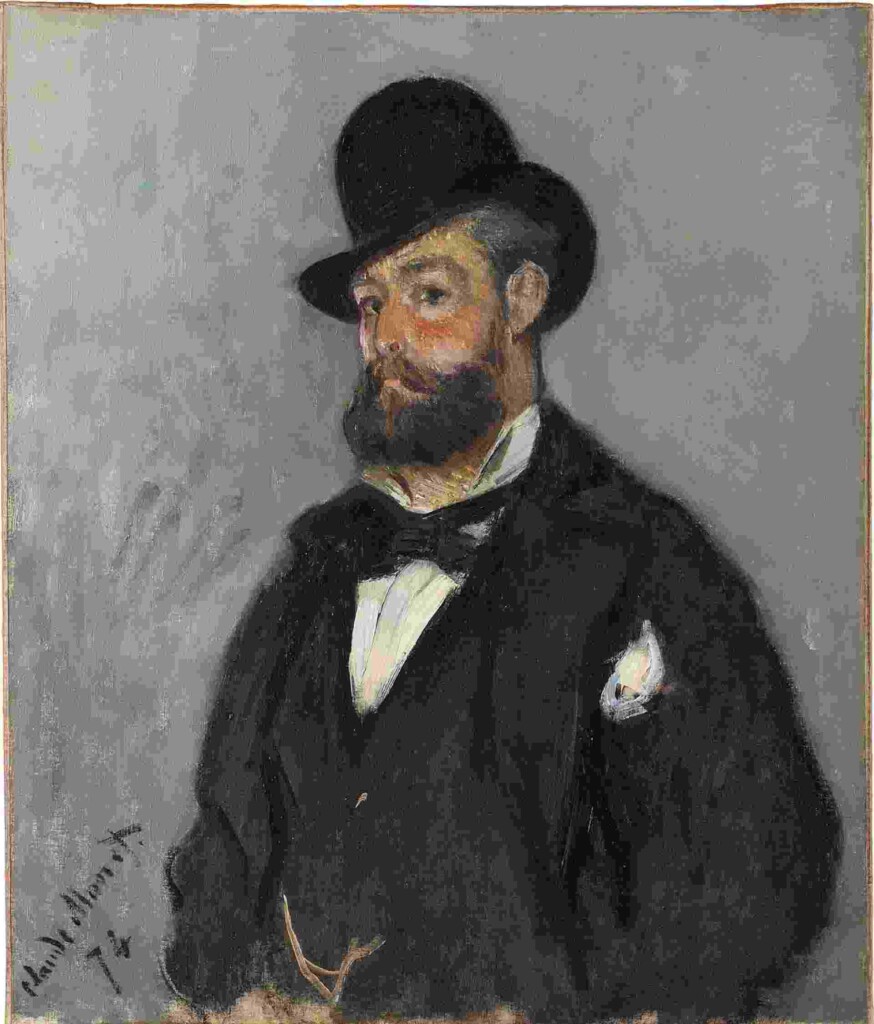
Leon Monet by Claude – Wikimedia Commons
Claude’s son Jean worked at Leon’s factory, and that was the first snowfall of the winter of their discontent, as Jean contracted a respiratory infection and died. Claude blamed Leon for Jean’s death, and at his 1914 funeral, Leon Monet’s side of the family wasn’t invited.
This was made all the worse by the death of Claude’s daughter Adrienne from similar causes.
Leon was in denial of the chemicals’ role in their deaths, and shortly after Adrienne passed, they exchanged final angry words and never spoke again.
Perhaps though, the Brothers Monet were made of stiffer stuff than most, because after Leon died just 3 years later at the ripe old age of 82, Claude lamented.
“I regret not being able to see my brother one last time, and tell him to forget everything that took us apart,” he wrote to his widow.
Chief among the showpieces is a large and lively portrait of Leon Monet painted by Claude during the year the former made his debut as an industrialist in Rouen. Leon didn’t like it—felt it was unfinished, but Claude’s friends Renoir and Sisley convinced Claude to leave it as it was. Leon hid it away all his life.
The exhibit, which runs until July 16th, also includes a variety of family photographs, records, woodblocks, and other materials that each tell a small part of the story of the Brothers Monet, and the exhibit itself may help one or two disgruntled siblings understand that blood (and paint) is thicker than water, and that the time to make amends should be sooner rather than (too) later.
SHARE This Story Of Brotherly Love With Impressionist Lovers You Know…
Quote of the Day: “We aim above the mark to hit the mark.” – Ralph Waldo Emerson
Photo by: Afif Ramdhasuma
With a new inspirational quote every day, atop the perfect photo—collected and archived on our Quotes page—why not bookmark GNN.org for a daily uplift?
It’s the most famous mathematical sequence in biology—the description of a spiral with a particular ratio found in the evolution of plants going back millions of years, and that is seen today in succulents like this aloe, but also in pineapples, sunflowers, and pinecones.
Named for the Italian mathematician that discovered it, the Fibonacci Sequence, or Fibonacci Spiral, is also known as nature’s secret code, as it also predicts the spiral of invertebrate shells like ammonites and snails.
Now though, scientists have just discovered where its spiral ends, and one would have to go back 407 million years ago.
The Early Devonian Period produced a plant known as the clubmoss, which arranged its leaves in a spiral, but which doesn’t follow the Fibonacci Sequence.
“Spirals are common in plants, with Fibonacci spirals making up over 90% of the spirals,” University of Edinburgh paleontologist Alexander Hetherington and colleagues wrote in their paper describing the discovery.
“Based on their widespread distribution it has long been assumed that Fibonacci spirals were an ancient feature that evolved in the earliest land plants and became highly conserved in plants.”
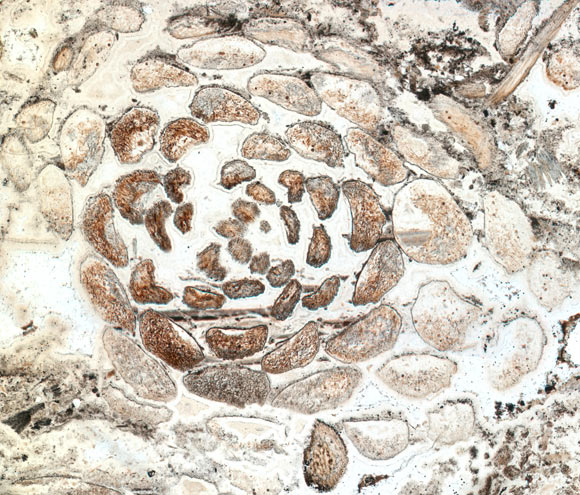
Asteroxylon mackiei. Image credit: Turner et al., doi: 10.1126/science.adg4014.
They characterize the Fibonacci spiral as being found in the arrangement of their organs around their stems. In most existing plant species, organs emerge at 137.5° from the previous organ. This results in continuous spirals of organs, with the number of clockwise and anticlockwise spirals forming consecutive numbers in a Fibonacci sequence.
The Fibonacci Sequence has also been found in spiral galaxies and large hurricanes. Fans of the band Tool probably know that band leader Maynard James Keenan wrote a song with the lyrics and time signature arranged in the numbers of the Fibonacci Sequence.
Asteroxylon mackiei was a clubmoss that featured among the world’s oldest leaf-bearing plants. The exceptionally preserved fossil subjected to 3D imaging for the study was found in the famous fossil site the Rhynie chert near the Aberdeenshire village of Rhynie in Scotland.
“The clubmoss Asteroxylon mackiei is one of the earliest examples of a plant with leaves in the fossil record,” said Holly Anne-Turner, the study’s first author. “Using these reconstructions we have been able to track individual spirals of leaves around the stems of these 407 million-year-old fossil plants. Our analysis of leaf arrangement in Asteroxylon shows that very early clubmosses developed non-Fibonacci spiral patterns.”
“This transforms our understanding of Fibonacci spirals in land plants,” the researchers said. It indicates that non-Fibonacci spirals were common in ancient clubmosses and that the evolution of leaf spirals diverged into two separate paths.”
SHARE This Break In Mathematical Evolution With Your Friends…
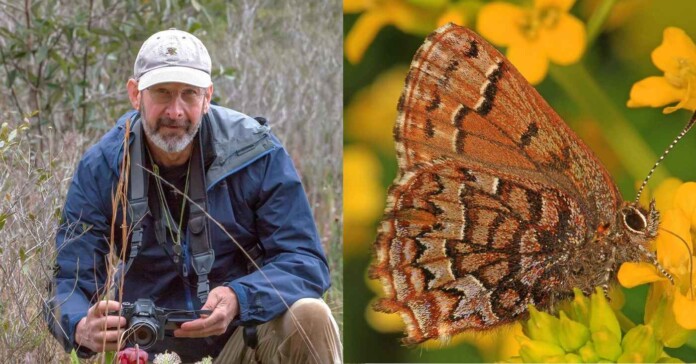
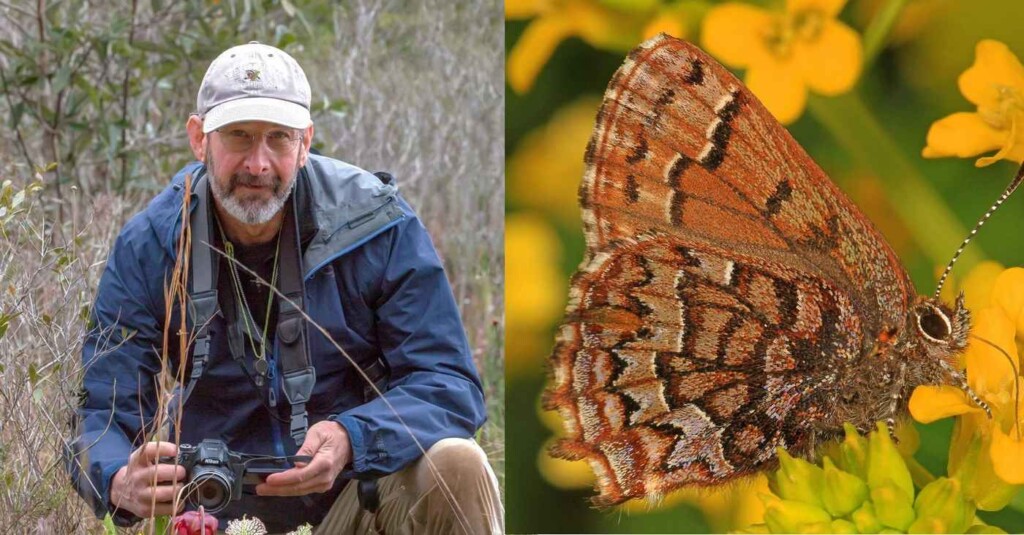
(left) Byran Pfeiffer - retrieved from Facebook (right) an Eastern pine elfin Judy Gallagher CC 2.0.
(left) Byran Pfeiffer – retrieved from Facebook (right) an Eastern pine elfin Judy Gallagher CC 2.0.
At times it can seem that some humans are just born to play the piano or run long distances, but natural talent isn’t limited to beauty or competition, some talent comes in subtler ways.
Take 65-year-old Bryan Pfeiffer, a man born seemingly for the purpose of hunting a little brown butterfly the size of a penny in the bogs of Vermont for 21 years.
Pfeiffer attempted, almost certainly in vain, to communicate what his final accomplishment meant when he wrote in his substack, Chasing Nature, that “Vermont is now a better place for having Bog Elfins—up there in the spruce where they belong.”
If Vermont is a better place for having bog elfins, then Earth is a better place—humanity is in better condition—for having people like Bryan Pfeiffer, who sought this tiny brown insect—not because he was discovering a new species he could name Pfeiffer’s elfin, but merely to confirm that it indeed inhabited his native Vermont; just that, and nothing more.
An entomologist, Pfeiffer has been compiling a butterfly species atlas for the state of Vermont, and he had a hunch that the elusive bog elfin could be found within its borders. The elusive insect dwells up among the high canopy of spruce trees most hours of the day, which has meant 21 years of wading through knee-deep bog water and clouds of biting, swarming insects.
He began his quest for the bog elfin at age 44 when his knees worked and his back was strong. Every year that passed, he told the Boston Globe, he wondered if his window was closing.
Then, after several years of looking in a single bog, he noticed a little brown butterfly coming down from the trees to alight on a juvenile spruce 20 feet from the man, who raised his binoculars and said to himself “I’ve been looking for you, for a very long time.”
But just like that, he couldn’t take a picture before it launched back up into the canopy. There are pine elfins in the bog too, so he couldn’t be sure he had found his prize without a photo. Scouring the rest of the bog in a bit of anxiety, he saw another brown butterfly alight nearby, and he didn’t wait for the optics—he swung his butterfly net, and inside was a bog elfin, the first ever seen in the state of Vermont.
He took a few pictures and released the insect back into the trees.
In his essay, published on his exceptional substack (he writes with the adoranze of Aldo Leopold at least, John Muir at best) he questions, looking back on his 21-year search, why it mattered so much, and how it’s almost certain to be just a footnote in the scientific record.
Indeed, with the focus paid to the decline of biodiversity, large newspapers are often publishing stories about the loss or recovery of some small colored newt in Asia, or a brown warbler in South America—almost begging the question of what degree of importance they have in the world, and why should we care about them?
“Here in the United States we protect speech we don’t necessarily care for, or that might lack obvious intrinsic value. It is a foundational doctrine—it makes us stronger, more open to ideas,” writes Pfeiffer.
“In our safeguarding little brown butterflies, like protecting speech, we show reverence not only for the popular and charismatic and profitable, but for the obscure and the vulnerable as well.”
Bravo Pfeiffer, bravo.
SHARE This Inspiring Story of TheOld Man and the Bog…
While modest, this simple table has a special secret—the artisans who crafted it lived more than 400 years ago.
The rare rosewood table, standing 31 inches (79cm) tall was made around 1,600CE during the Ming Dynasty. Known colloquially for their vases and porcelain, there was nothing the Ming Dynasty artisans couldn’t craft.
British Auctioneer, antiquities expert, and occasional television presenter Charles Hanson discovered the remarkable piece in a country home in Derby.
Reports place its value at between $70,000 and $100,000 but is likely to spark a bidding war at Hanson’s Auctioneers in October.
“Hanson’s Asian works of art consultant Adam Schoon has dated the table to around 1,600,” said Hanson, referring to the piece as a Banzhou side table. “To put that into historical context, that was the end of the Tudor period in England and Wales.”
“It is a work of art. It was crafted during the Ming Dynasty period which dates back to 1,368 – 1,644. Its simplicity defines modern style.”
Mr. Schoon was able to give Hanson a rich background in the use of the table, which thanks in no small part to the Chinese civilization’s immaculate record keeping, will give any potential bidders the complete history of its use.
Made of fine huanghuali wood, the unique floating panel construction is supported by three dovetail transverse stretchers underneath.
“Items like this are mentioned in 16th-century Chinese novels about life in grand houses. Its design has been seen in wall murals relating to the Jinyuan Dynasties [sic] of 1,115-1,368,” said Hanson, referring to the two dynasties preceding the Ming.
“Banzhuo literally means ‘half table’ and is so-called for its size, which is half that of an ‘eight immortals table,'” he continued. “The banzhuo was mainly used for serving wine and food and is also sometimes referred to as a jiezhuo, meaning extension table.”
SWNS / Hansons Auctioneers
“The simplicity of its construction is impressive too. It has mortise and tenon joints, which have been used by woodworkers around the world for thousands of years.”
The sellers inherited it from a relative who was an avid collector of Asian artifacts and was genuine ‘head-over-heels for anything Asian.’
Emperor Longqing lifted a ban on maritime trade which allowed huanghuali, a tropical hardwood, to be imported from Southeast Asia.
Due to the wood coming from slow-growing, small trees, the availability of furniture made from it is extremely rare.
“The wood itself is a thing of beauty. Its dense, beautifully-figured grain displays a broad range of colors from pale honey to rich mahogany,” Hanson continued. “It polishes to a translucent golden sheen. The finest huanghuali has a translucent shimmering surface with abstract patterns.”
“Today huanghuali furniture is in demand at auction. It appeals to wealthy collectors from the Far East due to its elegance and historical significance because they’re keen to repatriate works of art to their homeland to celebrate and honor their culture.”
SHARE This Story With Any Antique Hunters You Know…
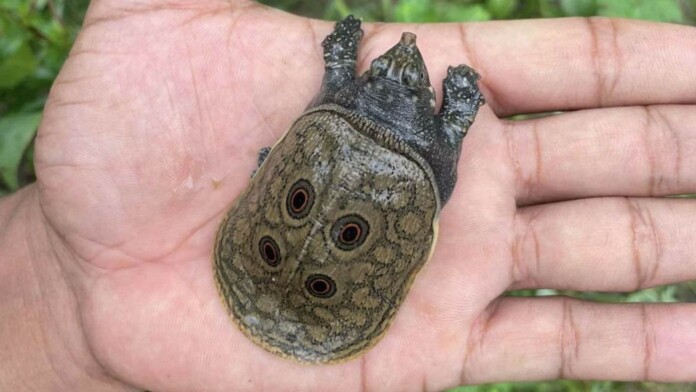
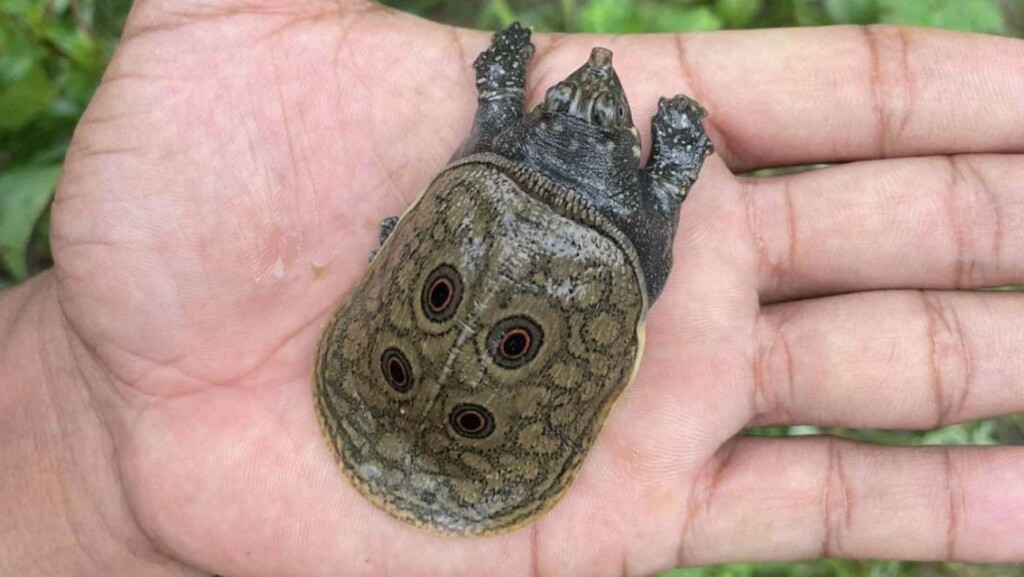
This little fellow is the Burmese peacock softshell turtle, and he’s sitting here in the hands of one of the first humans to ever hatch them in captivity.
As one of the most endangered freshwater turtle species on the planet, it’s hoped the 15 hatchlings will go a long way towards preserving these beautiful reptiles for future generations of Myanmar’s people.
The breeding program was undertaken by the conservation group Flora and Fauna International along with support from local volunteers and knowledge keepers around Myanmar’s Indawgyi Lake, one of the largest freshwater lakes in Southeast Asia.
The locals, trained by FFI, nominated “turtle guardians” to patrol the shores and look for nesting areas—of which they found 5 in the 2022 breeding season. They fenced them off and kept regular watch over them.
According to the conservation group, the video of the turtles hatching is the first known recording of the species born in the wild.
Amazing discovery: just-hatched Burmese peacock softshell turtles in Myanmar.
Our team collected the turtles in order to gather vital data on the species. They have since been released into the wild during a small ceremony held in the presence of the community. pic.twitter.com/wSKFJE8kYA
FFI has worked around Indawgyi for many years, and was instrumental in its designation as a UNESCO Biosphere Reserve in 2017. Home to 160 endemic birds, the lake also hosts fish, reptiles, primates, and mammals unique to the area.
The Burmese peacock turtles are named for the orange spots on their shells reminiscent of peacock feathers. They are considered a delicacy in the poverty-stricken country, and have been overhunted.
SHARE This Encouraging Conservation News With Your Friends…
Quote of the Day: “Don’t forget to love yourself today.” – Soren Kierkegaard
Photo by: pmv chamara
With a new inspirational quote every day, atop the perfect photo—collected and archived on our Quotes page—why not bookmark GNN.org for a daily uplift?
A Stockholm development company has a dream contract in its hands—the construction of a whole new city borough entirely of lumber that aims to be a sustainable ballast to an unbalanced city.
Spanning 25 blocks, 30 sustainable mass timber buildings will add 7,000 new offices and 2,000 new homes, with construction slated to begin in 2025, and the first buildings to be completed in 2027.
Known as Stockholm Wood City, the borough is not just an exercise in Swedish woodworking or sustainability, it’s a much-needed re-structuring of the urban landscape since most people live south of the historic center, but most offices are north of the historic center.
The development company in charge is called Atrium Ljungberg, and it appreciates the concept of a “15-minute city” where everything is a 15-minute walk from one’s front door.
“We are proud to introduce Stockholm Wood City. This is not only an important step for us as a company, but a historic milestone for Swedish innovation capability,” Annica Ånäs, CEO of Atrium Ljungberg, said in a statement.
“From tenants, there is a strong demand for innovative, sustainable solutions—a demand that we meet with this initiative.”
Timber construction of large buildings came about in the 90s with the invention of cross-laminated timber, known shorthand as “mass timber.” Consisting of multiple boards of lumber fused together using sophisticated machinery, the mass timber could bear much greater loads and forces. Additional applications made this special lumber fire-resistant.
The company alleges that studies have shown living around wooden buildings increases well-being by decreasing stress and increasing focus, though no such studies were cited.
What they undoubtedly do offer however is a massive reduction in CO2 emissions, since cement and steel emit more carbon dioxide into the atmosphere than any other aspects of manufacturing, and together just over 10 times what is emitted from air travel.
Stockholm Wood City – Atrium Ljungberg
The timber is harvested in Sweden, made into CLT, and erected in Stockholm.
“Our industry leaves a big mark, and it is important for us to make a positive difference in both the shorter and longer term,” said Ånäs. “The new development will create a dense, green city area with circular and sustainable principles built into the whole ecosystem.”
Recently, Sweden built the world’s tallest wooden skyscraper as a demonstration to the world what mass timber can do. This is perhaps a more sustainable and realistic open invitation to cities around the globe.
A suite of studies shows that time spent in nature, particularly around tree cover, improves mental and physical health.
The researchers believe that their presentation shows that nature “prescriptions” merit wider use in the medical profession.
Suggesting that spending time in nature walking with friends is good for mood and blood pressure will surprise pretty much no one, especially no one reading GNN. But the idea of time in nature as a prescription, just as a doctor might prescribe an SSRI for depression, hasn’t been widely evaluated scientifically, particularly in Australia.
A meta-analysis conducted in the country and published in The Lancet, shows that nature prescriptions as defined, benefitted daily step counts, depression and anxiety scores, and blood pressure.
“This study is built upon a long-term program of research that we are doing, where we show contact with nature—and trees especially—is really good for strengthening mental and physical health across our lives,” said Professor Xiaoqi Feng from UNSW Medicine & Health.
Nature prescriptions are emerging as a supplement to standard medical care. For example, the UK Government recently invested £5.77 million in a pilot program for ‘green social prescribing’ and Canada has a national nature prescription program.
In Australia, there is growing public interest in nature prescriptions. A recent survey of Australian adults led by Prof. Feng showed that over 80% of people were receptive to the idea.
“If we want nature prescriptions to become a national scheme, we really need to provide the evidence.”
One of the 28 studies analyzed included 47,000 people in Australia’s New South Wales state and found greater reported well-being in those living in the upper thirtieth percentile of tree-covered areas, suggesting the role of trees in any nature prescription scheme.
“The evidence shows that nature prescriptions can help to restore and build capacities for better physical and mental health. What we need now is to work out how to make nature prescriptions happen in a sustained way for those people with high potential to benefit, but who currently spend little time in nature,” said Prof. Feng.
PRESCRIBE Nature To Your Friends By Sharing This Story…
News oulets, and indeed, GNN, have reported multiple times that smart watches and their ability to monitor heart rate have saved lives.
But a Cincinnati woman was having a pulmonary embolism while she slept and the Apple Watch was able to detect it because unlike similar devices it measures heart rate also while the wearer is sleeping.
Not feeling well, 29-year-old Kimmy Watkins woke to find her watch beeping loudly.
It had recorded a resting heart rate of 178-beats per minute—equivalent to the high-intensity running or swimming for her age group.
Her doctors diagnosed her the next day with a pulmonary embolism, occuring when a blood clot gets stuck in an artery in the lung and blocks blood flow to part of the lung—a condition with a 50% fatality rate.
“I’m very lucky, and if my sleep hadn’t been disturbed, my partner would have found me asleep on the couch or not really asleep,” Watkins said.
Readers interested in turning on the heart rate tracker will find it under “Privary & Security” in settings, because the health data collected by apps on smartwatches and phones is not protected under law like traditional medical records.
Last September, an Apple Watch detected that a Englishman’s heart was in process of stopping—he was susceptible to suffering “sudden cardiac death” which as the same sounds, is very dangerous.
He was rushed to the hopsital after an MRI discovered the issue, afterwhich he underwent life-saving surgery to fit a pacemaker.
“My wife keeps saying that she saved my life, and she’s not wrong,” said David. “If she hadn’t had bought me my Apple watch for my birthday, I wouldn’t be here.”
SHARE These Stories Of Lives Saved By Technology With Your Friends…
Summer on Mars – NASA MAVEN's Imaging Ultraviolet Spectrograph
Summer on Mars – NASA MAVEN’s Imaging Ultraviolet Spectrograph
NASA’s MAVEN (Mars Atmosphere and Volatile Evolution) mission acquired “stunning views” of Mars in two ultraviolet images taken at different points along our neighboring planet’s orbit around the Sun.
By viewing the planet in ultraviolet wavelengths, scientists say they can gain insight into the Martian atmosphere and view surface features in remarkable ways.
MAVEN’s Imaging Ultraviolet Spectrograph (IUVS) instrument obtained these global views of Mars in 2022 and 2023 when the planet was near opposite ends of its elliptical orbit.
The IUVS instrument measures wavelengths between 110 and 340 nanometers, outside the visible spectrum.
To make these wavelengths visible to the human eye and easier to interpret, the images are rendered with the varying brightness levels of three ultraviolet wavelength ranges represented as red, green, and blue.
In this color scheme, atmospheric ozone appears purple, while clouds and hazes appear white or blue.
The surface can appear tan or green, depending on how the images have been optimized to increase contrast and show detail.
The first image was taken in July 2022 during the southern hemisphere’s summer season, which occurs when Mars passes closest to the Sun.
The summer season is caused by the tilt of the planet’s rotational axis, similar to seasons on Earth.
Argyre Basin, one of Mars’ deepest craters, appears at the bottom left filled with atmospheric haze (depicted as pale pink). The deep canyons of Valles Marineris appear at the top left filled with clouds (colored tan in the image).
The southern polar ice cap is visible at the bottom in white, shrinking from the relative warmth of summer.
Summer on Mars in Argyre Basin, one of the deepest craters, filled with atmospheric haze (NASA MAVEN’s Imaging Ultraviolet Spectrograph)Mars in Winter, when rapidly changing seasons in the north polar region cause an abundance of white clouds (NASA MAVEN’s Imaging Ultraviolet Spectrograph)
The second image is of Mars’ northern hemisphere and was taken in January 2023 after Mars had passed the farthest point in its orbit from the Sun.
The rapidly changing seasons in the north-polar region cause an abundance of white clouds. The deep canyons of Valles Marineris can be seen in tan at the lower left, along with many craters.
Ozone, which appears magenta in the UV view, has built up during the northern winter’s chilly polar nights. It’s then destroyed in northern spring by chemical reactions with water vapor, which is restricted to low altitudes of the atmosphere at this time of year.
MAVEN launched in November 2013 and entered Mars’ orbit in September 2014. The mission’s goal is to explore the planet’s upper atmosphere, ionosphere, and interactions with the Sun and solar wind to explore the loss of the Martian atmosphere to space.
Quote of the Day: “The cure for an obsession: Get another one.” – Mason Cooley
Photo by: KAL VISUALS
With a new inspirational quote every day, atop the perfect photo—collected and archived on our Quotes page—why not bookmark GNN.org for a daily uplift?
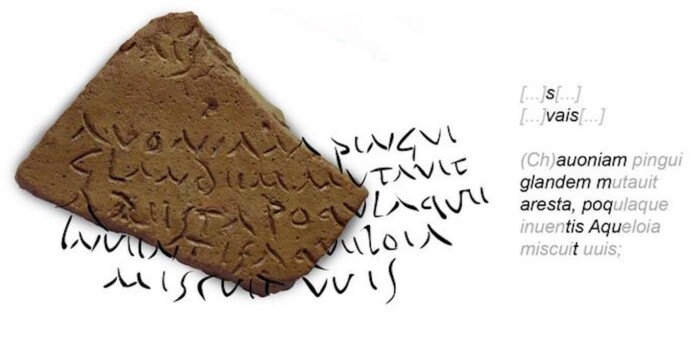
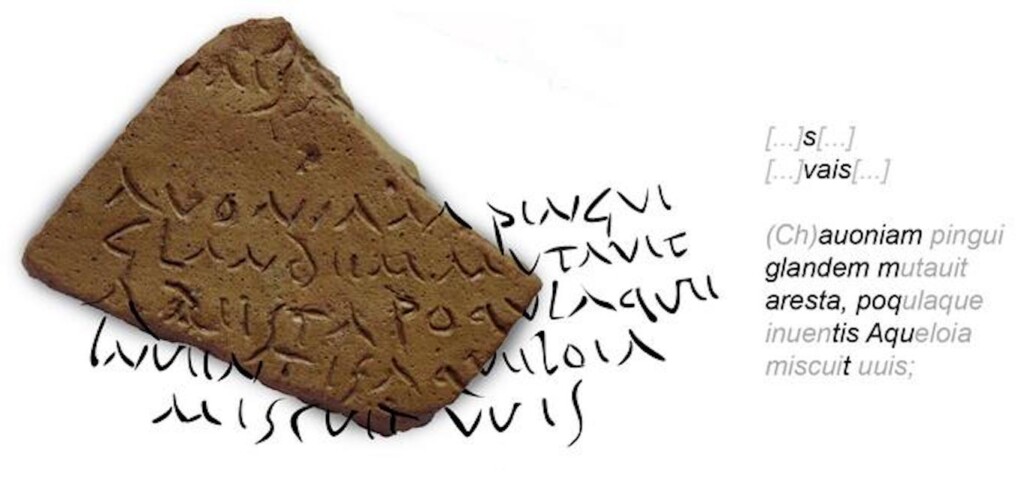
A piece of Roman pottery inscribed with the poet Virgil's verse – SWNS
A piece of Roman pottery inscribed with the poet Virgil’s verse – SWNS
Although popular, his works have never been found as decoration before and they believe the inscription on the bottom of an olive oil amphora is a world first.
The 1,800-year-old fragment was found near Cordoba in Spain, the epicenter of the Roman olive oil trade.
Although famous for his poem The Aeneid, the 2-inch-long fragment actually has verse from The Georgics which he wrote in 29 BCE.
The poem is dedicated to agriculture and life in the countryside which is fitting for the area in which it was found.
Translated the fragment reads “Earth changed Chaonia’s acorn for the rich corn ear, and blended draughts of Achelous with the newfound grapes.”
The archaeologists from the University of Cordoba were able to get the text by overlaying the Latin with the partial inscription.
“The magnitude and exceptionality of the discovery has left the European archaeological community flabbergasted,” said study author Iván González Tobar. “There were some spelling mistakes that held us back from seeing what it was straight away but we did eventually get there.”
The fragment was not unusual and many amphorae have inscriptions detailing the contents. It was only when they deciphered the words and realized they were part of Virgil’s poem that they became excited at the discovery.
Strangely, the verses were written on the underside of the amphora where few people would notice them, suggesting a curious cultural appreciation and a certain level of literacy in the fertile plain of the Guadalquivir area where it was found.
Virgil was the most popular poet of his time, and still many centuries later.
The Aeneid was taught at schools, and its verses were routinely written as a teaching exercise for many generations.
It’s common to find them on the remains of ceramic construction materials, with many experts saying these tablets had educational and funeral functions as Virgil’s verses served as an epitaph on many occasions.
As to why it was on the bottom of the olive oil amphora and who put it there, the authors of the study, published in the Journal of Roman Archaeology, have no answers.
They could only deduce that it was written by a specialized worker with a certain degree of literacy or someone from the nearby villages related to an aristocratic family owning the factory.
One other theory is that a child worker wrote it, as the regular use of young workers at this type of establishment has been previously documented.
“Maybe a worker there wanted to show them to a colleague or they could have been done by an adult or a child,” said Dr. Tobar. “What we do know is that this was done inside an amphora factory, and that the lines were probably written from memory.”
SHARE This Cool Discovery And Mystery With Your Friends…
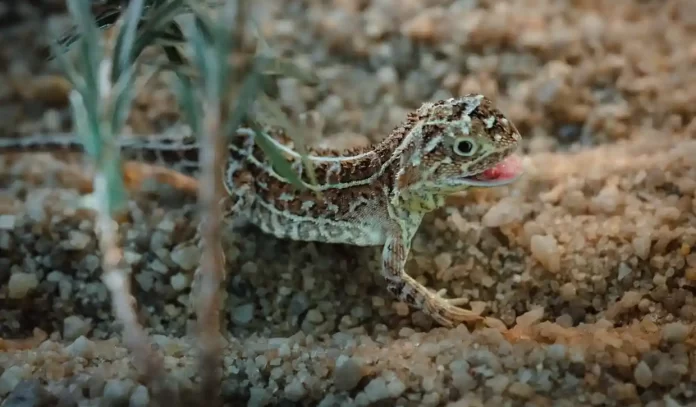
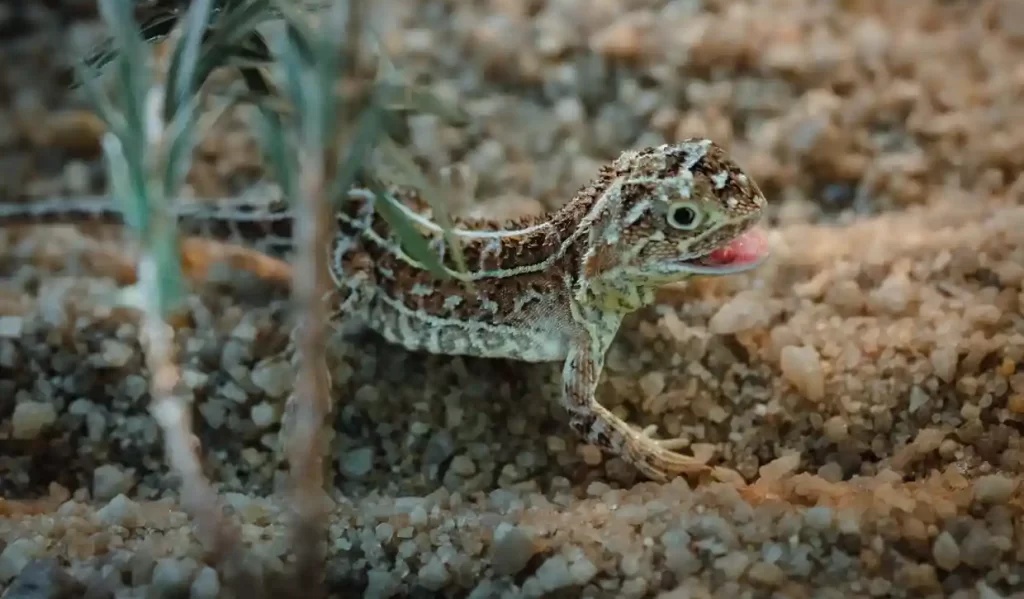
Victoria grasslands earless dragon. Photograph: Melbourne Zoo
Victoria grasslands earless dragon. Photograph: Melbourne Zoo
Last sighted in 1969, a tiny lizard from the Australian state of Queensland has been rediscovered by scientists who now hope to act fast to ascertain its numbers.
Not all dragons can be fearsome firebreathers. Indeed, the Victorian grassland earless dragon, Tympanocryptis pinguicolla, is just 15 centimeters long (6 inches).
Once commonly found in grasslands west of Melbourne, the little drake diminished at the paws of invasive predators like foxes and cats, and potentially from the fragmentation of habitat.
Considerable effort had been made to locate one of these tiny animals, though they never succeeded. Zoos Victoria, a coalition of zoos in Victoria state that runs many conservation programs, took up the hunt in 2017.
“The extraordinary rediscovery of this critically endangered and cryptic lizard inspires optimism for the recovery of this Victorian species,” said Dr. Jenny Gray, Zoos Victoria’s chief executive.
Tympanocryptis pinguicolla has no external ear opening or eardrum, hence the name “earless.”
The Guardian reports that the state and federal governments are pooling AU$188,000 for an expedition to assess the current population using sniffing dogs to locate them.
“I want to protect our precious creatures for our kids and grandkids. It’s such exciting news that the Victorian grassland earless dragon has been rediscovered. It’s a reminder about why it’s so important to invest in habitat restoration and the eradication of feral species like cats and foxes,” said Tanya Plibersek, the federal environment minister.
SHARE This Little Guy And His Rediscovery With Your Friends…
Firefighters are famous in society for their lifesaving efforts, but it’s not always by pulling people out of burning buildings, as it turns out.
One firefighter was pulling an overnight shift at his station in Ocala, Florida, when he heard an alarm go off. It wasn’t the sign to jump into the engine and rev up the sirens, rather it was the alarm that someone had abandoned a child in the Save Haven Baby Box outside.
Believing it might be a false alarm the man went outside to check, and lying there wrapped in a pink blanket was a little baby girl.
“She had a little bottle with her, and she was just chilling,” he said. “I picked her up and held her. We locked eyes, and that was it. I’ve loved her ever since that moment.”
Her name is Zoey; his name is anonymous for family privacy reasons. As it happened, this firefighter had been trying to have a baby with his wife for a decade without any luck, and he had a feeling she’d be on board with the idea his bursting heart was concocting on that fateful early morning.
However, the protocol for the Safe Haven Baby Box, a device that allows someone to safely and anonymously abandon a child—no questions asked, is that any infants found inside should be taken to the hospital.
The firefighter wrote a note explaining his desire to adopt the little one, attached it to Zoey’s blanket, and turned her over to the hospital.
“I explained that my wife and I had been trying for 10 years to have a baby. I told them we’d completed all of our classes in the state of Florida and were registered to adopt,” he told NBC News. “All we needed was a child.”
His wife cried when she heard the news, and despite his pleas to remain calm, it was January 4th, just 2 days after finding her in the box, that she was at home with them—en route for an official April adoption. The hospital explained that Zoey’s umbilical cord had been tied off with a shoelace.
These baby boxes are present in more than a dozen states and have been used 32 times since their debut not too long ago.
“The first thing that we want is we want to address the parents who legally surrendered this infant. And right now I’m going to talk directly to her or him,” said Safe Haven Baby Boxes Founder Monica Kelsey, at a recent press conference, explaining that Zoey was the 23rd baby taken care of in this way.
“Thank you. Thank you for keeping your child safe. Thank you for bringing your child to a place that you knew was going to take care of this child. And thank you for doing what you felt was best.”
There are no national surveys for this, but one adoption information website claims that experts believe between one and two million couples are currently waiting to adopt.
It’s difficult for most people to imagine what it would feel like to leave one’s newborn in a box at 2:00 a.m. in the morning, but it’s an inspiring site to see the comment section on the Facebook post announcing Zoey’s discovery—completely full of compassion and understanding.
SHARE This Heartwarming And Important News With Your Friends…
via Naomi Karp and Bastian Krack for the Bavarian National Museum
via Naomi Karp and Bastian Krack for the Bavarian National Museum
In Germany, a small handful of dedicated people are, without any invitation or request, gradually reuniting silver and gold objects with the Jewish families who once owned them.
While it’s well-known that fine art was confiscated from Jews living within the Third Reich, what’s less talked about is the assortment of candelabras, kiddush cups, and other important objects that were taken and usually sold to fund the regime.
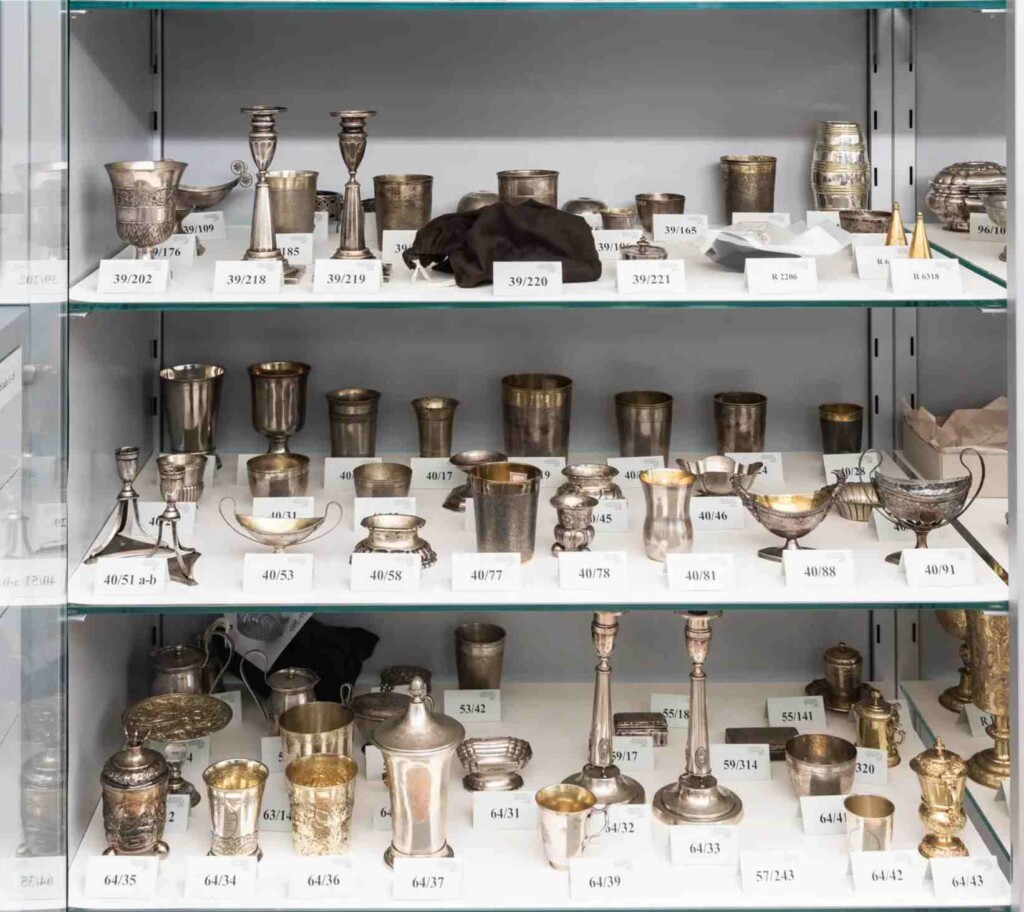
Museums in Stuttgart, Munich, Hamburg, and Berlin are all on the hunt for public records that can prove rightful ownership on behalf of the descendants of those whose possessions were confiscated, many of them now living in the US, Israel, and elsewhere.
“I started looking for heirs of looted silver following an exhibition titled ‘Silver for the Reich — Silver Objects from Jewish Property in the Bavarian National Museum,’ which consisted of many of the 112 stolen items stored in the museum,” Matthias Weniger, a curator and head of provenance research at the Bavarian National Museum in Munich, told the New York Times in an email.
Weniger has had some success—he managed to return a silver kiddush cup, used to honor the Sabbath in the Jewish tradition, that belonged to a Jew named William Bergman who survived the Holocaust and moved to the US where his son, Steven, was able to accept the cup on his behalf almost 80 years later.
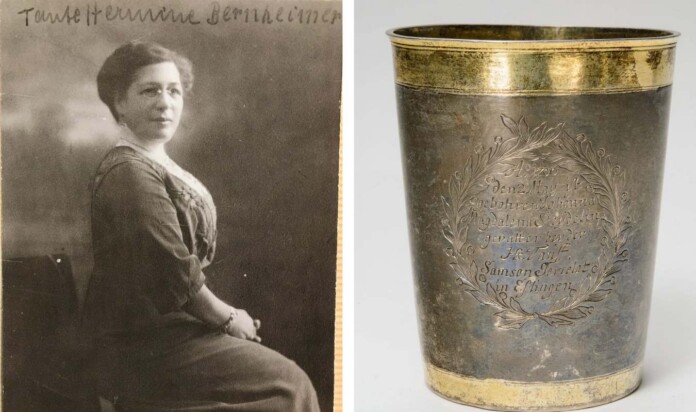
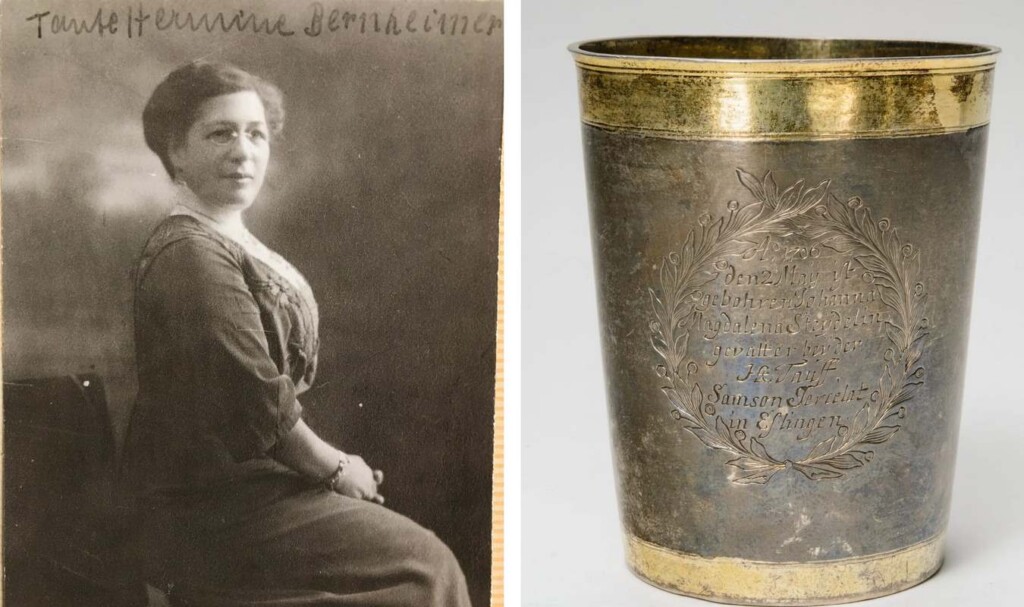
He also managed to, quite ironically, return a 300-year-old, gold and silver baptismal cup to the family of the Jew Hermine Bernheimer who perished in Theresienstadt concentration camp in 1939. Her great niece, Naomi Karp, donated the cup to the Jewish Museum in the town of Göppingen where Bernheimer was born.
Bastian Krack from the Bavarian National Museum
“The key to success in the search for heirs,” Weniger said, “is multiple databases and archives. Some cases take several years. Others take months, often many months. It took many months to find Steven Bergman.”
Irene Krauss, Weniger’s colleague and historian, uses multiple archival sources to look for the heirs of these silver objects, including ancestry.com, findagrave.com, and newspapers.com.
With findagrave, Krauss was able to locate a tombstone of Bergman’s which showed he had children, and then used newspapers.com to find an obituary.
Weniger’s Bavarian National Museum has 110 silver and gold objects confiscated during the Third Reich, a number which pales in comparison to the Berlin City Museum, which acquired 4,700 pieces of gold and silver tableware, jewelry, and other heirlooms from a pawnshop, of which only around 10% had any documentation at all showing who had previously owned them.
Many of the heirs, the Times reports, choose to donate the heirlooms to museums. In one case, 31 relatives had to sign off on such a donation. Others choose to lend them for various periods.
Famously, and quite possibly erroneously, Joseph Stalin was supposed to have described 1 death as a tragedy and 1 million as a statistic.
As statistical as the Holocaust can seem sometimes, it’s inspiring to know that the dead are remembered and honored, not only by their kin but by others as well, others like Weniger who feel inclined to delve into whatever is left accessible of their lives into order to right past wrongs, and maybe even help their souls to rest more easily.
SHARE These Museums Powerful Gestures Of Provenance On Social Media…