All News - Page 279 of 1715 - Good News Network
Home Blog Page 279

World’s Oldest Homo Sapiens Footprint Discovered–And it’s 153,000 Years Old

Nelson Mandela University / University of Leicester (SWNS)

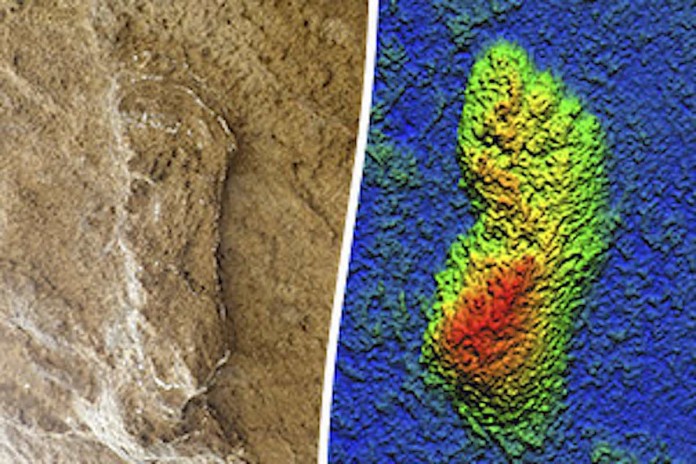
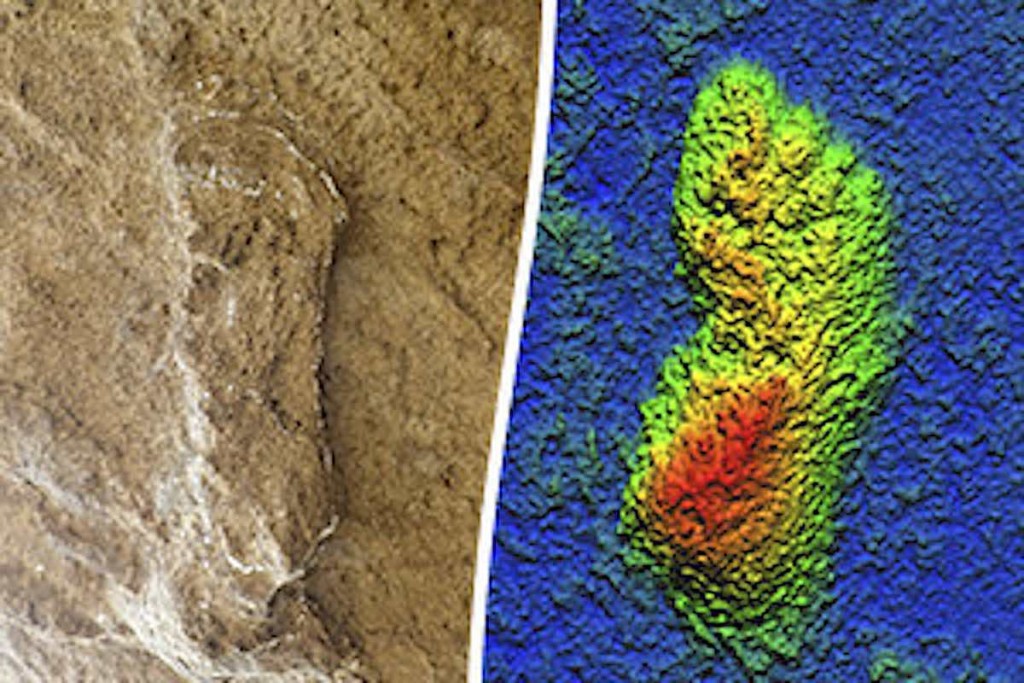
A 153,000-year-old footprint found in South Africa could be the world’s oldest ever made by our species.

Older footprints from the Homo genus have been found in Spain, but it’s not perfectly clear which species they belonged to as they pre-date the earliest evidence of neanderthals in Europe.

Scientists working in Africa identified the track made by Homo sapiens in the Garden Route National Park, west of the Cape Coast town of Knysna, and that it’s older than the two previously oldest tracks in Nahoon and Langebaan by 25,000 years.

“Just over two decades ago, as the new millennium began, it seemed that tracks left by our ancient human ancestors dating back more than about 50,000 years were excessively rare,” explained Charles Helm, Research Associate at Nelson Mandela University, and Andrew Carr, Senior Lecturer at University of Leicester, who together published a paper on their findings in the journal Ichnos.

“In 2023 the situation is very different. It appears that people were not looking hard enough or were not looking in the right places. Today the African tally for dated hominin ichnosites (a term that includes both tracks and other traces) older than 50,000 years stands at 14.

That count includes 4 from East Africa and 9 from South Africa. Another 10 ichnosites are spread across the world and can be found in places such as the UK and Arabian Peninsula.

“The footprints are ‘natural casts’, i.e. they are from the layer of sand that filled the footprints in,” says Dr. Helm.

“The South African hominin track sites are globally unusual in that this is a common mode of preservation. It means that, counterintuitively, we look on cave ceilings and rock overhangs for such footprints.”

Nelson Mandela University / University of Leicester (SWNS)

The South African sites on the Cape Coast, attributed to Homo sapiens, bear tracks that tend to be fully exposed when they’re discovered, in rocks known as aeolianites, which are the cemented versions of ancient dunes.

MORE ARCHAEOLOGY NEWS: Remains of Prehistoric BBQ Suggests Dinner was Served 780,000 Years Ago–600,000 Years Earlier than we Thought

Excavation is therefore not usually considered, and because of the sites’ exposure to the elements and the relatively coarse nature of dune sand, they aren’t usually as well preserved as East African sites.

“They are also vulnerable to erosion, so we often have to work fast to record and analyze them before they are destroyed by the ocean and the wind,” said Dr. Helm. “A key challenge when studying the palaeo-record—trackways, fossils, or any other kind of ancient sediment, is determining how old the materials are.”

In the case of the Cape Coast aeolianites, the dating method of choice is often optically stimulated luminescence.

MORE HUMAN HISTORY: Earliest Prehistoric Art Discovered –And it Turns Out to Be Hand Prints Made by Children 170,000 Years Ago

This method of dating shows how long ago a grain of sand was exposed to sunlight; in other words, how long that section of sediment has been buried.

“Given how the tracks in this study were formed—impressions made on wet sand, followed by burial with new blowing sand—it is a good method as we can be reasonably confident that the dating “clock” started at about the same time the trackway was created,” the researchers write.

SHARE This Human History With Your Friends.

The Incredible Moment 69-Year-Old Stops a Bank Robbery with Words and a Hug

Credit - Woodland Police Department - ABC
Credit – Woodland Police Department – ABC

When a struggling Californian attempted to alleviate his financial stress by robbing a bank, Michael Armus Sr. recognized it was out of sadness and not malice.

Stepping in with words, and eventually a hug, 69-year-old Michael diffused a situation potentially explosive situation, as the bank robber claimed he was carrying a bomb.

Everything seemed a normal day for Armus, who walked into the Bank of the West in Woodland, California when he noticed a former neighbor of his speaking to the teller with irritation and depression in his voice.

Unbeknownst to Armus, the neighbor, Eduardo Placensia, had passed a note to the teller claiming he was armed with explosives and demanded money to avoid detonation. However, the fact that Placensia’s shirt was pulled over his nose and mouth mixed with the teller’s frightened expression and quickly alerted Armus to the fact that all was not well.

“So, I just approached him, and I asked him, I said, ‘What’s wrong?… You don’t have a job?'” Armus told Good Morning America. “He said, ‘There’s nothing in this town for me. Nothing in this town for me. I just want to go to prison.'”

MORE DISPLAYS OF COMPASSION: Rags-to-Riches Story Sees Human Compassion and Social Media Turn Homeless Painter into LA’s Next Big Artist

“So, I took him outside, and I give the man a hug right here at the doors,” said Armus. “He started crying.”

The police arrived at that moment to take Placensia into custody for attempted robbery, later stating that he was in fact not armed at all.

WATCH the story below from GMA… 

SHARE This Man’s Bravery And Empathy With Your Friends On Social Media…

“Trust those who you have helped to help you in their turn.” – Neil Gaiman

Quote of the Day: “Trust those that you have helped to help you in their turn.” – Neil Gaiman 

Photo by: krakenimages

With a new inspirational quote every day, atop the perfect photo—collected and archived on our Quotes page—why not bookmark GNN.org for a daily uplift?

A New Poll Points to a Formula For the Perfect Vacation: ‘Unexpected’ and ‘Unforgettable’

By Kevin Delvecchio

What makes a vacation truly memorable? There may be a reliable formula, at least for younger people.

A poll of 2,000 travelers between 18 and 34 identified some of their favorite ingredients.

Traveling with a group of at least four people, enjoying a minimum of four new experiences, and doing something “unexpected” were among the most essential.

36% felt stepping out of your comfort zone was necessary for an unforgettable trip, wanting to push their boundaries at least four times during any given adventure.

32% believe making new friends is desirable, with a memorable vacation defined as meeting three new people.

At least three new dishes should also be tried.

Conducted by OnePoll and commissioned by Contiki, a social travel company, the survey recipients pointed to a successful vacation as including 45 photos and 15 videos to capture the “perfect moments” they want to remember.

Respondents have been on an average of seven memorable trips. Almost 30% of those who’ve traveled solo feel that those vacations created more memories than any other.

CHECK OUT: 42% Have Fallen Back in Love With a Partner After Going on Vacation Together

“Exploring a new destination and culture is opening yourself up to the unknown with the potential to create memories that can last a lifetime,” said Rachel Storey, Brand Director of Contiki.

The research also found that 34% feel they need to make every moment count when traveling due to increased work pressure. Nearly half (47%) feel so strongly about this that they would quit a job that didn’t allow them to take time off needed for a meaningful trip.

36% have a vacation bucket list that they want to tick off.

But 53% prefer a perfect moment to happen naturally or organically, rather than be something that is engineered—and 81% believe it’s the imperfect or unexpected moments that can make a vacation the most memorable.

KIDS? Out of Ideas For Entertaining the Kids? Here’s Some FREE Family Fun to Try While on Vacations

“When you reflect on trips from the past, it’s often the moments you couldn’t have imagined, that leave the deepest impact,” continued Rachel. “Whether it’s a moving encounter with a local, making a new friend, ordering an unusual item in a restaurant, or taking a leap of faith on a new activity – the ultimate souvenir is the memories you make along the way.”

TOP PERFECT MOMENTS TO EXPERIENCE ON VACATION

Watching a sunrise or sunset with friends or family
Some kind of joke or funny event that becomes a running joke
Something that becomes a story to tell for years to come
Doing something that takes you out of your comfort zone
Drinks or food with a view
Making a connection with a local or group of locals
Trying the local delicacy which is considered unusual at home
Taking a detour or getting lost and finding an empty beach or amazing view
Seeing a famous landmark
Swimming in the sea
Doing something adrenaline-spiking, such as bungee jumping or parachuting
Ticking something off your bucket list
Getting a full tour of a beautiful city
Seeing animals in their natural habitat
Finding the ideal souvenir or gifts
Getting a tour around a local town or village
Marriage proposed or witnessing a proposal
A romantic kiss
Climbing a mountain

Mom Became Pregnant While Already Pregnant, Conceiving Twins 28 Days Apart in Age

SWNS
Kennedy News and Media via SWNS license

An extra fertile mother was overjoyed when she discovered she was pregnant again—while already pregnant—after apparently conceiving her ‘twins’ 28 days apart.

Sophie Small conceived Holly and Darcy one month apart due to an incredibly rare phenomenon known as superfetation, where a new pregnancy occurs after the first one.

Sophie and her accountant husband Jonathan, who already have a 6-year-old son named Oscar, were trying for another baby.

Although the 30-year-old had an inkling that she was pregnant, the couple decided to keep trying just in case. The swimming instructor was thrilled when she took a pregnancy test and discovered it was positive. But, after extreme morning sickness landed her in the hospital 7 times, a seven-week scan showed she was pregnant with twins.

The two babies were different sizes and doctors were stumped as to why, until they realized she’d ovulated twice.

The couple only discovered the tots weren’t conceived at the same time after the birth in August 2020 when Darcy was born weighing 4lbs 2oz and her sister followed two minutes later weighing 6lbs 1oz.

“I was carrying two babies who were growing at different stages, but we didn’t know that,” explained Sophie, from Herefordshire, England.

Kennedy News and Media via SWNS license

“They couldn’t work out why I was so sick. I had a scan at seven weeks and they said they could tell something wasn’t right. They couldn’t work out why one twin was bigger than the other.

“They had their own sacs and placentas so they could feed when they wanted to.

LOOK: Four Sets Of Twins Stage Time-Travel Prank on NYC Subway (WATCH)

“When they were born there was a 35 percent growth difference between the two of them, which is massive and they [the staff] realized they’d been conceived four weeks apart.

“Darcy was a 32-week baby and Holly was a 36-week baby. I said it couldn’t be right, I’d never heard of it. I didn’t know how it happened.”

She says although the tots are twins, they couldn’t be more different: girly-girl Holly still weighs 6lbs more than tomboy Darcy.

The mum says she likes to confuse strangers in the street who stop to ask how many minutes are between the girls. Many don’t believe her when she says they’re twins.

CHECK OUT: UK’s Most Premature Twins Finally Go Home 5 Months After Being Given 0% Chance of Survival

“I say Darcy is two minutes older and four weeks younger, while Holly was born two minutes after but is four weeks older.

“They don’t even look like sisters, you wouldn’t even know,” said Sophie. “Holly has blonde hair, big beautiful blue eyes and wants to be a princess or a jockey.

“Darcy’s hair is a mousey brown hair, she’s a tomboy and wants to be a train driver.

WILD: Unaware She Was Pregnant, Lucky Lady is on Same Flight As NeoNatal Crew When She Gives Birth Prematurely

“They’ve started nursery (school) and they’re very confident. It was so difficult but they’re absolutely thriving.”

CHALLENGE the Doctors By Sharing This on Social Media…

Newborn Calf Leads Mother Cow to Greet Stranger Who Helped Them Reunite (WATCH)

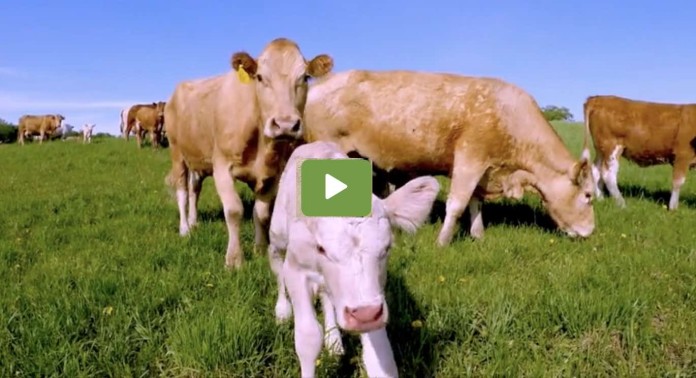
Flo is a devoted cow who’s nurtured several calves in her lifetime. But for this newborn, she gave birth too close to the fence dividing her pasture from the nearby highway.

The slope of the ground and the small space under the wires combined to form a unique spot that allowed a slippery newborn calf to slide under the wires.

The problem for Flo and her baby was that the fence was electrified to keep the cows from wandering onto the road, and to keep out predators like coyotes that would devour a baby calf.

Flo couldn’t reach the newborn, which was lying down silently in the grass.

A motorist who lived nearby came along soon after the calf was born. He often watched the cows as he drove past, but he was particularly interested in the herd at this time of year because calves were being born.

Dave stopped in the sunshine to watch the cows in the pond, but noticed that Flo looked distraught. Dave put his GoPro camera on the fence and started recording while he walked toward Flo. He knew very little about cows but he knew she was agitated.

He found the newborn and immediately knew he needed to take action, with the cars buzzing by presenting a real danger. The farmer’s house is at the top of the hill across the meadow and his truck was gone, so Dave tried to push the calf back under the fence.

LOOK: Doesn’t Matter to a Dolphin Mom As She Adopts a Whale Calf

Not knowing that some of the wires were live and some were not, he got himself a few shocks in the process.

Flo was encouraging Dave with a few “moos” as he worked—and soon she and her baby were reunited for the all-important first milk feeding, which contains colostrum for a healthy immune system.

Because the calf had received a few shocks himself, he was known as “Sparky” from that day forward.

Later that day, as Dave walked over to see how Sparky was doing, the baby peeled off from the herd to come give the man a sniff and a soulful look.

LOOK: Rescued Young Kangaroo is Convinced He’s a Dog, Loves Life on the Farm

It almost seemed like the newborn wanted to show its mom the stranger who delivered their emergency aid. Watch the scene unfold below…

KNOW Any Cow-Lovers? Share The Smiling Calf on Social Media…

Antibiotic That Destroys One of World’s Deadliest Superbugs Discovered by AI Supercomputer

Denise Catacutan, graduate student in the Department of Biochemistry & Biomedical Science at McMaster University and co-author of the paper.
By DeepMind

An antibiotic that could be used to treat one of the world’s most drug-resistant superbugs has been discovered by a supercomputer using AI.

Artificial intelligence is proving to be a great tool for combating antimicrobial resistance, which the World Health Organization named as one of the top ten global public health threats facing humanity.

In this case, Canadian and US scientists used ‘deep learning’ to identify an antibiotic molecule that can kill Acinetobacter baumannii, one of the most dangerous antibiotic-resistant bacteria. Notoriously difficult to eradicate, A. baumannii causes infections in vulnerable hospital patients—like premature babies and those with compromised immune systems.

The bug can survive on surfaces such as door handles, cupboards and beds for long periods, and can cause pneumonia, sepsis, and meningitis—all of which are potentially fatal.

The superbug’s ability to pick up DNA from other species of bacteria in its surroundings —including antibiotic-resistance genes—makes it uniquely invincible. But the AI algorithm predicted a compound that can beat it.

The researchers named the newly discovered compound abaucin, and proved its effectiveness in experiments on mice with infected wounds and bacterial cells grown in the lab.

Also Just Discovered: Neglected 80-year-old Antibiotic Reemerges as Highly-Effective Against Resistant Bacteria

The AI process used could also speed the discovery of treatments for other potentially fatal diseases—including MRSA—because it can access hundreds of millions, possibly billions, of molecules that have potential antibacterial properties.

Conventional molecule screening techniques are time-consuming, costly, and limited in scope.

Denise Catacutan, graduate student in the Department of Biochemistry & Biomedical Science at McMaster University and co-author of the paper.

“Using AI, we can rapidly explore vast regions of chemical space, significantly increasing the chances of discovering fundamentally new antibacterial molecules,” said lead author Dr. Jonathan Stokes, of McMaster University, in Ontario.

Co-author Professor James Collins, of Massachusetts Institute of Technology (MIT), agreed. “We know algorithmic models work. Now it is a matter of widely adopting these methods to discover new antibiotics more efficiently and less expensively.”

The study, published this week in the journal Nature Chemical Biology, describes abaucin as especially promising because it only targets A. baumannii—a crucial finding which means the pathogen is less likely to rapidly develop drug resistance.

CHECK OUT: A New AI that Predicts Lung Cancer Risk up to 6 Years in Advance, Like Finding a ‘Needle in a Haystack’

Most antibiotics are broad spectrum in nature, meaning they kill all bacteria, but they also disrupt the gut microbiome, which opens the door to a host of serious infections, including C difficile.

“We know broad-spectrum antibiotics are suboptimal and that pathogens have the ability to evolve and adjust to every trick we throw at them,” added Stokes. “AI methods afford us the opportunity to vastly increase the rate at which we discover new antibiotics, and we can do it at a reduced cost.”

WATCH the news report below from CTV…

SPREAD This Life-Saving News to the World on Social Media…

“The gift of patience opens when our body, heart, and mind slow enough to move in unison.” – Mark Nepo 

Quote of the Day: “The gift of patience opens when our body, heart, and mind slow enough to move in unison.” – Mark Nepo 

Photo by: Ayo Ogunseinde (cropped)

With a new inspirational quote every day, atop the perfect photo—collected and archived on our Quotes page—why not bookmark GNN.org for a daily uplift?

More Than 5,000 Ocean Species Entirely New to Science Discovered by English Expedition in Pacific

SWNS
SWNS

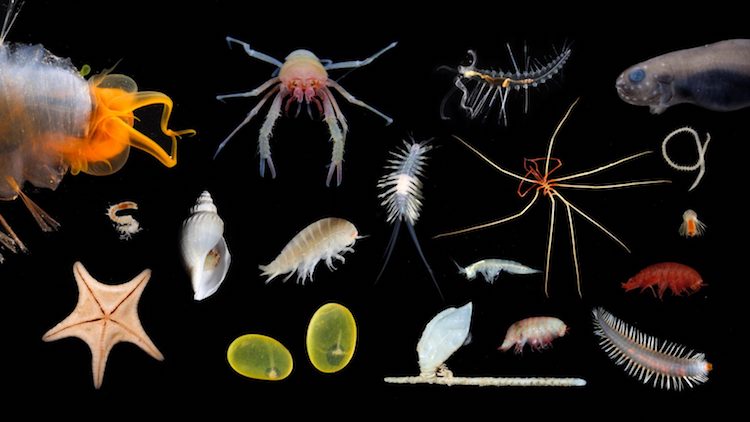
More than 5,000 new marine species have been discovered by an English expedition in the Pacific.

They include strange shellfish, carnivorous sponges, sea cucumbers, worms, and urchin-like spiny invertebrates.

The research published in the journal Current Biology supports the notion that we know more about space than we know about the deep ocean.

They were found in the Clarion-Clipperton Zone (CCZ)—a region covering nearly four million square miles between Mexico and Hawaii.

“There’s some just remarkable species down there,” said team member Muriel Rabone, a deep-sea ecologist at London’s Natural History Museum.

“Some of the sponges look like classic bath sponges, and some look like vases. They are just beautiful.

AMAZING: Kayaker Singing in Hopes of Attracting Beluga Whales Never Imagined They Were Actually Listening

“One of my favorites is the glass sponges. They have these little spines, and under the microscope, they look like tiny chandeliers or little sculptures.”

The CCZ is almost as big as Australia – and one of the most pristine wildernesses on Earth. It has been divided up for future deep-sea mining, so biologists are compiling the first ‘CCZ checklist’ to shed light on what might be at risk if companies start drilling.

It includes a total of 5,578 different species found in the region—up to 92 percent of which are entirely new to science.

They were collected during cruises by the Royal Research Ship, James Cook. Remote-controlled robots traversed the ocean floor, picking up samples and placing them in a simple box.

WATCH: Baby Octopus is Quick to Thank Human Rescuer Before it Swims Back to Sea

“In every single box core sample, we would see new species,” said Ms. Rabone, who co-ordinated the data.

Only six of the creatures described in over 100,000 records have been seen in other areas of the planet—suggesting the CCZ hosts a unique ecosystem.

New species from Cape Range Canyon and Cloates Canyon off Ningaloo (Credit: Greg Rouse / Scripps Oceanography), Nerida Wilson (Chief Scientist) and the FK200308 team.

Therefore, it is vital to learn more about the newly-discovered species, and how they are connected to the environment around them, they said. Additionally, they urge researchers to delve into the bio-geography of the region to better understand, for example, why certain species cluster in particular geological regions.

CHECK OUT: Goldie the Pufferfish Went to the Dentist for Work – Now Look at Her Smile

“There are so many wonderful species in the CCZ, and with the possibility of mining looming, it’s doubly important that we know more about these really understudied habitats.”

SHARE the Fish Tale With Science Lovers on Social Media…

‘Gift of Adoption’ Marks 5,000th Child Given a Home–Covering the Fees to Keep Siblings Together

Gift of Adoption
Gift of Adoption

An American nonprofit is celebrating a huge milestone after helping to unite three brothers at risk of separation—into a new forever family.

The Illinois-based Gift of Adoption Fund has facilitated the placement of 5,000 children since its founding 26 years ago—with over $15 million in grants awarded.

They provide grants of up to $15,000 to help families complete adoptions of kids in vulnerable circumstances—including, most recently, three brothers born in Ecuador.

“Gift of Adoption is elated to mark this milestone by helping to keep together three siblings at risk of separation,” said Gift of Adoption CEO Pam Devereux. “We’re incredibly grateful to our donors, volunteers and the families with a heart for adoption – we all reached this milestone together.”

Eleven-year-old Josue is the 5,000th child whose adoption was completed with assistance from the nonprofit. He was adopted along with biological brothers Darwin, 9, and Abraham, 6. The siblings were in an orphanage in Ecuador for five years—and at risk of separation—before Nicole and David gave them a new forever family in Wisconsin.

The couple had always sought to adopt older siblings, knowing how much it means to grow up together in the bonds of family—and the negative life outcomes that often await children who age-out of orphanages.

Gift of Adoption Fund

CHECK OUT: NICU Nurse Adopts 14-Year-Old Teen Patient with Triplets, to Keep Their Family Together

“Although international sibling adoptions can be complex and expensive, once we saw their faces, we knew we would make it work in any way we could,” Nicole said. “We are so happy that we can provide a permanent home for these brothers, and they can now grow up together in a stable environment.”

While a reported one-third of Americans have considered adoption, fewer than 4% complete the process- with many citing the high expense as a barrier. Gift of Adoption prioritizes grants for children facing what might be their only chance at adoption, such as those at risk of separation from siblings, entering foster care, aging out of a care system or with medical needs.

LOOK: ‘Mom, It’s Me!’ Woman Meets Son She Placed For Adoption 45 Years Ago And Confirms She Made Right Decision

The 5,000th child milestone also marks a full circle moment for the organization, originally founded by Gene and Lucy Wyka, also of Wisconsin. Since 1996, the Wykas have opened 27 chapters across the U.S. to ensure more children can find families.

Learn more about how you can help children in need—including how to donate, volunteer or apply for a grant—at www.giftofadoption.org.

And, Check Out ALL of GNN’S Wonderful Adoption Stories Here..

HELP Give Kids a New Loving Family by SHARING on Social Media…

9 People Who Had Won Millions in the Lottery Teamed Up to Restore Historic Lido to its Former Glory–LOOK

Ilkley Lido - SWNS
Ilkley Lido – SWNS

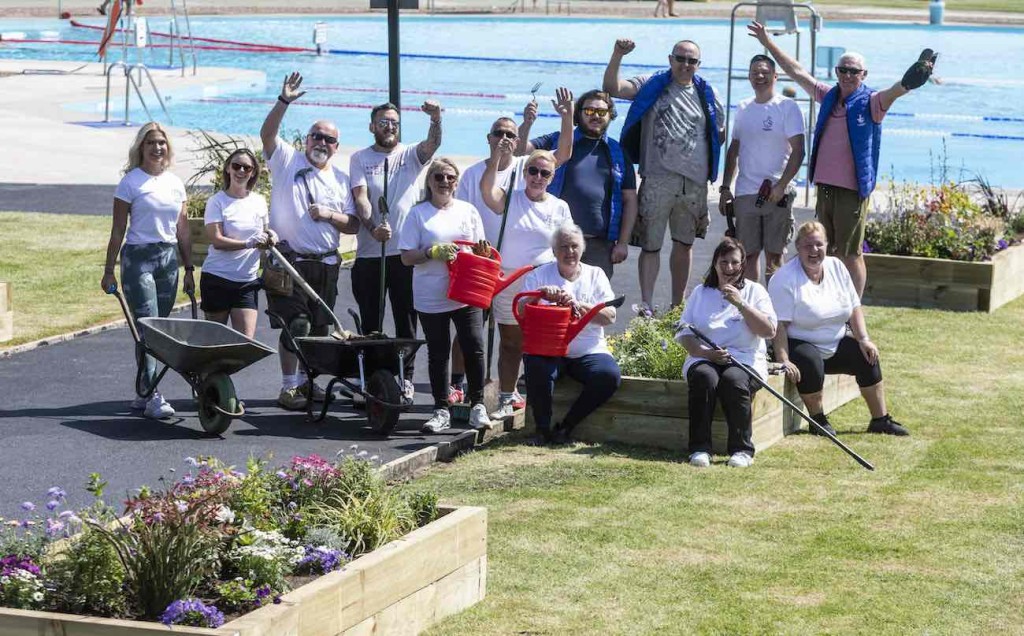
Nine different lottery victors with winnings that would total $20 million banded together and restored an historic lido to its former glory in West Yorks, England.

A lido is an open-air swimming pool open to the public—and Ilkley Lido is regarded as one of the best in the country, but the landscape has been left to turn almost ‘threadbare’ in recent years.

Now, thanks to the team of lottery winners, the grounds were transformed by new planter boxes full of eye-catching color and glorious flower blooms.

They spent the day building the boxes, then positioning them to line the driveway from the café to the mushroom-shaped pool, where thousands of bathers walk throughout the summer.

Inspired by a photograph of the Lido from the 1930s, they also installed hanging baskets to put on display around the café area to recreate the scene.

Duty officer Jodie King was amazed by the difference.

“I was taking a look at the pictures from the past. It looked amazing… and having that link to the past with a modern twist is breathtaking.”

Bathers at the Lido in the 1950s

“A lot of our older generation customers will have seen it when we had the flowers so it will be a great link to their childhood.

The Lido, which was built in 1935, is one of only 127 Lidos still remaining in England and can attract up to 4,000 visitors a day during the busy summer months.

Ilkley Lido (after) – SWNS

The unheated pool is 46 meters wide (150 feet) and boasts views of the famous Ilkley Moors.

POPULAR: Best Friends Win Million Dollar Lottery and Spread the Wealth in Hometown to Help Others

The lido, with the changing rooms and cafe on its grounds, is a grade II listed historic building, noted for its unusual timber-framed vernacular style.

Past Lottery winners celebrate finished planters in West Yorks, May 24, 2023 – SWNS

Sarah Ibbetson, from nearby Leeds, scooped up £3.1million in the National Lottery in 2002, and numbers as one of the regular visitors when her children were younger.

“This is such an amazing local facility,” said Sarah who pitched in with her husband. “We frequently brought our children here and have so many happy memories.

“It is wonderful to be back here, bringing color and creativity and restoring the Lido to how it would have looked in its heyday.”

67-year-old Elaine Thompson, from Newcastle, who won £2.7M on her wedding anniversary in 1995, said she had “a brilliant time” contributing to the community.

CHECK OUT: Irish Woman Who Won $145M Lottery Has Given Over Half: ‘I’m Addicted to Helping People’

“I’ve always said it’s not about the win, it’s about what you do with it and it’s great to give back. I’m 28 years into the win and, it’s been a great 28 years.”

Planter boxes installed – SWNS

“It will certainly be a very special and ‘colorful’ welcome this 2023 season.”

The Lido was designed by Archibald Skinner, the town’s surveyor and water engineer at the time, as part of the Silver Jubilee celebrations for King George V.

WATCH: Hummingbird Refuses to Leave the Dog Who Saved Her Life

Joining Sarah, Aldan and Elaine on the project were: Gary Henry, from County Durham, who won £4.4M in 2008; Susan and Michael Crossland, from Mirfield, who won £1.2M in 2008; Trish Emson and Graham Norton, from Rotherham, who won £1.7M in 2003; Elaine and Rob Leason, from East Riding of Yorkshire, who scooped a £1.4M share of a win in 2005; Alex Best, from Leeds, who won £1M in 2018; Margaret Storey, from Baildon, who won £1.4M in 1998; and Darren and Kate Donaghey, from Newcastle, who won £1M in 2018.

See some drone footage of their work day—no speakers needed…

DON’T FORGET TO SHARE This Shining Example of Generosity on Social Media…

Your Inspiring Weekly Horoscope From Rob Brezsny: A ‘Free Will Astrology’

Our partner Rob Brezsny provides his weekly wisdom to enlighten our thinking and motivate our mood. Rob’s Free Will Astrology, is a syndicated weekly column appearing in over a hundred publications. He is also the author of Pronoia Is the Antidote for Paranoia: How All of Creation Is Conspiring To Shower You with Blessings. (A free preview of the book is available here.)

Here is your weekly horoscope…

FREE WILL ASTROLOGY – Week of May 27, 2023
Copyright by Rob Brezsny, FreeWillAstrology.com

GEMINI (May 21-June 20):
Your meandering trek through the Unpromised Land wasn’t as demoralizing as you feared. The skirmish with the metaphorical dragon was a bit disruptive, but hey, you are still breathing and walking around—and even seem to have been energized by the weird thrill of the adventure. The only other possible downside was the new dent in your sweet dream. But I suspect that in the long run, that imperfection will inspire you to work even harder on behalf of your sweet dream—and this will be a blessing. Here’s another perk: The ordeal you endured effectively cleaned out stale old karma, freeing up space for a slew of fresh help and resources.

CANCER (June 21-July 22):
Testing time is ahead, but don’t get your nerves in an uproar with fantasy-spawned stress. For the most part, your challenges and trials will be interesting, not unsettling. There will be few if any trick questions. There will be straightforward prods to stretch your capacities and expand your understanding. Bonus! I bet you’ll get the brilliant impulse to shed the ball and chain you’ve been absent-mindedly carrying around with you.

LEO (July 23-Aug. 22):
Biologist Edward O. Wilson said that the most social animals are ants, termites, and honeybees. He used the following criteria to define that description: “altruism, instincts devoted to social life, and the tightness of the bonds that turn colonies into virtual superorganisms.” I’m going to advocate that you regard ants, termites, and honeybees as teachers and role models for you. The coming weeks will be a great time to boost your skill at socializing and networking. You will be wise to ruminate about how you could improve your life by enhancing your ability to cooperate with others. And remember to boost your altruism!

VIRGO (Aug. 23-Sept. 22):
Jack Sarfatti is an authentic but maverick physicist born under the sign of Virgo. He suggests that if we make ourselves receptive and alert, we may get help from our future selves. They are trying to communicate good ideas to us back through time. Alas, most of us don’t believe such a thing is feasible, so we aren’t attuned to the potential help. I will encourage you to transcend any natural skepticism you might have about Sarfatti’s theory. As a fun experiment, imagine that the Future You has an important transmission for you—maybe several transmissions. For best results, formulate three specific questions to pose to the Future You.

LIBRA (Sept. 23-Oct. 22):
I have five points for your consideration. 1. You are alive in your mysterious, endlessly interesting life, and you are imbued with the fantastically potent power of awareness. How could you not feel thrilled? 2. You’re on a planet that’s always surprising, and you’re in an era when so many things are changing that you can’t help being fascinated. How could you not feel thrilled? 3. You have some intriguing project to look forward to, or some challenging but engaging work you’re doing, or some mind-bending riddle you’re trying to solve. How could you not feel thrilled? 4. You’re playing the most enigmatic game in the universe, also known as your destiny on Earth, and you love ruminating on questions about what it all means. How could you not feel thrilled? 5. You never know what’s going to happen next. You’re like a hero in an epic movie that is endlessly entertaining. How could you not feel thrilled?

SCORPIO (Oct. 23-Nov. 21):
“Trust those that you have helped to help you in their turn,” advises Scorpio author Neil Gaiman. Let’s make that one of your mantras for the coming weeks. In my astrological understanding, you are due to cash in on favors you have bestowed on others. The generosity you have expressed should be streaming back your way in abundance. Be bold about welcoming the bounty. In fact, I hope you will nudge and prompt people, if necessary, to reward you for your past support and blessings.

SAGITTARIUS (Nov. 22-Dec. 21):
So many of us are starved to be listened to with full attention. So many of us yearn to be seen and heard and felt by people who are skilled at receptive empathy. How many of us? I’d say the figure is about 99.9 percent. That’s the bad news, Sagittarius. The good news is that in the coming weeks, you will have an exceptional ability to win the attention of good listeners. To boost the potential healing effects of this opportunity, here’s what I recommend: Refine and deepen your own listening skills. Express them with panache.

CAPRICORN (Dec. 22-Jan. 19):
Because you’re a Capricorn, earthiness is probably one of your strengths. It’s your birthright to be practical and sensible and well-grounded. Now and then, however, your earthiness devolves into muddiness. You get too sober and earnest. You’re bogged down in excess pragmatism. I suspect you may be susceptible to such a state these days. What to do? It may help if you add elements of air and fire to your constitution, just to balance things out. Give yourself a secret nickname with a fiery feel, like Blaze, or a crispy briskness, like Breezy. What else could you do to rouse fresh, glowing vigor, Breezy Blaze—even a touch of wildness?

AQUARIUS (Jan. 20-Feb. 18):
I love to use metaphors in my writing, but I hate to mix unrelated metaphors. I thrive on referring to poetry, sometimes even surrealistic poetry, but I try to avoid sounding like a lunatic. However, at this juncture in your hero’s journey, Aquarius, I frankly feel that the most effective way to communicate with you is to offer you mixed metaphors and surrealist poetry that border on sounding lunatic. Why? Because you seem primed to wander around on the edges of reality. I’m guessing you’ll respond best to a message that’s aligned with your unruly mood. So here goes: Get ready to surf the spiritual undertow all the way to the teeming wilderness on the other side of the cracked mirror. Ignore the provocative wasteland on your left and the intriguing chaos on your right. Stay focused on the stars in your eyes and devote yourself to wild joy.

PISCES (Feb. 19-March 20):
“The gift of patience opens when our body, heart, and mind slow enough to move in unison.” So says Piscean poet Mark Nepo. I feel confident you are about to glide into such a grand harmony, dear Pisces. Through a blend of grace and your relaxed efforts to be true to your deepest desires, your body, heart, and mind will synchronize and synergize. Patience will be just one of the gifts you will receive. Others include: a clear vision of your most beautiful future; a lucid understanding of what will be most meaningful to you in the next three years; and a profound sense of feeling at home in the world wherever you go.

ARIES (March 21-April 19):
My reading of the astrological omens inspires me to make a series of paradoxical predictions for you. Here are five scenarios I foresee as being quite possible in the coming weeks. 1. An epic journey to a sanctuary close to home. 2. A boundary that doesn’t keep people apart but brings them closer. 3. A rambunctious intervention that calms you down and helps you feel more at peace. 4. A complex process that leads to simple clarity. 5. A visit to the past that empowers you to redesign the future.

TAURUS (April 20-May 20):
Do you want a seed to fulfill its destiny? You must bury it in the ground. There, if it’s able to draw on water and the proper nutrients, it will break open and sprout. Its life as a seed will be over. The plant it eventually grows into will look nothing like its source. We take this process for granted, but it’s always a miracle. Now let’s invoke this story as a metaphor for what you are hopefully on the verge of, Taurus. I invite you to do all that’s helpful and necessary to ensure your seed germinates!

WANT MORE? Listen to Rob’s EXPANDED AUDIO HOROSCOPES, 4-5 minute meditations on the current state of your destiny — or subscribe to his unique daily text message service at: RealAstrology.com

(Zodiac images by Numerologysign.com, CC license)

SHARE The Wisdom With Friends Who Are Stars in Your Life on Social Media…

“There is no influence like the influence of habit.” – Gilbert Parker

Quote of the Day: “There is no influence like the influence of habit.” – Gilbert Parker

Photo by: andrew dinh

With a new inspirational quote every day, atop the perfect photo—collected and archived on our Quotes page—why not bookmark GNN.org for a daily uplift?

Creating Electricity From Moisture in the Air, Even in the Sahara Desert

The current Air-gen device can power small devices. Photo by UMass Amherst/Yao and Lovley labs.
The old Air-gen device could power small devices. Photo by UMass Amherst/Yao and Lovley labs.

A totally science-fiction device developed by scientists in Massachusetts would allow people to pull electricity out of thin air.

Back in 2020, GNN reported on an exciting experimental technology called Air-gen.

It used a protein nanowire film derived from the bacteria species Geobacter sandwiched between two electrodes that could generate electricity via the humidity absorbed within the fine pores of the film.

Now, the team from Univ. of Massachusetts Amhurst has made another breakthrough in this Air-gen technology.

“What we realized after making the Geobacter discovery is the ability to generate electricity from the air—what we then called the ‘Air-gen effect’—turns out to be generic,” explains Amhurst Professor Jun Yao.

“Literally any kind of material can harvest electricity from the air—as long as it has a certain property. It just needs to have holes smaller than 100 nm (nanometers)—or less than a thousandth of the width of a human hair.”

Graphic image of a thin film of protein nanowires generating electricity from atmospheric humidity. Photo by UMass Amherst.

These Air-gen devices could generate kilowatts of electricity that would be non-polluting, renewable, and low-cost. They could generate power even in areas with extremely low humidity such as the Sahara Desert, and have significant advantages over other forms of renewable energy including solar and wind, because unlike these, the Air-gen does not require sunlight or wind, and “it even works indoors.”

For readers curious as to how such a small setup generates power, it relies on the ‘mean free path,’ or the distance a single molecule of water travels in the air before it bumps into another.

Whatever material a manufacturer or engineer might use, provided it’s as small as Dr. Yao explains above, it should allow water molecules to pass from the upper to the lower part of the material.

MORE SCIENCE NEWS: Newly Discovered Enzyme Turns Air Into Electricity, Promising a New Clean Source of Energy

Each pore is so small the molecules would easily bump into the edge as they pass through, meaning the upper part would be bombarded with many more charge-carrying water molecules than the lower one.

It creates a charge imbalance, like that in a cloud, as the upper part increased its charge relative to the lower part. This would effectually create a battery that runs as long as there is any humidity in the air.

“You could imagine harvesters made of one kind of material for rainforest environments and another for more arid regions.”

MORE SCI-TECH: Swedish Firm to Unlock the Electricity of the Sea With Largest Wave Power Station in the World

Since humidity is ever-present the harvester would run 24/7, rain or shine, at night, and whether or not the wind blows. Because of its thinness, thousands can be stacked on top of each other so that it can efficiently be scaled up, increasing the amount of energy without increasing the footprint of the device.

Such an Air-gen device would be capable of delivering kilowatt-level power for general electrical utility usage anywhere on Earth.

SHARE This Breakthrough On A Breakthrough With Your Friends… 

Ring Lost Down Toilet 13 Years Ago is Discovered at Wastewater Treatment Facility 1,000 Feet From Her Home

A woman in Minnesota has been reunited with an anniversary ring she accidentally flushed down the toilet 13 years ago.

It was found in a sewage treatment plant just 1,000 feet from the woman’s home, in time to wear it for her 46th wedding anniversary.

Mary Strand received the ring from her husband Dave as an anniversary present after 33 years of wedlock, but while using the downstairs bathroom, the wet, perhaps soapy, perhaps incorrectly-sized ring, slipped off and spiraled down the porcelain throne into oblivion.

As it turned out, Dave ran a drain and sewage company and quickly used a camera to scour 200 feet of drain pipe to see if he could spot the ring. Alas, it seemed to have journeyed into the great brown beyond.

“I was thinking, ‘He’ll never buy me another ring,’ that’s what I was thinking,” Mary said with a huge laugh in front of reporters on Wednesday. “I felt really bad, because it was a gift.”

13 years later, John Tierney, a mechanical maintenance manager for the city of Roger’s Metropolitan Council’s nine wastewater treatment plants, was shoveling debris from one of the equipment with a few coworkers when they saw something sparkling.

After they put out the call on their Twitter account above, literally hundreds of people who had lost wedding rings called in, but because of the distinctive form, it was easy to determine whom it didn’t belong to.

MORE LOST AND FOUND: Widow Finds Late Husband’s Wedding Ring Under Apple Tree – 35 Years After He Lost It

One photo sent in looked a perfect match, and after professional examination they determined it was indeed Strand who could claim the ring.

“By the way, the water treatment plant in Rogers where Mary’s ring was found is located on Diamond Lake Road,” wrote KARE 11 news. “Coincidence? We think not.”

WATCH the story below from KARE 11… 

SHARE This Needle In A Haystack Story With Your Friends… 

New Indoor Farm in Downtown Compton Grows 4.5 Million Pounds of Affordable Greens in One Year

Towers of veggies in one of the grow rooms at Plenty's Compton farm - credit Plenty
Towers of veggies in one of the grow rooms at Plenty’s Compton farm – credit Plenty

Capable of growing 4.5 million pounds of leafy green vegetables per year, a new indoor vertical farm is getting its ribbon cut in the city of Compton.

Built and managed by the firm Plenty, one of the US’ leading indoor farming companies, it aims to be a nourishing flood for food deserts.

Indoor farms use ultraviolet light arrays to mimic the sun, and hydroponic growing apparatus stacked on vertical towers. Hydroponics use liquid fertilizer and mist to grow crops without soil. The number of fruits and vegetables capable of being grown this way is limited, but can be done in the middle of a city, and with other advantages such as an absence of pests.

“Plenty is an indoor growing company so we grow plants inside without the sun in controlled environments,” said Plenty CEO Arama Kukutai. “We are producing leafy greens and we also produce tomatoes, in the future, we’ll be producing strawberries and other fruit and produce.”

Plenty also say their Compton location is the West Coast’s only commercial-scale vertical farm, and one of the most advanced in the world.

MORE HYDROPONIC STORIES: Indian Man Grows Precious Saffron In a Shipping Container–Wants to Share His Hydroponic Technique With Others

To wit, robots do a lot of the work inside, carting around trays of lettuce, kale, and spinach, and moving the towers around the facility. Other than the robots, many of the other employees come from Compton itself.

SIMILAR FARMING NEWS: Canadian Family Turns Old School into Hydroponic Farm Growing Fresh Veggies Even in Winter For the Whole Town

“They were very committed to making sure that the people that they hired actually came from the city, came from this community, and this is what they’ve done,” said Compton Mayor Emma Sharif. “They’ve kept the community and to the city and 30% of the people that are hired comes from the community.”

The products grown there are available now in Compton’s stores like Whole Foods Market, Walmart, and Bristol Farms.

WATCH the story here from ABC 7 Compton… 

SHARE This Nourishing News With Your California Comrades… 

Detroit Students Build a House–Then Deliver it By Truck For Low Income Housing

WXYZ Detroit 7 - Fair use
WXYZ Detroit 7 – Fair use

It was a surreal sight for Pedro Rivera, a whole house was on the back of a trailer driving down a Detroit suburban road; a house that he and his friends had built with their own hands.

“All my friends, we all looked at each other like, ‘Wow, this is what we did,'” Rivera, a student at Oakland Schools Technical Campus-Northeast, told 7 Action News.

At the technical campus, students study to become specialists in carpentry, additions, or electrical work, but school instructor Aaron Swett who led the project to build a 1,368-square-foot home from the ground up, explained that it would help introduce the students to the whole gamut of construction trades.

The program, which includes working alongside professional tradesmen, prepares the students for their own careers in construction and carpentry, many of which are sorely needed in the US.

But it does something else as well, it provides a slow but steady supply of low and middle-income housing units for Michigan, a state that lacks them.

MORE DETROIT NEWS: City of Detroit Surprises Single-Mom Crossing Guard With $50k at a Tiger’s Game Following Viral Tiktok Post

The home cost $100,000 in materials, and will go on the market for around $170,000, about half the nationwide median listing price.

“Just seeing it getting lifted and everything, it was kind of like ‘Wow, this is our accomplishment,'” Rivera said of the home build. “It’s going to a good family. Good home, good neighborhood — it’s nice.”

WATCH the story below from WXYZ Detroit Action 7…

SHARE The Endeavor Of These Great Kids With Your Friends… 

“Rough diamonds may sometimes be mistaken for worthless pebbles.” – Thomas Browne

Quote of the Day: “Rough diamonds may sometimes be mistaken for worthless pebbles.” – Thomas Browne

Photo by: Jarren Simmons

With a new inspirational quote every day, atop the perfect photo—collected and archived on our Quotes page—why not bookmark GNN.org for a daily uplift?

Dutchman Starts Overnight Sleeper-Train Operation Throughout Europe: A Hostel on Rails

credit - European Sleeper
credit – European Sleeper

Tonight, Europe will experience a little resurrection—the first privately-run overnight sleeper train service will take passengers and their dreams aboard a Brussels to Berlin line.

Born from a former-train guard’s longing for a historic form of rail travel and a growing demand for low-carbon transport, European Sleeper used crowdfunding and friendly competition to revive this 19th-century form of locomotion.

The idea, according to European Sleeper’s founder Elmer van Buuren, is that people are realizing a combo of budget airline plus hotel stay involves a lot of extra planning, early mornings, and carbon emissions.

Alternatively, high-speed rail is expensive and booked weeks in advance.

By comparison, European Sleeper allows one to avoid the necessary booking of accommodations, while delivering passengers right into a historic city center in time for morning business meetings or a day of exploring, rather than 50 kilometers outside in an airport.

“Until a couple of years ago, everyone thought sleeper trains were a thing of the past and something for hopeless romantics with their heads in the 19th century. That is just not the case,” van Buuren told the Financial Times.

Van Buuren has faced a significant number of challenges in launching European Sleeper. Private rail companies are few and far between, and the stock of specialty sleeping carriages is either refurbished from the mid-20th century with a lack of modern amenities, or are being ordered too small in number for manufacturers to put any effort into them.

Furthermore, the coordination required between the EU member states to connect railway timetables is extremely difficult in the best of times, and has proven even harder still because the night trains would need a place to park during the day, and placements in arrival cities during the busiest hours.

Fortunately, the demand for sleeper trains won’t go away, and national railway companies are beginning to address the consumer demand to place orders of sleeper carriages.

Van Buuren turned to crowdfunding, raising €500,000 from 140 small investors in the first serious attempt. One of the large issues with finding the funding is that train operators need to apply every year for track capacity.

MORE RAILWAY INNOVATION: World’s First 100% Hydrogen-Powered Trains Now Running Regional Service in Germany to Replace Diesel

“And that means that you cannot really prove that you can produce your product for the next 10 years,” explains Elmer, this time to Euro News. “If we had a framework agreement across the borders that would guarantee… we will get the capacity for the next 10 years, that would highly de-risk the investment and get financiers on board.”

This, says van Buuren, will require the EU member state regulators and infrastructure managers to work out better plans than those they have now.

But despite these and other challenges, European Sleeper is launching its inaugural service tonight (Thursday, May 25th,) from Brussels to Berlin, on a three-way line that will connect these two cities plus Amsterdam. The company managed to amass another €2,000,000 in seed capital, which garnered them recognition from the European Commission as one of 10 pilot projects that aim to improve train travel and slash emissions.

What can travelers expect?

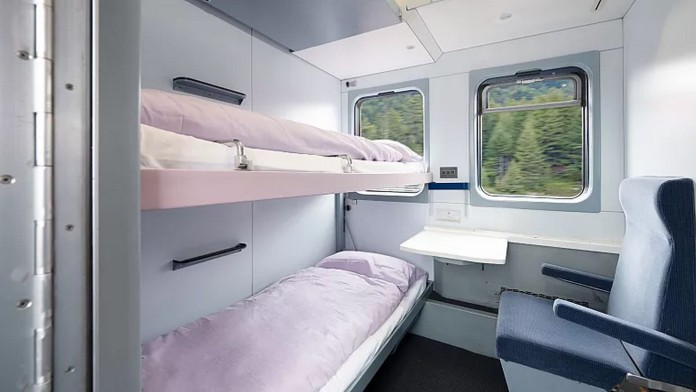
Aboard a European Sleeper train, three classes exist. The sleeping cars for a single business traveler are comfortable and run at €128 which includes breakfast. Small groups and families can book couchettes (from €89 per person, including breakfast) that seat either 4 or 6 people.

In the near future, the company wants to add dining cars so that the third class (recline seating) has refreshment options as well.

The expensive tickets take into account that the passenger is avoiding the need to book a hotel or a long taxi ride from the airport.

Starting next year, the three-way line which runs Monday, Wednesday, and Friday nights with returns on Tuesday, Thursday, and Sunday, will extend through Dresden down to Prague in the Czech Republic.

MORE LOW EMISSIONS TRAVEL: Boat-Plane Hybrid That Needs No Runway Could Transform Travel from LA to San Diego, Boston to NYC

In 2025, they will hopefully have lines that take passengers from Amsterdam, Brussels, and the UK, down through Lille, Provence, and Barcelona.

Several low-emissions travel options are debuting across Europe in the next few years. Along with European Sleeper, rigid airships will return to the continent’s skies for the first time in a century when Hybrid Air Vehicles (HAV) launch their services from Oslo to Stockholm or Liverpool to Belfast, with emissions even lower than those of rail travel.

Passengers will enjoy silent air travel with floor-to-ceiling windows and substantially more space and freedom of movement than aircraft.

SHARE This Exciting Return To The Train’s Past With Your Friends… 

Butterfly Populations Grew by 200% Higher in People’s Gardens than in Other Habitats

A small tortoiseshell (Algais urticae) SWNS.

Britain’s butterflies are bouncing back thanks in largest part to Britons’ gardens providing a safe haven, a new report reveals.

The study was the first to look at butterfly trends in UK gardens separately from those in the wider countryside and found that half of the 22 species of butterflies surveyed experienced a faster population increase in gardens than in other habitats between 2007 and 2020.

The study was conducted by the British Trust for Ornithology (BTO) and was carried out by nearly 8,000 volunteers in the BTO Garden BirdWatch scheme, which records other garden wildlife in addition to birds on a weekly basis.

They found numbers of marbled white and large skipper butterflies both grew by more than 200%, while those of the holly blue, small skipper, ringlet, brimstone, and orange-tip grew by 100%.

Although usually found in grasslands, marbled whites, large skippers, and small skippers have recently expanded their range in the UK.

Their increases are markedly greater in gardens but isn’t clear why these and other species are doing so well there. One theory is that gardens are providing refuge and feeding opportunities.

A report last year from Butterfly Conservation said that since the 1970s 80% of UK species had experienced declines, so the new study is more than welcome.

“It is extremely encouraging to see that gardens are contributing to the population growth of some of the UK’s widespread butterfly species,” said Dr. Kate Plummer, BTO Senior Research Ecologist and lead author on the paper.

“We are increasingly finding that gardens are crucial for biodiversity conservation, and these new findings certainly support that.”

Though not as efficient as bees, butterflies are important pollinators in both gardens and the countryside, and any plant that butterflies regularly visit has probably co-evolved its own reproductive strategies in sync with the insect; meaning if the butterfly declines, so will the plants they feed on.

“Ongoing monitoring, with the help of citizen scientists, will help us to better understand how to maximize the positive environmental impacts of our gardening activities,” said Dr. Plummer.

There was also an increase in butterfly populations across the wider countryside but on average the increases seen in gardens were bigger.

Although it reflects an already-established trend reported by the UK Butterfly Monitoring Scheme, the BTO says their results show the importance of gardens to the species’ recovery.

MORE INSECT NEWS: While in Lockdown Citizen Scientists are Going Outside Observing Insects, Helping Boost Their Recovery

As private gardens are difficult to access, they say their citizen-science approach opens a window for a clearer picture and understanding of the human impact on butterflies.

Importantly, the study’s findings highlight that individual garden owners have a role to play in protecting and enhancing UK butterfly populations through their gardening choices.

Thanks to the recording efforts of our dedicated Garden BirdWatch participants, we are understanding more and more about the importance of garden habitats for all sorts of wildlife,” said Dr. Michelle Reeve, BTO Garden BirdWatch Manager.

“The fates of bird populations are inextricably linked to that of other species, including butterflies, so learning how they are faring is crucial.”

MORE BUTTERFLY STORIES: A New Butterfly Has Been Named After The ‘Lord of the Rings’ Villain

To maximize one’s garden for butterflies, the BTO says they tend to visit perennial plants and location is important.

Butterflies much prefer to feed in sunny, sheltered parts of the garden, with scented blooms presented in large and visible displays.

SHARE This Great News And Great Gardening Tips With Your Friends…