












All News - Page 425 of 1715 - Good News Network
Home Blog Page 425

A Lost Sunken City of Gold and Jewels Found in the Mud of Indonesian River

WreckWatch Magazine

Nighttime divers on the Musi River in Indonesia are beginning to fish out fistfuls of gold, gems, and other treasures from the mud—and it might be the site of a fabled kingdom known in the 8th century as the ‘Island of Gold’.

WreckWatch Magazine

Dr. Sean Kingsley, a British maritime archaeologist, suspects the finds, such as a ruby-studded life-size golden Buddha worth millions, represent the gradual-rediscovery of a lost merchant palace city from the kingdom of Svirijaya, which ruled the trade routes in large parts of Indonesia for 400 years.

Situated around the town of Palembang, sometimes called “Venice of the East,” the palace city would have sat on a major artery of the maritime version of the Silk Road, and like its terrestrial counterparts in the cities of Qashqar, or Tashkent, would have bustled in its heyday with people of every faith and skin color.

Earlier diving expeditions conducted by Australian archaeologists have recovered pristine collections of ceramics preserved in the mud of the river, representing a staggering number of cultures—including every major Medieval power in Asia, and even the Dutch, British and Portuguese.

But now the treasures coming from the Musi River have a more legendary quality: Dr. Kingsley picks up the narrative when he spoke with Dalya Alberge at The Guardian about his upcoming presentation on the lost city in Wreckwatch Magazine.

“From the shallows have surfaced glittering gold and jewels befitting this richest of kingdoms – everything from tools of trade and weapons of war to relics of religion. From the lost temples and places of worship have appeared bronze and gold Buddhist figurines, bronze temple door-knockers bearing the demonic face of Kala, in Hindu legend the mythical head of Rahu who churned the oceans to make an elixir of immortality. Bronze monks’ bells and gold ceremonial rings are studded with rubies and adorned with four-pronged golden vajra scepters, the Hindu symbol for the thunderbolt, the deity’s weapon of choice.”

RELATED: See All the Treasure Hunting Good News in the Last Decades in the GNN Archive

“Exquisite gold sword handles would have graced the sides of royal courtesans, while bronze mirrors and hundreds of gold rings, many stamped with enigmatic letters, figures and symbols, earrings and gold necklace beads resurrect the splendor of a merchant aristocracy going about its daily dealings, stamping shipping manifests, in the palace complex.”

POPULAR: Family Finds 15th Century Gold Coins While Pulling Weeds in the Garden–6,000 People Have Dug Up Treasures During Lockdown

The image is of a city on wooden silts yet covered in golden decorations, floating on the river like a solid gold water lily. All around would have been hundreds of boats piled with luxury goods of every description, piloted by traders as from as far west as Turkey, and as far north as Korea. It would have been as stunning a sight to see as the great tent cities of the Mongol Empire.

Its disappearance isn’t detailed in any histories, or known by archaeology. The prevalence of volcanic activity in Indonesia could offer a Pompeii-like explanation, while it’s also possible that riverine activity could have swallowed the city up during a flood or mud slide.

LOOK: First Time a 10-Year-old Boy Uses His Birthday Metal Detector, He Unearths a Centuries-Old Sword

Kingsley hopes an official, wide-scale excavation will begin immediately.

SEND This Treasure to All Your Gold Seeking Friends on Social Media…

“Your own self-realization is the greatest service you can render the world.” – Ramana Maharshi

Quote of the Day: “Your own self-realization is the greatest service you can render the world.” – Ramana Maharshi

Photo: by Pen Tsai

With a new inspirational quote every day, atop the perfect photo—collected and archived on our Quotes page—why not bookmark GNN.org for a daily uplift?

Police Melt Over This 4-Year-old Boy’s Emergency Call Inviting Them to Come See His Toys (LISTEN)

NZ Police

A 4-year-old boy in New Zealand recently dialed the national emergency services number by accident. When the police answered his call? He invited them to see his favorite toys. Naturally, they took him up on his offer.

Southern District Police posted audio from the call on their Facebook page, stating, “While we don’t encourage children to call 111 to show us their toys, this was too cute not to share.”

“Hi,” the boy says on the phone to the police operator.

“Police lady,” he says, “Can I tell you something?”

After some back and forth, the little one says, “I’ve got some toys for you… Come over and see them!”

Given the picture at the bottom of the post, showing the boy hanging out on the bonnet of a police car—hands waving happily in the air—we’d say the spontaneous show-and-tell went more than well.

NZ Police

“Constable Kurt from Southern District Police responded by arriving at the child’s house and was,” the police said, “shown an array of toys.”

MORE: Indiana Boys Hop Off Their Bikes to Stand at Attention For Military Funeral Happening on Their Route

“He also had a good educational chat with the child and his parents about only using 111 for emergencies.”

Sounds like a worthy lesson to us.

(LISTEN to the adorable audio to get the full story below.)

SHARE This Sweet Kiwi Story With All Your Mates…

750,000-Panel Solar Farm Will Power Colorado Steel Mill, First of its Kind

Jatinsanghvi, CC license

The solar energy arm of petro-giant BP has brought together $285 million in private equity to fund a gargantuan solar energy project in Colorado that will power the world’s first carbon-neutral steel mill.

The Bighorn solar project array will feature three-quarters of a million panels generating 300 megawatts, negating 433,000 metric tons of carbon dioxide emissions per year—the equivalent of removing 92,100 fuel-burning cars from the road.

The 1,800 acre project in Pueblo will be the largest single-customer solar energy plant in the world.

Steel is vital to the world economy. It is also the third-largest contributor on the global greenhouse gas budget, and producing steel domestically removes the carbon-emissions of transit over the ocean from big steel producers or iron miners like China or South Africa.

“This project proves that even hard-to-abate sectors like steel can be decarbonized when companies come together with innovative solutions,” said Kevin Smith, CEO of Lightsource BP, Americas—the firm which will build and own the array. “It’s a great example of partners tackling complex issues that U.S. industry is facing today while, at the same time, preserving jobs in the manufacturing sector.”

RELATED: World’s Biggest Factory to Suck Carbon from the Sky and Store it For Millions of Years Turns on in Iceland

This is not the first movement towards decarbonizing the steel industry: a Swedish venture firm is already trying to create a scaled economy for “green steel” which they produce without adding brown coal.

“Bighorn Solar shows us what the future of American energy can look like. Renewable energy can create a more sustainable, competitive business,” said Dave Lawler, chairman and president of BP Americas. “Projects like this can make companies more resilient and protect jobs through the energy transition.”

MORE: Making Clean Hydrogen Energy Is Hard, But Researchers Just Solved a Major Hurdle

Many of the world’s largest oil producers, including Eni Spa, BP, and Shell are now turning collective billions of investment capital into renewable energy projects to aid in energy transition, achieve carbon neutrality, and help meet government mandates on emissions reductions.

POWER UP Hope—Share This Energy Story in Your News Feeds…

Istanbul Improves the Lives of Thousands of Stray Cats with Elaborate Outdoor Cat Houses

By bluXgraphics (motorcycle design Japan)=Midorikawa

In Istanbul, a city of 15 million people that’s famous for its relaxed attitude towards stray cats, groups of volunteers build elaborate houses for their feline neighbors.

There, cats can find donated food and toys, cushions and boxes to keep them out of harsh weather, and even a new owner if they’re lucky.

It all started back in 2008, when, according to one source, an interior architect named Didem Gokgoz regularly passed through a park on her way to work in the district of Sisli—in which there were always stray cats trying to find places to keep warm in winter.

Attempting to help the felines, she placed several plastic boxes they could shelter in around Mistik Park, but officials removed them because they were seen as an eyesore.

Gradually, Gokgoz came to know the people who would feed the stray cats, and formed a plan to build more refined and pleasant shelters anchored to the ground with chains. Gokgoz invited the mayor to a meeting, and the idea was discussed in circumstances that perhaps drove home the need for some sort of action.

“There were three of us in the pouring rain: Me, my lawyer friend, and Mr. Mustafa Sarigul [then the Sisli mayor],” Gokgoz reported to Tol, a solutions-focused journalism outlet in Istanbul.

“We showed him our designs, explained how it would work and everything. Mr. Sarigul listened carefully and said, ‘OK, do it; if we think it works, we will support it.'”

RELATED: Black Cat’s Meows Led Rescuers to 83-Year-old Owner After She Fell Into Ravine

Cat hotels

Estimated at 125,000, the stray cat population of Istanbul is a more appreciated component of the metropolis. A 2016 documentary called Cat was a hit with international audiences, and revealed an interesting relationship between the city’s furry residents and their human neighbors.

After getting Mr. Sarigul’s word that new houses would not be removed, Gokgoz, who now runs the nonprofit cat supplier Podo, installed two houses in Mistik Park with her friends.

The Mistik Park houses, whimsical and colorful, were a turning point, which after being covered by local news saw replication in parks around the city’s 39 districts. (See two of the designs on Tol.)

Gokgoz was flooded with requests to build houses: for two universities, cafes, and even the Industrial Development Bank of Turkey. After that came the requests to build cat houses in places further afield: the cities of Alanya, Izmir, and Gaziantep.

“It became something normal; individuals make requests for cat houses,” she said. “That was our main goal, and we’ve reached it. Today, everybody accepts that cats must have their own life spaces in the city.”

MORE: Minnesota Teen Builds Free Wheelchairs for Disabled Dogs and Cats – And Soon a Duck (WATCH)

The cats too, responded to the real estate boom, and moved to them in droves.

This allows volunteers, who often organize via WhatsApp groups, to keep a closer eye on the cats’ lives, ensuring that strays who wander into the community are spayed and neutered, and that any signs of disease can be dealt with swiftly.

SHARE the Good News From Turkey With Your Feline-Loving Chums…

Anti-Cancer Drug Derived From Himalayan Plant Clears Early Clinical Trials

University of Oxford

An Oxford University study has shown that the new drug NUC-7738—a novel chemotherapy drug, derived from a fungus—has up to 40 times greater potency for killing cancer cells than its parent compound, with limited toxic side effects.

The naturally-occurring nucleoside analogue known as Cordycepin (a.k.a 3’-deoxyadenosine) is found in the Himalayan fungus Cordyceps sinensis and has been used in traditional Chinese medicine for hundreds of years to treat cancers and other inflammatory diseases.

However, it breaks down quickly in the blood stream, so a minimal amount of cancer-destroying drug is delivered to the tumor.

In order to improve its potency and clinically assess its applications as a cancer drug, biopharmaceutical company NuCana has developed Cordycepin into a clinical therapy, using their novel ProTide technology, to create a chemotherapy drug with dramatically improved efficacy.

Once inside the body, Cordycepin requires transport into cancer cells by a nucleoside transporter (hENT1), it must be converted to the active anti-cancer metabolite, known as 3’-dATP, by a phosphorylating enzyme (ADK), and it is rapidly broken down in the blood by an enzyme called ADA.

RELATED: New Report Finds Survival Rates Are Improving Every Year For Most of the Common Cancers in U.S.

Together, these resistance mechanisms associated with transport, activation, and breakdown result in insufficient delivery of anti-cancer metabolite to the tumor.

NuCana have utilized novel ProTide technology to design a therapy that can bypass these resistance mechanisms and generate high levels of the active anti-cancer metabolite, 3’-dATP, inside cancer cells.

ProTide technology is a novel approach for delivering chemotherapy drugs into cancer cells. It works by attaching small chemical groups to nucleoside analogues like Cordycepin, which are then later metabolized once it has reached the patient’s cancer cells, releasing the activated drug. This technology has already been successfully used in the FDA approved antiviral drugs Remsidivir and Sofusbuvir to treat different viral infections such as Hepatitis C, Ebola, and COVID-19.

The results of the study, published in Clinical Cancer Research, suggest that by overcoming key cancer resistance mechanisms, NUC-7738 has greater cytotoxic activity than Cordycepin against a range of cancer cells.

MORE: New Cancer Treatments May Be on The Horizon – Success in mRNA Vaccine Trials Use Patients’ Immune Systems

Oxford researchers and their collaborators in Edinburgh and Newcastle are now assessing NUC-7738 in the Phase 1 clinical trial NuTide:701, which tests the drug in patients with advanced solid tumors that were resistant to conventional treatment.

Early results from the trial have shown that NUC-7738 is well tolerated by patients and shows encouraging signs of anti-cancer activity.

Further Phase 2 clinical trials of this drug are now being planned in partnership with NuCana, to add to growing number of ProTide technology cancer drugs that are being developed to treat cancer. That’s hopeful news indeed.

Source: University of Oxford

SHARE This Important Line of Research on Social Media…

“When you can think of yesterday without regret and tomorrow without fear, you are near contentment.”

Quote of the Day: “When you can think of yesterday without regret and tomorrow without fear, you are near contentment.” (author unknown)

Photo: by Ante Hamersmit

With a new inspirational quote every day, atop the perfect photo—collected and archived on our Quotes page—why not bookmark GNN.org for a daily uplift?

Dog Trapped in Narrow Crevice Licked Moisture From Walls Until Rescuers Found Her With Plumber’s Camera

New Jersey Initial Response Team

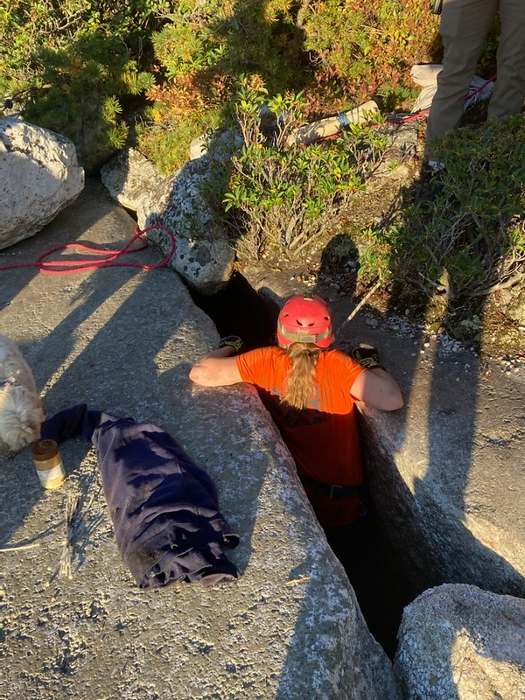
A dog which was trapped in a rocky crevice was successfully rescued unharmed after five days without food or water.

The incident started when a woman was hiking with her 12-year-old dog, Liza—who fell out of sight into the narrow crevice but could be heard barking.

Staff at Minnewaska State Park Preserve attempted unsuccessfully to access the crevice that evening before dark and made other unsuccessful attempts in the following days to get a camera into the narrow area to check the dog’s condition.

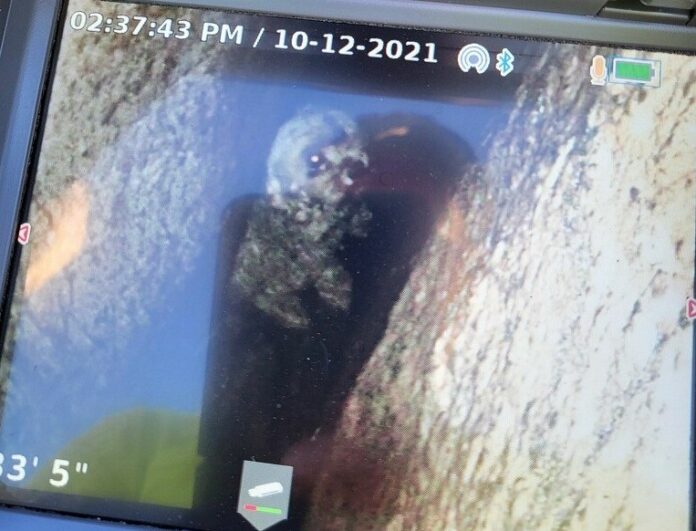
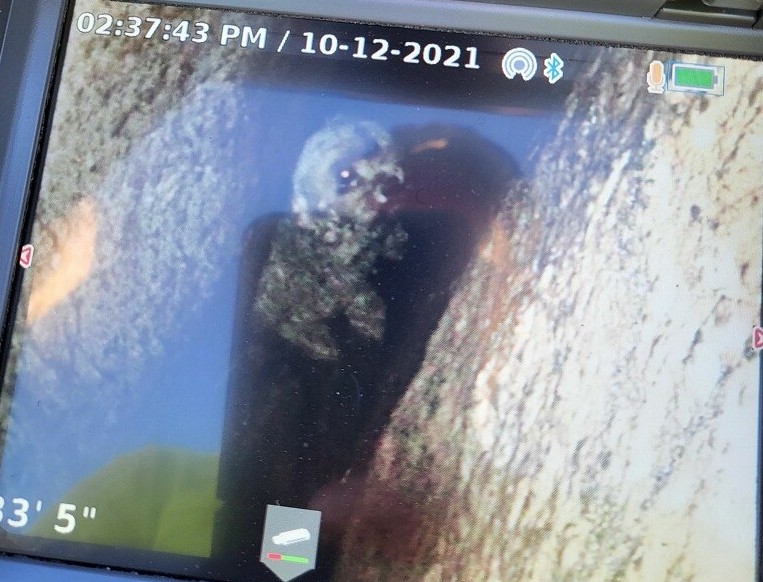
Members of the Ulster County Society for the Prevention of Cruelty to Animals were on scene to assist and a specialized plumbing inspection camera from Parks was utilized to reach the dog.

Parks received support from the New Jersey Initial Response Team, a regional volunteer group specializing in cave rescue.

Two NJIRT members were able to descend into the crevice to get the plumbing camera close enough to observe the dog moving in a narrow area, and apparently unharmed.

New Jersey Initial Response Team

It was a difficult situation. “This was a tight vertical fissure leading to an even tighter horizontal crack,” Mark Dickey, Chief of the New Jersey Initial Response Team, said in a statement. “Only Jessica Van Ord, our smallest team member, was able to squeeze and contort herself more than 40 feet from the surface to reach the dog.”

New Jersey Initial Response Team

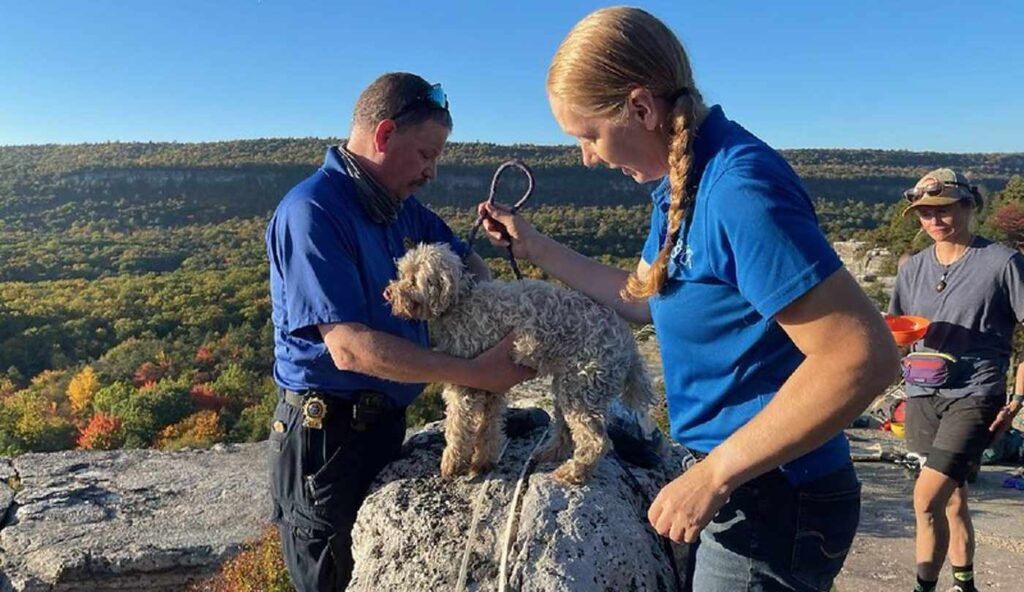
Van Ord described shimmying along a narrow passage and then using a hot dog hanging from the end of the catch pole to attract the dog into putting its head into the loop, which allowed another rescuer nearby to close the loop so Van Ord could bring the dog to her.

New Jersey Initial Response Team

Palisades Interstate Park Commission Executive Director Joshua Laird said, “We are thrilled that it was possible to reunite Liza with its owner,” and noted that the incident was a good reminder of why parks rules were that dogs needed to be on-leash.

A happy ending

New Jersey Initial Response Team

Gina Carbonari, Executive Director of the Ulster County SPCA, said, “It’s always heartwarming to not only have such a positive outcome in cases like this, but also to see so many people come together, putting themselves at risk, to save an animal’s life.

“We were all concerned the dog had not survived until Jessica was able to get closer and hear movement. The rejoicing on the surface to that news was just incredible and renewed everyone’s motivation to get this little dog to safety.  Every person there played a role in making this happen—an amazing team effort by multiple agencies.”

MORE: Wildlife Officers Finally Figure Out How to Remove Tire That Was Around an Elk’s Neck for 2 Years

SPCA officials determined the dog, while hungry and thirsty, was in good health and it was later reunited with its owner. While under observation with the camera, the dog was seen licking the damp walls of the crevice, likely providing itself with moisture that helped it survive.

WOOF a Little Good News Rescue into Friends’ Feeds…

Nebraska Teen Runner Helps Competitor Finish Race After He Collapsed, Giving Up His Own Qualifying Hopes

Featured image By Jay Slagle www.preprunningnerd.com

In the sport of track and field, athletes compete not only with one another but against themselves, and with each race they strive to achieve a new personal best.

For one Nebraska teen running in what would likely be his final cross country outing before graduating high school, his personal best turned out not to be about marking the fastest time but displaying the biggest heart.

Although it was a long shot when he came out of the blocks last Thursday, Bellevue East senior Brandon Schutt knew if his time was good enough that day, he still had the potential to qualify for the upcoming state meet.

A mile into the 3.1-mile race, however, Schutt realized he wasn’t going to be able to keep up the necessary momentum.

Rather than risk injury, he slowed to a comfortable pace that would allow him to simply enjoy the moment and the day.

Meanwhile, Omaha Burke High School sophomore Blake Cerveny was running a very different kind of race.

Aiming to beat his own personal record, after a fast start, he continued to push himself hard.

With less than 400 meters to go, Cerveny’s legs cramped up and failed him.

Jay Slagle/www.preprunningnerd.com

His will did not.

Determined to finish, Cerveny rose from the ground and continued on, only to fall again after another 150 meters… and again, he got up and started running. This time he’d made it only 25 meters more before going down. But he wasn’t done yet.

Concerned, his dad and his coach asked Cerveny if he wanted to stop. He didn’t. With Herculean effort, the young runner pulled himself up and with an unsteady gait, moved forward for one final push.

It wasn’t enough. A scant 100 meters from the finish line, he lay curled on the ground. His legs had simply given out.

Before Cerveny’s dad could reach his son, another runner—Brandon Schutt—was at his side to offer a helping hand.

Jay Slagle/www.preprunningnerd.com

His first attempt to get Cerveny up failed, but like Cerveny, he too refused to quit. With a second tug, Cerveny was on his feet.

At a measured jog, with Cerveny holding Schutt for support and Schutt helping Cerveny maintain balance, the two completed the final 75 meters of the course in tandem.

Jay Slagle/www.preprunningnerd.com

Schutt even made sure the injured runner crossed the finish line first, securing his opponent a faster time.

Jay Slagle/www.preprunningnerd.com

(Although Cerveny was automatically disqualified for having received help, Schutt’s time for the race will stand.)

RELATED: The 7 Mental Health Benefits of Running That You May Not Know About

“I saw Blake zig-zagging with 100 meters to go, a classic sign that his legs were about to give. As I kept my camera trained on him, I saw Brandon come into the picture. I began whispering, ‘No, no, no,’ to myself, because at the time, I didn’t know the Good Samaritan rule had been changed,” Jay Slagle, the citizen journalist who first broke the story on his blog, PrepRunningNerd.com told GNN.

“This is the first time I’ve ever seen an athlete stop his race and work so hard to help his fellow competitor across the finish line,” he added. “Perhaps more impressively, Brandon had virtually no time to think about whether he should help or not; he reacted so quickly that he did it instinctively.”

Three weeks prior to this meet, Schutt had found himself in the same situation as Cerveny, unable to complete the race. “I felt awful about not finishing,” he told KETV-7. “I felt like I was letting my teammates down and I was letting myself down—so ultimately I just made the call [to help him].”

As Cerveny was taken to the medical tent for care, Schutt rejoined his teammates for a post-race cool-down. (Cerveny, who was only suffering from extreme muscle fatigue with no sustained injuries, was soon up and able to leave on his own steam.)

Ironically, though the pair had competed in five separate races over the course of the season, they were still strangers. At the end of the eventful day, neither Cerveny nor Schutt knew each other’s names.

Thanks to Slagle’s coverage and a whirlwind of social media, however, Schutt’s uncredited act of kindness was quickly anything but anonymous. Soon enough, the local news outlet that picked up the story and ran with it arranged an on-camera reunion in which the boys were given the opportunity to reflect on what the day’s events had meant to them.

In today’s competitive world in which the emphasis in athletics is so often put on breaking records, it was inspiring to see that for an athlete like Brandon Schutt, the value of true sportsmanship still had legs.

“Brandon is an excellent person,” Bellevue East’s head track coach Rachel Carraher told KETV-7. “He is really kind and a great leader on the team.”

MORE: Hero Park Ranger Carries Dehydrated Dog To Safety Down a Treacherous Mountain Trail

And for others, like Blake Cerveny, knowing that finishing the race—no matter the odds or adversity–is the true meaning of a win.

(WATCH the KETV7 video showing the runners meeting below.)

SHARE This Heart-Warming Act of Kindness With the Favorites in Your Life…

This Carbon-Negative Perfume is Made from Captured CO2 – And it Smells Like Figs and Orange Peel

Air Company
Air Company

Demonstrating that CO2 isn’t only pollution, but can also be a valuable raw material, a company has launched a perfume line smelling of figs and tobacco, but made from greenhouse gases instead.

With the principal ingredient being ethanol, Air Company ditches the normal process of fermenting corn for that of their proprietary technology which acts as a kind of artificial photosynthesis when fed CO2 captured from nearby Brooklyn factories.

The result is entirely sustainable ethanol, since the factory is powered by 100% renewable energy.

Air Company has released a line of ethanol-based products sourced from CO2, including the Air Eau de Parfum, Air Vodka—which GNN has previously reported on—and Air hand sanitizer.

This has the double impact of reducing the amount of corn produced to create ethanol by commercial means, freeing up farmland for more productive and desired uses.

“The goal for us has always been to use these products in our own internal research and development for the company, but as beacons for people to show you that you can make these really sustainable products that people use every day in their lives,” cofounder and CEO Gregory Constantine told Fast Company.

RELATED: Spray-on Treatment Could Lengthen Life of Roads While Making Cities Cooler

Eau de Parfum contains hints of fig, jasmine, orange peel, powdery musk, tobacco, and azalea. However novel and exciting Eau de Parfum may be, the true innovation from this company’s technology is yet to come.

Air Company is hoping to open up the market for regenerative jet fuel, synthesized directly from the emissions in the air, from nearby factories, or from the airport itself to give chances for airlines to dramatically reduce their carbon-emissions footprint.

“We’re emerging as a pioneer in this space, creating a carbon-neutral jet fuel to be distributed across North America. To curb our emissions stemming from transport, we’ll deploy modular sites as close to airports as possible, creating a direct facility-to-airport pipeline,” the company writes.

MORE: Ralph Lauren Gives Competitors New Way to Dye Cotton, Uses 90% Less Chemicals, 40% Less Energy and Half the Water

CO2 contains several of the most fundamental building blocks of nature, and infrastructure that allows manufacturers to tap into it provides a serious incentive to invent new ways of capturing it from the atmosphere.

SPRITZ the News of This Fresh New Perfume in This Social Feeds…

Want to Learn to Code? This Nintendo-Style Video Game Will Teach You – And It’s Free

Twilioquest
Twilioquest

Writing code is a skill almost anyone can make use of, and now there’s a video game that will teach you how.

Set in an old school, Super Nintendo-like, 16-bit world, TwilioQuest teaches common coding languages like Python, JavaScript, and Open Source and combines the satisfying sense of progression inherent in role-playing games, with actual skills instead of virtual ones, allowing users to level-up in real life just as they level-up in the game.

Twilio is now releasing a version 3.2 of the game, which is free for Windows, Mac, and Linux systems, and which features better graphics and more levels, as well as a feature that allows players to code their own additional extensions into the game.

This peculiar way of teaching started back in 2013, and is now welcoming other platforms to contribute to the game’s content, such as media processing-software company Cloudinary, who are currently designing an extension to teach players how to use their video-processing APIs, a body of code that provides access to server infrastructure necessary to deliver video content.

“Our mission is to unlock the imagination of builders,” CEO Jeff Lawson told Fast Company.

MORE: Boys Who Play Video Games Linked With Lower Depression Risk, UK Shows Study

Each level is set to a different language. For Python coders, there are adventures in “The Pythonic Temple,” or you could risk a trek through “The Forest of Open Source”.

Their most recent level is “The Arcane Academy of API Arts,” set in a wizardry school reminiscent of the one in Harry Potter or The Magicians.

TwilioQuest’s popularity (it’s even used in middle and high schools as a fun way to help kids practice coding skills) is naturally beneficial to Twilio, a cloud-based communications company which offers clients solutions for video APIs, and automated emailing and text messaging.

But the lean team of just six developers responsible for making and updating TwilioQuest is proud of their work, and plan to continually introduce many, many more features over time to expand the capacity of their user base to develop their skills.

RELATED: Video Game Industry Is Nudging 250 Million Gamers To Protect The Planet

“Being a fellow nerd who definitely did play a bunch of Chrono Trigger and other classics of the 16-bit era, the metaphor of a role-playing game where you could kind of level up at your own pace seemed like a useful thing to build upon for training,” Kevin Whinnery, the game’s creator and head of the TwilioQuest team, told Fast Company.

(WATCH the TwilioQuest video below.)

CODE a Little Good News Into Mates’ Feeds by Sharing This Story

People Who’ve Tried Psychedelics Have Lower Risk of Heart Disease and Diabetes

Arp, CC license
Arp, CC license

A study has confirmed that the rates of heart disease and diabetes found in users of classic psychedelic substances, like psilocybin or MDMA, are lower compared to the general public.

Parsed from data of a survey of 375,000 Americans—with the results controlled for age, gender, marital status, income bracket, education level, race, and use of other types of drugs—it found non-users were twice as likely (2.3% to 4.5%) to develop heart disease and almost twice as likely (3.95% to 7.7%) to develop diabetes.

While there’s no evidence of a chemical association for this reduction, as psilocybin or other psychedelic substances really don’t act much on our metabolic or cardiovascular systems, the results could be of a behavioral nature, since the usage of these substances are typically associated with large changes in lifestyle, even when taken only once.

These could involve the decisions to exercise more, give up smoking, drink less, or other impactful decisions that could be hard without the aid of what many see as the wisdom of psychedelics.

It’s predicted that by 2030, half of Americans will be diabetic or pre-diabetic, and considering that many of such cases are entirely preventable, behavioral alternations could be far more important and impactful than pharmaceutical aids.

RELATED: Eating Mushrooms a Few Times a Week Could Dramatically Reduce Dementia Risk, Says 6-Year Study

The data, which came from the National Survey on Drug Use and Health, asked if the participants had even once used the classic psychedelic substances DMT, ayahuasca, LSD, MDMA, mescaline, peyote, or psilocybin, and if they had been diagnosed with heart disease or diabetes in the last year.

One potential explanation is that medicine like DMT and psilocybin activate serotonin receptors which can potentially act as an appetite suppressant, reducing cravings. However there would have to be enough frequent use of these compounds to make a lasting impact on body weight, blood lipids, or other cardiometabolic measurements.

“The findings are novel and build on previous findings on the associations between lifetime classic psychedelic use and various markers of physical health,” the authors wrote in their paper, noting the drawbacks of the study, specifically that the cross-sectional nature makes determining causality impossible.

MORE: Psychedelic Found in Magic Mushrooms Spurs Growth of Neural Connections Lost in Depression, Landmark Study Finds

“The direction of causality remains unknown,” lead author Otto Simonsson told Psypost. “Future trials with double-blind, randomized, placebo-controlled designs are needed to establish whether classic psychedelic use may reduce the risk of cardiometabolic diseases and, if so, through which mechanisms.”

SHARE This Groundbreaking Research With Friends on Social Media…
“A thousand words leave not the same deep impression as does a single deed.” – Henrik Ibsen

Quote of the Day: “A thousand words leave not the same deep impression as does a single deed.” – Henrik Ibsen

Photo: by Tyler Lagalo

With a new inspirational quote every day, atop the perfect photo—collected and archived on our Quotes page—why not bookmark GNN.org for a daily uplift?

Diver Finds 900-Year-old Sword Wielded in the Crusades Off the Coast of Ancient Israeli Town (LOOK)

Shlomi Katzin
Shlomi Katzin

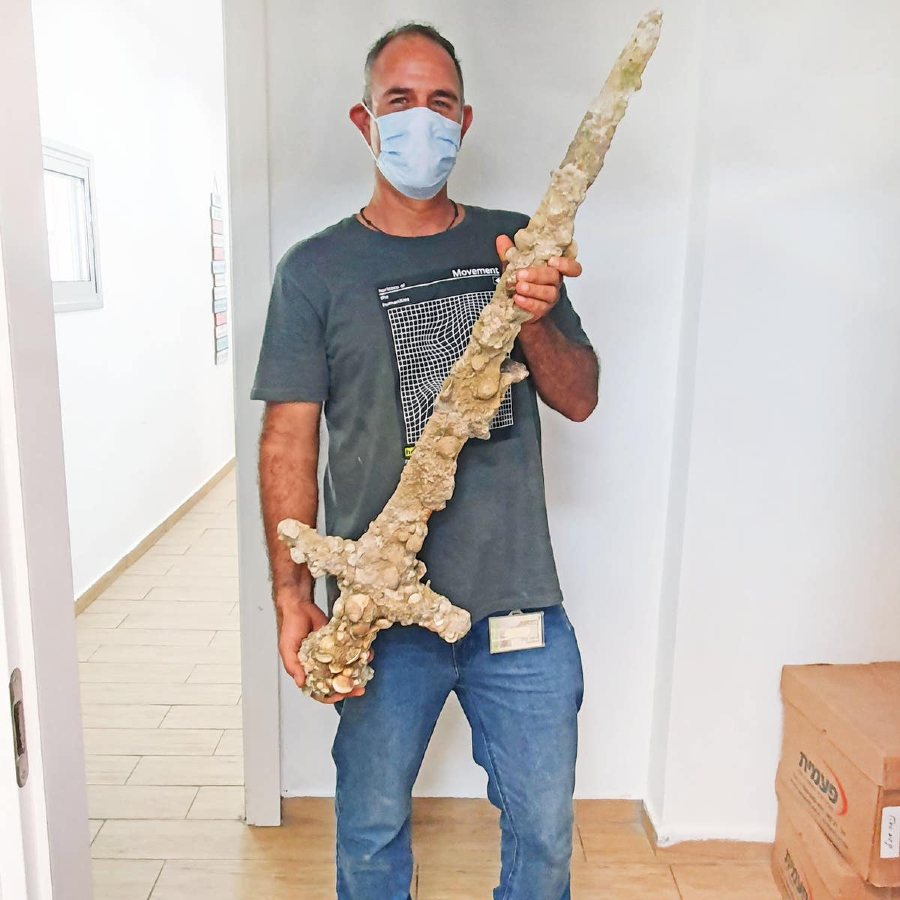
A man in Israel noticed the unmistakable shape of a sword during a recreational dive, and it turned out to be a 900-year-old relic from the Crusades.

Encrusted with shells and marine life, it’s not clear if the sword was from the Muslim or European side, but it’s now in possession of the Israeli Antiquity Authority (IAA) for further study.

Some of the most important tools and icons of mankind have similar shapes.

In abstract, a sword, a pickaxe, a cross, or an axe all look very similar, and so even when it was so entirely reclaimed by the sea as to be invisible in color, Shlomi Katzin, a resident of the town of Atlit, had no trouble spotting the sword and a number of other nearby artifacts off the Carmel coast.

“The sword, which has been preserved in perfect condition, is a beautiful and rare find and evidently belonged to a Crusader knight,” stated Nir Distelfeld, Inspector for the IAA.

“It was found encrusted with marine organisms, but is apparently made of iron. It is exciting to encounter such a personal object, taking you 900 years back in time to a different era, with knights, armor and swords.”

All locked up in shells and sand, it looked like it could have been forged in mythical Atlantis.

Nir Distelfeld/Israel Antiquities Authority

Shifting sands had apparently revealed the one meter-long weapon, along with stone and metal anchors, and pottery shards, in an area archaeologists knew to be rich with potential finds.

MORE: Human Footprints Found in New Mexico Are 23,000 Years Old – Long Before the Ice Age Glaciers Melted

“The Carmel coast contains many natural coves that provided shelter for ancient ships in a storm, and larger coves around which entire settlements and ancient port cities developed, such as Dor and Atlit,” explains Kobi Sharvit, Director of the IAA’s Marine Unit. “These conditions have attracted merchant ships down the ages, leaving behind rich archaeological finds.”

Indeed, Atlit was known to harbor seafaring vessels as early as 2,000 BCE, according to Sharvit.

In the 11th century, medieval European kings and the Catholic Church sent invading armies to the Holy Land in order to take back sites holy to Christendom.

Many of their initial successes were fleeting, as the Muslim armies, led by the Sultan Saladin, eventually retook everything they lost to Richard the Lionheart and others.

RELATED: 1,500-Year-Old Skeletons Found Locked in Loving Embrace Might Have Been ‘Romeo and Juliet’ Ending in China

However, their victories provide unique insight into the nature of the sword. No account of the Ayyubid or Mamluk forces taking to the sea has come down to us.

Smithsonian reports that while the Muslim armies built fortifications on the coasts, the sword is likely a Crusader sword, as even though virtually all participating nations used straight swords, and the barnacles make it impossible to find telling details, it was only the Europeans who were known to have traveled by sea.

SHARE This Amazing Discovery With Your History-Minded Chums…

Photo Catches the Moment a Squirrel Strikes ‘Mr Universe’ Pose on Their Windowsill

SWNS
SWNS

This funny picture shows a squirrel pulling a ‘Mr Universe’ pose on a windowsill.

65-year-old David Roberts snapped the tough-looking rodent in his garden in Glasgow.

Retired David said of his lucky moment with the critter, ”It was on the window ledge running about and looking in.” Basically, it was just acting like any other normal squirrel that makes its home in the gardens and parks around the Scottish city.

Then David looked again. He noticed the squirrel had stopped moving for a moment. In fact, it appeared to be cracking a pose.

Luckily, David had his camera ready to go—and got the perfect shot.

RELATED: From Cheeky Bears to Goofy Gophers, See the Fun Finalists of the Comedy Wildlife Photo Awards

”I was pretty chuffed with it,” David say. “I am always taking photos of birds at the feeders and try to get good shots with them in flight.”

SWNS

We’re just happy serendipity lined up to let us see these photos for ourselves.

LET This Fun Story Strike a Pose for Pals—Share This One…

20-Inch Deep Moss Is Like Walking on a Pillow of Green Snow (WATCH)

For all the curious attributes inherent in mosses, height is not among them. But a video of two jolly lads trudging through a field of 20-inch deep moss serves to make us feel like that’s a shame.

Like a pillowy green snow that doesn’t fall down the back of your neck if you jump in it, the moss is in the Dawsonia genus, and is found only in New Zealand and Australia.

Normally reaching heights reserved for vascular plants, those in the Dawsonia group are part of the highest-growing mosses on the planet: D. superba can reach up to 24 inches (60 cm) high, making it the tallest self-supporting moss on Earth.

Dawsonia mosses are more vascular-like, meaning they can move water further up and down their stems than other mosses.

Furthermore, they have a special moisture-retaining structure in their leaves, which also increases its width and collection area for sunlight.

These adaptations allow the moss to grow much higher than others.

MORE: Ditch That Hard-to-Grow Lawn And Start Cultivating Moss

That makes wading through it, or falling into its velvety arms, a truly special experience.

(WATCH the fun video below.)

CREATE Sweet Footsteps in Those News Feeds; Share This Story…

Internet Sleuth Solves 45-Year Guitar Mystery Returning the Beloved ’57 Gretsch to a Rock Idol

Bachman & Bachman YouTube channel

Back in 1976, when Canadian rock star Randy Bachman of The Guess Who and Bachman-Turner Overdrive discovered his favorite guitar had been stolen from his Toronto hotel room while he was on tour, he cried all night.

Having done every odd job on the block as a boy to afford the $400, 1957 Gretsch 6120 Chet Atkins model in Western Orange, its departure left a hole in his heart that would only be filled 35 years later, when an internet sleuth managed to track down the distinctive instrument to Japan.

Bachman, who used that guitar to write hits like Takin’ Care of Business and American Woman, told CBC News that he and Neil Young would “spend hours drooling over it” in the window of a Winnipeg music store.

“So I have a paper route where you make, like, two bucks a week delivering the paper, you mow a lawn for a dollar, you babysit someone, you get a dollar, you’re working at a car wash and you’d get 50 cents an hour. This is way, way back,” he told CNN. “So to save the 400 bucks was a big, big, big deal.”

Then it was stolen after the road manager didn’t use the 12-foot long tow chain to lock it up, as was Bachman’s custom, and in the aftermath he would buy hundreds of Grestch guitars trying to replicate the magic of the one he’d lost.

COVID sleuthing

Fast forward more than three decades, and a fan of Bachman was watching some Guess Who videos on YouTube when he came across one of Bachman and his son explaining the story of the guitar theft, and—being a fan of solving puzzles—he decided to see if he could locate the missing Gretsch by comparing hi-resolution imagery of the stolen guitar with second-hand listings of the same model around the world.

MORE: Restaurant Wants to Give Burglar a Second Chance – Offering Him a Job Application

“I probably went through maybe 300 Gretsch images and I got pretty good at it so I could see them and I could know right away that it wasn’t it,” William Long, the fan in question, told CNN.

He tracked it down to a Tokyo vintage music store, but looking over their website, found it had been sold. Comparing footage of a particular Japanese guitarist to that of Bachman playing the song Looking Out For #1 on Dutch television, Long concluded it was the same instrument by the distinctive pattern in the grain of the wood.

When Long finally got in contact with Bachman and explained the situation, Bachman said it was “like being hit in the face with a shovel.”

“Man, my guitar, I was in tears. It’s just unbelievable, because I’ve been searching for this forever and basically gave up on it,” he recounted.

The Japan connection

KoKo, Bachman’s Japanese daughter-in-law, reached out to Takeshi, the guitar’s then-owner, to explain the situation.

KoKo translated a Zoom meeting between the artists, in which Takeshi assured Bachman he was not the thief. “But of course,” said Bachman, noting Takeshi had only just been born the night the Gretsch was taken from his hotel room.

RELATED: ‘World’s Most Dangerous Malware’ Emotet Taken Down in International Cyber Crime Effort

Takeshi agreed to return the guitar if Bachman could find one just like it, a difficult task as fewer than 40 remain from the 1957 lot code. Fortunately, having been deprived of such a model for so long, Bachman had already amassed a rolodex of distributors and collectors, into which he dove until he found a guitar which he described as likely made “on the same bench.”

“When I first strummed this guitar at the music shop in Tokyo, it spoke to me like no other guitar I’ve ever played. I knew and felt it was destiny—I immediately and impulsively purchased it,” Takeshi said in a statement that was translated by KoKo.

“I’m so honored and proud to be the one who can finally return this stolen guitar to its owner, the rock star, Mr. Bachman who was searching for it for nearly half a century and I feel very grateful for this miracle happening in both our lives.”

CHECK OUT: After Botched Restaurant Burglary Attempt, Owner Offers Free Meals to Anyone Who is Desperate

Once the country eases COVID-19 restrictions, Bachman plans to travel to Japan to make the swap and have a jam session with Takeshi in a Tokyo club.

Bachman is considering turning the story into a mini-documentary, and will probably write some music about the whole saga in the upcoming album he’s preparing with his son under the somewhat expected handle of Bachman & Bachman—the same name as the YouTube channel they share.

(WATCH the Bachman & Bachman video for this story below.)

Editor’s note: This story has been altered to correctly account for the number of remaining guitars in the world. 

SHARE This Amazing Real-Life Sleuthing Story on Social…

Walking Storyteller Continues Historic 24,000-Mile Trek Retracing Passage of Human Ancestors Out of Africa

Paul Salopek/@OutofEdenWalk

The Out of Eden Walk, a National Geographic-sponsored retracing of our ancestor’s slow-motion exodus from Africa, through time and countless footsteps, is finally resuming after COVID-19 closed overland borders last year.

The host (or perhaps victim) Paul Salopek is a Pulitzer-winning journalist and photographer, and has been traveling overland on foot since the middle-years of Barack Obama’s presidency, documenting his trip across the beltline of the world. In Myanmar, the pandemic hit, and like everyone else he was stuck in one place for months.

Finally back on the road again, his latest dispatch is characteristic of a great travel memoir.

“For more than eight years, I have trailed the first human beings who roamed out of Africa during the Stone Age,” he writes in his most recent entry.

“My storytelling journey, called the Out of Eden Walk, has been stalled for more than a year in Myanmar. The novel coronavirus, a life form one thousand times thinner than a human eyelash, has blocked thousands of miles of Asian land borders.”

MORE: New Jersey Brothers Walk to California and Raise $70,000 for Restaurant Workers Like Them

Salopek describes thinking back to eight years ago, when he started in the rocky highlands of Ethiopia, visiting resting sites of the earliest human ancestors.

Entering the Holy Land, he wandered through scenes of war and the worst refugee crisis of a generation in Syria, before crossing the vast grasslands and savannas of the Central Asian Steppe, then the Indian subcontinent, before reaching the steamy river valleys of Yunnan.

“Roads are older than empires in Yunnan,” Salopek says as he finishes his first travel days in 20 months. “A hundred generations of long-legged mountaineers have hauled jade, tea, copper, and ivory atop the crooked lanes of Yunnan.”

While difficult to say, Salopek’s journey could be described as half over, as he still must cross northeastward through China and Russia, before crossing the Bering Strait in winter and plunging south all the way to the tip of South America, just as our early ancestors did, with the special exception of the Pacific Islanders.

RELATED: An Epic Adventure Few have Heard of: ‘The Great Loop’ Circles the Eastern US on Waterways Never Far from Shore

Half-time is often a good period to jump into a sports match, and as Salopek prepares to continue one of humanity’s all-time great walkabouts, it’s worth tuning in to see how the match ends.

LET Great Stories Wander Far and Wide; Share This One…

“Remind thyself, in the darkest moments, that every failure is only a step toward success… Every adversity will only hide, for a time, your path to peace and fulfillment.” – Og Mandino

Quote of the Day: “Remind thyself, in the darkest moments, that every failure is only a step toward success… Every adversity will only hide, for a time, your path to peace and fulfillment.” – Og Mandino

Photo: by Andreas Schmid, CC license on Flickr

With a new inspirational quote every day, atop the perfect photo—collected and archived on our Quotes page—why not bookmark GNN.org for a daily uplift?


More Than Half of Women Were Seven Months Into the Menopause Before Realizing What It Was

More than half of women didn’t realize they were going through the menopause until seven months after they first experienced signs, a poll has found.

A new survey of 1,000 women, who are going or have gone through the menopause, found 52 percent took considerable time to realize what was causing the aching joints, fatigue, and anxiety.

The poll found that 30 per cent wish there had been more education available about what to expect during menopause—with one in 10 taking over a year to recognize the signs.

More than a third reckon menopause should be more openly discussed, while a quarter didn’t feel there was enough information readily available about it.

A metallic taste, hair loss, and itchy skin were also among the health complaints women didn’t realize could be linked to menopause—until they were going through it.

Nearly two-thirds agreed menopause should not be a taboo topic and over half admitted it is so much more than ‘when your period stops’—as it’s currently defined in the dictionary.

The survey was commissioned by Always Discreet, which has created an online educational hub offering free menopause masterclasses designed to educate women on how best to manage their menopause.

Emma Gerrard, from P&G Fem Care, UK & Ireland said, “There appears to be a real information gap when it comes to the menopause and clearly many feel it’s simply not spoken of enough.

“But the more women speak to each other about it, the more we can demystify the experience and empower women to live it and define it, their way.

“Many believe women who go through menopause experience a few hot flushes and then their period stops.

“But it can last for many years and there are a variety of other signs some women experience which are completely swept under the carpet and not spoken about. It’s time women got talking.”

The poll also found more than a quarter (28 percent) of women felt ‘too young’ to be going through the menopause when the signs started.

While one in four (24 percent) felt apprehensive and 17 percent felt worried—although 15 per cent admit it left them feeling sentimental about the past.

And 52 per cent would have felt more empowered if they knew more about how to better manage their menopause.

MORE: Scrappy 81-Year-old Woman Completes Her Second Tough Mudder Race Over Huge Obstacles

It also emerged 67 per cent admitted they didn’t realize the signs of menopause would last so long.

More Confident

Despite this, more than one in 10 (11 per cent) said they felt more confident since going through the menopause, and a further one in 14 claimed to feel more feminine.

Just under half (45 percent) of those polled, via OnePoll, were lucky to have been able to share their experience with others to try and help them through it all.

But 54 percent said they had no one to help them through the menopause at all.

Always Discreet Brand Ambassador, Lorraine Kelly said: “It took me a while to realize I was going through the menopause, but when I did, it honestly was a relief. It suddenly all clicked and what I had been going through made sense.

“I think it’s because people don’t talk about it enough and so when it does happen, you don’t recognize the signs.

RELATED: Grave of 9,000-Year-old Skilled Huntress Found in the Peruvian Andes, Changing the Stereotype of ‘Man the Hunter’

“The awareness and education that Always Discreet are driving will help more women understand what is happening to them and will empower them to live their menopause their own way.”

To access the free menopause masterclasses created in conjunction with experts Over The Bloody Moon, head to their website.

SHARING is Caring—Pass on the Knowledge…