All News - Page 439 of 1736 - Good News Network
Home Blog Page 439

Scientists Discover How Intricate Spider Webs Are Made By Brains That Are a Fraction of the Size of a Human’s

Johns Hopkins University researchers discovered precisely how spiders build webs by using night vision and artificial intelligence to track and record every movement of all eight legs as spiders worked in the dark.

Their creation of a web-building playbook or algorithm brings new understanding of how creatures with brains a fraction of the size of a human’s can create structures of such elegance, complexity, and geometric precision.

“I first got interested in this topic while I was out birding with my son,” said senior author Andrew Gordus, a behavioral biologist in the Department of Biology in the Krieger School of Arts and Sciences. “After seeing a spectacular web, I thought, ‘if you went to a zoo and saw a chimpanzee building this you’d think that’s one amazing and impressive chimpanzee.’ Well this is even more amazing because a spider’s brain is so tiny and I was frustrated that we didn’t know more about how this remarkable behavior occurs. Now we’ve defined the entire choreography for web building, which has never been done for any animal architecture at this fine of a resolution.”

Web-weaving spiders that build blindly using only the sense of touch have fascinated humans for centuries. Not all spiders build webs but those that do are among a subset of animal species known for their architectural creations, like nest-building birds and puffer fish that create elaborate sand circles when mating.

The first step to understanding how the relatively small brains of these animal architects support their high-level construction projects is to systematically document and analyze the behaviors and motor skills involved, which until now has never been done, mainly because of the challenges of capturing and recording the actions, Gordus said.

CHECK OUT: MIT Scientists Spin Some Music Out of Spider Webs

Here his team studied a hackled orb weaver, a spider native to the western United States that’s small enough to sit comfortably on a fingertip. To observe the spiders during their nighttime web-building work, the lab designed an arena with infrared cameras and infrared lights. With that set-up they monitored and recorded six spiders every night as they constructed webs. They tracked the millions of individual leg actions with machine vision software designed specifically to detect limb movement.

“Even if you video record it, that’s a lot of legs to track, over a long time, across many individuals,” said lead author Abel Corver, a graduate student studying web-making and neurophysiology. “It’s just too much to go through every frame and annotate the leg points by hand so we trained machine vision software to detect the posture of the spider, frame by frame, so we could document everything the legs do to build an entire web.”

They found that web-making behaviors are quite similar across spiders, so much so that the researchers were able to predict the part of a web a spider was working on just from seeing the position of a leg.

RELATED: Company Mimics Spiders to Create Lustrous Faux Silk That is 1,000x More Energy Efficient

“Even if the final structure is a little different, the rules they use to build the web are the same,” Gordus said. “They’re all using the same rules, which confirms the rules are encoded in their brains. Now we want to know how those rules are encoded at the level of neurons.”

The findings, now available online, are set to publish in the November issue of Current Biology.

Future work for the lab includes experiments with mind-altering drugs to determine which circuits in the spider’s brain are responsible for the various stages of web-building.

“The spider is fascinating because here you have an animal with a brain built on the same fundamental building blocks as our own, and this work could give us hints on how we can understand larger brain systems, including humans, and I think that’s very exciting,” Corver said.

Source: Johns Hopkins University

SPIN Some Beautiful News for Your Friends—Share This Story…

Rare Canadian Cat Has Thumbs Making His Paws Look Like Cute Mittens

SWNS
SWNS

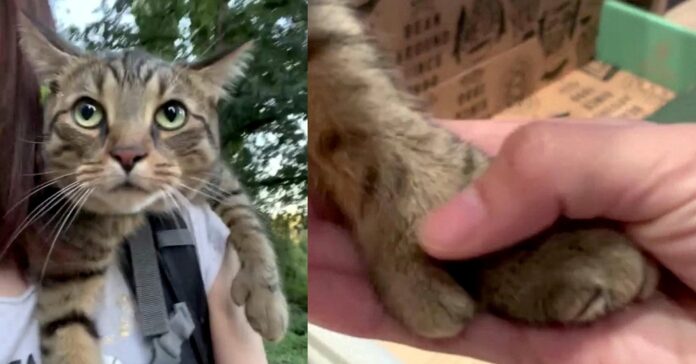
Meet Teddy, the adorable polydactyl cat who was born with extra toes that make his front paws look, like human hands.

Three-year-old domestic shorthair Teddy is a polydactyl, which means he has extra toes on his hind feet and two thumbs which makes his front paws look like mittens.

Teddy, who lives with his owner Selvynna Tang in Vancouver, British Colombia, has his own Instagram page and his adorable condition brings joy to his thousands of feline  followers.

Selvynna said, “Teddy is my little buddy! We spend a lot of time together, from working and relaxing at home, to walks and road trips! Teddy is used to going on adventures, so we get to do a lot of things together.

“The extra toes do not affect him too much. If the claws grow too long, it makes a tapping sound when he walks on my wood floors, and I will have to trim it, like any other claw. If the claw is too long it can sometimes get stuck on his scratching post too.

“On the grand scheme of things, Teddy is fairly low maintenance. He likes to sleep a lot, particularly during the work hours, which works out for me!

RELATED: Doberman Dog Nurses Tiny Abandoned Kitten Alongside Her Pups – the Adorable Photos Will Melt Your Heart

Normal cats have a total of 18 toes, with five toes on each fore paw, and four toes on each hind paw.

SWNS

Polydactyl cats may have as many as nine digits on their front or hind paws.

SWNS

Both Jake, a Canadian polydactyl cat, and Paws, an American polydactyl cat, were recognized by Guinness World Records as having the highest number of toes on a cat, 28.

MORE: Minnesota Teen Builds Free Wheelchairs for Disabled Dogs and Cats – And Soon a Duck (WATCH)

“Cats are very adaptable,” said Selvynna, “and they don’t know they are any different because that’s all they know. Even cats who are blind or deaf or even missing a limb can live very full lives.”

PAW This Little Story Over to Your Chums…

Bee Expert Finds 800,000 Wild Honeybees Thriving in Ancient English Forest, Now Naturalists are Buzzing With Hope

Filipe Salbany

Even in a place as populated and developed as southeast England, there are still ecological surprises waiting for those willing enough to be patient and wander far enough.

Filipe Salbany

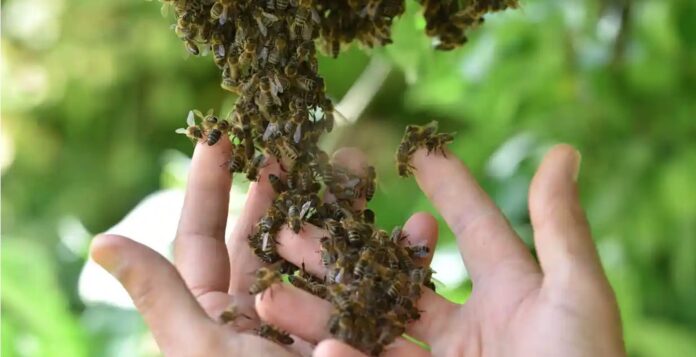
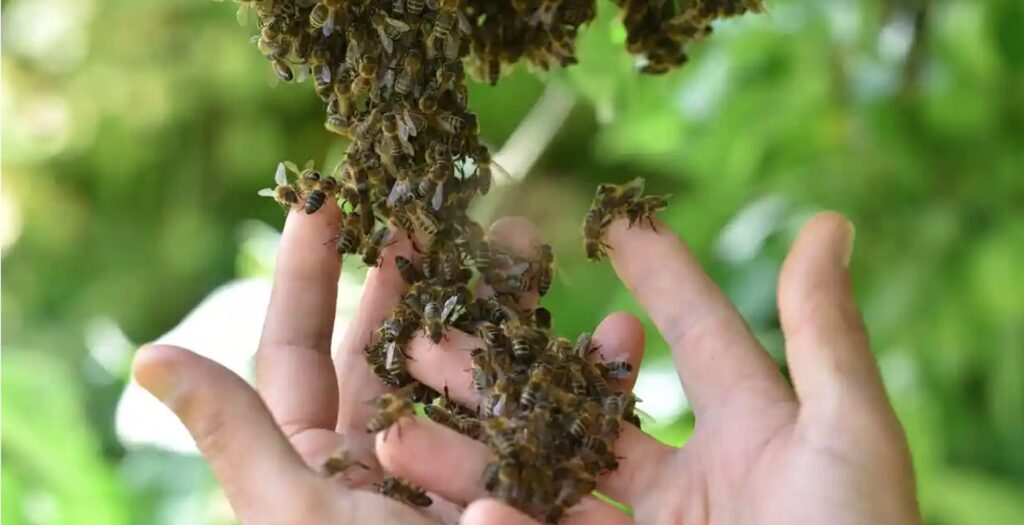
800,000 native honeybees, which some thought to be extinct, were found in an ancient oak woodland at Blenheim Palace in Oxfordshire, England. Experts said they could be the last remaining descendants of the British isle’s original forest honeybee populations.

If true, this would represent one heck of a second chance for the subspecies—because they are thriving.

The insects were found living in the hollow of some oak trees—typical for this forest bee species. The hollow was tiny, and quite high in elevation. Curiously, there had been no record of any bees living in Blenheim before, and immediate thoughts turned to escaped swarms of domesticated bees from nearby hives.

A bee-keeping veteran with more than 40 years experience, Filipe Salbany, would end up finding 50 separate colonies of bees in the estate’s forest. The grounds have had no gardening activity and the property isn’t open to the public, so this has truly been a ‘rewilding’ area.

He’s convinced they belong to the subspecies that probably should be called ‘Ye Olde Englishe Bee.’

“A wild bee that has adapted to the environment is called an ecotype, and this bee could be a very precious ecotype—the first wild bee that is completely adapted to living in the oak forest,” Salbany told the Guardian. 

RELATED: These Homegrown Mushroom Hives Could Save Ireland’s Bees

Smaller, darker, and furrier than imported European honeybees, the hermit hive members also displayed a resistance to temperatures as low as 39 °F (4 °C), about ten degrees lower than what causes normal bees to stop flying. The low temps also ward off the bee’s nemesis, the Varroa mite.

Blenheim Palace

“They are not from the imported stocks of bees that people bring in. The wings are smaller and their veins are very distinct,” says Salbany, who has almost finished his physical examinations. “They have had no treatment for the varroa mite—yet they’re not dying off.”

MORE: Orchids Make Fake Pollen to Tempt the Bees – But Scientists Discover it’s as Valuable as the Real Thing

The woods are a paradise of biodiversity, and no managed hives within the 400 acre estate are the main reasons which Salbany is giving for why the bees have likely remained strong through at least 200 years of history, that figure being the chronological age of the oldest tree-hollow hive found so far.

Featured image: Danny Perez, CC license

HELP Those News Feeds Buzz With Good News; Share This Story…

“Success is the ability to go from failure to failure without losing your enthusiasm.” – Winston Churchill

- credit: Quinn Dombrowski, CC 2.0. via Flickr.

Quote of the Day: “Success is the ability to go from failure to failure without losing your enthusiasm.” – Winston Churchill

Photo: by Quinn Dombrowski, CC license on Flickr

With a new inspirational quote every day, atop the perfect photo—collected and archived on our Quotes page—why not bookmark GNN.org for a daily uplift?


Kindness Book is a Perfect Holiday Gift, With Proceeds All Going to Charity

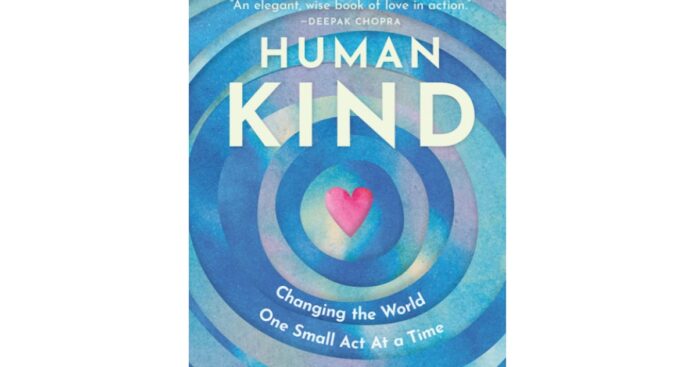
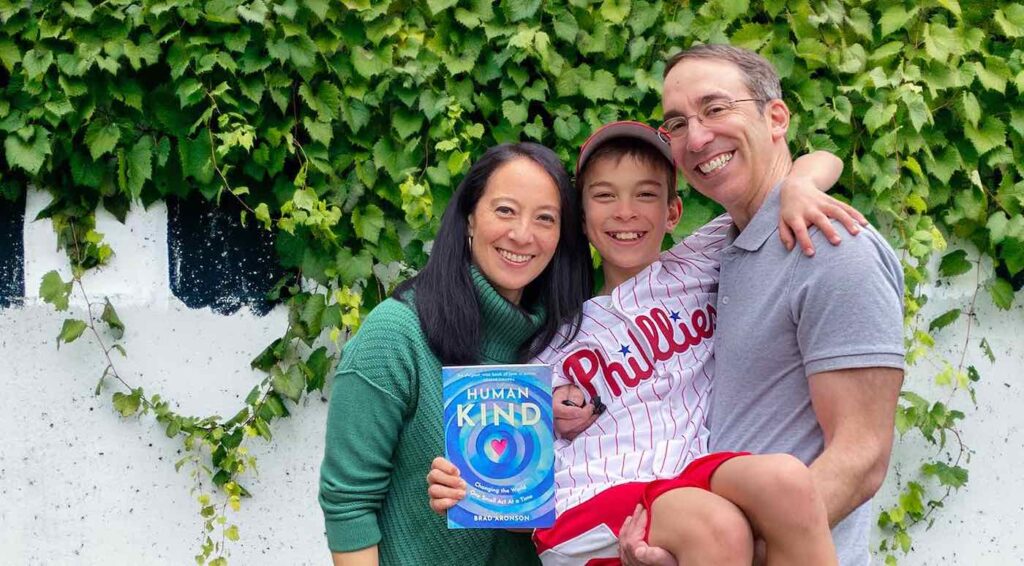
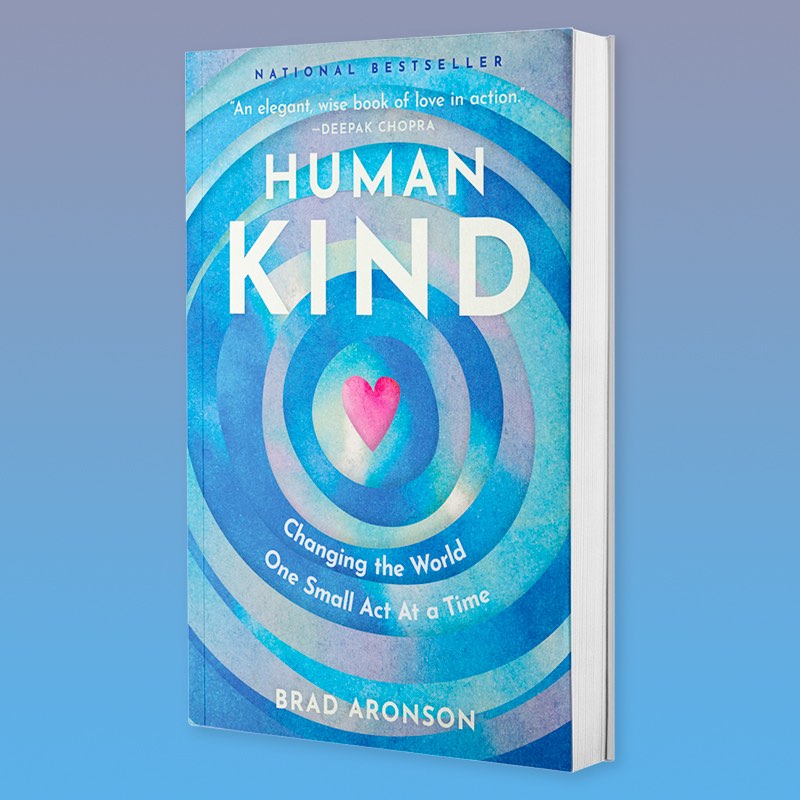
We’re always looking for books that inspire us to feel optimistic and positive about the world, and we are loving this one: HumanKind: Changing the World One Small Act At a Time.

Author Brad Aronson was inspired to write HumanKind when his family went through one of the most difficult times of their lives. His wife, Mia, was in the middle of two and a half years of treatment for leukemia when a patient advocate suggested that Mia, Brad, and their five-year-old son, Jack, create projects to provide a purpose, a distraction and a focus for the hours they were spending in the hospital every week.

Brad Aaronson and family

For Brad’s project, he wrote about the small acts of kindness by friends and strangers that carried his family through that difficult time.

But when he was done, he felt compelled to keep going. What about all the other stories out there? Other stories about seemingly small acts of kindness that had an extraordinary impact, often changing thousands of lives? He decided to seek them out—and those are the golden threads that weave a heartfelt tapestry in this book.

In HumanKind you’ll meet Rita Schiavone, who decided to cook an extra portion of dinner every night to feed to someone in need. Her evening ritual led to a movement that now provides more than 500,000 meals a year. You’ll also meet Larry Stewart, who was homeless when he received a $20 gift that inspired him to become a Secret Santa when he got back on his feet. He went on to give a total of $1.5 million to strangers in need and build a team of thousands who serve their own communities as Secret Santas. Then there’s 6-year-old Gabriel, whose simple request started a global kindness movement. You’ll meet many, many more heroes like these, as well.

HumanKind will inspire you to see the good in the world—and join in. Each chapter concludes with a ‘What We Can Do’ section, containing practical opportunities for how we can all help. And the ‘Hall of Fame’ at the end of the book has a well-vetted list of nonprofits that can guide you to easily channel your energies for good.

The pages will leave you feeling warm and grateful. And in keeping with the book’s theme, all proceeds from this national bestseller go to the nonprofit Big Brothers Big Sisters.

HumanKind is a popular gift for friends, family, employees, clients and board members. You can order five or more copies from the author and pay only $9.50 for each book (40% Discount).

You can buy HumanKind on the book’s website or Amazon or Barnes and Noble or other retailers.

SHARE the Inspiring Gift Idea With Friends on Social Media…

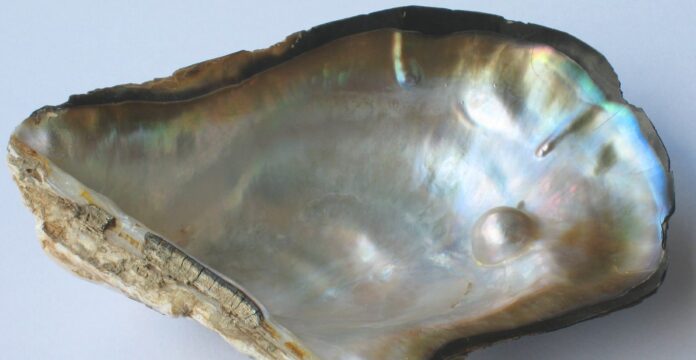
How an Oyster Can Form a Perfectly Symmetrical Pearl – Better Than We Humans, With All Our Technology

Manfred Heye, CC license

In research that could inform future high-performance nanomaterials, a University of Michigan-led team has uncovered for the first time how mollusks build ultradurable structures with a level of symmetry that outstrips everything else in the natural world, with the exception of individual atoms.

“We humans, with all our access to technology, can’t make something with a nanoscale architecture as intricate as a pearl,” said Robert Hovden, University of Michigan assistant professor of materials science and engineering and an author on the paper. “So we can learn a lot by studying how pearls go from disordered nothingness to this remarkably symmetrical structure.”

The study found that a pearl’s symmetry becomes more and more precise as it builds, answering centuries-old questions about how the disorder at its center becomes a sort of perfection.

Layers of nacre, the iridescent and extremely durable organic-inorganic composite that also makes up the shells of oysters and other mollusks, build on a shard of aragonite that surrounds an organic center.

The layers, which make up more than 90% of a pearl’s volume, become progressively thinner and more closely matched as they build outward from the center.

CHECK OUT: The Incredible Mathematics of Snowflakes

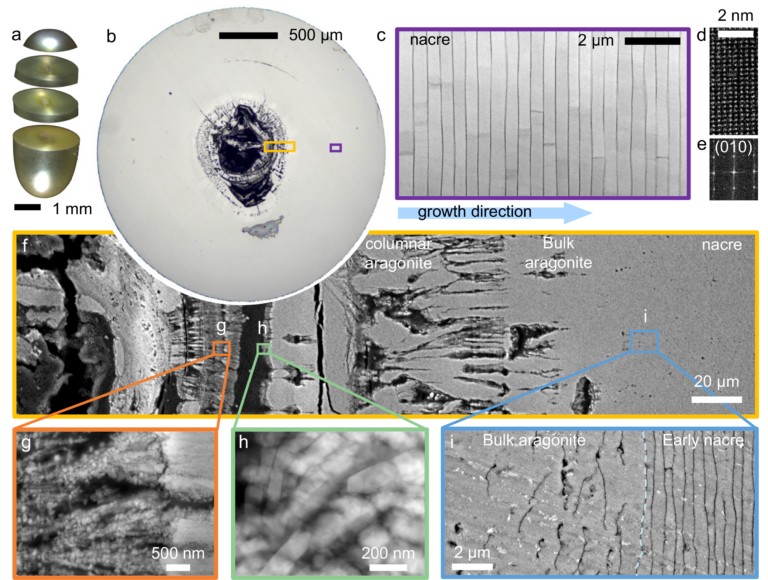
Perhaps the most surprising finding is that mollusks maintain the symmetry of their pearls by adjusting the thickness of each layer of nacre. If one layer is thicker, the next tends to be thinner, and vice versa. The pearl pictured in the study contains 2,615 finely matched layers of nacre, deposited over 548 days.

University of Michigan

“These thin, smooth layers of nacre look a little like bed sheets, with organic matter in between,” Hovden said. “There’s interaction between each layer, and we hypothesize that that interaction is what enables the system to correct as it goes along.”

The team also uncovered details about how the interaction between layers works. A mathematical analysis of the pearl’s layers show that they follow a phenomenon known as “1/f noise,” where a series of events that seem to be random are connected, with each new event influenced by the one before it. 1/f noise has been shown to govern a wide variety of natural and human-made processes including seismic activity, economic markets, electricity, physics and even classical music.

RELATED: New Mathematical Formula Unveiled to Prevent AI From Making Unethical Decisions

“When you roll dice, for example, every roll is completely independent and disconnected from every other roll. But 1/f noise is different in that each event is linked,” Hovden said. “We can’t predict it, but we can see a structure in the chaos. And within that structure are complex mechanisms that enable a pearl’s thousands of layers of nacre to coalesce toward order and precision.”

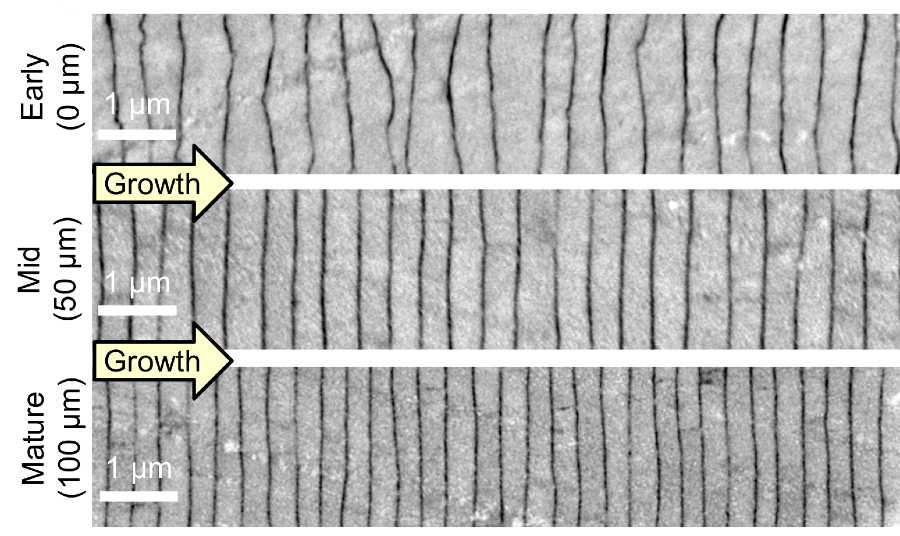
Electron microscopy shows how a pearl’s layers of nacre become more precise as they build outward from the pearl’s center/University of Michigan

The team found that pearls lack true long-range order—the kind of carefully planned symmetry that keeps the hundreds of layers in brick buildings consistent. Instead, pearls exhibit medium-range order, maintaining symmetry for around 20 layers at a time. This is enough to maintain consistency and durability over the thousands of layers that make up a pearl.

The team gathered their observations by studying Akoya “keshi” pearls, produced by the Pinctada imbricata fucata oyster near the Eastern shoreline of Australia.

They selected these particular pearls, which measure around 50 millimeters in diameter, because they form naturally, as opposed to bead-cultured pearls, which have an artificial center. Each pearl was cut with a diamond wire saw into sections measuring three to five millimeters in diameter, then polished and examined under an electron microscope.

MORE: The Mind-Blowing Mathematics of Sunflowers 

Hovden says the study’s findings, published in Proceedings of the National Academy of Sciences, could help inform next-generation materials with precisely layered nanoscale architecture.

“When we build something like a brick building, we can build in periodicity through careful planning and measuring and templating,” he said. “Mollusks can achieve similar results on the nanoscale by using a different strategy. So we have a lot to learn from them, and that knowledge could help us make stronger, lighter materials in the future.”

Source: University of Michigan

SHAPE Those News Feeds Towards the Good, Share This Pearl of a Story…

World’s Most Premature Baby Defies 1% Survival Odds to Break Guinness Record

This article has been reprinted with permission from Guinness World Records

Guinness World Records

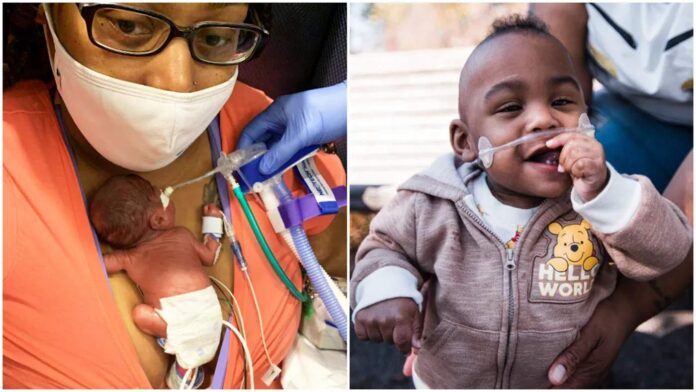
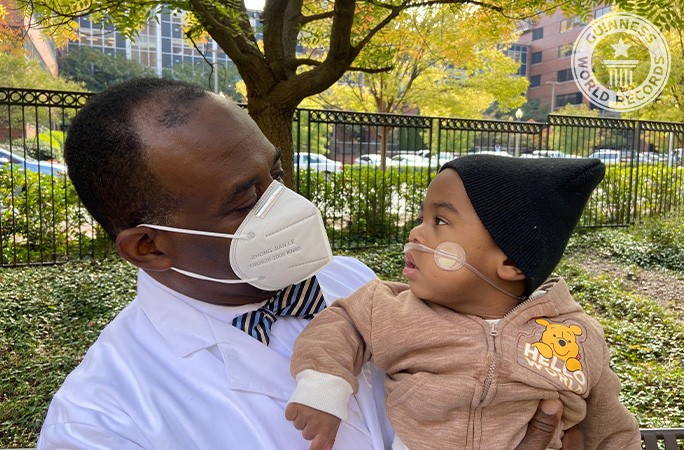
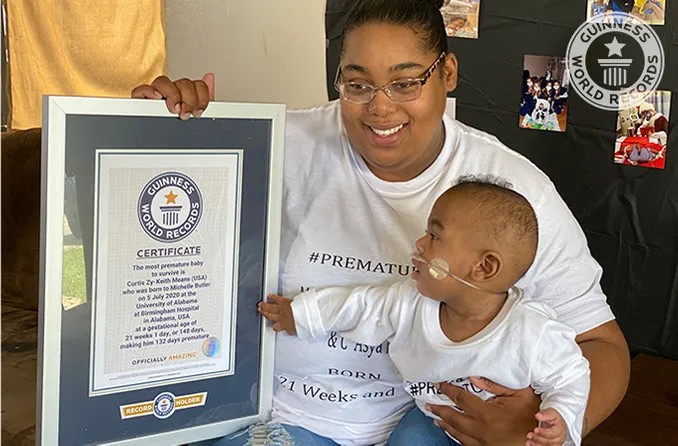
Born in July 2020, exactly one month after the previous world’s most premature baby, Curtis Zy-Keith Means from Alabama, USA, would go on to make history.

Initially, Michelle “Chelly” Butler’s pregnancy seemed to be progressing well and on track to go to full term. But on 4 July 2020, she had to be rushed into hospital for emergency surgery.

She was quickly transferred from her local hospital to the University of Alabama at Birmingham (UAB), which is heralded for having one of the leading neonatology and paediatric departments in the country.

Thanks to the quick response of the experienced medical team at the Regional Neonatal Intensive Care Unit (RNICU), following his mother’s wishes, Curtis was delivered at a gestational age of 21 weeks 1 day (148 days) at around 1 p.m. on 5 July.

His original due date had been 11 November. A full-term pregnancy is typically 40 weeks, or 280 days, making Curtis 132 days—almost 19 weeks—premature.

Guinness World Records

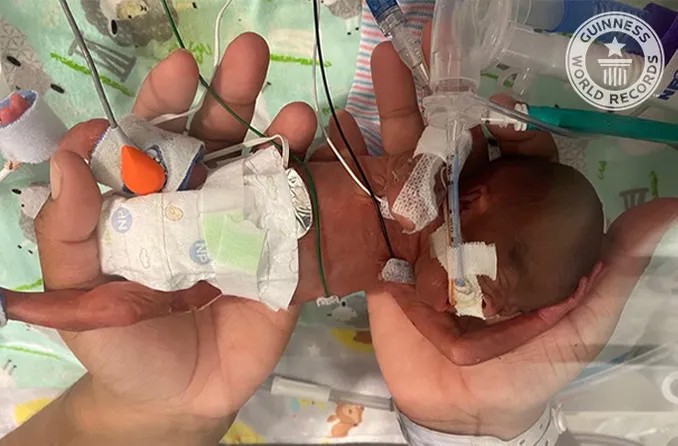
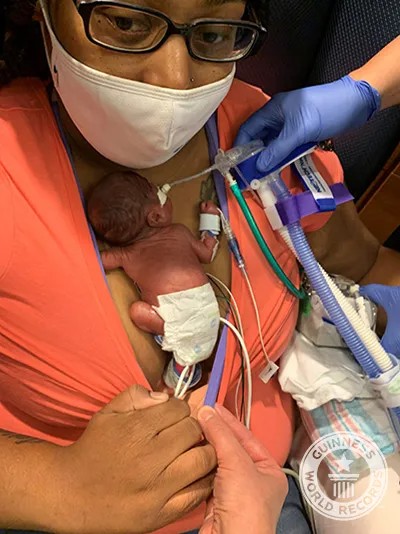
As a newborn, Curtis weighed only 420 g (14.8 oz), which is about the same as a soccer ball.

RELATED: Babies Mixed Up in Hospital, But Then Families Decide to Raise Them Together and They’re All Best Friends Now

“The medical staff told me that they don’t normally keep babies at that age,” Chelly told Guinness World Records in an exclusive interview. “It was very stressful.”

To everyone’s amazement, Curtis responded extraordinarily well to treatment and, as the days and weeks went on, he grew stronger and stronger.

That said, there were many challenges along the way and he required around-the-clock care for many months.

This incredible story of joy and beating the odds is tempered with heartache because Curtis was one of twins.

Also delivered at 21 weeks 1 day, his sister—C’Asya Means—was less developed and did not respond to the treatment in the way her brother did. Tragically, she passed away just a day after birth.

Guinness World Records

For the vast majority of preterm babies born this early on, the chances of a long-term future are vanishingly slim. This is what makes Curtis’ recovery all the more exceptional.

Dr Brian Sims, the neonatologist on duty who oversaw the twins’ delivery and who was greatly involved with Curtis’ subsequent treatment, told us, “The numbers say that babies at this age will not survive. Mom’s question to me was: ‘Can we give my babies a chance?'”

LOOK: First Neonatal Wearable Could Provide Real-time Detection of Jaundice and Vital Signs

After 275 days (about nine months) of being looked after by a huge team at the RNICU and the wider Women and Infants Center, it was determined that Curtis was fit enough to go home on 6 April 2021.

His discharge from the hospital was only made possible with a tailored course of medication and special equipment such as bottled oxygen and a feeding tube, but it was nevertheless a major milestone on his extraordinary journey.

Guinness World Records

Curtis, or “Poodie” as his family also call him, celebrated his first birthday on 5 July 2021. At this point he qualified as the most premature baby to survive.

He has three siblings, the eldest of which love to help out with day-to-day care such as bathtime, getting dressed and feeding.

MORE: Lullabies Can Actually Improve the Health of Premature Babies in Hospital –And Their Family’s Health Too

“He’s very active. I’m tired already!” Chelly told us with a grin when asked about her son’s energy levels.

“I’m very proud of him because where he came from and where he at now, I can tell the difference.

READ: Research Shows Babies Are Relaxed By Lullabies Even in Foreign Languages: The Frère Jacques Response

“Having this record is a blessing that he has accomplished and I’m thankful that [Guinness World Records] accepted him.”

Guinness World Records

Now in November—which is aptly Prematurity Awareness Month—Curtis is about to see in what would have been his first birthday (11 November) had he gone to full term.

Of course, setting records was the last thing on the mind of his mother and the doctors at the time of his delivery.

At that point, it was all about getting through those extremely challenging first minutes, hours and days.

CHECK OUT:  ‘Mind-blowing’ Surgery in Mothers’ Wombs Spared Dozens of Babies From Spina Bifida Paralysis

“He showed initially that he responded to oxygen, his heart rate went up, his numbers went up…” Dr Sims informed us.

“He was giving us a lot of positive feedback that… he wanted to survive.”

From the very beginning, Dr Sims was astounded by Curtis’ resilience. “I’ve been doing this almost 20 years… but I’ve never seen a baby this young be as strong as he was… There was something special about Curtis.”

(WATCH the video for this story below.)

SHARE This Story of Defying the Odds With Friends…

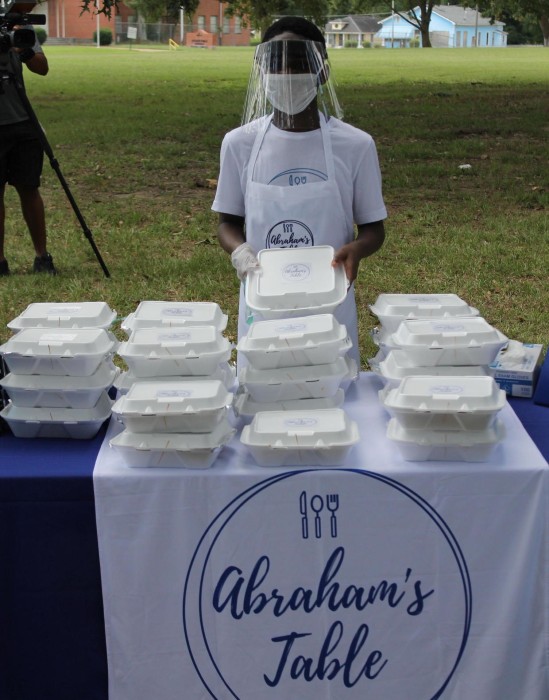
13-Year-old Boy Granted a “Make-A-Wish” and Uses It to Feed the Homeless Every Month for a Year

Abraham Olagbegi family photo Make a Wish YouTube
Abraham Olagbegi; family photo/Make-a-Wish;YouTube

When life hands you a miracle, you can bask in its glow—or you can pay it forward.

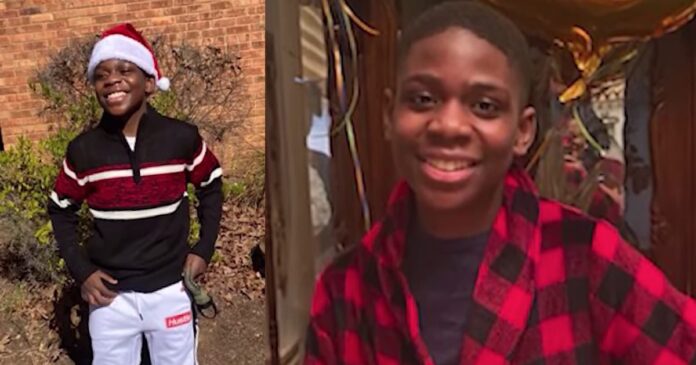
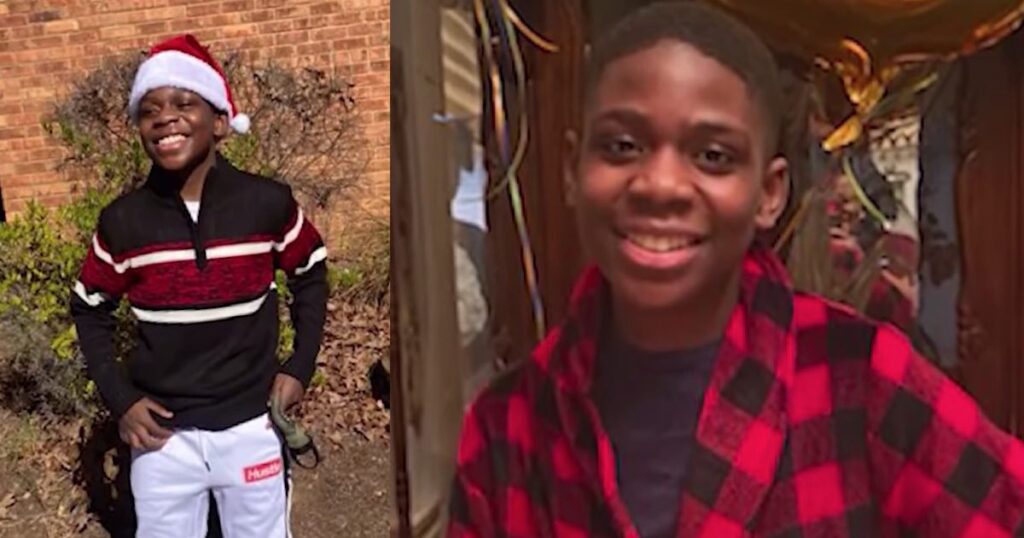
Abraham Olagbegi was 12 years old when he and his family learned that without a bone marrow transplant, the rare blood disease he’d been born with might prove fatal.

Fast forward one year, one successful transplant, and an intense schedule of chemotherapy later, and Abraham is out of the hospital and his prognosis is promising—but that’s not the only good news.

Over the course of his illness, Abraham learned he’d qualified as a recipient for Make-A-Wish, a charitable organization whose purpose is to make the dreams of seriously ill children come true one wish at a time. Rather than something for himself, Abraham chose to show thanks for his good fortune by passing it along to others.

On their way home from one of his many doctor’s appointments, the Mississippi teen shared his decision with his mom, Miriam. The wish Abraham asked for was to feed the homeless in his area one day a month for an entire year.

While she couldn’t have been more proud of Abraham, Miriam did wonder if perhaps he wouldn’t rather have something for himself—like a PlayStation—but really, she wasn’t surprised by her son’s selflessness. Prior to his diagnosis, Abraham and his family regularly volunteered in their community handing out hot meals to the homeless.

MORE: Boy Raises $700,000 For Hospice By Camping Out For 500 Nights After Dying Man Gives Him a Tent

“It was always a good thing to do, and that’s what I grew up doing that,” Abraham told WLBT-News 3. “So, I go back to my roots to do what I was taught to do.”

Make-a-Wish

“When he so easily gives to others at a time where everybody should really be supporting him, you just have to say, that’s a remarkable young man,” Linda Sermons, an assistant with Make-A-Wish Mississippi said in an interview with WAPT-News 16.

On the third Thursday of each month, Make-A-Wish’s Mississippi chapter has committed to helping Abraham coordinate with local organizations and businesses to feed up to 80 homeless people in Jackson’s Poindexter Park. As of October, Abraham has helmed two successful “Abraham’s Table” events, distributing the donated goods to folks in need.

“When the homeless people get the plate, some of them would come back and sing to us and thank us,” Abraham told CBS News. “It just really feels good, it warms our hearts—and my parents always taught us that it’s a blessing to be a blessing.”

“We were excited,” Sermons told WLBT News 3 during the first event in September. “This is our first philanthropic wish in our 20-plus years of the chapter in the state. [It’s] a huge milestone for us, but also this is the first meal that Abraham is able to serve.”

RELATED: Remarkable 10-Year-old Inspires the World to Donate Half a Million Books For Kids: ‘A Catalyst’ For Kindness

While a dozen days of giving is admirable, when the year is up, Abraham plans to keep his mission going. “We’re very excited to be able to continue on this endeavor. It’s just so rewarding,” Miriam told CBS. “If I was out there on the streets, homeless, I would want somebody at some point to think of me and to do something special for me, so, that’s what I try to instill in my kids.”

Abraham still receives weekly checkups to monitor his condition, but he has faith in his future. “I am a person of hope,” he told WLBT. And as the type of person who not only has hope but gives it as well, he’s a true inspiration.

(WATCH the CBS video for this story below. Editor’s Note: Viewers outside the US can view this video on the CBS website, here)

CURE Those News Feeds of Negative News—Share This Story of Kindness…

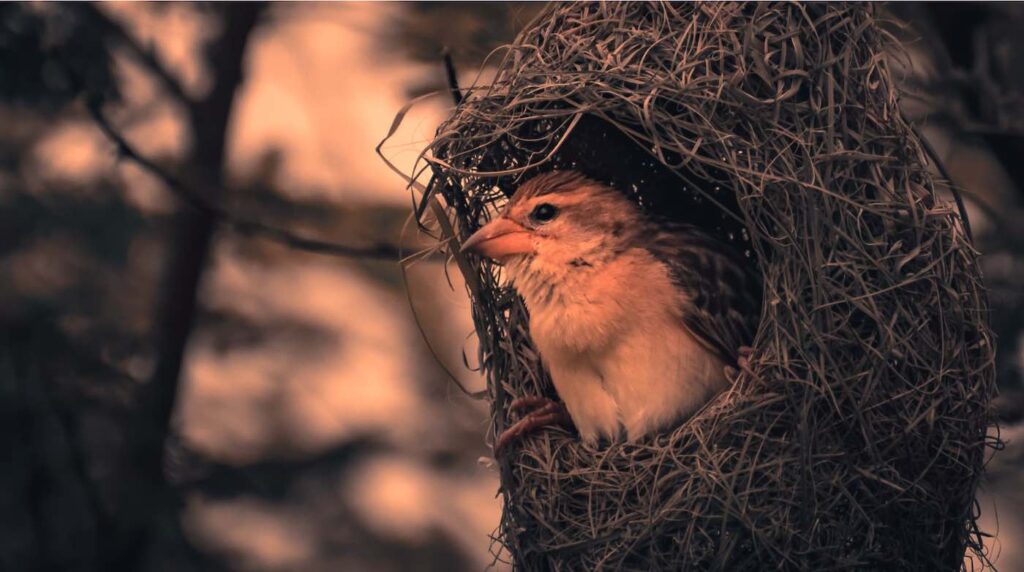
“A bird is safe in its nest—but that is not what its wings are made for.” – Amit Ray

Quote of the Day: “A bird is safe in its nest—but that is not what its wings are made for.” – Amit Ray

Photo: by Hersh Chauhan

With a new inspirational quote every day, atop the perfect photo—collected and archived on our Quotes page—why not bookmark GNN.org for a daily uplift?


Incredible Cave Paintings 8 Miles-Long Revealed Deep in Amazon Forest: The Sistine Chapel of Ancients

GIPRI Colombia/YouTube

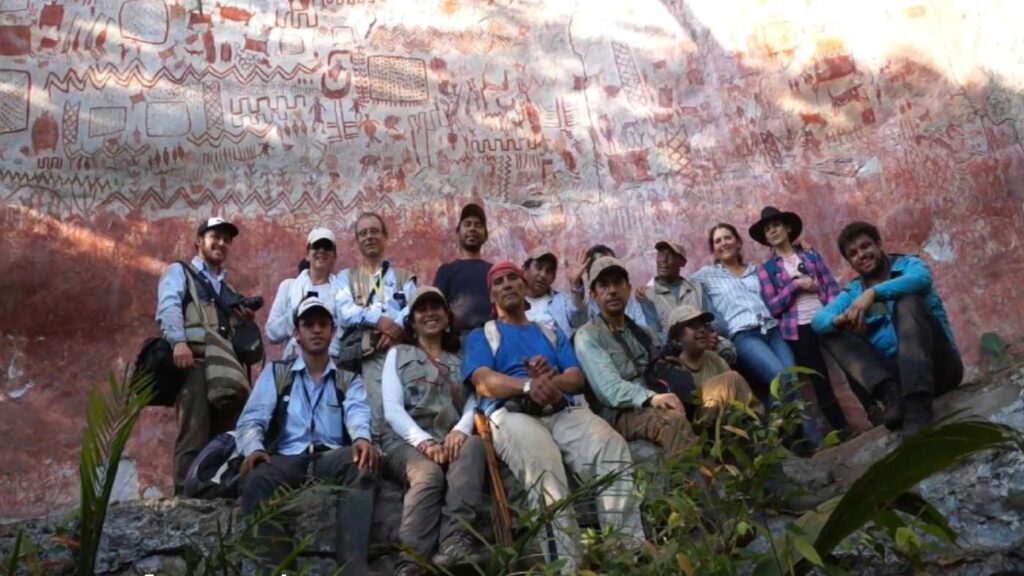
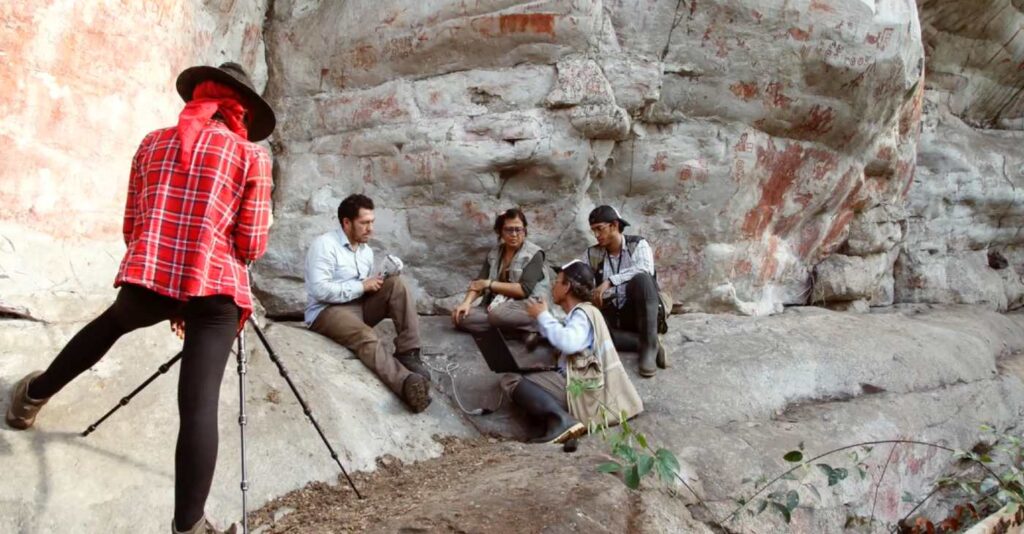
Tens of thousands of pristine cave paintings were found daubed across an eight-mile stretch of rock in a once-in-a-century discovery in Colombia’s Amazon rainforest.

Hailed as the “Sistine Chapel of the Ancients,” it’s the kind of discovery that changes the world of archaeology.

Believed to be 12,500 years old, the art is extremely detailed, and includes handprints and depictions of Ice Age megafauna like the mastodon, a relative of the mammoth, Ice Age horses, and giant ground sloths.

The discovery, made in Chiribiquete National Park in the south of Colombia, was actually made in 2019 but was kept quiet to be revealed in a major documentary called Jungle Mystery: Lost Kingdoms of the Amazon.

Presumably, archaeologists also want to preserve as much time to study the art alone as they can, as the news could draw tourists, or even looters and artifact hunters to the site.

RELATED: While Excavating 1000-Year-old Viking Ship, Norwegians Find Remnants of Elite Society

The discoverers suspect the works could have been made by Paleolithic hunters who crossed the Bering land bridge into the new world from Siberia.

Of majesty and mystery

A joint Colombian-British team made the discovery, led by Jose Iriarte, a professor of archaeology at Exeter University, who was quite vocal about the raw power of literally tens of thousands of different images, some of which are so well done they include horse tails with individual hairs painted.

CHECK OUT: Rare Archeological Treasures Discovered Beneath Attic Floorboards of English Tudor Mansion

“When you’re there, your emotions flow… We’re talking about several tens of thousands of paintings. It’s going to take generations to record them … Every turn you do, it’s a new wall of paintings,” he told the Observer.

GIPRI Colombia/YouTube

Further complicating the mystery is that the paintings cover nearly every inch even far up the cliff faces where they were only seen clearly when the archaeologist broke out the flying camera drones.

“I’m 5ft 10in and I would be breaking my neck looking up. How were they scaling those walls?” said Paleo-archaeologist Ella Al-Shamahi, who will present the new documentary.

Along with large mammals, birds, fish, lizards—masked figures often in dance are also painted here.

Trees and hallucinogenic plants are also depicted, which wasn’t a surprise to Iriarte who noted that “for Amazonian people, non-humans like animals and plants have souls, and they communicate and engage with people in cooperative or hostile ways through the rituals and shamanic practices that we see depicted in the rock art.”

Chiribiquete was an area that was controlled by the anti-government paramilitary organization FARC until recently, when they signed a truce with Bogota, which is likely one reason why it’s taken so long to discover such an enormous trove of cave paintings.

GIPRI Colombia/YouTube

Al-Shamahi recalled, according to the Guardian, that “when we entered FARC territory, it was exactly as a few of us have been screaming about for a long time. Exploration is not over. Scientific discovery is not over but the big discoveries now are going to be found in places that are disputed or hostile.”

MORE: Buried Roman City Mapped in Stunning Detail Using Ground-Penetrating Radar

The team will be back, searching the surrounding areas for more paintings as soon as COVID-19 allows.

Jungle Mystery: Lost Kingdoms of the Amazon debuted on Channel 4 in the UK in December. Watch a clip below…

SHARE This Astonishing Find on Your Own Wall on Social Media…

Bride Surprises Blind Groom by Wearing a Special Tactile Wedding Dress: ‘My mind was blown’

David Gannon Photography

Weddings are by their nature, inherently touching, but for one recent bride and groom, the ceremony was not only touching but tactile as well.

When Kelly Anne and Anthony Ferraro decided to tie the knot, Kelly wanted to make the day extra special for her soon-to-be husband. Since Anthony is blind, she knew he wouldn’t get to view her in her wedding finery, but nonetheless, she was determined to make sure he got to “see” her by on their big day.

He’d simply have to use his other senses.

Combining a variety of fabrics, the custom-made, one-of-a-kind gown Kelly came up with for her walk down the aisle was taken more from pages of a book by Louis Braille than as a nod to the designer fare of traditional bridal magazines.

Kelly’s dress told a romantic tale in texture—one that was meant for her true love alone to read.

“She’s like, ‘Well you can’t see me, so I’ve got to wear something that feels nice,’” Anthony told CBS News. “No one’s ever thought to do that—ever.”

RELATED: Implanted Electrodes Could Offer Improved Vision for 148 Million Blind People

Kelly’s eloquent nuptial frock wasn’t without precedent. For their first date, she purposely chose to wear a velvet dress so Anthony would be able to feel its softness.

She recalls her sister teased her over her wardrobe selection at the time, but Kelly refused to give in because she thought Anthony might appreciate the gesture. He did. So much so in fact, that the example served as inspiration for her multi-textured wedding gown.

When the couple met at the altar, a jubilant Kelly urged Anthony to feel her dress. “My mind was blown. I started crying,” he told CBS. “It was just like I was able to see Kelly. That was the best part… when I was feeling the dress, I was creating this image of an angel in my brain. It was just so beautiful.”

MORE: Restaurant Makes Special Chocolate For Blind Customer With Birthday Message in Braille

Anthony credits Kelly with the kind of empathy that’s all too rare in the world. He says being able to put yourself in other people’s shoes is admirable, but having the ability not only to understand that each of us is unique but also to be willing to take the extra step that’s sometimes needed to make others feel included, appreciated—and loved—is a true gift.

For Anthony, having found that quality of compassion in Kelly is more than just a wedding present—it’s a blessing that will last a lifetime.

(WATCH the CBS video for this story below. Editor’s Note: Viewers outside the US can view this video on the CBS website, here)

FEEL Good News Should Be Accesible to All—Share This Story…

Camping Travelers Can Rent Old, Empty Churches in UK to Help Pay for Historical Upkeep

All Saints Church in Langport bed-Champing_The-Churches-Conservation-Trust
All Saints Church in Langport/Champing; The Churches Conservation Trust

In the UK, historic churches are becoming unique destinations for an overnight stay in nature—at the same time that money is being raised to save them.

It’s all thanks to “Champing,” the latest in the history of the Brit’s tampering with the world “camping” (“glamping” originated as a word here in 2005.)

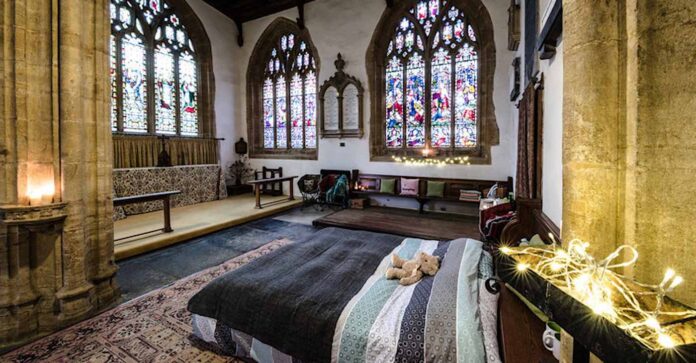
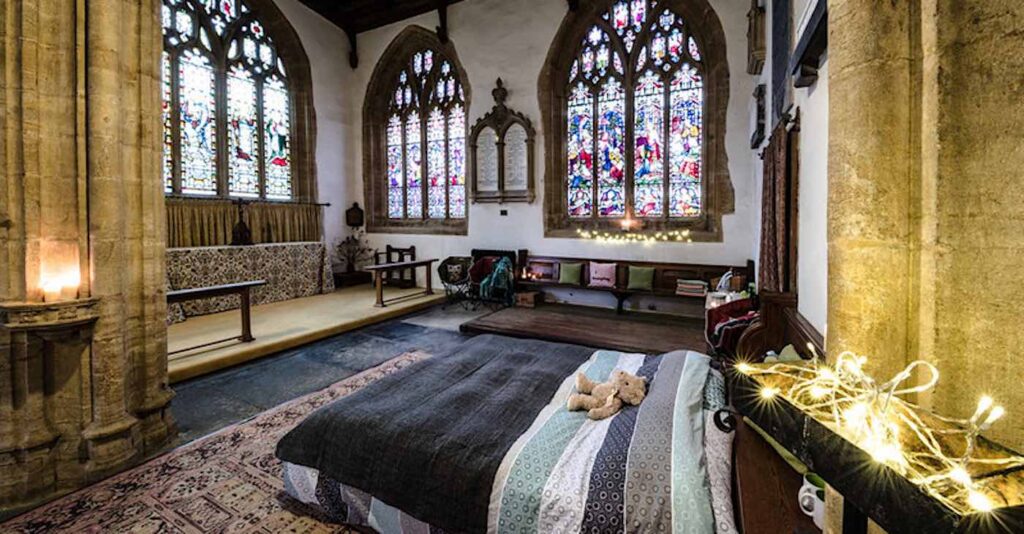
Champing involves booking a church as a campsite for the night, and Champing the organization ensures that unmet necessities are provided, and that all proceeds keep the churches, some of which date back to the 12th century, in good order.

Champing started when some Scots camped in a church cared for by The Churches Conservation Trust, and guessed after a great night that perhaps other folk would enjoy a similar nighttime experience.

On the banks of the River Nene, the Scots hired the local canoe rental company to provide accommodations to those traveling up the river in Northhampshire by hosting them at All Saints, at Aldwincle, a 12-sleeping church built in around the late 1400s.

Now Aldwincle is one of 20 churches managed by Champing, who provide camp beds, camp stoves, fairy lights, lanterns, and tea- and coffee-making equipment.

For the churches without flushing toilets, Champing provide a mobile one powered by solar energy.

Aldwincle/Champing

They’ll even try to include a breakfast, if delivery can be facilitated or if a restaurant is willing to partner with them.

Meet the churches

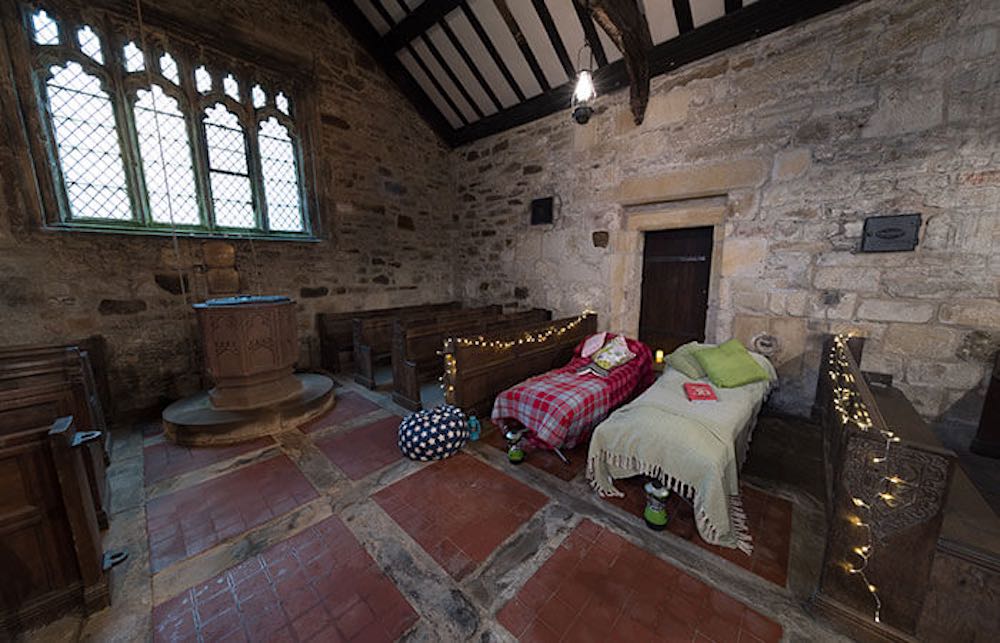
St. Leonard’s, in Old Langho, Lancashire, is a cozy church set in the heart of the Ribble Valley, an area of outstanding natural beauty and also known as the food capital of the North. There is a family friendly pub next door and a Michelin-starred restaurant nearby.

Exterior Old Langho,St Leonard’s Church;Champing

St. Leonard’s was built immediately following the Protestant Reformation, and the details are very different, including exquisitely-carved wooden pew benches engraved with the initials of the patrons of the early construction.

RELATED: Millennials Are Eating More Adventurously, Trying More Foreign Food—And Even Catching Their Own Dinner

An 540 square-mile forest, a medieval castle museum, and a manor house containing England’s first-ever wafflery, are all nearby.

Old Langho, St Leonard’s Church; Champing

Perched proudly on a hilltop, All Saints Church at Langport has a thriving local community to explore, with cideries, cozy cafes, and more. Built in the 12th century and rebuilt in the 15th, Langport has electricity, and the finest collection of stained glass in Somerset.

St. Cuthbert’s Church in Holme Lacy, Herefordshire, sits along a pretty bend in the River Wye, and is crafted of beautiful stone work containing exquisite monuments to the church’s patrons from the Middle Ages, the Scudamore Family, who were buried here.

MORE: Rent Winnie the Pooh’s Tree House in the Original Hundred Acre Wood at This ‘Bearbnb’

Nearby Hereford Cathedral is the stunning centerpiece of an old Medieval townscape. Its archives include world famous literary relics including the Chained Library, and some of the most famous documents in history, the Mappa Mundi and the Magna Carta.

HELP Good News Make the Pilgrimage to Friends’ Feeds; Share This Story…

See Incredible Transformation of Paralyzed Mice Given Nanofibers in 4 Week Study Breakthrough

SectionOfSpineInGreenWithRedRegenerative Samuel I. Stupp Laboratory . Northwestern University released
Samuel I. Stupp Laboratory/Northwestern University

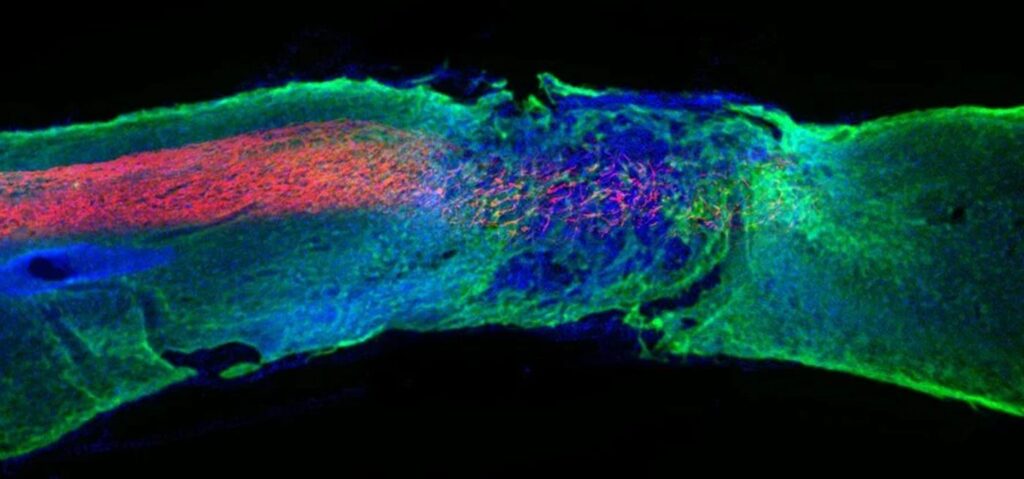
A “bioactive scaffold” regenerated damaged cells in the nervous systems of mice paralyzed from spinal cord injuries, allowing them to walk again 3-4 weeks after treatment—an astonishing feat never before achieved.

The treatment opens a gateway into research on curing paralysis that’s never been opened before, and could be subject of FDA trials as early as next year.

“I cannot tell you how excited I am about this work,” said Northwestern University’s Samuel Stupp, who led the trial. “This is probably the most important paper I’ve ever written, and it describes a piece of science that was truly unknown.”

Spinal cord injuries are generally game over as far as normal movement is concerned—on average, fewer than 3% of the 300,000 people in the U.S. living with such injuries will ever recover meaningful function over their legs.

Part of the reason is that the central nervous system isn’t very effective at repairing itself, and the scarring that occurs after such an injury acts as a physical barrier to most regeneration.

In some cases, external electrical stimulation can help retrain basic functions in the hands, but also the legs in a therapy program. GNN has also reported on the use of triple nerve transplants, which allowed for an Australian quadriplegic to regain the use of his hands.

MORE: Paralyzed Man’s Brain Waves Get Turned Into Sentences on Computer, Scientists ‘Thrilled’ Beyond Words

This new method uses an injection, but rather than injecting stem cells, proteins, or modified genes to try and program tissues to repair themselves, Stupp’s team used nanofibers, each just one ten-thousandth the width of a human hair, to mimic something called the extracellular matrix, which is a network of molecules surrounding cells. The fibers contain peptides, little bioactive molecules that transmit signals and promote nerve regeneration.

For the trial, published in Science journal, the mice that were paralyzed were given an injection of the fibers a day following their injury to simulate the time at which most spinal cord injury victims receive treatment.

RELATED: Paralyzed Patient Can Now Write as Fast as Smartphone By ‘Mindwriting’ With Brain Signals

After four weeks the mice could walk again, and those that had received a placebo shot could not. Afterwards, when their spinal cords were examined—it was found that the axons, the severed extensions of neurons which generally fail to repair under normal injury conditions—regenerated, and that the physical barrier of the scar tissue diminished significantly.

More ver, the layer of axons which form a protective insulation called myelin, reformed itself, as did oxygen carrying blood vessels, and more motor neurons survived.

Stupp and the rest of the research team hypothesized this was because the receptors in neurons are in constant motion, but so are nanofibers, and the result of which is that the overly-busy pairs connected more effectively.

LOOK:  Northwestern Scientists Repair and Reverse ALS Neuron Damage in Lab Using New Non-Toxic Compound

Stupps is now looking to trial the work with humans because the nervous systems across animal species are very similar, and because there’s simply nothing else out there for helping people who have lost mobility due to spinal cord injury.

(WATCH the video for this story below.)

SHARE the Latest Research and Help Others in the Know…

“Optimism is a strategy for making a better future. Because unless you believe that the future can be better, you are unlikely to step up and take responsibility for making it so.” – Noam Chomsky

Quote of the Day: “Optimism is a strategy for making a better future. Because unless you believe that the future can be better, you are unlikely to step up and take responsibility for making it so.” – Noam Chomsky

Photo: by Victor Malyushev

With a new inspirational quote every day, atop the perfect photo—collected and archived on our Quotes page—why not bookmark GNN.org for a daily uplift?


Woman Falls Down Mountain, Writes Hilarious Review For Leggings Giving Them 5-Stars

Cory H. Amazon review

A woman was so impressed by a pair of leggings after she tumbled ‘down a mountain’ that she posted an Amazon review that has gone viral.

Cory H. Amazon review

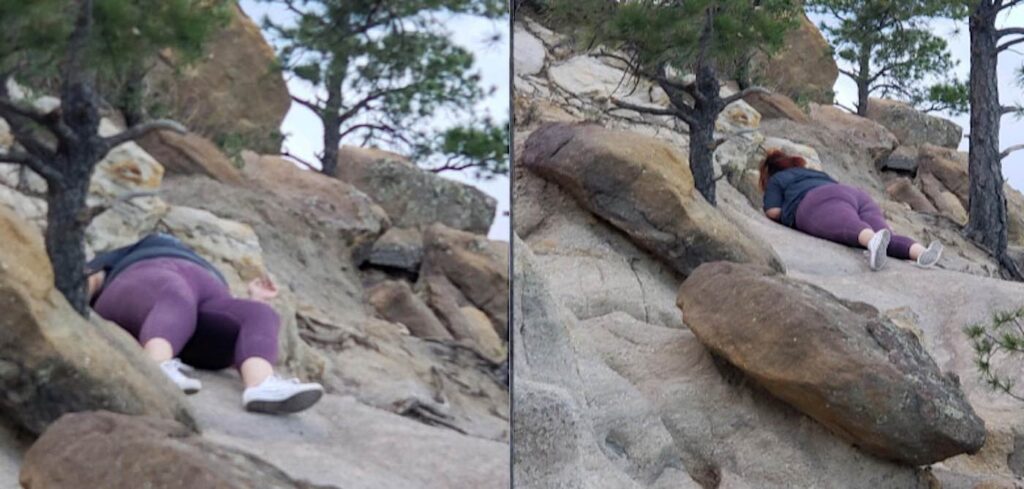
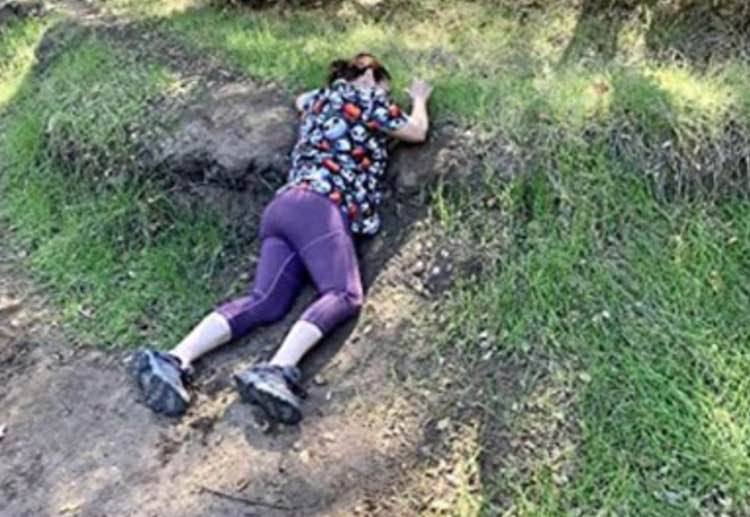
Cory H. posted photos of herself sprawled on a rocky slope saying there was not even a hole in the pants after the accident.

Her photographic testimony spurred over 18,000 shoppers to mark her review as ‘helpful’.

The Amazon user enthusiastically left a five-star rating for the Raypose exercise leggings, which cost $13.99, encouraging others to ‘order them now’.

She wrote: “Can I just say that I will be reordering them in every color. Here is me rolling and sliding down a mountain because I was too scared to get up. My leggings did not rip not even a little bit and I got stuck on rocks and trees.”

WATCH: Daughter Can’t Stop Laughing About Her Mom’s Exercise Routine

Screenshots of the amusing review were posted on Twitter last week, racking up more than 400,000 likes.

“I think about this twice per week,” the tweet said.

In response, another reviewer posted her own photo of the leggings in action, mimicking the image in amusing fashion by laying sprawled on her own hill.

Kimberly on Amazon

“Mountain sliding legging lady was right!” Kimberly, wrote.

POPULAR: Dad Hilariously Struggles to Keep Triplets From Climbing Furniture (Watch)

“These Raypose leggings off Amazon are exactly as good as the lady in the reviews says. Glad I bought five!”

SHARE the Laugh on Social Media—and the Leggings!

Students Build Solar-Powered Pop-Up Van For Touring in a Brilliant Mobile Home That Has Zero Emissions

By Bart van Overbeeke for Solar Team Eindhoven

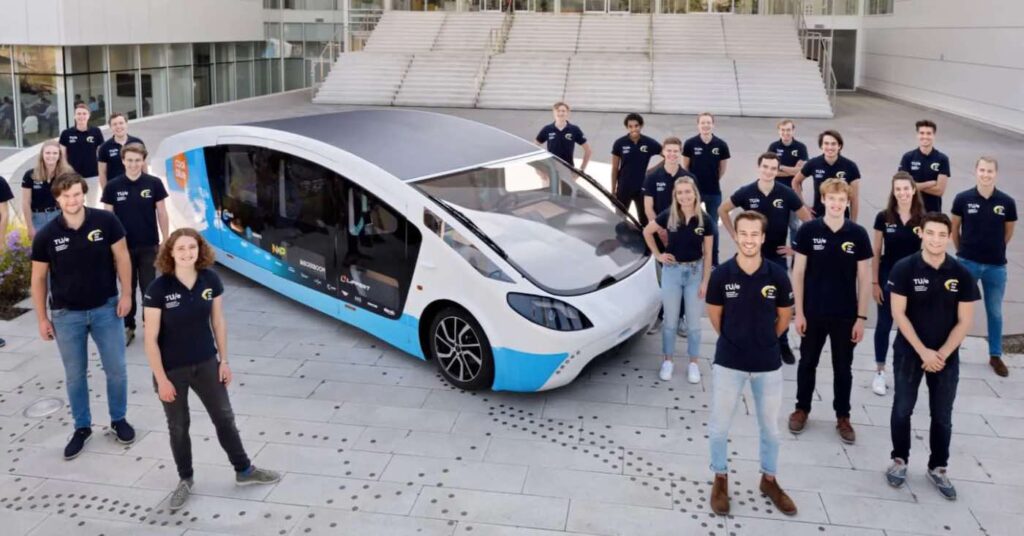
22 Dutch university students have completed an 1,800 mile road trip powered only by the sun, on a quest to show that sustainable vehicles can let you travel the world without harming the environment.

Enrolled in Eindhoven University of Technology in the Netherlands, the students say their van—named Stella Vita—is the world’s first solar powered mobile home.

With its solar panel roof, and wings that fold out with additional panels when parked, the team has doubled the solar surface to 17.5 square meters, which generates enough energy to live and drive on.

On a sunny day, Stella Vita, which is road legal and has a license plate, can travel up to 453 miles (730 km) within 24 hours and reach a speed of 75 miles per hour.

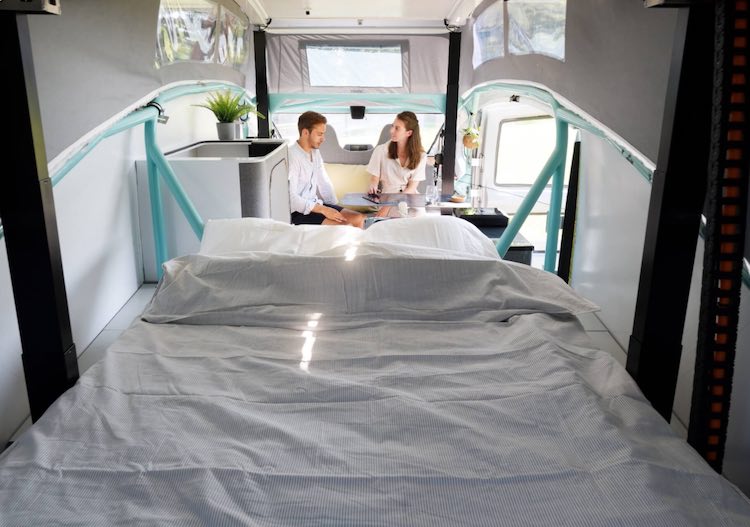
With a roof that pops up when stationary, you can stand inside while cooking.

Made for two people, it has a kitchen with a fridge, a seating area, bed, shower and toilet.

(See the video at the bottom.)

By Bart van Overbeeke for Solar Team Eindhoven

“Stella Vita is a self-sustaining house on wheels,” says their website. “Through solar panels on the roof, it is independent of charging stations.” But it does have an electric power charger in case of emergency.

The vehicle generates enough solar energy to drive, shower, watch TV, charge your laptop, and make coffee, says the team.

In one year, the students succeeded in designing and building the mobile home and last month completed their demonstration road trip from Eindhoven to the southern tip of Spain.

POPULAR: They’ve Designed a Livable Pontoon Boat Inspired by a Volkswagen Bus

The drivers and passengers can also track the amount energy used, and how much is remaining. News reports say that it has a 60 kilowatt-hour battery that allows it to travel 373 miles at night.

“On a cloudy day the vehicle can still produce 60-70% of the energy,” the team coordinator Dr. Carlo van der Weijer told The Guardian. “And even if there is no sun at all, you still have an efficient, normal electric car that you can charge from a charging port.”

By Bart van Overbeeke for Solar Team Eindhoven

This isn’t the first solar vehicle made by the team of University students and faculty that work under the name Solar Team Eindhoven, launched in 2012. In their first year, they pioneered the building of a solar powered family car called Stella.

Since then there have been 3 more vehicles before this pop-up van.

RELATED: Flying Car Completes First-Ever Flight Between Airports –Then Transforms Back into a Sports Car in 3 Minutes

Stella and its successors Stella Lux, Stella Vie and the 5-seater Stella Era all raced in the World Solar Challenge in Australia and won in its Cruiser Class all four times it was held – in 2013, 2015, 2017 and in 2019. Being the only competing “family car” with a license plate, the road registration of Stella cars contributed to the their winning score in the races.

Solar Team Eindhoven has set up a nonprofit foundation to promote their practical solar vehicle concepts for adoption on a broader scale.

LOOK: Aptera Solar-Powered Car With ‘1,000-Mile’ Range Gets 7,000 Preorders for Delivery in 2021

In 2017, some of the students responsible for the vehicles launched their own startup company to make a commercially viable version of the car, called Lightyear One, which was due to deliver the 4-passenger solar cars costing around $127,000 this year.

WATCH the Reuters video of the Stella Vita Euro road trip…

ROLL This Beauty Over to Your Traveling Buddies on Social Media…

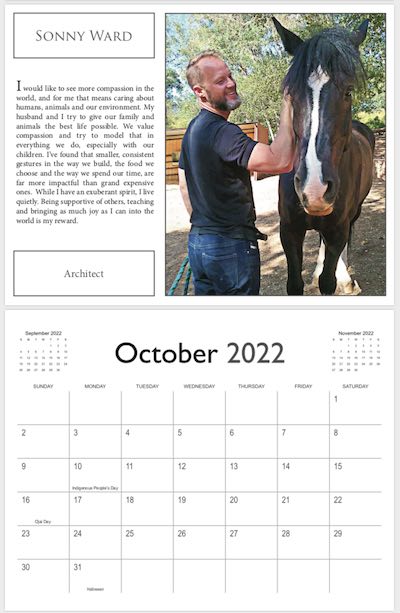
The Good Guys Calendar is a Celebration of Men and Their Good Deeds – Hang it on Your Wall in 2022

During the pandemic, Karen Banfield decided to focus on the goodness around her, specifically the men who were showing up with a generosity of spirit and open hearts.

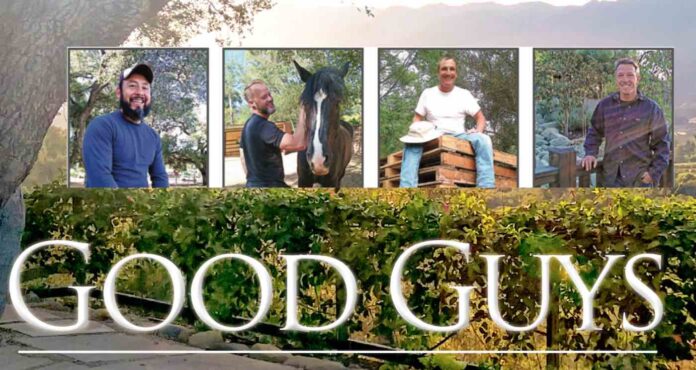
Her twelve favorites now make up a 2022 calendar called Good Guys.

“I focused on men because the news has been full of negative role models, and I believe having positive role models is essential,” she told GNN.

She photographed the twelve men in a natural environment and interviewed them, being sure to tell their stories in a way that conveyed their motivation for bringing kindness and goodwill into the world.

“These men, from diverse backgrounds, have touched many lives in small, often unnoticed, ways with compassion that made me smile—and just as often brought me to tears.”

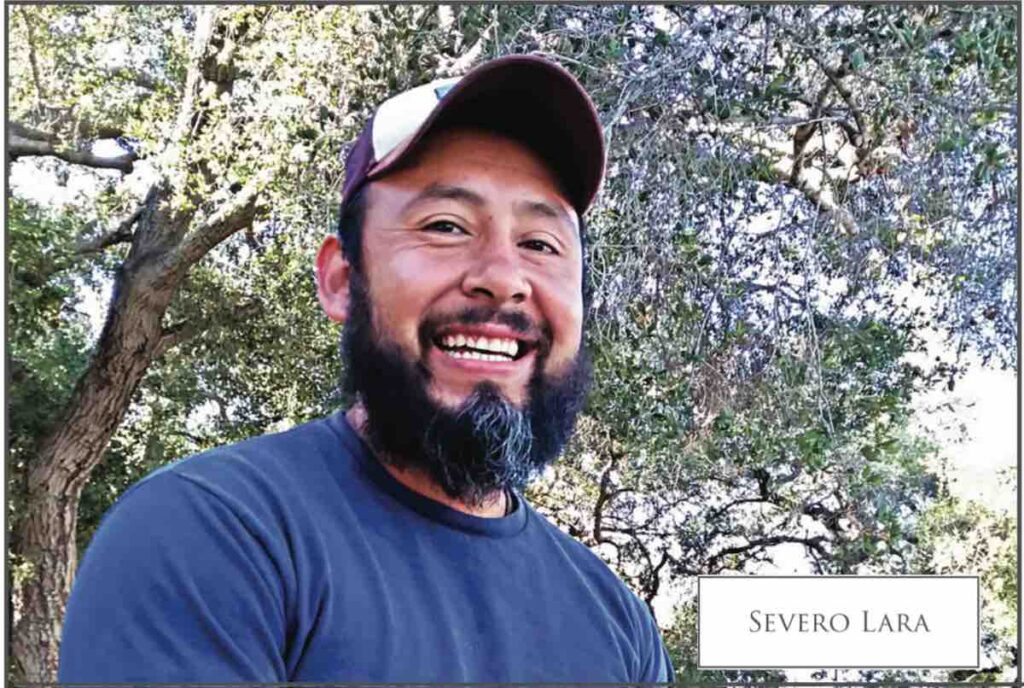
Mr. September (Severo Lara) was a single dad with two young girls when he was elected Mayor of the town of Ojai, California, where Banfield lives. A humble man, he often rode his bike to events when others arrive in expensive cars.

Although serving the village and several organizations, he always put the needs of his family first—even halting his campaigning the moment his young daughter tugged on his shirt to tell him she was tired and wanted to go home.

Banfield recalls, “Years ago, when I was still performing, I needed to transport chairs late at night from the theater to a storage unit. Severo was the one who showed up in the rain, after he had worked all day, to help load, transport and unload the chairs.”

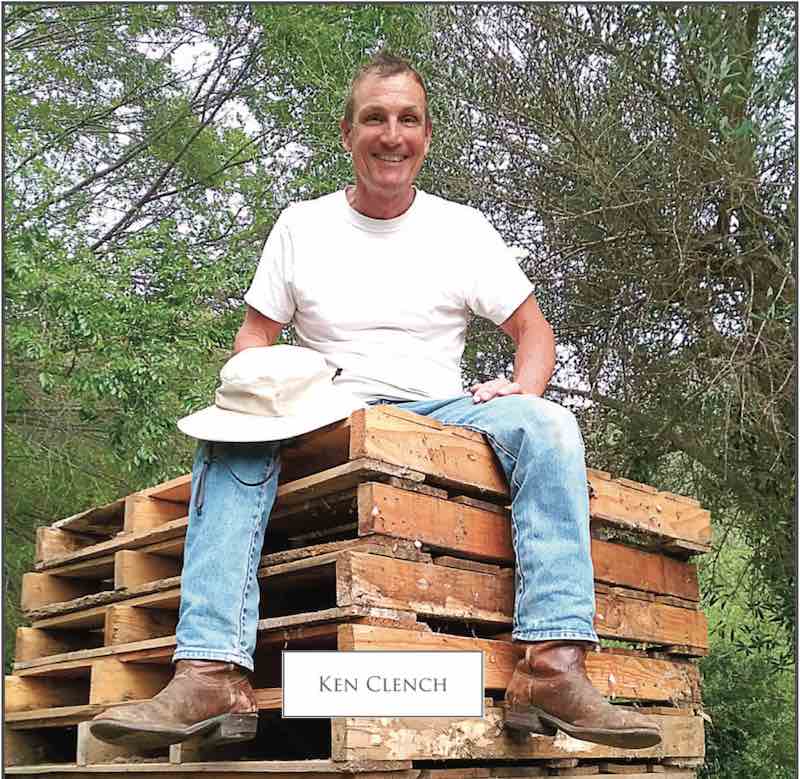
Mr. November (Ken Clench) first showed up on Banfield’s radar when he posted on a Facebook Community page offering free work to those in need. A month later, she arrived to a party, juggling food dishes, a gift, and a jacket in the driveway, when Ken swooped in, took the load from her arms and introduced himself with a smile.

“I asked about his donations of time and energy to the community and he said, ‘I’ve been going through a rough time, and keeping busy on my days off is the best medicine.’ A woodworker, Ken loves helping others. He built our little free library, and does other jobs in exchange for baked goods, dinner or conversation.”

A creative soul, when Ken joined Banfield’s Storytelling Class three years ago, he was nervous and full of fears and self-doubt, but his bravery, determination and willingness eclipsed all of that. In eight short weeks he was telling personal stories with confidence—and original music.

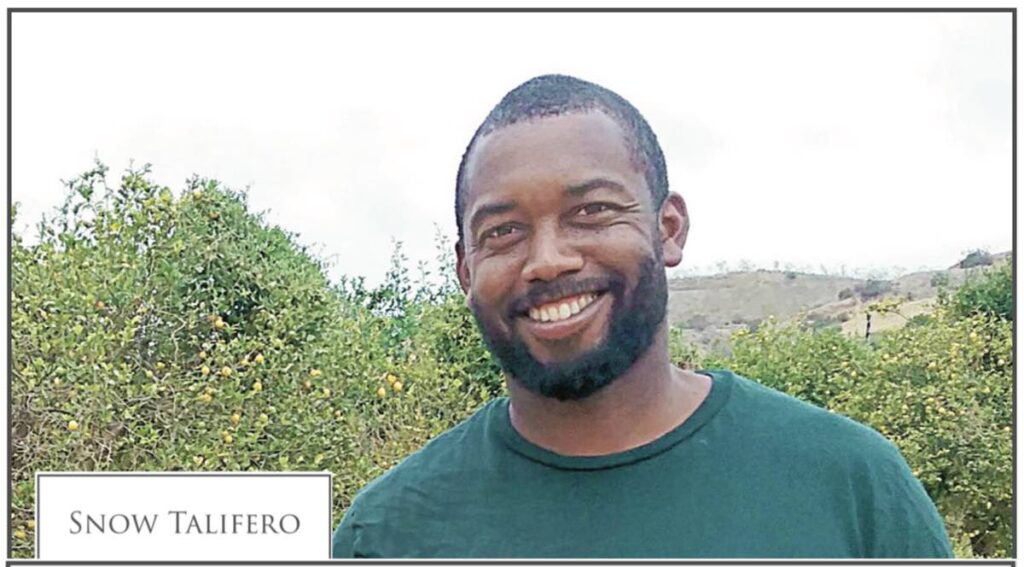
Mr. March (Snow Talifero) showed his generosity of spirit in the aftermath of the Thomas Fire, which nearly engulfed Ojai on its way to becoming the state’s largest-ever wildfire in 2017. The firefighter announced on the local community bulletin board that he would cut down dead trees for free, as a way to keep people safe.

Banfield said, “I thought about the need to get rid of that dead tree, but I’m a person with two afflictions: one the delusion that I am still capable of cutting down a tree at my advanced age, and two that I should do everything myself. So it was with trepidation and a little shame that I contacted Snow and asked for his service. He arrived the very next day, with his entire family in tow. They were going out to dinner, and in no time at all, he had cut the tree and readied it for removal.”

“It’s those little things that matter—those things that are easy for others, and almost impossible for me. I never forget a kindness, and value those who offer it with such grace and freedom.”

On the last page of the wall calendar, which Banfield is offering for sale, she invites readers to reflect on the Good Guys in their own lives, as a way to be grateful for the year ending in December, 2021.

To purchase the calendar, which measures 8 1/2 by 11 inches, visit her website (Click on the little credit card icons, if you don’t have a PayPal account.

The cost is $26.50 which covers shipping to anywhere in the U.S. If you need international shipping, you can email her at [email protected]. She also accepts Venmo or mailed checks for US shipping—but be sure to include your mailing address.

Karen Banfield: 25 Taormina Ln, Ojai, CA 93023.

HAIL These Good Guys on Your Social Media Wall By Sharing This Story Today… 

“No pessimist ever discovered the secret of the stars, or sailed to an uncharted land, or opened a new doorway for the human spirit.” – Helen Keller

Quote of the Day: “No pessimist ever discovered the secret of the stars, or sailed to an uncharted land, or opened a new doorway for the human spirit.” – Helen Keller

Photo: by Rowan Freeman

With a new inspirational quote every day, atop the perfect photo—collected and archived on our Quotes page—why not bookmark GNN.org for a daily uplift?


A 15 Million-Acre Protected Superhighway Near Galapagos Was Just Created to Preserve Marine Life

Hammerhead shark in Galápagos Marine Reserve – Galápagos Conservancy

Ecuadorian President Guillermo Lasso announced at the climate summit, COP 26 in Scotland, an expansion of the marine protections around the iconic Galápagos Islands by 23,000 square miles—nearly 15 million acres.

Lasso also announced the creation a protected swimway from Galápagos all the way to Costa Rica, an underwater superhighway refuge for a variety of endangered migratory animals such as scalloped hammerhead sharks, whale sharks, rays, sea turtles, and tuna.

The swimway will connect with Cocos Islands National Park, a UNESCO World Heritage Site off the coast of Costa Rica.

The new marine sanctuary expands the existing Galápagos Islands reserve by 45%, the equivalent of protecting a Lake Michigan-sized area of water—and there is already a fleet ready to police the area.

RELATED: Because Amazon Tribes Were Trusted, A True River Monster Was Saved

Industrial fishing has for decades harvested from this marine superhighway, and the new protection has galvanized members of the Galápagos Conservancy, a nonprofit which is the premiere protector of the endemic giant land tortoises they study and breed, but which also is active in marine conservation.

The news earned the Ecuadorian president a shout out from Hollywood eco-conscience Leonardo Di Caprio.

“Galápagos Conservancy will continue to fund the Galápagos National Park’s patrol boats to keep industrial fishing out of these precious waters. What’s more, we have groundbreaking new marine projects well underway for 2022, including more grants focused on marine conservation than ever before,” the group said in a statement.

“We hope that this agreement between Ecuador and Costa Rica will serve as a model for multinational collaboration in marine conservation going forward.”

More Good News Announced for the Earth

The announcement was hailed at COP-26 where, in other good news, 100 leaders from around the world pledged to reverse deforestation by 2030. More than 100 countries also signed a pledge to reduce their methane emissions by 30 percent by 2030—with the U.S. committing to a 50% reduction of the ultra-potent greenhouse gas by the end of the decade.

POPULAR: 20,000 Pounds of Trash Removed From Pacific Garbage Patch: ‘Holy mother of god. It worked!’

– Written with contributions from World At Large, a news website of nature, politics, science, health, and travel.

Don’t Forget to Share This With Your Ocean-Loving Friends on Social Media… 

This Week’s Inspiring Horoscopes From Rob Brezsny’s ‘Free Will Astrology’

Our partner Rob Brezsny provides his weekly wisdom to enlighten our thinking and motivate our mood. Rob’s Free Will Astrology, is a syndicated weekly column appearing in over a hundred publications. He is also the author of Pronoia Is the Antidote for Paranoia: How All of Creation Is Conspiring To Shower You with Blessings. (A free preview of the book is available here.)

Here is your weekly horoscope…

FREE WILL ASTROLOGY – Week beginning November 12, 2021
Copyright by Rob Brezsny, FreeWillAstrology.com
SCORPIO (Oct. 23-Nov. 21):
Scorpio theologian Eugene Peterson cleared up a mystery about the nature of mystery. He wrote, “Mystery is not the absence of meaning, but the presence of more meaning than we can comprehend.” Yes! At least sometimes, mystery can be a cause for celebration, a delightful opening into a beautiful unknown that’s pregnant with possibility. It may bring abundance, not frustration. It may be an inspiring riddle, not a debilitating doubt. Everything I just said is important for you to keep in mind right now.
SAGITTARIUS (Nov. 22-Dec. 21):
In 2017, Richard Thaler won the Nobel Prize for Economics. His specialty: researching how unreasonable behavior affects the financial world. When he discovered that this great honor had been bestowed on him, he joked that he planned to spend the award money “as irrationally as possible.” I propose we make him your role model for the near future, Sagittarius. Your irrational, nonrational, and trans-rational intuitions can fix distortions caused by the overly analytical and hyper-logical approaches of you and your allies.
CAPRICORN (Dec. 22-Jan. 19):
“Neurotic” and “neurosis” are old-fashioned words. Psychotherapists no longer use them in analyzing their patients. The terms are still useful, though, in my opinion. Most of us are at least partly neurotic—that is to say, we don’t always adapt as well as we could to life’s constantly changing circumstances. We find it challenging to outgrow our habitual patterns, and we fall short of fulfilling the magnificent destinies we’re capable of. Author Kenneth Tynan had this insight: “A neurosis is a secret that you don’t know you are keeping.” I bring this to your attention, Capricorn, because you now have extra power to adapt to changing circumstances, outgrow habitual patterns, and uncover unknown secrets—thereby diminishing your neuroses.
AQUARIUS (Jan. 20-Feb. 18):
Author Darin Stevenson wrote the following poetic declaration: “‘No one can give you the lightning-medicine,’ say the people who cannot give the lightning medicine.” How do you interpret his statement? Here’s what I think. “Lightning medicine” may be a metaphorical reference to a special talent that some people have for healing or inspiring or awakening their fellow humans. It could mean an ingenious quality in a person that enables them to reveal surprising truths or alternative perspectives. I am bringing this up, Aquarius, because I suspect you now have an enhanced capacity to obtain lightning medicine in the coming weeks. I hope you will corral it and use it even if you are told there is no such thing as lightning medicine. (PS: “Lightning medicine” will fuel your ability to accomplish difficult feats.)
PISCES (Feb. 19-March 20):
The superb fairywren gives its chicks lessons on how to sing when they are still inside their eggs. This is a useful metaphor for you in the coming months. Although you have not yet been entirely “born” into the next big plot twist of your hero’s journey, you are already learning what you’ll need to know once you do arrive in your new story. It will be helpful to become conscious of these clues and cues from the future. Tune in to them at the edges of your awareness.
ARIES (March 21-April 19):
For much of her life, Aries poet Mary Ruefle enjoyed imagining that polar bears and penguins “grew up together playing side by side on the ice, sharing the same vista, bits of blubber, and innocent lore.” But one day, her illusions were shattered. In a science journal, she discovered that there are no penguins in the far north and no bears in the far south. I bring this to your attention, Aries, because the coming weeks will be a good time to correct misimpressions you’ve held for a while—even as far back as childhood. Joyfully modernize your understanding of how the world works.
TAURUS (April 20-May 20):
Actor Elizabeth Taylor described her odd rhythm with actor James Dean. Occasionally, they’d stay awake till 3 am as he regaled her with poignant details about his life. But the next day, Dean would act like he and Taylor were strangers—as if, in Taylor’s words, “he’d given away or revealed too much of himself.” It would take a few days before he’d be friendly again. To those of us who study the nature of intimacy, this is a classic phenomenon. For many people, taking a risk to get closer can be scary. Keep this in mind during the coming weeks, Taurus. There’ll be great potential to deepen your connection with dear allies, but you may have to deal with both your and their skittishness about it.
GEMINI (May 21-June 20):
There are many different kinds of smiles. Four hundred muscles are involved in making a wide variety of expressions. Researchers have identified a specific type, dubbed the “affiliation smile,” as having the power to restore trust between two people. It’s soothing, respectful, and compassionate. I recommend you use it abundantly in the near future—along with other conciliatory behavior. You’re in a favorable phase to repair relationships that have been damaged by distrust or weakened by any other factor.
CANCER (June 21-July 22):
According to feminist cosmologists Monica Sjöö and Barbara Mor, “Night, to ancient people, was not an ‘absence of light’ or a negative darkness, but a powerful source of energy and inspiration. At night the cosmos reveals herself in her vastness, the earth opens to moisture and germination under moonlight, and the magnetic serpentine current stirs itself in the underground waters.” I bring these thoughts to your attention, fellow Cancerian, because we’re in the season when we are likely to be extra creative: as days grow shorter and nights longer. We Crabs thrive in the darkness. We regenerate ourselves and are visited by fresh insights about what Sjöö and Mor call “the great cosmic dance in which everything participates: the movement of the celestial bodies, the pulse of tides, the circulation of blood and sap in animals and plants.”
LEO (July 23-Aug. 22):
Your heart has its own brain: a “heart brain.” It’s composed of neurons similar to the neurons in your head’s brain. Your heart brain communicates via your vagus nerve with your hypothalamus, thalamus, medulla, amygdala, and cerebral cortex. In this way, it gives your body helpful instructions. I suspect it will be extra strong in the coming weeks. That’s why I suggest you call on your heart brain to perform a lot of the magic it specializes in: enhancing emotional intelligence, cultivating empathy, invoking deep feelings, and transforming pain.
VIRGO (Aug. 23-Sept. 22):
How did naturalist Charles Darwin become a skillful thinker who changed the world with his theory of evolution? An important factor, according to businessperson Charlie Munger: “He always gave priority attention to evidence tending to disconfirm whatever cherished and hard-won theory he already had.” He loved to be proved wrong! It helped him refine his ideas so they more closely corresponded to the truth about reality. I invite you to enjoy using this method in the coming weeks, Virgo. You could become even smarter than you already are as you wield Darwin’s rigorous approach to learning.
LIBRA (Sept. 23-Oct. 22):
You could soon reach a new level of mastery in an aptitude described by author Banana Yoshimoto. She wrote, “Once you’ve recognized your own limits, you’ve raised yourself to a higher level of being, since you’re closer to the real you.” I hope her words inspire you, Libra. Your assignment is to seek a liberating breakthrough by identifying who you will never be and what you will never do. If you do it right—with an eager, open mind—it will be fun and interesting and empowering.

WANT MORE? Listen to Rob’s EXPANDED AUDIO HOROSCOPES, 4-5 minute meditations on the current state of your destiny — or subscribe to his unique daily text message service at: RealAstrology.com

(Zodiac images by Numerologysign.com, CC license)

SHARE The Wisdom With Friends Who Are Stars in Your Life on Social Media…