Gran Via in Madrid by Felipe Gabaldón, CC license
Whether you’re from the U.S. and call it a “Beltway” or Europe and call it a “Ring road,” Madrid will be calling it the “green way” soon enough, as the Spanish capital aims to combat their city’s island of heat by encircling themselves with a sea of green.
Gran Via in Madrid by Felipe Gabaldón, CC license
Their urban forest project will involve planting nearly a half million trees on a 46-mile perimeter (75-km) around the city. When the trees have reached maturity, they should absorb around 175,000 tons of CO2 per year.
Black pine, beech, Spanish juniper and various oak species can all be found in the arid middle of Spain wherein lies the Spanish capital, and it is these native trees which require little water or specialized soil conditions that will constitute the new forest.
“What we want to do is to improve the air quality in the whole city, to fight the ‘heat island’ effect that is happening inside the city, to absorb the greenhouse emissions generated by the city, and to connect all the existing forest masses that already exist around the city,” Mariano Fuentes told Euronews.
As Madrid’s councilor for the environment and urban development, Fuentes explained that for cities that belch three-quarters of all human-caused CO2, which tend to absorb much more heat and poor air than surrounding countryside, methods for combating climate change and general environmental degradation need to be varied.
“It has to be a global strategy,” added Fuentes. “It’s not only about cars, but also a pedestrianization strategy, the creation of environmental corridors in every district… and most of all… to engage citizens in this new green culture, it is essential for every city to face the near future in the best conditions.”
Experts assured reporters that “it’s not a park,” but certainly for nature-loving Madrileños, it will be a place of respite, shade, and bird habitat that will work night and day to absorb excess heat and clean the air of the European mega-city.
WATCH the video from EuroNews…
Plant Some Good News on Social Media For All Your Friends Who Love Spain…
Quote of the Day: “The whole world is a series of miracles, but we’re so used to seeing them that we call them ordinary things.” – Hans Christian Anderson
Photo: by Fabrizio Morelli
With a new inspirational quote every day, atop the perfect photo—collected and archived on our Quote of the Day page—why not bookmark GNN.org for a daily uplift?
The Hyundai driver whose car tumbled over a Florida causeway into the Indian River in the middle of the night has a few Good Samaritans to thank for saving her life.
One bystander called 911, while she sprinted across the street to flag down an a Melbourne police officer who happened to be conducting a traffic stop nearby.
“Help! There is a person in the water, please!”
Officer Peter Dolci III came running and police body camera footage shows the car, which the witness said flipped over 2 or 3 times, half submerged on its side.
Dolci jumped into the water and discovered a Good Samaritan crouched in the river partially inside the vehicle holding the unconscious driver’s head above water.
When Officer Luke Drummer arrived, they pried out the window so they could pull her out and drag her to land.
The unidentified Samaritan could be heard saying she isn’t breathing and urging officers to give her CPR.
“He did a great job,” Dolci told reporters. “He kept his cool.”
FREE WILL ASTROLOGY – Week beginning July 23, 2021
Copyright by Rob Brezsny, FreeWillAstrology.com
LEO (July 23-Aug. 22):
“Once upon a time”: That’s your phrase of power these days. What do I mean by that? I’m suggesting that you will strengthen your problem-solving abilities by engaging in playful pretending for the sheer fun of it. I’m predicting that you will boost your confidence by dreaming up amusing magical stories in which you endure heroic tests and achieve epic feats. And I’m proposing that you will fine-tune your ability to accomplish practical feats if you regard your robust imagination as crucial to your success.
VIRGO (Aug. 23-Sept. 22):
Virgo singer-songwriter Fiona Apple says she’s not religious. On the other hand, she regularly kneels on the ground and announces to whatever great power might be listening, “Thank you for my problems, and I send my love everywhere.” She’s sincere. She regards her sadness and her challenges as being equally important to her happiness and success. The difficulties teach her what she didn’t even realize she needed to know, and make her appreciate the good times more intensely. I suggest you borrow from her approach right now.
LIBRA (Sept. 23-Oct. 22):
Nobel Prize-winning author Albert Camus wrote, “Great feelings bring with them their own universe”—which he said may either be degraded or splendid, selfish or generous. I love that he allowed for the possibility that great feelings could be positive and noble. So many renowned thinkers focus on negative and ignoble states of mind. In accordance with current astrological potentials, Libra, your task is to cultivate feelings that are splendid and generous. These sentiments should exalt you, uplift you, and empower you to spread transformative benevolence to those whose lives you touch.
SCORPIO (Oct. 23-Nov. 21):
“How can you hold on to something that won’t hold still?” asked Scorpio poet Benjamin Fondane. In general, you Scorpios have more talent than every other sign of the zodiac at doing just that: corralling wiggly, slippery things and making them work for you. And I expect this skill will be especially in play for you during the coming weeks. Your grasp on the elusive assets won’t ever be perfect, but it will be sufficiently effective to accomplish small wonders.
SAGITTARIUS (Nov. 22-Dec. 21):
Sagittarian Calvin Trillin is a witty writer with a good imagination and a flair for inventive language. But back in school, he confesses, “Math was always my bad subject. I couldn’t convince my teachers that many of my answers were meant ironically.” You Sagittarians are authorized by the cosmic powers-that-be to borrow your style and attitude from Trillin in the coming weeks. So you shouldn’t be fixated on mathematical precision and fastidious logic; your task is not to be conceptually impeccable and scrupulously sensible. Rather, you have a license to be extra lyrical and lush and rhapsodic and humorous and irrepressible.
CAPRICORN (Dec. 22-Jan. 19):
In 2011, an eBay seller produced a 19th-century photo that he said proved Capricorn actor Nicholas Cage is a time-traveling vampire. Although the character in the image did indeed resemble the Oscar-winning star, he rejected the theory, and emphatically declared that he is not a time-traveling vampire. Maybe that all sounds absurd, but I must tell you that you may soon have to deal with people’s equally inaccurate and off-kilter theories about you. My advice: Don’t take it personally. Simply correct others’ misimpressions and rely solely on yourself for definitive ideas about who you are.
AQUARIUS (Jan. 20-Feb. 18):
I’ve assembled excerpts of love poems for your inspiration. Why? Because you’re entering the Intensified Intimacy Phase of your astrological cycle. Consider using the following riffs as inspiration when you interact with loved ones. 1. “I profess the religion of love; it’s the belief, the faith I keep.” 2. “Holding your hand, I can hear your bones singing into mine and feel the moon as it rolls through you.” 3. “Raw light spills from your eyes, utterly naked, awakening an intoxicating shimmer of adventure.” 4. “I ask you please to speak to me forever.” (Poem fragments are from Ibn ‘Arabi, Al-Saddiq Al-Raddi, Herman Hesse, Sara Eliza Johnson, Alejandra Pizarnik.)
PISCES (Feb. 19-March 20):
A “moon garden” brings joy through flowers and plants that reveal their full beauty after dark. Among the flowers that bloom at night are evening primrose, angel’s trumpet, and Dutchman’s pipe cactus. As for the flowers whose aromas are most potent after the sun sets: night-blooming jasmine, garden heliotrope, and honeysuckle. According to my reading of the astrological omens, you will have resemblances to a moon garden in the near future, Pisces. Be alert for opportunities to glow and grow in the dark.
ARIES (March 21-April 19):
Author Valerie Andrews reminds us that as children, we all had the “magical capacity to see the land as an animal does; to experience the sky from the perspective of a flower or a bee; to feel the earth quiver and breathe beneath us; to know a hundred different smells of mud and listen unselfconsciously to the soughing of the trees.” Oh, how I would love you to be able to recover even a fraction of those talents in the coming days. My reading of the current astrological potentials tells me that your chances of doing so are much better than usual. Your ability to connect with the eternal child and wise animal within you is at a peak.
TAURUS (April 20-May 20):
Taurus singer Barbra Streisand has a ‘shopping mall’ built below her large home to display her precious belongings and show them off when friends come over. Among the storefronts are an antique store, doll shop, costume shop, and candy store. The coming weeks would be an excellent time for you to start building a shopping mall beneath your home, too, Taurus. If that’s too expensive or complicated, here are alternatives: 1. Revitalize your appreciation for your treasured possessions. 2. Acquire a new treasured possession or two that will inspire you to love your life even more than you already do. 3. Reacquaint yourself with the spiritual powers that your treasured possessions arouse in you.
GEMINI (May 21-June 20):
The Dalai Lama says there are core similarities between science and Buddhism. Both keep searching for ever-more complete versions of the truth. Both employ firsthand observation and experimentation to do that noble work. If they find new information that contradicts previously held versions of the truth, both are willing to discard them. Now that you Geminis are entering the Deep Questioning Phase of your astrological cycle, I’d love you to make generous use of the Buddhist/Scientific approach. More complete versions of the truth will be available in abundance in the coming weeks—if you’re alert for them.
CANCER (June 21-July 22):
Cancerian artist Artemisia Gentileschi (1593–1656) achieved the impossible: She became a supremely skilled and renowned painter in an era when women had virtually no opportunities to become artists. Many aspects of her work distinguished her from other painters. For example, she depicted women as having strong, agile hands and arms. In Artemisia’s world, the power of women’s wrists, forearms, and fingers signifies their ability to put their mark upon the world, to accomplish strenuous practical tasks with grace and flair. If I were going to paint images of you in the coming weeks, I would also portray you as having strong, agile hands and arms. I suspect you’ll have potent agency to get things done—to adeptly manipulate the material world to serve your ideals. (Thoughts about Artemisia’s hands come from art historian Mary D. Garrard.)
WANT MORE? Listen to Rob’s EXPANDED AUDIO HOROSCOPES, 4-5 minute meditations on the current state of your destiny — or subscribe to his unique daily text message service at: RealAstrology.com
A realtor in Missouri is determined to make her hometown “a city where no one sleeps outside.”
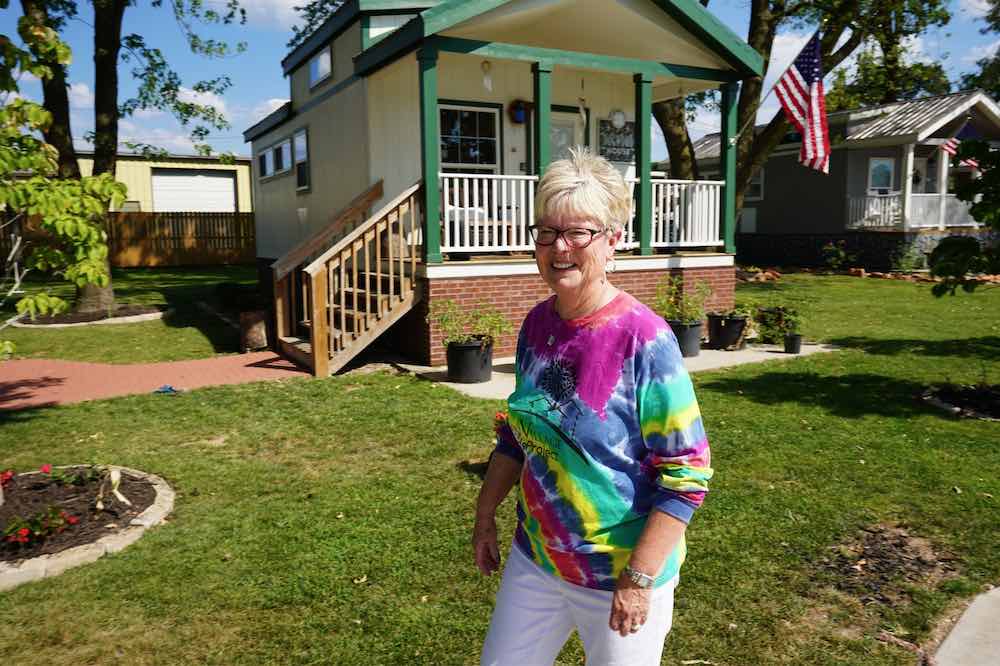
Courtesy of Linda Brown
For nine years Linda Brown and her husband David organized a nightly drop-in shelter where homeless people in Springfield could eat, shower, do laundry, use a computer, and socialize during bingo games and karaoke—but they wanted to do more.
So they transformed an abandoned mobile home property into a village of tiny homes that provides permanent housing to the chronically disabled homeless.
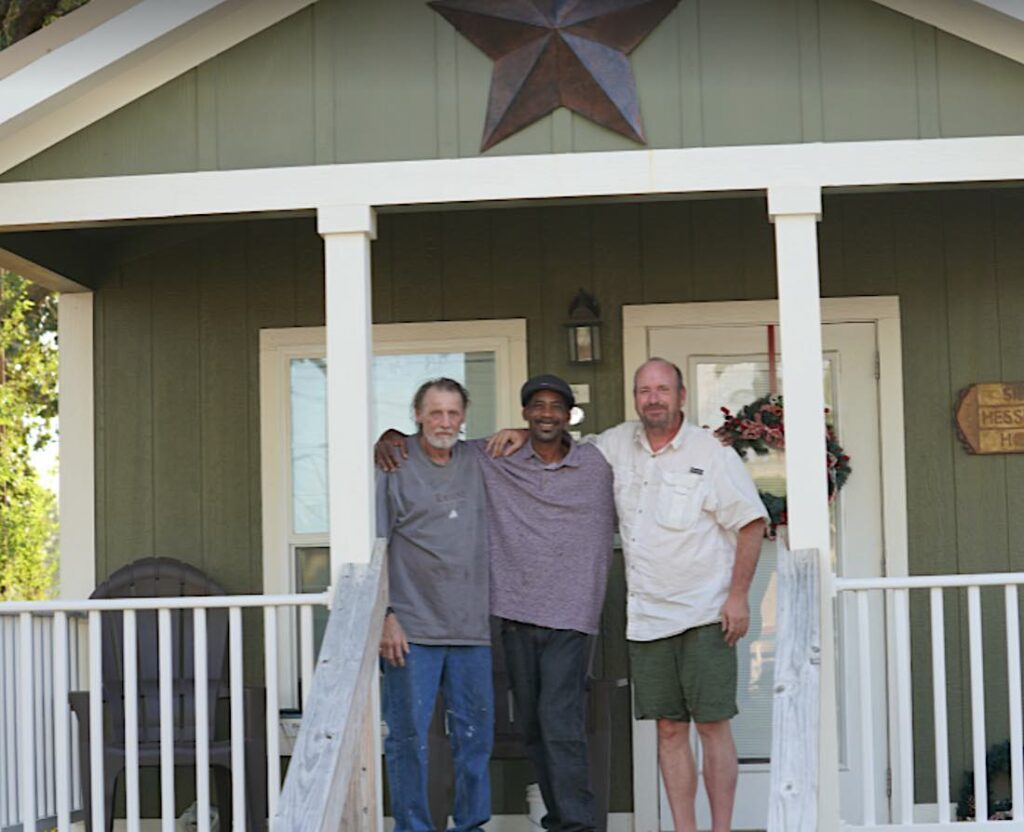
They raised $4.75 million and opened Eden Village in 2018, erecting 31 tiny homes that are now occupied by people like Jonathan Fisher. He was battling substance abuse, and had lived on the streets for two years when he met Linda Brown, who changed his life.
“In the worst moments of my life, Linda gave me guidance, care, and made me feel like I was still worth something,” Fisher says. He says that Brown took the time to learn about how he became homeless, and then encouraged him as he rebuilt his life. She even offered him a job.
Now sober, Fisher works full-time for Brown, doing construction and maintenance on the 31 homes, and helping others experiencing struggles similar to what he went through.
The driving philosophy behind Eden Village is the same that fuels the Housing First movement: The root causes of a person’s homelessness cannot be thoroughly addressed until his or her immediate housing needs are met.
“I watched as my (homeless) friends walked off into the darkness to a hidden, wet, cold camp while we went home to a warm bed,” Linda told the National Association of Realtors, who honored her with their Good Neighbor Award in 2020. “I had to do something,”
That was the moment that formed her vision for the tiny-home village that serves as a place where the chronically disabled homeless “can live with dignity and self-worth.”
After drawing sponsorship money from Coldwell Banker, the Greater Springfield Board of Realtors, local banks, churches, and area residents, by February 2019, all 31 tiny homes, which cost about $42,000 each, were occupied.
Linda Brown
“It takes someone who wants to do something, and then believes they can. I’ve watched Linda Brown live that out,” says Nate Schleuter, who helped launch a tiny-home village for the homeless in Austin, Texas, but now is the chief visionary officer for Eden Village.
“It’s exciting to watch the homeless who thought they’d live the rest of their life on the street now have a home.”
Eden Village, courtesy of Linda Brown
Brown’s 13 years of real estate expertise has been essential to the development of the tiny-home community. She learned of a listing for an abandoned 4.2-acre mobile park on Springfield’s east side. The property wouldn’t need to be rezoned for tiny-home trailers, and the infrastructure and utilities were already in place.
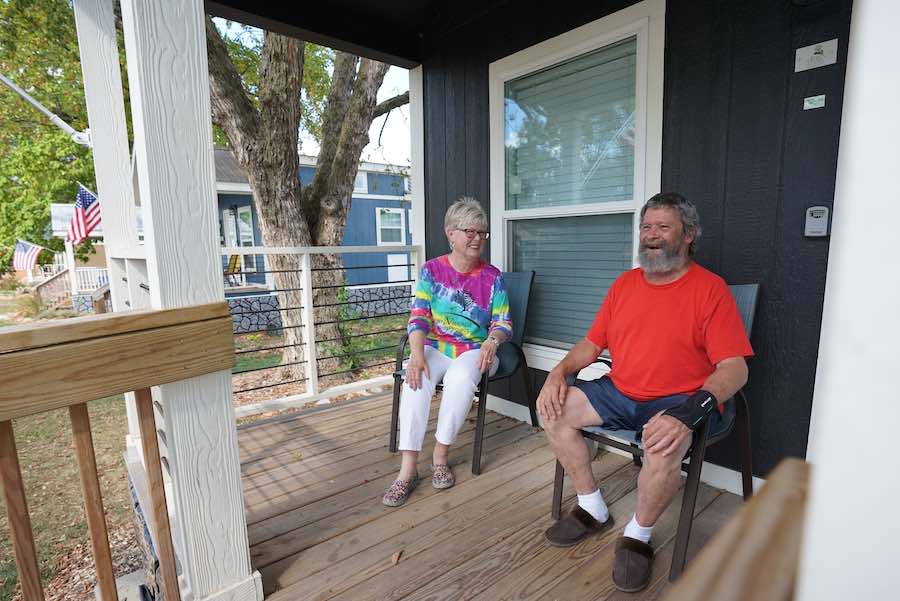
The tiny homes are rolled in on wheels attached to their steel frames, qualifying them as recreational vehicles. The 400-square-foot individual homes are fully furnished, including dishes and bedding. Residents pay $300 per month, which includes utilities. Most receive government disability checks of $725 per month to cover expenses. They can remain in their home as long as they wish, provided they remain a good neighbor in the community.
Wide-angle photo of interior of tiny home – courtesy of Linda Brown
The village includes a 4,000-square-foot community center where residents can hold cookouts, do laundry, and access a medical office staffed with student nurse volunteers and mental health professionals. Eden Village was even the site of a marriage ceremony for two residents.
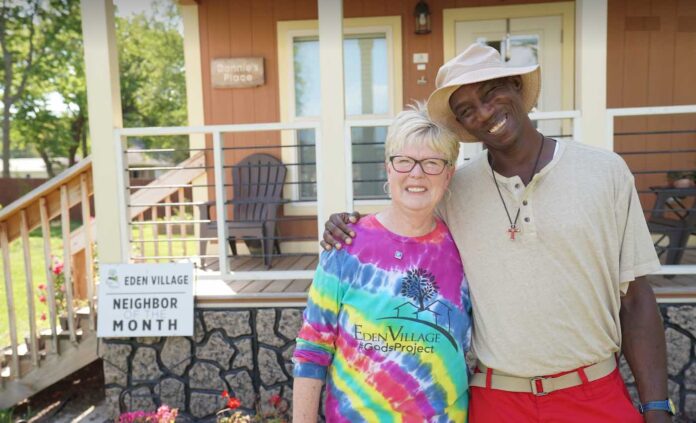
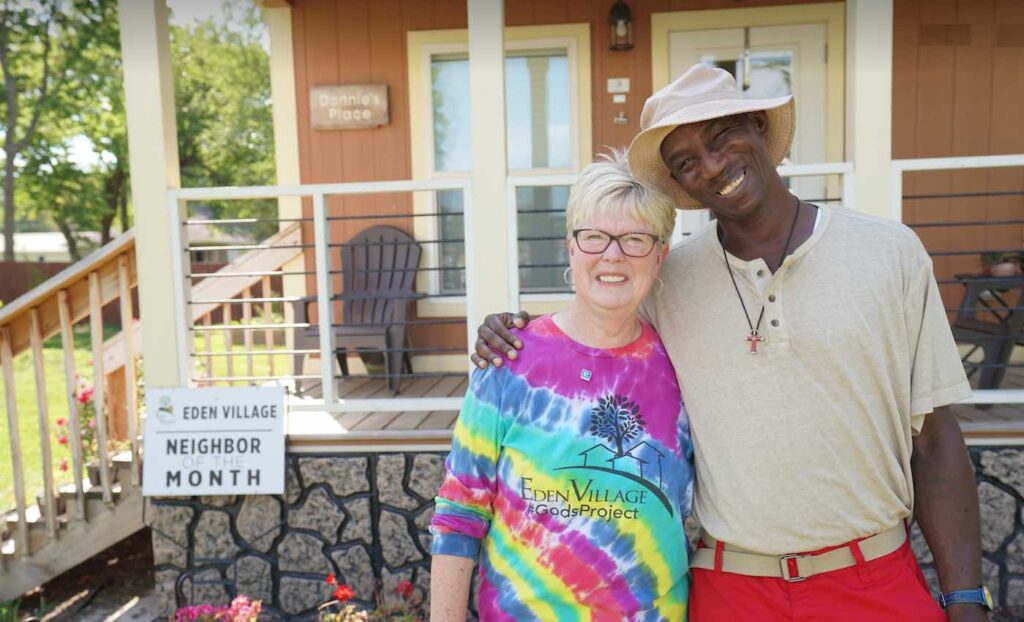
Linda Brown with Eden Village resident
Plans for additional villages are already underway on donated land. Eden Village 2 will house 24 residents in tiny homes and is close to opening.
Then, work will begin on Eden Village 3, which could house up to 80 residents in duplexes. Over the next six years, Brown, who is a realtor for Amax Real Estate, plans to have five villages across Springfield, housing an estimated 200 homeless people.
Fisher says Brown’s devotion helped him emerge from the grip of homelessness. “She helped me to build a better life,” Fisher says. “Even when I was struggling with homelessness and sobriety, she showed me I was valuable and that my potential shouldn’t be wasted. She made me feel like I belonged somewhere.”
Other cities are seeking to duplicate Eden Village. One project is underway in Wilmington, N.C., and 34 other communities are making plans. You can visit the Eden Village website to donate to the 501(C-3) nonprofit or volunteer with them.
SHARE the Inspiring Idea With Your Own Community on Social Media…
Tree in Tongass National Forest- USDA Forest Service
The US Department of Agriculture announced this month an end to large-scale old growth timber sales in Alaska’s Tongass National Forest, “returning stability and certainty” to the conservation of 9.3 million acres of the world’s largest temperate old growth rainforest.
Tree in Tongass National Forest- USDA Forest Service
The USDA will also move to restore the two-decades-old ‘Roadless Rule’ protections at Tongass, which were stripped in 2020 by the Trump administration.
In this unique landscape, the Pacific Ocean moisture collides with the towering Coast Mountains on the Canadian border to create the lush greenery and thick old-growth forest that spans 500 miles at the Southern tip of the state. About the size of West Virginia, the land is filled with islands and salmon streams, where granite cliffs drop into deep fjords.
“We look forward to meaningful consultation with Tribal governments and Alaska Native corporations, and engaging with local communities, partners, and the State to prioritize management and investments in the region that reflect a holistic approach,” said US Secretary Tom Vilsack.
“This approach will help us chart the path to long-term economic opportunities that are sustainable and reflect Southeast Alaska’s rich cultural heritage and magnificent natural resources,” he added.
There were tentative logging plans for three major harvests of more than 15,750 acres on Forest Service land, but the environmental analyses were never completed, so the Biden administration officials said these sales would not take place.
USDA’s actions to preserve the temperate rainforest are “critical for carbon sequestration, addressing the climate crisis and maintaining the productivity and health of the region’s fisheries and fishing industry,” said a department statement. “It stores more carbon than any other national forest in the United States.”
The Tongass National Forest has international significance as the largest intact temperate rainforest in the world, representing nearly a third of all such remaining old-growth forests. It holds more biomass per acre than any other rainforest in the world and is home to more than 400 species – including 5 species of salmon that return to spawn in the Tongass each year.
Small and micro old growth sales will still be offered to the indigenous community for cultural uses such as totem poles and canoes.
Quote of the Day: “Heaven can be found in the most unlikely corners.” – Mitch Albom
Photo: by Aaron Burden
With a new inspirational quote every day, atop the perfect photo—collected and archived on our Quote of the Day page—why not bookmark GNN.org for a daily uplift?
Since the start of the pandemic, there have been tons of stories making the media rounds about crazy-generous restaurant customers leaving behind outrageously large tips to the amazement of stunned and deliriously happy waitstaff.
While it’s true that an extra—or even extravagant—monetary tip is always a nice bonus, sometimes a heartfelt show of appreciation can mean a whole lot more.
Last Sunday, as waitress Megan King was working a routine shift, she took the order of an elderly woman who was eating alone. King classed their interaction as pleasant, but nothing out of the ordinary.
“She came in about halfway through my 17-hour shift, and it was on Sunday, which is always pretty busy,” King told Newsweek. “About halfway through her meal, it started to slow down so we chatted for a few minutes. Small talk, nothing too deep. She told me she was almost 70… and she just wanted to stop by an old favorite for a bite.”
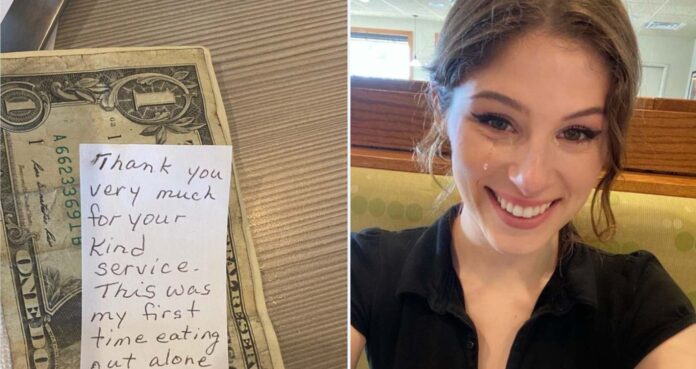
But the note the patron left behind with the $3 tip on her $11 check brought King to tears.
“Thank you very much for your kind service,” it read. “This was my first time eating out alone since my husband passed. I was hoping I could get through it.”
As she’d eaten her meal, King noticed the woman seemed quiet and contemplative. The waitress’s first instincts made her assume there might have been something wrong with the food, but in hindsight, King wishes she’d been a little more alert to her customer’s cues.
“I wish I would’ve taken her quiet as an invitation,” she told Newsweek. “I think that’s what she wanted, looking back… I guess she did, in a way. [She needed] an ear.”
King says she was so choked with emotion when she read the note, she had to take a moment to pull herself back together in the ladies’ room.
On Tuesday, captioned only with the words “in pain,” King posted a picture of the note and one of her tearful reaction to Twitter.
Some commenters noted that they thought the woman had given King short shrift on the tip—leaving only a dollar—which was not the case. King was quick to dispel the error and the stereotype that the elderly are bad tippers in general.
“A lot of our customers are older and living on fixed incomes, so they tip what they can,” King told Newsweek. “They are always welcome, no matter how much or little they tip.”
As a rule, tipping at the end of a meal is recognition for good service, but it’s all too easy to lose the importance of human interaction in the passing transaction. King, who has a special place in her heart for the restaurant’s older patrons, hasn’t lost sight of what matters.
The word “gratuity” comes from the Latin gratuitas meaning “gift” or gratus “pleasing, thankful”—and not surprisingly, it’s also the same root word from which we get a measure of “grace.”
Not money in the bank, perhaps, but priceless nonetheless.
Physicists have discovered a way to trap the world’s coldest plasma in a magnetic bottle, a technological achievement that could advance research into clean energy, space weather, and astrophysics.
“To understand how the solar wind interacts with the Earth, or to generate clean energy from nuclear fusion, one has to understand how plasma—a soup of electrons and ions—behaves in a magnetic field,” said Rice Dean of Natural Sciences Tom Killian.
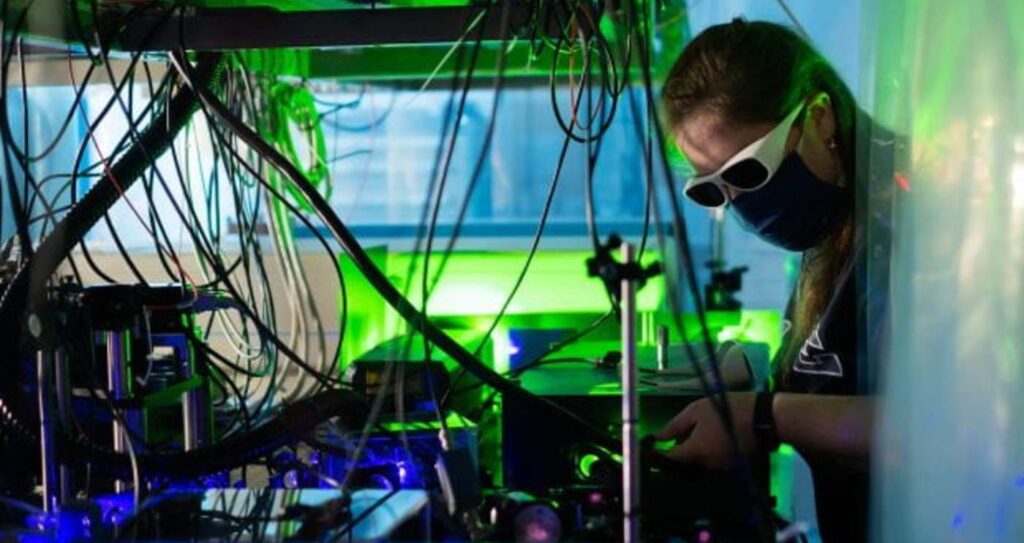
Using laser-cooled strontium, Killian and graduate students Grant Gorman and MacKenzie Warrens made a plasma about 1 degree above absolute zero, or approximately -272 degrees Celsius, and trapped it briefly with forces from surrounding magnets.
It is the first time an ultracold plasma has been magnetically confined, and Killian, who’s studied ultracold plasmas for more than two decades, said it opens the door for studying plasmas in many settings.
“This provides a clean and controllable testbed for studying neutral plasmas in far more complex locations, like the sun’s atmosphere or white dwarf stars,” said Killian, a professor of physics and astronomy.
“It’s really helpful to have the plasma so cold and to have these very clean laboratory systems. Starting off with a simple, small, well-controlled, well-understood system allows you to strip away some of the clutter and really isolate the phenomenon you want to see.”
That’s important for study co-author Stephen Bradshaw, a Rice astrophysicist who specializes in studying plasma phenomena on the sun.
“Throughout the sun’s atomosphere, the (strong) magnetic field has the effect of altering everything relative to what you would expect without a magnetic field, but in very subtle and complicated ways that can really trip you up if you don’t have a really good understanding of it,” said Bradshaw, an associate professor of physics and astronomy.
Solar physicists rarely get a clear observation of specific features in the sun’s atmosphere because part of the atmosphere lies between the camera and those features, and unrelated phenomena in the intervening atmosphere obscures what they’d like to observe.
“Unfortunately, because of this line-of-sight problem, observational measurements of plasma properties are associated with quite a lot of uncertainty,” Bradshaw said. “But as we improve our understanding of the phenomena, and crucially, use the laboratory results to test and calibrate our numerical models, then hopefully we can reduce the uncertainty in these measurements.”
Four states of matter
Jeff Fitlow/Rice University
Plasma is one of four fundamental states of matter, but unlike solids, liquids, and gases, plasmas aren’t generally part of everyday life because they tend to occur in very hot places like the sun, a lightning bolt, or candle flame.
Like those hot plasmas, Killian’s plasmas are soups of electrons and ions, but they’re made cold by laser-cooling, a technique developed a quarter century ago to trap and slow matter with light.
Killian said the quadrupole magnetic setup that was used to trap the plasma is a standard part of the ultracold setup that his lab and others use to make ultracold plasmas.
But finding out how to trap plasma with the magnets was a thorny problem because the magnetic field plays havoc with the optical system that physicists use to look at ultracold plasmas.
“Our diagnostic is laser-induced fluorescence, where we shine a laser beam onto the ions in our plasma, and if the frequency of the beam is just right, the ions will scatter photons very effectively,” he said.
“You can take a picture of them and see where the ions are, and you can even measure their velocity by looking at the Doppler shift, just like using a radar gun to see how fast a car is moving. But the magnetic fields actually shift around the resonant frequencies, and we have to disentangle the shifts in the spectrum that are coming from the magnetic field from the Doppler shifts we’re interested in observing.”
That complicates experiments significantly, and to make matters even more complicated, the magnetic fields change dramatically throughout the plasma.
“So we have to deal with not just a magnetic field, but a magnetic field that’s varying in space, in a reasonably complicated way, in order to understand the data and figure out what’s happening in the plasma,” Killian said. “We spent a year just trying to figure out what we were seeing once we got the data.”
The plasma behavior in the experiments is also made more complex by the magnetic field. Which is precisely why the trapping technique could be so useful.
“There is a lot of complexity as our plasma expands across these field lines and starts to feel the forces and get trapped,” Killian said. “This is a really common phenomenon, but it’s very complicated and something we really need to understand.”
One example from nature is the solar wind, streams of high-energy plasma from the sun that cause the aurora borealis, or northern lights. When plasma from the solar wind strikes Earth, it interacts with our planet’s magnetic field, and the details of those interactions are still unclear.
Another example is fusion energy research, where physicists and engineers hope to recreate the conditions inside the sun to create a vast supply of clean energy.
Killian said the quadrupole magnetic setup that he, Gorman, and Warrens used to bottle their ultracold plasmas is similar to designs that fusion energy researchers developed in the 1960s.
The plasma for fusion needs to be about 150 million degrees Celsius, and magnetically containing it is a challenge, Bradshaw said, in part because of unanswered questions about how the plasma and magnetic fields interact and influence one another.
“One of the major problems is keeping the magnetic field stable enough for long enough to actually contain the reaction,” Bradshaw, who is the corresponding author of a published study about the work in Physical Review Letters, said. “As soon as there’s a small sort of perturbation in the magnetic field, it grows and ‘pfft,’ the nuclear reaction is ruined.
“For it to work well, you have to keep things really, really stable,” he said. “And there again, looking at things in a really nice, pristine laboratory plasma could help us better understand how particles interact with the field.”
One innovative company perfectly embodies the ideals of consumers who deserve and are demanding the ‘right to repair’.
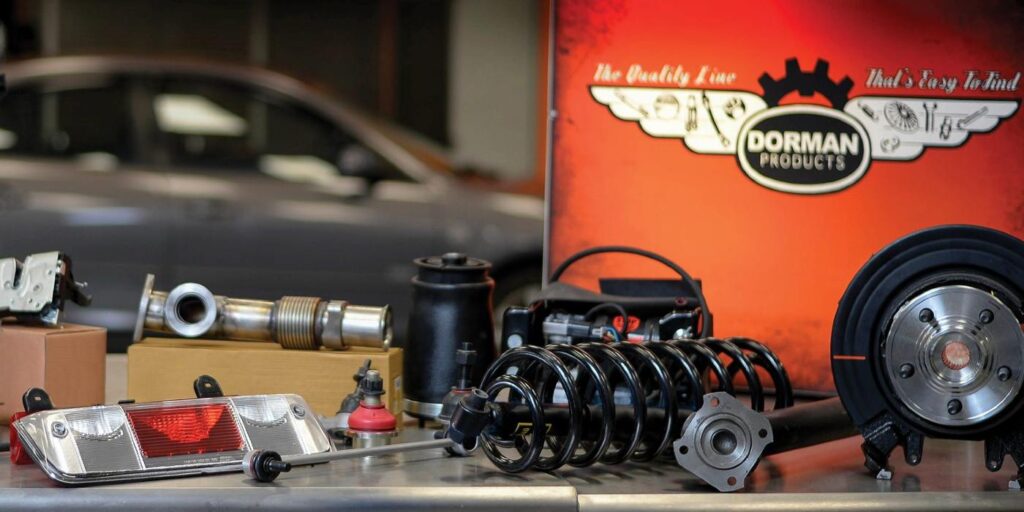
Dorman Products‘ constant detective work to see which automotive parts are failing in large numbers on which models has allowed them to grow into a big operation—where they know exactly which parts on your car are likely to break first, why, and how to make them better, giving consumers not only cheaper prices at the garage, but the freedom of DIY.
For those old enough to remember being able to open the hood of a car and see parts they could reach with their hands, they’ll know it’s much more difficult nowadays to make repairs on your own.
After-market auto parts is a $200+ billion a year sector, and while most manufacturers have to make millions of different parts and get bossed around by the original equipment manufacturer (OEM), Dorman stays nimble by choosing only the parts likely to break, and selling them at a third of the cost.
They’ve gotten so good at this that the parts departments at many dealers stock the Dorman parts instead of OEM parts.
The secret is constant market research. By repeatedly plumbing the depths of America’s auto-workforce to learn which parts are going wrong and why, they attain short-term near-monopoly positions in thousands of mini-markets—the brake dust shields for 00-14 GMC models’ wheels for example.
From tens of thousands of new product ideas, Dorman will choose several thousand that are in extreme niches and likely to be ignored by OEMs or big after-market producers. It then re-designs the part to fix any flaws, for instance adding a protective coating to a fast corroding part or changing the interface to make it easier to install.
In this way they not only please the customer, but their outsourced R&D department—the mechanics that submit ideas for new parts inform them of ones they are replacing frequently, and are perhaps more likely to look at the Dorman catalogue before ordering an OEM part.
They back up this innovative business model with a strong marketing presence of how-to guides, a big social media block, and newsletters to ensure they are sowing the seeds for future information/buying opportunities.
For example, they do a monthly parts review, explaining which after-market solutions they’ve perfected on original designs. In some cases, like master cylinder or lift-gate motor parts, Dorman explain the OEMs often require you to replace the whole assembly, rather than specific inferior components they’ve identified and improved. When you factor in labor, the cost savings are astronomical.
(WATCH the video about this story below…)
Fix Up Your Social Media Feed By Sharing The Good News With Your Friends…
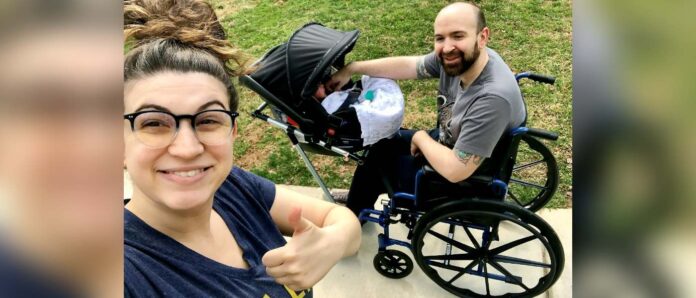
A group of school kids made a special wheelchair stroller so a disabled dad can take his newborn son out for a walk.
37-year-old Jeremy King has impaired mobility following an operation to remove a brain tumour in 2017.
He was concerned how he would manage to help his expecting wife Chelsie after she gave birth.
Chelsie, a teacher at Bullis School in Maryland recruited the help of her students who designed the WheeStroll—a child seat which attaches to a wheelchair.
Just a few weeks after the couple’s son Phoenix was born, Jeremy was able to take him out for walks with the pram-wheelchair hybrid.
Jeremy said: “I was emotional and elated because something like this really increases independence with my child.
“It has allowed me to experience things that I would not have been able to do before having the WheeStroll. It allows us as a family to have more freedom of movement.”
Middle school theatre instructor Chelsie said: “Being able to see Jeremy have some independence with our son is a gift.
“This surgery changed our lives drastically and we have worked very hard to accept, learn, and overcome those challenges but parenting is a whole new set of challenges.
“It has given us the ability to do something simple like take a walk as a family; something that a lot of families don’t have to think twice about.”
Just three months after getting engaged to Chelsie, Jeremy underwent an eight-hour surgery for a brain tumour in October 2017 which resulted in impaired mobility.
He said: “I was very concerned with the safety of myself and our child especially with Chelsie having to potentially support both of us.
“It played on my mind constantly which is why it was important for us to find things to help.”
The couple searched for a product to help Jeremy but with no luck, Chelsie recruited the help of her colleague, innovation and technology lab coordinator Matt Zigler.
She asked him if he could design something to attach to Jeremy’s wheelchair to allow him to hold their child while on the go.
Chelsie said: He had the idea to throw this to his ‘making for social good’ class and I thought that was an amazing idea.”
The school kids conducted interviews with the family and the fire department, who provide infant car seat installation training.
The school team purchased or 3D printed all the parts required, and even borrowed a wheelchair from the school nurse as a prototype.
Jeremy, who works in administration, said: “It was a very emotional experience because I never thought I would be able to do something safely like taking a walk with my child.”
The WheeStroll was completed in time for the baby’s birth on March 4 this year and, within a few weeks, Jeremy was taking baby Phoenix for a walk.
“We hope that people will see this story,” Jeremy said, “and know there are ways around their challenges and can build this for themselves at a low cost.
“I want to personally thank the students for taking my situation into account and developing this amazing device.”
Rosy Maple Moth, Andy Reago and Chrissy McClarren/CC license
Forest tent caterpillar moth with eggs, Scott Tunnock at USDA Forest Service/CC license
A New York photographer acquired a new lease on night in the Catskills during the draconian state lockdowns by suspending a white sheet in her yard illuminated with black lights and waiting to see who shows up.
She is just one of many “moth-ers,” enthusiasts of the butterfly’s generally nocturnal cousin, that are taking to fields, porches, and patios for National Moth Week—a large citizen science project to catalogue the biodiversity of moths.
During the lockdowns, reports of Americans picking up all manner of curious hobbies while self-isolating were all over the news channels. From trying to replicate their favorite airline dishes, to growing mushrooms inside their coat closet, they kept themselves busy.
Carla Rhodes is no different. With her white sheet and camera, she would stay out to between 1-4 am in the anticipation of seeing beautiful moths in her home of Woodstock, New York.
Falling in love with the pink and yellow fuzz of the rosy maple moth, the moonlight-white wings of the giant leopard moth, all covered in black spots, and the yellow stripes of the Anna tiger moth, there was always the feeling, according to Rhodes, that maybe tonight she would see a new species.
“It blows my mind just knowing that that many creatures come out of nowhere; they’re all there just waiting to be seen,” Rhodes told Smithsonianwho were reporting on her adventures. “I don’t think moths are appreciated in the way that they should be.”
World-wide wingbeats
Rosy Maple Moth, Andy Reago and Chrissy McClarren/CC license
Rhodes isn’t the only one enjoying moths, as the COVID-19 lockdowns brought British moth-ers out in force as well. Butterfly Conservation reports that registered moth sightings rose by a third since the lockdowns began, which for many shires meant first time sightings.
In Cheshire, seven species never before registered in the county were recorded including the light feathered rustic and beautiful marbled moths. Several new species were also sighted in Cornwall, while in Yorkshire alone mothing was 25% more common last year.
Royal Walnut Moth, Patrick Coin/CC license
Dr. David Roy of UK Center for Ecology and Hydrology stated that “Moths are an integral part of ecosystems and are excellent indicators of biodiversity and quality of habitats. By submitting more records, the public is improving scientists’ understanding of the impacts of environmental changes on moth populations and also British wildlife. This then provides the necessary evidence to inform conservation action to protect habitats, and the species they support.”
Adult royal moth, Scott D. Werner
Smithsonian concurs on this point, adding that the more citizen scientists report butterfly sightings the faster policies to protect them can be implemented, and the more effective they’ll be.
Spanning from July 17th to the 25th, National Moth Week invites moth-ers and mothing enthusiasts to submit data on sightings to several organizations that gather citizen science data, such as iNaturalist, Field Guide, Nature Share, or the Encyclopedia of Life. Along with providing excellent resources for identifying the fuzzy flyers that show up in your garden, you can register your favorite places aa a mothing site; helpful to scientists for all different reasons.
Anna tiger moth, J.B Sulllivan Research Collection
The organizers also have an events map so you can meet other mothing enthusiasts in your area.
There’s no reason to give butterflies all the credit as joy-inducing colorful insects, as in addition to the pollinating services of the moths, their colors are just as bright, you only have to stay out late to see them.
Quote of the Day: “Surround yourself only with people who are going to take you higher.” – Oprah Winfrey
Photo: by Tyler Nix
With a new inspirational quote every day, atop the perfect photo—collected and archived on our Quote of the Day page—why not bookmark GNN.org for a daily uplift?
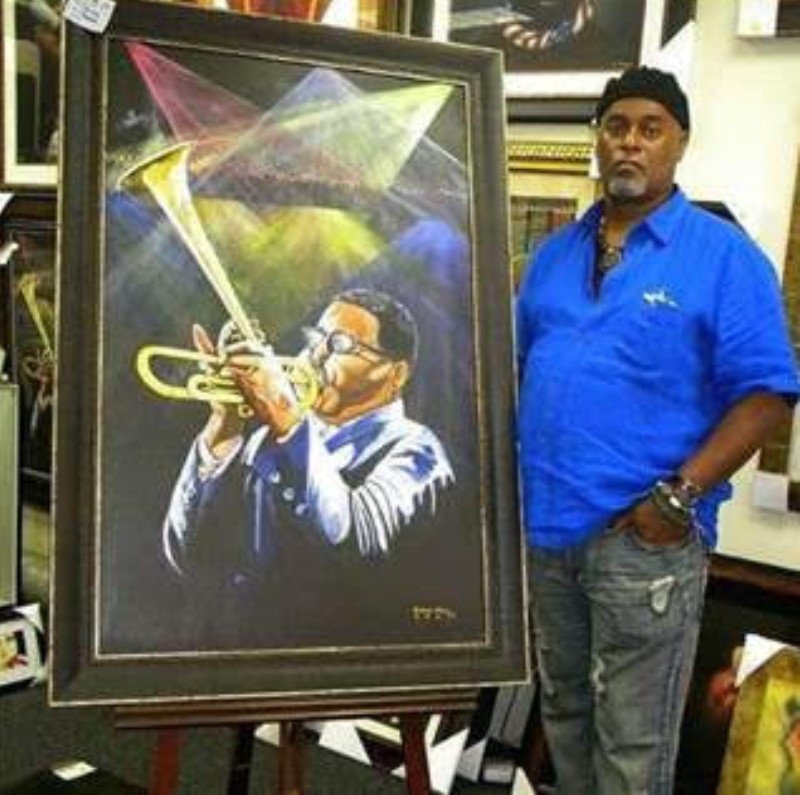
Sometimes the distance between fortune, fame, and ruin is just a house fire away, as Los Angeles painter Richard Hutchins found out found after his studio in Santa Monica burned down.
Thanks to the power of social media however, Richard also understands another distance—the one between homelessness and stardom.
In a real-life riches-to-rags-to-riches story filled with more serendipity than a John Cusack movie, Richard went from living on the streets to being exhibited in Beverly Hills’ largest art gallery, to selling millions of dollars worth of his unique canvasses to people like Oprah, the rappers 2 Chaainz and Whiz Khalifa, and Philadelphia Phillies slugger Bryce Harper.
“I’ve always asked God to give me the opportunity to present myself to the world, and it’s just something that drives me,” Richard told GNN. “My inspiration is people. I’m not trying to get rich, I just want to earn enough to leave something behind that I can continue to help people, [but] the world reached out tremendously.”
It’s fair to say that as well-spoken as Richard is, ‘tremendously’ is an understatement. A once-famous artist who had painted canvasses for Marvin Gaye and Mohammed Ali, Richard knew the heights an artist could achieve, but just one month ago it would have been hard to imagine ever climbing to them again.
Brushing with death and god
Richard Hutchins
This totally-L.A. story begins when Charlie “Rocket” Jabalay, founder of the Dream Machine Foundation, finished his career at 29 as a manager for hip-hop artists in Atlanta after he was diagnosed with a brain tumor.
“I wanted to chase my dream that I had since I was a kid,” Charlie told GNN. “That happens to us all; we bury a dream and build up something else, but I was facing death and I thought ‘if I’m going to die let me chase my dream,’ and my dream was to become a professional athlete.”
“I lost 130 pounds and biked across America and did Iron Man and marathons and reversed my brain tumor. All my dreams came true, and that’s why I wanted to start making other peoples’ dreams come true. I had a conversation with God, and I asked ‘You’ve done so much for me, what can I do for you?’ And God spoke loud, he said ‘go give love.'”
As enshrined forever on Charlie’s Instagram feed, he came across Richard Hutchins sitting on a cart in front of Ralphs, saying he used to be a famous artist and that his dream would be to walk into a museum and see a painting of his hanging on the wall.
While Charlie and his foundation spent $2,000 to get Richard a canvass and some oils to paint with, Richard was being admitted to the emergency room. At 70-years old and battling cancer, thousands of stories have finished on that page, but not Richard’s. He managed to pull through and was discharged shortly after.
“Out of nowhere” as Charlie described it, an old friend who just happened to operate the Cool HeART Gallery, the largest art galley in Beverly Hills, called the former athlete, and upon hearing about Richard simply offered to throw him a late-June art show alongside celebrity LA artists Ruben Rojas and Richard Orlinksi.
“Charlie kept coming by saying ‘we have a surprise for you’ and every surprise got bigger and bigger and bigger, until I ended up on the red carpet in Beverly Hills,” says Richard.
Let’s go Dream Machine!
Richard Hutchins
To drum up support for Richard’s exhibition appearance, Charlie’s Dream Machine Foundation created a Shopify website for Richard to sell his art in order to try and get his life back in order.
The results were staggering, with $50,000 dollars worth of original prints, canvasses, and commissions sold in the first 24 hours, doubling to $100,000 just a few days later. Once again, Charlie was there to capture all of the action on his Instagram.
Steve Harvey bought a print, noting, “I was homeless and know what Richard Hutchins is going through. I am honored to purchase his art. Let’s go Dream Machine!”
Other celebrities like Trey Songz and Will Smith shared the story, the former noting, “this is amazing,” and even his hosting service Shopify produced a small video about the instantaneous life-transformation happening in real time.
“I came from South Georgia; aged six I was in the cotton field working after school, and during break I would take the brown bags and I would pull them apart and use sticks from the fire to start drawing stick men,” says Richard, reflecting on his journey. “It’s my opportunity now to pay it forward.”
Now Richard has a money manager, a health coach to ensure he doesn’t end up in the ER again any time soon, a new car, and a new career, all without losing any sense of where he could have been.
“About a minute before Charlie pulled up, I stood up and got ready to walk away, but this particular day which was Easter, I stood up and something pushed me back down,” explains Richard. “If I had left that minute I would have never seen Charlie.”
“I don’t want to draw attention to myself, I want to draw attention to the problem. I call the president, the vice-president, I say ‘come to Skid Row,’ that’s my dream—to use my power to help better this place; to help better Los Angeles.”
Richard has since established a foundation named after his late mother for the purpose of providing scholarships to kids who can’t afford to go to school. Richard’s canvasses are next on the road to Miami, where they are to be exhibited alongside those of Richard’s hero, Andy Warhol.
Within a week of going from homelessness to the 1%, Richard was working to give as much back as he could. It’s a story that helps remind us of so many things—of compassion, of belief in the human spirit, in modesty, and it reminds us to never, never give up on our dreams.
You’re on vacation and somehow, your family dog goes missing. You search and you pray and then you search some more. As the days go by with no word, your brain may tell you it’s time to give up hope—but in your heart you never do.
And sometimes that hope is rewarded.
The Battista family of New York City was on vacation in Ocean City, Maryland when their 2-year-old Boston terrier Fisher went AWOL on July 4, 2020.
The Battistas immediately blanketed the area with missing posters, barraged social media, and even got Fisher face-time on a local floating billboard.
With no leads, the family decided to remain in the area for an extended stay. They hired a tracker and even went so far as consulting with an “animal communicator” in hopes of tapping into Fisher’s whereabouts using doggy ESP—all to no avail.
The family also set up a #findfisher Facebook page, which quickly gathered 8,000 followers, and launched an online fundraiser to raise awareness and aid them in their efforts to bring their beloved fur baby home.
“We’ve alerted Ocean City police, fire, beach patrol, postal service, Scopes, lifeguards—you name it!” Matthew Battista wrote to Fisher’s GoFundMe page.
“Signs have been posted from the inlet to 77th St, and we have extended our canvassing to the nearby Delaware beaches of Fenwick, Bethany, Dewey, and Reheboth. We’ve extended our stay in Ocean City and arranged to bring in a professional dog tracker, in addition to making continuous searching trips in car, on foot, and on bike.”
Although they eventually were forced to return home to New York minus Fisher, the Battistas refused to give up. But even with the massive media blitz, it seemed Fisher had pulled a full-on Houdini.
Undaunted, the Battistas kept the wheels of the Internet grapevine turning, refusing to let the details of Fisher’s disappearance be forgotten. As a result, Fisher became something of a media darling in absentia.
And that’s surely part of the reason the Battistas’ perseverance paid off.
On April 20, 2021, 290 days after Fisher made his unauthorized Independence Day exit, Baltimore City resident Wayne Horn was performing maintenance on his motorcycle when he noticed a stray dog in the road.
“I called him over because cars speed up and down my road,” Horn told Delaware Online. “He came over to me, so we gave him water. He laid down and was content, he didn’t want to leave.”
When a friend of Horn’s posted pix of the found pooch to Facebook the responses of “That’s Fisher!” came back faster than a boomerang.
Although the findings were later confirmed by a micro-ship scan, Elissa Battista recognized Fisher immediately. “From the moment I saw the photos I knew it was him from the markings and his little tongue sticking out,” she posted to Facebook.
The reunion was quickly arranged. The Battistas had some local friends pick him up from the Horns, and then Elissa made the five-hour trip to retrieve Fisher and bring him home. Apart from minor signs of possible frostbite, Fisher was in excellent shape.
The Battistas are so thankful to have Fisher back, they’re now doing their part to pay it forward, once again by using the powers of social media for good. The Facebook page formerly known as “Find Fisher” has been transformed into “Find Fisher’s Friends” and is now dedicated to helping other pet parents locate their lost four-legged loved ones.
The family has also pledged to apply any leftover funds from their GoFundMe to the charity of Fisher’s choice once he was safely back with his family. While we’re still awaiting “woof” on what that might be, the takeaways from this story seem clear:
Social media and microchips are powerful tools in reuniting lost pets with their families. Using both is the best chance of a happy outcome.
And while no reunion is guaranteed, if you’re thinking of giving up hope—don’t. Because more than anything, as Fisher’s 10-month walk-about proves, hope has no expiration date.
PAW This Good News Rescue Story Over to Pals On Social Media…
Officers from the Department of Marine and Coastal Resources and local fisheries department have been informed but they are yet to visit the family to check the authenticity of the pearl.
SWNS
Curious neighbors, however, have already flocked to their house to have a look at the pearl.
Prasarnphon added that they will be ready to sell the pearl at the right price after it was checked by officials.
He said: ‘We know that the pearl is expensive so we want to give it to the person at the right price after it has been checked.’
In February, trucker Monthian Jansuk found a similar pearl in Chonburi province, while fisherman Hatchai Niyomdecha stumbled upon the rare gem in Nakhon Si Thammarat in January. Hatchai was offered up to $351,000 for the 7.68-gram precious gem—so the most recent lucky fisherman could truly see his fortunes change quite soon.
Melo pearls range from orange to tan to brown in color, with orange being the most expensive shade. They are usually found in South China Sea and Andaman Sea off the coast of Myanmar and are produced by predatory sea snails called Volutidae.
SHARE This Sweet Find of a Story With Your Friends…
If one doesn’t want to use herbicides to control their lawn, what’s the alternative to constant mowing and hedge-trimming? Well, in olden days, they used goats.
In fact, many organic landscapers today use goats, as they are living weed whackers, immune to all sorts of natural poisons and seemingly unfazed by thorns. They can eat poison oak as easy as we can eat a piece of celery.
In Manhattan’s Riverside Park, two dozen goats have been unleashed upon untended and overgrown brush and weeds in order to avoid having to use chemicals, or spending thousands in labor costs.
Onlookers gathered round to watch the calico-herd of animals charge into the park during the Running of the Goats, as Reuterscalled it.
“They chowed down on Japanese knotweed, they noshed on porcelain berry, they snacked on multiflora rose, they easily traversed the hard-to-reach terrain behind me and gulped down poison ivy without even giving it a second thought,” said Dan Garodnick, Riverside Park Conservancy president and CEO at the ceremonial day of deployment.
“It’s healthy for the goats and it’s good for the environment. That’s farm to table.”
Along with working much longer hours than landscapers, goats—according to Jordon Martins-Cihanek, son of the owner of Green Goats farm who provided the animals—actually neutralize a lot of the seeds of the various unwanted plants, preventing them from regrowing next year.
The team of 24 goats will eventually be reduced down to five lucky landscapers: Skittles, Ms. Bo Peep, Chalupa, Mallemar, and Buckles, who will live in the park until August 24th, at which time the (G)reatest (O)f (A)ll (T)ime goat-grading competition will produce a winner, who presumably gets the next park all to themselves.
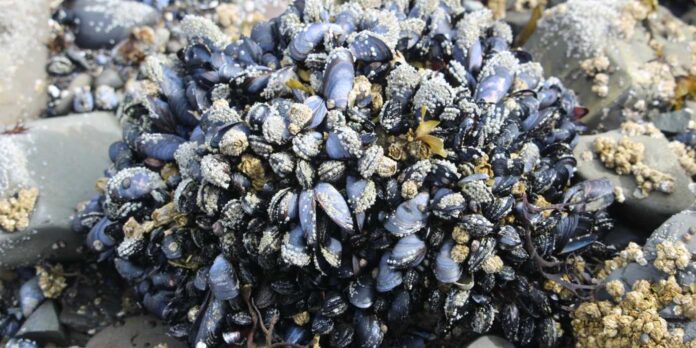
Instead of shelling out for a water filtration plant, mussels’ constant filter feeding is being tested as a potential wide-scale application for microplastic clean-up in our oceans.
Belying their humble evolutionary stature, the mussel can do something that humanity could only achieve by spending millions on equipment, and that is cleaning microplastics smaller than 5mm out of the ocean.
A voracious filter feeder, mussels absorb microplastics and than excrete them, while doing no harm to the organism.
Microplastics are devilish pollutants that can come from tire wear, fracture off long-floating plastic debris, or get pulled off artificial textiles and end up in the ocean via sewage. They’re so small that often the required fineness of a net in order to collect them ensures that any marine life, even tiny ones, will be collected as well.
A trial near the Plymouth Marine Laboratory in England is looking to see how many mussels it would take to make a meaningful impact on microplastic pollution.
A blog entry from a biologist at our EPA suggests that one adult mussel can filter feed through 15 gallons of water a day, and that a 6-mile bed of mussels can remove 25 tons of particulate matter a year.
The Plymouth trial is replicating an earlier experiment that placed around 300 mussels in a flow tank that fed them phytoplankton and microplastics. They collected around 25% of the microplastics that were in the water—a staggering 250,000 pieces per hour. The particles were deposited in the bivalve’s droppings which the researchers say could be used for biofuel because it’s full of carbon.
This was funded by the Waitrose Plan Plastic, a grant program for plastic cleaning solutions funded by the sales of plastic carrier bags at Waitrose grocery stores in the UK.
Out in the Plymouth Sound, the team monitoring the mussels keep them in clusters in buckets under which are suspended receptacles to ensure all the waste is collected and the microplastics can be disposed of properly.
“The trials so far have been extremely promising and we’re very excited about the positive impact systems like these could potentially have on estuarine areas, particularly in places where microplastics might accumulate such as marinas, harbors or near wastewater treatment works,” said Professor Pennie Lindeque, Head of Science – Marine Ecology and Biodiversity, in a press release.
While nanoplastics can pass through the mussel’s membranes and into their limited anatomy, the microplastics are too large to harm them at the levels they are currently found in the oceans.
“This has been a really exciting experiment, because we always hoped that mussels would have the capacity to filter out microplastics, but they do it really well, and they do it without harming themselves,” Lindeque says.
(WATCH the video about this story below.)
FILTER OUT Cynicism From Friends’ Feeds—Share This Story…
Quote of the Day: “To live is so startling it leaves little time for anything else.” – Emily Dickinson
Photo: by Ashim D’Silva
With a new inspirational quote every day, atop the perfect photo—collected and archived on our Quote of the Day page—why not bookmark GNN.org for a daily uplift?
Dr. Edward Chang/Barbara Ries, University of California San Francisco
Researchers at UC San Francisco have successfully developed a “speech neuroprosthesis” that has enabled a man with severe paralysis to communicate in sentences—translating signals from his brain to the vocal tract directly into words that appear as text on a screen.
Dr. Edward Chang/Barbara Ries, University of California San Francisco
The achievement builds on more than a decade of effort by UCSF neurosurgeon Edward Chang to develop a technology that allows people with paralysis to communicate even if they are unable to speak on their own.
“To our knowledge, this is the first successful demonstration of direct decoding of full words from the brain activity of someone who is paralyzed and cannot speak,” said Chang, who’s senior author on the study. “It shows strong promise to restore communication by tapping into the brain’s natural speech machinery.”
Each year, thousands of people lose the ability to speak due to stroke, accident, or disease. With further development, the approach described in this study could one day enable these people to fully communicate.
Translating Brain Signals into Speech
Previously, work in the field of communication neuroprosthetics has focused on restoring communication through spelling-based approaches to type out letters one-by-one in text.
Chang’s study differs from these efforts in a critical way: his team is translating signals intended to control muscles of the vocal system for speaking words, rather than signals to move the arm or hand to enable typing.
Chang said this approach taps into the natural and fluid aspects of speech and promises more rapid and organic communication.
“With speech, we normally communicate information at a very high rate, up to 150 or 200 words per minute,” he said, noting that spelling-based approaches using typing, writing, and controlling a cursor are considerably slower and more laborious. “Going straight to words, as we’re doing here, has great advantages because it’s closer to how we normally speak.”
Over the past decade, Chang’s progress toward this goal was facilitated by patients at the UCSF Epilepsy Center who were undergoing neurosurgery to pinpoint the origins of their seizures using electrode arrays placed on the surface of their brains.
These patients, all of whom had normal speech, volunteered to have their brain recordings analyzed for speech-related activity. Early success with these patient volunteers paved the way for the current trial in people with paralysis.
Previously, Chang and colleagues in the UCSF Weill Institute for Neurosciences mapped the cortical activity patterns associated with vocal tract movements that produce each consonant and vowel.
To translate those findings into speech recognition of full words, David Moses, PhD, a postdoctoral engineer in the Chang lab, developed new methods for real-time decoding of those patterns and statistical language models to improve accuracy.
But their success in decoding speech in participants who were able to speak didn’t guarantee that the technology would work in a person whose vocal tract is paralyzed. “Our models needed to learn the mapping between complex brain activity patterns and intended speech,” said Moses. “That poses a major challenge when the participant can’t speak.”
In addition, the team didn’t know whether brain signals controlling the vocal tract would still be intact for people who haven’t been able to move their vocal muscles for many years. “The best way to find out whether this could work was to try it,” said Moses.
The First 50 Words
To investigate the potential of this technology in patients with paralysis, Chang partnered with colleague Karunesh Ganguly, an associate professor of neurology, to launch a study known as “BRAVO” (Brain-Computer Interface Restoration of Arm and Voice).
The first participant in the trial is a man in his late 30s who suffered a devastating brainstem stroke more than 15 years ago that severely damaged the connection between his brain and his vocal tract and limbs.
Since his injury, he has had extremely limited head, neck, and limb movements, and communicates by using a pointer attached to a baseball cap to poke letters on a screen.
The participant, who asked to be referred to as BRAVO1, worked with the researchers to create a 50-word vocabulary that Chang’s team could recognize from brain activity using advanced computer algorithms. The vocabulary—which includes words such as “water,” “family,” and “good”—was sufficient to create hundreds of sentences expressing concepts applicable to BRAVO1’s daily life.
For the study, Chang surgically implanted a high-density electrode array over BRAVO1’s speech motor cortex. After the participant’s full recovery, his team recorded 22 hours of neural activity in this brain region over 48 sessions and several months. In each session, BRAVO1 attempted to say each of the 50 vocabulary words many times while the electrodes recorded brain signals from his speech cortex.
Translating Attempted Speech into Text
To translate the patterns of recorded neural activity into specific intended words, the other two lead authors of the study used custom neural network models, which are forms of artificial intelligence. When the participant attempted to speak, these networks distinguished subtle patterns in brain activity to detect speech attempts and identify which words he was trying to say.
To test their approach, the team first presented BRAVO1 with short sentences constructed from the 50 vocabulary words and asked him to try saying them several times. As he made his attempts, the words were decoded from his brain activity, one by one, on a screen.
Then the team switched to prompting him with questions such as “How are you today?” and “Would you like some water?” As before, BRAVO1’s attempted speech appeared on the screen. “I am very good,” and “No, I am not thirsty.”
The team found that the system was able to decode words from brain activity at rate of up to 18 words per minute with up to 93 percent accuracy (75 percent median).
Contributing to the success was a language model Moses applied that implemented an “auto-correct” function, similar to what is used by consumer texting and speech recognition software.
Moses characterized the early trial results—which appear in the New England Journal of Medicine—as a proof of principle. “We were thrilled to see the accurate decoding of a variety of meaningful sentences,” he said. “We’ve shown that it is actually possible to facilitate communication in this way and that it has potential for use in conversational settings.”
Looking forward, Chang and Moses said they will expand the trial to include more participants affected by severe paralysis and communication deficits. The team is currently working to increase the number of words in the available vocabulary, as well as improve the rate of speech.
Both said that while the study focused on a single participant and a limited vocabulary, those limitations don’t diminish the accomplishment. “This is an important technological milestone for a person who cannot communicate naturally,” said Moses, “and it demonstrates the potential for this approach to give a voice to people with severe paralysis and speech loss.”