All News - Page 456 of 1733 - Good News Network
Home Blog Page 456

When Walked On, These Wooden Floors Harvest Enough Energy to Turn On a Lightbulb

Sun et al/Matter
Sun et al/Matter

Researchers from Switzerland are tapping into an unexpected energy source right under our feet: wooden floorings.

Their nanogenerator enables wood to generate energy from our footfalls.

They also improved the wood used in the their nanogenerator with a combination of a silicone coating and embedded nanocrystals, resulting in a device that was 80 times more efficient—enough to power LED lightbulbs and small electronics.

The team began by transforming wood into a nanogenerator by sandwiching two pieces of functionalized wood between electrodes.

Like a shirt-clinging sock fresh out of the dryer, the wood pieces become electrically charged through periodic contacts and separations when stepped on, a phenomenon called the triboelectric effect.

The electrons can transfer from one object to another, generating electricity. However, there’s one problem with making a nanogenerator out of wood.

“Wood is basically triboneutral,” says senior author Guido Panzarasa, group leader in the professorship of Wood Materials Science. “It means that wood has no real tendency to acquire or to lose electrons.” This limits the material’s ability to generate electricity, “so the challenge is making wood that is able to attract and lose electrons,” Panzarasa explains.

To boost wood’s triboelectric properties, the scientists coated one piece of the wood with polydimethylsiloxane (PDMS), a silicone that gains electrons upon contact, while functionalizing the other piece of wood with in-situ-grown nanocrystals called zeolitic imidazolate framework-8 (ZIF-8).

ZIF-8, a hybrid network of metal ions and organic molecules, has a higher tendency to lose electrons. They also tested different types of wood to determine whether certain species or the direction in which wood is cut could influence its triboelectric properties by serving as a better scaffold for the coating.

RELATED: Football Fans Can Now Eat Their Coffee Cups After They’re Done Sipping

The researchers found that a triboelectric nanogenerator made with radially cut spruce, a common wood for construction in Europe, performed the best.

Together, the treatments boosted the triboelectric nanogenerator’s performance: it generated 80 times more electricity than natural wood. The device’s electricity output was also stable under steady forces for up to 1,500 cycles.

The researchers found that a wood floor prototype with a surface area slightly smaller than a piece of paper can produce enough energy to drive household LED lamps and small electronic devices such as calculators. They successfully lit up a lightbulb with the prototype when a human adult walked upon it, turning footsteps into electricity.

MORE: Nightclub in Scotland Will Capture Energy From Dancers to Power the Venue

“Our focus was to demonstrate the possibility of modifying wood with relatively environmentally friendly procedures to make it triboelectric,” says Panzarasa.

“Spruce is cheap and available and has favorable mechanical properties. The functionalization approach is quite simple, and it can be scalable on an industrial level. It’s only a matter of engineering.”

Besides being efficient, sustainable, and scalable, the newly developed nanogenerator also preserves the features that make the wood useful for interior design, including its mechanical robustness and warm colors.

The researchers say that these features might help promote the use of wood nanogenerators as green energy sources in smart buildings. They also say that wood construction could help mitigate climate change by sequestering CO2 from the environment throughout the material’s lifespan.

The next step for Panzarasa and his team, whose work has been published in Matter journal, is to further optimize the nanogenerator with chemical coatings that are more eco-friendly and easier to implement. “Even though we initially focused on basic research, eventually, the research that we do should lead to applications in the real world,” says Panzarasa.

“The ultimate goal is to understand the potentialities of wood beyond those already known and to enable wood with new properties for future sustainable smart buildings.”

Source: Cell Press

GENERATE HEAT in Friends’ Feeds by Sharing This Story…

A Sorceress’ Toolkit Has Been Discovered in the Ashes of Pompeii

Archaeological Park of Pompeii

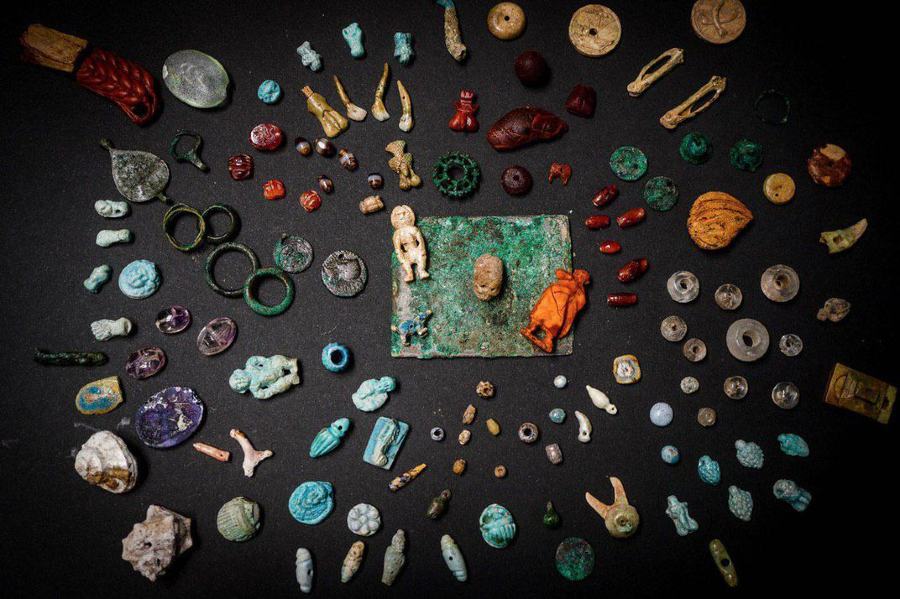
Out of the ashes of Pompeii, archaeologists recently pulled up a time capsule, though only the bronze hinges remained of what is being described as a “sorceress’ toolkit.”

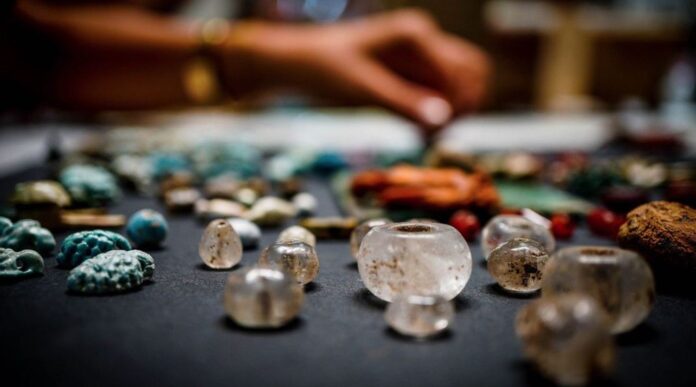
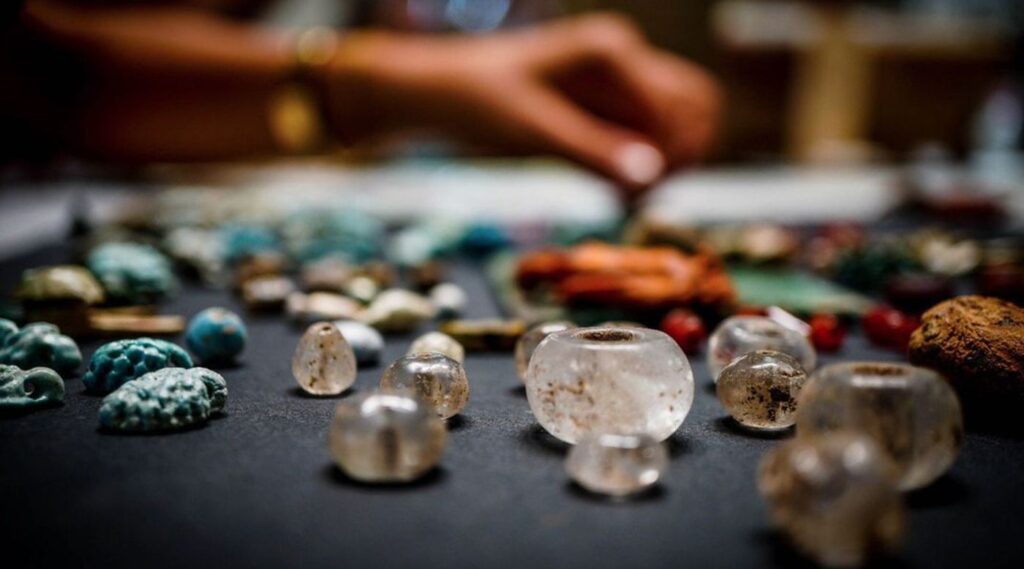
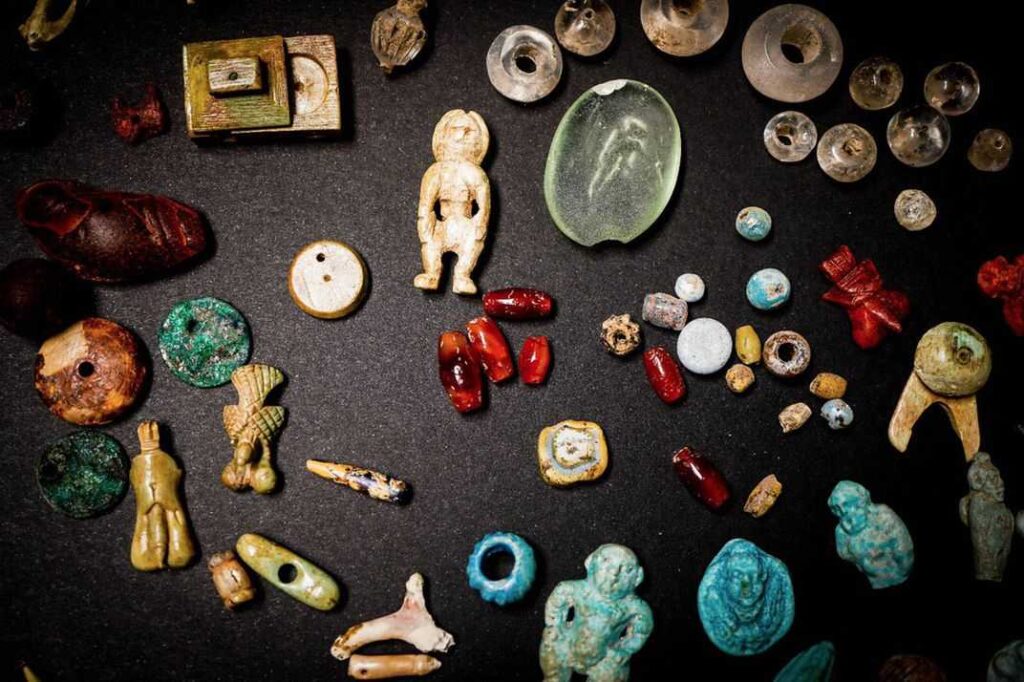
Inside were a collection of around 100 little objects: two mirrors, tiny skulls, scarab beetles, bone-carved objects like buttons, bells, and little fists, decorative elements made of amber, carnelian, and bronze, carved images of men and satyrs, and of course, miniature phallic amulets.

All in all it’s everything your average sorceress could need on the job, which archaeologists believe were to tell fortunes, divine pregnancies, conduct fertility rites, and ward off bad luck.

MORE: Archaeologists in Egypt Discover Mummy With Gold Tongue

“They are objects of everyday life in the female world and are extraordinary because they tell micro-stories, biographies of the inhabitants of the city who tried to escape the eruption” states Pomeii General Director Massimo Osanna.

“In the same house, we discovered a room with ten victims, including women and children, and now we are trying to establish kinship relationships, thanks to DNA analysis. Perhaps the precious box belonged to one of these victims.”

Archaeological Park of Pompeii

The box containing the toolkit was found in the Garden House in Regio V, a luxurious villa which also included some highly sexualized friezes on the walls, such as the myth of Queen Leda and the Swan, and a fresco of Priapus, the god of fertility.

RELATED: 1,500-Year-Old Skeletons Found Locked in Loving Embrace Might Have Been ‘Romeo and Juliet’ Ending in China

Early hypotheses are that the owner of the objects was not of status and could even have been a slave.

The lack of gold or precious stones among the trinkets suggests this, as the Pompeiians adored the yellow metal.

Speaking with Italian news agency Ansa, Osanna theorized the objects belonged a kind of Roman love doctor, but that’s pure speculation.

The toolkit will soon be on display in the Palestra Grande on the Pompeii site.

Archaeological Park of Pompeii

It’s fascinating that, even though most of us grew up learning about the city of Pompeii buried under the ash of Vesuvius, major discoveries are still being made there today despite the fact the site is only 163 acres (66 hectares).

CAST a Spell on Your Mates, Share This Story…

“More than 500 of the most successful people have told me their greatest success came just one step beyond the point at which defeat had overtaken them.” – Napoleon Hill

Quote of the Day: “More than 500 of the most successful people this country has ever known told me their greatest success came just one step beyond the point at which defeat had overtaken them.” – Napoleon Hill

Photo: Iva Rajović

With a new inspirational quote every day, atop the perfect photo—collected and archived on our Quotes page—why not bookmark GNN.org for a daily uplift?


New Cancer Treatments May Be on The Horizon – Success in mRNA Vaccine Trials Use Patients’ Immune Systems

Fotointeresantes, CC license

A personalized, mRNA vaccine, given to patients with particular kinds of aggressive cancers could leverage the immune system of the patient to kill the cancer on its own, and in doing so usher in a new epoch of cancer treatment.

Messenger RNA (ribonucleic acid) vaccines were what sparked the COVID-19 vaccine drives, as Pfizer and Moderna adapted the technology to create an emergency treatment to train the body to fight off the viral spike protein.

What most of us won’t know however, is that the mRNA vaccines were originally in development for aggressive cancer types.

Molly Cassidy, a mother studying for the Arizona Bar exam, is living proof that while the approach isn’t a panacea, it can clear away some of the most dreadful and fast cancers we know of.

After being diagnosed with head and neck cancer, she underwent surgery and chemotherapy. However it was only ten days after finishing chemo that she found a marble-like bump on her collarbone from the cancer’s swift return. Later examinations found it had spread from her ear all the way to her lungs, and she was told to get her affairs in order.

MORE: New Report Finds Survival Rates Are Improving Every Year For Most of the Common Cancers in U.S.

Cassidy was told she was eligible to join a clinical trial at the University of Arizona, testing an mRNA vaccine personalized to the cancer mutations of the host. By 27 weeks, Cassidy had received nine vaccine doses paired with an immunotherapy drug, and her CT scans were clear: the cancer had left her body.

Personalized Medicine

A personalized medicine approach to disease is challenging, however it could be said that the rise of cancer and of so many other diseases across the west is a result of the broader Western-health sector adopting a once-size fits all (or one-pill fits all) approach to everything from cancer to diet to mental health.

RELATED: Simple Blood Test That Can Detect 50 Types of Cancer is Now Accurate Enough to Be Rolled Out

Precision or personalized medicine is becoming a little more common now, with many functional medicine clinics paying more attention to genetic phenotypes and other biomarkers before drafting a therapy plan. This approach recently broke ground in a huge way in the field of Alzheimer’s, and the USDA is using artificial intelligence based on demographics and other information to make more precise dietary guidelines.

Tailor-made mRNA vaccines are an exciting form of personalized medicine to treat cancer, and involve taking a tissue sample from the patient’s tumor and analyzing it for mutations. This not only hones the immune system into the cancerous cells, but differentiates them from healthy, non-cancerous cells.

The result is that the messenger RNA creates proteins shed from the exterior of the tumor and brings immune cells like T cells up to speed on how to fight it.

“One of the things cancer does is it can turn on signals to tell the immune system to quiet down so the cancer is not detected,” explains Daniel Anderson, a biotech scientist at MIT, to National Geographic. “The goal of an mRNA vaccine is to alert and gear up the immune system to go after the characteristic features of tumor cells and attack them.”

Currently, phase-one clinical trials are running for metastatic melanoma, GI-tract cancer, colorectal cancer, pancreatic and ovarian cancer, and non-small cell lung cancer.

One of the most exciting things, even in these early days of mRNA cancer vaccines, is that they will offer a chance at survival for advanced and incurable cancers, not only because they have the potential to be very effective, but also because patients, like in Cassidy’s case, will have no other options.

It’s likely the personalized mRNA vaccines will in practice be paired with immune checkpoint therapy—a breakthrough class of treatment that won the Nobel Prize in 2018. Similar to stem cell treatment, a patient’s T cells are drawn out before being multiplied in a lab, trained on the target cancer cell, and then reintroduced to help fight off the cancer.

CHECK OUT: Coffee is Now Linked to Reduced Risk of Many Ailments, Including Liver Disease, Parkinson’s, Melanoma, Even Suicide

Some animal studies have had success in this way, with one group of rats fighting off triple-negative breast cancer, and another group showing great success against cancer of the lymph nodes. 

National Geographic concluded their feature on mRNA vaccines with a suggestion that based on early success, FDA-approval could be given in around five years.

CURE News Feeds of Despair—Share This Exciting Story…

A Certain Kind of Smiling Can Repair Relationships that Have Been Damaged by Mistrust

Queen's University Belfast
Queen’s University Belfast

A smile is the key to a thousand doors, but deploying it in every situation without mastery of its use is dangerous, says a new social science study.

They say it takes 400 muscles to smile, well scientists at Queen’s University Belfast found that subtle differences in the way in which a person smiled had not-so-subtle impacts on the opinions which the test participants had about the smiler.

“Smiling at another person does not always lead to trust and cooperation,” said Dr. Stephanie Carpenter from the University of Michigan, a co-author of the study. “Subtle differences in a smile can have a real impact on whether people trust each other and choose to cooperate. In fact, the way you smile in a good or bad situation can impact whether people trust you.”

While playing a set of economic games, such as those that require trust to create value for both players, or which can confer more value for a single person willing to deceive, the subject individual first displayed uncooperative behavior and thus triggered a loss of trust or confidence in their partner.

It was then that, depending on the characteristics of the smile made at game’s end by the subject, the participants altered their expectations of how the smiler would behave during the next game.

Three different smiles were used, which were labeled as reward, dominance, and affiliation. These three words belittle the emotional reaction they trigger, and a glance at each one invokes strong feelings, and likely memories of seeing such expressions in the past.

RELATED: This Simple 10-Question Word Test Reveals How Creative You Are

After untrustworthy or uncooperative behavior, a reward smile—a big ear-to-ear smile like a kid who got the ice cream he was begging for, and a dominance smile, a smirk-y sign of superiority, elicited very little trust, expectations of change in behavior, and positivity when compared with a totally neutral expression, or a look of regret, meaning that sometimes smiles can create even stronger negative feelings than not smiling.

However the “affiliation smile,” which seems to have a hint of regret, like the smile a someone might make after consoling a dear friend, created a desire to repair the broken relationship and to trust the person who had just done something unfair.

MORE: Deeply Empathetic People Process Music Differently in Their Brains

“Think about movie villains, for example in James Bond films,” said Dr. Magdalena Rychlowska from Queen’s University, who led the research published in Cognition and Emotion journal. “They often make happy smiles when something bad has happened or is about to happen. This context makes these otherwise happy and normal smiles feel threatening and unpleasant.”

She adds, “The findings of this study show the power of subtle facial expressions and the positive consequences that an affiliation smile can have in difficult situations. It also highlights the importance of social context—a happy smile that could be read as a signal of trustworthiness in one setting can, in another setting, be seen as evidence of bad intentions.”

Mastery of the smile then, can be an excellent way of getting out of difficult social situations, while the lack thereof can be an excellent way of getting into one.

RAISE a Little Grin in Others—Share This Story…

Boat-Plane Hybrid That Needs No Runway Could Transform Travel from LA to San Diego, Boston to NYC

Regent seaglider
REGENT

The future of travel is bold, with a boat-plane hybrid set to transform short distance ferry services.

From the Virgin Hyperloop to HAV carbon-free dirigibles to self-driving cars to, now, this, the REGENT “seaglider” is an electric transport plane that can do 180 mph, or around six-times the speed of a ferry, and with double the range of electric aircraft, but with half the manufacturing costs.

All these pros are down to its unique design as essentially a trio of vehicles in one, which the company believes will seize control of a market for short flights/ferry routes such as LA to Santa Barbara or San Francisco, or New York to Boston, with maybe Washington, D.C. thrown in there as well.

When loading and offloading passengers, the seaglider rests on the sea like a normal seaplane or boat.

When operating within the crowded waters of a port, the seaglider deploys its hydrofoils, matching its impressive propulsion with the maneuverability of the foils below.

MORE: Flying Car Completes First-Ever Flight Between Airports –Then Transforms Back into a Sports Car in 3 Minutes

Once on the open sea, the foils are withdrawn and it takes on the aspects of a “wing-in-ground effect vehicle,” a design invented all the way back in the 1960s, that uses high speeds to hover just above the surface of the water. (Watch their video below.)

So far REGENT’s founders have raised almost $10 million from investors, which have included Mark Cuban and Peter Thiel.

Regent seaglider

Wing-in-ground effect vehicles are actually considered boats, and subject to maritime, rather than aviation laws. In this way the seaglider can skirt around current technology limitations of battery-powered electric motors and offer truly zero-emissions transport.

The company imagines that battery advances currently being pursued should raise the range of the seaglider to 500 miles from 180 miles in the not-too-distant future.

RELATED: Rubber Made From Dandelions is Making Tires More Sustainable – Truly a Wondrous Plant

The company has received statements of intent worth $465 million, have acquired the sponsor dollars of operators Brittany Ferries, Goombay Air, and SplitExpress, and expect to have a quarter-sized prototype by the end of the year, and a full-sized prototype operational in 2023.

(WATCH the video for this story below.)

POWER UP the Good News by Sharing It…

Plumber Has Landed Record Deal After Music Mogul Heard Him Singing –While He Fitted His Bathroom

SWNS

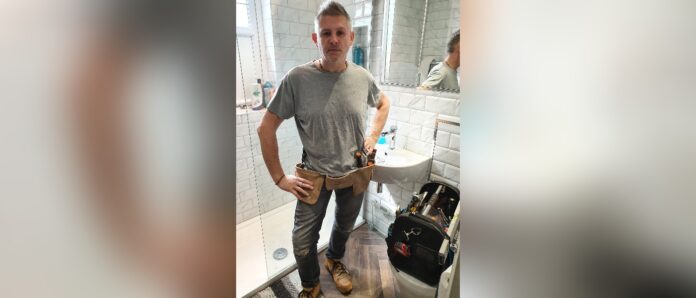
A plumber is flush with success after he landed a record deal when a music mogul heard him singing—while he fitted his bathroom.

49-year-old Kev Crane spent six weeks installing a new suite at the home of Paul Conneally—completely unaware he was the owner of a record label.

Kev would spend his working days singing along to his favourite tunes on the radio including David Bowie and Meat Loaf.

Record company boss Paul was so impressed with this dulcet tones he gave him a deal, and he’s now made his first album.

Kev says he shocked when Paul offered him a chance to sign onto his New Reality Records, which has artists from Brazil, New York, and Britain.

Stunned Kev, of Leicestershire, said, “I got a call to go and quote some bathrooms, I thought fair enough.

“I then started work at Paul’s house, and I like to sing while I am working, and he pulled me into the living room one night for a conversation about my singing voice.

MORE: Deeply Empathetic People Process Music Differently in Their Brains

”I started telling him that I love music, that I used to be in a band and had written an album—more of a hobby really.

”I was shocked when he said he wanted to hear it.

“I sent him the album on the Friday and I thought if I don’t hear from him over the weekend, I can just go back to work for him on the Monday and just carry on fitting his bathrooms.”

Kev used to be in a cover band called ‘The Reprise’ in 1990s, covering bands like Depeche Mode, as well as writing his own music.

But after two unsuccessful auditions for the popular UK tv shows Fame Academy and Stars in Their Eyes in the early 2000s, he decided to give it up.

Then Paul said he really liked the album. He wanted to sign Kev up to his label.

Kev says, “I carried on working at his house and at the same time finishing my album in the recording studio—it’s overwhelming.

Those first tracks are now being released online, weekly up until Christmas.

RELATED: Irish Musicians Saving Oral History By Recording Elders Singing Old Campfire Songs

“My wife has been so overwhelmed by it all,” says Kev, “in tears about it. Good tears because she knows it’s my passion.” After the full release of his album, Why Can’t I Be You? Kev plans to write for other musicians.

“I’d love to do it full-time, but, at the minute, I am just going with the flow. It’s my dream. If it ends next week, I tried.”

(WATCH the singer in action in the video below.)

SING OUT the Good News By Sharing For All to Hear…

Poets in Europe Are Writing Tributes For the Lonely Funerals of Society’s ‘Unclaimed’ Citizens

We felt like we were being serenaded with kindness when we learned that in the Netherlands and Belgium there are official ‘City Poets’ who brighten otherwise lonely funerals.

pavel danilyuk

Akin to a town crier, or some other mainstay of a Middle Ages-set period piece, the City Poet has only been an official position since the turn of the 21st century.

As quaint is it may seem, the job is a serious one, for upon his or her shoulders rests the responsibility for composing funerary poems for those who die anonymously, unclaimed by friends or family.

In an exploration of the Lonely Funeral Foundation, a collective of poets that work to ensure every individual who falls through the cracks of Dutch society has some kind of memorial service, published on the Ploughshares blog at Emerson College, Boston, the reader learns of a stark yet moving tradition that is both modern and rustic, and speaks to the responsibility of a society in the 21st century.

A City Poet is defined by The Mayor Initiative as “a remunerated professional with clear job requirements and term duration. He or she is usually appointed by the City Council for a limited time with the objective of writing poems about the city they come from—for the good and the bad times, but also for regular or random events, official occasions and ceremonies, with the objective to inform and entertain the citizens.”

The Lonely Funerals concept was put forward by one such City Poet—Bart Droog of Groningen, in 2001, after which it spread to other Dutch cities and to those in Belgium, another country that started the City Poet idea around the same years.

MORE: Amid the Green Funeral Movement, Scattering Ashes Ensures These Forests Remain Pristine Forever

In Amsterdam, where a dozen people might die unclaimed per year, the City Poet has to, at a moment’s notice, be ready to transform himself from artist to sleuth.

Details about these people can often be scant—presenting a huge challenge to someone trying to write a poem, much less one in memory of a life.

The City Poet must be ready to collect records of lodging, employment, and immigration, or talk to neighbors and others that might have interacted with the person.

There is a simple prize for a yearly contest to see which poet composed the most moving lonely funeral poem, organized by Ger Fritz, a former employee of the Amsterdam Department of Funerals, and one of the originators of the concept.

“People are story machines… What the Lonely Funeral does is return stories to people who have somehow lost theirs along the way,” an Amsterdam poet Frank Starik, told the Ploughshares Blog.

Also speaking with Ploughshares, poet Hester Knibbe remarked at the difficulty of the job: “How do you write a poem about someone you don’t know anything about… ? It’s like a word that just won’t come: you describe, you try to imagine a basic life, trying to force it into some highs and lows.”

RELATED: Dutch Man Invents Coffin That Turns Bodies Into Mushrooms: ‘We are nutrients, not waste’

Sometimes details are so scant, the poets must fight the urge to fill in gaps with recognizable themes from literature or from the poet’s own life.

Pioneer Droog refers to the Lonely Funeral Foundation as the “social task of the poet,” and indeed it’s considered a vital civil service akin to social insurance or other benefits; that through honoring those the society let down, those who remain can perhaps work to better it.

HONOR This Story By Sharing It on Social…

“Before the reward, there must be labor. You plant before you harvest. You sow in tears before you reap joy.” – Ralph Ransom (Happy Labor Day)

Quote of the Day: “Before the reward, there must be labor. You plant before you harvest. You sow in tears before you reap joy.” – Ralph Ransom (Happy Labor Day)

Photo: Tim Mossholder

With a new inspirational quote every day, atop the perfect photo—collected and archived on our Quotes page—why not bookmark GNN.org for a daily uplift?


4 Tuna Species Recovered After Decade of Fishing Quotas–With Albacore in Stores Being Truly Sustainable

Yellowfin tuna by Martin Gil Gallo-CC-By-NC

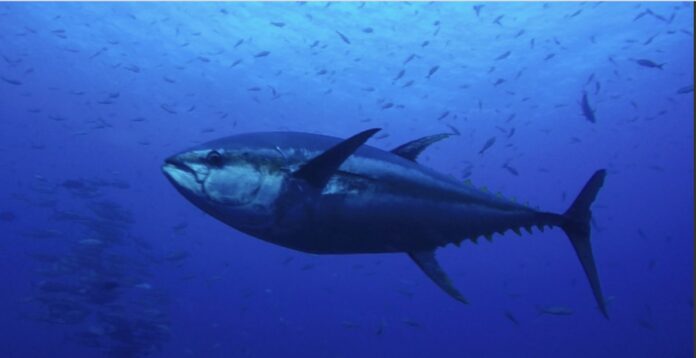
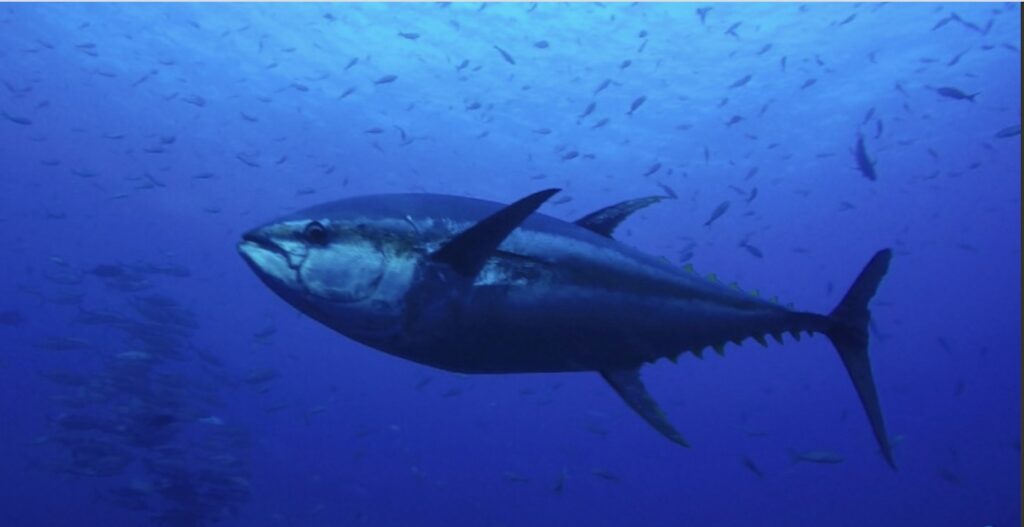
Four commercially-fished tuna species are on a significant path to recovery thanks to the enforcement of regional fishing regulations over the last ten years, according to yesterday’s update of the IUCN Red List of Threatened Species.

“Today’s IUCN Red List update is a powerful sign that, despite increasing pressures on our oceans, species can recover if states truly commit to sustainable practices,” said Dr Bruno Oberle, IUCN Director General.

States and others are now gathered at the IUCN World Conservation Congress in Marseille, France, to work towards binding targets that will increase and maintain biodiversity across the planet.

“The newly released results on the status of commercial tunas emphasize that sustainable fisheries are possible,” said Dr Beth Polidoro, Associate Professor at Arizona State University and Red List coordinator.

RELATED: A Fisherman’s Underwater Sculptures Have Stopped Illegal Trawling – Bringing Art and Biodiversity Back to Italian Bay

In the Red List update, the seven most commercially fished tuna species were reassessed. Four moved in a positive direction thanks to countries enforcing more sustainable fishing quotas and successfully combatting illegal fishing:

  • Atlantic bluefin tuna moved from Endangered to Least Concern
  • Southern bluefin tuna (Thunnus maccoyii) moved from Critically Endangered to Endangered
  • Albacore (Thunnus alalunga) and yellowfin tunas (Thunnus albacares) both moved from Near Threatened to Least Concern
  • Pacific bluefin tuna (Thunnus orientalis) improved its position from Vulnerable to Near Threatened in this update due to the availability of newer stock assessment data and models, but is still depleted.

“The take home message for the general public is that things like albacore tuna—which is the one that is widely on supermarket shelves—is of least concern now,” Craig Hilton-Taylor, who heads the IUCN Red List, told BBC News. “It means that what they’re eating has been sustainably caught and is well managed.”

CHECK OUT: Canada Launches Satellite Technology That Identifies ‘Dark Vessels’ Illegally Catching Billions of Fish

Despite global improvement at the species level, some regional tuna stocks remain depleted. For example, while the larger, eastern population of Atlantic bluefin tuna, which originates in the Mediterranean, has increased by at least 22% over the last four decades, the species’ smaller native western Atlantic population, which spawns in the Gulf of Mexico, has declined by more than half in the same period.

“These Red List assessments are proof that sustainable fisheries approaches work, with enormous long-term benefits for livelihoods and biodiversity,” said Dr Bruce Collette, Chair of the IUCN SSC Tuna and Billfish Group. “Tuna species migrate across thousands of kilometers, so coordinating their management globally is also key.”

MORE: Scientists Find Half the World’s Fish Stocks Are Recovered—or Increasing—in Oceans That Used to Be Overfished

Share The Ocean of Good News With Tuna-loving Folks on Social Media…

French Beekeeper Invents a Trap to Take on Asian Hornets Decimating Bee Populations in Europe

Asian hornet (Vespa velutina), by Charles J. Sharp – CC license

A beekeeper was so devastated five years ago when all his bee hives were destroyed by Asian hornets, he vowed to figure out a solution to fight back.

Asian hornet (Vespa velutina), by Charles J. Sharp – CC license

French beekeeper Denis Jaffré thought about it night and day, and finally came up with a trap that stops the invasive species, which has no natural predators in Europe where they have been terrorizing hives since arriving accidentally in a cargo shipment from Southeast Asia.

The trap Jaffré invented does no harm to bees.

It attracts insects with a sugary bait using a funnel, but the larger hornets can’t get out. Bees can easily escape through tiny holes.

Reuters reports that the beekeeper won an inventor’s prize 3 years ago and is now manufacturing the traps using 3D printers and six employees, and is being flooded with orders.

RELATED: These Homegrown Mushroom Hives Could Save Ireland’s Bees

He hopes that governments will get involved so Europe can stop the spread of the so called predatory species.

See the story below from Reuters… [CORRECTION: The Reuters article appearing in the Globe and Mail incorrectly identified the pests as ‘murder hornets’ and ‘Asian giant hornets’ which are a different species than is in France today.]


POPULAR: Teen Rescues Bumblebee–And Now it Won’t Leave Her Side, Even Sleeping in a Jar by Her Bed

SHARE the Innovative Good News With Bee-lovers on Social Media…

Woman Delivers Compliment Jars Anonymously to Dozens of Friends With Notes of Praise During Pandemic

This blog was submitted to GNN by one of our readers for publishing. If you have an interesting story of kindness or positivity, be sure and send it to us for review.

We all know 2020 was a rough year and many people turned to thinking about what they could do to improve the situation for themselves or for others.

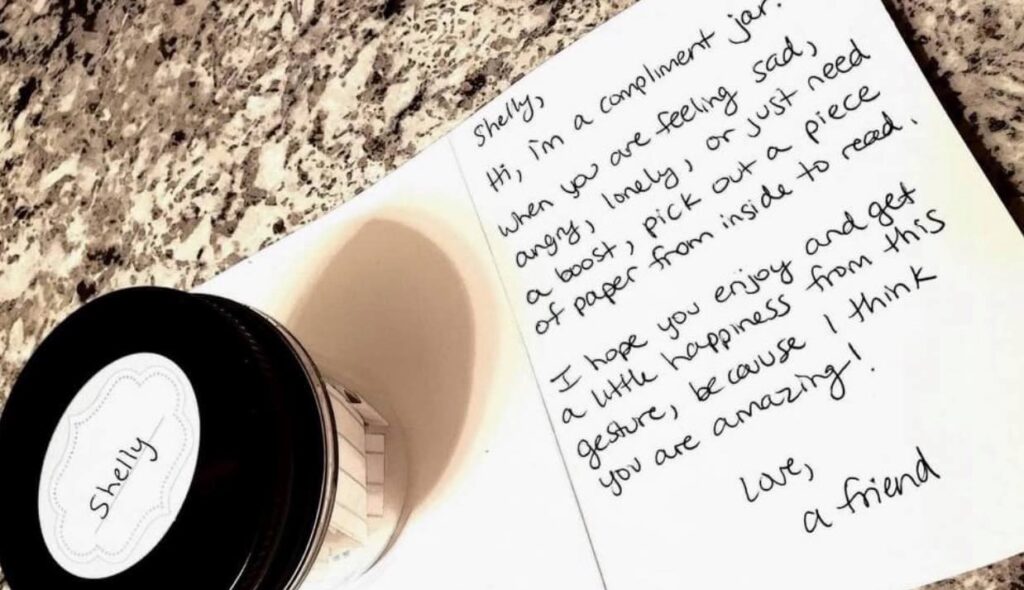
One of those people was Kimberly Wybenga. She wanted to brighten the outlook for friends and family and wondered ‘who doesn’t love a compliment’?

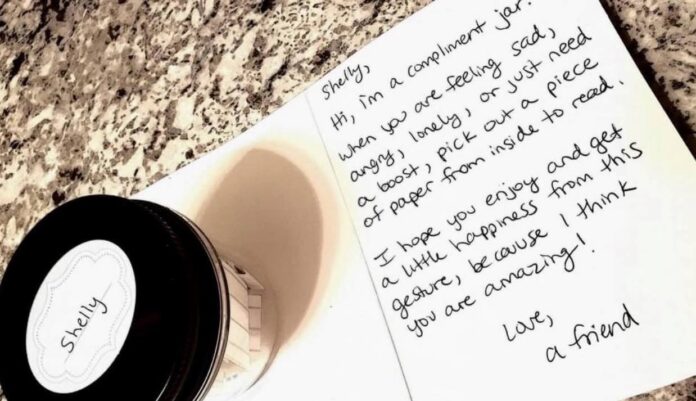
She bought 10 small jars and wrote out compliments for 10 friends that she thought could use a dose of happiness.

Just writing out the compliments brought her joy and she bought 20 more jars to spread the love even further.

She didn’t stop there, either. She bought an additional 20 jars bringing the total number of kindness gift jars to 50—and did it all anonymously. Altogether, she hand-wrote 1,750 compliments! (See the video below.)

One recipient commented, “Sometimes the universe knows exactly what you need. This touched me to the core. The thoughtfulness that went into this is amazing.”

Another said, “I hope whoever did give this to me realizes just how much I needed this gift. I’ve opened it and read one when I needed it, but tonight I dumped it all out and read every single nice thing this person said about me.”

RELATED: Best Boyfriend Ever Fills Anniversary Gift – a Prescription of ‘Love Pills’– With Tiny Notes

“I know everyone is dealing with some kind of struggle and I just thought it would be nice to support them any way I could,” Wybenga told GNN, “even if I didn’t know what they were going through.”

The 38 year-old tried to deliver her boxes of hope anonymously, signing “a friend” at the bottom of each card. She mailed some packages and hand-delivered others that lived closer to her home in Colorado.

The ones that she hand-delivered, she even tried to disguise herself so if people had cameras, they wouldn’t know it was her. Dressed in a black jacket, her long blue hair pulled up into a beanie, and a mask, she placed the boxes on doorsteps. She even parked around corners or down streets so people wouldn’t see her car.

RELATED: A ‘Trail Angel’ Sprinkles Good Deeds Along Appalachian Trail For Unsuspecting Hikers

All the effort to remain anonymous didn’t work much of the time because Wybenga’s handwriting was recognized by multiple people. Others looked up her zip code on the package or did some sleuthing and discovered it was her.

“Seeing other people happy brought me so much joy,” she said. “The world is a better place with all my friends and family.”

She decided to now share the story publicly, in the hope that it would inspire someone else to spread kindness.

Watch her lovely YouTube video below…

MORE: Check Out More Silver Linings of the Pandemic on the GNN Page Here

SHARE the Compliment Jars as a Birthday Gift Idea on Social Media… 

“Even a wounded world is feeding us. Even a wounded world holds us, giving us moments of wonder and joy.” – Robin Wall Kimmerer

Quote of the Day: “Even a wounded world is feeding us. Even a wounded world holds us, giving us moments of wonder and joy.” – Robin Wall Kimmerer

Photo: Karl Fredrickson

With a new inspirational quote every day, atop the perfect photo—collected and archived on our Quotes page—why not bookmark GNN.org for a daily uplift?


In Hurricane Stricken New Orleans, a Solar Microgrid Kept the Lights on in This Apartment Building for Low Income Vets

- Architect Eskew Dumez Ripple

Another hurricane, another power outage? In the state of Louisiana, one apartment complex is keeping the lights on—a beacon of hope in New Orleans.

Architect Eskew+Dumez+Ripple

St. Peter Residential, which opened one month before the pandemic began, built in that emergency functionality using an 8-hour solar battery and a panel array on its roof—and it kept the units running after Hurricane Ida made landfall.

At $7.4 million, the 45,000 square foot building is the first net-zero emission apartment complex in the state, meaning it offsets or removes as much power as it generates onsite. Designed as “a calming oasis intent on building community in a dense urban environment,” the 50-unit, mixed-income living spaces are served by a microgrid of 450 solar panels that generate electricity on demand, and stored excess power in a battery located in the parking lot.

St. Peter was designed to cultivate a community (with the inclusion of a wellness center for yoga and meditation and common event and outdoor spaces), and importantly, half of the 50 units—29 affordable apartments and 21 market-rate units—are reserved for veterans.

The microgrid has now seen three storms: Hurricane Zeta which took out power in the area last October, Winter Storm Uri which resulted in the same thing, and now Hurricane Ida.

Lauren Avioli is the director of housing development for the nonprofit SBP, which oversaw the funding and construction of St. Peter.

SBP, named after St. Bernard Project, was founded by Zack Rosenburg and Liz McCartney after the couple (now married) volunteered in the St. Bernard parish following the devastation wrought by Hurricane Katrina. Since then, SBP has rebuilt homes for more than 2,000 families and hired Eskew+Dumez+Ripple as the architect to design this innovative complex that provides residents with extremely low energy bills.

POPULAR: Tens of Millions Now Have Power Thanks to Off-Grid Solar Systems –Many of Them Recycled

“It’s not just post-disaster emergency power,” Avioli told Fast Company magazine. “It’s also helping people at the property save money on a blue sky day because we can use some of the energy that’s being generated by the solar panels to run the building.”

Architect Eskew+Dumez+Ripple

It doesn’t work all the time, however. For example, on Tuesday when the power went off it was cloudy, and the system couldn’t deliver as much electricity as the building managers would have hoped for.

But the days after were sunny and powerless in New Orleans, except for St. Peter’s tenants, many of whom have transitioned from lower-income housing, or even from homelessness.

SBP believes it’s a no-brainer as far as city planning goes, to place these resilient solar microgrids on as many rooftops as possible—especially if, as some scientists’ believe, global climate change is making storms like Ida hit harder and more often than normal.

Cities would not only be doing their best to keep the power on, but to mitigate their share of emissions going up into the atmosphere.

RELATED: Realtor Transforms Abandoned Properties into Tiny Home Villages That Give Permanent Housing to Chronic Homeless

The St. Peter project is a shining example of how developers and cities can commit to helping find solutions to eradicating both poverty and climate change emissions that are exacerbating such storms.

SHARE The Sunny News About Innovation in America on Social Media…

4-yo Learns Piano in Lockdown, Wins Elite Competition But Can’t Play Carnegie Hall as She’s Too Young for Vaccination

SWNS

The youngest winner of one of the world’s most prestigious music competitions can’t claim her prize—playing piano at Carnegie Hall—because she’s too young to get the vaccine.

SWNS

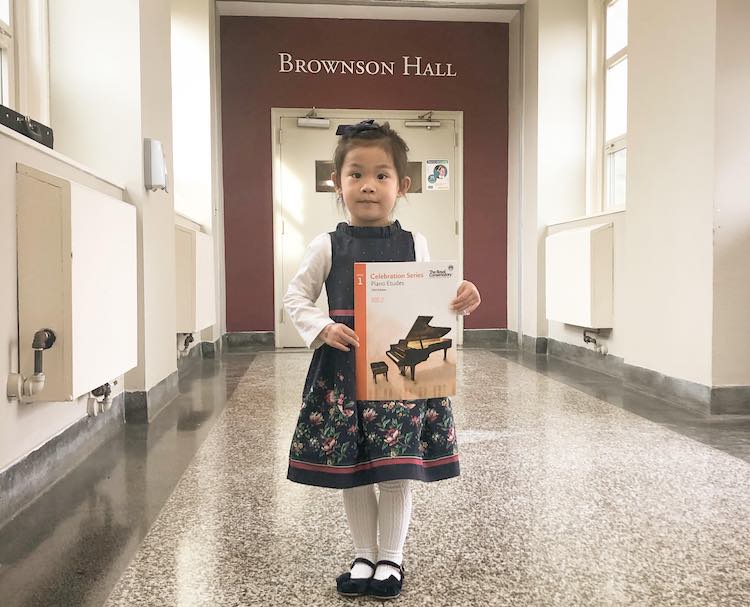
Four-year-old Brigitte Xie only started playing piano a year ago in lockdown, but instantly revealed a talent for music.

The pint-sized prodigy can read music and play a note-perfect rendition of Beethoven’s Sonatina in F Major—her feet dangling far above the pedals.

She won the Elite National Music Competition last December, and then in March this year won first place at the American Protégé International Competition, which wins her an invitation to perform at world-renowned music venue Carnegie Hall in New York City this November where all performers are required to be vaccinated against COVID-19.

Pre-schooler Brigitte was forced to pull out – but will be given anther chance at a future concert in 2022.

Her mother, Nicole Sun from Ridgefield, Connecticut said, “She doesn’t know much to be honest; I tell her ‘yeah baby you won the prize’ and she was like ‘ok, can we go to Disney store now?’

“I tell her ‘you’re going to perform in front of many people’ and she seemed excited because she likes performing.”

A pianist herself, Nicole took the opportunity to introduce her daughter to it while under lockdown last year to keep her entertained.

But even though she’s showing a prodigious talent, her mom is not going to push it on her.

“As a parent I’m still open to everything, I don’t tell her that she must be a pianist. Whatever she wants to be is fine.”

Her daughter began playing piano at age three during the lockdown, and when her mom couldn’t keep up with lessons, she found an online tutor, Felicia Feng Zhang. The little musician “picked up more in six months than most do in years worth of lessons”.

SWNS

She quickly learned to read sheet music and sight read classical pieces, and eventually started attending in-person lessons with Felicia in Greenwich, Connecticut, who urged her to enter competitions.

RELATED: 11-year-old Girl Drummer, Nandi Bushell, Finally Joins Foo Fighters on Stage

Her mom didn’t know, at this young age, that Brigitte could follow instructions and play the pieces.

“Before the media approached me I thought she was just one of the normal students.”

Brigitte passed her Royal College of Music Level 1 exam before her 4th birthday in May with a first class mark of 86.

She practices for just 45 minutes a day, and has one half-hour lesson a week, but neither Nicole or dad, Tao Xie, have to nag her, as she’ll wander over herself.

RELATED: 2-Year-old Girl With a Genius IQ is the Youngest American to Become Member of Mensa

The tinkling tot wants to perform Mozart when she eventually takes the stage— and, had she been able to perform this year, would potentially have been the youngest ever to play on Carnegie Hall.

SEND This Mini Mozart to Social Media Where She CAN Play…

Clever Cockatoos Craft 3-Piece Tool Set to Extract Fruit – Becoming Only 4th Animal Species to Do So

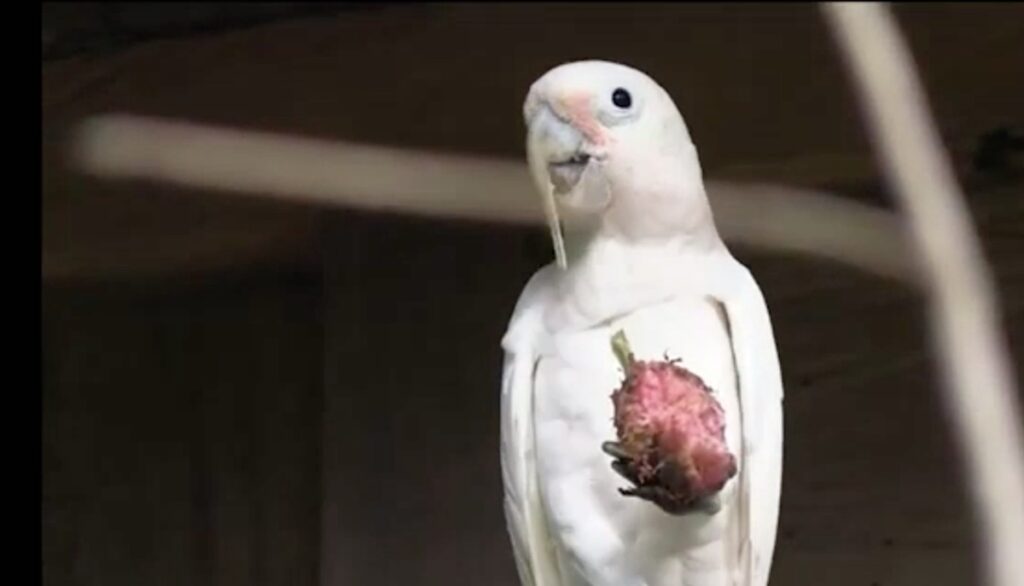
Goffin’s Cockatoo uses medium sized tool to penetrate seed. – Messerli Institute video

Truly astonishing behavior has just been recorded in a pair of wild Goffin’s Cockatoos, who like expert bandits, manufactured an entire three-piece set of tools to burgle their way into the pit of a mango.

Caught wild and held for a short time in a research aviary in Indonesia, it is the kind of behavior that typifies the most advanced tool users in the animal kingdom, and solidifies the Goffin’s Cockatoo as one of the avian group’s major bird-brainiacs.

Perhaps the most delightful part of this discovery was that it happened serendipitously, while Mark O’Hara and Berenika Mioduszewska were studying a new group of wild birds in their research aviary on the island of Tanimbar.

“I’d just turned away, and when I looked back, one of the birds was making and using tools,” O’Hara, of the Messerli Research Institute in Vienna Austria, tells Science. “I couldn’t believe my eyes!”

Before the capture of the canny cockatoos, O’Hara and Mioduszewska had spent an eye-watering 900 hours watching them feed high in the canopy without ever once witnessing tool use.

A few other bird species, like the New Caledonian Crow and Hyacinth Macaw, have been documented making stick tools, and even hook tools.

Goffin’s Cockatoos are well-documented as intuitive social learners that can solve a variety of problems and puzzles. The Messerli Institute has, in fact, shown how one individual was able to teach his mates how to craft and use tools. That, however, was just one tool, for one purpose.

This new observation is the first time any bird species has been seen creating and using a set of tools in a specific order

RELATED: Research Shows Why Crows Are So Intelligent and Even Self-Aware—Just Like Us

The bird-brained bandit

While researching the cockatoos, the team would regularly provide them with food they found about the island, including the wawai, or sea mango, which is poisonous to humans but nutritious for birds. At the center of the mango a hard pit protects a large, nutritious seed.

For awhile it seemed there was nothing special about the bunch of birds they captured, but two individuals, upon getting their talons onto the pits, began to craft not one, not two, but a set of three different tools to work their way into the fruit pit.

“Repeated provisions of the fruit allowed us to analyze the behavior in detail, and to collect and trace some of the manufactured tools,” explains O’Hara in a video abstract. “Using a structure-from-motion technique we could create 3D models and gather detailed measurements such as size and volume…[of the tools used]. Based on the physical properties, the function analysis classified three types of tools; we discovered that each tool type seemed to serve a different purpose.”

LOOK: Man is Stunned After He Sets Up Camera Inside Bird Box and Attracts 41 Million Fans Worldwide

With a thicker section of branch, they would use their beak to push and pry open one end of the pit, while with a second, medium-fine implement, they punctured the membrane surrounding the seed. Lastly, they would make a scoop-like tool which when maneuvered with their mouth, allowed them to extract the seed material.

Goffin’s Cockatoo uses medium sized tool to penetrate the seed. – Messerli Institute video

This making of tool sets has been seen in humans, chimpanzees, and capuchin monkeys; full stop. Chimps use between two and five tools for termite and beehive raids.

Tool use has been proposed in the parrot lineage as having a strong captivity bias, so whether the behavior was tied to their stay in the aviary or whether they use tools in the wild is something O’Hara and Mioduszewska discuss in their research paper in Cell. 

“If they had a genetic predisposition to use tools, all the birds would do it,” O’Hara tells Science. “Since only a few make these, it’s more likely they invented them independently,” which would be even more likely as the two individuals displayed immediate and exceptional proficiency.

RELATED: ‘Like a Beautifully-tuned Instrument’: 2000 Microphones Unlock the Mystery of Why Hummingbirds Hum

They believe that it is not species-wide but acquired by individuals through opportunistic innovations, or by watching and learning from others. A number of intriguing details emerge in the Discussion section, such as that tools tended to be crafted to specifications before use, rather than through a trial-and-error process.

Another detail is that around the island they had found fruit underneath wawai trees that appeared to had been foraged on with tools. One actually contained a wooden fragment inserted into the fissure of the pit, which provided enough years go by, could be the first-ever instance of “avian-archaeology.”

CHECK OUT: New Bird Song That ‘Went Viral’ Across a Sparrow Species Was Tracked by Scientists For the First Time

O’Hara and Mioduszewska’s paper is filled with videos that are stunning to watch, and can be accessed here for free.

FLY This to Your Bird-Loving Flock on Social Media…

11-year-old Girl Drummer, Nandi Bushell, Finally Joins Foo Fighters on Stage – LOOK

“It Happened!!!,” Nandi Bushell wrote on the YouTube video shot by her dad which tallied 1.1 million views this week.

In her grunge flannel shirt, the 11-year-old drummer took the stage at the Los Angeles Forum to finally meet her rock star idol in person—and play alongside Dave Grohl and his world-renown Foo Fighters.

Nandi accepted the invitation and traveled with her parents from Ipswich, England, where she’s been playing since she was five-years-old.

It was a bright spot during the pandemic in August 2020 when she made a video challenging Grohl to an epic drum battle during lockdown.

Her drumming is so superlative that multiple friends of the former Nirvana drummer were texting him, saying he had to respond with a video of his own.

Over several weeks they went back and forth with dueling videos, and in September, Grohl, a Grammy Award-winning singer, drummer and guitarist, penned a song just for Nandi, the wunderkind who also plays guitar and bass. (The video is incredible, with Dave’s daughters, hereby known as “the Grohlettes,” joining him as back-up singers.)

On August 26, near the end of the California show, Dave introduced the girl who had initiated their drum-off by playing her cover version of the Foo Fighters hit Everlong. Now it was time to join the big boys playing that song for the encore.

Nandi Bushell’s YouTube channel

The crowd began chanting ‘Nandi. Nandi. Nandi.’

“It was EPIC!!!,” she wrote on her Twitter page.


Her dad, John, who was screaming for joy throughout the video from the side of the stage, was truly living the Everlong lyrics as he was hearing them:

And I wonder… If everything could ever feel this real forever.
If anything could ever be this good again.

See the full video of her time on stage via her YouTube channel. below..

WATCH: Dog Howls For Joy as New Back-up Singer in Baby’s Band

SHARE This With All Your Rock-n-Roll Fans on Social Media…

This Week’s Inspiring Horoscopes From Rob Brezsny’s ‘Free Will Astrology’

Our partner Rob Brezsny provides his weekly wisdom to enlighten our thinking and motivate our mood. Rob’s Free Will Astrology, is a syndicated weekly column appearing in over a hundred publications. He is also the author of Pronoia Is the Antidote for Paranoia: How All of Creation Is Conspiring To Shower You with Blessings. (A free preview of the book is available here.)

Here is your weekly horoscope…

FREE WILL ASTROLOGY – Week beginning September 3, 2021
Copyright by Rob Brezsny, FreeWillAstrology.com

VIRGO (Aug. 23-Sept. 22):
“I often wonder who I am and where is my country and where do I belong and why was I ever born at all,” wrote Virgo author Jean Rhys (1890–1979). I don’t think you will be agitated by those questions during the next eight weeks, Virgo. In fact, I suspect you will feel as secure in your identity as you have in a long time. You will enjoy prolonged clarity about your role in the world, the nature of your desires, and how you should plan your life for the next two years. If for some inexplicable reason you’re not already enjoying these developments, stop what you’re doing and meditate on the probability that I am telling you the bold truth.

LIBRA (Sept. 23-Oct. 22):
Several states in the US have statutes prohibiting blasphemy and such cursing could theoretically get you fined in Massachusetts, South Carolina, and Wyoming. In the coming days, it’s best to proceed carefully in places like those, since you’ve been authorized by cosmic forces to curse more often and more forcefully than usual. Why? Because you need to summon vivid and intense protests in the face of influences that may be inhibiting and infringing on your soul’s style. You have a poetic license to rebel against conventions that oppress you.

SCORPIO (Oct. 23-Nov. 21):
Everyone dreams at least three dreams per night. In a year, your subconscious mind generates over 1,100 dreams. About this remarkable fact, novelist Mila Kundera writes, “Dreaming is not merely an act of coded communication. It is also an aesthetic activity, a game that is a value in itself. To dream about things that have not happened is among humanity’s deepest needs.” I bring this to your attention, Scorpio, because September is Honor Your Dreams Month. To celebrate, I suggest the following experiments. 1. Every night before sleep, write down a question you’d like your dreams to respond to. 2. Keep a notebook by your bed and transcribe at least one dream each time you sleep. 3. In the morning, have fun imagining what the previous night’s dreams might be trying to communicate to you. 4. Say prayers of gratitude to your dreams, thanking them for their provocative, entertaining stories.

SAGITTARIUS (Nov. 22-Dec. 21):
In her autobiography Changing, Sagittarian actor Liv Ullmann expresses grief about how she and a loved one failed to communicate essential truths to each other. I propose we regard her as your anti-role model for the rest of 2021. Use her error as your inspiration. Make emotionally intelligent efforts to talk about unsaid things that linger like ghostly puzzles between you and those you care about.

CAPRICORN (Dec. 22-Jan. 19):
“I could do with a bit more excess,” writes author Joanne Harris. “From now on I’m going to be immoderate—and volatile,” she vows. “I shall enjoy loud music and lurid poetry. I shall be rampant.” Let me be clear, Capricorn: I’m not urging you to be immoderate, volatile, excessive, and rampant every day for the rest of your long life. But I think you will generate health benefits and good fortune if you experiment with that approach in the coming weeks. Can you think of relatively sane, sensible ways to give yourself this salubrious luxury?

AQUARIUS (Jan. 20-Feb. 18):
While wading through the internet, I found a provocative quote attributed to the ancient Greek philosopher Socrates. He supposedly said, “My ultimate goal is to look totally hot, but not be unapproachable.” I confess that in the past I have sometimes been fooled by fake quotes, and this is probably one. Still, it’s amusing to entertain the possibility that such an august personage as Socrates, a major influencer of Western thought, might say something so cute and colloquial. Even if he didn’t say it, I like the idea of blending ancient wisdom with modern insights, seriousness with silliness, thoughtful analysis with good fun. In accordance with astrological omens, I recommend you experiment with comparable hybrids in the coming weeks. (PS: One of your goals should be to look totally hot, but not be unapproachable.)

PISCES (Feb. 19-March 20):
“If you don’t know what you want,” writes Piscean novelist Chuck Palahniuk, “you end up with a lot you don’t.” Very true! And right now, it’s extra important to keep that in mind. During the coming weeks, you’ll be at the peak of your ability to attract what you want and need. Wouldn’t you prefer to gather influences you really desire—as opposed to those for which you have mild or zero interest? Define your wants and needs very precisely.

ARIES (March 21-April 19):
Aries poet Anna Kamienska wrote, “I’ve learned to value failed conversations, missed connections, confusions. What remains is what’s unsaid, what’s underneath. Understanding on another level of being.” In the coming weeks, I suggest you adopt her perspective as you evaluate both past and present experiences. You’re likely to find small treasures in what you’d assumed were wastelands. You may uncover inspiring clues in plot twists that initially frustrated you. Upon further examination, interludes you dismissed as unimportant or uninteresting could reveal valuable wrinkles.

TAURUS (April 20-May 20):
After studying your astrological omens, I’ve decided to offer you inspiration from the ancient Roman poet Catullus. I hope the extravagant spirit of his words will free you to be greedy for the delights of love and affection. Catullus wrote, “Give me a thousand kisses, then a hundred; then another thousand, then a second hundred; then yet another thousand.” I’ll add the following to Catullus’s appeal: Seek an abundance of endearing words, sweet favors and gifts, caresses and massages, and help with your work. If there’s no one in your life to provide you with such blessings, give them to yourself.

GEMINI (May 21-June 20):
Gemini author Elif Batuman writes that the Old Uzbek language was rich in expressions about crying. There were “words for wanting to cry and not being able to, for loudly crying like thunder in the clouds, for crying in gasps, for weeping inwardly or secretly, for crying ceaselessly in a high voice, for crying in hiccups, and for crying while uttering the sound ‘hay hay.'” I recommend all of these to you in the coming days, as well as others you might dream up. Why? It’s prime time to seek the invigorating release and renewal that come from shedding tears generated by deep and mysterious feelings.

CANCER (June 21-July 22):
A blogger named MythWoven imagines an “alternate universe where I literally go to school forever (for free) so I can learn about art and literature and history and languages for 100 years. No job skills. No credit requirements. No student loans. Just learning.” I have longings like hers. There’s an eternal student within me that wants to be endlessly surprised with exciting information about interesting subjects. I would love to be continually adding fresh skills and aptitudes to my repertoire. In the coming weeks, I will give free rein to that part of me. I recommend you do the same, my fellow Cancerian.

LEO (July 23-Aug. 22):
In 2016, the International Garden Photograph of the Year depicted lush lupine flowers in New Zealand. The sea of tall purple, pink, and blue blooms was praised as “an elegant symphony” and “a joy to behold.” What the judges didn’t mention is that lupine is an invasive species in New Zealand. It forces native plant species out of their habitat, which in turn drives away native animal species, including birds like the wrybill, black stilt, and banded dotterel. Is there a metaphorically comparable phenomenon in your life, Leo? Problematic beauty? Some influence that’s both attractive and prickly? A wonderful thing that can also be troublesome? The coming weeks will be a favorable time to try to heal the predicament.

WANT MORE? Listen to Rob’s EXPANDED AUDIO HOROSCOPES, 4-5 minute meditations on the current state of your destiny — or subscribe to his unique daily text message service at: RealAstrology.com

(Zodiac images by Numerologysign.com, CC license)

SHARE The Wisdom With Friends Who Are Stars in Your Life on Social Media…

“The secrets of making dreams come true summarized in four Cs: Curiosity, confidence, courage, and constancy, and the greatest of all is confidence. When you believe in a thing, believe in it all the way, implicitly and unquestionable.” – Walt Disney

Quote of the Day: “The secrets of making dreams come true summarized in four Cs: Curiosity, confidence, courage, and constancy, and the greatest of all is confidence. When you believe in a thing, believe in it all the way, implicitly and unquestionable.” – Walt Disney

Photo: MD Duran

With a new inspirational quote every day, atop the perfect photo—collected and archived on our Quotes page—why not bookmark GNN.org for a daily uplift?


Neighbors Secretly Plan a Hokey-Pokey Birthday Flash Mob for 93-Year-old Super Fan of the Song (WATCH)

This 93-year-old woman has an obsession. It’s not an unusual collection of plates or a passion for exotic reptiles. It’s a song, and one song only—The Hokey Pokey.

“You put your right foot in. You put your right foot out.
You put your right foot in, and you shake it all about.
You do the Hokey Pokey, and you turn yourself around,
That’s what it’s all about…”

For Phyllis Brinkerhoff—Mrs. B. as she’s affectionately known around the town in Prairie Village, Kansas—that really is what it’s all about.

“It’s just a fun, joyous song,” Mrs. B recently told CBS’s Steve Hartman. And Mrs. B wanted to share the love, even if it became a bit annoying to her neighbor.

She gave Melanie Mendrys a copy of a Hokey Pokey CD—and anxiously awaited her friend’s conversion—from someone who merely knew the song to a die-hard fan who wanted to do the dance.

When proof of such a change in sentiments wasn’t forthcoming, the enthusiastic senior became something of a nudge, often calling Mendrys to see if she’d experienced her Hokey Pokey epiphany yet.

WATCH: Dick Van Dyke Celebrates 90th Birthday With Flash Mob of Chimney Sweeps

Mendrys admits the corny song was never likely to make it to the top ten of her personal hit parade—but, then, the neighbor did something extraordinary for Mrs. B’s upcoming 93rd birthday.

Mendrys and her daughter secretly created special invitations and passed them out to the community inviting them to a one-in-a-million surprise party—a Hokey Pokey flashmob.

RELATED: Flash Mob of Child Musical Prodigies Wows Crowd in Paris

The neighbors donning birthday hats assembled on the front lawn of Mrs B’s home where they put their ‘whole selves in’ and broke out in a performance of her favorite song.

And, the huge smile on her face? That’s what it’s all about.

WATCH the video from our friends at On the Road… **NOTE: International viewers can see it at CBS)
Put Your Right Hand on the Share Button, and Send This Tear-jerker to Friends…