












All News - Page 90 of 1714 - Good News Network
Home Blog Page 90

First-Known Sighting of a ‘Massive’ Antarctic Squid is Caught on Camera During Nat Geo Expedition

First-known sighting of living Antarctic squid ‘Gonatus antarcticus’, spotted by researchers on the National Geographic and Rolex Perpetual Planet Expedition in the Southern Ocean – Credit: ROV SuBastian / Schmidt Ocean Institute
First-known sighting of living Antarctic squid Gonatus antarcticus, spotted by researchers on the National Geographic and Rolex Perpetual Planet Expedition in the Southern Ocean – Credit: ROV SuBastian / Schmidt Ocean Institute

Researchers have recorded a video sighting of a three-foot-long deep-sea squid species that’s never been filmed nor seen alive.

Gonatus antarcticus squid, an elusive squid found only in the frigid waters around Antarctica, was discovered on Christmas Day by the Schmidt Ocean Institute’s research vessel, the R/V Falkor (too), in a surprise moment caught on camera via the research vessel’s remotely operated vehicle, SuBastian.

Prior to the astonishing discovery, the species was only known from carcasses in fishing nets or when the squids’ beaks were found in the stomach of fished marine animals.

Footage of the squid shows the animal with scratches on its arms and fresh-looking sucker marks on its mantle but otherwise shows it is in good shape. Spotted at a depth of approximately 2,152 meters—below 6,000 feet—in the Weddell Sea, researchers have not been able to confirm the squid’s sex from the footage, nor age, but the discovery is a reminder of how much more there is to learn about the relatively unexplored polar regions of our world’s ocean.

Undertaken through the National Geographic and Rolex Perpetual Planet Expedition in the Southern Ocean, the footage will be broadcast in an upcoming National Geographic documentary, and more can be read about this amazing encounter and animal on the Nat Geo website.

According to squid expert Dr. Kathrin Bolstad, who worked with marine biologist and expedition team member Manuel Novillo on the species identification, the large single central hook observed on each tentacle club clinched her confirmation that the squid was the elusive Gonatus antarcticus.

It belongs to the family Gonatidae, which contains 19 species across three genera. Known as armhook squids after the central hook spotted by Bolstad,

The research team also mapped several previously unexplored sites throughout the Southern Ocean, including depths that reached 10,000 feet, obtaining various samples of sediment, water, and biota to study the health of various Southern Ocean habitats, including abyssal plains, hydrothermal vents, troughs, canyon walls and sea ice.

This work was conducted aboard the Falkor in collaboration with the Schmidt Ocean Institute, which provided National Geographic Explorers the opportunity to leverage its state-of-the-art tools and capabilities during its maiden voyage to the Southern Ocean.

ALSO CHECK OUT: Thar’ Be a Kraken! First Video Footage of a Possible Colossal Squid in its Own Habitat Captured

Though not as large as the giant squid or colossal squid, three feet is a significant size under the pressures of life 3,000 meters below sea level.

GNN reported recently that the colossal squid had been filmed for the first time when a juvenile drifted past the cameras on the same Schmidt Ocean Institute vessel earlier this year. Dr. Bolstad was also consulted to identify the creature.

DEEP-SEA DELIGHT: Thriving Ecosystem of Deep-Sea Creatures Discovered After Iceberg Detached Serendipitously from Antarctica

“We’re finally seeing confirmed footage of this animal that some of us have been studying and dreaming about for decades,” said Dr. Bolstad at the time. “The spots on the mantle [the tube-like body] tells us that it almost certainly can switch back and forth between being completely transparent… to being quite opaque.”

Unlike the colossal squid, however, this armhook squid was an adult, meaning much more can be learned about it.

SHARE This Amazing Deep-Sea Discovery With Your Friends On Social Media… 

Salvaged Materials and Appliances from 100-yo Baltimore Homes Offered Back to Community for Free

Credit: Charles and Hudson (CC BY-SA 2.0)

100-year-old townhomes were razed in West Baltimore recently to make room for a new Amtrak tunnel.

Though the homes may be gone, the historic and economic value they contained was not simply cast aside, because the national train operator contracted a salvage company to take out any historic building materials and still-functioning appliances and offer them back to the community for free.

Located temporarily in the old Atlas Storage building off Edmondson Avenue, the salvage center contains “anything a house would take to survive” said one visiting resident.

Maurice Spencer snagged a water heater and a condenser, after his started leaking.

WMAR 2 Baltimore reports that a local organization looking to build a community amphitheater was able to grab a series of marble steps to use as benches.

“I saw some doors in there that I really like,” Spencer told the ABC affiliate. “They have wood bannisters, doors, windows. If anyone is interested in doing a little work to your home, this would be the place to start looking for something if you don’t have the money to purchase the things.”

A SIMILAR STORY IN BELGIUM: ‘Urban Miners’ Are Unearthing the Treasures That Can Be Reused as Buildings Are Demolished

Amtrak capital construction manager Alexis Hightower said that they were only technically obligated to salvage and store historic materials, but stainless steel sinks, and well-working appliances like stoves and fridges ended up there too.

Credit: Dutchtown St Louis (CC BY-SA 2.0)

One can imagine the discussions between the demolition crews peeling off historic walnut flooring only to arrive at a fridge only a year old that they were supposed to throw out.

“As they had a chance to go in and inspect each property, they brought it to our attention, hey there are some other valuable items, some still fairly new,” said Hightower.

The goods available are only free for residents of the “Midtown Edmondson or Greater Rosemont neighborhoods” but anyone can come and shop.

SALVAGING HISTORIC AMERICA: Historic Homes Being Turned into Heritage Building Materials by These Awesome Savannah Women

It’s open Monday through Wednesday from 9 a.m. to 3 p.m. and by appointment on Saturdays.

The address is 2150 Harlem Avenue. For more information, call (443) 423-1115.

SHARE This Great Community Service And Chance To Preserve Antique Baltimore…

In World First, Mexicans Just Voted for Their Supreme Court Justices

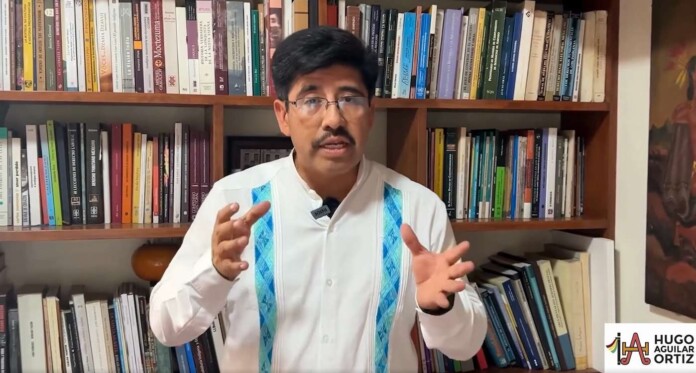
credit - Hugo Aguilar, via Facebook screengrab
credit – Hugo Aguilar, via Facebook screengrab

Americans often refer to our country as undergoing a continual experiment in self-government. Well, down in Mexico, that experiment has been taken to a whole other level.

On the first of June, the North American nation became the first in modern history to elect its judges at all levels by popular vote.

The first supreme court chief justice elected democratically on Earth is Hugo Aguilar, a noted indigenous rights defender of the highest esteem in Latin America who also acted as legal counsel to the Zapatista guerilla movement during their demilitarization.

He is a member of the Mixtec indigenous group, an ancient Mesoamerican lineage surviving from 1,500 BCE inhabiting a tri-state area of Western Oaxaca and neighboring portions of Puebla and Guerrero.

Aguilar, like 20% of Mexico’s population, considers himself indigenous, and has said previously that the native populations are owed “a significant debt” from colonialism. He has vowed to wear Mixtec clothing in court over the traditional toga, or judicial robe.

Aguilar worked at the National Institute of Indigenous Peoples under President Claudia Sheinbaum’s predecessor and popular native figure Andres Manuel Lopez Obrador.

Despite a distinguished 30-year-career as a lawyer, Aguilar has never held the post of a judge before. In a Facebook post following his victory, Aguilar delivered a speech in his native language, with Spanish added in subtitles.

ALSO CHECK OUT: Refugee Makes History Becoming British Ambassador: ‘Mom Was Worried I Wasn’t English Enough’

Winning the popular vote by a margin of almost 400,000 votes over the second-place winner, the first-of-their-kind elections also saw five female justices elected to join Aguilar on the bench.

They were organized by Lopez Obrador during the second-half of his tenure following continual clashes with the court over the constitutionality of his policies, a disagreement which President Sheinbaum has suggested was influenced by corruption and special interests.

MORE WINS FOR DEMOCRACY: Politician Declared Winner But Gives Up His Seat When He Learns of Election Interference on his Behalf

The President suggested that the world would see how a different judicial-political system could exist. However, critics of the election pointed out that only 13% of eligible voters participated.

SHARE This Groundbreaking Moment In Mexican Democracy With Your Friends…

“Having a place to go is a home. Having someone to love is a family. Having both is a blessing.” – Donna Hedges

Getty Images for Unsplash+

Quote of the Day: “Having a place to go is a home. Having someone to love is a family. Having both is a blessing.” – Donna Hedges

Photo by: Getty Images for Unsplash+

With a new inspirational quote every day, atop the perfect photo—collected and archived on our Quote of the Day page—why not bookmark GNN.org for a daily uplift?

Getty Images for Unsplash+

Good News in History, June 11

Yasunari Kawabata in 1946

126 years ago today, Yasunari Kawabata was born. Winner of the 1968 Nobel Prize in Literature, the novelist is recognized as one of the foremost of his time, with titles such as Snow Country and Thousand Cranes held up in the country as masterpieces. His characters were deeply influenced by his time as a reporter for the Japanese newspaper, the Maichini, and the Demimonde leftism that was repressed in the interwar period informed his writing substantially. READ some more about this famous author… (1899)

12-Year-old Girl Plants 150,000 Trees in India, Becoming a Reforestation Leader

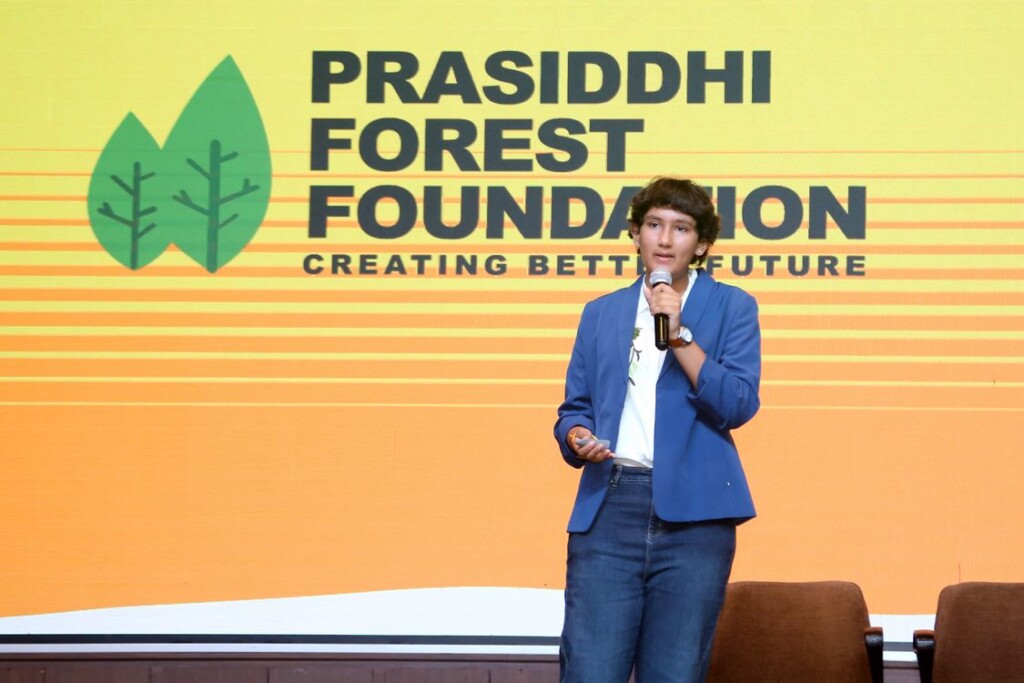
Youngest Indian environmental leader- Prasiddhi Singh -submitted by Jacob Weissman YPL Prasiddhi Forest Foundation
Youngest Indian environmental leader Prasiddhi Singh – submitted by Jacob Weissman YPL Prasiddhi Forest Foundation

Called the Indian Greta Thunberg, this 12-year-old is on a mission to green India’s skies and minds.

Armed with determination, a charming personality, and a great marketing concept, she’s planting a grassroots movement towards environmentalism that’s staggering to see in one so young.

Prasiddhi presenting her vision – submitted by Jacob Weissman YPL Prasiddhi Forest Foundation

At age 8, she won the Dal Puraskar, an Indian order of merit, and told the Times of India she had already planted 14 “fruit forests” in government schools, offices, and community areas with the help of thousands of volunteers.

At just 12, she’s planted over 150,000 trees, founded the Prasiddhi Forest Foundation, undertook the restoration of mangroves and lakes, ran a TEDx, spoke at the UN Climate Change summit COP 28 and 29, and is presumably now doing something else equally amazing that’s not yet been reported.

The Foundation organizes classes, workshops, and events under the principle of a “3G Network” which stands for ‘Generate’ one’s own oxygen, ‘Grow’ one’s own food, and ‘Gift’ one’s effort to their community.

According to Young Planet Leaders, Prasiddhi started her tree growing efforts at age 7 as a personal response to a devastating cyclone. However, her concept of fruit forests goes far beyond sheltering from storms.

These biodiverse, edible landscapes are both ecological solutions and social infrastructure, and they’re drawing volunteers from around the country, but particularly in her home state of Tamil Nadu.

WATCH her tell her story and dig why so many people are recognizing her work…

SHARE This Incredible Young Talent And What She’s Doing For The World… 

China Achieves ‘Excellent’ Water Quality in 90% of Rivers and Lakes, Now Looks to Improve Whole Ecosystems

The Yulong River - credit, Qeqertaq, CC 3.0. BY-SA
The Yulong River – credit, Qeqertaq, CC 3.0. BY-SA

Having achieved incredible results in improving water quality across the nation, China is embarking on a ten-year project to ensure the ecosystem beyond the shoreline meets similar standards.

The plan, unveiled recently by China’s Ministry of Ecology and Environment aims to match improvements in water quality seen in 2,573 rivers and lakes across the country with improvements to the overall ecosystem in which the fresh water is found, including those which humans rely on, and the cultural artifacts located there as well.

It could be said that the protagonist of China’s 4,000 year history isn’t the Chinese people themselves, but fresh water.

From the moment that humans began cultivating rice in the central and northern Chinese plains, control and manipulation of water became the unifying feature of Chinese society, transcending social status, and imbedding itself into the lore of the first emperor who supposedly tamed the Yellow River floods in 2,700 BCE.

As centuries passed, traveler after traveler remarked upon the inexhaustible supply of fresh water for irrigation, and of a network of irrigation canals that spread like a spider’s web as far as the eye could see. The Qin Dynasty completed the ancient world’s largest landscape engineering project when it constructed the Grand Canal, while 2,000 years later, the vast breadth of the Yangtze and Pearl rivers, following industrialization, allowed the Chinese manufacturing market to provide for every corner of the Earth.

Beyond economization and production, the lake and river were the subjects of countless poems and songs across the ages, and the constructions of bridges, pagodas, temples, palaces, and scenic villages where canals replace streets, on and around China’s vast freshwater resources, flourished whenever money was available.

In 2015, China completed an action plan for the prevention and control of water pollution, and in 2024, the proportion of surface-water sections nationwide classified as having excellent water quality reached 90.4%.

In this new action plan, the whole ecology of the riverine ecosystems is being addressed, and will include in its scope projects for restoring spawning grounds, ensuring migratory birds have access to food resources in areas where they alight, enhancing habitat connectivity and fish passage where obstructions are found, strengthening flood control and drainage systems where present, and measuring eutrophication in lakes and reservoirs.

FRESH WATER STORIES: World’s Largest Oyster Restoration Is Big Success – Fulfilling Virginia’s Promise to Chesapeake Bay Rivers

“The document marks another comprehensive initiative to protect China’s water ecosystems following the action plan for prevention and control of water pollutions in 2015,” said Liu Jing, deputy director of the environment ministry’s Department of Water Ecology and Environment.

“A beautiful river or lake is one where the ecological flow is maintained so that it never runs dry. Besides, the ecological functions of the water bodies and their surrounding buffer zones are preserved or restored, and biodiversity is effectively protected,” said Liu.

CHINA IMPROVES POLLUTION METRICS: China’s War on Pollution Improved Air Quality 42%, Reduced Global Pollution Average, and Returned 2 Years of Life to Citizens

“Moreover, pollutant emissions within the watershed are well-managed, and the water quality has fundamentally improved or maintained excellent levels. And the public’s needs for scenic views and recreational activities by the water are met,” she added.

“Significant progress” is expected by 2030, by which time it’s hoped the project will have also begun to reverse the current declining trend in aquatic wildlife in the Yellow River, and to accelerate the current improving trends for wildlife in the Yangtze.

SHARE This Commitment To Restoring Fresh Water Ecosystems On Social Media…

Hero Crane Driver Who Rescued Man from Burning Building Granted Humble Bucket List Wish

(left) courtesy photo (right) Glen with his new shed - credit, Bucket List Wishes Charity
(left) courtesy photo (right) Glen with his new shed – credit, Bucket List Wishes Charity

In late 2023, GNN reported that a construction worker had been rescued from the side of a burning high-rise building thanks to a heroic crane operator.

A basket was suspended on the end of Glen Edwards’ crane meant for holding people while they work along the facades of buildings, and despite terrible visibility from the smoke and a blustery wind, he successfully positioned it close enough for the worker to climb aboard and escape a mixture of fire, smoke, and toxic fumes.

In an update to that story, Edwards, who enjoys a hero’s reputation in Reading, has received a series of home improvements as a gift for the heroism he demonstrated that day.

The gift has another explanation though, and that’s that Edwards, who is currently 66-years-old, has received a terminal cancer diagnosis.

He likely had cancer on the day he saved the construction worker’s life, and although it was previously treated successfully, it’s come back, and he recently told Britain’s ITV that it has spread to his spine.

Hearing about it, and his life-saving deed, Bucket List Wishes got in touch with Glen and said they wanted to fulfill a bucket list item of his if it could be done, with Gini Hackett, the charity’s founder, reaching out personally.

“I found it amazing to do this wish for him,” Hackett told ITV. “He’s really humble, what he did was incredible. He is a real hero to us so we absolutely had to do something for him.”

ALSO CHECK OUT: ‘Hero’ Gamer Thwarts Attack on California School by Reporting Teens Discussing Bombing Intentions Online

Humble is as humble does, and all Mr. Edwards asked for was new flooring and a garden shed for a home he had recently moved into. It was work that needed doing, so that’s what he hoped to receive—not a lavish cruise or a dream vacation.

In return, Hackett and Bucket List Wishes took care of the shed and flooring, but also added completely new kitchen appliances, a large gift voucher for new bedding, and, as an extra surprise, a fishing trip to the Victorian-era seaside resort town of Swanage on the Dorset coast.

MORE HEROES BEING RECOGNIZED: A Stranger Delivered CPR for 20 Minutes to Save a Montreal Man Then Vanished

Edwards also spoke with ITV about his rescue.

“The smoke was absolutely intense, I could hardly see him, well, I couldn’t see him. I knew he was there, he was standing on the edge of the building,” he said.

“He’s got two girls, eight and 13 they were at the time, and I got a very heartfelt letter that would bring a tear to your eye.”

SHARE This Tearjerking Story Of A Humble Hero Receiving A Just Reward… 

Yurok Tribe Celebrates Again as Ancestral Homelands are Returned–in Wake of Historic Dam Removal

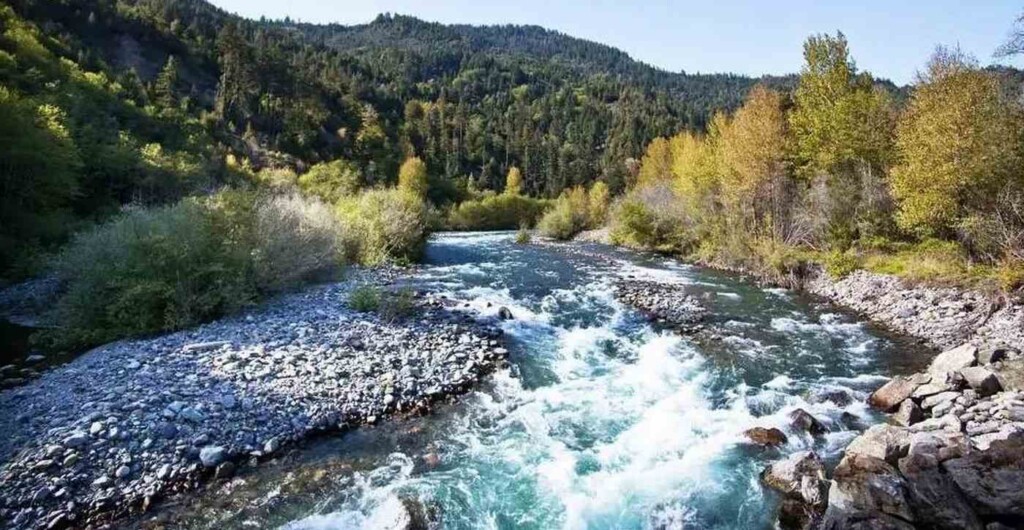
Blue Creek - credit, Cindy M. Diaz/Western Rivers Conservancy
Blue Creek – credit, Cindy M. Diaz/Western Rivers Conservancy

In Northern California, a native American tribe is celebrating the return of ancestral lands in one of the largest such transfers in the nation’s history.

Through a Dept. of the Interior initiative aiming to bring indigenous knowledge back into land management, 76 square miles east of the central stretch of the Klamath River has been returned to the Yurok tribe.

Sandwiched between the newly-freed Klamath and forested hillsides of evergreens, redwoods, and cottonwoods, Blue Creek is considered the crown jewel of these lands, though if it were a jewel it wouldn’t be blue, it would be a giant colorless diamond, such is the clarity of the water.

It’s the most important cold-water tributary of the Klamath River, and critical habitat for coho and Chinook salmon. Fished and hunted on since time immemorial by the Yurok and their ancestors, the land was taken from them during the gold rush before eventually being bought by timber companies.

Barry McCovey Jr., director of the Yurok Tribal Fisheries Department, remembers slipping past gates and dodging security along Blue Creek just to fish up a steelhead, one of three game fish that populate the river and need it to spawn.

Profiled along with the efforts of his tribe to secure the land for themselves and their posterity, he spoke to AP about the experience of seeing plans, made a decade ago, come to fruition, and returning to the creek on which he formerly trespassed as a land and fisheries manager.

“To go from when I was a kid and 20 years ago even, from being afraid to go out there to having it be back in tribal hands … is incredible,” he said.

Part of the agreement is that the Yurok Tribe would manage the land to a state of maximum health and resilience, and for that the tribe has big plans, including restoring native prairie, using fire to control understory growth, removing invasive species, restoring native fish habitat, and undoing decades of land-use changes from the logging industry in the form of culverts and logging roads.

“And maybe all that’s not going to be done in my lifetime,” said McCovey. “But that’s fine, because I’m not doing this for myself.”

The Yurok Tribe were recently at the center of the nation’s largest dam removal, a two decades-long campaign to remove a series of four hydroelectric dams along the Klamath River. Once the West Coast’s third-largest salmon run, the Klamath dams substantially reduced salmon activity.

Klamath River flows freely, after Copco-2 dam was removed in California – Courtesy of Swiftwater Films

Completed last September, the before and after photographs are stunning to witness. By late November, salmon had already returned far upriver to spawn, proving that instinctual information had remained intact even after a century of disconnect.

“Seeing salmon spawning above the former dams fills my heart,” said Joseph L. James, chairman of the Yurok Tribe, the leaders of the dam removal campaign along with the Karuk and Klamath tribes.

“Our salmon are coming home. Klamath Basin tribes fought for decades to make this day a reality because our future generations deserve to inherit a healthier river from the headwaters to the sea.”

Last March, GNN reported that the Yurok Tribe had also become the first of America’s tribal nations to co-manage land with the National Park Service under a historic memorandum of understanding involving Redwoods National Park.

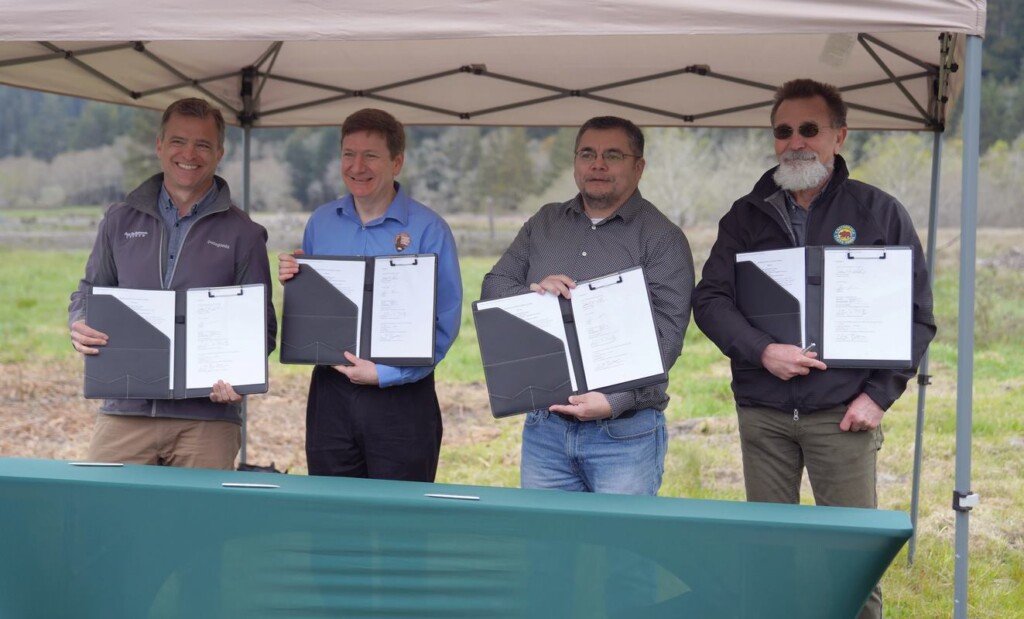
(left) Save the Redwoods President and CEO Sam Hodder, Redwood National and State Parks Superintendent Steven Mietz, Yurok Chairman Joseph L. James and California State Parks North Coast Redwoods Superintendent Victor Bjelajac sign the landmark agreement at ‘O Rew.

The nonprofit Save the Redwoods bought a piece of land adjacent to the park, which receives 1 million visitors annually and is a UNESCO Natural Heritage Site, and handed it over to the Yurok for stewardship.

ALSO CHECK OUT: Bison Return to Manitoba First Nation Lands for First Time in 100 Years – (WATCH)

The piece of land, which contained giant redwoods, recovered to such an extent that the NPS has incorporated it into the Redwoods trail network, and the two agencies will cooperate in ensuring mutual flourishing between two properties and one ecosystem.

Back at Blue Creek, AP reports that work has already begun clearing non-native conifer trees planted for lumber. The trunks will be used to create log jams in the creek for wildlife habitat.

Costing $56 million, the land was bought from the loggers by Western Rivers Conservancy, using a mixture of fundraising efforts including private capital, low interest loans, tax credits, public grants and carbon credit sales.

MORE INDIGENOUS VICTORIES: Rainforest Oil Exploration Stopped as Court Rules Uncontacted Tribes Have Right to Remain in Isolation

The sale was part of a movement called Land Back, which involves returning ownership of once-native lands of great importance to tribes for the sake of effective stewardship. Studies have shown around the tropics that indigenous-owned lands in protected areas have higher forest integrity and biodiversity than those owned by national governments.

Land Back has seen 4,700 square miles—equivalent to one and a half-times the size of Yellowstone National Park—returned to tribes through land buy-back agreements in 15 states.

SHARE This Inspiring Indigenous News With Your Friends On Social Media… 

“Sometimes the poorest man leaves his children the richest inheritance.” – Ruth E. Renkel

Getty Images for Unsplash+

Quote of the Day: “Sometimes the poorest man leaves his children the richest inheritance.” – Ruth E. Renkel

Photo by: Getty Images for Unsplash+

With a new inspirational quote every day, atop the perfect photo—collected and archived on our Quote of the Day page—why not bookmark GNN.org for a daily uplift?

Getty Images for Unsplash+

Good News in History, June 10

Photo by Jonn Leffmann, CC license

90 years ago today, Alcoholics Anonymous was founded in Akron, Ohio, by Bill Wilson—who, the previous day, drank his last drink. He co-founded it with Dr. Bill Smith who helped form AA’s Twelve Step program of spiritual and character development to enable its members to “stay sober and help other alcoholics achieve sobriety.” READ about the Twelve Traditions through which they operate… (1935)

Arizona Teen Returns Lost Wallet Containing $300, Receives Electric Bike He Had Been Saving for

Emil Kalibradov via Unsplash

Last month in Arizona a young man profited unexpectedly from choosing honesty over greed after finding a lost wallet.

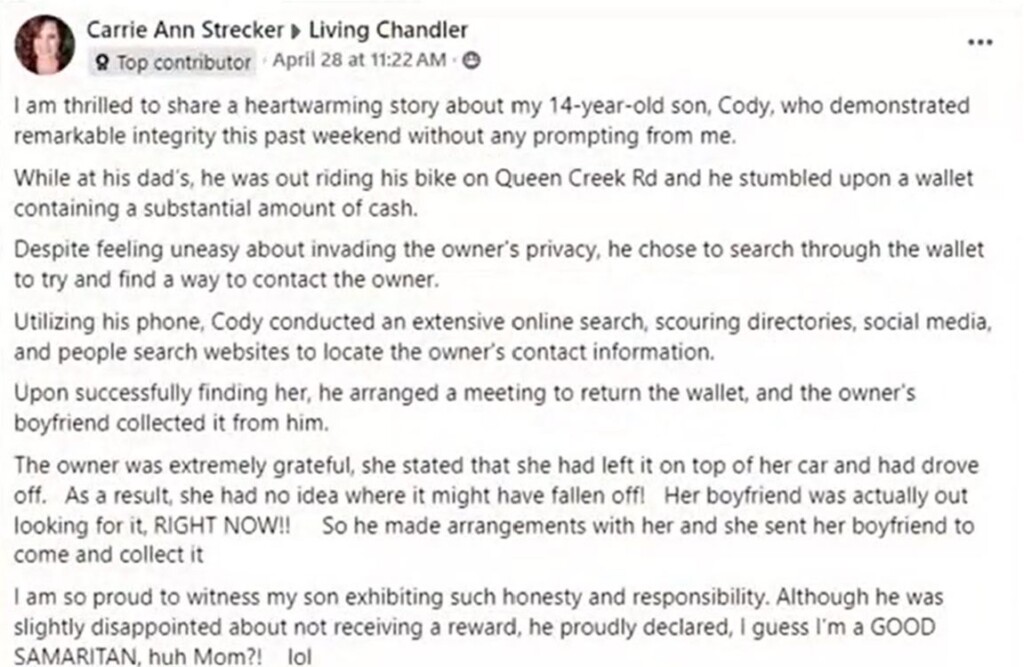
14-year-old Cody Chalmers found the wallet while riding his bike in Chandler on May 2nd, finding 300$ cash and credit cards inside.

But even though he was in the middle of saving money for an electric dirt bike with a hefty price tag, young Chalmers didn’t waste anytime considering his good fortune.

Sending his mother a photo of the ID contained in the wallet, she was able to run some basic internet searches until she found a phone number.

Speaking with AZ Family, Chalmers said that he was happy he did the right thing.

“I thought that someone would feel really bad if they lost it, so I was like, I better return this,” he said, adding that he remembered immediately how his father reacted years ago when he lost his wallet. “It kind of taught me how bad it is to like take someone’s money, like because their wallet is basically their life.”

Impressed with her son’s honesty, Carrie Strecker made a boast post on a local Chandler Facebook page, remarking how Cody joked that he “was a Good Samaritan now HUH mom?”

Seeing the story of the lost wallet, another Good Samaritan decided that $3,500 of his own money was less important than rewarding Cody’s honesty and asked his mom to send him a link to the electric bike. He intended to buy it for Cody as a gift.

Now there are fewer cooler cats than Cody along the hot streets of Chandler, as he rides around on his black e-bike—which was sold be a company called, if it can be believed, “Integrity E-bikes.

WATCH the story below from Inside Edition…

CELEBRATE This Young Man’s Honesty And Recognition On Social Media…

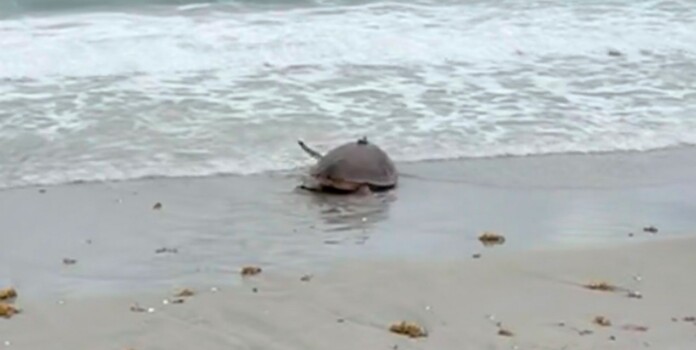
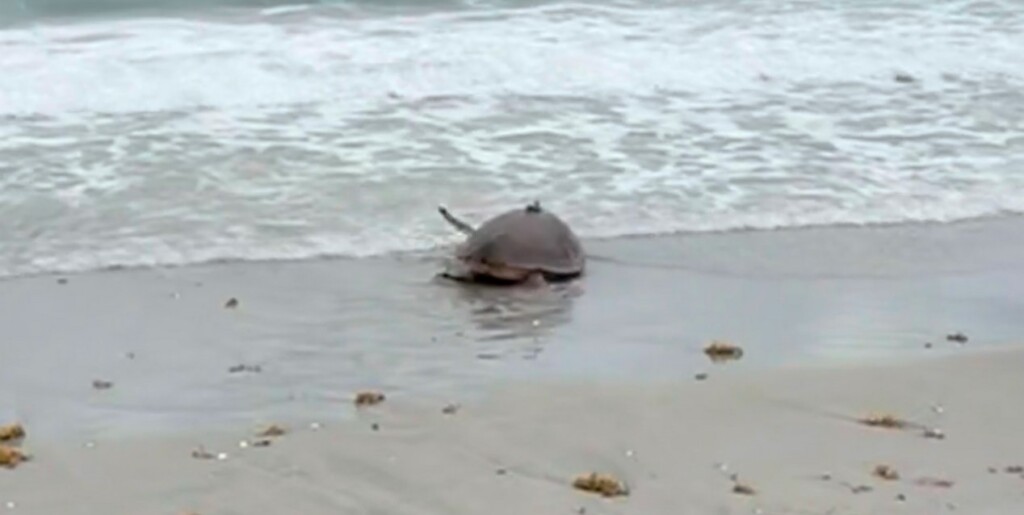
Saved from a Predator’s Jaws, Amputee Turtle Released Back into the Wild with Important Mission – (WATCH)

Dilly Dally going out to sea - screengrab from Loggerhead Marine Life Center, released
Dilly Dally going out to sea – screengrab from Loggerhead Marine Life Center, released

From Florida comes the story of one lucky turtle who was attacked by a predator and lived to tell the tale.

Dilly Dally was taken in by the Loggerhead Marinelife Center’s turtle veterinarians after she was rescued in Port St. Lucie with severe wounds on her front right flipper.

Though not a fully grown adult, it was probably a shark that wounded her, as they are a sea turtle’s only potential predator once they reach maturity.

Brought to shore by the Inwater Research Group in January, the center at Juno Beach applied antibiotics and treated her wounds, but it wasn’t enough to save her flipper which was successfully and safely amputated.

At Juno, Dilly Dally gradually mastered the art of swimming with one flipper during a five-month rehab program. The front pair are used by the animals for speed, while their smaller rear flippers are for turning.

Then, last Wednesday, it was time to let Dilly Dally go back to her home. A video recorded by the Loggerhead Marinelife Center showed four women carrying Dilly Dally in a plastic tub to the beach at high tide. After 2 minutes of scooting, she vanishes under the waves, with the last sight being the antenna of a satellite tracker which was strapped to her shell.

In this way Dilly Dally will become a pioneer: the first three-flippered turtle to be tracked by the center.

TURTLE TALES: 

“So now Dilly Dally has an active live satellite tag on her and we can get real-time data on where she goes, which is really exciting because we don’t really know what happens to our three flipper turtles once you release them,” Marika Weber, a vet tech at the Juno center who was part of Dilly Dally’s care team, told CBS.

“Now we know if their migration or foraging patterns change and it’ll be really helpful to see what happens to these patients.”

Turtles can live long productive lives having lost limbs—hence why she was deemed suitable for release.

WATCH the video release below… 

SHARE This Beautiful Scaled Life Saved, Healed, And Headed For Better Days…

Hundreds of Newly-Found Structures Reveal True Scope of Hidden Pre-Incan Civilization

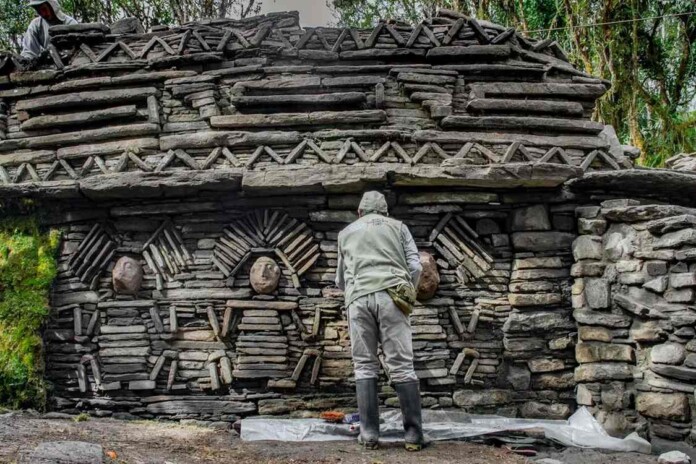
Conservation work on the North Basing of Building 1 in Pajatén, Peru - credit, Heinz Plenge Pardo
Conservation work on the North Basing of Building 1 in Pajatén, Peru – credit, Heinz Plenge Pardo

At a UNESCO Heritage Site in Peru, archaeologists have announced the discovery of over 100 additional hidden structures belonging to a pre-Incan civilization.

Gran Pajatén is located high in the northeastern Peruvian Andes, and was likely a major center of the Chachapoya civilization, which thrived for 400 years before being conquered by the Inca.

Discovered in the 1960s, and excavated in the 1980s, the remoteness of the site led to its eventual neglect.

Between 2022 and 2024, an interdisciplinary team from World Monuments Fund Peru carried out a conservation and documentation project within Río Abiseo National Park, a UNESCO Mixed World Heritage site recognized for its extraordinary cultural richness and natural beauty.

Using technology like LiDAR, the researchers identified “a sophisticated urban settlement complete with agricultural terraces, circular buildings and cliffside tombs at altitudes of up to nearly 10,000 feet above sea level,” Smithsonian Magazine writes.

“This discovery radically expands our understanding of Gran Pajatén and raises new questions about the site’s role in the Chachapoya world. Evidence now confirms that it is not an isolated complex but part of an articulated network of pre-Hispanic settlements from different periods,” said Juan Pablo de la Puente Brunke, Executive Director of WMF in Peru, in a statement from the fund.

The Chachapoya society (pronounced cha-cha-POE-ya) was composed of regional chiefdoms that nevertheless shared a distinctive architectural and artistic language, as reflected in their unique circular buildings, geometric friezes, and highly decorated cliffside burials.

FROM SOUTH AMERICA: 89-year-old had to ‘Speak Up’ to Save Believed-Extinct Language of Indigenous People Who Revered Silence

Archaeological investigations have confirmed that Chachapoya presence at Gran Pajatén dates back as far as the fourteenth century, with soil layer analysis hinting at even earlier use of the site. Combined with the discovery of a nearby network of pre-Hispanic roads connecting Gran Pajatén to other sites such as La Playa, Papayas, and Los Pinchudos, these findings support a broader interpretation of the complex as part of a hierarchical, well-connected territory.

With one team member telling Art News that research into the site and the civilization has only just scratched the surface, and that only 10% of the aerial LiDAR survey has been processed and documented, exciting the future for this lesser-known treasure of Peru’s past.

MORE ANDEAN DISCOVERIES: Circular Stone Plaza Moves Up Start of Stone Age Construction in the Andes on Par with Stonehenge

In parallel with these remote sensing efforts, the team also undertook archaeological and conservation interventions at one of the most important structures within the Gran Pajatén complex, pictured here in this article above.

A free exhibition at the Museo de Arte de Lima (MALI), Peru, on view from May 21st to June 18th, offers an opportunity to explore the Chachapoya culture and learn more about WMF’s recent discoveries.

SHARE This Beautiful Culture’s Patrimony And The Exciting Work Revealing It…

UK to Lift 100,000 Kids From Poverty With Free School Lunches for All Low Income Households

- credit Curated Lifestyle for Unsplash +
– credit Curated Lifestyle for Unsplash +

The UK government has announced that 500,000 additional children will receive a free school lunch following a major expansion in the program that provides it.

Previously, the free meal was available only to students who come from the lowest of low-income households. Following the expansion, most low and middle-class citizens will be able to qualify, and the government says it will lift 100,000 students out of poverty from the cost savings which will amount to around £500 per month, corresponding to nearly $700.

Despite having a ceiling of £7,400-per year for eligibility, last year an estimated 2.1 million students received a free school meal.

A rather arbitrary cut-off point, someone making £8,000 per year hardly possesses greater means to pay for the school meal than someone making below the cutoff point.

Under the new plan, any students from households on the UK’s universal credit will be eligible to receive one free meal a day. The universal credit replaced a number of British welfare programs, and provides a monthly cost of living assistance handout to people living in a variety of situations with a net worth of less than $20,000.

Set to begin at the outset of the 2026 scholastic year, the new expansion will also address food quality, and will be fully, rather than partially funded, to ensure there’s no delay in getting the expansion moving.

“Today’s historic step will help us to deliver excellence everywhere, for every child and give more young people the chance to get on in life,” the UK’s education secretary Bridget Phillipson said, adding “background shouldn’t mean destiny.”

ADDITIONAL READS: Adding 70 Windows to Illinois School Improves Student Wellbeing and Performance, Confirming Studies – LOOK

The decision comes amid a record-high level of childhood poverty in one of Europe’s largest economies. The new Labor government under Prime Minister Sir Keir Starmer has vowed to drive down poverty levels in the UK, and the expansion of the student meal program was a part of that.

Free school lunches became a hot topic during the administration of Boris Johnson, when the young black Manchester United star Marcus Rashford decided to criticize Johnson for reducing the size of the free school lunch program.

MORE STORIES LIKE THIS: More Than 90% of Schools in England Ban Smartphone Use, 13 US States Have Already Taken Action

While some sport pundits believed Rashford’s aim was noble, they also felt he should focus on his soccer. But he persevered and the government relented. Through this and his work with hunger charities in the city of Manchester, he was presented with an MBE, the British order of merit below a knighthood, for his advocacy work on behalf of England’s poorest students.

SHARE The News Of Britain’s Expansion Of Free School Lunches With Your Friends… 

“There are only two lasting bequests we can hope to give our children. One of these is roots, the other, wings.” – Goethe

Quote of the Day: “There are only two lasting bequests we can hope to give our children. One of these is roots, the other, wings.” – Johann Wolfgang von Goethe

Photo by: Ben White Photography

With a new inspirational quote every day, atop the perfect photo—collected and archived on our Quote of the Day page—why not bookmark GNN.org for a daily uplift?

Good News in History, June 9

On this day 110 years ago, the musician and innovator Les Paul was born in Waukesha, Wisconsin. A natural engineer and phenomenal musician, Lester Polsfuss, as a teen, invented his own speaker and one of the earliest solid body guitars–carving it out of a piece of railroad plank. READ more… (1915)

12-Year-old Girl Earns Thousands Crafting Tiny Doll House Decorations for Hobbyists Who Love her Talent

Arabella Duffy’s miniature strawberry short cake– SWNS

Meet the 12-year-old who has turned her hobby into a career and has earned thousands selling her miniature doll houses and accessories.

Arabella Duffy started making tiny food out of polymer and clay two years ago and spends up to six hours on each creation, whether a cookie, croissant, or strawberry shortcake.

After posting her work on social media channels like TikTok, Arabella was inundated with positive messages and people wanting to buy her creations.

She has sold over 400 items and makes around £2,000 a year ($2,500)—but she has plans to expand, in order to save the profits for college, so she can study Egyptology.

“She sits in her attic making stuff all night,” said Arabella’s mother, Sophy Smith, an artist, from London. “The end product is unbelievable.”

“Because she is home-schooled and doesn’t attend school, it has been great for her. She is doing things she loves and has a business. I’m so proud of her.

“The reaction to her work has been inspiring; other people have been inspired and created their own miniature items.”

Arabella Duffy with her miniature food-SWNS
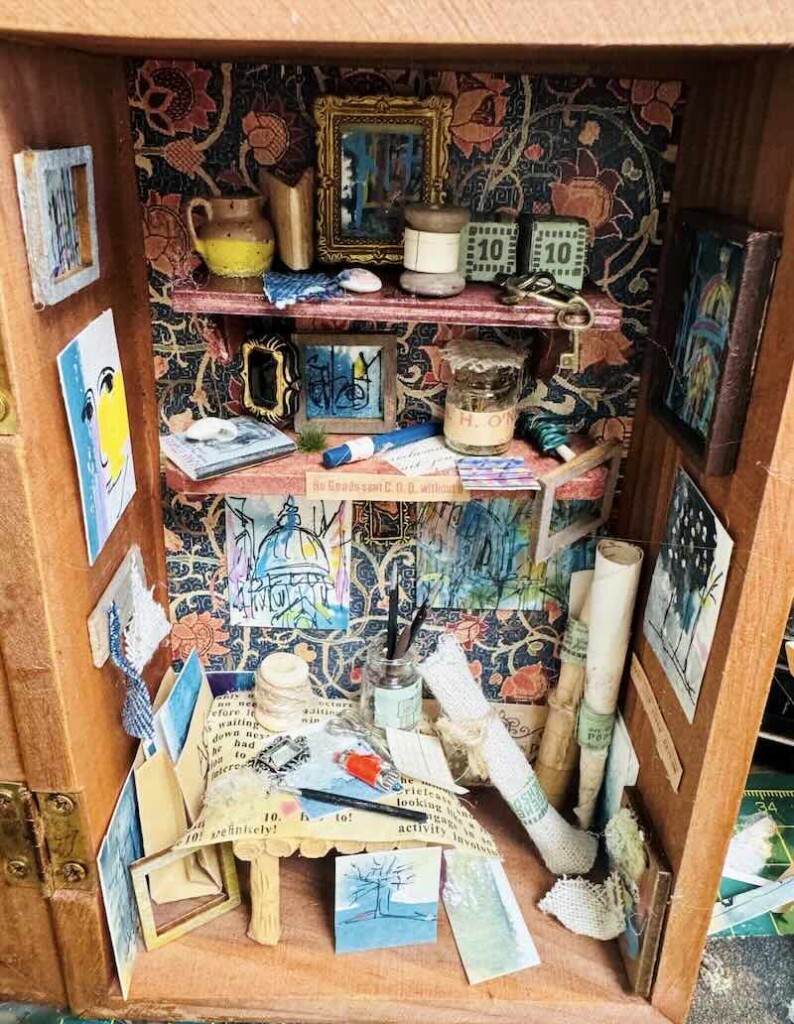
Arabella Duffy’s Alice in Wonderland miniature dollhouse room – SWNS

This month, the family will open a shop in Hampstead, where they will sell Arabella’s dioramas, matchbox paintings, and miniatures, in her own display area.

Arabella Duffy dollhouse accessories for sale -SWNS

The family is full of creatives: her mom paints watercolors and her dad works in the film industry. Sophy even asks her 12-year-old daughter for help because of how good she is.

Arabella is a perfectionist who won’t sell anything not up to her high standards.

Sophy recalls, “She made some clay cookies the other day, and because the chocolate didn’t look like it was melting in the end, she didn’t sell them. She can get frustrated sometimes because she won’t get it right away.”

“She is so into history. She loves Frida Kahlo and all the designs she did. She’s recreated a lot of artists’ studios and lots of these (miniature) rooms. It’s very accurate.”

Arabella Duffy’s tiny artist’s room – SWNS

“She even did a Marie Antoinette scene, and she researched all of the things about her to make it perfect.” Sophy told SWNS news agency.

Arabella Duffy’s Marie Antoinette scene – SWNS

“Building the miniature rooms takes a couple of days. She will create the scenes using a tiny suitcase, furniture, and fabrics.”

LOOK HOW SWEET: Third Grade Teacher Crocheted Mini Versions of Every Student in Her Class for End-of-Year Gift

She now sells her fake food for from £18 a piece, and miniature rooms on tables for from £30 a pop. Her most expensive piece was a shelf stuffed full of sweets – which sold for £55.

“Everyone is really proud of her and saying that they see a very bright future for her… and they can’t wait to see the next project she completes.

“The creativity she has and the imagination she has is amazing.”

“When I sell a piece of work, part of me is sad that it is gone,” says Arabella. “But I’m happy that someone is going to cherish it. The English breakfast creation is one of my favorites. I think it’s my best work to date.”

Arabella Duffy clay miniatures-English Breakfast-SWNS

LOOK: Man Who Built Adorable Mouse Village to Cope With Depression Adds a Pub, Book Shop, and Hobbit Homes

The young artist told SWNS, “I like to push my limits and see how far I can push myself, and I want to inspire the younger generation.”

Follow her latest work on Instagram @arabellaloulou_.

SHARE THE AWESOME IDEAS With Creative Friends on Social Media…
Never Too Late to Start Eating the MIND Diet That May Prevent Dementia: New Study of 90,000 People

Monika Grabkowska for Unsplash+

It’s never too late to start eating better to prevent dementia, according a new analysis of research involving 90,000 adults.

People over the age of 45 who followed a dietary pattern known as the MIND diet were “significantly” less likely to develop Alzheimer’s disease or related forms of dementia, said the University of Hawaii scientists.

The MIND diet stands for Mediterranean Intervention for Neurodegenerative Delay, and was developed by the late Martha Clare Morris, ScD, a Rush University nutritional epidemiologist. It combines the traditional Mediterranean diet with the blood pressure-lowering DASH diet (Dietary Approaches to Stop Hypertension).

It includes proven ‘brain-healthy’ foods such as leafy green vegetables, berries, nuts, fish, and olive oil.

The study found that the MIND diet had a stronger and more consistent risk reduction relationship with dementia than other ‘healthy’ diets for the majority of racial groups in the study.

Participants who improved their adherence to the diet the most over time showed the greatest pattern of risk reduction.

Overall, participants who scored higher for MIND adherence at the start of the study had a 9% lower risk of dementia, with an even greater reduction, of around 13%, among those who identified as African American, Latino or White.

The beneficial relationship was seen similarly among younger and older groups, which suggests that there are benefits to adopting the diet at any age.

DIET TO THE RESCUE: Type 2 Diabetes Patients Who Stick to Low-Carb Diet May Be Able to Stop Taking Medication: Study

“Our study findings confirm that healthy dietary patterns in mid to late life, and their improvement over time. may prevent Alzheimer’s and related dementias,” said Dr. Song-Yi Park, Associate Professor at the University of Hawaii at Manoa.

“This suggests that it is never too late to adopt a healthy diet to prevent dementia.”

Dr. Park and her colleagues analyzed data from more than 90,000 American adults who provided information about their diet, starting in the 1990s.

Credit: Irina del

The participants were between 45- and 75-years-old at the outset, and more than 21,000 developed Alzheimer’s or related dementias in the years that followed.

The results also showed that people who improved their adherence to MIND over 10 years—including those who didn’t follow the diet closely at first—had a 25% lower risk of dementia compared to those whose adherence declined.

GOOD ADVICE:
Landmark Study Shows Link Between Dietary Patterns And Depression in Women
People Happy with Their Lives Are Less Likely to Suffer Heart Attack or Stroke

Dr. Park said that trend was consistent across different ages and racial groups.

However, the protective relationship between a healthy diet and dementia was not as apparent among Asian Americans and even less so for Native Hawaiians.

“A tailored approach may be needed when evaluating different subpopulations’ diet quality,” said Park, who added that further studies could help clarify those patterns.

Dr. Park presented the findings at the annual meeting of the American Society for Nutrition in Orlando, Florida, on June 2.

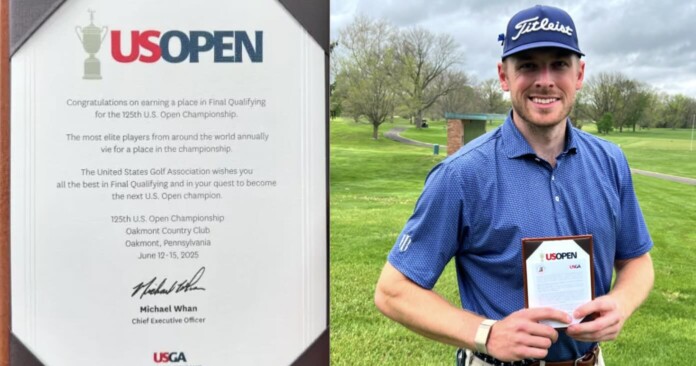
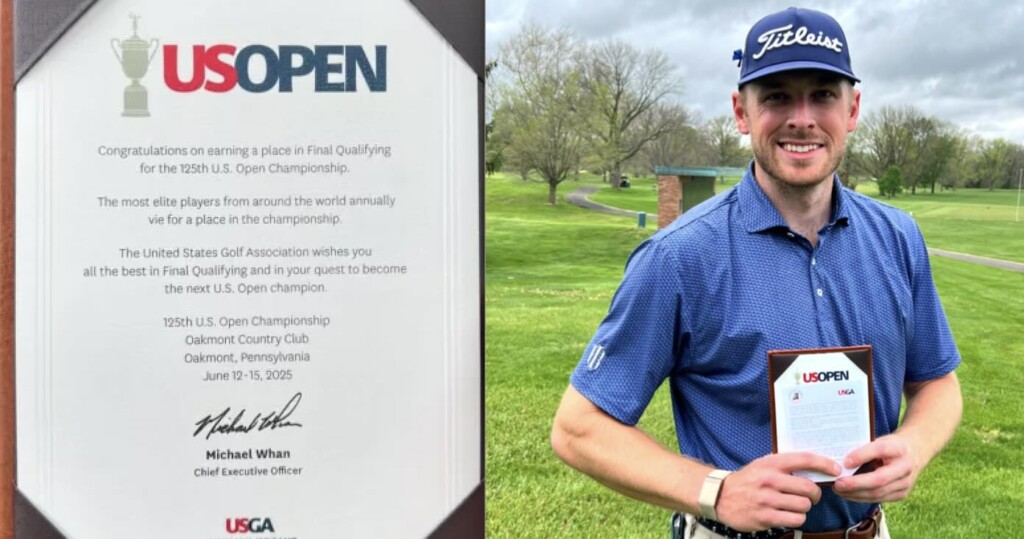
Dentist Who Caddied There as a Kid Just Qualified to Play in the US Open on the Same Course: ‘It’s a Dream Come True’

Image Credit: Matt Vogt @mattvogt317/Instagram

As the emotions were about to erupt from his eyes, Matt Vogt tried not to cry.

Matt Vogt (pronounced ‘vote’) grew up outside of Pittsburgh and spent his teenage years working as a caddy at the famous Oakmont Country Club. That course is hosting professional golf’s 125th U.S. Open next week. And thanks to a sequence of events that seems stolen from Hollywood, Vogt will be playing in it.

Ranked way down at 1,173 in the World Amateur Golf Rankings, Matt works as a dentist in Indianapolis—but he shot 8-under par to win the U.S. Open’s Final Qualifying tournament in Washington state last weekend, earning himself a trip back to his hometown to star in golf’s national championship.

Vogt’s father passed away about two months ago, making the moment even more emotional. The 34-year-old wore a ribbon on his hat to remember his dad during the round. And Matt said he felt his presence, as the putts kept dropping in and the dream moved ever closer to reality.

“I told you I was going to try not to cry,” Vogt told the Golf Channel in a post-round interview that you can watch below. “We stayed present all day. I knew I could do this. I knew I could do it.

“You know, Oakmont, and Pittsburgh, and everything there means so much to me. Having grown up in Pittsburgh and caddied there, it took every ounce of energy in my body not to think about that all day.”

“I feel like I am going to wake up from a dream here in a little while and this isn’t going to be real, but it’s real, and I’m so excited.”

AMAZING: Golf Buddies Sink Consecutive Holes-in-One on Same Tee-Shot–Beating 17 Million to 1 Odds

Vogt, who played college golf at Butler University in Indiana, advanced through local qualifying earlier in the spring, then won this year’s Indianapolis Open.

After that, he needed to finish second at the U.S. Open Qualifying in Walla Walla, Washington to earn a spot in the championship, which starts June 12 in the Pittsburgh suburb of Oakmont.

Whether it was fate, destiny, or a little help from above, Vogt won the whole thing—and he didn’t hesitate to give his dad a little credit.

“I was looking up to the skies, and I knew he was with me,” Vogt told Reuters. “I wish he was here to share it with me, but I know he’s watching.”

PUTT-TACULAR!
Watch 84-Year-old Lady’s Reaction to Winning New Car After Sinking Incredible 93-ft Putt
Ordinary Black-American Didn’t Set Out to Change the World–But Did, When She Created First Golf Course Open to Blacks

In a few days, the humble dentist will return to Oakmont, the course that first inspired his dream two decades ago, and where he carried the clubs of other golfers while often letting his mind wander.

What would it be like to play in a U.S. Open here?

The answer will arrive next week as dreams and reality merge into one.

“I will soak up every single second of that week,” Vogt said in an article from GolfWeek. “It’s just a dream come true.”

WATCH the interview Golf below…

SHARE THE INSPIRING STORY With Aspiring Golfers on Social Media…