














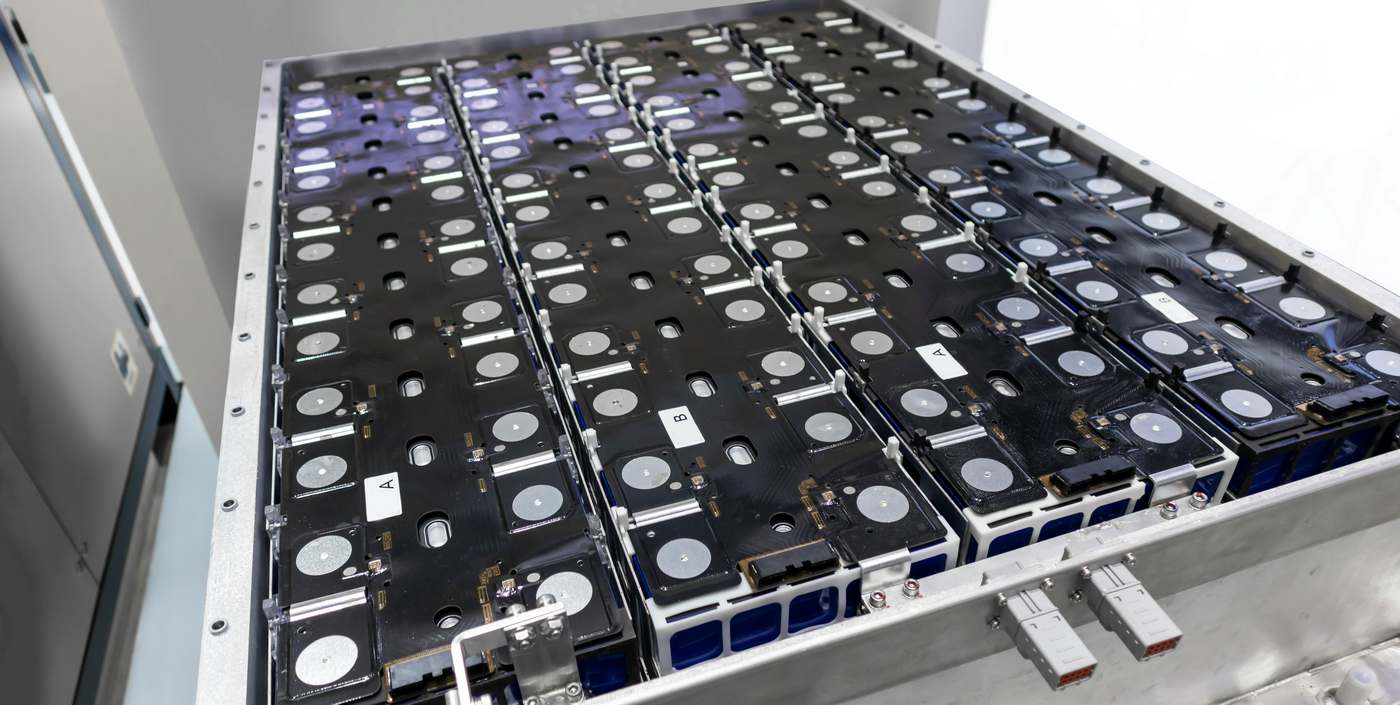
What if instead of investing billions into battery recycling plants, you could simply take your aging electric vehicle battery back, give it a good scrub, and get all that lost range back?
That’s near the mark of what Cornell University scientists have recently demonstrated, if a little editorialized.
Indeed, the current foreseen solution to the absolute tsunami of retired lithium-ion battery packs coming towards global landfills following the US and Chinese EV boom is called pyrometallurgy, and involves shredding the batteries into a giant corrosive mess before extreme heat separates out the cobalt, lithium, nickel, aluminum, and manganese for reuse.
Typically, however, much of the tonnage that’s chucked into these pyrometallurgical circuits consist of usable EV battery packs that are charging and discharging at about 70-80% of their previous maximum capacity, making them very much usable.
Through a process called Direct Electrode-to-Electrode Regeneration, or DEER, Cornell University scientists showed that if extracted from their battery apparatus and given a electrochemical bath, the electrodes inside lithium-ion batteries can gain back up to 95% of their maximum charge.
The mechanism behind the method is reversing the process through which lithium-ion batteries lose range. Over hundreds of charge and discharge cycles, a thick substance called solid electrolyte interphase (SEI) builds up on the electrodes that impedes the flow of electrons through the battery. If dunked in a bath of 1,3-dimethyl-2-imidazolidinone (DMI) the SEI layer is removed, and the electrodes, having regained almost all their potential, can be replaced in the battery pack.
“This process not only reverses interphase growth, but also leaves a thin lithium fluoride layer that slows down SEI growth in subsequent cycles,” wrote Nachiket Mhatre at Slashgear.
ALSO CHECK OUT: Pinch of Gold Dust May Be Secret to Bringing Longer Lasting and Safer Batteries to Market
Batteries that were thusly cleaned of SEI took longer to lose charge than virgin batteries out of the factory. Once substantial charging potential had been lost for a second time, a second DMI bath again replenished the battery’s range, although to a lesser extent.
Batteries can lose potential for various reasons, and the DEER method will only work if the cause is SEI buildup on the electrodes. If the battery is losing capacity because of structure damage or lithium loss, DEER cannot help them.
DEALING WITH BATTERIES: China’s Dying EV Batteries and Solar Cells Are Powering a Circular Economy Worth $38 Billion per Year
DEER does cost less, however, per kilogram of batteries than traditional pyrometallurgy—running up $15.25 per kg compared with $26.31 kg. This cost can be brought down further if future applications can find a way to recover the DMI solution, itself making up around 62% of the total costs.
“This electrode-level regeneration framework provides a scalable pathway toward closed-loop battery manufacturing with substantially reduced cost, energy consumption, and greenhouse gas emissions, supporting more sustainable electrification at the system level,” the authors from Cornell wrote in the study presenting the DEER method of battery refurbishment—published in the journal Energy and Environmental Science.
SHARE This Cheaper, Less Wasteful Method For Recycling EV Batteries…