













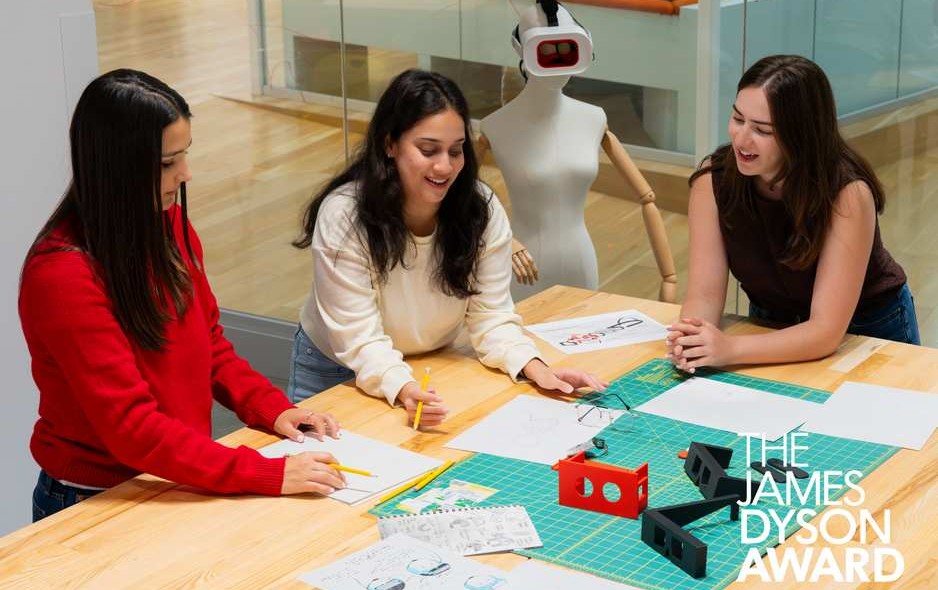
A trio of students at Harvard University have invented a low-cost, eye-tracking headset designed to help schools quickly screen child athletes for possible concussions.
The invention takes just 2 to 3 minutes to screen for a concussion, or at least indicate sub-concussive trauma may be present, and it won the inventors the James Dyson Award 2026 for the United States.
CDC analysis of the 2017 Youth Risk Behavior Survey found that 15.1% of US high school students—approximately 2.5 million—reported at least one concussion related to sports or physical activity in the prior 12 months.
The interdisciplinary Harvard team consisting of Radhika Saran, Cleo Pontone, and Sophia DeVito wanted to come up with a device that could deliver actionable information on the sidelines in real time that could help coaches make decisions on player welfare which in the heat of a competitive match moment might be difficult.
The CDC advises that athletes with a suspected concussion should be removed from play immediately and kept out until cleared by a healthcare provider. If a minor-age athlete plays just 15 minutes of high-intensity sport with a concussion, it can double the required recovery time.
Saran, Pontone, and DeVito invented “Rumble Rims” which they say closes a gap in concussion care between expensive clinical systems and subjective sideline checks. The system gives schools a more accessible way to track eye movements that research suggests may provide an objective window into concussion-related neurological disruption.
The headset conducts a screening in infrared light which the athlete cannot see. The athlete completes an oculomotor task that captures how the eyes follow, fixate, and move. The coach-facing mobile display then translates complex eye-tracking measurements into real-time guidance that can help inform whether an athlete should be removed from play and referred for professional medical evaluation.
After the game, the recovery dashboard allows repeat testing over time, creating an objective record that athletes, families, and clinicians can use to monitor progress before return-to-play.
“We wanted to give coaches, athletes, and families clearer information at the exact moment of risk,” said Saran, co-creator of Rumble Rims. “If objective tools already exist, they should not be locked inside expensive clinical systems. They should be accessible where young athletes are actually getting injured.”
The team’s sideline-first design process was shaped by user research with athletes, coaches, medical professionals, and physical therapists. Early concepts explored helmets, mouthguards, a black-curtain room, and expandable structures that enclosed the screen, camera, and athlete’s face.
Through testing, the team realized accuracy depended less on building a controlled room and more on controlling the relationship between the eyes and cameras, leading to a headset design that moves with the athlete’s head while keeping the screen separate and setup simple for coaches under sideline pressure.
According to the CDC, about 7 in 10 emergency department visits for sports and recreation-related traumatic brain injuries and concussions are among children ages 17 and under, when the brain is still developing.
YOU MAY ALSO LIKE: Inventor Envisioned a Waterless Toilet for Astronauts, Realized it Could Solve a Global Sanitation Crisis Instead
“As a coach, my primary initiative is to make sure my student athletes are safe,” said Elliot Sawyer-Kaplan, a high school lacrosse coach who contributed his experience and view to the development of Rumble Rims.
“Once we take the emotion out of the decision, it’s not in the coach’s hands, it’s not in the player’s hands. This is so incredibly important for the development of children’s brains.”
Rumble Rims takes home $6,500 from the James Dyson Award national prize to support its next steps in development. The team plans to build and test a higher-fidelity headset prototype, refine the oculomotor test and validate the system with athletes, coaches, trainers, and medical advisors. Long term, they hope to pilot Rumble Rims with schools and youth sports programs.
OTHER ACCOMPLISHED STUDENTS: 3 Teens Win Global Earth Prize for Inventing Tamarind Powder That Easily Removes Microplastics
While the technology is still in development, its focus on objective eye-movement data responds to a clear clinical need: concussion assessment today still often depends on symptoms, history and clinical evaluation, while structural imaging is frequently normal and self-reporting can be incomplete.
The James Dyson Award is organized by the James Dyson Foundation, which since 2002 has supported design, technology, and engineering education program around the world through hundreds of millions in charitable contributions and education/opportunity development projects.
WATCH the students present below…
SHARE These Brilliant Students’ Accomplishments With Your Friends…