

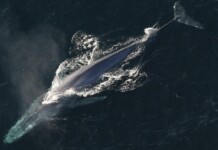












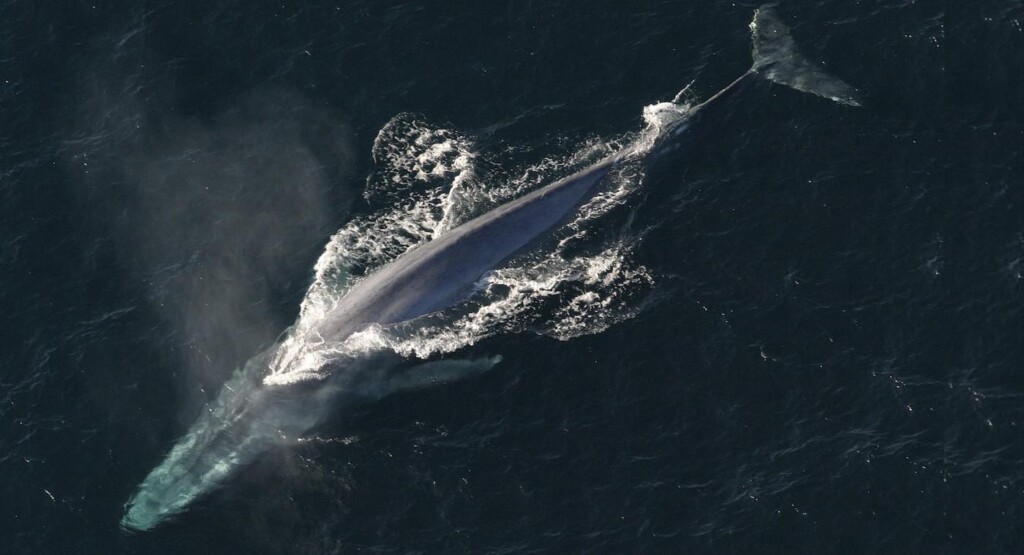
Antarctic blue whales have increased in number 1,000% since 1973 when the harpoons were finally hung up for good.
Growing from just 418 whales to 4,018, the superb recovery has averaged 4.5% per year.
Though the International Whaling Commission banned the killing of Antarctic blue whales in 1964, illegal whaling continued until 1973. These long-lived animals—the largest ever known to have existed—reproduce very slowly with just one calf every 3 years or so.
As impressive a comeback as the whales have made, counting 4,018 animals was also quite the impressive feat of data science.
Even though one can spot a blue whale with a satellite, the Southern Ocean population spends most of its time underwater.
Zoe Rand, a postdoctoral scholar in the University of Washington School of Marine and Environmental Affairs, lead a study that examined historical catch data, modern photo identification records, and decades of “line transect” surveys to estimate current population.
Line transect surveys from 1978 to 1984, 1985 to 1991, and 1991 to 2004 surveyed the entire Southern Ocean by sailing boats along straight lines and counting whales seen and the distances they remained from the boat.
These data sources not only indicated the number was growing, but that it has grown so substantially over time.
OTHER WHALES RECOVERING: Fin Whales Are Feeding In Huge Numbers in Antarctica for First Time in 45 Years – WATCH
Blue whales are considered “Critically-Endangered” by the IUCN, but any animal thus designated in the organization’s Red List that could recover to such an extent would likely not be considered so for much longer, even if the population remains a fraction of its pre-whaling numbers.
Rand wrote in a statement that blue whales and whales in general are marine ecosystem engineers that change vast areas through their activity. During feed, defecation, or death, thousands of other creatures directly respond to blue whale biology.
SHARE This Amazing Recovery By The World’s Largest Animal…